

Add a Second Generator to Your Existing System | PAVO
Most generator purchases are sized for the load on the day the order is signed. Most generator failures of planning happen three years later, when the load has grown past the set that was sized for it.
Can I add a second generator to my existing generator system? Yes — if the first set was specified with a paralleling-capable controller, a busbar and main breaker sized for two sets, and room, air and fuel for a second machine. Without those provisions, adding a second set means replacing the switchgear and often the controller as well.
Contents
- The Growth Problem: One Set, One Ceiling
- 500 + 500 Later vs 1,000 kVA Now: The Cost Comparison
- Design the First Set for the Second: Five Provisions on Day One
- The Retrofit: Adding a Second Set to an Existing Single-Set Site
- Can You Parallel Two Different Sizes?
- When to Add the Second Set: Load-Growth Triggers
- Frequently Asked Questions
- Specification Checklist: Eight Lines Before the Deposit
The Growth Problem: One Set, One Ceiling
A single generator has a hard ceiling: its standby rating. A 500 kVA set can carry 500 kVA, for the limited hours its standby rating allows, and nothing more. When the load grows past that ceiling, the owner has three options. Buy a bigger set and write off the first one. Add a second set and run the two in parallel. Or run the first set overloaded and wait for the failure that follows.
The third option is the most common and the most expensive. A set run above its standby rating overheats, trips on high coolant temperature or overload, and ages at several times the normal rate. The first two options are a planning decision, and the difference between them is decided years before the second set is needed — at the moment the first set is specified.
Case 1: A plastics factory in Vietnam — 500 kVA, then 640 kVA
A plastics injection-moulding factory outside Ho Chi Minh City installed a 500 kVA standby set in 2021. The load at the time was 380 kVA: six injection-moulding machines, the cooling tower, and the factory lighting. Three years later the factory added four moulding machines and a second cooling tower. Peak load reached 640 kVA. The set, rated 500 kVA standby and 455 kVA prime, was now carrying a load 28% above its standby rating on every outage.
The factory’s first response was to shed load manually during outages — two moulding machines off, the cooling tower on a timer. That worked for one outage season. Then a moulding machine was damaged by a voltage dip when the overloaded set’s governor could not hold frequency under a step load, and the repair cost $6,400. The factory then bought a second identical 500 kVA set and a paralleling switchgear panel, at a total installed cost of roughly $58,000. The switchgear alone accounted for $14,000 of that, because the original installation had a single-set automatic transfer switch and a busbar sized for one machine. Everything downstream of the first set had to be replaced.
The factory’s engineering manager later calculated that specifying a paralleling-capable controller and a 1,000 kVA busbar on day one would have added about $3,500 to the original installation. The retrofit cost four times that, plus two days of shutdown to rewire the plant room.
Case 2: A hotel in Kenya — a second wing, a second ceiling
A 90-room hotel on the Kenyan coast opened with a 300 kVA standby set, sized for the load of the original building: rooms, kitchen, water pumps and the conference hall. Two years later the hotel added a 40-room wing with its own kitchen and laundry. Peak load rose to 430 kVA. The set could not carry it.
The hotel’s situation was worse than the factory’s, because there was no room for a second set. The generator room was built tight around the first machine, with 600 mm of clearance on three sides and a louvre sized for one radiator. Adding a second 300 kVA set would have meant a new plant room, a new exhaust route and a new fuel tank — a civil works project, not an electrical one. The hotel replaced the 300 kVA set with a 600 kVA set and sold the original at a 45% loss on its purchase price, after two years of service.
Both cases share the same structure. The load grew. The first set did not grow with it. And the cost of fixing the problem was decided, not when the load grew, but when the first installation was designed — by what was left out of it.
500 + 500 Later vs 1,000 kVA Now: The Cost Comparison
The first question in any growth plan is whether two sets are cheaper than one big set. The answer depends on what is being counted. On generator equipment alone, two 500 kVA sets cost more than one 1,000 kVA set — typically 15–25% more, because two engines, two alternators, two controllers and two canopies cost more than one of each at double the size. On the complete installed project, the gap widens: industry guidance from Turnkey Industries puts parallel systems at 40–60% above the project cost of a single generator of equivalent total capacity, because the paralleling switchgear, the busbar, the extra cabling, the additional fuel and ventilation provisions and the longer commissioning all add cost.
That comparison, taken alone, would end the discussion in favour of one big set. It is the wrong comparison. The right comparison is between two sets bought at different times and one big set bought on day one — and the difference is the cost of capacity that is not yet needed.
| Item | One 1,000 kVA set now | 500 kVA now + 500 kVA later |
|---|---|---|
| Generator equipment, day one | 1,000 kVA set, full price | 500 kVA set, about half the price |
| Capital tied up before the load exists | Full 1,000 kVA | Half — the second 500 kVA is bought when the load arrives |
| Paralleling switchgear | Not needed | Required — panel plus synchronising controllers |
| Busbar and main breaker | Sized for 1,000 kVA | Sized for 1,000 kVA from day one, or replaced later |
| Fuel system | Sized for 1,000 kVA load | Sized for 500 kVA, extended when the second set arrives |
| Room and ventilation | Sized for 1,000 kVA | Sized for one set, with space reserved for the second |
| Part-load fuel efficiency before growth | One large set at 30–40% load | One 500 kVA set at 60–75% load |
| Maintenance per year | One service programme | Two service programmes once the second set arrives |
| Failure consequence | One machine down = no power | One machine down = half power, critical loads kept |
The table’s last row is the one that usually decides the question. A single 1,000 kVA set is a single point of failure: when it is down for service or for a fault, the site has no power at all. Two 500 kVA sets in parallel are a 500 kVA set that keeps running when its partner is offline. For a factory, a hotel or a hospital, that difference is worth more than the price premium on the equipment.
The part-load fuel penalty
The strongest financial argument for two sets is fuel. A diesel engine is at its most efficient between roughly 50% and 75% of its rating. Below that band, specific fuel consumption rises sharply: at 25% load, a diesel set burns 40–60% more fuel per kWh than at full load, according to Turnkey Industries’ fuel analysis, because fixed parasitic loads — cooling fans, oil pumps, alternator excitation — consume the same power regardless of output, and combustion at light load is less complete.
The numbers from the Cummins C500D5 datasheet make the point concrete. At 100% prime load the set burns 93.2 L/h. At 75% it burns 69.9 L/h. At 50% it burns 49.0 L/h. At 25% it burns 29.2 L/h — which is 31% of the full-load fuel burn for 25% of the output. A site whose real load is 200 kVA on a 1,000 kVA set is running at 20% load, in the worst part of the curve, and paying for it in fuel and in wet stacking — the unburned fuel and carbon that accumulate in the exhaust when a diesel runs too cool for too long.
Two 500 kVA sets solve this by matching the running capacity to the load. At 200 kVA, one set runs at roughly 44% of its prime rating while the second stands by. At 600 kVA, both run at roughly 66% each. The paralleling controller starts and stops sets automatically as the load rises and falls, keeping each running machine inside its efficient band. Industry analysis puts the fuel saving at 15–20% for a variable load served by two 750 kW sets at 80% load instead of one 2,000 kW set at 60% load. Over 3,000 operating hours a year at $1.10 per litre, that saving is worth $8,000–$12,000 a year on a 500 kVA-class installation — enough to pay for the paralleling switchgear in two to three years.
Maintenance: two sets, two service programmes
The cost that two sets cannot avoid is maintenance. Two engines need two oil changes, two sets of filters, two batteries and two service visits. Turnkey Industries’ figures put annual maintenance for three 500 kW sets at $9,000–$15,000, against $4,000–$7,000 for a single 1,500 kW unit — more than double, for the same total capacity. For a 500 + 500 kVA pair, the equivalent comparison is roughly $6,000–$9,000 a year against $3,000–$4,500 for one 1,000 kVA set.
That premium buys something a single set cannot: maintenance without a shutdown. A parallel pair can be serviced one machine at a time, with the other carrying the critical load. A single set must be taken offline, and the site must either accept the outage or hire a rental set for the service window. For a site that cannot accept a shutdown — a hospital, a cold store, a data hall — the maintenance premium is the price of continuous operation, not a waste.
Design the First Set for the Second: Five Provisions on Day One
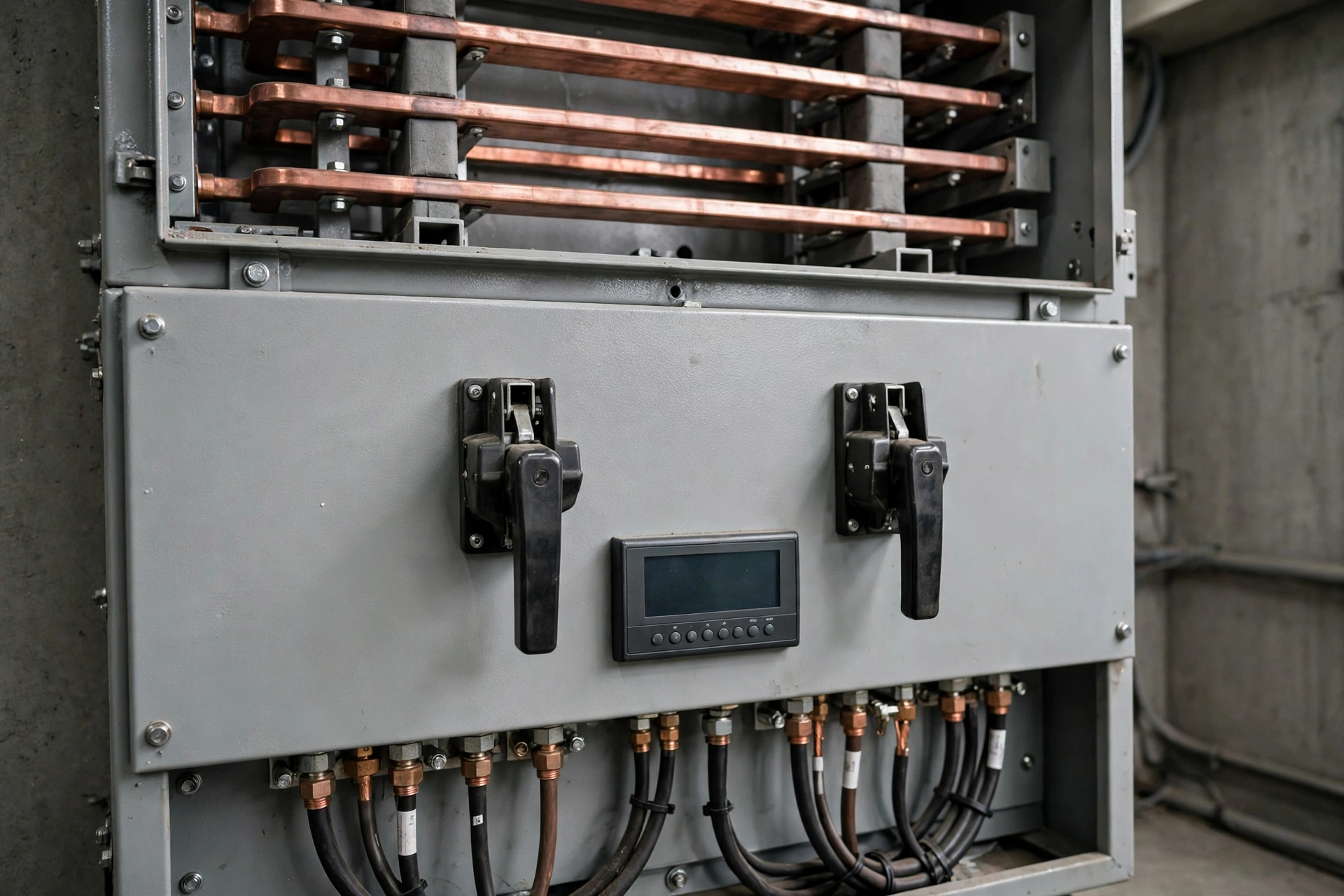
The cheapest second generator is the one that was planned for. Five provisions, made when the first set is installed, decide whether the second set is a week’s work or a rebuild. Together they cost roughly $3,000–$5,000 on a 500 kVA installation. Left out, they cost $12,000–$18,000 to retrofit, plus shutdown time.
Provision 1: Size the busbar and main breaker for 1,000 kVA
A 500 kVA set at 400 V three-phase draws about 722 A. A 1,000 kVA plant draws about 1,443 A. A busbar sized for 722 A cannot carry the second set, and a main breaker rated 800 A will trip the moment both sets feed the bus together. Sizing the busbar and the main breaker for the final plant capacity on day one costs the difference between a 800 A and a 1,600 A breaker and a heavier copper bar — typically $800–$1,500. Replacing them later costs the parts plus a shutdown, a new panel section and re-termination of every feeder — typically $4,000–$7,000.
The busbar must also have a spare way — a physical position for the second set’s breaker — reserved and labelled. A panel with no spare way needs a new panel section, which is where most retrofit budgets are lost.
Provision 2: Specify a paralleling-capable controller from the start
The controller is the decision that cannot be deferred cheaply. A standard auto-start controller such as the Deep Sea DSE7320 MKII starts one set and watches one transfer switch. It cannot synchronise, and it cannot share load. A synchronising and load-sharing controller such as the Deep Sea DSE8610 MKII can synchronise up to 32 sets, manage load sharing and run automatic start/stop sequencing as the load changes. A genuine DSE8610 MKII costs roughly $925–$1,250.
Specifying the DSE8610 on the first set costs the difference between the two controllers — a few hundred dollars. Retrofitting it later means replacing the controller on the first set as well as buying one for the second, re-wiring the control circuits, and re-commissioning the whole plant. The guide to remote monitoring explains the DSE family in detail; the point here is that the controller is the one component where buying the bigger capability on day one is always cheaper than upgrading later.
Provision 3: Leave room, air and fuel for the second machine
A second 500 kVA canopy set needs roughly the same footprint as the first, plus 1 m of clearance on all sides for service access. It also needs its own combustion and cooling air: a second radiator discharging into the same room needs a second louvre, or a louvre sized for two radiators from the start. The article on generator-room ventilation sizing gives the airflow figures — roughly 9.2 m³/s of cooling air for a 500 kVA set by the rule of thumb, and 12.1 m³/s by heat balance — and a room designed for one set’s air will cook the second set if the louvre is not enlarged.
Fuel is the same logic. Two sets at full prime load burn about 186 L/h between them. A bulk tank sized for 24 hours on one set gives 12 hours on two. The day tank, the transfer pump and the bulk tank should be sized for the final plant, or at least piped so that a second day tank can be added without cutting into the live fuel line. The fuel-ageing article explains why a tank that is too large for the current load is also a problem — diesel goes bad in storage — so the right answer is a tank sized for the final load with a polishing and testing regime, not simply the biggest tank that fits.
Provision 4: Keep the two sets identical
The pre-existing PAVO guide to parallel operation states the rule plainly: parallel identical sets if you can. Same engine, same alternator, same controller. Two identical sets share load evenly, share spare parts, share service practice and share one set of documentation. Two different sets — different engines, different governor response, different alternator characteristics — can be paralleled, but they need careful droop settings and they will never share load as evenly. The growth plan should therefore specify the second set as an identical twin of the first, and the purchase order for the first set should record the engine model, alternator model and controller model so that the twin can be ordered without guesswork three years later. The guide to spare parts makes the same point for a different reason: one set of spares covers two identical machines, and three sets of spares are needed for three different ones.
Provision 5: Plan the transfer switch for two sources
A single-set installation uses one automatic transfer switch between the utility and the generator. A two-set parallel plant needs a different arrangement: the two sets feed a common busbar through the paralleling switchgear, and the transfer switch — or a pair of transfer switches — sits between that busbar and the load. The article on the automatic transfer switch explains the 10-second gap and the timer sequence; the growth point is that a single ATS bought for one set cannot simply be re-used for two. Specifying a switchgear arrangement that accepts a second source on day one — a paralleling panel with a spare breaker way, or a dual-source ATS — costs little at the time and avoids replacing the transfer equipment when the second set arrives.
The Retrofit: Adding a Second Set to an Existing Single-Set Site
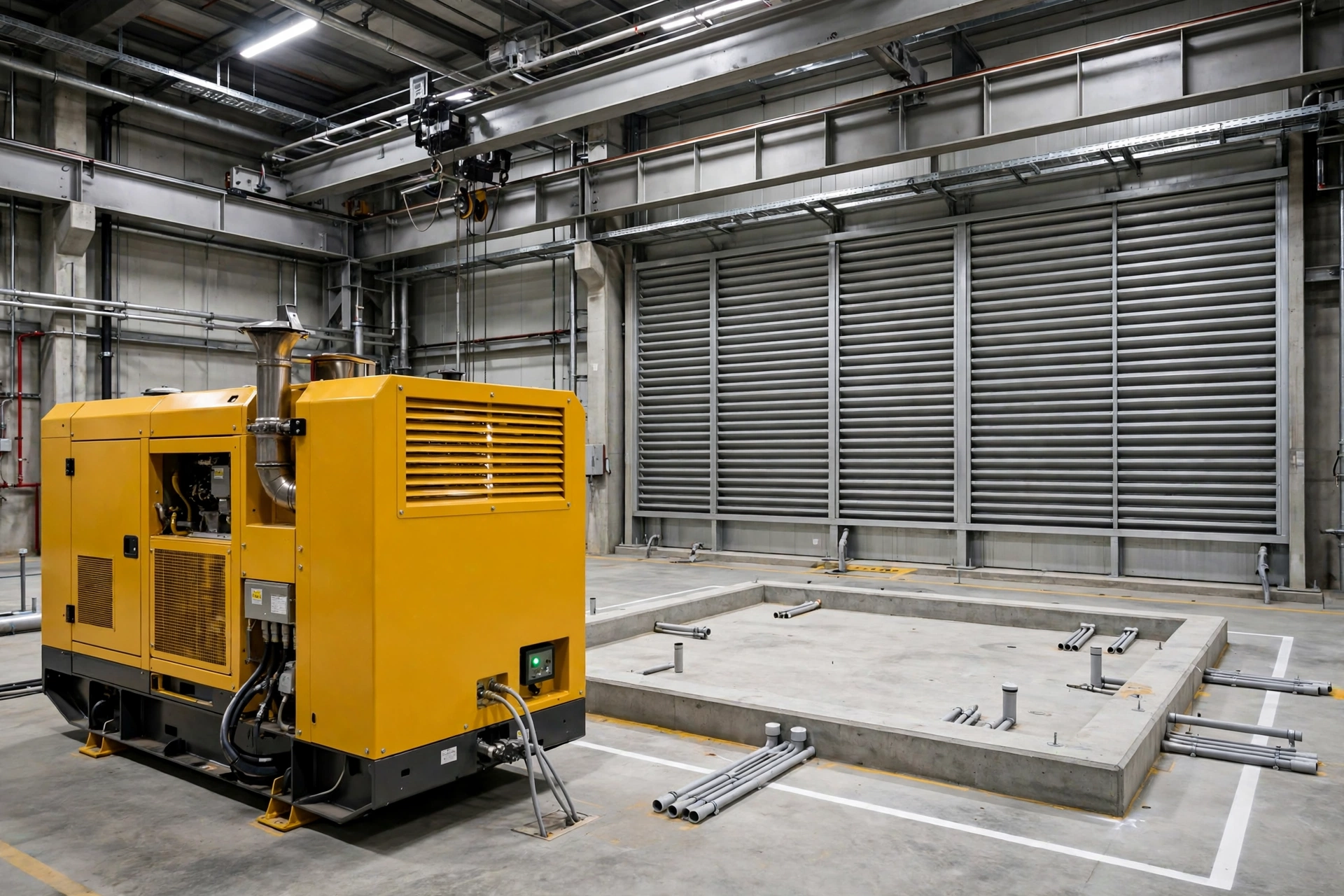
Most sites reading this article already have one set and no provisions for a second. The retrofit is possible, and it is done regularly, but it is a project with four steps, in order, and skipping one of them is how retrofits fail.
Step 1: Audit the existing installation before buying anything
The audit answers five questions. What is the engine model, alternator model and controller model of the existing set? What is the rating — standby or prime — and how many hours a year does it run? What is the capacity of the busbar, the main breaker and the transfer switch? How much room, air and fuel capacity is actually available? And what is the load profile — the real demand across a working week, not the nameplate total?
The load profile decides the size of the second set. If the existing 500 kVA set is carrying 450 kVA at peak and the load is growing at 10% a year, the second set needs to be at least 500 kVA, and the pair must carry the peak with one set down for service — which is the N+1 test. If the second set is bought too small, the plant still has a ceiling, and the whole exercise has to be repeated. The rating letters matter here: the article on standby and prime ratings explains why a set’s standby rating cannot be treated as its continuous capacity.
Step 2: Replace the transfer arrangement with paralleling switchgear
The existing single-set ATS comes out, or is re-purposed as the transfer switch between the new common busbar and the load. The paralleling switchgear panel goes in: two generator breakers, a synchronising controller for each set, load-sharing lines, and the busbar. A synchronising panel built around the DSE8610 costs roughly $2,999–$3,251 for a two-set configuration, before installation. The panel must be installed with the plant shut down — there is no way to rewire a live busbar — so the retrofit needs a planned outage window, typically a weekend, and a rental set if the site cannot be dark.
This is also the step where the protection study happens. The pre-existing PAVO guide to parallel operation covers the five mistakes in detail, and the third of them is the one that matters most in a retrofit: protecting each generator and forgetting the bus. A fault on the common bus takes out both sets. The bus needs its own protection, sized for the combined fault current of two alternators, and the protection settings on both sets need to be re-coordinated so that a fault on one set does not trip the other.
Step 3: Upgrade or replace the controller on the existing set
If the existing set has a standard auto-start controller, it must be replaced with a synchronising and load-sharing controller — the DSE8610 MKII or its equivalent — and the new set must carry the same controller. If the existing set already has a paralleling-capable controller, it needs only a firmware and configuration update, which is a day’s work rather than a replacement. This is the step that separates a $3,000 retrofit from a $8,000 one, and it is entirely decided by what was specified on day one.
The controller upgrade also needs the load-sharing lines run between the two sets — a shielded twisted-pair or CAN bus cable, run separately from the power cables to avoid interference. A load-sharing line run in the same tray as the power cables picks up noise, and a noisy load-sharing signal is what makes one set hog the load while the other idles.
Step 4: Commission as a system, not as two machines
Commissioning a parallel pair is not two single-set tests. The sequence is: synchronise the second set onto the bus with the first set carrying load, and watch the meters as the load transfers; step the load in 25% increments to full plant load and record the kW and kVAr split at each step; test the failure modes — trip one set under load and confirm the other picks up the critical load without a blackout; test the automatic start and stop sequencing by varying the load and confirming sets start and stop at the set points; and run the pair under a load bank at 75–100% of combined rating for at least two hours, to prove the load sharing holds under sustained load.
The load-bank test is the step most often skipped, and the one that finds the most faults. A pair that shares load evenly at 50% can share badly at 90%, when governor droop and AVR response diverge. The test costs a day of a technician’s time and a load bank hire. Skipping it costs the first real outage.
Can You Parallel Two Different Sizes?
The growth plan usually calls for an identical twin. Reality sometimes delivers something else: the original set is discontinued, the budget only stretches to a smaller second set, or a used set is available at the right price. Different-size sets can be paralleled, but the rules change.
What mismatched sets actually do to each other
Two sets in parallel share load in proportion to their ratings when both are on the same droop setting — a 500 kVA set and a 250 kVA set should share in a 2:1 ratio. In practice, they share in proportion to their governor and AVR responses, and a smaller set with a faster governor will take more than its share until its overload protection trips. The larger set then takes the full load, trips on overload in turn, and the plant goes dark — a cascade that starts with a load-sharing error of a few percent.
The practical consequence is that mismatched sets need isochronous load sharing — active, measured sharing through the controllers — rather than simple droop sharing, and they need a protection study that accounts for the different fault currents and different overload curves of the two machines. The DSE8610 and its equivalents support this, but the commissioning takes longer and the load-sharing test needs more steps. A pair of identical sets can be commissioned in a day. A mismatched pair takes two.
The 2:1 rule and the droop compromise
The working rule for mismatched sets is that the larger set should be no more than twice the size of the smaller — a 500 kVA set with a 250 kVA partner, not a 500 kVA set with a 100 kVA partner. Beyond a 2:1 ratio, the smaller set’s contribution is too small to matter and its protection settings become too sensitive to coordinate with the larger machine’s. Below that ratio, the pair works, but the plant’s usable capacity is less than the sum of the ratings: the pair should be treated as the larger set plus about 80% of the smaller set’s rating, because the sharing will never be perfectly proportional and the margin protects against the smaller set tripping first.
There is one more consideration. A mismatched pair loses the spares and service advantage of identical sets: two engine models, two filter sets, two AVR types. Over a ten-year life, the extra spares and the extra service knowledge cost more than the saving on the second set’s purchase price. The identical twin is the cheaper machine over the life of the plant, even when it is not the cheaper machine on the day it is bought.
When to Add the Second Set: Load-Growth Triggers
The second set should be ordered before it is needed, not after the first set starts tripping. Three triggers, measured from the site’s own records, mark the point.
| Trigger | Measurement | Threshold | Action |
|---|---|---|---|
| Peak load vs standby rating | Highest 15-minute demand on the set, from the controller log | Above 80% of standby rating | Order the second set; lead time is 8–12 weeks |
| Annual load growth | Year-on-year peak demand, from utility bills or controller logs | Above 10% a year for two years | Budget the second set for the next financial year |
| Hours above 75% load | Controller log, hours per year above 75% of prime rating | Above 200 hours a year | Plan the second set; the first set is spending too much time near its limit |
| Service without shutdown | Can the site accept a shutdown for a full service? | No — 24/7 operation | The second set is justified on redundancy alone, regardless of load |
| Step-load events | Voltage dip on motor starting, from the controller’s event log | Dip below 15% on any start | Second set, or a soft starter — check the motor-starting article first |
The 80% rule
The first trigger is the one to watch. A set that runs at 80% of its standby rating at peak has 20% headroom for a motor start, a load step or a hot day’s derating. A set that runs at 95% has none, and the next load added to the building — a chiller, a compressor, a new production line — takes it over the rating. The controller log records the peak demand; if nobody reads the log, the first sign of the problem is a trip.
The lead time matters too. A 500 kVA set ordered from a manufacturer takes 8–12 weeks from order to delivery, and the paralleling switchgear and the installation add another 2–4 weeks. A site that waits until the first set is overloaded will spend three to four months running a set above its rating while the second set is in transit. The order should be placed when the peak crosses 80%, not when it crosses 100%.
Frequently Asked Questions
Can I add a second generator to my existing generator system?
Yes, if the existing set has — or can be fitted with — a synchronising and load-sharing controller such as the Deep Sea DSE8610 MKII, and if the switchgear can be replaced with a paralleling panel and a busbar sized for both sets. The retrofit takes a planned shutdown of one to two days, a protection re-study, and a full load-bank commissioning test. The cost is typically $12,000–$18,000 for the switchgear, controllers and installation on a 500 kVA-class site, plus the price of the second set itself.
Is it cheaper to buy two smaller generators or one big generator?
Two smaller sets cost 15–25% more in generator equipment than one set of the same total capacity, and 40–60% more as a complete installed project, because of the paralleling switchgear and the extra installation work. But two sets burn 15–20% less fuel on a variable load, because each set runs inside its efficient 50–75% band instead of one large set running at 20–30% load. Two sets also keep half the power when one is down for service. For a steady load near the peak, one big set is cheaper. For a variable load, or a site that cannot shut down, two sets are cheaper over the life of the plant.
How to parallel two diesel generators of different sizes?
Use synchronising and load-sharing controllers on both sets, set the load sharing to divide the load in proportion to the ratings — a 500 kVA set and a 250 kVA set share 2:1 — and keep the size ratio within 2:1. The protection study must account for the different fault currents and overload curves of the two machines, and the pair should be treated as the larger set plus about 80% of the smaller set’s rating, not the full sum. Commission with a load bank at 75–100% of combined rating, stepping the load in 25% increments and recording the kW split at each step.
How much does paralleling switchgear cost for a diesel generator?
A synchronising panel built around a Deep Sea DSE8610 controller costs roughly $2,999–$3,251 for a two-set configuration, and a genuine DSE8610 MKII controller alone costs $925–$1,250. A complete retrofit — panel, two controllers, busbar work, cabling and commissioning — typically runs $12,000–$18,000 on a 500 kVA-class site. Specifying the paralleling-capable controller and a busbar sized for two sets when the first set is installed costs roughly $3,000–$5,000 and avoids most of the retrofit cost.
Can you run two generators at the same time on one load?
Yes — that is what paralleling is. Two synchronised generators feed a common busbar and share the load between them, in proportion to their ratings, under the control of synchronising and load-sharing controllers. The pair behaves as one power plant: if one set trips, the other picks up as much of the load as it can carry, and the controllers shed non-critical load if the remaining capacity is not enough. What two generators cannot do is simply be wired together: without synchronisation, their outputs clash out of phase and destroy each other. The controllers, the switchgear and the commissioning test are what make two machines into one plant.
Specification Checklist: Eight Lines Before the Deposit
1. What is the peak load today, and what will it be in three years? Read the controller log, not the nameplate total. If the peak is above 80% of the standby rating, the second set is already due.
2. Is the first set’s controller paralleling-capable? Check the model number. A DSE8610 MKII or equivalent means a configuration update. A standard auto-start controller means a replacement, and the cost of that replacement belongs in the budget.
3. Is the busbar and main breaker sized for the final plant? A 500 kVA set draws about 722 A at 400 V; a 1,000 kVA plant draws about 1,443 A. If the busbar is sized for one set, it is replaced, not extended.
4. Is there a spare breaker way in the panel for the second set? No spare way means a new panel section. Reserve it on day one, labelled, even if the second set is three years away.
5. Is there room, air and fuel for the second machine? A second 500 kVA set needs the same footprint again plus 1 m clearances, a louvre sized for two radiators, and a fuel system sized for 186 L/h at full load on both sets.
6. Is the second set an identical twin? Same engine, same alternator, same controller. The twin shares load evenly, shares spares and shares one service programme. A different set costs more over ten years than it saves on the day it is bought.
7. Has the protection been re-studied for two sets? The bus needs its own protection, sized for the combined fault current, and the settings on both sets need re-coordination. The article on parallel operation explains the five mistakes that a re-study prevents.
8. Is the commissioning a system test, not two single-set tests? Synchronise under load, step the load to full plant rating, trip one set and confirm the other carries the critical load, and run a load bank at 75–100% of combined rating. A pair that is not tested as a system is not a system.
A second generator is not a bigger generator. It is a second machine, a second service programme, a second set of spares and a second controller — and, done properly, it is the cheapest way to grow a power plant, because the capacity is bought when the load arrives instead of three years before it. The five provisions in this article cost $3,000–$5,000 on day one and save $12,000–$18,000 on the retrofit. For a growth plan priced against a specific site, with the first set’s model, the load profile and the room dimensions, contact PAVO and the engineering team will return the paralleling specification with the switchgear, the controllers and the cost.