

How to Monitor a Diesel Generator Remotely Online | PAVO
How to monitor a diesel generator remotely comes down to three links: a controller that measures, a gateway that carries the data off site, and a rule that tells a named person what to do. Get any one link wrong and the other two are decoration.
How to monitor a diesel generator remotely is a wiring and configuration question, not a shopping question. The controller already measures voltage, frequency, oil pressure, coolant temperature, battery voltage and run hours. Remote monitoring connects those measurements to a phone in another country, through Modbus and a 4G gateway, with alarms on the values that predict a failed start.
Whether remote monitoring is worth buying at all is a separate decision, covered in the companion piece on generator remote monitoring.
Contents
- Remote Monitoring Is Three Links, Not One Product
- The Controller: What a Deep Sea DSE7320 MKII Actually Exposes
- Modbus RTU on RS-485: Wiring, Registers and Polling
- Modbus RTU vs Modbus TCP: Which One the Site Gets
- The Gateway: Getting Data Off Site on 4G
- Watching from Abroad: Dashboards, Alarms and the 03:00 Call
- Frequently Asked Questions
- Remote Monitoring Specification Checklist
Remote Monitoring Is Three Links, Not One Product
Most disappointing installations fail because the buyer purchased one link and assumed the other two came with it. A controller with an RS-485 port and no gateway gives a screen in the generator room. A gateway with no alarm rule gives a log nobody reads. A dashboard with no measured data gives a pretty page of zeros.
Link 1: The Controller Measures
The controller is the only part of the chain that touches the engine. It reads the sensors, runs the start sequence, applies the protection settings and keeps the event log. If the controller does not measure a value, or does not expose it on a port, no dashboard in the world can display it.
Deep Sea Electronics controllers are the common case on export sets — PAVO fits Deepsea, Smartgen or ComAp controllers across its 9 to 3750 kVA range — and the rest of this article uses Deep Sea models as the worked example. The principles transfer: every serious controller exposes its data on RS-485 Modbus, and every one of them needs the same three links.
Link 2: The Gateway Carries
Something has to take the controller’s local language and put it on a network that reaches the person who needs it. That is a gateway on the set, a router with a public address, or a device that combines both. The gateway polls the controller every few seconds, stores readings locally when the network drops, and forwards them when the connection returns.
Link 3: The Dashboard Decides
A dashboard that shows a value is not monitoring. Monitoring is a rule that says: if this value crosses this line, this person is told, and this is what they do next. Five alarms, each with a named responder and a written response, beat fifty parameters on a screen nobody opens.
Budget the three links separately. A typical single-set installation runs about $350–550 for the controller upgrade if the set was ordered with a basic panel, $250–700 for a 4G gateway, under $50 for RS-485 cabling and termination, and $5–15 a month for the SIM data plan. Cloud subscriptions range from free to about $25 a month per set. These are indicative 2026 figures; confirm them with the supplier before ordering. The expensive failure is not the hardware. It is a $600 gateway wired to a controller that was never configured to expose its data.
The Controller: What a Deep Sea DSE7320 MKII Actually Exposes
A controller is not a black box with a screen. It is a measurement instrument with a published register map, and the map decides what remote monitoring can ever show.
Which Deep Sea Model to Specify
Deep Sea’s range splits by job. The DSE4510 is a compact auto-start module for small single sets. The DSE7310 MKII is an auto-start module for larger single sets. The DSE7320 MKII adds mains (utility) sensing and automatic load transfer control — it is the auto mains failure (AMF) module, and it is the default choice for a standby set that must start itself and transfer load when the grid fails. The DSE8610 MKII is the load-sharing and synchronising module for paralleled sets.
For a single standby set, specify the DSE7320 MKII. For a prime-power set that runs on remote start with no mains to monitor, the DSE7310 MKII is enough. For two or more sets in parallel, the DSE8610 MKII is the correct module, and the monitoring conversation changes: the register map now includes synchronising and load-share data, and the gateway polls the set that holds the bus, not each engine separately.
What the Controller Measures
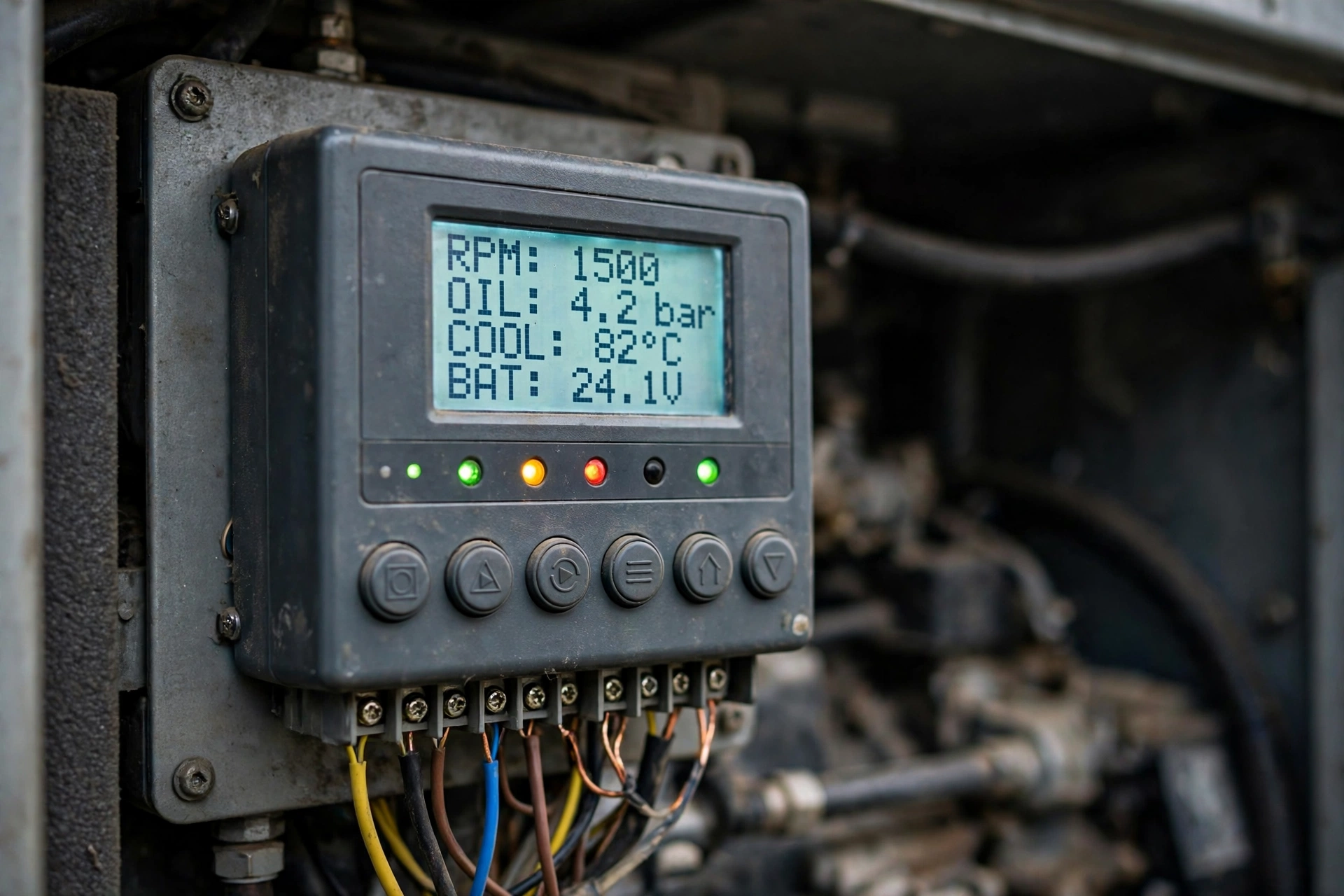
The DSE7320 MKII carries USB, RS-232 and RS-485 ports plus dedicated DSENet terminals for expansion, and its published feature list states that the integrated RS-232 and RS-485 ports provide Modbus RTU support with configurable Modbus pages. It senses three-phase generator and mains voltage from 15 V to 415 V phase-to-neutral and frequency from 3.5 Hz to 75 Hz. DC supply is 8–35 V, with maximum operating current 340 mA at 12 V and 160 mA at 24 V. It logs up to 10 parameters internally, supports seven languages, and runs a dual-core processor with a drag-and-drop PLC editor for custom logic.
What that means in practice is a fixed, documented list of values the controller can expose:
| Value | Where it comes from | Why remote monitoring wants it |
|---|---|---|
| Generator voltage, current, frequency | Alternator sensing | Confirms the set is producing clean power, not just running |
| kW, kVA, kVAr, power factor | Calculated from sensing | Load trending; overload before it trips |
| Engine speed (RPM) | Magnetic pickup | Overspeed and underspeed detection |
| Oil pressure | Engine sensor, kPa | Falling trend predicts a failed start weeks ahead |
| Coolant temperature | Engine sensor, °C | Overheating and thermostat faults |
| Battery voltage | DC supply sensing | The single best predictor of a failed start |
| Fuel level | Level sender (if fitted) | Theft, leaks and run-time remaining |
| Run hours and start count | Internal counters | Service scheduling and rental billing |
| Alarm and shutdown status | Protection logic | The event that triggers the 03:00 call |
Two values on that list deserve emphasis. Battery voltage is the cheapest early warning in the whole system: a 24 V bank sliding from 27.2 V to 24.1 V over six weeks is a battery dying in plain sight, and the controller sees it every day. Fuel level is the second: a 500 kVA set at prime full load burns 93.2 L/h, so a 645-litre tank gives under seven hours, and a fuel-level trend that falls 40 litres overnight with the set stopped is theft, not consumption.
One limit to note: the DSE7320 MKII logs up to 10 parameters internally. That is enough for the values above. It is not a historian. Long-term trending — months of oil pressure or fuel level — lives on the gateway or the cloud platform, not in the controller.
Modbus RTU on RS-485: Wiring, Registers and Polling
Modbus is the protocol that turns the controller’s measurements into data another device can read. It is old, simple and unencrypted, which is exactly why it works on a generator in a shed in northern Nigeria and exactly why it must never be exposed directly to the internet.
Wiring the RS-485 Bus
RS-485 is a two-wire serial bus. The controller is a slave; the gateway or the logging device is the master. The wiring rules are short, and most failed first attempts break one of them:
- Use twisted pair, connect A to A and B to B, and if nothing answers, swap them — manufacturers do not agree on labelling.
- Terminate both ends of a long bus with 120-ohm resistors. A bus without termination reflects the signal and produces intermittent read errors that look like a software fault.
- Match the controller’s baud rate, parity and stop bits exactly, and note its Modbus unit ID. The default slave ID on a Deep Sea controller is 10; give each set on a multi-set bus a unique ID.
- Keep the RS-485 cable away from power cables. Ground the shield at one end only. Use an isolated adapter or gateway so a fault on the set does not travel back into the logging device.
- RS-485 supports up to 32 devices on one bus, so a single gateway can poll several controllers — the DSE890 MKII gateway supports up to five.
A generator room is electrically noisy. A twisted pair run beside a 400 V cable will pick up enough interference to corrupt reads. Route the bus with the control wiring, not the power wiring, and the problem mostly disappears.
Reading the Register Map
The register map is the document that makes Modbus work. Deep Sea publishes a GenComm communications manual and a Modbus register map for each controller family, and each map is laid out differently. Read it before writing any code or configuring any gateway.
The map tells the poller which address holds which value, whether it is a holding register or an input register, how it is scaled, and whether it is signed. Oil pressure may be stored in kPa, coolant temperature in whole degrees, battery voltage in tenths of a volt. Values like run hours or kWh usually span two 16-bit registers, and the word order matters: read the high word first or the value comes out wrong by a factor of 65,536.
Before touching a gateway, write down the dozen values the site actually needs — fuel level, battery voltage, coolant temperature, oil pressure, frequency, run hours and the alarm status registers cover most maintenance decisions — and map each one to its register, data type and scale factor. A short, correct table beats a 200-register dump that nobody maintains.
Polling Intervals and Scan Time
The gateway polls the controller on a schedule. Status values — running state, voltage, frequency, alarms — are typically polled every 5–30 seconds. Logged values for trending can be polled every 1–5 minutes. Do not poll faster than the controller’s minimum scan time; the manual states it, and a gateway that hammers the bus will return stale or missed reads.
One configuration detail from the integration notes: set the controller’s master inactivity timeout to at least twice the gateway’s poll interval, so a slow network does not make the controller decide its master has gone away. And when remote start and stop are implemented over Modbus — the Senquip application note shows a script doing exactly this on a DSE8610 — interlock it. A remote start command that can fire while a technician is working on the set is a safety failure, not a feature. Remote start belongs behind a maintenance lockout, a named operator and an audit log.
Modbus RTU vs Modbus TCP: Which One the Site Gets
Modbus RTU and Modbus TCP carry the same registers. They differ in transport, and the site’s network decides which one fits.
| Modbus RTU | Modbus TCP | |
|---|---|---|
| Transport | RS-485 serial, two-wire | Ethernet, TCP/IP |
| Distance | Up to about 1,200 m on RS-485 | Limited by the LAN; gateways bridge it |
| Devices per link | Up to 32 on one bus | One IP address per device |
| Speed | 9,600–115,200 baud | 10/100 Mbps Ethernet |
| Typical use | Controller to gateway on the set | Gateway to BMS, SCADA or building network |
| Security | Physical access to the bus | Must sit behind a firewall or VPN — never internet-facing |
When RTU Is the Right Answer
RTU is the right answer on the set itself. The controller’s RS-485 port is the native interface, the wiring is two wires, and a gateway mounted in the same canopy polls it over a metre of cable. Every field case in this article — the Central Africa fleet, the Nigerian telecom towers — uses RTU between controller and gateway. It is also the right answer where there is no Ethernet on site, which is most generator rooms.
When TCP Is the Right Answer
TCP is the right answer once the data leaves the set and enters a building. A building management system (BMS) or SCADA platform expects Modbus TCP on Ethernet, and the gateway or a serial server translates RTU to TCP at the panel. Data centres and hospitals with an existing BMS specify TCP for that reason: the generator appears as one more device on the network the facilities team already watches.
The rule is simple: RTU on the set, TCP in the building. A quotation that offers only one of them has not read the site. And whichever transport is chosen, Modbus has no authentication. Never expose a Modbus TCP port directly to the internet. The gateway should talk to its cloud platform over TLS or MQTT with credentials, or sit behind a VPN. A generator that can be started from the public internet is a liability, not a feature.
The Gateway: Getting Data Off Site on 4G
The gateway is the second link, and it is where most budgets are decided. It is also the component most often bought twice, because the first one was specified from a datasheet instead of from the site’s signal.
The DSE890 MKII Gateway
Deep Sea’s own gateway is the DSE890 MKII, a 4G gateway with 2G and 3G fallback, Ethernet and GPS. It communicates with up to five connected DSE controllers — one over USB, several over CAN, RS-485 or Ethernet — and transmits to the DSEWebNet cloud platform or to a third-party MQTT broker. It logs data internally and transmits at regular intervals. GSM standby current is 207 mA at 12 V and 113 mA at 24 V, which matters on a site where the gateway draws from the same battery bank as the starter: a gateway that flattens the start battery has made monitoring worse than useless.
DSEWebNet is the manufacturer’s own cloud service. It shows instrumentation, operating state and event history, and it supports remote start and stop where the controller allows it. For a single-brand fleet — all Deep Sea controllers, one login — it is the shortest path from the set to a phone.
Third-Party Gateways and MQTT
The manufacturer’s gateway is not the only option, and for mixed fleets it is often the wrong one. A third-party 4G gateway wired to the controller’s RS-485 port reads the same Modbus registers and forwards them to any MQTT broker or telematics platform the owner already uses. The Central Africa case in this article did exactly that: six 230–330 kVA sets with DSE4510 and DSE7320 controllers, a MasterCAN RS2CAN converter reading up to 100 parameters over Modbus RTU, and a CANUp gateway feeding the satellite-monitoring company’s existing telematics service. The operator sees alternator voltage, power, current, frequency and power factor, engine RPM, coolant temperature and oil pressure, and total running hours — in the same service as its trucks and tractors, with emergency shutdown notifications included.
The deciding question is not which gateway is better. It is which service the owner already opens every morning. A gateway that feeds a platform nobody logs into is a cost, not a system.
SIM Cards, Signal and the Second SIM
A 4G gateway is only as good as its signal, and generator sites are often where signal is worst: basements, container yards, rural towers, steel canopies. Before ordering, check the signal at the set’s actual location with a phone on the same network, not at the site office. A gateway with an external antenna mounted outside the canopy will hold a connection that an internal antenna loses every time the canopy door closes.
Two practical rules follow. First, fit two SIM cards from different networks where the gateway supports it, with automatic switch-over: one network’s outage is not the site’s problem. Second, confirm the gateway stores readings locally and forwards them when the connection returns. A gateway that drops data during a network outage leaves a gap in exactly the period — the outage — that matters most. The DSE890 MKII logs internally; confirm the same for any third-party gateway before buying.
Costs for this link, indicative for 2026: the DSE890 MKII gateway $400–700, a third-party 4G gateway $200–400, an external antenna $15–40, and a SIM data plan $5–15 a month. A gateway with a single SIM, no local storage and an internal antenna is cheaper on the quotation and more expensive on the first site visit.
Watching from Abroad: Dashboards, Alarms and the 03:00 Call
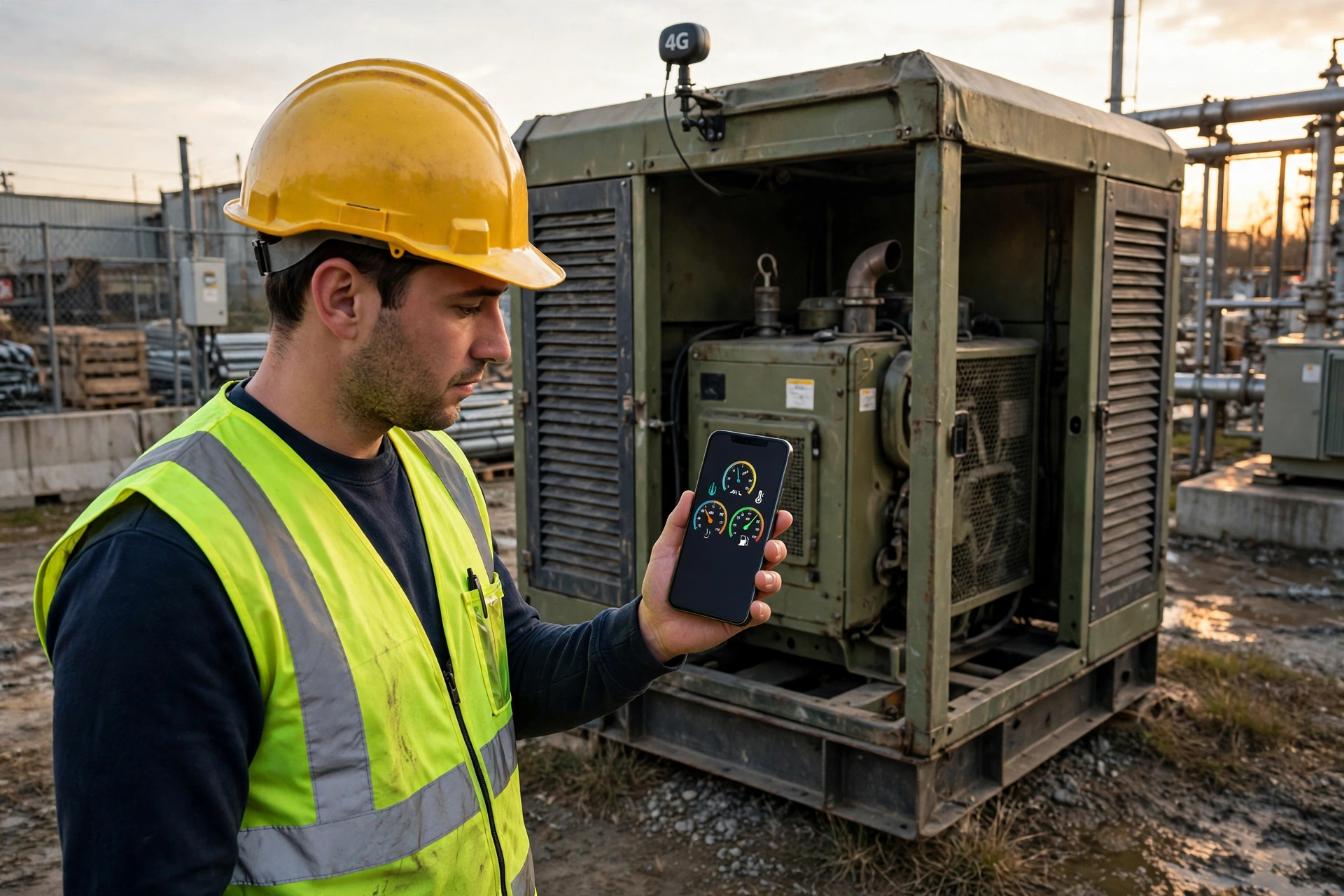
The third link is the one that decides whether the system earns its keep. Watching from abroad means the person who can act is in another city or another country, and the system has to bridge that distance with a rule, not a graph.
The Five Alarms That Matter
Five alarms cover the failures that actually stop a set. Each one needs a named responder and a written response, or it is noise.
- Failed start. The set was commanded to start and did not reach speed. Response: dispatch, do not wait for the next test.
- Common fault / shutdown. Low oil pressure, high coolant temperature, overspeed. Response: do not attempt a remote restart until the cause is known.
- Low battery voltage. Below 24.0 V on a 24 V bank, trending down over days. Response: replace the battery or the charger before the next outage, not after it.
- Low fuel level. Below the level that covers the next expected outage plus the delivery lead time. Response: order fuel now. A 500 kVA set burns 93.2 L/h at full load; 200 litres is barely two hours. The fuel consumption and tank sizing figures show how fast a bulk tank empties over 8, 24 and 72 hours.
- No communication. The gateway has not reported for a set period, typically 30 minutes. Response: treat as a fault, not as a network quirk. A set that cannot be seen cannot be trusted, and how long a generator takes to start after a power outage is only about ten seconds when everything works.
Monitoring the generator does not cover the UPS that bridges the gap while it starts. A set whose voltage and frequency wander will keep tripping the UPS, the classic case of a UPS switching to battery on generator power. Watch the UPS input window as part of the same alarm set, or the generator will test fine and the load will still drop.
Set the thresholds from the controller’s own numbers, not from defaults. A battery alarm at 22 V on a 24 V bank fires after the battery is already too weak to crank. An oil-pressure warning set below the engine’s normal hot-idle pressure fires on every warm start. Confirm each threshold against a week of real readings from the site.
Case 1: Telecom Towers in Northern Nigeria
A telecom operator runs 75 kVA Cummins silent sets on towers across northern Nigeria, where grid supply is unreliable and each set runs 8–12 hours a day, about 300 days a year. That is prime duty, and the standby and prime power ratings decide the frame — but the monitoring problem is distance. The nearest technician is often four hours away on a bad road.
Each tower carries a DSE7320 MKII and a 4G gateway. The operator watches three values: battery voltage, fuel level and run hours. Battery voltage trending down over a fortnight triggers a battery replacement on the next scheduled visit, before the failed start that would take the tower down. Fuel level falling faster than the run-hours math allows triggers a theft investigation — a 645-litre tank that loses 40 litres overnight with the set stopped is not evaporation. Run hours feed the service schedule directly: oil and filters at the manufacturer’s interval, not at a guessed date.
The result is not dramatic. That is the point. The towers stopped failing on Friday nights and started being serviced on Tuesdays, and the operator’s maintenance budget moved from emergency call-outs to planned visits.
Case 2: Six Sets in Central Africa
A satellite-monitoring company in Central Africa was asked in 2022 to monitor diesel sets of 230–330 kVA used as backup power for industrial facilities. The sets carried DSE4510 and DSE7320 controllers, which displayed voltage, frequency, current, power, coolant temperature, oil pressure, RPM and engine hours — but only on the controller, in remote areas where nobody could watch them constantly.
The manufacturer’s own gateway would have locked the data into a branded service that could not show the company’s other assets. Instead, a MasterCAN RS2CAN converter connects to the controller’s RS-485 Modbus RTU port and reads up to 100 parameters, passing them to a CANUp telematics gateway that sends them to the telematics service the company already runs. The operator sees alternator and engine data with export to text or spreadsheet, and receives notifications on emergency shutdowns and faults — in the same service as every other monitored asset.
The lesson is about the third link, not the hardware. The converter and gateway mount quickly on each set, and the configuration shows whatever alternator and engine data the user needs. The monitoring worked because it fed a service the operator already used, with alarms the operator already acted on.
Frequently Asked Questions
How to monitor a diesel generator remotely?
Fit a controller that exposes its data on Modbus, wire a 4G gateway to the controller’s RS-485 port, and set five alarms — failed start, common fault, low battery, low fuel and loss of communication — each with a named responder. The controller measures, the gateway carries, and the alarm rule decides. A dashboard alone is not monitoring.
What is a Deep Sea controller for a generator?
A Deep Sea controller is the electronic module that starts, protects and monitors a diesel generator set. The DSE7320 MKII is the auto mains failure model: it senses mains and generator voltage, starts the engine on grid failure, transfers the load, and exposes voltage, frequency, oil pressure, coolant temperature, battery voltage, fuel level and run hours over Modbus RTU on RS-485. It is the measurement instrument that remote monitoring reads.
How to connect a diesel generator to Modbus?
Wire the controller’s RS-485 port to the gateway or logging device with twisted pair, A to A and B to B, fit 120-ohm termination resistors at both ends of the bus, and match baud rate, parity, stop bits and the controller’s Modbus unit ID — default 10 on Deep Sea controllers. Then read the controller’s published Modbus register map and configure the gateway to poll the registers for the values the site needs, checking scaling and word order for each one.
Can I monitor my generator from another country?
Yes, provided the set has a 4G gateway with a data SIM and the gateway forwards readings to a cloud platform or MQTT broker reachable from anywhere. The owner opens the same dashboard or receives the same push alerts whether they are on site or on another continent. The practical requirements are a working mobile signal at the set, a gateway that stores readings during network outages, and alarms routed to a person who can dispatch a local technician.
What is Modbus RTU vs Modbus TCP for a generator?
Modbus RTU runs over RS-485 serial wiring and is the native interface between a generator controller and its gateway; Modbus TCP runs over Ethernet and is the interface a building management system or SCADA platform expects. Use RTU on the set and TCP in the building, with the gateway or a serial server translating between them. Modbus has no authentication, so a Modbus TCP port must never be exposed directly to the internet.
Remote Monitoring Specification Checklist
Before ordering, confirm these ten points in writing. A supplier that cannot answer them has not specified a monitoring system — it has sold a box.
- Controller model and Modbus map. DSE7320 MKII for AMF duty, DSE7310 MKII for remote start, DSE8610 MKII for paralleling. The published register map is attached to the quotation.
- Values polled. Fuel level, battery voltage, coolant temperature, oil pressure, frequency, run hours and alarm status registers, each with register address, data type and scale factor.
- Gateway model and capacity. DSE890 MKII or third-party 4G gateway, number of controllers supported, and local storage during network outages.
- SIM and signal. Two SIMs from different networks where supported, external antenna outside the canopy, signal checked at the set’s location.
- Cloud platform. DSEWebNet, MQTT broker or existing telematics service — named, with login and subscription cost stated.
- The five alarms. Failed start, common fault, low battery, low fuel and loss of communication, each with a threshold set from real site readings and a named responder.
- Remote start interlock. Remote start and stop, if enabled, sit behind a maintenance lockout and an audit log.
- Security. Modbus TCP behind a firewall or VPN, never internet-facing; gateway to cloud over TLS or authenticated MQTT.
- Polling schedule. Status every 5–30 seconds, trending every 1–5 minutes, master inactivity timeout at least twice the poll interval.
- Commissioning test. A forced failed start, a low-fuel alarm and a loss-of-communication alarm, each verified end to end before handover — and a load bank testing run to confirm the set takes load, since monitoring reports the engine, not the alternator’s ability to carry it.
Remote monitoring does not make a generator reliable. It makes an unreliable generator visible early enough to fix, and a reliable one cheap to look after from another country. The controller, the gateway and the alarm rule each cost a few hundred dollars. The failed start they catch costs a cold store, a tower, or a data centre generator redundancy plan that assumed the set would start. Specify the three links, test all five alarms, and put the phone number of the person who will actually drive out there at 03:00 in the alert list.
For a set that needs monitoring specified with it, or a fleet that needs bringing onto one dashboard, contact PAVO — PAVO’s engineers specify Deep Sea and Smartgen controllers, Modbus gateways and remote monitoring with every set they build, from 9 kVA to 3750 kVA, and will tell you straight which tier your site actually needs.