

What Is ISO 8528 G1 G2 G3? Generator Class Guide | PAVO
A generator can hold its rated kVA and still fail the load — not because it is too small, but because its voltage and frequency move too far, for too long, when the load steps.
What is ISO 8528 G1 G2 G3? These are the four performance classes in ISO 8528-5 that limit how far a generator’s voltage and frequency may deviate when load is suddenly applied or removed, and how fast both must recover. G1 is the loosest, G3 the strictest standard class, and G4 is whatever buyer and manufacturer agree in writing.
- G1, G2, G3 and G4: What the Standard Actually Measures
- The Limits in Numbers: Voltage Dip, Frequency Dip and Recovery Time
- Case 1: Hospital — G2 Is the Floor, G3 Is the Decision
- Case 2: Data Centre — Why G3 Is the Minimum and G4 Appears in Tenders
- Case 3: Tower Crane — The Motor Start That Breaks a G2 Set
- What Decides the Class in Practice: Alternator, Governor and Load Steps
- Frequently Asked Questions
- Specification Checklist: Six Lines Before the Deposit
G1, G2, G3 and G4: What the Standard Actually Measures
Two generator sets can carry the same headline figure — 500 kVA, same engine family, same enclosure — and behave differently the moment a large load switches on. One holds voltage within 10% and recovers in two seconds. The other dips 22%, takes eight seconds to recover, and drops the contactors on the load it was bought to protect. The kVA rating does not explain the difference. The performance class does.
ISO 8528 is published in parts, and the two parts buyers confuse most are Part 1 and Part 5. Part 1, ISO 8528-1, defines the ratings: standby and prime power ratings — ESP, PRP, COP and LTP, plus the Data Centre Power (DCP) rating added in the 2018 revision. Ratings answer how long and how hard a set can run. Part 5, ISO 8528-5, defines the performance classes: G1, G2, G3 and G4. Classes answer how steady the power stays while it runs.
A buyer who specifies only the rating has specified half the machine. A 500 kVA ESP set and a 500 kVA PRP set differ in duty; a G2 set and a G3 set differ in behaviour under load steps. Both distinctions cost money when they are wrong, and the class error is the one that shows up first — usually during the first monthly test, in front of the facility manager, when the UPS alarms and the lights flicker.
Where the Classes Sit in ISO 8528
The classes are defined by what happens at the terminals when load changes in a single step. The standard measures three things: how far voltage and frequency deviate, how long they take to return inside the permitted band, and how far they sit from nominal once they settle. Each figure is tied to a stated load step and a stated power factor. A dip figure quoted without those two conditions cannot be checked against anything, and a supplier who quotes one should be asked for the other two before the order is placed.
ISO 8528-1 assigns each class a type of load. G1 covers applications where only the basic parameters of voltage and frequency need to be specified — general-purpose loads that tolerate wide swings. G2 covers applications where the voltage characteristics are very similar to the commercial public utility supply: lighting systems, pumps, fans and hoists, where temporary deviations are acceptable. G3 covers sets powering strategically critical loads, or loads that particularly require a stable and accurate supply — hospitals, data centres, telecom sites and UPS-fed equipment. The class follows the load, not the price.
G4: The Class That Is Not a Class
G4 has no fixed limits. It is the class for performance criteria agreed between the supplier and the buyer. It appears when the standard’s own load steps do not match the site — for example, a hyperscale data centre that wants a 60% load step held to a 10% voltage dip, tighter than G3’s 15% at a 100% step. The requirement is written into the contract, the manufacturer designs and tests to it, and the factory acceptance test proves it.
G4 is not a higher grade to be bought off the shelf. It is a negotiation. A quotation that claims “G4” without stating the agreed step, the agreed dip and the agreed recovery time has claimed nothing. The buyer should insist on all three in writing, with the test method named.
The Limits in Numbers: Voltage Dip, Frequency Dip and Recovery Time
The operating limits for each class come from Table 4 of ISO 8528-5:2022. The table below gives the figures that decide most disputes. They are the limits for diesel sets at the standard’s load steps, and they are the numbers a buyer should ask to see on a factory test report.
| Parameter | G1 | G2 | G3 |
|---|---|---|---|
| Steady-state frequency band | ±2.5% | ±1.5% | ±0.5% |
| Maximum frequency dip, 100% load step | −15% | −10% | −7% |
| Maximum frequency rise, 100% load rejection | +18% | +12% | +10% |
| Frequency recovery time | ≤10 s | ≤5 s | ≤3 s |
| Steady-state voltage deviation | ±5% | ±2.5% | ±1% |
| Maximum voltage dip, 100% load step | −25% | −20% | −15% |
| Maximum voltage rise, 100% load rejection | +35% | +25% | +20% |
| Voltage recovery time | ≤10 s | ≤6 s | ≤4 s |
Read the table as a buyer, not as an engineer. The steady-state rows describe normal running: a G3 set holds frequency within ±0.5% — ±0.25 Hz on a 50 Hz system — and voltage within ±1%, or ±4 V on a 400 V system. A G1 set is allowed ±2.5% on frequency and ±5% on voltage, five times looser. The transient rows describe the step: when the full rated load is applied in one block, a G3 set may dip 15% on voltage and 7% on frequency, and must be back inside its band within 4 seconds on voltage and 3 seconds on frequency. A G1 set may dip 25% on voltage and 15% on frequency, and is allowed 10 seconds to recover.
Frequency: How Far and How Fast
Frequency is the engine’s problem. When load is applied, the engine slows until the governor opens the fuel rack and the turbocharger catches up. The depth of the dip depends on the engine, its governor and the size of the step; the recovery time depends on how fast the governor responds. A mechanical governor with 5% droop cannot hold G3’s ±0.5% steady-state band. That is why G3 sets use electronic isochronous governors, which hold frequency flat from no load to full load.
The frequency figure matters most to UPS systems and variable-speed drives. A UPS rejects a source whose frequency slews faster than about 0.5 Hz per second, and a drive trips on frequency deviation long before the engine stalls. A set that meets G2 on paper can still fail a UPS load if the load is applied in one step and the frequency swings through the UPS input window on the way down.
Voltage: The Dip the Load Actually Feels
Voltage is the alternator’s problem. In the first cycles after a load step, the alternator behaves like a voltage source behind its subtransient reactance, X”d, typically 0.10 to 0.25 per unit. The dip can be approximated as X”d × S ÷ (G + X”d × S), where S is the starting kVA and G is the online generator kVA. The formula has one practical consequence: the dip is decided by the ratio of the step to the set, and by the alternator’s reactance — not by the engine.
A 15% dip on a 400 V system leaves 340 V at the terminals. Most contactors hold in at that level. Most drives do not trip. A 25% dip leaves 300 V, and contactors start dropping out, motors stall, and UPS units transfer to battery. The difference between G2 and G3 is, in practice, the difference between a flicker the building notices and an outage the building records.
Case 1: Hospital — G2 Is the Floor, G3 Is the Decision
A 600-bed regional hospital runs a 1,000 kVA ESP set, 400 V, 50 Hz, feeding operating theatres, intensive care ventilators, an MRI suite and a 300 kVA double-conversion UPS that carries the IT network and patient monitors. Grid outages total about 60 hours a year. The set was specified as G2. The reasoning was defensible: ISO 8528-12, the part covering emergency power supply to safety services, takes G2 as its baseline class, and the G2 set was about 6% cheaper than the G3 alternative.
For eleven months the arrangement worked. Then the monthly test found the problem. The automatic transfer switch moved roughly 600 kVA onto the set in a single step. Voltage dipped 18% and frequency dipped 8%, recovering in about 4.5 seconds. Every figure was inside the G2 limits — voltage dip −20%, frequency dip −10%, frequency recovery 5 seconds — so the set passed its own test. The load did not pass. The UPS input window is ±10% on voltage, and it rejects a source slewing faster than about 0.5 Hz per second. On every test the UPS transferred to battery for 40 seconds until the generator settled, cycled its batteries, and raised an alarm the facilities team learned to ignore.
The alarm stopped being ignorable during a real outage in the rainy season. The grid failed at 02:14, the set started inside 10 seconds as NFPA 110 Type 10 requires, and the UPS went to battery exactly as it had in every test. It was a textbook black start — the set restoring power from a dead grid without external supply. The difference was that the batteries were at 60% charge from the previous week’s test cycle, and the ICU monitors ran on battery for 40 seconds before the generator output steadied enough for the UPS to accept it. No patient was harmed. The hospital’s engineering director described the incident in one sentence: the generator had passed every test and still failed the load.
What Changed: G3, PMG Excitation and Two-Step Transfer
The replacement set was specified G3, with a permanent-magnet (PMG) excitation system and an electronic isochronous governor, and the transfer was re-sequenced into two steps: 40% of load immediately, the remaining 60% after five seconds. On the acceptance test the voltage dip measured 11% and the frequency dip 4%, with recovery in 2.4 seconds — inside G3 limits with margin. The UPS stayed on mains through the transfer and has stayed on mains through every monthly test since.
The cost difference between the two sets was about $7,000 on a $118,000 order. The hospital’s insurers, who had been notified of the incident, did not ask about the price. They asked for the new test report, the class letter on the datasheet, and the transfer sequence in writing. A hospital’s correct class is G3 unless the load list proves otherwise; G2 is the floor the standard allows, not the level a life-safety load deserves. The same logic applies to any site where a UPS sits between the generator and the load it protects — which is the subject of the guide to UPS switching to battery on generator power.
Case 2: Data Centre — Why G3 Is the Minimum and G4 Appears in Tenders
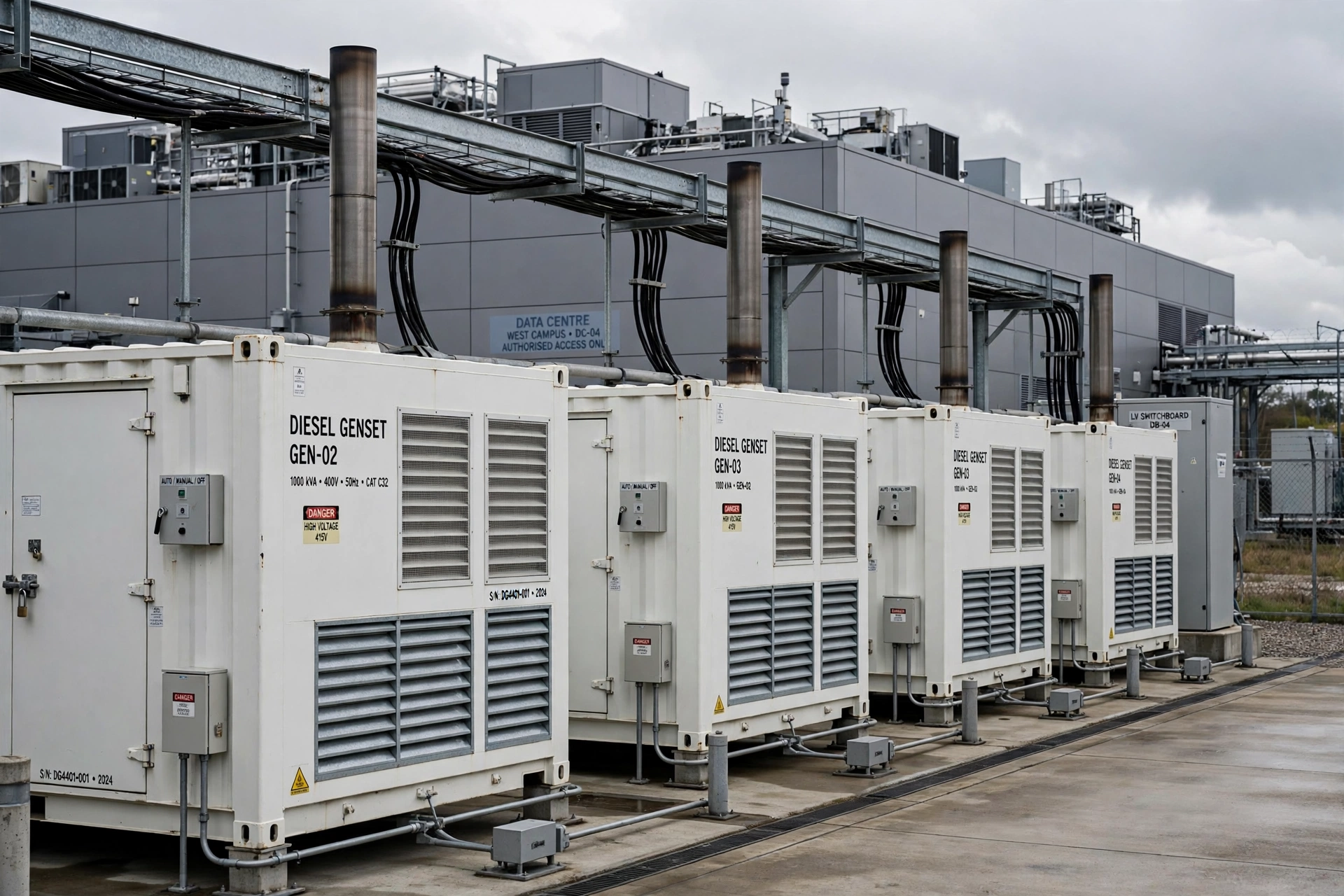
A colocation data centre outside Frankfurt runs a 2.5 MW hall on N+1 containerised sets, each a 2,063 kVA standby / 1,875 kVA prime unit of the type covered in the guide to data centre generator sizing. The sets are ESP-rated, because the grid is reliable and outages are short, but they are G3-class, because the load is not forgiving. When the grid fails, the UPS carries the IT load for the 10-second gap while the sets start, stabilise and close onto the busbar. The sets then accept load in steps — 50%, then 75%, then 100% — and the chillers restart after the IT load, because a chiller compressor restarting after a trip draws five to seven times its running current.
At the factory acceptance test, the 50% step — about 938 kVA applied in one block — produced a voltage dip of 12% and a frequency dip of 5.5%, with recovery in 2.1 seconds. All three figures sit inside G3. The 100% step was not tested as a single block, because the site never applies load that way; the test report says so, and the operations team tests the same sequence on site every quarter.
The numbers behind the specification are not abstract. Uptime Institute’s 2025 outage analysis reports a median significant outage of 53 minutes, with 57% of operators reporting that their most recent major outage cost more than $100,000. ITIC’s 2025 survey puts median downtime at $9,000 per minute, about $540,000 per hour, for large enterprises. A set that dips 20% instead of 12% does not merely flicker the lights; it risks dropping the UPS to battery during the handover, and a UPS on battery during a generator start is a countdown, not a backup.
When the Tender Asks for G4
A hyperscale tender for the same campus asked for more than G3. The specification required a 60% load step held to a 10% voltage dip — tighter than G3’s 15% at a 100% step, and at a step size the standard does not define. That is a G4 requirement: agreed between buyer and manufacturer, written into the contract with the step, the dip and the recovery time all stated. The manufacturer met it by fitting an alternator one frame larger than the engine required, cutting the subtransient reactance and the dip with it. The price premium was about 4% on the set. The tender was won on the test report, not on the price.
The lesson is not that every data centre needs G4. It is that G3 is the minimum a data centre should accept, and that anything tighter must be agreed as G4 in writing — step size, dip, recovery time and test method — before the order is placed. A tender that asks for “G4” without those numbers has asked for nothing.
Case 3: Tower Crane — The Motor Start That Breaks a G2 Set
A construction site in Lagos runs a tower crane off a 200 kVA set. The crane’s hoist motor is 75 kW, started direct-on-line. The site’s average load is modest — site lighting, a site office, the crane at part load — and the 200 kVA set was sized on the average, with a 25% margin. On paper the set was adequate. On the first heavy lift it was not.
A 75 kW motor draws about six times its full-load current at start. Full-load current is roughly 141 A at 400 V; starting current is about 846 A, or roughly 586 kVA of starting demand against a 200 kVA set. With a subtransient reactance of 0.12 per unit, the voltage dip works out at about 26%: 0.12 × 586 ÷ (200 + 0.12 × 586). That exceeds G2’s 20% limit and G3’s 15% limit by a wide margin. The crane’s variable-speed drive tripped on undervoltage, the hoist brake set with a 12-tonne load suspended 40 metres up, and the site lost half a day while the load was lowered by hand.
The set was not faulty. The motor was not faulty. The specification was faulty: it had been written on average load, and the class is decided by the largest single step, not by the average. Motor starting is the step that decides most construction-site specifications, and the starting multiples are the numbers that matter:
| Starting method | Starting current, × full-load current |
|---|---|
| Direct-on-line (DOL) | 6–8× |
| Star-delta | 2–3× |
| Soft starter | 2–4× |
| Variable-speed drive (VFD) | 1.0–1.5× |
Soft Start and the Next Frame Up
The fix had two parts. A soft starter cut the hoist’s starting demand from about 586 kVA to roughly 245 kVA. The set was upsized to 350 kVA, one frame up, which also cut the alternator reactance the step sees. The same formula now gives a dip of about 8% — inside G3 limits with margin. The crane has lifted through every shift since, and the soft starter paid for itself in the first week by ending the half-days lost to tripped drives.
The crane case is the cheapest lesson in this article. A G2 set would have been adequate for the site’s lighting and pumps. It was never adequate for a 75 kW motor started direct-on-line. The class question is always the same: what is the largest single step this set will ever see, in kVA, and what does the voltage do when it happens?
What Decides the Class in Practice: Alternator, Governor and Load Steps
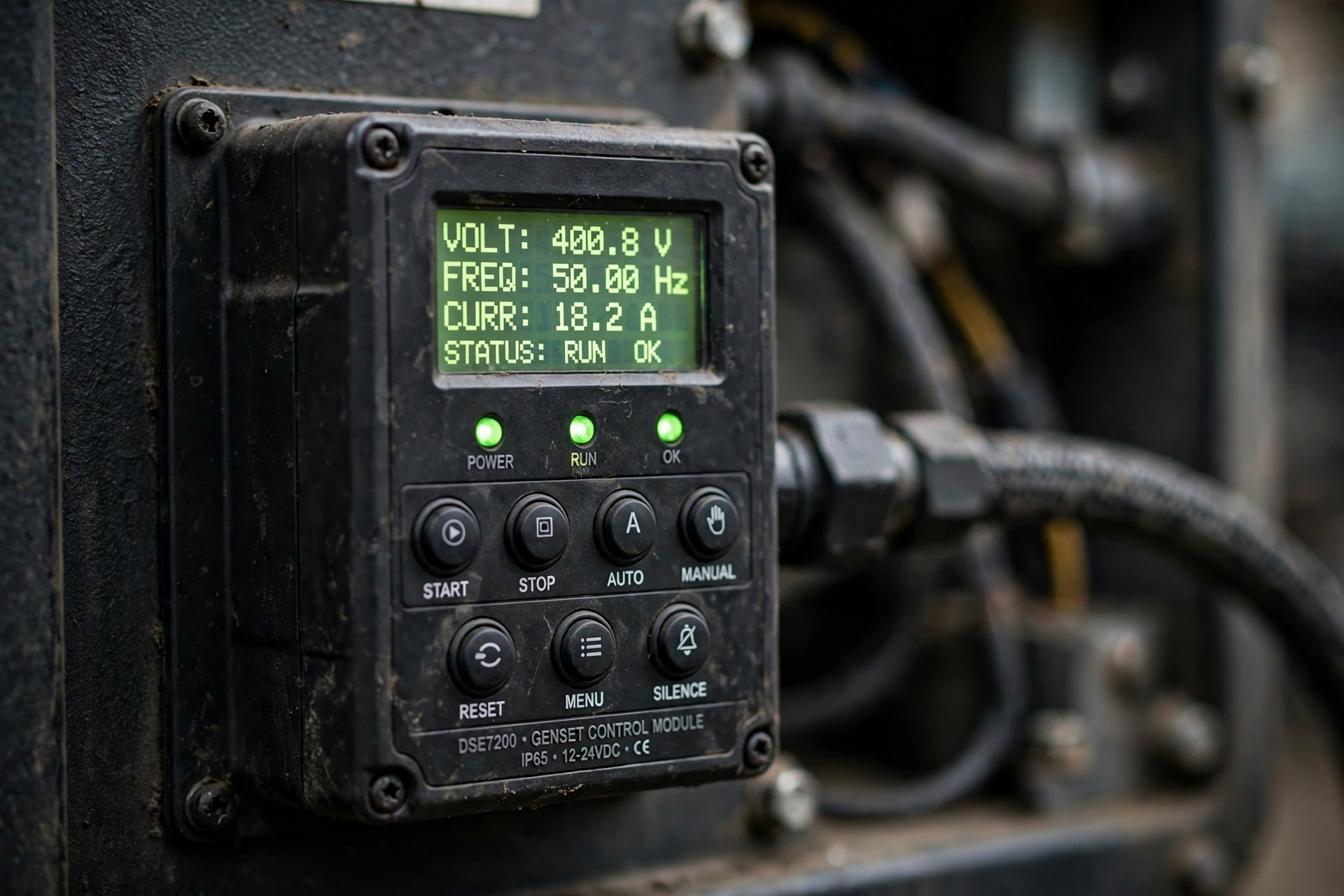
A class letter on a datasheet is a claim. Three things decide whether the claim survives the factory test: the alternator, the governor, and the order in which load is applied. Kohler’s white paper on ISO 8528-5 makes the point directly: specifying a G3 class does not guarantee adequate performance, because alternator sizing and load sequencing often have a bigger impact than the class rating alone. The buyer who understands the three levers can buy the right set at the right price; the buyer who only reads the letter pays for the letter and hopes.
The Alternator: Excitation and Reactance
Voltage recovery is an alternator and excitation problem. A shunt-excited alternator takes its excitation power from its own output terminals, so its excitation collapses exactly when the load step drags the voltage down. A PMG or auxiliary-winding (AREP) excitation system takes its power from an independent source, so the automatic voltage regulator keeps full forcing available through the dip and pulls the voltage back faster. That is why PMG excitation is close to a default on G3 sets feeding UPS and drive loads, and why a G3 claim on a shunt-excited alternator deserves a close look at the test report.
Two more alternator figures matter. Subtransient reactance, X”d, sets the depth of the dip; a larger alternator frame has lower reactance, which is why oversizing the alternator by one frame is the standard remedy for a dip that is too deep. Pitch matters for harmonics: a 2/3-pitch winding suppresses the triplen harmonics that non-linear loads generate, and a six-pulse variable-speed drive draws total harmonic current distortion of 30–45%, which heats alternator windings and distorts the terminal voltage. Sites with heavy drive loads typically target total harmonic voltage distortion of 5–8% at the generator terminals, and the alternator — not the engine — is what delivers it.
The Governor: Frequency Recovery Is an Engine Problem
Frequency recovery is an engine and governor problem, and it is the slower of the two recoveries. Voltage recovers in milliseconds to about a second on most frames; frequency takes seconds, because the engine must physically accelerate and the turbocharger must spool. The governor’s droop sets the steady-state band: G1 allows 8% droop, G2 allows 5%, G3 allows 3%, and an isochronous electronic governor holds frequency flat across the load range. A set with a mechanical governor cannot meet G3’s ±0.5% steady-state frequency band, whatever the alternator does.
Turbocharger lag is the hidden variable. A naturally aspirated engine recovers faster from a step than a turbocharged engine of the same rating, because there is no turbo to spool. That is one reason smaller sets sometimes outperform larger ones on transient response: the engine, not the kVA figure, decides the recovery time.
Load Sequencing: The Cheapest Upgrade
The cheapest way to meet a tighter class is often not a bigger set but a better sequence. Applying load in steps — 50%, then 75%, then 100%, with a few seconds between steps — cuts the largest single step the set ever sees, and with it the dip. Delaying chiller restart until after the IT load is stable, staggering motor starts, and starting the largest motor first while the set is lightly loaded are all free or nearly free, and each one moves the measured dip by several percentage points.
Load sequencing is also the most commonly skipped item in a specification, because it belongs to no single supplier. The generator manufacturer supplies the set, the switchboard manufacturer supplies the transfer sequence, and the site’s electrical contractor wires it. The buyer who writes the sequence into the contract — step sizes, delays, and the order of loads — gets the class they paid for. The buyer who leaves it to commissioning gets whatever the site electrician decides on the day.
Frequently Asked Questions
What is ISO 8528 G1 G2 G3?
ISO 8528 G1, G2 and G3 are the performance classes in ISO 8528-5 that limit how far a generator’s voltage and frequency may deviate when load is suddenly applied or removed, and how fast both must recover. G1 is the loosest class, for basic loads; G2 matches commercial utility supply, for lighting, pumps and fans; G3 is the strictest standard class, for hospitals, data centres, telecom sites and UPS loads. A fourth class, G4, covers criteria agreed between buyer and manufacturer.
What does G2 mean on a generator?
G2 means the set holds steady-state frequency within ±1.5% and voltage within ±2.5%, and on a 100% load step dips no more than 10% on frequency and 20% on voltage, recovering within 5 seconds on frequency and 6 seconds on voltage. It is broadly equivalent to commercial utility power and suits lighting, pumps, fans and hoists. It is also the baseline class ISO 8528-12 sets for emergency power to safety services, but a site with UPS or sensitive electronic loads usually needs G3.
What generator class do I need for a hospital?
A hospital should specify G3 as the default, with an ESP rating for the duty and a 10-second start to meet NFPA 110 Type 10. G2 is the minimum ISO 8528-12 allows for safety services, but hospital loads include UPS-fed monitors, imaging equipment and drives whose input windows are tighter than G2’s limits. The specification should also name the largest single load step, the transfer sequence, and PMG excitation, and the factory test should record the measured dip and recovery time.
What is a G3 generator for a data centre?
A G3 generator for a data centre is a set that holds steady-state frequency within ±0.5% and voltage within ±1%, and on a 100% load step dips no more than 7% on frequency and 15% on voltage, recovering within 3 seconds on frequency and 4 seconds on voltage. Data centres specify G3 because the UPS handover and the step loading of IT equipment and chillers demand it. Where a tender needs tighter limits at a specific step size, the requirement is written as G4 and agreed with the manufacturer.
How much voltage dip can a generator handle?
A generator can handle the dip its class allows: 25% for G1, 20% for G2 and 15% for G3 on a 100% load step, with recovery within 10, 6 and 4 seconds respectively. The better question is how much dip the load can handle — most UPS units transfer to battery outside ±10%, most drives trip on undervoltage below about −15%, and contactors drop out around −25% to −30%. Size the set and sequence the load so the measured dip stays inside the most sensitive load’s window, not merely inside the generator’s class limit.
Specification Checklist: Six Lines Before the Deposit
- Name the class in the contract — with the conditions. “G3 per ISO 8528-5:2022” is not enough. State the load step, the power factor, the maximum dip and the recovery time. If the step is not the standard 100% step, the class is G4 and all four figures must be agreed in writing.
- Name the largest single step load, in kVA, with its starting method. The class is decided by the largest step, not the average load. A 75 kW motor started direct-on-line is a 586 kVA step; the same motor on a soft starter is roughly 245 kVA. The quotation must show the calculation.
- Ask for the factory transient test at the contract step. The test report should record the measured voltage dip, frequency dip and recovery times, not merely state the class. A set that claims G3 without a transient test report has not proved the claim.
- Check the alternator on the datasheet. PMG or AREP excitation, digital AVR, subtransient reactance X”d, and 2/3 pitch where non-linear loads dominate. An oversized alternator — one frame up — is the standard remedy for a dip that is too deep, and it costs far less than a larger engine.
- Confirm the sensitive loads’ input windows against the class limits. UPS input tolerance, drive undervoltage trips and contactor hold-in voltage are the real limits. A set that meets G2 while the UPS needs ±10% will pass its test and fail the site.
- Confirm the rating separately from the class. A G3 set with the wrong duty rating still fails — the class says nothing about how many hours the set can run. ESP, PRP, COP or DCP must be stated alongside the class, as the guide to standby and prime power ratings explains, and the two letters answer different questions.
The class letter on a datasheet is a promise about behaviour, not about size. A buyer who reads it as a grade — G3 is better than G2, so buy G3 — overpays on simple sites and still risks failure on complex ones. The buyer who reads it as a contract — this dip, at this step, recovered in this time — gets the set the load actually needs. PAVO builds sets from 9 to 3,750 kVA in open, silent and containerised configurations, powered by Cummins, Weichai, Yuchai and Shanghai Diesel, and every set leaves the factory with its rating and its class stated on the test report — including the transient figures, not just the letters. A 1125 kVA silent set for a hospital and a containerised set for a data centre hall are different machines for different loads, and the class is one of the lines that makes them different.
Before requesting a price, send the load list with the largest single step and its starting method, the UPS and drive input windows, and the class the site requires. Any manufacturer that knows its business will price the correct class from those lines — and will show the test report that proves it. To discuss the class, the step loads and the test report for a specific site, contact PAVO.