

Generator Start Time: How Long After a Power Outage? | PAVO
Ten seconds is the standard answer. Ten seconds is also long enough to crash a server, stop a production line, or spoil a cold store.
How long does it take for a generator to start after a power outage? A well set up standby system restores power in about 10 seconds: 1–3 seconds for the transfer switch to confirm the outage, 5–8 seconds for the engine to crank and stabilise, and under a second to move the load. The timers set most of that time.
Contents
- The 10-Second Gap, Second by Second
- What an Automatic Transfer Switch Actually Does
- Why the Engine Needs Those Seconds
- The Standards That Set the Clock
- What the Gap Costs
- Closing the Gap Without Breaking the System
- Frequently Asked Questions
- Specification Checklist: Seven Lines Before the Order
The 10-Second Gap, Second by Second
A standby system does not restore power in one action. It runs a fixed sequence, and each step has its own clock. Measured on a healthy 500 kVA standby set with a standard automatic transfer switch, the sequence looks like this:
| Time after grid failure | Event |
|---|---|
| 0.0 s | Grid voltage falls below the transfer switch pickup threshold, typically 70–80% of nominal. |
| 0.1–2 s | The switch controller confirms the failure is real, not a dip or a recloser operation. |
| 1–3 s | Engine start delay expires; the start signal closes and the generator controller cranks. |
| 3–5 s | The diesel engine fires and accelerates toward rated speed, 1,500 rpm at 50 Hz. |
| 5–8 s | Voltage and frequency build to about 90% of nominal; the controller confirms the set is stable. |
| 8–10 s | The transfer switch moves the load from the dead utility feed to the generator. |
| ~10 s | The building is on generator power. |
Three facts in that table surprise most buyers. First, the switch itself is the fastest part of the system. The mechanical transfer takes 50–200 milliseconds. Second, the engine is the slowest part, and it cannot be hurried much: a diesel engine must crank, fire, accelerate a rotating mass of several hundred kilograms to 1,500 rpm, and build a stable magnetic field in the alternator. Third, the first three seconds are deliberate. The transfer switch waits on purpose, because most grid disturbances last less than a second.
A utility recloser typically clears a transient fault and restores supply within 0.3–1 second. If the transfer switch reacted instantly, every passing fault would start the generator, transfer the building, and then transfer it back — three switching events and a full start cycle for a disturbance the building never needed to notice. The engine start delay, usually set at 1–3 seconds, filters those out. On a site with a clean utility feed, it rarely matters. On a site where the feeder trips and recloses several times a week, it is the difference between a generator that starts ten times a year and one that starts two hundred times.
The total varies with the set. A small residential standby unit with a gas engine can reach stable output in 5–7 seconds. A 1,000 kVA diesel set with a large turbocharged engine typically needs 8–12 seconds. Cold weather adds time: at −10°C, crank time doubles unless a block heater has kept the coolant warm. A weak starter battery adds more, or removes the start entirely. The often-quoted “10 seconds” is a design target for emergency systems, not a property of diesel engines. It is achieved by sizing the battery, heating the block, and setting the timers to match — not by buying a faster engine.
What an Automatic Transfer Switch Actually Does
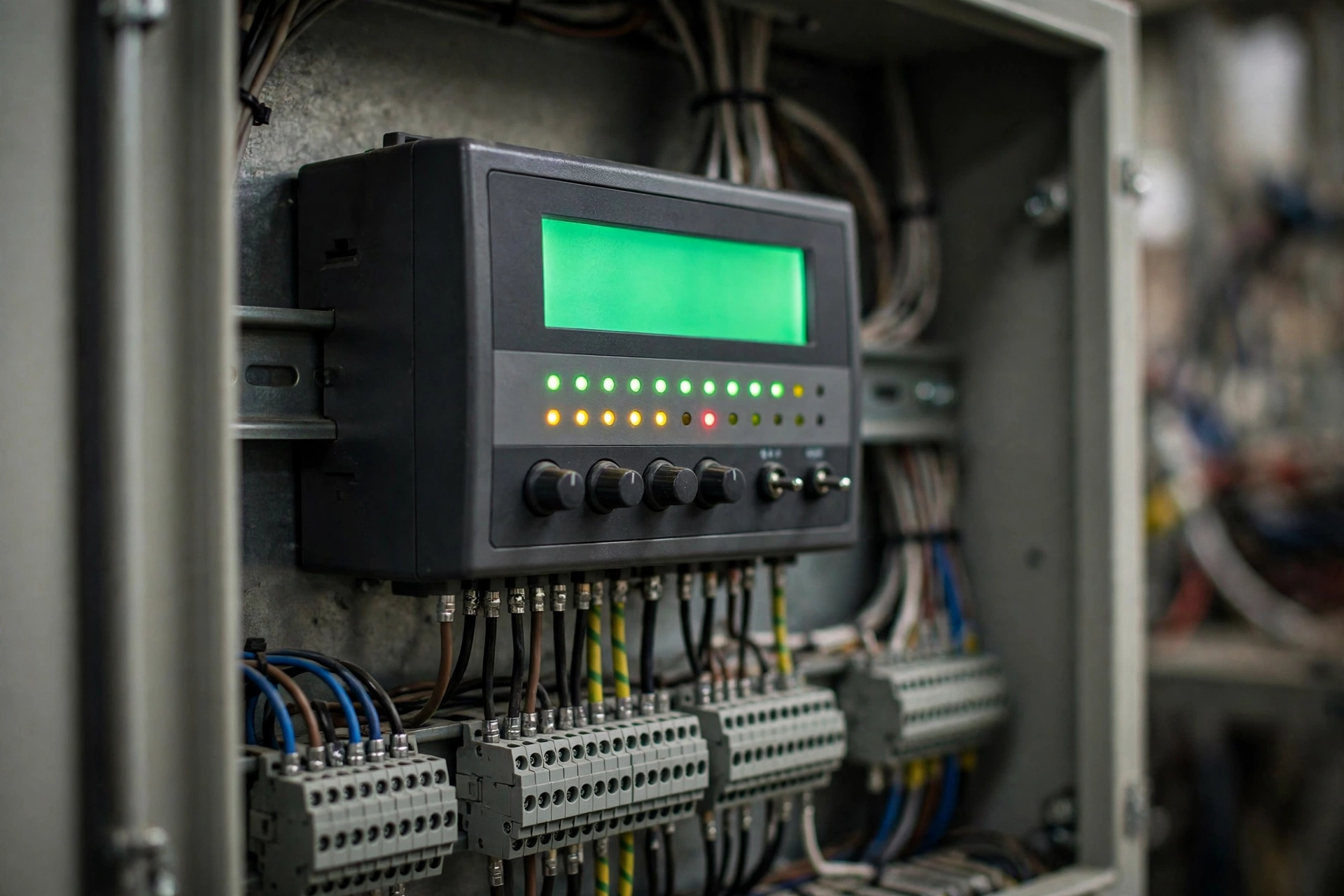
The automatic transfer switch is the part of the system most buyers never see and most failures trace back to. It has three jobs: watch the utility, start the generator, and move the load. It does all three without human input, and it does them in the same order every time. The same hardware matters beyond ordinary outages: after a total grid collapse, the sequence that brings a site back is a black start, and the transfer switch is the device that decides when the load reconnects.
Sensing the Failure and the Start Delay
The switch monitors all three phases of the utility supply for voltage and frequency. When voltage on any phase falls below the pickup setting — commonly 80% of nominal — or frequency drifts outside its window, the controller starts its timers. The engine start delay runs first, typically 1–3 seconds. If the utility recovers inside that window, nothing happens. No start, no transfer, no log entry worth reading.
When the delay expires with the utility still down, the switch closes its engine-start contact. That contact is a dry relay closure to the generator controller, the electrical equivalent of turning a key. The generator’s own controller then handles cranking, fuel, and speed governing. The switch waits for the generator to report acceptable voltage and frequency, usually 90% of nominal on both, before it moves the load. Transferring onto an unstable set is worse than waiting: a set still accelerating will dip voltage under load, trip its own protections, or stall.
Open Transition, Closed Transition and Delayed Transition
Most transfer switches are open transition: break-before-make. The utility contactor opens, the generator contactor closes, and between the two events the load is connected to nothing. That dead interval lasts 50–200 milliseconds, depending on the mechanism. For lighting, heating and most motors, it passes unnoticed. For a server without a UPS, it is a reboot.
A closed transition transfer switch does the opposite: make-before-break. It synchronises the generator to the utility, closes onto the generator while the utility is still connected, and then opens the utility contactor. The parallel lasts under 100 milliseconds and the load sees no interruption at all. The price is complexity and paperwork. The moment a generator parallels with the grid, even for a tenth of a second, the utility treats it as an interconnection: synchronising check relay, protective relays, and an application on file. For a hospital or a data centre that cannot tolerate a blink, that paperwork is worth doing. For a warehouse, it rarely is.
Delayed transition adds a deliberate pause in the centre-off position, usually 0.5–3 seconds, to let motor residual voltage decay before the load is reconnected to a new source. Without it, a large motor still spinning down can be reconnected out of phase with the generator, drawing an inrush current several times its running current and tripping the set on overcurrent. Sites with large direct-on-line motors — chillers, crushers, air compressors — specify delayed transition as standard. Sites without them never notice its absence.
Retransfer and Cooldown
When the utility returns, the switch does not rush back. The retransfer delay, usually set at 5–30 minutes, confirms the utility is stable and not flickering. Only then does the switch move the load back to the grid. The generator then runs unloaded for a cooldown period of 3–5 minutes so the turbocharger and exhaust components cool evenly before shutdown. Skipping cooldown cooks oil in a hot turbocharger bearing. It is a small timer with an expensive failure mode.
Why the Engine Needs Those Seconds
A generator does not produce power the moment it fires. It produces power when the engine holds rated speed and the alternator holds rated voltage under load. The seconds between cranking and transfer are physics, not hesitation.
Cranking and Building Speed
The starter motor must turn a cold diesel engine against compression until it fires. On a 500 kVA set, that takes 1–3 seconds of cranking in warm conditions. The controller is typically set for three crank attempts of about 10 seconds each, with rests between them. If the set has not started after three attempts, it locks out and raises an alarm. A healthy set starts on the first attempt. A set that needs the second or third attempt has a problem — weak battery, fuel starvation, or a failing starter — and the monthly test report should have shown it.
Once firing, the engine accelerates from zero to 1,500 rpm. The governor controls that ramp to avoid overspeed, and the rotating assembly — crankshaft, flywheel, alternator rotor — carries enough inertia that the ramp takes 2–4 seconds on a mid-range set. Larger engines take longer. A 2,000 kVA set with a 30-litre engine does not accelerate like a 100 kVA set, and no timer setting changes that.
Voltage and Frequency Stabilisation
At rated speed, the automatic voltage regulator builds excitation in the alternator until output reaches nominal voltage, and the governor trims frequency to 50 Hz. The transfer switch waits until both are inside its window, about 90% of nominal. Transferring early risks a voltage dip that drops out contactors downstream and stalls the set under a load it was not yet ready to carry. The stabilisation wait is usually 1–2 seconds. It is the cheapest insurance in the whole sequence.
Cold Starts and the Block Heater
Cold is the largest single variable in start time. At 20°C, a well-maintained diesel starts in 1–2 seconds of cranking. At −10°C, the same engine needs longer cranking, and oil viscosity rises enough to slow the starter. At −20°C without starting aids, many sets will not start at all within their crank allowance.
The standard answer is a jacket water heater, usually 1–3 kW depending on engine size, that holds coolant near 40°C around the clock. It costs a small amount of electricity — roughly 24–72 kWh a day — and it is the difference between a 10-second start and a failed start in winter. Battery warmers and synthetic oil help at the same sites. A set installed in northern China, Kazakhstan or northern Europe without a block heater has a start-time problem that no timer adjustment will fix. The heater should be on the acceptance test checklist, not discovered during the first cold outage.
The Standards That Set the Clock
The 10-second figure is not a marketing claim. It is written into codes that inspectors enforce, and the code that applies depends on what the building is. The rating of the set behind the switch decides how long it can carry the load once transferred; the difference between standby and prime power ratings is a separate decision from transfer time, and it should be settled before the switch is specified.
| Standard | Requirement | Applies to |
|---|---|---|
| NFPA 110, Level 1, Type 10 | Power restored within 10 seconds of failure | Hospitals, life safety, emergency systems |
| NEC Article 700 | Transfer within 10 seconds | Emergency systems |
| NEC Article 701 | Transfer within 60 seconds | Legally required standby systems |
| NEC Article 702 | No time requirement | Optional standby systems |
| ISO 8528-1, Class G2/G3 | Voltage and frequency transient limits | UPS loads, data centres, telecom |
NFPA 110: Type 10, Class 48, Level 1
NFPA 110 classifies emergency power systems by type, class and level. Type 10 means the system restores power within 10 seconds. Class 48 means it can run for 48 hours. Level 1 means failure could result in loss of life or serious injury. A hospital emergency system is typically specified as Level 1, Type 10, Class 48. That single line on a specification sheet sets the battery size, the block heater, the timer settings and the test regime. A set that takes 14 seconds to transfer fails the specification even if it runs perfectly for 48 hours afterwards.
NEC Articles 700, 701 and 702
The National Electrical Code divides standby power into three articles. Article 700 covers emergency systems and demands transfer within 10 seconds. Article 701 covers legally required standby systems and allows 60 seconds. Article 702 covers optional standby and sets no time limit at all. The distinction matters at the design stage: a building wired under Article 702 with a 30-second transfer time is compliant, while the same installation under Article 700 is not. The transfer switch and the generator are the same hardware in both cases. The code article decides whether the timer settings pass inspection.
What the Gap Costs
Ten seconds sounds short until it is priced. The cost depends entirely on what the load does without power, and three sites show the range.
Case 1: A Hospital in Nairobi
A 400-bed hospital outside Nairobi runs a 650 kVA load on an 800 kVA standby set. Grid outages average 60 hours a year, mostly in the rainy season. The emergency system is specified to NFPA 110 Level 1, Type 10, and the measured transfer time is 9 seconds.
Nine seconds is within the standard, and it is also long enough to matter. Operating theatre lights are on UPS. Ventilators are on UPS. But the corridor lighting is not, the lifts stop between floors, and the imaging suite reboots. The hospital’s answer is tiered: life safety on the 10-second generator, critical equipment on UPS with 15 minutes of battery, and everything else accepting the gap. The UPS batteries are tested quarterly, because a UPS with dead batteries converts a 10-second gap into a 10-second outage for the equipment that needed it most. The hospital’s facilities manager puts it plainly in the maintenance log: the generator protects the building, the UPS protects the patients, and neither works without the other.
Case 2: A Colocation Data Centre in Frankfurt
A colocation data centre in Frankfurt runs two 1125 kVA silent sets in N+1 configuration behind a 1,000 kVA UPS. During a grid disturbance in 2025, the measured sequence was 11 seconds from feeder loss to generator power: 2 seconds of engine start delay, 8 seconds of crank and stabilisation, and under a second of transfer.
Eleven seconds would have been a disaster without the UPS. With it, the servers never noticed. The UPS carried the full IT load for those 11 seconds and would have carried it for 15 minutes at full load if the generator had failed to start. The economics explain the redundancy. ITIC’s 2025 survey puts median downtime at $9,000 per minute for large enterprises. Uptime Institute’s 2025 outage analysis reports a median significant outage of 53 minutes, with 57% of operators reporting that their most recent major outage cost more than $100,000. Against those figures, a second generator set and a UPS are not insurance. They are the product the data centre sells.
Case 3: A Cold-Storage Warehouse in Jeddah
A cold-storage warehouse in Jeddah holds 2,400 tonnes of frozen food at −22°C, in a building where summer ambient temperature reaches 48°C. The standby set is a 500 kVA unit, and the measured transfer time is 14 seconds — slower than the 10-second target, because the set is ten years old and its starter battery is undersized for the heat.
Fourteen seconds does not thaw frozen food. The warehouse’s refrigeration compressors restart automatically, and the insulated store rises less than 0.5°C during the gap. The real exposure is different: if the set fails to start at all, the store warms at roughly 1°C per hour with the doors closed, and the stock is lost in about a day. Smaller sites face the same arithmetic: a 75 kVA Cummins silent set serving a rural clinic still needs the same battery discipline, because a failed start is a failed start at any size. The warehouse therefore spends its maintenance budget on the two items that decide whether the set starts: the starter batteries, replaced every three years regardless of test results, and the monthly load-bank test, run at 80% load for two hours. The transfer time is 14 seconds. The start reliability is what the warehouse actually buys.
Closing the Gap Without Breaking the System
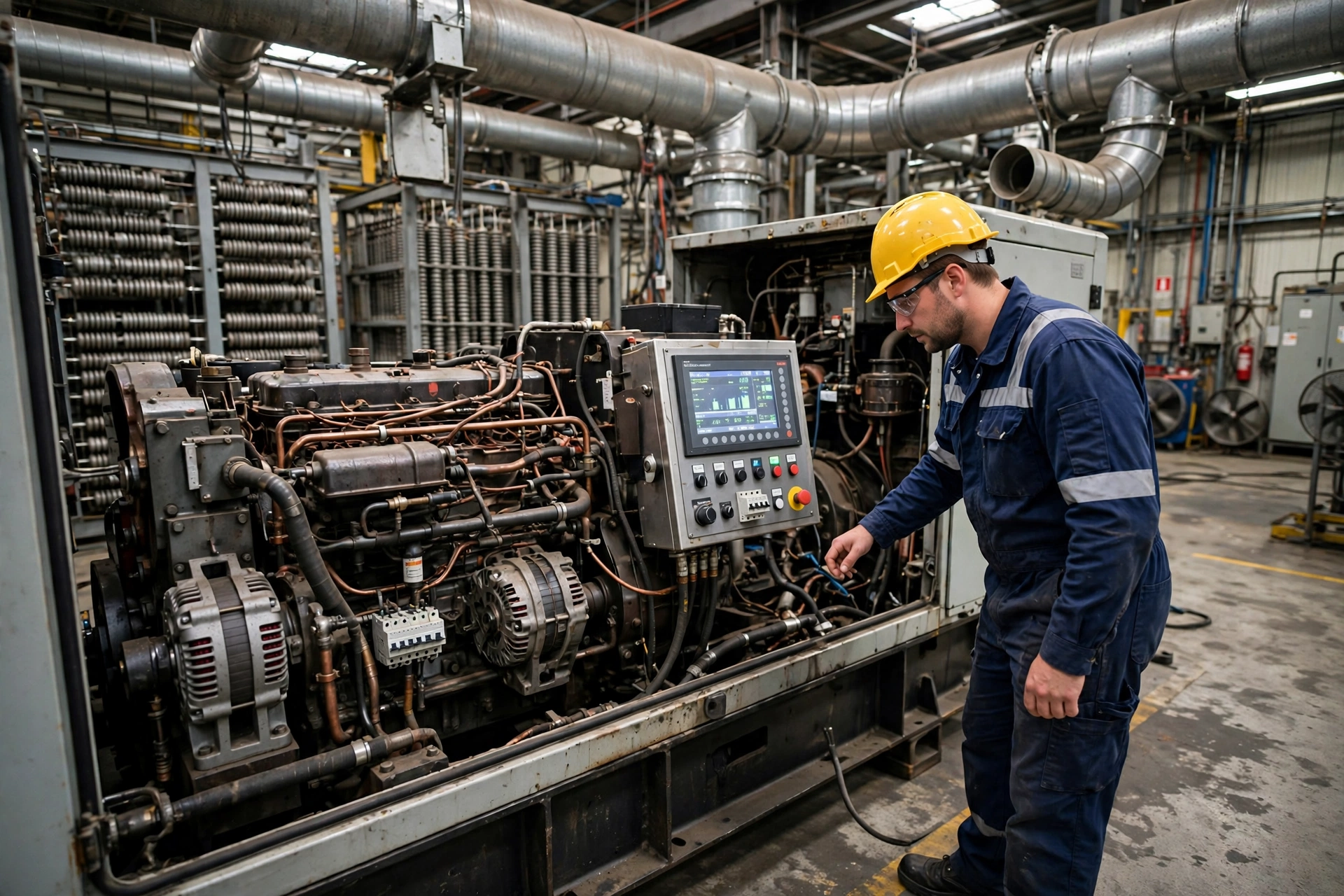
The gap cannot be eliminated with a diesel generator alone. It can be shortened, bridged, or designed around. Each option has a cost, and the wrong option costs more than the gap itself.
The UPS Bridge
A UPS is the only device that covers the gap completely. It carries the load from the instant the grid fails until the generator takes over, and it covers a failed generator start for as long as its batteries last. Sizing is straightforward: the UPS must carry the critical load, and its battery must last longer than the worst-case generator start time plus a margin. A 15-minute battery covers a 10-second transfer with room for two failed start attempts and a second transfer. A 5-minute battery covers the same transfer but leaves no margin for anything going wrong.
The common mistake is putting the whole building on UPS. A UPS sized for the full load costs several times more than one sized for the critical load, and its batteries need replacement every 3–5 years. The correct design puts servers, life safety and control systems on UPS, and lets lighting, lifts and general power wait 10 seconds. That split is a design decision, not a purchasing decision, and it belongs in the electrical drawings before the generator is ordered.
Timer Settings That Actually Help
Three timer settings decide most of the gap, and all three are adjustable on a modern transfer switch controller. The engine start delay, normally 1–3 seconds, can be shortened to 0–1 second on a site where the utility never flickers — but on a site with frequent recloser operations, shortening it multiplies nuisance starts and wear. The transfer delay, the wait for generator stabilisation, can be trimmed to the minimum the set needs, but transferring onto an unstable set trips the load it was meant to protect. The retransfer delay, 5–30 minutes, can be shortened, but transferring back onto a flickering utility causes a second outage minutes after the first.
The practical rule: set the timers from the site’s outage history, not from the factory defaults. A site with a stable grid and a hospital load keeps the start delay short. A site with a flickering rural feeder keeps it long. The settings should be recorded on the switch door, dated, and reviewed after any change to the utility supply.
Batteries, Heaters and the Weekly Test
Most failed starts are not engine failures. They are battery failures, fuel failures and heater failures. A starter battery loses about half its cranking capacity at 0°C compared with 25°C, and a battery that tests well in summer can fail in the first cold week of winter. Load-testing the battery every six months, and replacing it on a fixed schedule rather than on failure, removes the most common cause of a missed start.
The weekly test should run the set under load, not at idle. A 30-minute run at 70–80% load through a load bank exercises the fuel system, the cooling system and the transfer switch, and it produces a start-time measurement every week. A set that took 9 seconds last month and 13 seconds this month is telling the maintenance team something. A set that is never timed tells them nothing until the outage that matters.
Frequently Asked Questions
How long does it take for a generator to start after a power outage?
A correctly set up standby system restores power in about 10 seconds: 1–3 seconds for the transfer switch to confirm the outage, 5–8 seconds for the engine to crank and stabilise, and under a second for the switch to move the load. Larger sets and cold weather can extend that to 12–15 seconds.
What is an automatic transfer switch and how does it work?
An automatic transfer switch is a device that monitors the utility supply and, when voltage or frequency fails, signals the standby generator to start and then transfers the building’s load to it. When utility power returns and proves stable, it transfers the load back and lets the generator cool down before shutting it down.
How long does an automatic transfer switch take to transfer power?
The switching mechanism itself takes 50–200 milliseconds for an open-transition switch, and under 100 milliseconds of parallel operation for a closed-transition switch. The full outage-to-power time is much longer, typically 5–15 seconds, because the total is dominated by the engine start delay and the time the diesel engine needs to reach stable speed and voltage.
Do I need a UPS with a standby generator?
Yes, for any load that cannot tolerate a 10-second interruption — servers, medical equipment, control systems and security systems. The generator covers outages lasting minutes to days; the UPS covers the 10-second gap and any failed generator start. Loads that can wait 10 seconds, such as lighting and general power, do not need UPS protection.
What is the NFPA 110 10 second rule for emergency power?
NFPA 110 Type 10 requires an emergency power system to restore power within 10 seconds of normal source failure. It applies to Level 1 systems, where failure could result in loss of life, and to emergency systems under NEC Article 700. The 10 seconds is measured from the failure of the normal source to the restoration of power to the load.
Specification Checklist: Seven Lines Before the Order
1. What is the required transfer time — 10 seconds, 60 seconds, or no requirement? Name the code article: NEC 700, 701 or 702, or NFPA 110 Type 10. The answer sets the battery, the heater and the timer settings.
2. What is the measured transfer time on the factory test? Ask for the timed sequence from the factory acceptance test, not a brochure figure. A set that measures 14 seconds in the test bay will not measure 10 seconds on site.
3. Which transition type — open, closed or delayed? Open transition suits most buildings. Closed transition suits loads that cannot blink. Delayed transition suits sites with large direct-on-line motors. The choice is made once, at order time.
4. What is the UPS runtime at full critical load? It must exceed the worst-case generator start time with margin for a failed start attempt. Fifteen minutes at full load is a common specification for data centres and hospitals.
5. Is a block heater included, and what temperature does it hold? For any site where ambient temperature falls below 10°C, a jacket water heater holding coolant near 40°C is not optional. Confirm it is on the quotation, not added later.
6. What is the starter battery replacement schedule? Batteries should be load-tested every six months and replaced on a fixed interval, typically three years. A battery replaced on failure has already caused an outage.
7. What does the weekly test measure? The test should run the set under load and record the start time and transfer time. A test that only confirms the engine runs tells the owner nothing about the gap.
The 10-second gap is not a flaw in the generator. It is the time a diesel engine needs to do its job, and the time a transfer switch needs to be certain the outage is real. Buyers who measure the gap, bridge it with a UPS where it matters, and maintain the batteries and heaters that decide whether the set starts, get the full value of their standby system. Buyers who assume the lights stay on will discover the gap at the worst possible moment — during the outage they bought the generator for.
A buyer specifying a standby system should send the supplier the duty, the required transfer time with its code article, the critical load that needs UPS cover, and the site’s lowest ambient temperature. Any manufacturer that knows its business — PAVO included, with a range of 9 to 3750 kVA in open, silent diesel generator sets and containerised configurations, powered by Cummins, Weichai, Yuchai and Shanghai Diesel — will size the set, the switch and the starting aids from those four lines. The set itself must also meet the site’s emissions standard, which is fixed at order time and cannot be changed by timer settings. To discuss a standby system for a specific site, contact PAVO with the transfer time the building needs and the load that cannot wait.