

Diesel Generator Spare Parts: What to Stock on Site | PAVO
A generator set has roughly 2,000 parts. About 30 of them decide whether it starts on the night the grid fails — and almost none of them are on the purchase order.
What spare parts should I keep for a diesel generator? Keep one full service set of filters and belts per set, a spare starting battery, a spare AVR, the two sensors that shut the engine down, and a fuel lift pump. The rest — turbocharger, injectors, controller — is a supply path, not a shelf.
Contents
- The Shutdown That Proves the List
- Three Tiers, Not One List
- The Stocking Table: Quantities by Set Size and Duty
- Batteries, Filters and Belts: The Parts That Stop a Set
- The AVR and the Controller: Small Boxes, Long Lead Times
- Remote Sites, City Sites and What Not to Stock
- Frequently Asked Questions
- Specification Checklist: Seven Lines Before the Order
The Shutdown That Proves the List
Every spares list is written after a failure. The list below is written from two of them, both ordinary, both avoidable, both expensive in exactly the way a missing $40 part is expensive.
Case 1: A hotel in the Caribbean — one fuel filter, 14 hours dark
A 120-room hotel on a Caribbean island runs a 250 kVA standby set. Grid supply is unreliable in the hurricane season, and the set had carried the hotel through three outages in two years without a fault. In September, during a 14-hour grid outage, the set stopped after 40 minutes. The fault was a clogged fuel filter. The hotel kept no spare on site.
The maintenance contractor was 90 minutes away by road, and the road was flooded. A replacement filter arrived the next morning, 14 hours after the outage began. The hotel refunded one night for 86 occupied rooms — roughly $12,000 in room revenue, before the restaurant and conference refunds. The filter that would have fixed the set in 15 minutes costs about $35.
The hotel’s spares shelf held oil, coolant and a spare air filter. It held everything except the one part that stops a diesel engine most often. Fuel filters clog without warning because the contamination is invisible: water in the tank, microbial growth, or a delivery of dirty fuel. The article on how diesel fuel goes bad in the tank explains why the filter, not the fuel, is usually the first casualty.
Case 2: A telecom tower in northern Nigeria — one AVR, 11 days offline
A telecom tower in northern Nigeria runs a 75 kVA set in prime duty, 8–12 hours a day, because grid supply is unreliable. The set ran for 19 months. Then the voltage regulator failed. The engine started, ran at speed, and produced no usable voltage — the classic AVR failure signature.
The nearest genuine AVR was in Lagos, a two-day road journey, and the site had no spare. An aftermarket regulator was fitted on day four. It held voltage for nine days, then drifted, and the tower’s rectifiers began tripping on overvoltage. The genuine part arrived on day 11. The tower was on battery backup and a rented portable set for most of that period. Tower downtime in that market is measured in lost subscriber revenue and regulator fines, not in the cost of the part: the genuine AVR costs about $280.
Both cases share the same structure. The part that failed was cheap. The part that failed was small enough to post. The part that failed was not on the shelf because nobody had decided, in writing, that it belonged there. A spares list is not a shopping list. It is a decision, made in advance, about which failures the site will fix in an hour and which it will wait a week for.
Three Tiers, Not One List
The first mistake in spares planning is treating every part the same. A fuel filter and a turbocharger are not two items on one list. They belong in different tiers, with different rules, because they fail differently, cost differently and take different times to replace.
Tier 1 — Service consumables: the parts every service uses
Tier 1 is the parts a scheduled service consumes: oil filter, fuel filter, fuel-water separator element, air filter, engine oil, coolant, and the gaskets and O-rings for the filter housings. These are needed at every service, and a shortage delays routine work rather than causing a breakdown. The rule for Tier 1 is simple: hold one full service set per generator, plus one extra fuel filter.
The extra fuel filter is the only exception to the quantities in the table below. Fuel filters clog between services, and they clog at the worst moment — under load, during an outage, when the tank has been disturbed. A set that has one fuel filter on the shelf has one chance. A set that has two has a service and an emergency.
Tier 2 — Critical single-point parts: the parts that stop the set
Tier 2 is the parts whose failure stops the engine or the output, that fail without warning, and that a technician can replace on site in under two hours. This is the tier that decides whether an outage lasts 40 minutes or 14 hours: starting batteries, battery charger, starter motor or solenoid, fan and alternator belts, radiator hoses, thermostat, fuel lift pump, fuel stop solenoid, magnetic speed pickup, AVR, rotating diode set, and the two sensors that shut the engine down — oil pressure and coolant temperature.
Every part in Tier 2 shares three properties. It is small enough to store. It is cheap relative to the downtime it prevents. And its lead time from a supplier is longer than the outage it would cause. A starter motor costs $400–$900 for a mid-size set and takes 3–7 days to arrive from a regional distributor. A battery charger costs $150–$400 and takes the same. Neither is worth a week of downtime.
Tier 3 — Insurance spares: the parts with long lead times
Tier 3 is the parts that rarely fail, cost a great deal, and take weeks to arrive: turbocharger, coolant pump assembly, a complete set of injectors, and the controller or display module. These are held only where the consequence of waiting justifies the capital — critical sites, remote sites, and fleets of identical sets where one spare covers several machines.
A turbocharger for a 500 kVA set costs $1,800–$3,500 and takes 4–8 weeks from the engine manufacturer. Holding one for a single standby set in a city with a distributor 40 minutes away is poor capital allocation. Holding one for three identical prime sets on a mine site 600 km from the nearest town is not. The tier system exists to make that distinction explicit, in advance, rather than in the middle of an outage.
What each of these parts does, and how it fails, is covered in the guide to diesel generator parts and components. This article does not repeat that explanation. It answers the question that follows it: which of those parts should be on the shelf, in what quantity, and at what cost.
The Stocking Table: Quantities by Set Size and Duty
Quantities depend on three variables: set size, duty, and distance from supply. A 30 kVA standby set in a city needs less than a 500 kVA prime set on a mine site, and the difference is not proportional — it is structural. The table below gives the minimum holding for a single set, in three scenarios. Figures are indicative, built from manufacturer service schedules and the lead times in this article.
| Part | 100 kVA standby, city | 500 kVA standby, city | 500 kVA prime, remote site |
|---|---|---|---|
| Oil filter | 2 | 2 | 4 |
| Fuel filter + water separator | 3 | 3 | 6 |
| Air filter element | 1 | 2 | 4 |
| Engine oil (litres) | 20 | 40 | 80 |
| Coolant (litres) | 10 | 20 | 40 |
| Fan / alternator belt set | 1 | 1 | 2 |
| Radiator hose set | 0 | 1 | 1 |
| Thermostat | 0 | 1 | 1 |
| Starting battery (per set) | 1 | 1 | 2 |
| Battery charger | 0 | 1 | 1 |
| Starter motor | 0 | 0 | 1 |
| Fuel lift pump | 0 | 1 | 1 |
| Fuel stop solenoid | 0 | 1 | 1 |
| Magnetic speed pickup | 0 | 1 | 1 |
| AVR | 0 | 1 | 1 |
| Oil pressure sensor | 1 | 1 | 2 |
| Coolant temperature sensor | 1 | 1 | 2 |
| Fuse and relay kit | 1 | 1 | 1 |
| Injector set | 0 | 0 | 1 |
| Turbocharger | 0 | 0 | 0–1 |
| Controller module | 0 | 0 | 0–1 |
Three points in the table deserve attention. First, the 100 kVA city set holds no AVR, no starter motor and no fuel lift pump. That is deliberate: in a city with a distributor, those parts arrive in 24–48 hours, and the set is standby duty, so a 48-hour wait is inconvenient rather than catastrophic. The same parts on the remote prime set are mandatory, because the wait there is measured in weeks and the set runs every day.
Second, the quantities scale with the service interval, not with the set size. A prime set at 3,000 hours a year consumes four oil services a year at the standard 250-hour interval — or 500-hour interval on some engines — while a standby set at 100 hours a year consumes one. The prime set therefore holds four oil filters not because it is bigger, but because it services four times as often. A standby set that holds four oil filters is holding three years of stock that will expire before it is used.
Third, the turbocharger and controller module show 0–1 on the remote column because they are a judgement call, not a rule. The deciding factors are fleet commonality and criticality. One turbocharger shared across three identical sets on one site is a sound holding. One turbocharger for one set is usually not — unless the site is a hospital or a data centre, where the cost of a week without power exceeds the cost of the part by two orders of magnitude.
The table is a minimum. A fleet of identical sets changes the arithmetic: the second set does not need a second AVR on the shelf, because one spare AVR covers both. The third set does not need a third starter motor. Fleet commonality is the cheapest way to improve spares coverage, and it is one of the strongest arguments for buying identical sets rather than mixing brands across a site. A site with one Cummins, one Perkins and one Weichai needs three of everything. A site with three identical sets needs one of everything, plus consumables.
Batteries, Filters and Belts: The Parts That Stop a Set
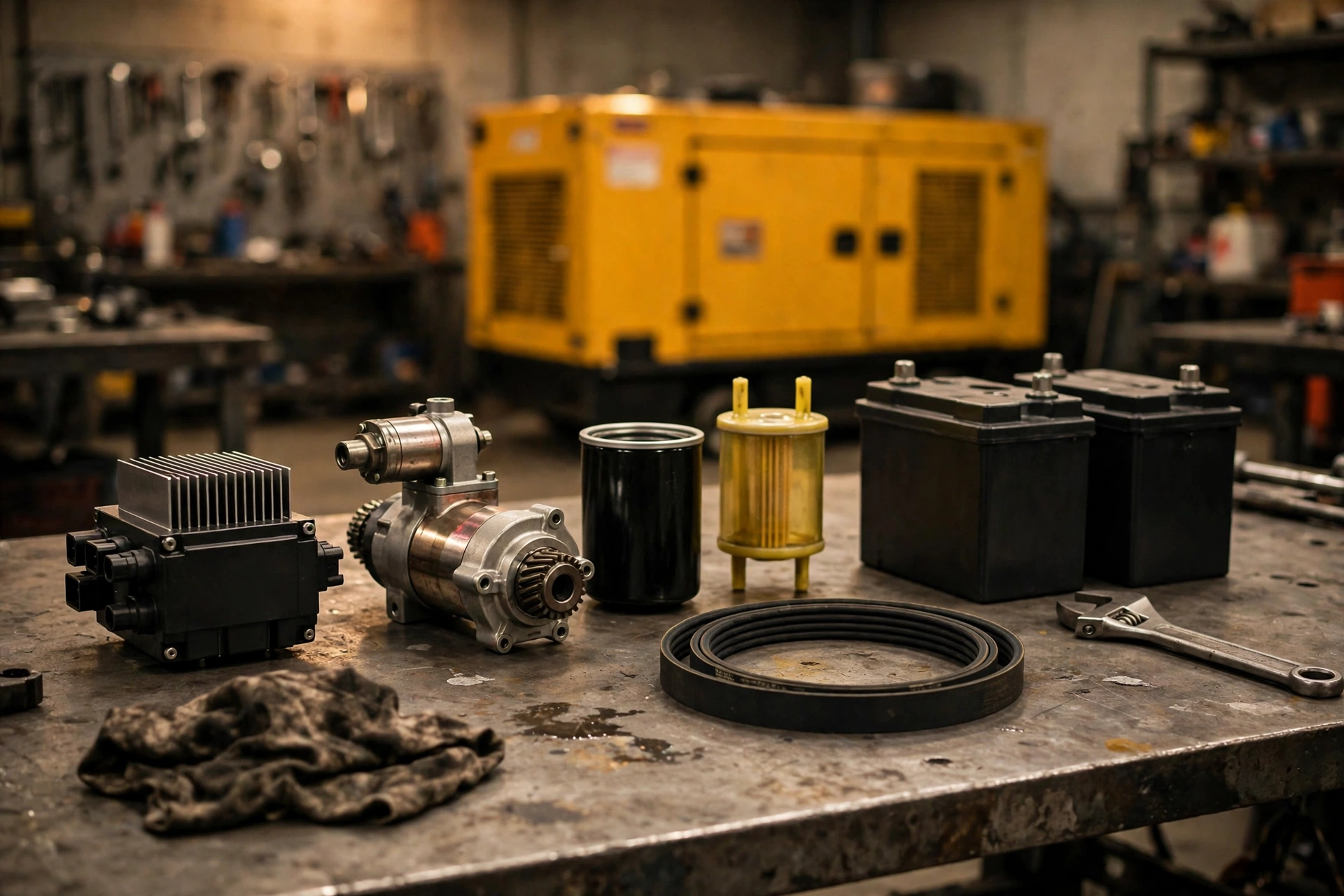
Most generator downtime comes from a short list of parts, and the list is short enough to memorise: batteries, chargers, filters, belts, sensors, solenoids, AVRs and controllers. Of those, the battery is first by a wide margin.
Batteries: replace on age, not on failure
About half of emergency generator set failures are battery problems, according to EGSA and other industry bodies cited in the Clifford Power battery maintenance guide. The battery is the first link in the starting chain, and it must perform after months of sitting idle — the hardest duty a battery has.
A flooded lead-acid starting battery lasts 3–5 years in generator service. An AGM battery lasts 5–7 years. A pure-lead AGM lasts 8–10 years. A lithium battery lasts 10–15 years but needs a battery management system and costs several times more. In hot climates — sustained ambient temperatures above 35°C — the flooded lead-acid figure falls to 2–3 years. Heat, not cold, is what kills generator batteries in the markets where PAVO sets work hardest.
The practical rule, from Generator Source and the battery manufacturers, is to replace flooded lead-acid batteries every 24–36 months, regardless of their apparent condition. A battery that passes a load test at 30 months can still fail at 36 months, and the failure will occur during an outage, not during a test. The cost of replacing a battery a year early is about $150–$400. The cost of replacing it a week late is an outage.
Two operational details matter. First, a healthy, fully charged 12 V battery reads 12.6 V or higher. A battery that drops below 9.6 V during a load test is finished and should be replaced, not recharged. Second, in a 24 V system with two 12 V batteries, replace both at the same time. Mixing a new battery with a three-year-old battery leaves the system as weak as the older unit, and the new battery ages faster carrying the load.
The stocking rule follows from the replacement rule. Hold one spare battery per set on a standby site, two on a remote prime site. A spare battery held on a shelf is itself ageing — it self-discharges at roughly 3–5% per month for flooded lead-acid — so it needs a trickle charge every month, or it will be flat when it is needed. A battery charger on the shelf, at $150–$400, is what keeps the spare battery useful. A spare battery without a charger is a paperweight with terminals.
Filters, belts and hoses: cheap parts, expensive delays
Filters are the most frequently replaced parts on any generator, and the cheapest. An oil filter costs $8–$25. A fuel filter costs $15–$40. An air filter element costs $30–$120 depending on size. The service interval is the same across most engines: oil and oil filter every 250 hours or 3 months, whichever comes first, with the fuel filter changed at the same service and the air filter inspected at every service and replaced when restriction is measured, not on a calendar.
The fuel filter interval is the one to watch. The question “how often should I change the fuel filter on a diesel generator” has two answers, and both are correct. The scheduled answer is every 250 hours or at every oil service. The real answer is whenever the fuel is suspect — after a delivery from a new supplier, after the tank has been opened, after the set has sat for six months, or when the engine stumbles under load. A fuel filter changed a service early costs $25. A fuel filter changed a day late costs an outage.
Belts and hoses age by calendar, not by hours. A fan belt in a hot engine room lasts 2–3 years before cracking, whether the set runs 100 hours or 3,000. Radiator hoses last 3–5 years. Both are rubber, both degrade in heat and ozone, and both fail suddenly — a belt snaps, a hose splits, the engine overheats and shuts down in minutes. Hold one belt set per generator and one hose set per generator, and replace them on age, not on appearance. A belt that looks fine at three years is a belt that has already exceeded its design life.
Shelf life applies to the spares themselves. Rubber parts stored in a hot, sunlit store degrade almost as fast as rubber parts on the engine. Store belts and hoses flat, in the dark, below 25°C, and rotate them: the oldest belt on the shelf goes on the engine first. Engine oil kept sealed lasts 2–3 years. Coolant concentrate lasts about 2 years. A filter has no expiry date, but a filter stored in a damp store will rust from the inside. The spares shelf needs the same discipline as the generator room.
The AVR and the Controller: Small Boxes, Long Lead Times
The AVR is the part that most often surprises a buyer — not because it fails often, but because the price range is so wide that the wrong choice is easy to make.
The AVR: genuine, aftermarket, and the $270 question
The automatic voltage regulator holds the generator’s output voltage within ±2–3% of nominal, correcting in under 100 milliseconds when load changes. When it fails, the engine runs normally and the voltage is wrong — too high, too low, or absent. Sensitive loads trip, or worse, they do not trip and are damaged.
A genuine Stamford SX460 AVR costs $255–$295. An aftermarket SX460 costs $8–$30. A genuine Stamford AS440 costs about $350. The price gap is not a bargain; it is a different product. The aftermarket unit is a copy of the circuit, built to a price, with no factory test certificate and no warranty behind it. The telecom tower case in the first section shows what that means in practice: nine days of service, then voltage drift, then tripped rectifiers.
The stocking question — should I keep a spare AVR for my diesel generator — depends on the alternator and the site. For a Stamford alternator on a critical or remote site, the answer is yes: one spare AVR, genuine, in a sealed bag, with the part number written on the outside. The cost is $255–$350, the size is a paperback book, and the replacement takes 30 minutes with a screwdriver. For a city standby set with a distributor nearby, the answer is no: the part arrives in 24–48 hours and the set is not running daily.
One caution applies to the spare itself. An AVR is an electronic board. It does not age like a belt, but it is vulnerable to moisture and static. Store it sealed, in its original packaging, in a dry cabinet — not loose in a drawer with the spanners. And record the alternator model and the AVR part number in the same document as the engine serial number. An AVR ordered from memory, for the wrong alternator, is a second outage.
The controller and the sensors
The controller is the most expensive electronic part on the set, and the least likely to be stocked. A Deep Sea or ComAp controller module costs $800–$2,500 depending on the model, and takes 4–12 weeks to arrive if it is not a current model. Older controllers are worse: some are discontinued, and the only source is a used unit or a reconditioned board. The decision to hold a spare controller is therefore a decision about the age of the set and the criticality of the site. For a new set on a critical site, the controller is a supply-path item, not a shelf item — but the supply path must be confirmed in writing, with the supplier, before the outage, not during it.
The sensors are the opposite: cheap, small, and worth holding two of each. An oil pressure sensor costs $20–$60. A coolant temperature sensor costs $20–$60. Either one can shut the engine down, because the controller treats a failed sensor as a fault condition. A sensor that reads wrong is indistinguishable, to the controller, from an engine that is actually failing. Hold two of each, because a sensor failure during an outage is a five-minute fix with a spare and a day’s wait without one. The full picture of how these parts are monitored from a distance is covered in the guide to remote monitoring, and the sensors are the reason that guide matters: a remote alarm is only useful if the part it points to is on the shelf.
The magnetic speed pickup deserves the same treatment. It costs $30–$80, it is the size of a spark plug, and when it fails the engine either will not start or will hunt wildly on speed. It is one of the least-known parts on a generator and one of the most common causes of a no-start that is not the battery. Hold one. The same applies to the fuel stop solenoid — $50–$150, a 20-minute replacement, and a complete stop if it fails closed.
Remote Sites, City Sites and What Not to Stock
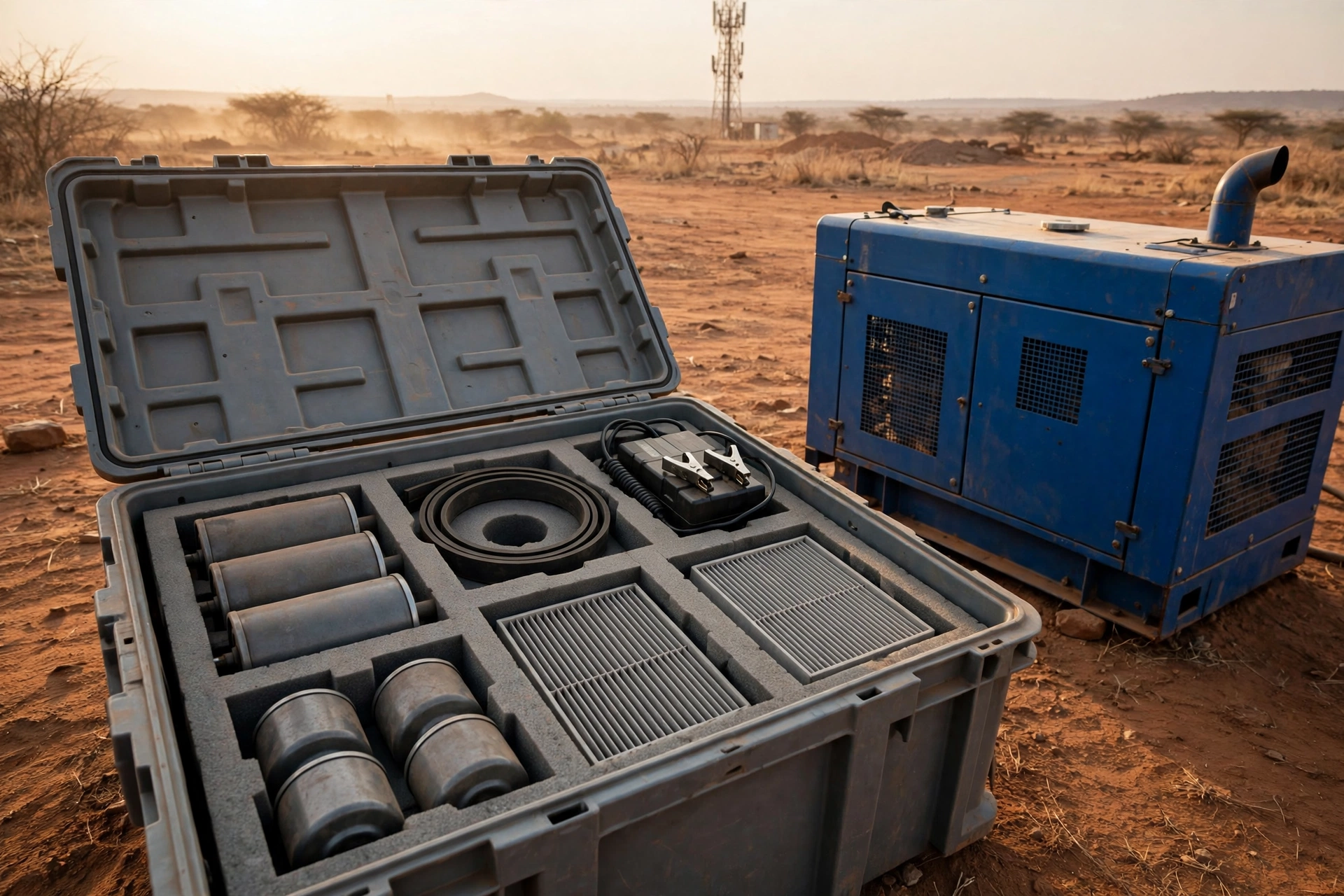
The same generator needs a different spares list in different places. Distance from supply is the variable that changes everything, because it changes the cost of waiting.
A city site: the distributor is the shelf
A standby set in Lagos, Nairobi or Manila, within an hour of a distributor, needs a short list: one full service set of filters, one extra fuel filter, one spare battery, one belt set, and the two sensors. Total cost: roughly $600–$900 for a 100–500 kVA set. The distributor holds the AVR, the starter motor, the lift pump and the controller. The site’s job is to hold the parts that fail between services, and to hold the part numbers for everything else.
The part numbers matter more than the parts. Every order for a generator part needs three things: the engine model and serial number, the alternator model, and the rating class under ISO 8528. Without those, the supplier guesses, and a guessed part is a second delivery. Keep a one-page spares record on the wall of the generator room and a copy with the facilities manager: engine model and serial, alternator model and serial, controller model, AVR part number, filter part numbers, belt part number, battery specification. That page is worth more than half the shelf.
A remote site: the shelf is the distributor
A prime set on a mine, a telecom tower or a construction camp 600 km from the nearest town needs the full table in the previous section, plus the parts the city site leaves to the distributor: a spare AVR, a starter motor, a fuel lift pump, a fuel stop solenoid, a magnetic speed pickup, a battery charger, and a complete injector set. Total cost for a 500 kVA prime set: roughly $3,500–$5,500.
The remote list also needs a different discipline: the kit. Loose parts on a remote site get lost, borrowed, or fitted to the wrong machine. Pack the spares as a kit — one sealed crate per set, with a printed contents list inside the lid, checked every six months. The crate in the photograph in this article is that kit: filters, belts, a battery charger and the small electrical parts, packed in foam, ready to be carried to the set. A kit that is checked is a kit that works. A kit that is not checked is a box of parts that may or may not be there.
The remote site also needs a fuel discipline that a city site can skip. Fuel delivered to a remote site in drums is the most common source of filter-clogging contamination, and the fuel filter is the part that pays for it. A water separator element and a spare fuel filter are the cheapest insurance on a remote site, and they are the parts most often missing when the set stops.
What not to stock: the three traps
The first trap is the turbocharger for a single standby set in a city. It costs $1,800–$3,500, it takes 4–8 weeks to arrive, and it fails rarely on a standby set that runs 100 hours a year. The capital earns nothing sitting on the shelf, and the part itself ages: seals dry, bearings settle, and a turbocharger stored for five years is not the same as a new one. Buy the supply path — a confirmed supplier, a part number, a quoted lead time — and spend the money on the parts that fail.
The second trap is the overhaul kit. Pistons, liners, rings, bearings and gaskets for a full engine rebuild cost $3,000–$8,000 for a mid-size set, and they are useless without a workshop, a crane, and a technician qualified to rebuild the engine. An overhaul is a planned event, ordered when the hours dictate it, not a shelf item. Holding an overhaul kit is holding a bet that the engine will need rebuilding before the parts expire, and it is a bet the buyer almost always loses.
The third trap is the wrong brand. A site with three different engine brands needs three sets of filters, three belt part numbers, three AVR types and three sensor types — and the spares budget triples while the coverage stays the same. The cheapest spares decision a buyer makes is at the purchase stage: buy identical sets. The second cheapest is to standardise the engine across a fleet, even when the kVA differs. A 100 kVA set and a 500 kVA set on the same Cummins 6BT family share filters, sensors and service practice. A 100 kVA Cummins and a 100 kVA Weichai share nothing.
Frequently Asked Questions
What spare parts should I keep for a diesel generator?
Keep one full service set of filters and belts per set, an extra fuel filter, a spare starting battery, a battery charger, and the two sensors that shut the engine down — oil pressure and coolant temperature. On a critical or remote site, add a spare AVR, a starter motor, a fuel lift pump, a fuel stop solenoid and a magnetic speed pickup. The turbocharger, injectors and controller are a confirmed supply path, not a shelf item, unless the site is remote or the set is critical.
How often should I change the fuel filter on a diesel generator?
Change the fuel filter at every oil service — every 250 hours or 3 months, whichever comes first — and immediately whenever the fuel is suspect: after a delivery from a new supplier, after the tank has been opened, after the set has sat for six months, or when the engine stumbles under load. Always change the fuel-water separator element at the same time, and always keep one spare fuel filter on the shelf, because a clogged filter stops the engine without warning.
How long do diesel generator starting batteries last?
A flooded lead-acid starting battery lasts 3–5 years in generator service, an AGM battery 5–7 years, and a pure-lead AGM 8–10 years. In hot climates above 35°C, the flooded lead-acid figure falls to 2–3 years. Replace flooded batteries every 24–36 months regardless of apparent condition, load-test every six months, and replace any battery that drops below 9.6 V under load. In a 24 V system, replace both 12 V batteries at the same time.
Should I keep a spare AVR for my diesel generator?
Yes, if the set is on a critical or remote site: one genuine AVR, matched to the alternator model, sealed in its original packaging. A genuine Stamford SX460 costs $255–$295 and takes 30 minutes to fit. No, if the set is a city standby set with a distributor within 24–48 hours — the part arrives faster than the outage justifies stocking it. Do not stock an aftermarket AVR as a spare: the $8–$30 copy is a different product, and it is the part that fails next.
How much does it cost to stock spare parts for a diesel generator?
A city standby set of 100–500 kVA needs roughly $600–$900 of spares: filters, one spare battery, a belt set and the two sensors. A remote 500 kVA prime set needs roughly $3,500–$5,500, adding an AVR, starter motor, fuel lift pump, solenoids, a battery charger and an injector set. Against a single outage, the comparison is stark: the hotel case in this article lost $12,000 in one night for want of a $35 filter, and the telecom tower lost 11 days for want of a $280 AVR.
Specification Checklist: Seven Lines Before the Order
1. What is on the shelf today, in writing? List every spare part held on site, with quantities and part numbers. If the list does not exist, the spares do not exist — they are a pile of parts, not a plan.
2. What is the engine model, serial number and alternator model? Record them on one page in the generator room and with the facilities manager. Every order depends on them, and the outage is the wrong time to look for them.
3. What is the duty — standby or prime — and how many hours a year? Duty decides quantities. A prime set at 3,000 hours a year services four times as often as a standby set at 100 hours, and the spares holding must reflect that. The rating letters are explained in the article on standby and prime ratings.
4. How far is the nearest supplier, in hours, not kilometres? A distributor 40 minutes away is a shelf. A distributor two days away is a reason to hold an AVR and a starter motor. A site with no road access in the rainy season is a reason to hold both, plus an injector set.
5. What is the battery replacement date, not just the battery age? Write the replacement date on the battery and in the maintenance log. A battery replaced on a fixed 24–36 month interval never causes an outage. A battery replaced on failure has already caused one.
6. Is the set tested under load, and does the spares list cover what the test finds? A monthly no-load run does not find a clogged fuel filter or a weak AVR. Load bank testing finds both, and the spares list should hold the parts the test most often condemns: filters, belts and the AVR.
7. Who is authorised to fit the spares, and what happens at 2 a.m.? A shelf of parts is useless without a technician who can fit them and a key to the store. Name the person, keep the key where they can reach it, and make sure the automatic transfer switch and the UPS switching to battery are both understood by the same person — because the spares, the transfer switch and the UPS are one system on the night the grid fails.
A spares list is not an expense. It is the cheapest insurance a generator owner buys: $600–$900 for a city standby set, $3,500–$5,500 for a remote prime set, against a single outage that costs ten times as much for want of a filter. The parts are small, the shelf is small, and the decision is made once — in advance, in writing, before the outage. For a spares list priced against a specific set, with part numbers matched to the engine and alternator, contact PAVO with the set model, the duty and the site location, and the engineering team will return the list with quantities and prices.