

Standby vs Prime Power Generator: Ratings That Decide Life | PAVO
Standby, prime and continuous are not three sizes of the same generator. Pick the wrong rating and your set will fail on its first real outage.
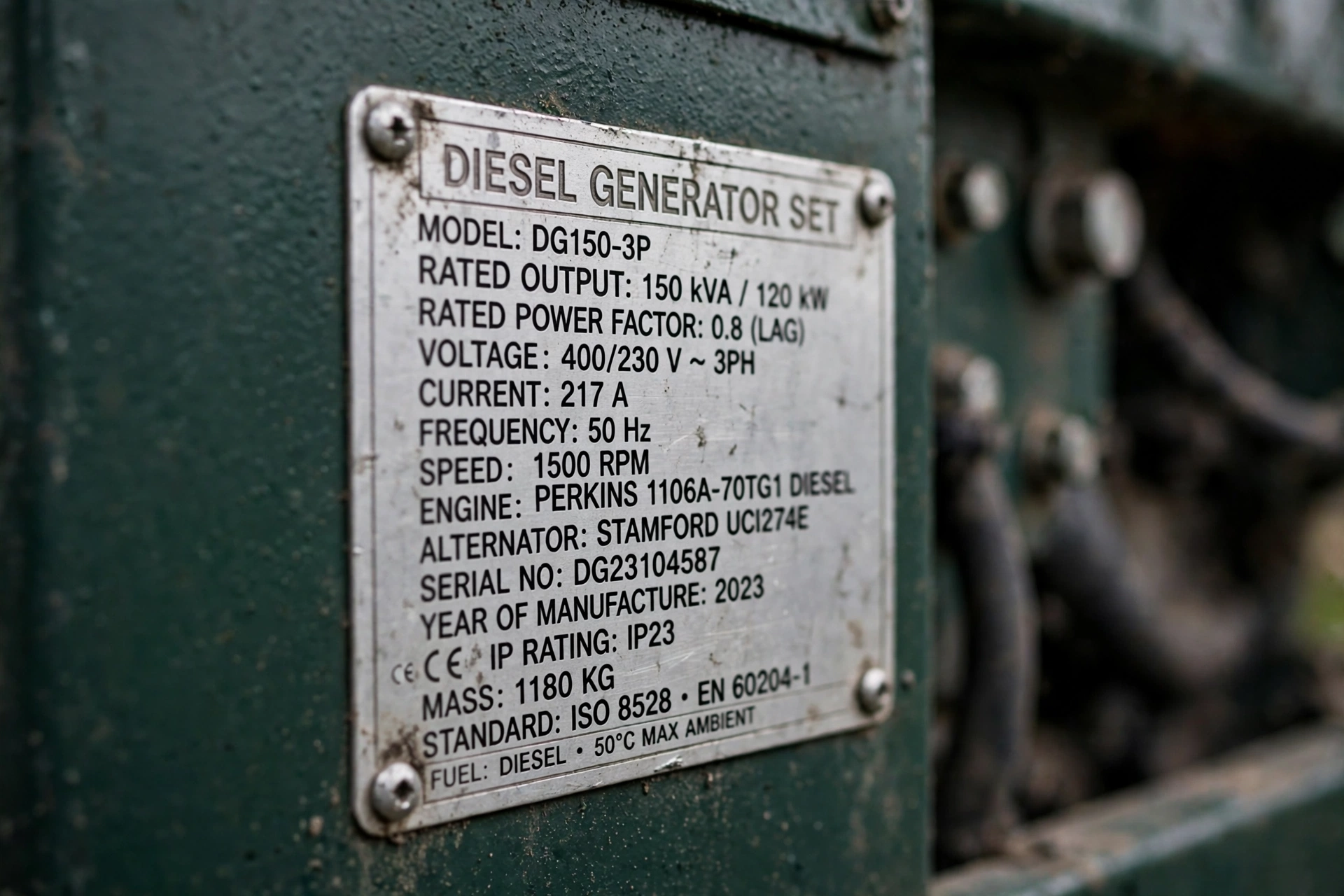
What is the difference between standby and prime power generator ratings? Standby power (ESP) is for up to 200 hours a year when the grid fails. Prime power (PRP) is for unlimited hours at variable load. Continuous power (COP) is for constant load at 100%. The same engine is rated about 10% lower in prime than in standby — a 500 kVA standby set is a 455 kVA prime set.
- ISO 8528-1: Four Ratings, Four Promises
- Why the Same Engine Has Different kVA Figures
- How Long Can a Standby Generator Run?
- Ratings in Practice: Four Cases
- Can I Use a Standby Generator as Prime Power?
- Derating
- Specification Checklist
- Frequently Asked Questions
Standby, prime and continuous power are the three ratings most often confused in diesel generator procurement. The confusion is expensive. A standby-rated set sold into prime duty will run, for a time, and then fail early. A prime-rated set sold into standby duty wastes capital on capability the site will never use. The rating is not a marketing label. It is a statement, under ISO 8528-1, of how many hours the set is designed to run, at what load, and with what overload allowance.
This article explains each rating in engineering terms, shows how the same engine carries different kVA figures, and applies the ratings to four common applications: quarrying, hospitals, data centres and telecom towers.
ISO 8528-1: Four Ratings, Four Promises
ISO 8528-1 defines four ratings. They differ in annual hours, load factor and overload allowance — not in build quality.
| Rating | Code | Annual hours | Load | Overload allowance |
|---|---|---|---|---|
| Emergency standby power | ESP | Up to 200 hours | Variable, average 70% | None |
| Prime power | PRP | Unlimited | Variable, average 70% | 10% for 1 hour in 12, about 25 hours/year |
| Continuous operating power | COP | Unlimited | Constant, 100% load factor | None |
| Limited-time running power | LTP | Up to 500 hours | Constant, up to 100% | None |
Emergency standby power (ESP) is the rating for a set that waits for the grid to fail. Two hundred hours a year covers monthly testing and occasional outages. A 30-minute monthly test consumes 6 hours of that allowance before any real outage occurs.
Prime power (PRP) is the rating for a set that works every day. Hours are unlimited, load varies, and the average load factor is about 70%. The 10% overload allowance — one hour in twelve — exists for motor starting and transient peaks, not for sustained operation above rating.
Continuous operating power (COP) is the rating for constant, steady load at 100% load factor, 24 hours a day. It carries the lowest kVA figure for the same engine, because there is no recovery period at light load.
Limited-time running power (LTP) covers up to 500 hours a year at constant load up to 100%. It suits peak shaving, seasonal outages and temporary sites. Beyond 500 hours, LTP no longer applies.
A set that fails in service is often not underrated in kVA. It is rated for the wrong duty.
Why the Same Engine Has Different kVA Figures
The clearest illustration is a single datasheet. The Cummins C500D5, powered by the QSZ13-G5 engine, is rated 500 kVA / 400 kW standby and 455 kVA / 364 kW prime. The engine, alternator and enclosure are identical. The difference — about 9% — is the margin the manufacturer reserves for continuous duty. Remember: 500 kVA is not 500 kW at 0.8 power factor.
That 9% matters in procurement. A quotation for a “500 kVA prime” set built on a C500D5 frame is either quoting the next frame up, or quoting standby power and labelling it prime. The datasheet, not the headline figure, is the authority. Any quotation that states only “500 kVA” without ESP, PRP, COP or LTP should be returned for clarification before a deposit is paid.
The same principle applies across the range. A prime rating is typically 10–15% lower in kVA than the standby rating of the same frame, and the prime price per kVA is correspondingly higher. That premium buys design life at high annual hours, not extra peak output. For a buyer asking 500 kVA generator standby vs prime which one do I need, the answer depends on annual hours: daily duty needs the 455 kVA prime rating, occasional outage duty can use the 500 kVA standby rating.
How Long Can a Standby Generator Run?
The question has two answers: the standard limit, and the fuel limit.
The Standard Limit
The standard limit for ESP is 200 hours a year. A site that loses grid power for 300 hours a year exceeds it by 100 hours, whether or not the control panel reports a fault. Wear accumulates without an alarm: oil consumption rises, cylinder glazing develops, and carbon build-up increases. Failure typically appears not at hour 201, but at 2,000 hours, when the set should have had 20,000 hours of service life remaining.
The Fuel Limit
The fuel limit is more immediate. The C500D5 carries a 645-litre tank. Fuel consumption at prime rating is 29.2 L/h at 25% load, 49.0 L/h at 50%, 69.9 L/h at 75% and 93.2 L/h at 100%. That gives 22.1, 13.2, 9.2 and 6.9 hours of runtime respectively. At standby rating, consumption rises to 34.8, 55.6, 78.5 and 107.1 L/h — six hours at full load on a full tank.
A standby set is therefore not more powerful for free. It is the same engine pushed harder, for fewer hours, at higher fuel consumption. For any outage longer than 72 hours, a bulk tank and a contracted fuel delivery plan are essential. In practice, more prime-duty sites fail on fuel logistics than on engine faults.
Ratings in Practice: Four Cases
Case 1: Quarry — A Prime Duty Mis-Sold as Standby
A quarry in Ghana specified a 500 kVA set for a crusher line. Running load: crusher motor 200 kW, conveyor 45 kW, lighting and controls 15 kW — 260 kW total, or 325 kVA at 0.8 power factor. The crusher starts direct-on-line, drawing about five times its running current for a few seconds. With a 20–25% allowance for starting transients and voltage dip, prime demand was 400–450 kVA.
Operating hours were ten per day, six days a week — over 3,000 hours a year. That is a prime duty by any definition.
The set supplied was standby-rated, selected because the standby figure was larger and the price lower. It operated for four months without incident. By month five, oil consumption had risen to one litre every six hours, then every four. By month seven, exhaust smoke under load had increased. At month eight, inspection found cylinder glazing, bore wear and carbon build-up — the standard pattern of a set run beyond its rating for extended hours.
The rebuild cost exceeded the saving on the purchase price. The warranty claim was refused on grounds of misapplication. The lesson is not that standby sets are unreliable. It is that a standby set cannot be expected to deliver prime service life.
Case 2: Hospital — A Standby Duty Correctly Specified
A hospital outside Lagos runs a 350 kW load, 438 kVA at 0.8 power factor. Grid outages total about 40 hours a year. The set is standby-rated.
In one rainy-season outage the set ran continuously for eleven hours, took full load without tripping, and completed the year at 164 hours including tests. No fault, no intervention, no early overhaul. That is what a correct rating looks like: unremarkable, reliable service.
A prime-rated set on the same site would have cost more for capability the hospital will never use. The same arithmetic that condemned the quarry installation validates the hospital installation. Duty decides the rating, not kVA alone.
Case 3: Data Centre — Where Ten Seconds Costs $90,000
A colocation data centre compared two quotations, both headed “500 kVA”. One was $11,000 cheaper. The datasheets showed the difference: one set was prime-rated, the other standby-rated. Same headline figure, different duty.
Data centres buy time, not just power. Uptime Institute’s 2025 outage analysis reports a median significant outage of 53 minutes, with 57% of operators reporting that their most recent major outage cost more than $100,000. ITIC’s 2025 survey puts median downtime at $9,000 per minute, about $540,000 per hour, for large enterprises. Power accounts for 45% of impactful outages.
Against those figures, an $11,000 saving on the wrong rating is not a saving. A data centre set is almost always standby-rated — for example, a 1125 kVA silent set — and is judged on two criteria: black start under 10 seconds, and the ability to accept full load without tripping. Transfer, start and step-load response matter as much as engine output. That is why data centres specify N+1 redundancy, test under load bank, and treat a failed monthly test as an incident.
Case 4: Telecom Tower — A Prime Duty at Remote Sites
A telecom tower in northern Nigeria illustrates the opposite shape with the same stakes. A 75 kVA Cummins silent set may run 8–12 hours a day, 300 days a year, because grid supply is unreliable. That is a prime duty.
The specification that matters there is not peak kVA but serviceability: a large fuel tank, a fuel-theft prevention plan, service intervals measured in hundreds of hours, and a controller that can be monitored remotely. A standby-rated set on that site will follow the quarry pattern — acceptable for months, then early wear, then a rebuild far from a workshop.
Can I Use a Standby Generator as Prime Power?
For a short, defined emergency, yes. For sustained daily operation, no.
The 200-hour annual limit for ESP is not advisory. Extended operation beyond it accelerates wear even when no fault is displayed. The correct question is not whether the set will run — it will — but whether the manufacturer will stand behind it at that duty, and for how many hours.
What Prime Power Means
What does prime power mean on a diesel generator? In practical terms, it means the manufacturer warrants the set for unlimited annual hours at variable load, with a 10% overload allowance for one hour in twelve. The service schedule is built for thousands of hours a year, not dozens. Per kVA, prime costs roughly 10–15% more than standby. Over five years on a prime site, it is almost always cheaper, because it avoids an early overhaul and a refused warranty claim.
Where load is constant rather than variable — a steady industrial process at 100% load, 24 hours a day — the correct rating is COP, not PRP. COP carries the lowest figure on the datasheet, and it is the only honest figure for that duty.
Derating: The Site Reduces Output Whether the Budget Allows for It or Not
Ratings are stated at 25°C and sea level. Few sites meet those conditions.
Above 1,000 m altitude, output falls by about 1% per 100 m climbed. Above 40°C, the alternator loses about 3% per 10°C. The combined effect is material:
| Site conditions | Approximate available output |
|---|---|
| Sea level, 25°C | 100% |
| Sea level, 40°C | 96% |
| Sea level, 50°C | 92% |
| 1,000 m, 25°C | 90% |
| 1,000 m, 40°C | 86% |
| 1,000 m, 50°C | 82% |
Johannesburg sits at 1,500–1,700 m. A set rated 100 kVA there has already lost roughly 6% before it starts. A mine at 4,000 m in the Andes loses far more. Lagos, at sea level, is not affected by altitude, but sustained 40°C ambient temperature reduces a nominal 100 kVA set to the high 80s.
Every export quotation should therefore be re-rated for the site — altitude, maximum ambient temperature, duty and annual hours — before the order is placed. If that means the next frame up, the buyer should know before the container leaves Shanghai or Wuhu, not after it arrives. The emissions standard on the same datasheet requires the same attention: a missing Stage V certificate has turned trucks away at inspection, and no rating argument will reopen that gate.
Frequently Asked Questions
What is the difference between standby and prime power generator ratings?
Standby power (ESP) is rated for up to 200 hours a year at variable load when the grid fails. Prime power (PRP) is rated for unlimited hours a year at variable load, with a 10% overload allowance for one hour in twelve. Continuous power (COP) is rated for unlimited hours at constant 100% load.
How long can a standby generator run?
A standby-rated set is designed for up to 200 hours a year, including monthly tests. A 30-minute monthly test uses 6 hours of that allowance. Running beyond 200 hours a year accelerates wear, even if no fault is displayed.
Can I Use a Standby Generator as Prime Power?
For a short, defined emergency, yes. For sustained daily operation, no. A standby set run as prime power will wear early, and the warranty claim is likely to be refused for misapplication.
What does prime power mean on a diesel generator?
Prime power means the manufacturer warrants the set for unlimited annual hours at variable load, with a 10% overload allowance for one hour in twelve. The service schedule is built for thousands of hours a year.
500 kVA generator standby vs prime which one do I need?
If the set will run daily for more than a few hundred hours a year, choose the prime rating — 455 kVA prime on a C500D5 frame. If it will run only during occasional outages, up to 200 hours a year, the 500 kVA standby rating is the correct choice.
Specification Checklist: Five Questions Before the Deposit
- Which rating is quoted — ESP, PRP, COP or LTP? The letters must appear on the datasheet and the contract. A sheet that will not name its rating is a warning.
- At what power factor? Almost always 0.8. A 500 kVA set delivers 400 kW. A quotation for 500 kW on a 500 kVA alternator should be rejected.
- At what frequency and speed? 50 Hz at 1,500 rpm, or 60 Hz at 1,800 rpm. Export buyers are caught here more often than anywhere else. Confirm it in writing.
- At what site conditions? Ask for the derated figure at the actual altitude and maximum temperature, not the catalogue figure at 25°C and sea level.
- Will the warranty stand at the stated duty? Ask in writing: “If this set runs at the stated duty, for the stated annual hours, at the stated site conditions, will the warranty remain valid?” A direct answer, with the rating letters attached, is worth more than a 5% discount. A vague answer is a warning.
The contract should state the rating in full, for example: “500 kVA ESP / 455 kVA PRP, ISO 8528-1, 0.8 pf, 50 Hz, rated at 25°C sea level, derated to [site conditions].” If a supplier will not write that, the buyer has learned everything necessary about that supplier.
Before requesting a price, a buyer should provide four lines: duty in words, honest annual hours including tests, load profile with the largest single motor and its starting method, and site altitude, maximum temperature and enclosure type. Any manufacturer that knows its business — PAVO included, with a range of 9 to 3750 kVA in open, silent diesel generator sets and containerised configurations, powered by Cummins, Weichai, Yuchai and Shanghai Diesel — will price the correct rating from those four lines. A supplier that prices from kVA alone is not doing the buyer a favour. For the full sizing method, see our guide on how to size a diesel generator.
The price on a quotation states what a generator costs today. The rating states how long it will last doing the buyer’s job. Of the two figures, the rating decides whether the buyer still owns a useful asset in five years. Read the rating line before the price line.
If you are specifying a set and want a second pair of eyes on the rating line, contact PAVO for a quotation rated for your site, duty and annual hours.