

How to Break In a New Diesel Generator: 100 Hours | PAVO
A new diesel engine is not finished when it leaves the factory. The first 100 hours decide whether it burns clean oil for 20,000 hours — or drinks oil for the rest of its life.
How to break in a new diesel generator? Run it loaded from 25% up to 75% of rated load over the first 100 hours, vary the load, and change the oil and filter at 50 hours. A new set that spends its first 100 hours idling or lightly loaded never seats its piston rings, and the damage is permanent.
Contents
- What Break-In Actually Does Inside a New Engine
- The 100-Hour Load Ladder
- The First Oil Change: At 50 Hours, Not 250
- The Two Mistakes That Ruin a Break-In
- How to Tell the Rings Have Seated
- Three New Sets, Three Break-Ins
- Frequently Asked Questions
- Break-In Checklist: The First 100 Hours
What Break-In Actually Does Inside a New Engine
A new diesel engine arrives with machined surfaces that are close to their final shape but not yet matched to each other. The piston rings, the cylinder walls, the bearings and the valve train all need a controlled period of running under real combustion pressure before they settle into the fit they will hold for the rest of the engine’s life. That period is break-in, and on an industrial diesel generator it lasts roughly the first 50 to 100 hours of operation.
The work that matters most happens between the piston rings and the cylinder wall. Cylinder walls are not smooth. They are honed with a fine crosshatch pattern — a deliberate network of microscopic peaks and valleys that holds the oil film the rings ride on. During break-in, combustion pressure pushes the top ring outward against that crosshatch, and the ring face and the wall wear into each other until they match. Done right, the result is a gas-tight seal: full compression, minimal blow-by, clean oil. Done wrong, the crosshatch polishes over into a mirror finish before the rings have seated, and the seal never fully forms.
Combustion Pressure Is the Tool That Seats the Rings
The force that seats a ring is called break mean effective pressure, or BMEP — the average pressure inside the cylinder during the power stroke. BMEP rises with load. At no load, BMEP is low, the ring presses lightly against the wall, and the two surfaces slide past each other without wearing into a match. At 50–75% load, BMEP is high enough to press the ring firmly into the crosshatch, and the controlled wear that creates the seal takes place.
This is why every manufacturer manual says the same thing in different words: load the engine. Northern Lights, whose generator engines power marine and industrial sets worldwide, states it plainly in the OM944T operator’s manual: “The first 100 hours on a new or reconditioned engine are critical to its life and performance. Maintain at least a 75% load on your generator set for the first 100 hours. Vary the load to help seat the rings.” Generac’s manuals set a shorter formal break-in — 25 hours at varying loads — then require at least 50% load for the 75 hours after that. Westerbeke specifies about 50 hours, starting at 20–60% load for the first 10 hours and then working up to full load in periods, with the load varied throughout.
The numbers differ between brands because engine sizes and applications differ. The principle does not: rings seat under load, not at idle.
Bearings, Turbocharger and Valve Train Settle Too
The rings get the attention, but they are not the only parts finding their fit. Main and big-end bearings arrive with factory clearances designed to accommodate initial wear. During the first 20–30 hours, microscopic high spots polish down and oil pressure readings stabilise as the bearing surfaces establish their final geometry. The turbocharger bearings need the same treatment: a steady oil film at operating temperature, established over the first hours of loaded running, protects them against the premature wear that follows a cold, lightly loaded start-up.
Coolant temperature follows a similar pattern. On a new set, coolant temperature typically takes 15–20 hours of varied-load operation to stabilise inside the manufacturer’s range. A set that runs cool for its first weeks — because it is lightly loaded — is a set whose rings, bearings and turbocharger have all been running outside the conditions they were designed to break in under.
None of this is visible from the control panel on day one. A badly broken-in engine starts, runs, holds voltage and passes its commissioning test. The bill arrives later, usually after 1,000 hours or more, in the form of oil consumption, blow-by and falling compression that no service can reverse without stripping the engine.
The 100-Hour Load Ladder
The practical answer to break-in is a load ladder: a schedule that steps the load up in stages over the first 100 hours, with readings taken at every stage. The ladder below follows the consensus across manufacturer manuals and the staged schedules published by industrial generator specialists. It assumes a new set installed and commissioned on site, with a load bank test available to make up the load the building cannot yet provide.
| Stage | Hours | Load | What to watch |
|---|---|---|---|
| First start, no load | 0.5 | None | Oil pressure rising at once, no leaks, steady frequency |
| Light load | 4.5 | 25% of rating | Exhaust colour, coolant temperature stabilising |
| Medium load | 15 | 50% of rating | Knock, vibration, oil pressure when hot |
| Heavy load | 30 | 75% of rating | Fuel rate settling, exhaust clean under sustained load |
| Full load in blocks | 10 | 100% in short blocks | All readings stable at the top of the range |
| Sustained service load | 40 | 50–75%, varied | Oil consumption, blow-by, readings holding steady |
The first half hour at no load is a check, not a warm-up habit. It exists to prove oil pressure, find leaks and confirm the governor holds frequency. After that, the set should be loaded. The light stage runs about four and a half hours at a quarter of rating; the medium stage fifteen hours at half rating; the heavy stage thirty hours at three quarters. The full-load stage runs ten hours, but in short blocks rather than one continuous run — the point is to prove the machine holds its readings at the top of its range, not to wear it there before the oil has been changed. The remaining forty hours run at the site’s real load, varied between 50% and 75%.
Fuel use during the ladder is worth budgeting. A 500 kVA set burns roughly 25 L/h at 25% load, 50 L/h at 50% load, 75 L/h at 75% load and 100 L/h at full load. The full 100-hour ladder on a 500 kVA set therefore consumes about 6,000–6,500 litres of diesel. A 250 kVA set uses roughly half that; a 1,000 kVA set roughly double. That fuel is not wasted. It is the cost of a break-in done properly, and it is a fraction of the cost of the engine work a bad break-in eventually demands.
Where the Load Comes From on a New Site
The obvious problem with a load ladder is that a new site rarely has enough real load to give a new generator 75% of its rating. A hospital’s standby set, a data centre’s N+1 set, a telecom tower’s backup set — all of them are sized for a load that does not yet exist, or that only appears during an outage. The answer is a load bank: a resistive bank hired for the commissioning week, connected to the set’s output, and stepped through the ladder in the same way the building load would be.
A portable load bank for a 500 kVA set rents for roughly $600–1,500 per day, and the full ladder needs two to three days of bank time. That is the cheapest money in the entire installation. The alternative — letting the set break in on the building’s 10–15% standby load, or on weekly no-load exercise runs — is the single most common way a new generator is damaged before it has done a day of real work. The maintenance schedule the set will follow for the rest of its life assumes an engine that was broken in properly. Nothing in that schedule can fix one that was not.
The First Oil Change: At 50 Hours, Not 250
The first oil change on a new diesel generator is the most important service the engine will ever have. It is also the one most often skipped, because the normal service interval — 250 hours on most industrial sets — makes 50 hours feel early. It is not early. It is the point at which the oil has done its hardest job and needs to leave.
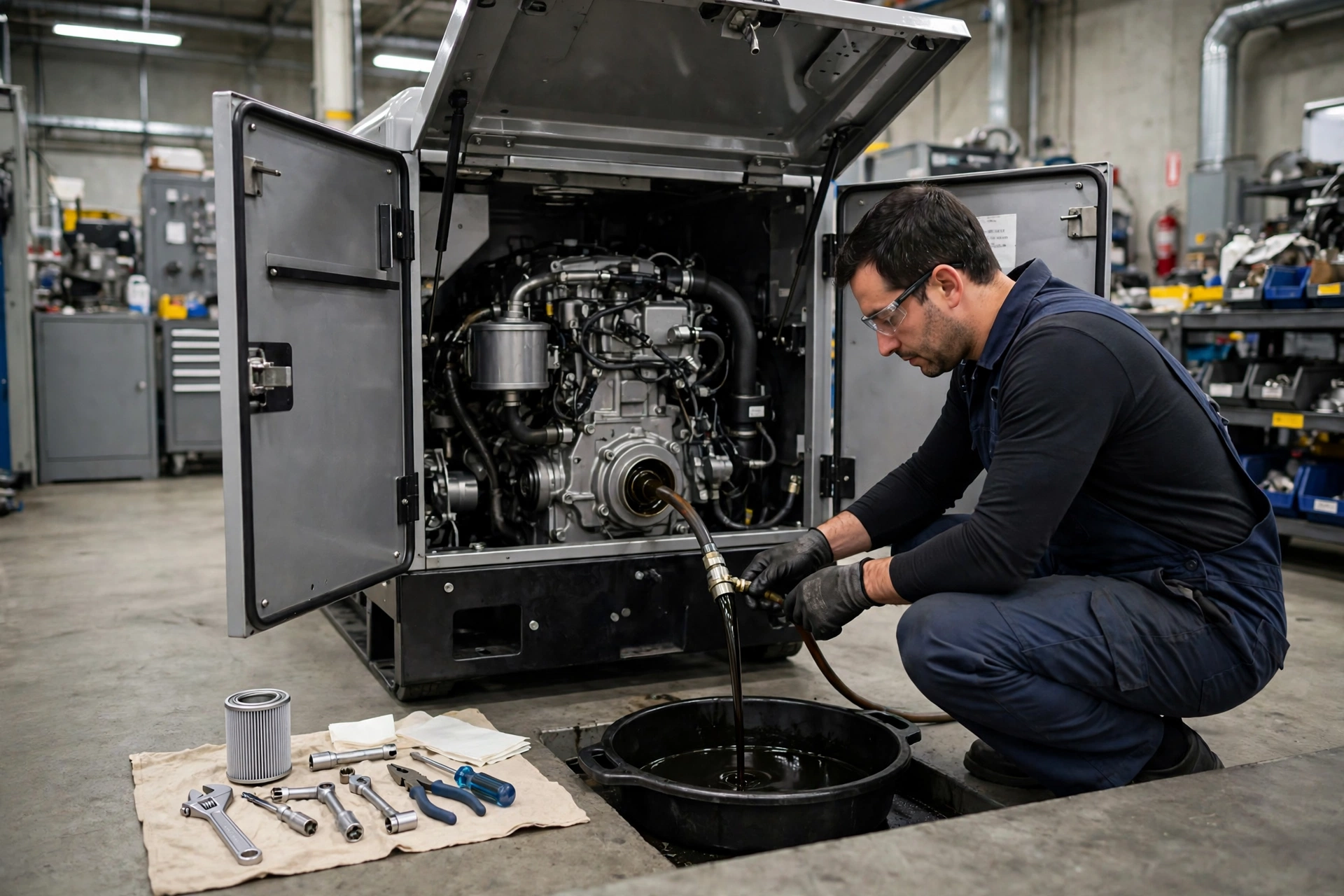
During break-in, every fresh metal surface sheds wear particles: microscopic machining debris, casting sand the factory wash missed, and the metal worn off rings, bearings and cylinder walls as they find their fit. All of it ends up in the oil, circulating through bearings that would rather it did not. Northern Lights specifies an oil and filter change at 50 hours, and then again at 100 hours. Turnkey Industries, writing for industrial units, puts the first change at 25–50 hours depending on the manufacturer. Generac calls for a 25-hour check-up after its 25-hour break-in. The exact hour varies. The principle does not: the first change comes far earlier than the normal interval.
What the First Oil Tells You
Drain the oil at 50 hours and look at it before it goes into the drum. A small amount of fine metallic shimmer is normal — that is the wear debris the change exists to remove. Large flakes, grit, or a heavy grey sludge are not normal, and they are worth a phone call to the supplier before the set runs another hour. Send a sample for oil analysis if the set is large or the site is remote: an analysis costs $30–60 and reports iron, chromium and copper levels that name the wearing component. Iron points at rings and liners; copper at bearings; chromium at ring faces. A first analysis at 50 hours is the baseline every later analysis is measured against.
Check the fuel filters at the same service. Turnkey’s guide recommends inspecting them after the first 10 hours to verify there is no manufacturing debris or contamination from the fuel storage system. A filter full of debris at 10 hours is a fuel system problem, not an engine problem — and it is far cheaper to find at 10 hours than at 1,000.
Oil Grade During Break-In
Use the oil the engine manufacturer specifies, in the viscosity the manual names — typically 15W-40 for industrial diesels in temperate climates, 10W-30 or 5W-40 where the site is cold. Do not switch to a full synthetic during break-in unless the manufacturer explicitly allows it. Several manufacturers and rebuild specialists advise conventional oil for the first change, because some synthetics are slick enough to slow ring seating. The rule is simple: follow the manual for the first 100 hours, and make any change to synthetic after the rings have seated and the 100-hour oil change is done.
The 50-hour service also includes the checks that belong to any new machine: belt tension adjusted, coolant level and concentration checked, hose clamps tightened, the air filter inspected, and the cylinder head bolts re-torqued where the manual calls for it. Budget $800–2,000 for a full 50-hour service on a 500 kVA set, including oil, filters and labour. It is the best-spent money in the set’s first year.
The Two Mistakes That Ruin a Break-In
Two patterns destroy a break-in, and both are common, because both look like care. The first is running the new set too lightly. The second is running it too hard, too soon. Both leave the same evidence in the engine, and both are avoidable.
Mistake One: Idling and Light Load — the Glazing Trap
A new set that idles for hours, or runs for weeks at 10–15% load on weekly exercise, never generates enough combustion pressure to seat its rings. The cylinder walls glaze: hard carbon fills the crosshatch micro-grooves and polishes them smooth. Once that happens, there is no going back. The crosshatch is gone, the oil film that the rings depend on cannot be maintained, and the only repair is to remove the cylinder head, hone the bores to re-establish the crosshatch, and fit new rings. On a 500 kVA engine, that is a $6,000–9,000 job, plus the downtime.
Glazing is the classic standby-set failure, because standby sets are the ones that spend their lives lightly loaded. A set installed in a hospital or a high-rise, commissioned on a Friday, and then left on weekly 20-minute no-load exercise is being glazed from its first week. The exercise run is not break-in. It is the opposite of break-in. Any new standby set needs its load ladder completed — on a load bank if the building cannot provide the load — before it settles into its standby routine. The standby and prime power rating on the nameplate describes the duty the set is built for. It does not describe the duty the set should break in under.
Mistake Two: Full Load Too Soon — the Overheating Trap
The opposite error is to put a new set straight onto full load and leave it there. A green engine’s rings have not yet found their shape, and sustained full load in the first hours overheats ring faces that have not yet seated, risks scuffing the bores, and loads bearings whose clearances are still settling. The manuals are consistent on this point: full load belongs in the ladder, in short blocks, after the light and medium stages — not in the first hour.
A related version of the same mistake is lugging: repeated motor-start surges the engine cannot handle, or a load that drags the speed down and holds it there. A generator that is lugged during break-in is an engine whose rings are being forced against the wall under the worst conditions — high pressure, low speed, poor oil film. If the site’s real load includes large motors, start them one at a time during the first 100 hours, and keep the load bank available to hold the set at a steady 50–75% between starts.
How to Tell the Rings Have Seated
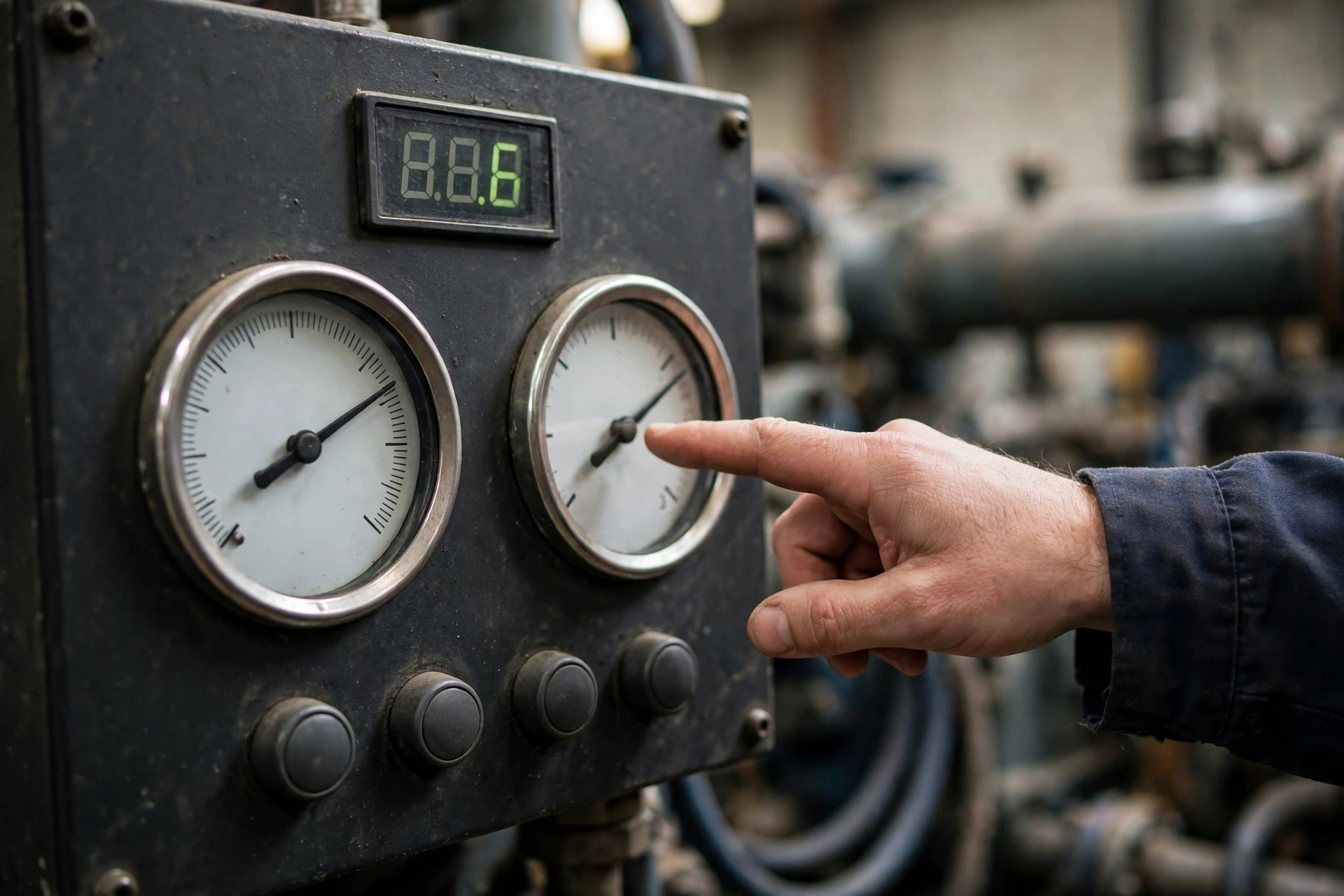
Break-in is finished when three things are true: the oil has been changed at 50 hours and again at 100 hours, the readings at rated load are stable and inside the manufacturer’s range, and the exhaust is clean under sustained load. Each of those has a number behind it, and the numbers are worth recording, because they become the baseline the set is judged against for the rest of its life.
Oil Consumption: The First Number That Talks
A new engine burns some oil during break-in. That is normal — a few hundred millilitres across the first 20–50 hours while the rings seat. Oil consumption that continues past 100 hours is not normal. A properly seated industrial diesel burns almost no oil between services: on a 500 kVA set, expect well under 0.5 litres per 100 hours once break-in is complete. A set burning 1 litre or more per 10 hours after 100 hours has rings that never seated, and the consumption will not improve with time. It will get worse as the glazed walls polish further and the rings wear without ever sealing.
Record the oil level at every stage of the ladder, at the same temperature and the same point in the run. A falling level that stabilises after 50 hours is break-in working. A falling level that continues past 100 hours is break-in that failed.
Blow-By and Compression: The Proof in the Crankcase
Blow-by is combustion gas escaping past the rings into the crankcase, and it is the direct symptom of a ring seal that never formed. With the engine running at operating temperature, remove the oil filler cap carefully and watch the vapour. A light haze is normal. A strong, pulsing stream of vapour is blow-by, and it means the rings are not sealing. The same gas carries soot and water vapour into the crankcase, which shows up as sludge under the valve cover and as oil that darkens far faster than it should.
A compression test settles the question with numbers. Test each cylinder after the 100-hour oil change and compare the readings: cylinders within 10% of each other are a healthy engine. One cylinder down by a third is an engine that runs fine on a commissioning day and fails on a cold morning or under twelve hours of full load. The test costs half a day on a V-engine in a tight canopy. It is the cheapest money in a new-generator purchase, and it is the only test that proves the rings seated.
Three New Sets, Three Break-Ins
Case 1: A Data Centre 1,000 kVA in Johor — The Ladder Done at the Factory
A data centre operator in Johor, Malaysia, ordered two 1,000 kVA containerised sets from PAVO in 2025 for an N+1 backup installation. The contract specified that break-in would be completed at the factory before shipping, on the factory load bank, with the readings recorded in the FAT report. Each set ran the full ladder: 25% for five hours, 50% for fifteen, 75% for thirty, full load in blocks for ten, then forty hours at varied 50–75% load. Oil and filters were changed at 50 hours and again at 100 hours, with an oil analysis at each change.
On site, the sets were installed, connected to the automatic transfer switch, and put into standby service. After 18 months and 340 hours of exercise and outage runtime, oil consumption on both sets is under 0.2 litres per 100 hours, compression readings across all cylinders sit within 5% of each other, and neither set has needed anything beyond scheduled service. The factory break-in cost the buyer two extra days of factory time and about 4,000 litres of diesel per set. It bought an engine that will hold its compression for its full design life.
Case 2: A Hotel 250 kVA in Nairobi — The Set That Was Never Loaded
A hotel in Nairobi bought a 250 kVA standby set in 2024, installed it in a basement plant room, and commissioned it on a Friday afternoon with a 30-minute no-load run. The building’s load was never connected to the set for break-in — the electrician planned to do it “next week” — and the set settled into its weekly 20-minute exercise run at no load. For six months it ran at 0–10% load, twenty minutes a week, and nothing looked wrong. It started every time. It held voltage. The gauges were normal.
At the first annual service, the technician found the oil level down 1.2 litres after a 10-hour outage run, blue smoke under load, and a compression test showing two cylinders 25% below the others. The diagnosis was glazed cylinder walls: the rings had never seated, because the set had never seen enough combustion pressure to seat them. The repair was a head-off hone and re-ring, $6,800, plus a week of downtime during which the hotel ran on a rented set at $1,400. The load bank that would have prevented it cost $900 for three days. The hotel now runs every new set through the full ladder before it enters standby service.
Case 3: A Construction Site 500 kVA in Manila — Break-In on a Hired Load Bank
A contractor in Manila bought a 500 kVA prime-power set in 2023 for a two-year high-rise project. The set arrived on a Friday, and the site needed power on Monday. There was no time for a factory break-in, and the site load — tower crane, hoists, site cabins — was not yet connected. The contractor hired a 500 kVA load bank for the weekend and ran the ladder on it: light, medium and heavy stages across Saturday and Sunday, full-load blocks on Sunday afternoon, oil and filter change at 50 hours on Monday morning before the set went into service.
The set ran 2,400 hours in its first year, at an average of 60–70% load, burning about 55 L/h. Oil consumption after break-in settled at 0.3 litres per 100 hours. At the 1,000-hour service, compression readings were even across all six cylinders and the oil analysis showed iron levels in the normal range. The weekend of load-bank hire cost $1,800 including delivery. The contractor’s previous set, bought in 2021 and broken in on site load alone, needed a re-ring at 8,000 hours — a $7,500 repair that this set has shown no sign of needing.
Frequently Asked Questions
How to break in a new diesel generator?
Run it loaded in steps over the first 100 hours: 25% load for about 5 hours, 50% for 15 hours, 75% for 30 hours, then full load in short blocks for 10 hours, and varied 50–75% load for the remaining 40 hours. Change the oil and filter at 50 hours and again at 100 hours, and never let a new set idle or run lightly loaded for long periods.
How long is the break in period for a diesel generator?
The break-in period is 50 to 100 hours, depending on the manufacturer: Northern Lights specifies 100 hours at a minimum of 75% load, Generac specifies 25 hours followed by 75 hours at no less than 50% load, and Westerbeke specifies about 50 hours. After 100 hours, with the oil changed and the readings stable at rated load, the engine is considered broken in and the normal service interval applies.
What happens if you don’t break in a diesel generator properly?
The piston rings never seat against the cylinder walls, and the walls glaze — hard carbon fills the crosshatch pattern and polishes it smooth. The result is permanent: high oil consumption, blow-by into the crankcase, low and uneven compression, blue smoke under load and poor cold starting. The only repair is to remove the cylinder head, hone the bores and fit new rings, a job that costs $6,000–9,000 on a 500 kVA engine.
Can you run a new generator at full load?
Yes, but not immediately and not continuously. Full load belongs in the break-in ladder after the light and medium stages, in short blocks of an hour or so, to prove the set holds its readings at the top of its range. Sustained full load in the first hours overheats rings that have not yet seated, and repeated full-load running before the 50-hour oil change wears bearings that are still settling.
When should you change the oil on a new diesel generator?
Change the oil and filter at 50 hours, and again at 100 hours — far earlier than the normal 250-hour service interval. The first oil carries the wear debris from every fresh surface finding its fit, and leaving it in the engine lets that debris circulate through the bearings. After the 100-hour change, follow the normal maintenance schedule for the set.
Break-In Checklist: The First 100 Hours
- First start: no load for 30 minutes only — prove oil pressure, find leaks, confirm steady frequency, then load the set.
- Run the load ladder: 25% for 5 hours, 50% for 15 hours, 75% for 30 hours, full load in short blocks for 10 hours, varied 50–75% for the remaining 40 hours.
- Hire a load bank if the site cannot provide 50–75% load — a standby set’s real load is not enough to break it in.
- Change the oil and filter at 50 hours, and again at 100 hours. Inspect the fuel filters at 10 hours.
- Record oil pressure, coolant temperature, voltage, frequency and fuel rate at every stage — the readings are the baseline for the set’s whole life.
- Watch the exhaust at every stage: light smoke at a cold start is normal, continuous black, blue or white smoke is not.
- Check oil consumption at 50 and 100 hours — a few hundred millilitres during break-in is normal, a litre per 10 hours after 100 hours is not.
- Never idle a new set for long periods, and never leave it on weekly no-load exercise until the ladder is complete.
- Run a compression test after the 100-hour oil change — cylinders within 10% of each other prove the rings seated.
- Keep the ladder log, the oil analysis results and the load bank readings with the set’s service records, and keep a spare parts list — filters, belts and a spare AVR — on the shelf before the set enters service.
A new generator’s first 100 hours are the cheapest hours it will ever run. The fuel, the load bank hire and the early oil change cost a fraction of the engine work a bad break-in eventually demands, and they buy the one thing no service can give back: rings that sealed the first time. Before the next new set goes into service, ask the supplier for the break-in schedule in writing, book the load bank, and contact PAVO for the factory break-in option — so the first 100 hours happen on a test bay, not on a building that cannot load the set.