

How Often Should a Diesel Generator Be Serviced? | PAVO
A generator that is never serviced does not fail on a convenient day. It fails on the night the grid goes down.
How often should a diesel generator be serviced? A standby set needs a monthly loaded run, oil and filters every 250 hours or six months, and an annual service with a load bank test. Prime sets follow the hour meter: oil at 250 hours, a major service at 1,000, and an overhaul at 15,000 to 30,000 hours.
- Hours or Calendar: The Rule That Decides Every Interval
- The Full Schedule at a Glance
- Three Duties, Three Schedules
- Oil, Fuel and Air Filters
- Coolant, Batteries and Starting
- Load Testing and the Annual Service
- What Service Costs — and What Skipping It Costs
- Frequently Asked Questions
Hours or Calendar: The Rule That Decides Every Interval
Every service interval in a generator manual is stated twice: once in hours, once in calendar time. The instruction is always the same — service at whichever comes first. That single rule is the whole maintenance schedule in one sentence, and it is the rule most often ignored.
Oil degrades in two ways. Running hours wear it out through heat, soot and shear. Calendar time wears it out through oxidation and moisture, even when the engine never turns. A standby set that runs 50 hours a year still needs fresh oil annually, because the oil in its sump is a year old, not 50 hours old. A prime set that runs 250 hours in six weeks needs its oil change in six weeks, not six months.
The hour meter and the calendar are therefore both service triggers, and a site that watches only one of them will miss half its services. The practical tool is a service log: one line per event, recording the date, the hour-meter reading, the work done, the parts fitted and the oil-analysis result. A log that shows a 250-hour service done at 410 hours tells the next buyer, the next insurer and the next warranty assessor everything they need to know. Most warranty disputes over generator engines are settled, one way or the other, by that log.
standby and prime power ratings change the schedule because they change the duty. A standby set is maintained by the calendar; a prime set is maintained by the hour meter. The rest of this article follows that split.
The Full Schedule at a Glance
The table below is a typical schedule for a commercial diesel set in the 100–1,000 kVA range, drawn from Cummins, Perkins and Weichai service practice. The engine manual for a specific model is the final authority, and it always wins over a generic table. What the table gives is the shape of the programme: small, frequent services, a major service at four figures of hours, and an overhaul decision at five figures.
| Interval | Typical work | Applies to |
|---|---|---|
| First 50 hours | First oil and filter change, check for leaks, re-torque as specified | Every new or rebuilt set |
| Every 250 hours or 6 months | Oil and oil filter, fuel filter check, coolant test, battery test, belt and hose inspection | All duties |
| Every 500 hours or 12 months | Fuel and air filters, water separator service, drive belts, electrical connections | All duties |
| Every 1,000 hours or 24 months | Valve clearance, injector inspection, coolant change, alternator insulation test | All duties |
| Every 2,000 hours | Cooling system flush, turbocharger inspection, control panel and AVR check | Prime and continuous |
| Every 6,000–12,000 hours | Top-end inspection, cylinder head and turbocharger work as indicated | Prime and continuous |
| Every 15,000–30,000 hours | Major overhaul or replacement decision, based on oil analysis and compression | All duties |
The 50-Hour Break-In Service
A new diesel engine is not broken in when it leaves the factory. The first 50 hours seat the piston rings, wear in the bearings and shed fine metal into the oil. That first oil change, usually at 25–50 hours, removes the wear metals before they circulate as grinding paste. Skipping it is the cheapest saving in generator ownership and the most expensive. The commissioning checklist for a new set puts the break-in oil change first for exactly this reason, and a factory test report is no substitute for it.
The 250-Hour / Six-Month Service
This is the workhorse interval. Oil and oil filter, a fuel-filter condition check, a coolant level and additive test, a battery voltage and specific-gravity check, and a visual pass over belts, hoses and connections. On a standby set it falls due every six months; on a prime set running 2,000 hours a year it falls due every six weeks. The cost is small — oil, two filters and an hour of labour — and it is the service that catches most developing faults while they are still cheap.
The 1,000-Hour Major Service
At 1,000 hours the work goes deeper: valve clearance is measured and set, injectors are inspected and tested, the coolant is changed rather than topped up, and the alternator windings are insulation-tested. Valve clearance drift is silent; a tight exhaust valve burns, a loose one hammers its seat, and neither shows a symptom until the damage is done. Cummins practice puts valve adjustment at roughly 1,200 hours on many mid-range engines; Perkins specifies 500-hour oil intervals with valve work at the major service. The manual for the engine on the nameplate settles the number.
The 15,000-Hour Overhaul Decision
A well-maintained industrial diesel is designed for 20,000 to 30,000 hours of service life. The overhaul decision at 15,000–30,000 hours is driven by evidence, not by the calendar: rising oil consumption, falling compression, oil analysis showing bearing metals climbing, and fuel consumption creeping above the datasheet figure. A set that has had its oil changed on schedule and its coolant maintained can reach the top of that range. A set that has not will be rebuilt at half of it, and the rebuild will cost more than every skipped service combined.
Three Duties, Three Schedules
Duty decides the schedule. The same engine, installed in three different applications, needs three different maintenance programmes.
Standby: The Hospital and the Data Centre
A standby set in a hospital or data centre runs perhaps 40–60 hours a year: monthly tests and the occasional outage. Its schedule is calendar-driven. Monthly loaded exercise, a six-month oil and filter service, and a full annual service with a load bank test. The risk on a standby set is not wear but neglect: fuel ageing, battery self-discharge, coolant additive depletion, seals drying out. Diesel fuel ageing in a tank that sits for a year is a maintenance problem, not a fuel problem, and it is handled on the calendar, not the hour meter.
Prime: The Telecom Tower and the Quarry
A prime set on a telecom tower or a quarry runs 2,000–3,000 hours a year, eight to twelve hours a day. Its schedule is hour-driven. Oil every 250 hours means a service every five to six weeks, and the annual service count reaches eight or more. Sites like this plan service around fuel deliveries and shift patterns, because a set that stops for an unplanned service stops the site. Remote sites carry a spare parts list on site — filters, belts, a spare AVR, a starter motor — because the cost of a 300 km round trip for a fuel filter exceeds the cost of the filter by a factor of twenty.
Continuous: The 24/7 Plant
A continuous-duty set runs 8,760 hours a year, and its schedule is built around planned shutdown windows rather than the calendar. Oil changes at 250 hours would mean a service every ten days, so continuous sets commonly run extended 500-hour oil intervals supported by oil analysis, with the analysis result — not the hour count — deciding whether the oil stays in. The discipline is the same, but the evidence is laboratory data rather than a date on a wall chart.
Oil, Fuel and Air Filters
Three consumables decide engine life. They are cheap, they are changed often, and they are the items most often stretched past their interval.
Engine Oil
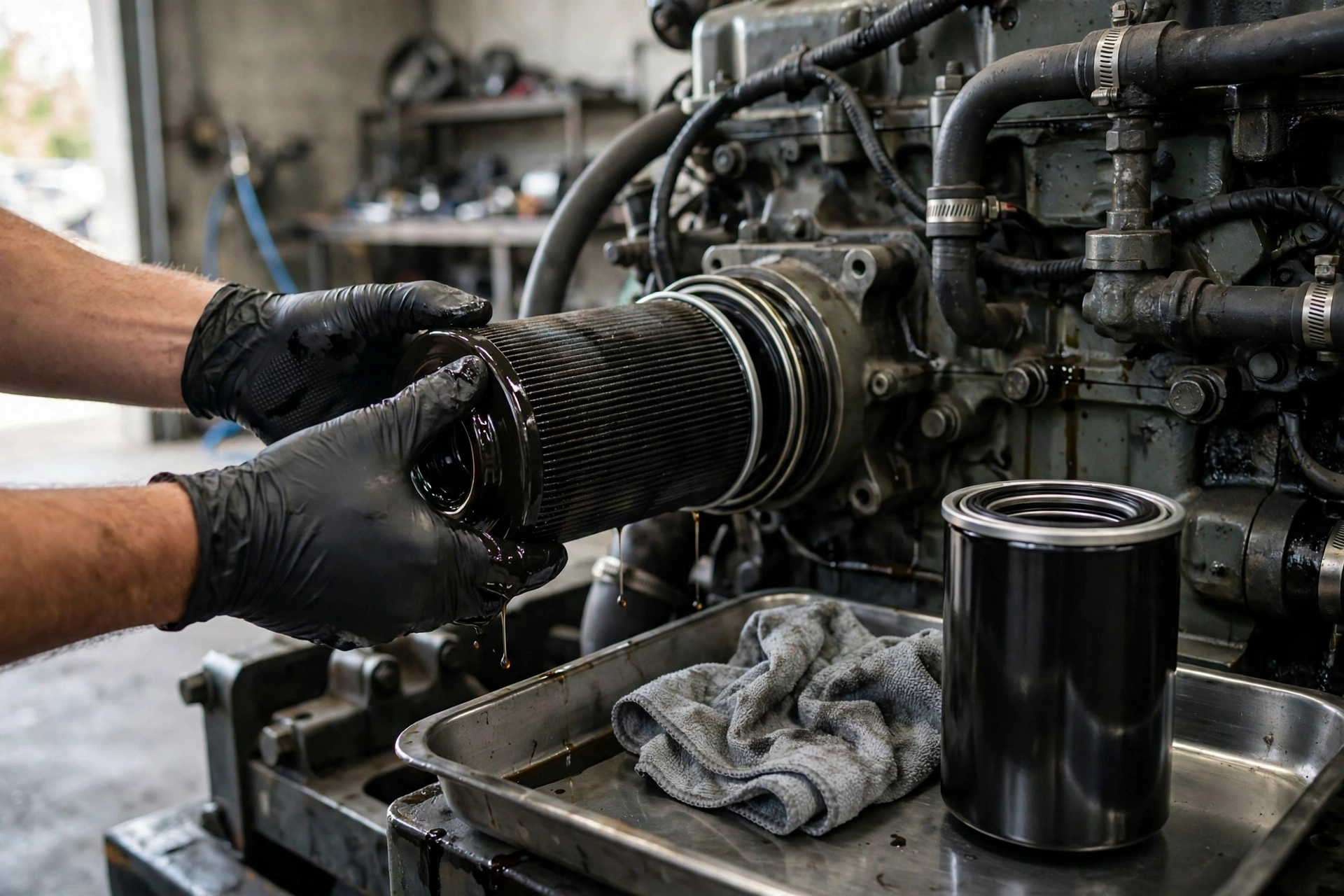
Most mid-range diesel engines specify a 15W-40 heavy-duty oil meeting API CI-4 or CK-4, changed every 250 hours or six months for standby duty and every 250–500 hours for prime duty, depending on the manufacturer. The first change comes at 25–50 hours. Synthetic oil extends the interval on some engines but never removes the calendar limit: a year-old synthetic is still a year old. Oil analysis, at roughly $30–60 per sample, reports soot loading, fuel dilution, coolant contamination and wear metals, and it is the cheapest diagnostic in generator ownership. A sample that shows fuel dilution rising is an injector problem caught at $60 instead of a $2,500 injector set plus a scored bore.
Fuel Filters and Water
Diesel fuel carries water, and water kills injectors. The water separator is drained weekly or monthly depending on the site, and the primary and secondary fuel filters are changed at 500 hours or annually. A set that runs on fuel stored for a year needs its filters changed more often, not less, because aged fuel carries more sediment and microbial growth. Injector replacement on a 500 kVA set runs $800–2,500 per injector, and a six-cylinder engine has six of them. A $40 fuel filter is not the place to save money.
Air Filter
A restricted air filter costs power and fuel before it costs an engine. The restriction indicator on the intake — a small gauge that shows red when the element is loaded — is checked at every service, and the element is changed when the indicator says so, not on a fixed date. Dusty sites halve the interval: a quarry set and a data-centre set in the same city need different air-filter schedules, and the indicator, not the calendar, is the judge.
Coolant, Batteries and Starting
The engine gets the attention. The cooling system and the starting system cause the failures.
Coolant
Coolant has three jobs — removing heat, preventing freezing, and protecting the inside of the engine from corrosion and cavitation. The additive package that does the third job depletes on a schedule of its own, typically two years or 1,000–2,000 hours. Test strips check the additive level in thirty seconds; a refractometer checks the glycol concentration and freeze point. Coolant maintenance is a change on the engine maker’s interval, not when the coolant looks bad, because depleted coolant never looks bad until the liner pitting is already done. Cavitation pitting on a wet liner is a $5,000–10,000 repair that a $15 bottle of test strips prevents.
Batteries
Battery failure is the most common reason a generator fails to start. Industry surveys of emergency power failures consistently put batteries and chargers at the top of the list, ahead of fuel and engine faults. A 24 V starting system floats at roughly 27.2 V, and the charger must hold it there; a charger that drifts high boils the batteries dry, and one that drifts low leaves them flat. Batteries are load-tested annually and replaced every three to five years, before they fail rather than after. Terminals are cleaned and tightened at every service, because a corroded terminal behaves exactly like a dead battery on the one night it matters.
Charger, Starter and Alternator
The starting circuit is checked as a system: charger output voltage, battery condition, starter motor draw, and the alternator’s AVR and windings. The alternator windings are insulation-tested at the major service, and the AVR is checked for stable voltage under step load. A generator that starts and then produces unstable voltage has a starting-system problem in the alternator, not the engine, and the insulation test is what finds it before the load does.
Load Testing and the Annual Service
A service that never tests the set under load has not proven the set works. It has proven that the set starts.
The Monthly Loaded Run
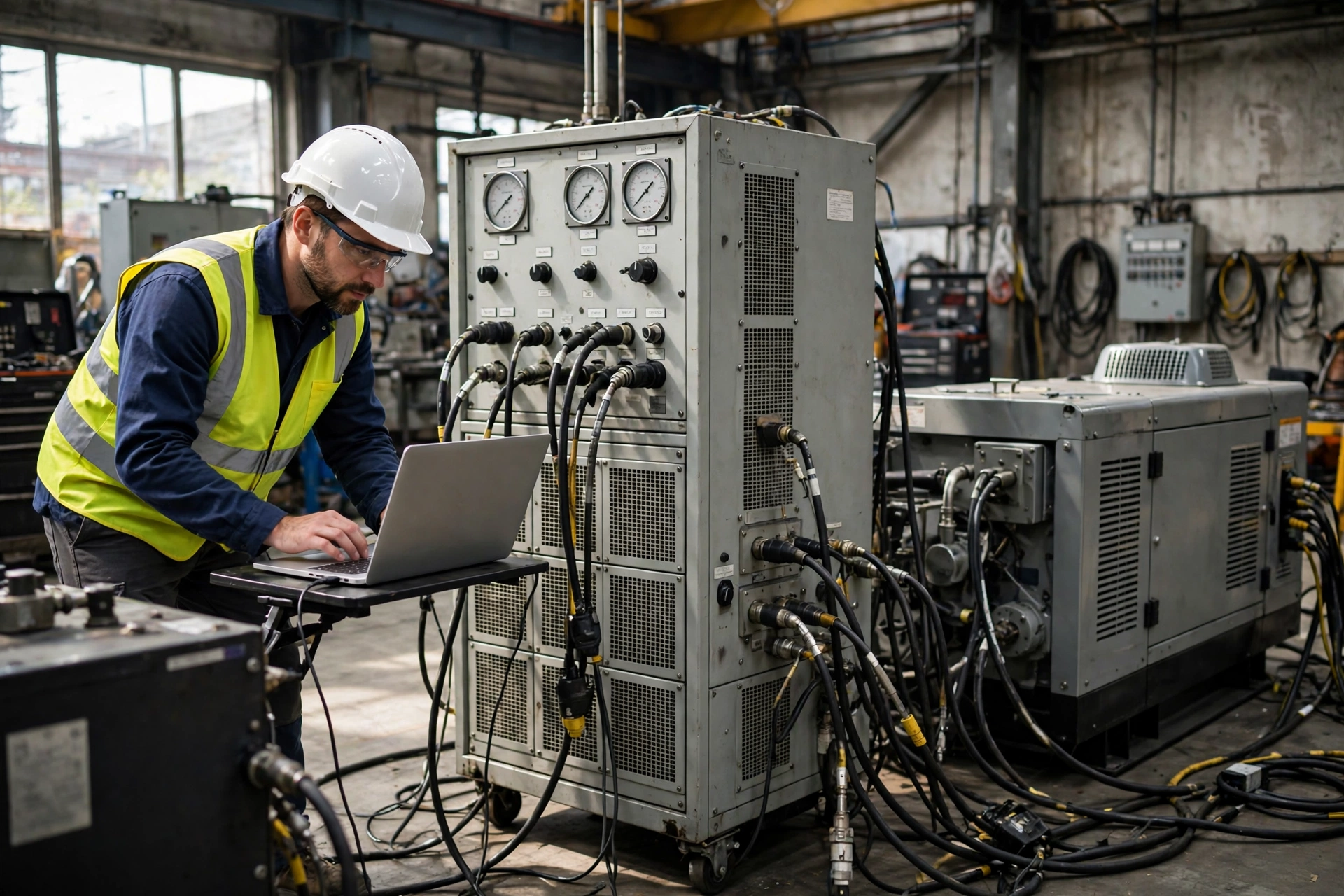
NFPA 110, the standard hospitals and emergency systems live under, requires a monthly exercise run of at least 30 minutes at 30% or more of nameplate kW. Thirty percent is the floor, not the goal. A no-load weekly run keeps the battery charged while the engine slowly glazes its bores — the wet-stacking pattern that leaves a set unable to carry load when the outage finally arrives.
The Annual Load Bank Test
The annual load bank test runs the set at 70–100% of rated load for one to two hours, burns carbon deposits out of the exhaust system, and proves the set can carry its rated load for a sustained period. It is the only test that answers the question the owner actually needs answered: will this set carry the building? A set that passes a load bank test at 100% load for two hours has earned its annual service stamp. A set that has never been load-banked has not.
What the Annual Service Includes
The annual service is the full programme in one visit: oil and all filters, coolant test and change if due, battery load test, belt and hose replacement as indicated, valve clearance if the hour count requires it, alternator insulation test, control-panel and automatic transfer switch functional test, and the load bank test itself. It is also the visit where the service log is reviewed as a whole — oil consumption trend, fuel consumption against the datasheet, any fault codes stored in the controller — because trends, not single readings, are what predict the next failure.
What Service Costs — and What Skipping It Costs
Service is cheap. Failure is not. Typical annual service costs, excluding the load bank test, run roughly $400–700 for a 100 kVA set, $800–1,200 for a 250 kVA set, and $1,200–2,000 for a 500 kVA set, with labour rates varying by region. A load bank test adds $600–1,500 depending on set size and site access. A major overhaul on a 500 kVA engine runs $18,000–30,000. The arithmetic is not close.
| Set size | Typical annual service | Load bank test | Major overhaul |
|---|---|---|---|
| 100 kVA | $400–700 | $600–900 | $8,000–12,000 |
| 250 kVA | $800–1,200 | $700–1,100 | $12,000–18,000 |
| 500 kVA | $1,200–2,000 | $900–1,500 | $18,000–30,000 |
Case 1: A Nairobi Hotel — Three Skipped Annuals
A 250 kVA standby set at a hotel in Nairobi ran its monthly tests and nothing else for three years. No oil change, no coolant test, no load bank. On the night of a grid failure during a wedding reception, the set started, took load, and tripped on high coolant temperature after nine minutes. The coolant additive had depleted two years earlier; the thermostat housing had corroded through and the system had been losing coolant slowly for months. The repair — thermostat housing, coolant flush, new coolant, and a load bank test — cost $2,100. The three skipped annual services would have cost $2,400. The hotel lost the reception, the booking, and the next three weekends of functions. The arithmetic of skipping service only works if the set never gets called.
Case 2: A Zambian Mine Camp — Oil Stretched to 600 Hours
A prime-power 400 kVA set at a mine camp in Zambia ran 3,000 hours a year, and the site stretched oil changes from 250 hours to 600 hours to save on service visits. At 9,400 hours the oil analysis showed fuel dilution and iron climbing; at 9,800 hours an injector failed, scored a bore, and the set came out for a rebuild at 10,000 hours — a third of its design life. The rebuild cost $24,000 and six weeks of hired-in rental power at $3,500 a week. The saved oil changes were worth roughly $900 a year. The service interval is not a suggestion from the oil company. It is the manufacturer’s statement of how long the oil protects the engine.
Case 3: A Johannesburg Data Centre — The Contract That Pays
A colocation data centre outside Johannesburg runs four 1,500 kVA sets on a full service contract: monthly loaded tests, six-month services, annual load bank tests, oil analysis at every service, and a parts stock on site. In five years the site has recorded zero failed starts and zero failed transfers, across 41 grid events. The contract costs roughly $9,000 a year per set. One failed transfer at that site, at ITIC’s median downtime figure of $9,000 a minute, would cost more than the annual contract in the first sixty seconds. The contract is not an expense. It is the cheapest insurance the site buys.
Frequently Asked Questions
How often should a diesel generator be serviced?
A standby set should be serviced every six months or 250 hours, whichever comes first, with a full annual service and load bank test. A prime set is serviced by the hour meter — oil at 250 hours, a major service at 1,000 hours — which can mean a service every five to six weeks on a site running 2,000 hours a year.
How often should you change the oil in a diesel generator?
Change the oil after the first 25–50 hours on a new set, then every 250 hours or six months, whichever comes first. Prime and continuous sets typically follow 250–500 hour intervals depending on the engine manufacturer, and standby sets still need an annual change even at low hours because oil degrades with age.
What does a diesel generator annual service include?
The annual service includes oil and all filters, a coolant test and change if due, a battery load test, belt and hose inspection, valve clearance if the hours require it, an alternator insulation test, a functional test of the control panel and transfer switch, and a load bank test at 70–100% of rated load.
How many hours does a diesel generator last before overhaul?
A well-maintained industrial diesel is designed for 20,000 to 30,000 hours before a major overhaul. The actual figure depends on duty and maintenance: a set serviced on schedule with clean fuel and maintained coolant reaches the top of that range, while a neglected set can need a rebuild at half of it.
How often should diesel generator coolant be changed?
Change the coolant every two years or 1,000–2,000 hours, following the engine manufacturer’s interval, and test the additive level with strips at every service. Extended-life coolants last longer but are not fill-for-life, and topping up with the wrong coolant dilutes the additive package from the first day.
Service Contract Checklist: Ten Lines Before You Sign
- Which intervals apply — hours, calendar, or whichever comes first — and are they written into the contract?
- Does the contract include the monthly loaded exercise run, or only the annual visit?
- Is a load bank test included annually, and at what load and duration?
- Are oil analysis samples included at every service, and who reviews the results?
- Are filters, oil and coolant included in the price, or billed separately?
- Does the contract cover the transfer switch and control panel, or only the engine?
- What is the guaranteed response time for a failure to start, in hours, not working days?
- Are genuine filters and the specified oil grade named in the contract?
- Is the service log maintained by the contractor and handed over at every visit?
- Does the contract state what happens to the warranty if a service is missed?
A generator is not maintained by buying a good engine. It is maintained by a schedule, a log, and a contractor who shows up on the date in the contract whether or not the set has been needed. The sets that start on the night they are needed are the sets somebody serviced in the months when nobody was watching. Before the next service falls due, ask the manufacturer for the schedule for the engine on the nameplate — and contact PAVO to put that schedule into a service plan for the site.