

How to Buy a Used Diesel Generator: A Buyer’s Guide | PAVO
A used generator is the cheapest way to buy power — and the most expensive way to buy somebody else’s neglected maintenance.
How to buy a used diesel generator? Start with the hour meter and the service records, inspect the set cold, and demand a two-hour load bank test at full rated load before any money changes hands. A used industrial set typically costs 40–60% less than new, and the inspection that protects that saving costs a fraction of one repair.
Contents – The Price Gap: What a Used Set Really Saves – Reading the Hour Meter: The Number That Lies by Omission – Paperwork First: Records, Nameplate and Emissions – The Physical Inspection: What to Look At Before the Engine Starts – Cold Start and Exhaust: Ten Minutes That Tell the Truth – The Load Bank Test: The Only Proof That Matters – Three Used Sets, Three Outcomes – Frequently Asked Questions
The Price Gap: What a Used Set Really Saves
A new 500 kVA standby set from a recognised engine brand lists at roughly $75,000–110,000 delivered, depending on the engine, the canopy and the controller. The same rating, five years old, with 2,000–4,000 hours on the meter and a clean service record, lists at $28,000–45,000. That is a saving of 40–60% off the new price, which is the range used-equipment dealers report across the industrial market — and it is the reason the used market exists at all.
The saving is real, but it is not free. A used set carries three costs a new set does not: the inspection before purchase, the deferred maintenance the previous owner skipped, and the shorter remaining life. A buyer who budgets for all three still comes out ahead on most standby applications. A buyer who budgets for none of them pays the new price anyway, in repairs, spread over the first year.
The table below shows typical dealer-listing ranges for common sizes, against new-equipment prices for comparable standby-rated sets. These are market ranges, not quotes: engine brand, canopy, controller, emissions tier and location move any individual set by 20–30% either way.
| Set size | Typical new price | Typical used price (3–7 years) | Saving |
|---|---|---|---|
| 100 kVA | $22,000–32,000 | $9,000–16,000 | ~50% |
| 250 kVA | $42,000–60,000 | $17,000–30,000 | ~55% |
| 500 kVA | $75,000–110,000 | $28,000–45,000 | ~55% |
| 1,000 kVA | $140,000–200,000 | $55,000–90,000 | ~55% |
When Used Is the Right Call
Used makes sense when the duty is standby — a set that will run 50–200 hours a year and mostly sit ready. A five-year-old standby set with 2,000 hours has used roughly a tenth of its design life, and the saving buys the fuel, the installation and the first five years of service with money left over. It also makes sense when time matters: a new set built to order takes 15–35 working days from a factory like PAVO’s, and longer from Western brands quoting 72–104 weeks on large engines. A used set in a dealer’s yard can be on a truck this week.
When New Is Cheaper in the End
Used is the wrong call when the duty is prime or continuous. A prime set runs 2,000–3,000 hours a year, so a used set with 8,000 hours already sits at the midpoint of its life, and the buyer is paying for the worn half. It is also the wrong call when the site needs a warranty the seller cannot give, or when the emissions tier of the used set is already barred from the site’s jurisdiction. A Tier 2 set that cannot legally work in the buyer’s city is not a bargain at any price.
The Hidden Costs to Budget Before You Bid
Before bidding, a buyer should price four items: an independent pre-purchase inspection ($500–1,500), a full service on arrival (oil, all filters, coolant, belts — $800–2,000 on a 500 kVA set), a load bank test if the seller has not already run one ($600–1,500), and a contingency of 10–15% of the purchase price for the first repair. A $35,000 set with a $3,500 contingency is still a $38,500 set — and a $35,000 set bought without one becomes a $50,000 set the month the alternator needs a rewind.
Reading the Hour Meter: The Number That Lies by Omission
The hour meter is the first number every buyer asks for, and it is the number most often misread. Hours measure exposure, not condition. A generator that ran 100 hours a year for ten years is a fundamentally different machine from one that ran 1,000 hours a year for the same decade, even though both show 1,000 hours.
Standby Hours and Prime Hours Are Different Currencies
Standby and prime power ratings describe different duties, and the hours accumulate at different rates. A standby set in a hospital or data centre runs 50–200 hours a year, mostly in weekly exercise and the occasional outage. A prime set on a construction site or a telecom tower runs 2,000–3,000 hours a year. The same 5,000 hours therefore means a 25-year-old standby set or a two-year-old prime set — and the wear, the corrosion and the risk are entirely different in each case.
| Hour reading | Standby duty | Prime duty |
|---|---|---|
| 0–500 hours | Very low — near-new | Very low — first months |
| 500–2,500 hours | Low to average — 5–15 years of standby | Low — first year or two |
| 2,500–6,000 hours | Moderate to high for standby | Moderate — 2–3 years of prime |
| 6,000–10,000+ hours | High — near or past standby design life | High — approaching overhaul |
| 10,000–30,000 hours | Beyond design life for most standby engines | Overhaul territory — inspect hard |
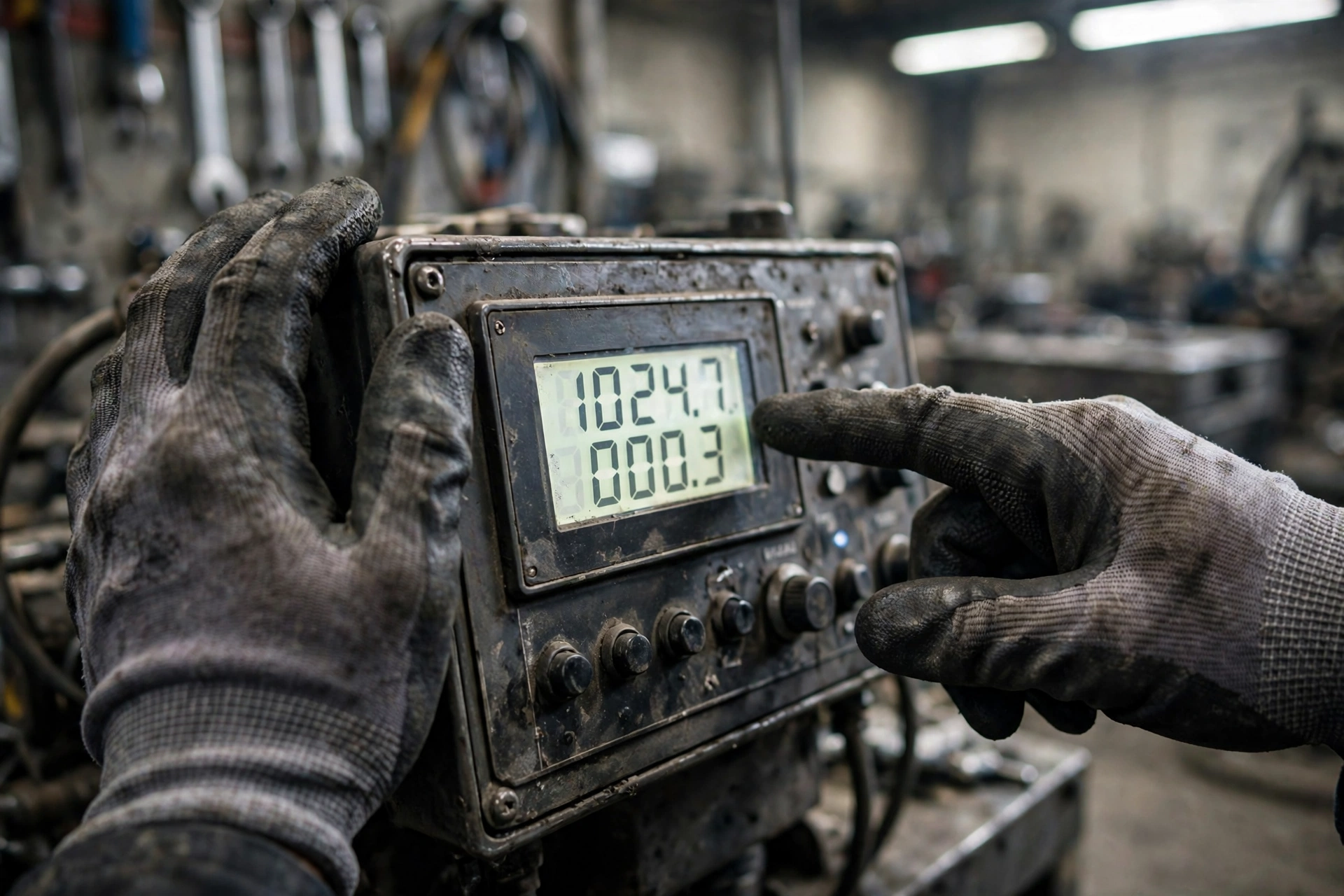
Industrial diesel engines are designed for 10,000–30,000 hours before a major overhaul, with the best-maintained industrial units reaching 20,000–40,000 hours. For a standby set, 2,000–3,000 hours is moderate — roughly 15–20 years of typical exercise and outage runtime. For a prime set, anything above 8,000 hours puts the engine near the midpoint of its operating life, and the buyer should price the coming overhaul into the offer.
The “Zero-Hour” Trap
A listing that says “zero hours” or “zero-hour rebuilt” does not mean the set is factory-new. It usually means the engine was overhauled or rebuilt and the hour meter was reset, or the set was refurbished and tested after servicing but never redeployed. A zero-hour rebuild by the original manufacturer or a certified technician can be a good buy — but only with the paperwork that says who rebuilt it, what was replaced, and what warranty the rebuild carries. Without that paperwork, “zero hours” is a meter reading, not a condition.
Cross-Checking the Meter Against the Controller
On a modern set, the hour meter is not the only clock. Digital controllers from Deep Sea, ComAp and SmartGen keep their own internal logs of engine starts, fault history and runtime, independent of the dashboard gauge. A buyer should compare the two numbers. A mismatch of 15% or more between the meter and the controller log warrants a hard question, and a controller that has been replaced — wiping its log — is a fact the seller should volunteer, not one the buyer should discover. The manufacture date on the nameplate is the third check: a set that claims 3,000 hours but was built eight years ago has either sat idle for years or had its meter interfered with, and both stories need explaining.
Paperwork First: Records, Nameplate and Emissions
The inspection starts on paper, before anyone touches the set. A seller with complete records is selling a maintained machine. A seller with no records is selling a story.
Service Records: The Log That Settles Arguments
A proper service log shows the date, the hour-meter reading, the work done, the parts fitted and the oil-analysis result for every service. Oil changes every 250–500 hours, filter changes on schedule, coolant changes every two years — the pattern should be visible at a glance. Gaps of 500 hours or more between oil changes on a prime set indicate neglect, and a log that stops two years before the sale indicates a set that has been sitting, not a set that has been maintained. The absence of records is itself a finding: it is the single most reliable warning sign that a used generator has been neglected, and it should move the price down or the buyer out the door.
The Nameplate: Ratings, Voltage and Frequency
The nameplate confirms what the set actually is, as opposed to what the listing says it is. Check the kVA and kW ratings, the standby and prime power figures, the voltage options, the phase, the frequency (50 Hz or 60 Hz) and the power factor, usually 0.8. A set rated 500 kVA at 50 Hz is a different machine from one rated 500 kVA at 60 Hz, and a set wired for 400 V three-phase will not serve a site that needs 480 V without a transformer or a reconfiguration. The engine serial number and the alternator serial number should also be recorded — they are what the parts supplier and the insurer will ask for, and a serial number that does not match the paperwork is a reason to stop.
Emissions Tier and Where the Set May Legally Work
Emissions standards decide where a used set is allowed to work, and they decide its resale value. A Tier 4 Final or Stage V set works almost anywhere and rents anywhere. A Tier 2 set is being fenced into fewer jobs every year: it cannot be used for mobile or rental work in many jurisdictions, and in the United States a true emergency standby set may stay at Tier 2 or Tier 3 only under a federal leash of around 100 hours a year for testing and maintenance. A buyer who imports a Tier 2 set into a Stage V market has bought a machine that cannot legally run — and the customs paperwork will not refund the mistake. Confirm the tier on the engine plate, confirm it against the destination’s rules, and confirm it before paying, not after the inspector arrives.
The Physical Inspection: What to Look At Before the Engine Starts
Walk around the set before it starts. A cold, silent machine tells the truth; a running one hides it behind noise and vibration. Knowing the main generator parts and what each one costs to replace turns a walk-around into a price negotiation.
Leaks, Rust and the Frame
Oil, fuel or coolant under the engine, around hoses and at joints indicates a problem that may be minor — a worn seal, a $50–200 fix — or serious, a cracked block or a failing pump, a $2,000+ repair. Surface rust on the frame and canopy is cosmetic and fixable. Deep pitting, or rust that has eaten through metal, indicates years of neglect or coastal exposure. Small cracks near welds can sometimes be repaired; cracks in load-bearing sections or in the engine block itself are deal-breakers. Dents matter less than most buyers think. A dented canopy that still seals is a cosmetic discount; a corroded base tank that weeps fuel is a safety problem.
Oil, Coolant and the Radiator
Pull the dipstick. Oil that is black is normal on a diesel; oil that is milky indicates water in the sump, and oil that smells of diesel indicates fuel dilution — both are reasons to stop and test, not to buy. Check the coolant level and colour: rusty or oily coolant indicates a failing head gasket or a corroded cooling system, and a radiator with bent or blocked fins will overheat under load even if it idles perfectly. The air filter and oil filter tell the same story as the service log: a clogged air filter means the set ran in dusty conditions or was never serviced, and a dark, sludgy oil filter suggests infrequent oil changes. The maintenance schedule the set should have followed is the standard the inspection is measured against.
The Alternator, Wiring and Canopy
The alternator is the second most expensive component after the engine, and it is the one buyers inspect least. Look for copper windings rather than aluminium — aluminium rewinds sag under motor-starting loads — and check the insulation class, usually H on a proper industrial set. Wiring should be tidy, labelled and free of chafing, melted insulation and improvised repairs; a control cabinet full of twisted wire and electrical tape is a set that has been repaired by whoever was cheapest, not by whoever was qualified. The canopy doors should close and seal, the sound insulation should be intact rather than oil-soaked, and the battery box should be dry and clean. A spare parts list for the set — filters, belts, a spare AVR, a starter motor — is worth asking about at this stage, because the parts the seller has on the shelf are the parts the set has needed before.
Cold Start and Exhaust: Ten Minutes That Tell the Truth
The most important ten minutes of a used-generator purchase happen before the engine is warm. Insist on a cold start, and touch the engine block first to confirm the seller has not pre-warmed it.
Start It Cold — and Touch the Block First
A healthy diesel starts promptly on a cold morning without excessive cranking. Long cranking, repeated attempts or a start that needs ether points to low compression, tired injectors, a weak starter or a battery that is already past its life. Watch the gauges as it settles: oil pressure should rise within seconds and hold steady, coolant temperature should climb smoothly, and voltage and frequency should stabilise at rated values. A set that starts easily warm but struggles cold has a problem the seller knows about — which is why the seller warmed it up before the buyer arrived.
What the Smoke Means
Exhaust colour at a cold start is a diagnostic, not a decoration. Light smoke at startup is normal and should clear within a minute as the engine reaches operating temperature. Continuous black smoke indicates over-fuelling or a restricted air supply. Blue smoke indicates oil burning past worn valve guides, piston rings or turbocharger seals. White smoke indicates unburned fuel from low compression, faulty glow plugs or timing problems — or coolant entering the combustion chamber, which is a head-gasket failure. A set that smokes continuously at any colour is a set with an engine problem, and the colour names the problem.
Blow-By and the Oil-Cap Test
With the engine running, remove the oil filler cap carefully and watch the vapour. A light haze is normal on a working diesel. A strong, pulsing stream of vapour — blow-by — means combustion gas is escaping past worn piston rings into the crankcase, and the engine is losing compression on every stroke. A compression test settles the question with numbers: pull the injectors, test each cylinder, and compare. Cylinders that read within 10% of each other are a healthy engine; one cylinder down by a third is an engine that runs fine on a dealer’s lot and fails on a cold morning or under twelve hours of full load. The test costs half a day on a V-engine in a tight canopy, and it is the cheapest money in a used-generator purchase.
The Load Bank Test: The Only Proof That Matters
No used commercial generator should be bought on the strength of an unloaded idle run. An engine can start instantly and sound smooth at no load while hiding cooling, fuel-delivery and voltage-regulation defects that only appear under stress. A load bank test is the only reliable way to verify that a used generator can actually deliver its rated power under real conditions.
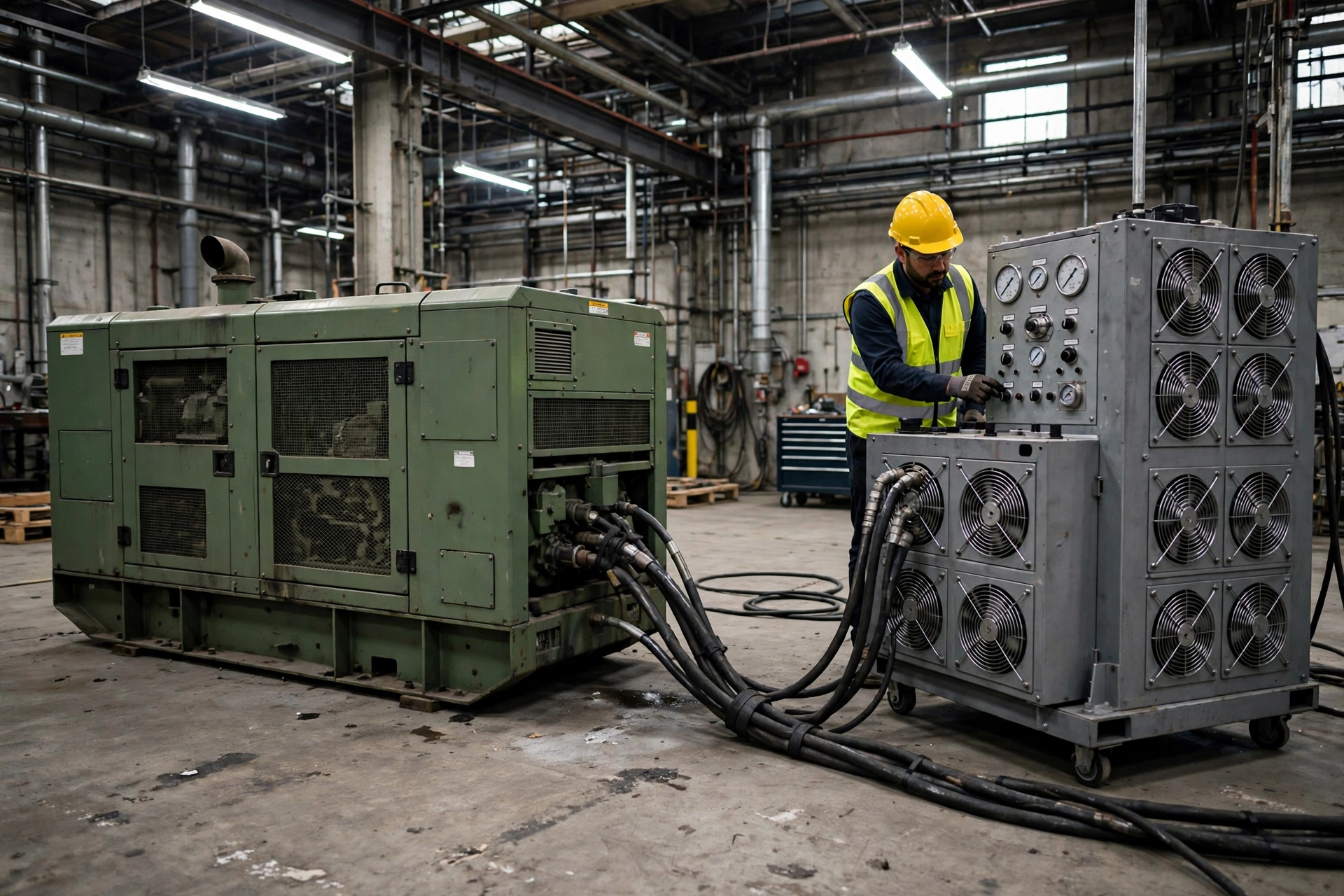
How a Proper Pre-Purchase Load Bank Test Runs
A standard pre-purchase test follows a staged step-up: 30–45 minutes at 25%, then 50%, then 75% of rated capacity, allowing the engine to reach operating temperature at each step, then at least one full continuous hour at 100% of rated load, and a brief surge check at 110%. The whole test runs a minimum of two hours. The staged steps matter: they heat-soak the cooling system, load the turbocharger, and expose the faults that a five-minute run never reaches. A seller who offers a fifteen-minute run at 50% load is offering a demonstration, not a test.
The Numbers the Set Must Hold
During the test, four numbers must stay inside their limits: voltage within ±5% of rated, frequency within ±1 Hz of rated (or ±0.5 Hz on a well-governed set), coolant temperature below the manufacturer’s alarm point — typically 95–104 °C on the gauge — and oil pressure steady within the manufacturer’s range. The set should also hold its load without hunting: a governor that surges the speed up and down under steady load is a governor, a fuel pump or an injector problem that will trip a UPS or stall a motor on the buyer’s site. Record the numbers at each step. A test with no recorded numbers is a test that never happened.
The Red Flags That End the Deal
Stop the deal, or renegotiate hard, if the set cannot reach full load, if voltage or frequency drifts outside limits under load, if coolant temperature keeps climbing at 75% load, if the exhaust produces continuous blue or white smoke under load, or if the set trips on any alarm during the test. Each of these is a repair measured in thousands: a radiator recore $1,500–4,000, an alternator rewind $3,000–8,000, an injector set $800–2,500 per injector, a major overhaul $18,000–30,000 on a 500 kVA engine. The load bank test exists to find these costs before the buyer owns them.
Three Used Sets, Three Outcomes
Case 1: A Lagos Rental Fleet 500 kVA — The Buy That Worked
A contractor in Lagos bought a 500 kVA Cummins-powered set from a rental fleet in 2023 for $38,000 — roughly 45% of the new price. The meter showed 9,800 hours, a high number, but the records showed oil changes every 250 hours, a full service history, and a load bank test at 100% for two hours before the sale. The buyer budgeted a full service on arrival and a spare AVR and fuel filters. Three years and 1,400 hours later, the set has needed one starter motor and one set of belts — $1,900 in total. High hours with complete records beat low hours with no records, and the load bank test was the proof that made the hours safe to buy.
Case 2: A Nairobi Hotel 250 kVA — The Bargain That Wasn’t
A hotel in Nairobi bought a 250 kVA standby set in 2024 for $14,000, a price 30% below comparable listings. The meter showed 1,900 hours and the canopy was freshly painted. There were no service records, no oil analysis, and the seller declined a load bank test, offering instead a fifteen-minute run at no load. The buyer accepted. In the first year the set needed a radiator recore ($2,800), two injectors ($3,400), a replacement AVR ($900) and a battery charger ($600) — $7,700 in repairs, plus three failed starts during grid outages. The fresh paint cost the seller perhaps $400. It cost the buyer $7,700 and the confidence of the hotel’s guests. The inspection that would have found all four faults cost less than the radiator alone.
Case 3: A Manila Construction Site 350 kVA — The Honest High-Hour Buy
A contractor in Manila bought a 350 kVA prime-power set with 12,400 hours in 2022 for $16,000, knowing it was near overhaul. The compression test showed even readings across all cylinders, the load bank test held 100% for an hour, and the price left room for the overhaul the buyer had already budgeted at $14,000. The set ran another 5,600 hours over two years before the overhaul, earning roughly $42,000 in rental-equivalent value against a total cost of $30,000. A high-hour set is not a bad buy when the buyer knows the hours, tests the engine, and prices the overhaul into the offer. It is a bad buy only when the buyer discovers the hours after paying.
Frequently Asked Questions
How to buy a used diesel generator?
Start with the hour meter, the service records and the nameplate, then inspect the set cold, check the oil, coolant and alternator, and demand a two-hour load bank test with one full hour at 100% rated load. Never buy on an unloaded idle run, and never pay before the test results are recorded.
How many hours is too many for a used diesel generator?
For a standby set, 2,000–3,000 hours is moderate and 6,000 hours is high; for a prime set, 8,000 hours puts the engine near the midpoint of its life. Industrial diesels are designed for 10,000–30,000 hours before overhaul, so the hours matter less than the maintenance record — a documented 10,000-hour set is a better buy than an undocumented 2,000-hour one.
What to check when buying a used diesel generator?
Check the hour meter against the controller log, the service records, the nameplate ratings and the emissions tier, then inspect for leaks, rust, oil and coolant condition, and the alternator and wiring. Start the engine cold, read the exhaust smoke, test for blow-by, and finish with a staged load bank test to full load.
How much does a used diesel generator cost?
A used industrial set typically costs 40–60% less than new: roughly $9,000–16,000 for 100 kVA, $17,000–30,000 for 250 kVA, $28,000–45,000 for 500 kVA and $55,000–90,000 for 1,000 kVA. Prices move 20–30% with engine brand, canopy, controller, emissions tier and location, and the buyer should budget a further 10–15% for inspection, service and first repairs.
Is it worth buying a used diesel generator?
Yes, for standby duty, when the set has complete service records, passes a cold start and a two-hour load bank test, and the price leaves room for a full service and a contingency. It is not worth it for prime or continuous duty at high hours, without records, or when the emissions tier bars the set from the site where it will work.
Buyer’s Inspection Checklist: Ten Checks Before You Pay
- Hour meter reading, cross-checked against the controller log and the manufacture date on the nameplate.
- Complete service records — oil, filters, coolant and oil-analysis results — with no unexplained gaps.
- Nameplate ratings confirmed: kVA, kW, voltage, phase, frequency and standby and prime power figures.
- Emissions tier confirmed against the rules of the site where the set will work.
- Physical inspection: leaks, rust, frame cracks, radiator condition, oil and coolant on the dipstick.
- Alternator and wiring inspected: copper windings, insulation class, tidy wiring, intact canopy and battery box.
- Cold start observed — block touched first, cranking time noted, gauges watched as it settles.
- Exhaust smoke read at startup and under load: black, blue and white each name a different fault.
- Blow-by checked at the oil filler cap, and a compression test run if any cylinder is suspect.
- Two-hour load bank test completed with one full hour at 100% load, voltage, frequency, temperature and oil pressure recorded at every step.
A used generator is not a gamble when it is bought this way. It is a calculated purchase: a machine with a known history, a tested engine, and a price that leaves room for the work it still needs. The sets that bankrupt their buyers are not the high-hour ones. They are the untested ones, bought on a clean canopy and a confident seller. Before the next listing tempts a quick decision, ask the seller for the records, the cold start and the load bank test — and contact PAVO for a new-set price to compare against, so the saving is measured against a real alternative, not against a guess.