

What Size Generator Do I Need for a Rice Mill? | PAVO
A rice mill does not just lose production when the grid fails. It loses the paddy sitting in hot water — and soaked paddy starts to ferment within hours, not days.
What size generator do I need for a rice mill? A 1–2 tonne-per-hour village mill needs a 60–125 kVA standby set, a 5–10 tonne-per-hour commercial mill 250–500 kVA, and a 240 tonne-per-day parboiling plant 1,000–2,000 kVA in parallel prime sets — sized for the milling line and the parboiling boiler house, not the whole site.
Contents:
- Why a Rice Mill Is Not Just Another Factory Load
- What the Generator Has to Power
- Sizing by Mill Capacity
- The Parboiling Problem
- What Happens in the First 60 Seconds
- Three Mills, Three Lessons
- Frequently Asked Questions
- Specification Checklist
Why a Rice Mill Is Not Just Another Factory Load
Rice is the largest food crop on earth by the number of people who eat it, and almost every tonne of it passes through a mill. The FAO forecast world rice production for 2024/25 at a record 538.9 million tonnes on a milled basis, with trade at 54.9 million tonnes and utilisation at 535.8 million tonnes. On a paddy basis the harvest is larger still: FAOSTAT put 2024 paddy production at about 820.2 million tonnes, with India at 217.9 million tonnes, China at 207.5 million tonnes, Bangladesh at 60.6 million tonnes and Indonesia at 53.1 million tonnes. Every tonne of that paddy has to be cleaned, husked, whitened, polished, graded and bagged, and most of it has to be dried or parboiled first. The mill is the bottleneck between the field and the table, and the mill runs on electricity.
The first difference from an ordinary factory is that the raw material is alive in the practical sense: paddy is a biological product with a moisture content that has to be managed every hour. Freshly harvested paddy arrives at 20–25% moisture and has to be dried to about 14% before it can be stored or milled safely. Paddy held wet ferments, heats and grows mould. A mill that loses power in the middle of a drying run does not just stop producing. It leaves tonnes of damp grain sitting in dryers and silos, and the clock on that grain is measured in hours. A warehouse can wait out a blackout. A wet paddy silo cannot.
The second difference is the parboiling line, which is where the largest rice mills in South Asia and West Africa make their money and take their risk. Parboiling soaks paddy in water, steams it and dries it again before milling, and the whole sequence is a timed chemical process. A traditional cold soak takes 36–38 hours to bring the kernel to 30–35% moisture; a modern hot soak at 50–70°C takes 3–4 hours. Steaming at 100–120°C gelatinises the starch in 2–15 minutes. Drying then has to bring the grain back down to about 14% in stages, with a tempering rest of about 4 hours in between. Every one of those steps is timed. A power cut that stops the soak pumps, the steam boiler feed and the dryer fans leaves paddy sitting in water that is cooling and fermenting, and the batch is written off before the grid comes back.
The third difference is that the mill’s own fuel is sitting in a pile outside the door. Husk is about 20% of paddy by weight, and a Sri Lankan energy audit of six mills found that 95% of the husk produced was burned in the mill’s own boilers for drying and parboiling, at a boiler efficiency of about 30%. A mill that processes 100 tonnes of paddy a day produces about 20 tonnes of husk a day. That is a free fuel stream, and it is also a dust explosion hazard, a fire load and a storage problem. The generator room, the husk pile and the boiler house have to be planned together, because the same dust that feeds the boiler will kill an air filter in a week.
The fourth difference is the market the mill serves. Rice milling is seasonal in a way almost no other industrial process is. Upstream of the mill, grain drying and storage on farms faces the same moisture clock, with smaller loads and the same dust. The harvest comes in a rush, the mill runs 12–16 hours a day for months, and then it stands idle. A mill that goes down in the middle of the harvest season does not lose a week of output — it loses the week its farmers cannot wait, because their paddy is sitting in the open and losing weight and quality every day. In Nigeria, where the grid is unreliable enough that millers run on diesel as a matter of routine, the cost of power decides whether a mill survives at all. As of May 2025 the country had 268 rice mills, and the smaller ones in Kebbi State were already shutting down, while the larger ones — WACOT, Labana, Lolo, Rayhaan and Sajo — were running only partially.
That combination is the whole subject of this article. Sizing a generator for a rice mill is not a matter of adding up the nameplate and buying the biggest set in the catalogue. It is a matter of deciding which loads must never stop, which loads can wait, and how long the paddy in the soak tanks can be left without power before the batch is lost.
What the Generator Has to Power
A rice mill has five load groups, and they do not matter equally in an outage. The sizing exercise starts by sorting them into three tiers: must never stop, must restart within minutes, and can wait until the grid returns.
Tier 1 — must never stop. The control system, the boiler safety controls, the dryer temperature monitoring, emergency lighting and the UPS that keeps the colour sorter and the PLC alive through the transfer. The load is small, typically 5–15 kW even on a large mill, but it is the load that decides whether the rest of the plant can be shut down safely. Lose the dryer temperature monitoring and a dryer full of paddy can overheat unseen. Lose the boiler controls and the steam supply is gone for the parboiling line.
Tier 2 — must restart within minutes. The milling line itself: pre-cleaner, destoner, rubber-roll husker, paddy separator, whiteners, polishers, graders and colour sorter, plus the elevators and conveyors that move grain between them, and the boiler feedwater and condensate pumps that keep steam available for parboiling. This is where the kVA lives. The polishers are the single largest consumer on the line, taking 30–40% of the mill’s electrical energy, and the husker is the most power-intensive stage per tonne at 5–8 kWh per tonne of paddy. All of these machines are induction motors, and they start against a loaded line.
Tier 3 — can wait. Bagging lines, warehousing, workshops, office loads and HVAC in non-critical areas. These are shed on transfer and restored when the grid returns. Putting them on the generator board is the most common sizing mistake in rice-mill backup design: it inflates the set by 20–30% and buys nothing, because a bagging line cannot run when there is no milled rice coming off the polisher.
The load split inside a typical commercial mill looks like this:
| Load group | Share of mill electrical load | On the generator board? |
|---|---|---|
| Polishers and whiteners | 30–40% | Yes — core production |
| Husker and paddy separator | 18–25% | Yes — core production |
| Pre-cleaner and destoner | 8–12% | Yes |
| Graders, colour sorter and elevators | 8–12% | Yes — sorter on UPS first |
| Dryers and parboiling auxiliaries | 10–15% | Selected only — fans and pumps |
| Boiler house (fans, feed pumps) | 5–8% | Yes — steam for parboiling |
| Controls, lighting, UPS | 1–3% | Yes — always |
| Bagging, warehousing, offices | 5–10% | No — shed on transfer |
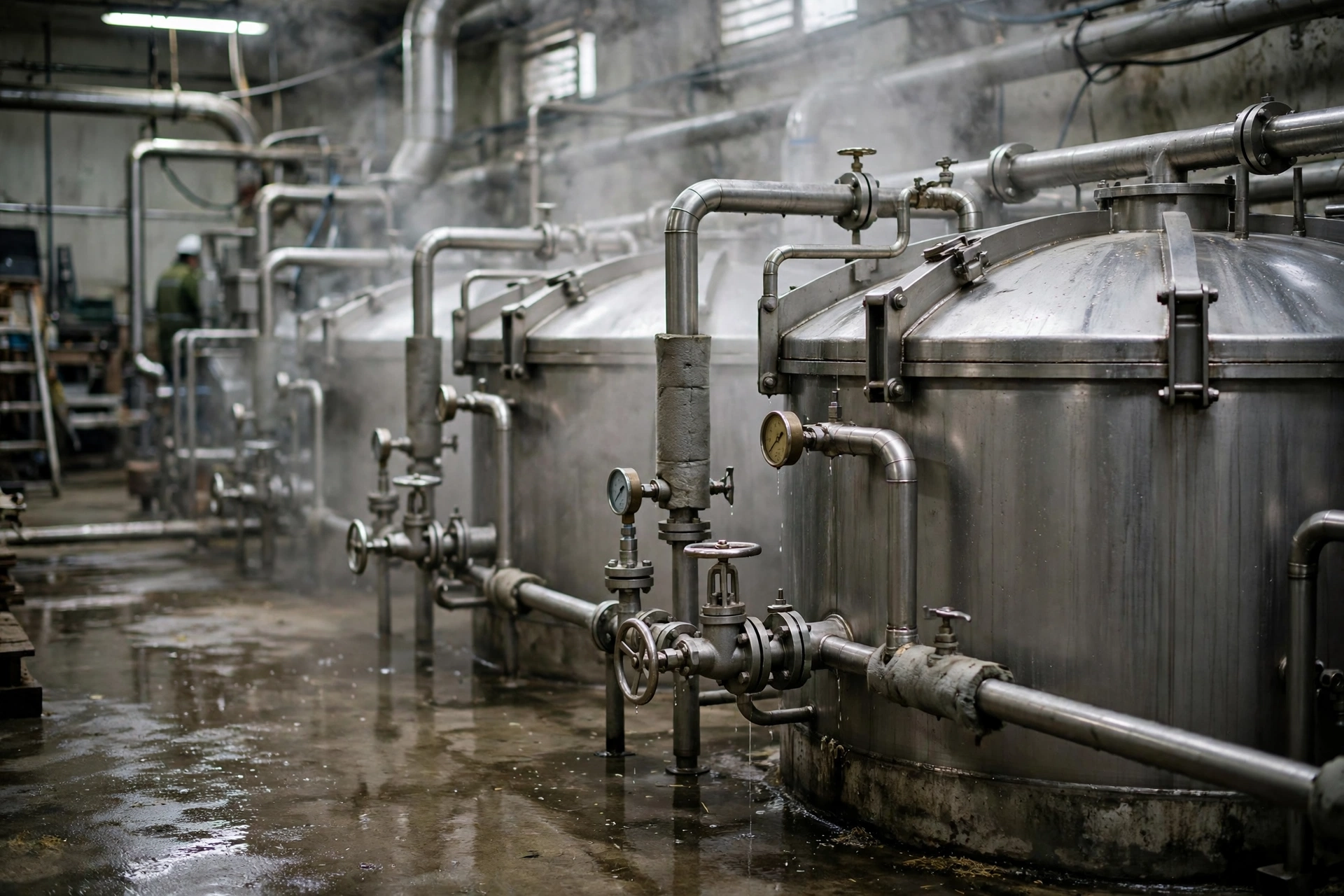
Two loads on that table deserve a closer look. The colour sorter is the most sensitive machine in the mill: it reads every grain with cameras and fires air jets to eject discoloured kernels, and it loses its calibration and its product stream if it drops out mid-run. It belongs on the UPS, with the generator picking it up after transfer, not on the raw generator board. The dryer fans are the opposite: they draw modest power, but they are the load that protects the paddy. A dryer full of wet grain with no airflow will heat, sweat and start to ferment within hours, and the grain in the middle of the bed is the first to go.
A modern mill uses 18–26 kWh of electricity per tonne of paddy, according to research published in the Journal of Food Science and Technology in 2012. Older semi-modern mills use more: a Sri Lankan audit measured 42.84 kWh per tonne in semi-modern mills and 41.10 kWh per tonne in modern ones, with thermal energy of 917–1,092 MJ per tonne on top for drying and parboiling. The electrical figure is the one that sizes the generator. A mill processing 100 tonnes of paddy a day at 25 kWh per tonne burns 2,500 kWh a day of electricity, and if it runs 12 hours that is an average load of about 210 kW — before motor starting is counted at all.
Sizing by Mill Capacity
Rice mills are sold by throughput in tonnes of paddy per hour, and the generator follows the same scale. The table below gives the working bands for a modern multi-stage mill running raw paddy, with the generator sized for the milling line plus the dryer and boiler auxiliaries, and with a 25% starting margin built in for the largest motor on the line. Parboiling mills need the upper end of each band, because the soak pumps, steam condensate return and dryer fans add 15–25% to the connected load.
| Mill capacity | Connected load | Generator (standby) | Generator (prime) | Fuel at full load |
|---|---|---|---|---|
| 0.5–1 t/h village mill | 15–30 kW | 30–60 kVA | 25–50 kVA | 7–12 L/h |
| 1–2 t/h small commercial | 25–60 kW | 60–125 kVA | 50–100 kVA | 12–25 L/h |
| 2–5 t/h medium commercial | 60–150 kW | 125–250 kVA | 100–200 kVA | 25–50 L/h |
| 5–10 t/h large commercial | 150–300 kW | 250–500 kVA | 200–400 kVA | 50–100 L/h |
| 10–20 t/h industrial mill | 300–600 kW | 500–1,000 kVA | 400–800 kVA | 100–200 L/h |
| 240 t/day parboiling plant | 600–1,200 kW | 1,000–2,000 kVA | 800–1,600 kVA | 200–400 L/h |
Three rules govern the numbers. First, the generator is sized on the running load plus the largest single motor start, not on the sum of every nameplate. A 22 kW polisher motor started direct-on-line draws six to seven times its running current for a fraction of a second, and that transient is what trips an undersized set. Soft starters or variable-frequency drives on the polishers and the husker cut that transient by more than half, and they are the cheapest kVA a mill owner will ever buy. The motor starting article works through the same maths for the general case.
Second, the duty rating matters more than the headline number. A mill that runs on the generator for a few hours during a grid failure needs a standby-rated set. A mill in northern Nigeria or rural Myanmar, where the grid is absent for whole days, needs a prime-rated set, and the prime rating is typically 10% lower than the standby rating for the same machine. A 500 kVA standby set is a 455 kVA prime set, and running it at standby load on prime duty will shorten its life. The difference between the two ratings is explained in the article on standby and prime power ratings.
Third, parboiling changes the answer. A raw-rice mill and a parboiling mill of the same throughput do not need the same generator. The parboiling plant adds soak pumps, hot-water circulation, steam condensate pumps, extra dryer fans and a boiler house that has to keep steam up while the mill runs. In a Bangladesh study of parboiled-rice mills, total energy ran at 708.5 kWh per tonne of paddy, of which biomass supplied 91.74% and electricity only 7.81% — but that 55.3 kWh per tonne of electricity was concentrated in the huller, the vibrating sieve and the water pumps, and it all had to be available at the same time. Budget 15–25% more generator capacity for a parboiling mill than for a raw mill of the same size.
A worked example makes the bands concrete. The same sizing discipline applies across food processing plants, but a rice mill adds the parboiling clock and the husk boiler to the calculation. Take a 5 tonne-per-hour commercial mill in Punjab, running 12 hours a day through the harvest season. Connected load is about 140 kW: pre-cleaner and destoner 7 kW, rubber-roll husker 22 kW, paddy separator 5 kW, four polishers at 18 kW each, graders and colour sorter 11 kW, elevators and conveyors 9 kW, dryer fans 15 kW and boiler auxiliaries 8 kW. At 22 kWh per tonne, the mill burns 2,640 kWh a day. The generator that carries it is a 250 kVA standby / 225 kVA prime set, running at about 70% load — the sweet spot for fuel efficiency and for wet-stacking avoidance. At full load a set of that size burns about 50 litres of diesel an hour, so a 12-hour harvest day on generator power costs 600 litres, and a 5,000-litre bulk tank gives eight days of autonomy. The set costs roughly $28,000–40,000 installed with an automatic transfer switch, and the tank and bunding add another $4,000–6,000. Against that, a single lost harvest week at 60 tonnes a day and a milling margin of $25–40 per tonne costs $10,500–16,800 in margin alone — before the spoiled paddy is counted.
The Parboiling Problem
Parboiling is the reason a rice mill’s backup-power problem is different from any other food plant’s. It is a timed hydrothermal process, and the mill has no control over the clock once the paddy is wet. The sequence is always the same — soak, steam, dry — and each step has a window that the power supply has to respect.
Soaking: the batch starts fermenting
Soaking is the longest and the most vulnerable step. In the traditional cold-soak method the paddy sits in water for 36–38 hours until the kernel reaches 30–35% moisture. In the modern hot-soak method the water is held at 50–70°C and the same moisture level is reached in 3–4 hours. Both methods share the same failure mode: if the circulation pumps stop and the water stops moving, the temperature falls unevenly, the grain at the bottom of the tank stays warm and wet, and fermentation starts. A long cold soak that goes wrong produces the sour smell millers know at once, and the mycotoxin risk that follows it. The practical limit is short. A soak tank that loses power for more than 4–6 hours in hot weather is a batch that has to be inspected grain by grain, and a soak that runs past 12 hours without circulation is usually written off. The generator’s job in this window is narrow and specific: keep the circulation pumps and the hot-water temperature control alive, which takes 10–20 kW on a mid-size plant, and keep the soak from becoming a loss.
Steaming: the starch window is minutes long
Steaming is the shortest step and the least forgiving. The soaked paddy is steamed at 100–120°C — typically 110°C for 2–15 minutes — to gelatinise the starch inside the kernel. Under-steaming leaves white, chalky centres that break in the polisher; over-steaming splits the husk and cooks the grain. The steam comes from the mill’s own boiler, and the boiler is fired on husk, so the fuel is not the problem. The problem is the feedwater pumps, the condensate return and the boiler controls, all of which are electric. Lose power mid-steam and the temperature in the steaming vessel falls within minutes. The batch in the vessel is lost — it cannot be re-steamed, because the starch has already partly gelatinised and the grain will crack on drying. On a 10 tonne-per-hour parboiling line, one lost steam batch is 5–8 tonnes of paddy, worth $2,000–3,500 at current paddy prices, plus the fuel and labour already spent on it.
Drying and tempering: the crack that shows up later
Drying is where a power cut does its quietest damage. The steamed paddy is dried in stages: hot air brings it to about 22% moisture in roughly 35 minutes, then it is tempered — left to rest for about 4 hours so the moisture evens out through the kernel — then dried again to 16–18% in about 30 minutes, and finally brought to about 14% with room-temperature air over up to 6 hours. Drying too fast in one pass cracks the kernel, and cracked kernels break in the polisher, which is where the miller discovers the loss — hours or days after the outage that caused it. A dryer that stops mid-cycle leaves wet grain sitting in a hot bed with no airflow. The grain in the middle heats, sweats and starts to ferment, and the grain at the edges cools and re-absorbs moisture. The damage shows up as a higher broken-rice percentage and a lower head-rice yield, and a 5-point drop in head-rice recovery on a 100-tonne day is 5 tonnes of broken rice sold at a discount of $80–150 per tonne. The generator’s job here is the dryer fans and the temperature monitoring — 15–30 kW on a mid-size mill — and it is the cheapest insurance in the plant.
What Happens in the First 60 Seconds
A rice mill’s power failure is not a single event. It is a sequence, and the first minute decides how much of the rest of the day is recoverable. The grid drops, the transfer switch decides, the generator starts, the loads come back in order — and in between, the milling line is full of grain that has stopped moving.
The transfer switch decides first
The automatic transfer switch is the component that matters most and gets the least attention. NFPA 110 requires a Level 1 emergency system to restore power within 10 seconds, and a modern ATS with a correctly set engine-start delay does it in 8–12 seconds from grid loss to generator on load. That is fast enough for the control system and the dryer fans. It is not fast enough for the milling line, which stops dead the moment the grid drops: the husker, the polishers and the elevators all stop with grain in them. The 10-second gap is unavoidable with a standby set, and the mill has to be designed around it. The colour sorter needs a UPS that bridges the gap. The PLC needs one too. Everything else is designed to restart cleanly, not to ride through.
Load shedding happens on its own
The second decision is the order in which loads come back. A generator that tries to pick up the whole mill at once will stall or trip on overload, because every motor on the line starts at the same time and draws its starting current together. The correct sequence is staged: controls and dryer fans first, then the boiler auxiliaries, then the milling line in order from the end backwards — graders and sorter first, then polishers one at a time, then the husker, then the pre-cleaner — with 5–10 seconds between each start. The generator sizing guide sets out the same staged-start method for the general case. On a rice mill the staging matters twice over, because a polisher that starts against a full load of grain draws more current than the same motor starting empty, and a husker that restarts with paddy packed between its rubber rolls can stall outright. The miller who restarts the line in the wrong order spends the next hour clearing chokes by hand.
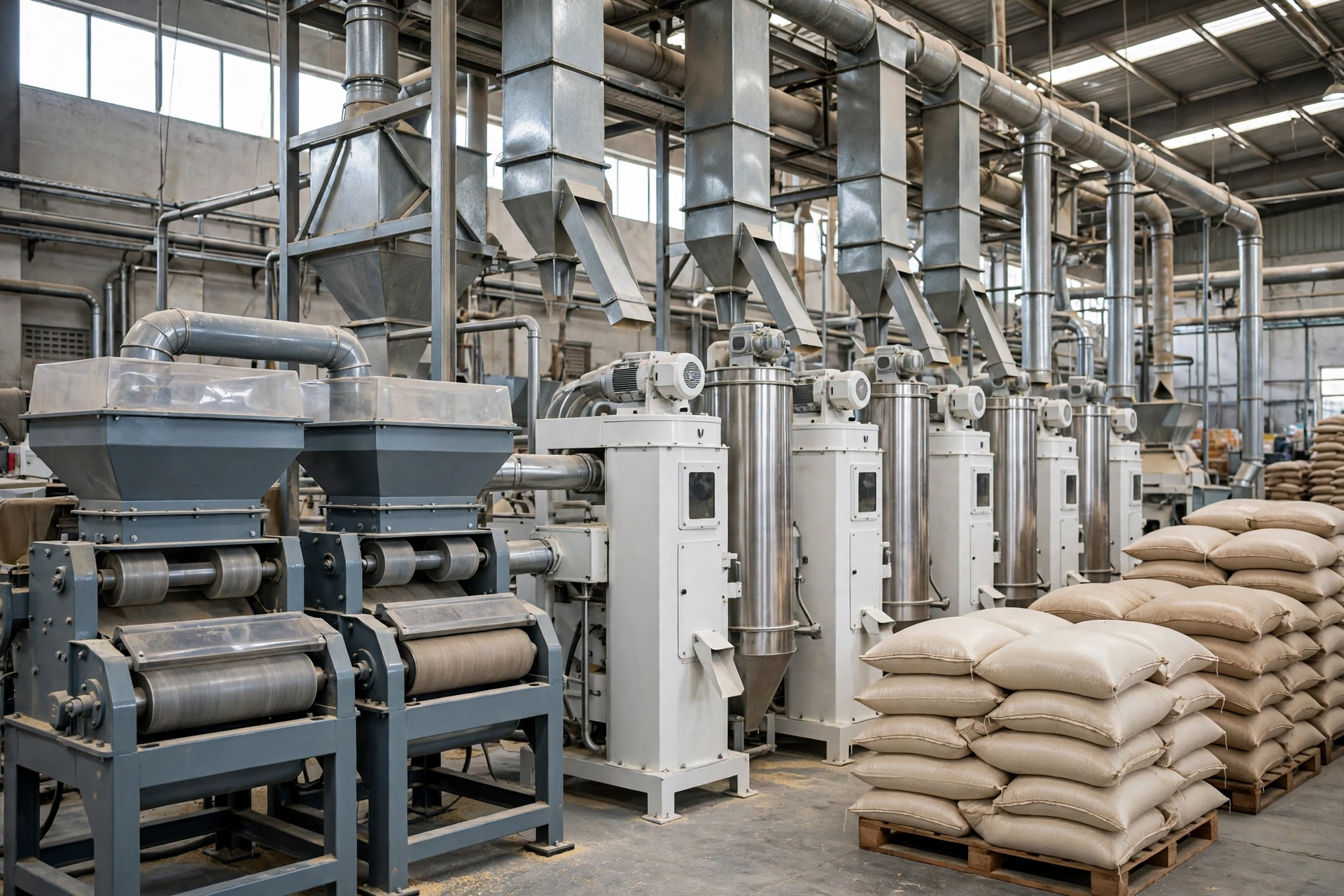
The mill chokes while it waits
The third event in the first minute is the one nobody plans for: the line is full. A modern milling line holds 200–400 kg of grain in its machines, elevators and spouts at any moment, and when the power stops, all of it stops where it is. The husker holds paddy between the rolls. The polishers hold brown rice in the whitening chamber. The elevators hold grain in their boots. If the generator is back in 10 seconds and the line restarts in the right order, most of that grain clears itself. If the restart takes 10 minutes — because the generator failed to start, or the ATS was in manual, or the fuel valve was shut — the grain settles, packs and bridges. The husker rolls have to be opened and cleaned. The polisher chambers have to be emptied by hand. The elevator boots have to be dug out. A 30-minute restart delay on a 5 tonne-per-hour mill costs 2.5 tonnes of lost production and an hour of clearing, and a mill that has to clear its husker by hand every time the power blips will do it twice a week in the harvest season. The fix is unglamorous: a weekly test run under load, a fuel system that is checked rather than assumed, and a starting battery that is replaced before it fails. The maintenance schedule article sets out the same weekly and monthly discipline for the general case.
Three Mills, Three Lessons
Kano, Nigeria: the mill that runs on diesel by default
Kano State in northern Nigeria is one of the country’s rice-milling centres, and it is also a place where the grid cannot be relied on for a full working day. After the withdrawal of the fuel subsidy, mills in Kano came to depend heavily on diesel generators, and the diesel price nearly doubled between 2023 and 2024. One Kano miller, Bala Dayyabu, described the arithmetic plainly: milling operations depended on the generating set, and the rising diesel price had pushed the cost of production up with it. Another operator had invested more than N50 million in machines — dryers, boilers, polishing and bagging machines, a borehole, transformers and giant generating sets — and then suspended production and laid off his workers, because the mill could not break even on diesel at over N1,000 a litre. Small-scale operators in the state were spending about N700,000 a month on energy alone. The lesson from Kano is not that a generator is optional. It is that in a market where the grid is unreliable, the generator is the mill’s primary power source in practice, and it has to be sized and costed as a prime-power machine — with the fuel budget, the service intervals and the spare-parts stock of a machine that runs every day, not as a standby set that runs once a month. A mill that buys a standby-rated set and then runs it 12 hours a day will be buying a replacement engine within two seasons.
Agricon West Africa: 240 tonnes a day, and the diesel bill that forced a switch
Agricon West Africa, established in 2022, built a rice-processing plant in Nigeria with a 240 tonne-per-day parboiling capacity, aimed at processing homegrown rice at scale and cutting the country’s dependence on imports. Energy was the biggest problem from the start. The plant ran on diesel generators, and the fuel bill dominated the operating cost while the output stayed limited. The company’s plant manager, Emmanuel Njin, put it directly: running diesel generators was a huge financial burden, responsible for a larger running cost with less output. The answer was a 1.5 MW Jenbacher gas engine plant running on compressed natural gas, supplied by Clarke Energy, which cut energy costs by 60–65% and halved fuel consumption against diesel. The lesson is not that every mill should switch to gas. It is that a parboiling plant at 240 tonnes a day is a prime-power load of 600–1,200 kW, and at that scale the fuel choice is the business decision, not an afterthought. A diesel set is the right answer for standby duty and for mills below 500 kVA. Above that, and above 2,000 running hours a year, the miller has to price diesel against gas, against husk-fired steam and against a grid connection, because the fuel bill will be larger than the capital cost of the set within two years. The diesel generator still has its place in that plant — as the black-start and emergency set that keeps the soak tanks, the boiler controls and the dryer fans alive when the gas plant itself is down.
Kaduna, Nigeria: $12 a day for a mill that shatters its own rice
Habibu Lawal is a rice miller in Kaduna State, and his mill is the other end of the scale from Agricon: a single old, inefficient one-stage mill, powered by a diesel engine, serving the farmers around him. He spends $12 a day on diesel alone to run it, and the ageing motor costs another $12 a month to service and repair. Worse, the outdated one-stage mill shatters a significant portion of the rice grains as the bran and husk are removed, cutting the amount of saleable milled rice from every kilogram of paddy he feeds into it. A Power Africa study found that a new two-stage electric mill could cut his operating costs by roughly 10% at a $0.60 per kWh tariff while increasing the yield of milled rice by 20–30% and improving the quality. He cannot make the change, because there is no financing and no reliable electricity in his community, so the noisy, unreliable and expensive diesel machine is his only option. The lesson from Kaduna is about the bottom of the market, and it is the one PAVO’s export customers should hear most clearly. A 60–125 kVA standby set on a village mill is not a luxury. It is the difference between a mill that runs and a mill that shatters its own product and still loses money. The set has to be simple — a mechanical governor, a Deep Sea or Smartgen controller the local technician can read, and an air filter that can be cleaned in the field — because the nearest service engineer is a day away.
The worked example: a 10 tonne-per-hour parboiling mill
Put the three lessons together and the specification writes itself. A 10 tonne-per-hour parboiling mill in Bangladesh, running 12 hours a day through the season, processes 120 tonnes of paddy a day and produces about 78 tonnes of white rice at a 65% milling recovery. Connected load is about 280 kW: milling line 190 kW, dryer fans 30 kW, boiler auxiliaries 25 kW, soak and condensate pumps 20 kW, controls and lighting 15 kW. The generator that carries it is two 500 kVA prime sets in parallel — 1,000 kVA in total, running at about 65% load, with one set able to carry the essential board alone if the other is down for service. A Cummins C500D5 of that size burns 93.2 litres an hour at prime full load, so the pair at 65% load burns about 120 litres an hour, or 1,440 litres for a 12-hour day. A 15,000-litre bulk tank gives ten days of autonomy, and the husk the mill produces — 24 tonnes a day — fires the boiler that makes the steam for parboiling, so the thermal load never touches the generator at all. Installed cost is roughly $180,000–240,000 for the two sets, the paralleling switchgear and the automatic transfer switch, and the payback against lost production is measured in a single harvest season.
Frequently Asked Questions
What size generator do I need for a rice mill?
A 1–2 tonne-per-hour village mill needs a 60–125 kVA standby set, a 5–10 tonne-per-hour commercial mill 250–500 kVA, and a 240 tonne-per-day parboiling plant 1,000–2,000 kVA in parallel prime sets. Size on the running load plus the largest single motor start, with a 25% starting margin, and add 15–25% for a parboiling line over a raw-rice mill of the same throughput.
Do rice mills need a backup generator?
Yes, unless the grid is genuinely reliable for the whole harvest season. A mill loses production, spoils soaked paddy and chokes its line in a single outage, and in markets such as northern Nigeria the generator is the mill’s primary power source in practice. The only mills that can do without one are those on a grid that has never failed during a harvest.
How long can a rice mill run on a generator?
As long as the fuel lasts, within the set’s duty rating. A standby-rated set is built for about 200 hours a year under ISO 8528, while a prime-rated set is built for unlimited hours at variable load. A 250 kVA set with a 5,000-litre tank runs a 5 tonne-per-hour mill for about eight 12-hour days, and a mill that runs on generator power every day needs a prime-rated set and a bulk tank, not a standby set and a day tank.
What happens to a rice mill during a power outage?
The milling line stops with grain in it, the soak tanks stop circulating, the steam boiler loses its feedwater pumps and controls, and the dryer fans stop. Soaked paddy starts to ferment within 4–6 hours in hot weather, a steam batch in progress is lost, and a dryer full of wet grain heats and sweats. A restart after more than 30 minutes usually means clearing the husker and the elevator boots by hand.
Can a diesel generator power a rice mill?
Yes. A rice mill is an induction-motor load, and a correctly sized diesel set with staged starting and soft starters on the polishers and the husker carries it without difficulty. The limits are the usual ones: the set must be sized for motor starting, not just running load; the parboiling boiler house and the dryer fans must be on the essential board; and a mill that runs on the generator every day needs a prime-rated set, because a standby set run at prime duty will not last.
Specification Checklist
Rating and duty
Buy the rating for the duty the mill will actually run. Standby for a mill on a reliable grid that fails a few times a year; prime for a mill that runs on the generator daily or for whole harvest weeks. Check the rating on the nameplate, not the brochure: a 500 kVA standby set is a 455 kVA prime set, and the 10% difference is the margin that keeps the engine alive. Parallel two smaller sets rather than buying one large one when the load exceeds 1,000 kVA, so one set can carry the essential board while the other is serviced.
Fuel autonomy and storage
Size the tank for the longest outage the mill has actually experienced, plus two days. A 5,000-litre tank serves a 250 kVA set for about eight 12-hour days; a 15,000-litre tank serves a 1,000 kVA parboiling plant for ten. Store diesel in a bunded tank, test it for water and microbes every quarter, and remember that diesel fuel ageing in a hot climate is faster than the textbook says. Keep the day tank full and the transfer pump tested, because a generator with an empty day tank is a sculpture.
Starting and transfer
Fit an automatic transfer switch with a 10-second transfer, a UPS on the colour sorter and the PLC, and soft starters or variable-frequency drives on the polishers and the husker. Stage the restart from the end of the line backwards, with 5–10 seconds between motor starts, and write the sequence on a laminated card next to the panel. Test the whole sequence under load every week, not once a season.
Placement, dust and the husk pile
Put the set upwind of the husk pile and the boiler house, on a concrete plinth with a bund, and fit a two-stage air filter with a restriction gauge. Rice husk dust is fine, abrasive and combustible, and it will block a standard air filter in days during the harvest. Keep the generator room ventilated — a 250 kVA set needs roughly 2–3 square metres of free louvre area — and keep the husk pile at least 10 metres from the set and the fuel tank. Check the exhaust stack height against the mill’s own dust cloud, and fit a rain cap that actually sheds water.
Testing, spares and the weekly run
Run the set under at least 50% load for 30 minutes every week, and under full load for two hours every month, with the load bank if the mill cannot provide it. A no-load weekly run tells the miller nothing about whether the set will take the milling line. Stock the spares that stop a harvest: fuel filters, oil filters, air filter elements, a set of V-belts, a starting battery and a spare AVR. A 125 kVA set’s spares stock costs less than $500; a single lost harvest day costs ten times that.
A rice mill is one of the few industrial loads where the backup generator pays for itself in a single season, and one of the few where getting it wrong spoils the product rather than merely stopping it. Size the set for the milling line and the parboiling boiler house, put the dryer fans and the soak pumps on the essential board, and test the whole system under load every week. For a generator sized to a specific mill — throughput, parboiling or raw, grid conditions and fuel autonomy — contact PAVO with the load list, and the rating will be confirmed before the set goes into production.