

What Size Generator Do I Need for an RV? Guide | PAVO
An RV air conditioner asks for three times its running power in the first second — and that one second decides whether the night is cool or the breaker trips.
What size generator do I need for an RV? A 30-amp RV with one 13,500 BTU rooftop air conditioner needs a 3,500–4,500 watt generator. A 50-amp coach with two air conditioners needs 6,500–8,000 watts. A small camper with no air conditioner runs on 2,000–2,400 watts.
Contents:
- What Size Generator Do I Need for an RV?
- How Long Will a Generator Run an RV Air Conditioner?
- Can a Diesel Generator Power an RV?
- What Is the Best Generator for an RV?
- Can I Plug My RV into a Generator?
- Noise, Campsite Rules and the Neighbours
- Frequently Asked Questions
- RV Generator Checklist Before You Buy
What Size Generator Do I Need for an RV?
The answer depends on two things: the rooftop air conditioner, and the RV’s electrical service. Everything else in the rig is small by comparison. A microwave draws 1,000–1,200 watts. A television draws 150. LED lights draw less than 100 watts combined. The air conditioner is the load that sets the generator size, and it sets it twice — once for running watts, once for starting watts.
A 13,500 BTU rooftop unit — the most common size on 30-amp travel trailers and Class C motorhomes — draws 1,300–1,800 watts while running and 2,800–4,000 watts for the half second its compressor starts. A 15,000 BTU unit draws 1,500–2,000 watts running and 3,200–4,500 watts starting. The surge is the number that trips undersized generators, which is why motor starting is treated as a sizing discipline of its own rather than a footnote. Size for the surge, then check the running watts.
| RV type / setup | Recommended generator size | What it covers |
|---|---|---|
| Camper van, no air conditioner | 2,000–2,400 W inverter | Fridge, lights, charging, laptop |
| 30-amp travel trailer, one 13,500 BTU AC | 3,500–4,500 W | One AC, converter, fridge, lights |
| 30-amp trailer, one 15,000 BTU AC | 4,000–4,800 W | Larger AC plus microwave, used carefully |
| Class C motorhome, one AC | 3,600–4,500 W | One AC, converter, fridge, microwave |
| 50-amp coach, two ACs | 6,500–8,000 W | Both ACs, converter, kitchen, water heater |
| Class A diesel pusher | 8,000–10,000 W onboard diesel | Two ACs plus full house loads |
These ranges come from the same generator sizing method used for houses: minimum generator size = total running watts + highest single starting watts + 10–20% headroom. The only difference is that an RV’s numbers are smaller and its ceiling is lower — a 30-amp RV cannot use more than 3,600 watts through its own shore cord, however large the generator is.
The load list every RV owner should make
Before shopping, list the loads that run at the same time. The table below uses typical figures; the nameplate on each appliance wins over any table.
| Load | Running watts | Starting watts |
|---|---|---|
| 13,500 BTU rooftop air conditioner | 1,300–1,800 | 2,800–4,000 |
| 15,000 BTU rooftop air conditioner | 1,500–2,000 | 3,200–4,500 |
| Microwave oven | 1,000–1,200 | 1,000–1,200 |
| Converter / battery charger, 45 A | 500–600 | 600 |
| Absorption fridge on AC | 300–600 | 300–600 |
| Electric water heater element | 1,440 | 1,440 |
| Television | 100–200 | 100–200 |
| LED lights, whole rig | 50–100 | 50–100 |
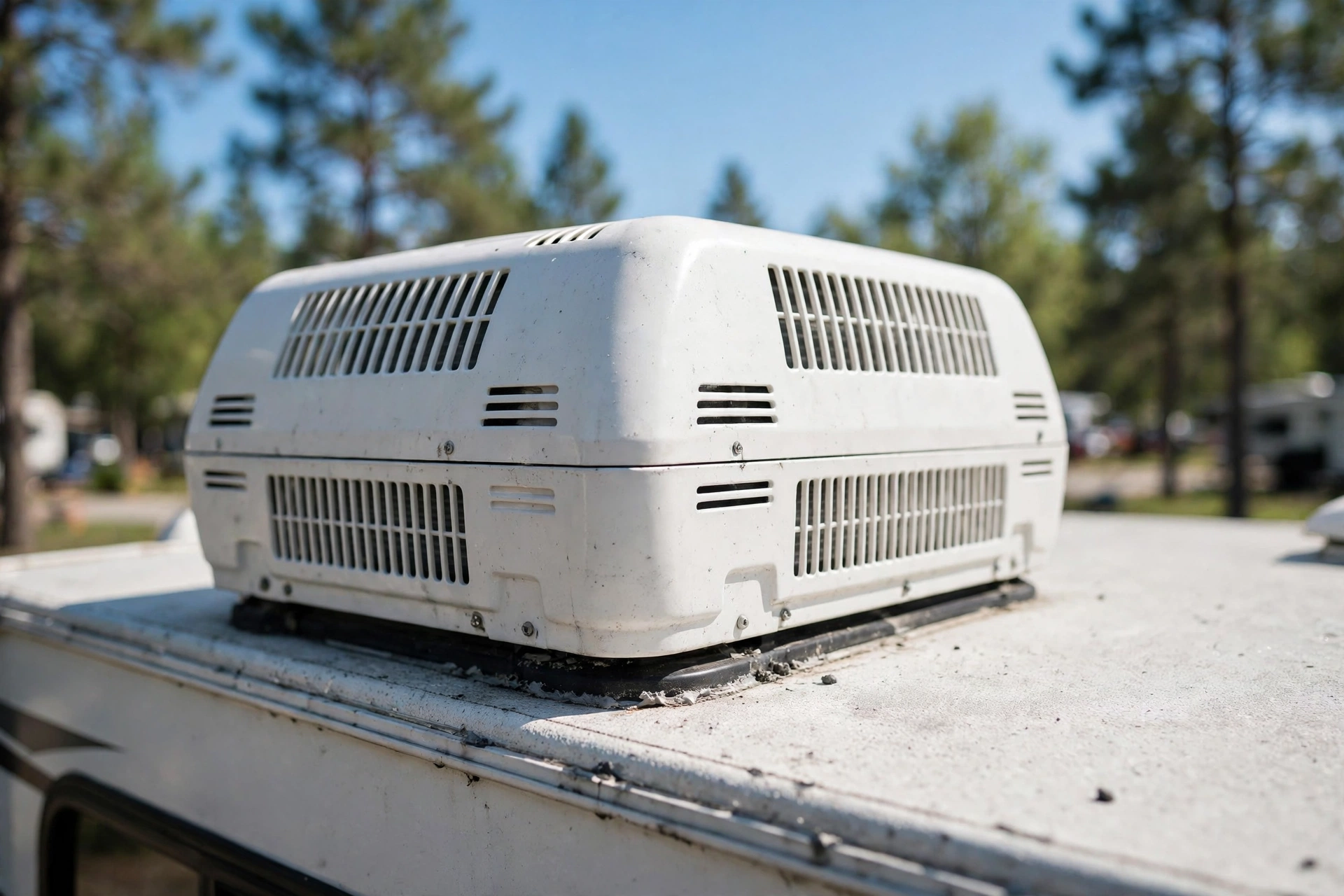
Take a typical evening in a 30-amp travel trailer in Texas heat. Air conditioner starting: 3,000 W. Converter bulk-charging a flat battery bank: 600 W. Fridge on AC: 400 W. Lights and television: 250 W. Total at the moment the compressor starts: 4,250 W. A 3,000 W generator trips. A 3,600 W generator is marginal — it works only if the converter is not charging and the fridge is on gas. A 4,000–4,500 W generator handles the same evening with headroom. That arithmetic is exactly why the 3,500–4,500 W class exists, and why a 3,000 W set disappoints owners who bought it for one air conditioner.
A soft starter changes the sum. Fitted to the rooftop unit, it cuts the compressor’s starting surge by 65–75%, dropping a 13,500 BTU start from about 3,000 watts to 1,700–2,200 watts. With a soft starter, the same trailer’s worst second becomes roughly 3,000 watts total — inside a 3,600 W generator’s capacity, and inside a pair of paralleled 2,200 W inverters. The device costs around $300, and the same air conditioner sizing logic that applies to a house applies here at smaller numbers: fix the surge before buying a bigger generator.
The 30-amp ceiling and the 50-amp ceiling
RV electrical service comes in two sizes, and the service — not the generator — sets the hard ceiling. A 30-amp RV runs on 120 volts at 30 amps: 120 × 30 = 3,600 watts maximum through its own shore cord. A 50-amp RV runs on 120/240 volts split-phase at 50 amps: 240 × 50 = 12,000 watts. A 4,500 W generator plugged into a 30-amp RV can only deliver 3,600 watts to the rig; the extra 900 watts sits unused behind the cord. That is not a defect. It is the reason 30-amp owners should buy a generator with a TT-30 outlet and stop at the 3,600–4,500 W class, and the reason 50-amp owners need a generator with a 120/240 V outlet and a 14-50 adapter.
The ceiling also explains why a 2,000 W inverter generator cannot run a standard rooftop air conditioner without help. The unit needs 2,800–4,000 watts for half a second, and the generator’s maximum is 2,000. No amount of load management changes that — the only fixes are a soft starter, a second paralleled unit, or a larger generator. Owners who report that their 2,000 W set “runs the AC fine” are usually describing a soft-started unit, a small 9,000–10,000 BTU unit, or a compressor that has not yet cycled on a hot afternoon.
How Long Will a Generator Run an RV Air Conditioner?
Runtime is a fuel question, and the answer is measured in litres per hour at the load the RV actually draws. A 3 kW petrol inverter generator burns about 0.7 litres per hour at 25% load, 0.9–1.1 litres per hour at 50% load, and about 1.33 litres per hour at full load. A 13,500 BTU air conditioner running steadily draws about 1,500 watts — roughly half the capacity of a 3,000 W set — so the burn sits near 1 litre per hour while the compressor runs.
The Honda EU2200i, the reference 2,200 W inverter in this class, carries a 3.6-litre (0.95-gallon) tank and is rated at 8.1 hours at 25% load and about 3.2 hours at rated load. Those figures describe a light load. With an air conditioner cycling at 60% duty on a warm night, the same set empties its tank in roughly four hours. The tank, not the engine, is the limit — which is why extended-run fuel caps and auxiliary tanks are a standard accessory for boondockers, and why onboard generators that draw from the vehicle’s own tank are a different proposition entirely.
One tank, one night
An eight-hour night with the air conditioner cycling at 60% duty needs about 7–8 litres of petrol on a 3,600 W inverter generator, or about 7.5 litres of diesel on an onboard Cummins Onan QD 3200 running at half load (0.3 gallons per hour, or 1.1 litres per hour). The numbers are close because the loads are close; the difference is where the fuel comes from. A portable set needs its tank refilled or an auxiliary tank fitted. An onboard set draws from the motorhome’s own fuel tank — until the pickup tube runs dry.
That pickup tube deserves attention. On most motorhomes the generator’s fuel pickup stops at about one-quarter of a tank, deliberately, so the generator cannot strand the vehicle. Owners of Winnebago Navion motorhomes on Sprinter chassis report the QD 3200 cutting out with the gauge still showing a quarter tank — about 6 gallons left in a 26-gallon tank — and the reserve light not yet on. The generator is not faulty. It is doing what it was designed to do. The practical rule is simple: treat a quarter tank as empty for generator purposes, and refuel before an overnight run, not during it.
The fuel bill for a week off-grid
A week of dry camping with the air conditioner running eight hours a day needs roughly 55–60 litres of fuel — about 15 gallons — at one litre per hour. At US prices of roughly $3.50 per gallon for petrol and $3.80 for diesel, that is $50–$60 for the week, before any daytime charging or cooking loads. Diesel carries about 129,000 BTU per gallon against petrol’s roughly 114,000, which is why a diesel set of the same output burns less per kilowatt-hour: the Onan QD 8000 makes twice the watts of a petrol QG 4000 and still burns only about half a gallon per hour at half load.
Fuel storage is the other half of the bill. A 20-litre jerry can is roughly 20 hours of air conditioning at half load on a 3 kW set, or 18 hours on a QD 3200. Two cans cover a long weekend. Four cans cover a week, and at that point the weight — about 17 kg per full 20-litre can — and the smell start to matter. Sites that run a generator for a full week usually carry the fuel in the vehicle’s own tank, which is the strongest argument for an onboard diesel set on a diesel motorhome: one tank, one fuel, one fill-up.
Can a Diesel Generator Power an RV?
Yes — and for a diesel motorhome it is the natural choice. A diesel generator shares the vehicle’s fuel, burns less per kilowatt-hour than petrol, and stores fuel that is far less volatile in a hot storage bay. The question is not whether diesel works in an RV. It is whether the owner wants an onboard diesel set, a portable diesel set, or a petrol inverter — and the answer depends on the rig.
| Fuel | Energy per gallon | Typical burn, 3–4 kW class | Noise | Weight | Best for |
|---|---|---|---|---|---|
| Diesel | ~129,000 BTU | 0.3–0.5 gal/h at half load | Higher, needs enclosure | Heavier | Onboard, diesel motorhomes |
| Petrol | ~114,000 BTU | 0.25–0.6 gal/h at half load | Lower, inverter sets 48–60 dBA | Lighter | Portable, trailers, vans |
| Propane (LP) | ~91,000 BTU | 0.31–0.8 gal/h at half load | Similar to petrol | Heavier (tank) | Trailers with LP already aboard |
The diesel vs gas comparison for a house applies here with one change: in an RV the fuel decision is also a storage decision. Petrol in jerry cans is a fire risk in a hot compartment and a smell that never quite leaves. Diesel is safer to carry, and a diesel motorhome already carries 60–100 litres of it. A petrol trailer has no diesel aboard at all, so a petrol inverter is the only sensible portable choice for it.
Onboard diesel: the quiet diesel option
Cummins Onan builds almost every onboard RV generator sold. The QD 3200, fitted to Sprinter-based Class B and small Class C motorhomes, is a 3,200-watt diesel set running on a 347 cc single-cylinder engine. Cummins publishes its fuel consumption as 0.2 gallons per hour at no load, 0.3 at half load and 0.4 at full load — 0.7, 1.0 and 1.4 litres per hour. The QD 8000, the standard set for large Class A diesel pushers, burns 0.49 gallons per hour at half load and 1.02 at full load. Both are enclosed, liquid- or air-cooled sets with a two-year or 2,000-hour warranty, started from a switch inside the coach.
Onboard sets have two weaknesses worth knowing. The first is the quarter-tank fuel pickup described above. The second is light-load running. A diesel engine run for hours below about 40% load burns fuel inefficiently and risks wet stacking — unburned fuel and carbon collecting in the exhaust — the same failure mode that affects standby sets in buildings. A QD 8000 idling along at 1,500 watts to charge phones is running at under 20% load. The fix is the same as on a construction site: load the set properly, run the air conditioner and the water heater together, and give it a proper loaded run rather than hours of idling. The standby rating of an onboard set is built for intermittent duty, not for continuous light-load running.
Portable diesel vs petrol inverter
Portable diesel generators below 3 kW are rare, heavy and loud compared with petrol inverters. A 3 kW diesel portable weighs roughly twice what a 3 kW petrol inverter weighs, and its open-frame engine runs 10–15 dB louder — enough to breach a 60 dB campground limit on its own. That is why the portable RV market is dominated by petrol inverters: a Honda EU2200i weighs 21 kg and runs at 48–57 dBA, a Yamaha EF2200iS is similar, and a 3,600 W RV-ready inverter with a TT-30 outlet weighs 25–30 kg and can be lifted by one person.
Diesel wins where the set is built in. An onboard diesel set is enclosed, muffled and mounted on the vehicle’s own isolation mounts, so its noise is contained in a way no portable diesel can match. It also shares the vehicle’s fuel system and service network: a diesel pusher’s owner services one fuel type, one filter set and one engine family. For a trailer owner with no diesel aboard, the petrol inverter is the right answer. For a diesel motorhome owner, the onboard diesel set is the right answer. Buying a portable diesel set to power a petrol trailer is the worst of both — heavy, loud and fed from jerry cans.
What Is the Best Generator for an RV?
There is no single best generator for an RV. There is a best generator for each rig, and the rig’s service — 30-amp or 50-amp — decides it before any brand comparison begins. A 30-amp trailer needs a 3,500–4,500 W inverter with a TT-30 outlet. A 50-amp coach needs 6,500–8,000 W with a 120/240 V outlet. A camper van with no air conditioner needs 2,000–2,400 W and nothing more. Buy the size first, then compare brands on noise, weight and service.
| Rig | Best generator type | Example class | Why |
|---|---|---|---|
| Camper van / Class B, no AC | 2,000–2,400 W inverter | Honda EU2200i, Yamaha EF2200iS | Light, quiet, charges batteries |
| 30-amp trailer, one 13,500 BTU AC | 3,600 W RV-ready inverter | WEN 3600, Champion 4500 | TT-30 outlet, clears AC start |
| 30-amp trailer, one 15,000 BTU AC | 4,000–4,800 W inverter | Pulsar PGD40ISCO, WEN 4800 | Headroom for microwave with AC |
| 50-amp fifth wheel / Class A, two ACs | 6,500–6,800 W inverter | WEN 6800, Westinghouse 6500 | Both ACs plus kitchen loads |
| Class A diesel pusher | Onboard diesel 8,000–10,000 W | Cummins Onan QD 8000 / QD 10000 | Shares coach fuel, push-button start |
| Sprinter Class B / small Class C | Onboard diesel 3,200 W | Cummins Onan QD 3200 | Fits the chassis, one fuel |
The portable generator market has settled on a few reliable names. Honda’s EU series remains the quietest, at 48–57 dBA, and the most expensive per watt. Yamaha’s EF series is close on noise and slightly cheaper. WEN and Champion sell the 3,600–4,800 W RV-ready class at roughly half the Honda price, with a factory TT-30 outlet that takes the RV’s shore cord without an adapter. Westinghouse and Pulsar cover the 6,500 W class for 50-amp coaches. All of them are inverter sets, which matters for an RV: inverter output is clean sine-wave power at stable frequency, safe for the converter, the television and the air conditioner’s control board. A conventional open-frame set’s frequency wanders with engine speed, and its voltage dips hard on a compressor start.
The 3,600-watt sweet spot
The 3,600 W class exists because of one sum: a 13,500 BTU air conditioner starting at 3,000 watts plus a 45-amp converter bulk-charging at 600 watts equals exactly 3,600 watts. A generator rated 3,600 watts starting and 3,000–3,200 watts running clears that second with nothing to spare — which is why owners who run the microwave while the air conditioner cycles still trip it. The class works when the owner manages loads: air conditioner on, converter charging, fridge on gas, microwave off. Turn the fridge to AC and the water heater to electric at the same moment, and the same set overloads.
Altitude makes the margin thinner. Most manufacturers derate output by about 3.5% per 1,000 feet, so a 3,600 W generator makes closer to 3,100 watts at a 7,000-foot Colorado campground. At that altitude the 3,600 W class no longer clears the 3,000 W air conditioner start plus the converter. Owners who camp high should buy the 4,000–4,500 W class, or fit a soft starter, or both. The same derating applies to every generator, petrol or diesel, and it is the reason a set that works at sea level in Florida trips on its first start in the Rockies.
Two small sets vs one big set
Paralleling two 2,200 W inverters gives 4,400 watts of starting power — more than a single 3,600 W set — with two advantages a single set cannot match. Each unit weighs about 21 kg, so one person can lift either; a 4,500 W inverter weighs 45–50 kg. And if one unit fails, the other still charges batteries and runs the lights. Honda’s EU2200i Companion carries the 30-amp outlet; the standard EU2200i does not, so the pair needs the Companion model and the official parallel kit, including the ground wire that bonds the two frames together.
The trade-off is cost and complexity. Two EU2200i units cost more than one 3,600 W inverter, need two fuel tanks filled, and need the parallel kit connected correctly. For a couple who already own one 2,200 W set, adding a Companion is the cheapest route to air conditioning. For a buyer starting from nothing, a single 3,600–4,500 W RV-ready inverter is simpler, cheaper and one machine to maintain. Either route works; the wrong route is a single 2,000 W set and a hope that the air conditioner starts.
Can I Plug My RV into a Generator?
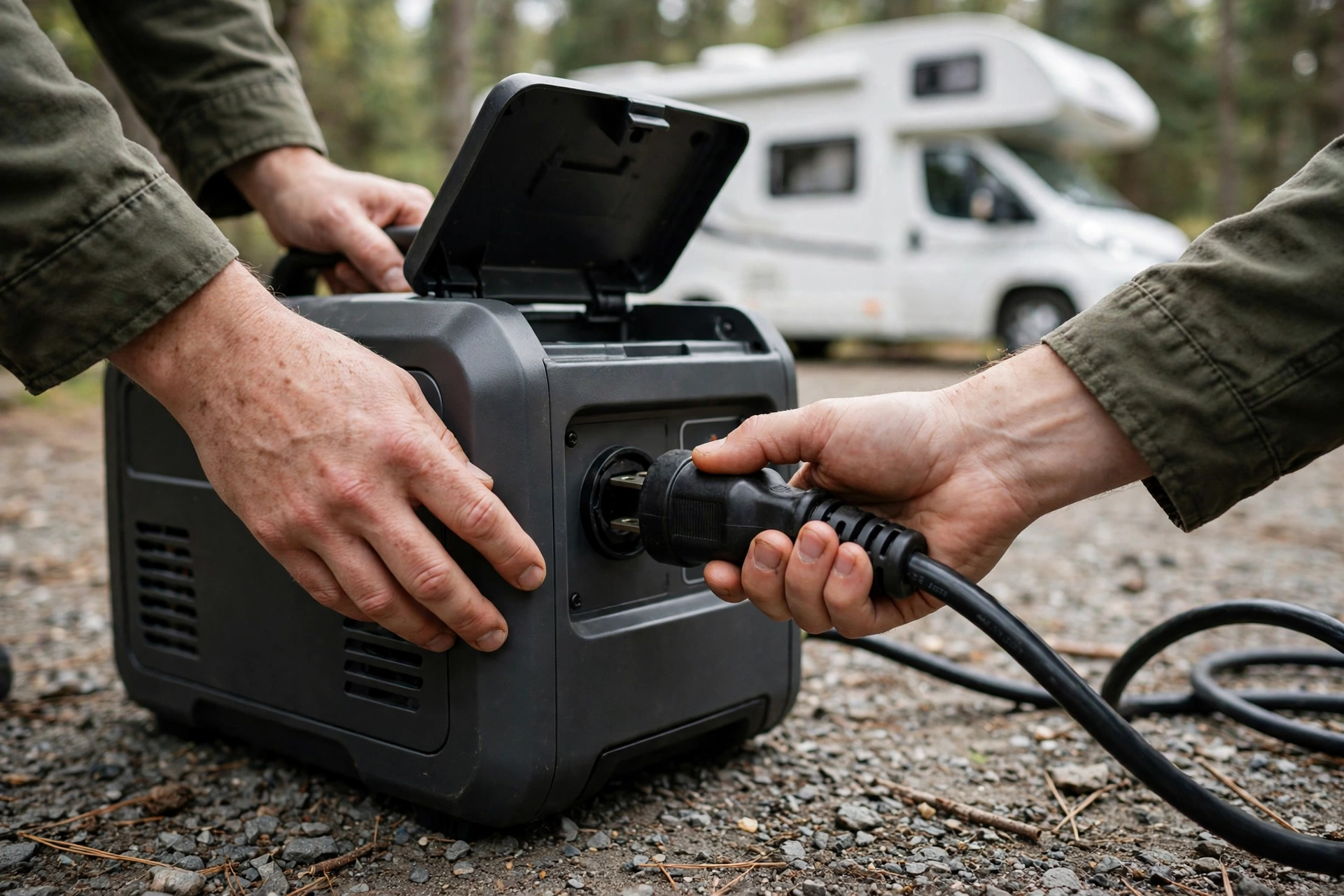
Yes — with the right outlet, the right adapter, and one rule that is never broken: the RV must never be connected to two power sources at the same time. The connection itself is straightforward. A 30-amp RV’s shore cord ends in a TT-30 plug: three prongs, 120 volts, 30 amps. It plugs directly into a generator with a factory TT-30R outlet, which most RV-ready inverters now carry. A 50-amp RV’s cord ends in a 14-50 plug: four prongs, 120/240 volts, 50 amps. It needs a generator with a 120/240 V twist-lock outlet and a dogbone adapter to the 14-50.
The mistakes happen with adapters. A generator’s 120/240 V twist-lock outlet carries two hot legs, and a proper dogbone adapter uses one hot leg plus neutral to give the RV 120 volts. A home-made adapter that ties both hot legs to the TT-30 sends 240 volts into a 120-volt RV system — and destroys the converter, the air conditioner control board and anything else plugged in, in seconds. Buy a name-brand adapter from Camco or a similar maker, check that it is wired for the outlet it plugs into, and never use a male-to-male “suicide” cord to backfeed the RV. Generator sizing is a numbers problem. Adapter wiring is a safety problem, and it does not forgive a guess.
The TT-30 connection
The TT-30 connection has one quirk that confuses first-time owners: the plug looks like a household plug but is not one. A TT-30 is rated 30 amps at 120 volts; a household 15-amp outlet is rated 15 amps at 120 volts. A dogbone adapter from a 15-amp household outlet to a TT-30 will power the RV’s lights and converter, but it will trip the household breaker the moment the air conditioner starts. That is correct behaviour — the adapter is not the limit, the 15-amp circuit is. The same logic applies the other way: a 30-amp RV plugged into a 50-amp pedestal through an adapter is limited to 30 amps by its own main breaker, and the pedestal’s extra capacity is unused.
Before plugging in, switch off the air conditioner, the water heater and the microwave at the RV’s breaker panel, connect the cord, start the generator, let it stabilise for a minute, then switch the loads back on one at a time. Starting a generator under full load is hard on the engine and the alternator, and it is the most common cause of a compressor failing to start on the first attempt. The same sequence applies to shore power: connect first, load second.
The floating-neutral trap and the bonding plug
Most portable inverter generators have a floating neutral — the neutral is not connected to the generator’s frame or ground. That is normal and legal for a portable set. It becomes a problem when the RV’s electrical management system (EMS) or surge protector checks the power and sees an open ground. The EMS reads the missing neutral-to-ground bond as a fault and refuses to pass power at all. The generator runs, the RV stays dark, and the owner concludes the generator is broken.
The fix is a neutral-ground bonding plug: a small plug, about $15 from Southwire, that connects neutral to ground inside the plug body and is inserted into any spare 15- or 20-amp outlet on the generator. It gives the RV’s electrical system the bond it expects from shore power, and the EMS passes power. Two cautions apply. First, the plug belongs only on a floating-neutral generator feeding an RV — never on a campground pedestal or a household outlet. Second, generators with GFCI-protected outlets are usually bonded at the factory already, because a GFCI requires it; adding a bonding plug to one of those sets trips the GFCI immediately. A three-light outlet tester, plugged into the generator, shows in seconds whether the set is floating or bonded. No grounding rod is needed for a single RV — a rod is required only when one generator distributes power to several RVs, which is a different job with different rules.
Noise, Campsite Rules and the Neighbours
Noise decides more RV generator purchases than watts do, because a generator that is too loud is a generator that cannot be used. Campgrounds measure noise in dB(A), and the scale is logarithmic: a 10 dB increase sounds roughly twice as loud. A quiet inverter generator runs at 48–57 dBA at quarter load, measured at 23 feet. A conventional open-frame generator runs at 67–74 dBA — roughly four times as loud to the ear — and is banned outright at many campgrounds. The noise level on a spec sheet is measured at 25% load, the quietest the set ever runs; at full load, with the air conditioner cycling, the same set is several decibels louder.
What 60 dB actually means
Sixty decibels is normal conversation. It is also the most common campground limit. The US National Park Service caps generator noise at 60 decibels in its campgrounds, and many private parks copy the figure. An inverter set at 52–58 dBA passes. An open-frame set at 70 dBA does not, and no muffler accessory or plywood box reliably brings it under the limit — the exhaust is only part of the noise; the engine block and the cooling fan make the rest. Distance helps: doubling the distance from the set drops the level by about 6 dB, which is why the set belongs as far from the neighbouring pitch as the cord allows, exhaust pointed away from other sites, never under a neighbour’s window.
Generator hours and quiet hours
Most campgrounds restrict generator use to set hours. Shenandoah National Park’s Loft Mountain Campground allows generators from 8–10 a.m. and 4–7 p.m., with a 60 dB limit, and enforces quiet hours from 10 p.m. to 6 a.m. Cherry Hill Campground in New York allows only closed-frame inverter generators under 60 dB, and bans generator use entirely during quiet hours from 11 p.m. to 7 a.m. North Shore Campground caps generators at 70 dB, allows them only from 8 a.m. to 8 p.m., and does not allow commercial-grade or diesel generators at all. Some parks ban generators entirely in designated generator-free zones.
The practical consequence is that a generator cannot run an air conditioner all night at most campgrounds — the hours simply do not allow it. An RV owner who needs overnight cooling has three options: book a site with hookups, fit a soft starter and run a battery bank through the night with the generator recharging during allowed hours, or camp where the rules allow it. None of those options is fixed by buying a bigger generator. Check the specific campground’s rules before arrival; a quick call avoids arriving with a set that is not welcome at that particular park.
Frequently Asked Questions
What size generator do I need for an RV?
A 30-amp RV with one 13,500 BTU rooftop air conditioner needs a 3,500–4,500 watt generator. A 50-amp coach with two air conditioners needs 6,500–8,000 watts. A camper van with no air conditioner runs on 2,000–2,400 watts. Size for the air conditioner’s starting watts, not its running watts, and add 10–20% headroom.
Can a diesel generator power an RV?
Yes. Diesel generators power RVs every day, most commonly as onboard Cummins Onan Quiet Diesel sets — the QD 3200 at 3,200 watts for Sprinter-based motorhomes and the QD 8000 at 8,000 watts for Class A diesel pushers. Diesel shares the coach’s fuel tank, burns about 0.3 gallons per hour at half load on a QD 3200, and is safer to store than petrol. A portable diesel set is rarely the right choice for a petrol trailer.
How long will a generator run an RV air conditioner?
A 3,600 W inverter generator runs a 13,500 BTU air conditioner for about 7–8 hours on a full tank at typical cycling, burning roughly 1 litre of fuel per hour. A Honda EU2200i with a 3.6-litre tank lasts about 4 hours with the air conditioner cycling at 60% duty. An onboard diesel set runs as long as the vehicle’s tank allows, but its fuel pickup stops at about a quarter tank.
What is the best generator for an RV?
The best generator depends on the rig. For a 30-amp trailer with one air conditioner, a 3,600 W RV-ready inverter with a TT-30 outlet, such as the WEN 3600, is the best value. For a 50-amp coach with two air conditioners, a 6,500–6,800 W inverter is the right size. For a diesel motorhome, the onboard Cummins Onan Quiet Diesel set is the best option. For a camper van with no air conditioner, a 2,200 W inverter is enough.
Can I plug my RV into a generator?
Yes, using the RV’s own shore cord. A 30-amp RV plugs into a generator’s TT-30 outlet, and a 50-amp RV needs a 120/240 V outlet with a dogbone adapter to its 14-50 plug. Most inverter generators have a floating neutral, so an EMS may refuse power until a neutral-ground bonding plug is fitted. Never use a male-to-male cord, never connect two power sources at once, and never use a home-made adapter that could send 240 volts into a 120-volt RV.
RV Generator Checklist Before You Buy
- Read the air conditioner nameplate. Note the BTU rating and the LRA. A 13,500 BTU unit needs 2,800–4,000 starting watts; a 15,000 BTU unit needs 3,200–4,500.
- Check the RV’s service. 30-amp means a 3,600 W ceiling through the shore cord; 50-amp means 12,000 W. Buy the generator to match the service, not the other way round.
- Add up the worst second. Highest starting watts plus the running watts of everything else on at that moment, plus 20% headroom. That total is the minimum generator size.
- Check the noise figure at full load, not quarter load. Under 60 dBA at 25% load is the campground target; open-frame sets at 67–74 dBA are banned at many parks.
- Check the campground rules before the trip. Generator hours, decibel caps and diesel bans vary park by park, and a set that is legal at one park is not welcome at the next.
- Test the whole combination before the first trip. Plug in, fit the bonding plug if the EMS demands it, start the air conditioner on generator power, and run it for an hour. A failure in the driveway is a lesson. A failure at a campground at midnight is a ruined weekend.
Size the generator for the first second, not for the afternoon. The air conditioner will run happily on modest power for hours — but it will only start if the set can deliver the surge, and it only gets one chance per thermostat cycle. Read the nameplate, do the starting-watts maths, fit a soft starter if the set is marginal, and test the combination on generator power before the campsite. For a set matched to the rig’s real loads, contact PAVO with the RV’s service size, air conditioner BTU rating and load list, and the right frame can be quoted against numbers instead of guesses.