

What Size Generator Does a Hotel Need? Guide | PAVO
A hotel does not lose power the way an office does. An office sends people home. A hotel has 200 guests asleep on the sixth floor, a kitchen full of food going warm, and a lift full of people between floors.
What size generator does a hotel need? A 60-room boutique hotel needs 100–150 kVA, a 150-room hotel needs 250–400 kVA, and a 400-room resort needs 800–1,500 kVA or two sets in parallel. The deciding loads are the chillers, the lifts and the kitchen, not the room count alone.
Contents:
- Why a Hotel Is Not Just a Big House
- The Three Load Tiers: What Must Stay On
- Sizing the Set: From Boutique to Resort
- Motor Starting: Chillers, Lifts and Pumps
- How Quiet Does a Hotel Generator Need to Be?
- How Long Can a Hotel Run on a Generator?
- Three Hotels, Three Outages
- Frequently Asked Questions
Why a Hotel Is Not Just a Big House
A hotel is the hardest common building to back up, because it is four buildings at once. It is a residence, with people sleeping in it. It is a restaurant, with cold storage that cannot warm up. It is a machine room, with chillers, pumps and lifts that draw starting currents several times their running current. And it is a business that sells the night itself — a guest who spends one night in the dark does not come back, and writes about it.
That combination changes every sizing assumption. An office generator can be sized for a 9-to-5 load profile and a planned evacuation. A hotel generator must be sized for 2 a.m. on a Saturday in August, with the building full, the kitchen cold rooms at temperature, the chillers running, and the lifts in use. The peak is not a spreadsheet figure. It is a real hour, and it happens every week.
It also changes the failure mode. When an office generator fails to start, the cost is a lost morning. When a hotel generator fails to start, the cost is a building full of guests in a dark stairwell, food safety timers running out in the cold rooms, and a front desk fielding refund demands before dawn. One 2026 hospitality maintenance guide reports that one in three hotel generators still fails to start on the first attempt during a real outage — a figure that explains why testing discipline matters as much as the kVA figure on the quotation.
The regulatory position is stricter too. A hotel is not a private house with a portable set. In most jurisdictions it falls under the same emergency power rules as other public buildings: life safety loads must transfer within 10 seconds under NFPA 110 Type 10, and the system must be tested weekly and monthly whether or not an outage has happened. Do hotels need a backup generator? In practice, yes — building codes require emergency power for life safety systems in hotels above a certain height or occupancy, and the market requires the rest. A hotel without backup power is a hotel that closes the first time the grid fails on a full weekend.
The Three Load Tiers: What Must Stay On
No hotel backs up everything. The specification that works is a tiered load list, agreed before the set is sized, and wired through separate distribution boards so the generator never has to argue with itself about what matters.
Tier 1 — Life Safety: Non-Negotiable
These loads transfer within 10 seconds — the 10-second ATS gap between grid failure and generator power — and run for as long as the outage lasts. Emergency lighting and exit signage, fire alarm and detection, the fire pump, smoke extraction fans, lift recall to the ground floor, and emergency communications. NFPA 110 classifies these as Level 1 systems — failure could result in loss of life — and the authority having jurisdiction decides the exact list. A hotel that puts anything else on the life safety board has misunderstood the standard.
The life safety load is usually smaller than people expect: 30–60 kVA on a mid-size hotel. The fire pump is the large item in it, and it is often the reason the whole set jumps a frame size. A 45 kW fire pump starting direct-on-line can draw 250–300 A for a few seconds, and that transient has to be carried without dropping the voltage below the level the emergency lighting and the alarm panel will tolerate. A hotel above six storeys faces the same evacuation and lift problem as any tall building, and the high-rise emergency power rules apply to its life safety loads.
Tier 2 — Guest Comfort: What Keeps the Hotel Open
Guest room lighting and sockets, one lift in normal service, hot water, kitchen cold storage, reception and Wi-Fi, CCTV and access control, and the water booster pumps. These are the loads that decide whether guests stay or leave. Lose the cold rooms and the kitchen writes off a night of food. Lose the hot water and the morning’s check-outs turn into complaints. Lose the Wi-Fi and the business guests leave for the hotel across the road.
Tier 2 is where the kVA figure is made. A 150-room hotel typically carries 150–250 kVA of Tier 2 load at peak, dominated by the chillers and the kitchen. The temptation is to add Tier 2 loads one at a time until the set is sized for the whole building by accident. The discipline is to list them, price them, and choose.
Tier 3 — Revenue and Discretionary: What Can Wait
Full air conditioning to every room, spa and pool heating, ballroom and function lighting, laundry, decorative lighting, and EV chargers. These loads earn money, and on a full house they are worth carrying — but they are the first to be shed when the set is under strain, and the first to be left off when the budget is tight.
The honest way to handle Tier 3 is a load-shedding scheme, not a bigger generator. A staged contactor that drops the laundry and the pool heaters for the first 60 seconds, then reconnects them once the set has taken the Tier 1 and Tier 2 loads, costs a fraction of the next frame size and protects the voltage when it matters most.
| Tier | Loads | Typical share of a 150-room hotel | Transfer |
|---|---|---|---|
| 1 — Life safety | Emergency lighting, fire alarm, fire pump, smoke extraction, lift recall | 30–60 kVA | Within 10 seconds, automatic |
| 2 — Guest comfort | Rooms, one lift, hot water, cold storage, reception, Wi-Fi, water pumps | 150–250 kVA | Within 10 seconds, automatic |
| 3 — Revenue | Full HVAC, spa, pool, ballroom, laundry, EV chargers | 100–200 kVA | Staged, or shed |
| Total if everything is backed up | 280–510 kVA |
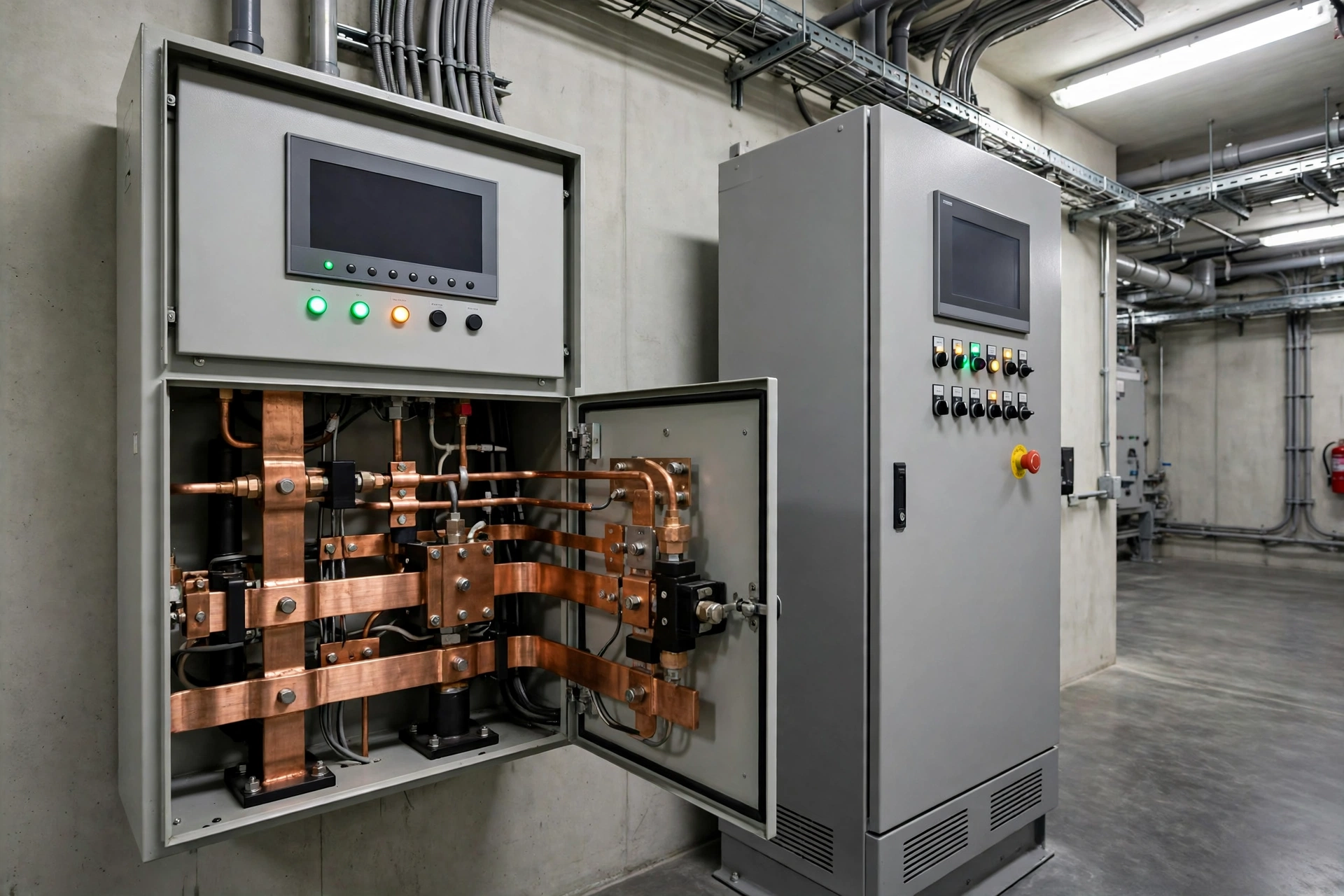
The table is the whole argument for tiering. Back up everything and a 150-room hotel needs a 500 kVA set. Back up Tiers 1 and 2 and shed Tier 3, and the same hotel runs on a 300–400 kVA set, burns roughly a third less fuel, and still keeps every guest safe and comfortable. The same logic applies to commercial building backup power in general — the life-safety-versus-revenue split is the core of that discipline — but a hotel feels the split more sharply, because its revenue loads are also its reputation loads.
Sizing the Set: From Boutique to Resort
Sizing starts from the load list, not from the room count. Two 150-room hotels can need sets 100 kVA apart: one with a central chiller plant and a full commercial kitchen, another with split air conditioning units and a breakfast-only kitchen. Room count is a sanity check, not a specification. The generator sizing guide method — list every load with running and starting figures, sum them, add 20–25% reserve — is the only method that survives contact with a real building.
The Boutique Hotel: 40–80 Rooms
A 40–80 room boutique or guesthouse typically needs 100–150 kVA. Loads are modest: split air conditioning or a small VRF system, a kitchen with two or three cold rooms, one or two lifts, and domestic hot water from heat pumps or a boiler. The largest single motor is usually a 15–22 kW chiller compressor or a 7.5 kW water pump.
At this size the choice is usually a single silent canopy set, 400 V three-phase, with a sub-base tank of 300–500 litres. A 125 kVA set at 75% load burns about 19 L/h, so a 500-litre tank gives roughly 26 hours — enough for the grid failures a boutique hotel actually sees, with a fuel delivery on day two. Installed cost at the commonly quoted $400 per kW works out to roughly $40,000–$48,000 for the set and installation, before the ATS and the civil works.
The Mid-Size Hotel: 120–200 Rooms
A 120–200 room hotel is the most common hotel generator size in the world, and the range is wide: 250–400 kVA. The spread comes from the chiller plant. A hotel with a 200 kW central chiller and a full kitchen sits at the top of the range. A hotel with VRF units in the rooms and a smaller kitchen sits at the bottom. Resort and island specialists put mid-size hotels at 200–800 kW of demand depending on cooling and pump loads, which is 250–1,000 kVA at 0.8 power factor — a reminder that “mid-size” covers a lot of ground.
The 240-room property used as the worked example in a 2026 hotel maintenance guide runs a single 400 kW diesel set — 500 kVA — which is at the top of this band because it carries guest rooms, lifts, fire pumps and point-of-sale systems through a 96-hour outage scenario. That is a full-backup specification, not a Tier 1-and-2 specification. The difference between the two is about one frame size and roughly $30,000 in set cost.
The Large Hotel and Resort: 250 Rooms and Up
A 250–400 room hotel needs 500–800 kVA, and a 500-room resort with a central plant, multiple restaurants and a spa needs 1,000–2,000 kVA, usually as two sets in parallel rather than one large set. Large resorts and mixed-use developments are quoted in the 1,000–3,550 kW class, and at that scale the right question is not “how big” but “how many”. Two 800 kVA sets in parallel give N+1 redundancy: one set carries the night load alone, both carry the day load, and a failure on one set leaves the hotel running instead of dark.
Parallel sets also solve the wet stacking problem that kills single large sets in hotels. A hotel’s load swings hard between 2 a.m. and 2 p.m. — a single 1,500 kVA set running at 15% load at 3 a.m. will glaze its cylinders within a season. Two sets let the controller shut one down at night and keep the other above 40% load, where a diesel engine is happy.
| Property | Rooms | Typical set size | Fuel at 75% load | 24-hour fuel |
|---|---|---|---|---|
| Boutique / guesthouse | 40–80 | 100–150 kVA | 15–23 L/h | 360–550 L |
| Mid-size hotel | 120–200 | 250–400 kVA | 38–62 L/h | 920–1,490 L |
| Large hotel | 250–400 | 500–800 kVA | 77–123 L/h | 1,850–2,950 L |
| Resort, full house | 500+ | 1,000–2,000 kVA (parallel) | 154–308 L/h | 3,700–7,400 L |
The fuel figures use the Cummins C500D5 datasheet as the anchor — 93.2 L/h at full prime load and 69.9 L/h at 75% for a 455 kVA prime rating — scaled by kVA. They are planning figures, not quotations. The datasheet for the set actually bought is the authority, and any quotation that states fuel consumption without stating the load percentage it was measured at should be returned for clarification.
The other sizing rule that catches hotels out is the square-footage shortcut. One cost guide quotes 50 kW plus 5 W per square foot as a rough hotel estimate. On a 100,000 sq ft hotel that gives 550 kW — 688 kVA — which is a reasonable upper bound for a full-backup specification, and a gross overestimate for a Tier 1-and-2 specification. Use it to check a load-list calculation, never to replace one.
Motor Starting: Chillers, Lifts and Pumps
The running load of a hotel is rarely the problem. The starting load is. A hotel is full of induction motors that draw five to seven times their running current for the first second, and they tend to start at the worst possible moment — the instant the generator has just taken the load.
The Chiller Compressor
The chiller is the largest single motor in most hotels. A 150 kW screw chiller compressor draws about 190 kVA running, and roughly six times that — over 1,100 kVA of transient demand — if it starts direct-on-line. No hotel generator is sized for that. The solutions, in order of cost, are a soft starter, which cuts the inrush to roughly 2.5–3 times running current, or a variable-speed drive, which cuts it to 1.2 times or less.
The difference is a frame size. A 400 kVA set that cannot start a direct-on-line chiller can start the same chiller on a soft starter with room to spare. This is why the chiller starting method belongs in the generator specification, not in a separate HVAC document. The motor starting discipline — locked-rotor kVA, starting method, and voltage dip — decides hotel generator sizes more often than the running load does.
The Lift
A traction lift is the second problem motor, and it is worse than the chiller in one respect: it starts and stops all day. A 15 kW lift motor draws about 19 kVA running and 95–115 kVA for the second it accelerates a full car. A hotel with three lifts that all call at once after a power cut — which is what happens when the lights come back on — can see a 300 kVA transient on top of its running load.
The standard answer is sequencing. The lift controller staggers the cars so only one accelerates at a time, and the generator specification assumes one lift starting at a time, not three. The other answer is a modern gearless lift with a regenerative drive, which draws far less starting current and, on the way down, returns a little power. A hotel that is replacing its lifts should ask the lift supplier for the starting kVA figure in writing, because it goes straight into the generator calculation.
The Pumps
Fire pumps, water booster pumps and sewage pumps are smaller individually but they start without warning. A 7.5 kW booster pump draws 9.4 kVA running and 56 kVA starting. A 45 kW fire pump draws 56 kVA running and 340 kVA starting direct-on-line — and unlike the chiller, the fire pump cannot be put on a soft starter in many jurisdictions, because the fire code wants the pump to start at full torque, immediately, every time.
That is the single most common reason a hotel generator jumps a frame size: not the rooms, not the kitchen, but the fire pump. A 500 kVA set that would otherwise be a 400 kVA set is often a fire pump decision, not a hotel decision. The fire pump figure belongs on the first page of the load list, with its starting method stated, before any other sizing work begins.
| Motor | Running kVA | DOL starting kVA | With soft starter / VSD |
|---|---|---|---|
| 150 kW chiller compressor | 190 | ~1,140 | ~475–570 / ~230 |
| 15 kW traction lift | 19 | ~95–115 | ~50 (gearless drive) |
| 7.5 kW booster pump | 9.4 | ~56 | ~28 |
| 45 kW fire pump | 56 | ~340 | Usually DOL by code |
| 5 kW cold room compressor | 6.3 | ~38 | ~19 |
How Quiet Does a Hotel Generator Need to Be?
A hotel generator is the only generator that has to run while its neighbours are asleep in the building it serves. The noise specification is therefore not a line in a datasheet. It is a guest-satisfaction specification, and it is measured at the bedroom window, not at the set.
The Numbers
A standard open diesel set produces 95–110 dB(A) at 7 metres. A standard silent canopy set produces 65–75 dB(A) at 7 metres. A super-silent canopy set produces 65–70 dB(A) at 7 metres, and the quietest configurations go below 65 dB(A). For a hotel, the open set is not an option at any price. The choice is between standard silent and super silent, and the price difference — typically 15–30% on the set — is small against the cost of one season of noise complaints.
The limits that matter are the boundary limits, not the set rating. Residential night limits in most jurisdictions sit at 45–55 dB(A). One US state, New Jersey, sets 65 dBA by day and 50 dBA at night, measured at the complainant’s property line, with fines of up to $3,000 per violation per day for businesses. India’s CPCB standard caps new sets up to 1,000 kVA at 75 dB(A) at 1 metre, with an acoustic enclosure fitted at the factory. The numbers differ by country, but the pattern does not: the night limit is the binding one, and it is 10–15 dB below the day limit.
Distance and Siting
Sound falls by roughly 6 dB(A) every time the distance doubles. A set rated 75 dB(A) at 7 metres reads about 69 dB(A) at 14 metres, 63 dB(A) at 28 metres and 57 dB(A) at 56 metres. Distance is the cheapest silencer a hotel can buy, which is why the generator belongs at the far end of the service yard, behind a wall, with the exhaust pointed away from the rooms — not in the basement under the honeymoon suite.
The siting rules that follow from the numbers are simple. Keep the set as far from guest rooms as the cable run allows. Put a solid wall between the set and the nearest bedroom window. Point the radiator discharge and the exhaust away from the building. Never site a set under a bedroom, because structure-borne vibration travels through a concrete frame far more effectively than airborne noise travels across a courtyard, and no canopy fixes vibration. Anti-vibration mounts and a floating plinth are part of the noise specification, not an accessory.
Choosing the Enclosure
| Enclosure | Noise at 7 m | Where it belongs | Trade-off |
|---|---|---|---|
| Open set | 95–110 dB(A) | Never at a hotel | Cheapest, unusable |
| Standard silent canopy | 70–78 dB(A) | Service yard, 30 m+ from rooms | Lowest cost, needs distance |
| Super silent canopy | 65–70 dB(A) | Near the building, courtyard | 15–30% premium, larger box |
| Acoustic room / container | 65–75 dB(A) | Large sets, rooftop plant | Best control, needs ventilation design |
The enclosure decision should be made from the night boundary limit and the distance to the nearest bedroom, working backwards. A set that meets the day limit and fails the night limit will be discovered at 2 a.m. by a guest, not by an engineer. The silent generator noise levels guide covers how the dB(A) figure is measured and what the distance does to it — the two facts a hotel buyer needs before signing the enclosure option.
One more noise trap is specific to hotels: the weekly test. NFPA 110 requires a 30-minute no-load exercise every week, and a hotel that runs it at 3 p.m. on a Saturday will test its generator in front of a full terrace. The test belongs at 10 a.m. on a Tuesday, when the building is at its quietest, and the test time belongs in the operating procedures, not left to whoever is on duty.
How Long Can a Hotel Run on a Generator?
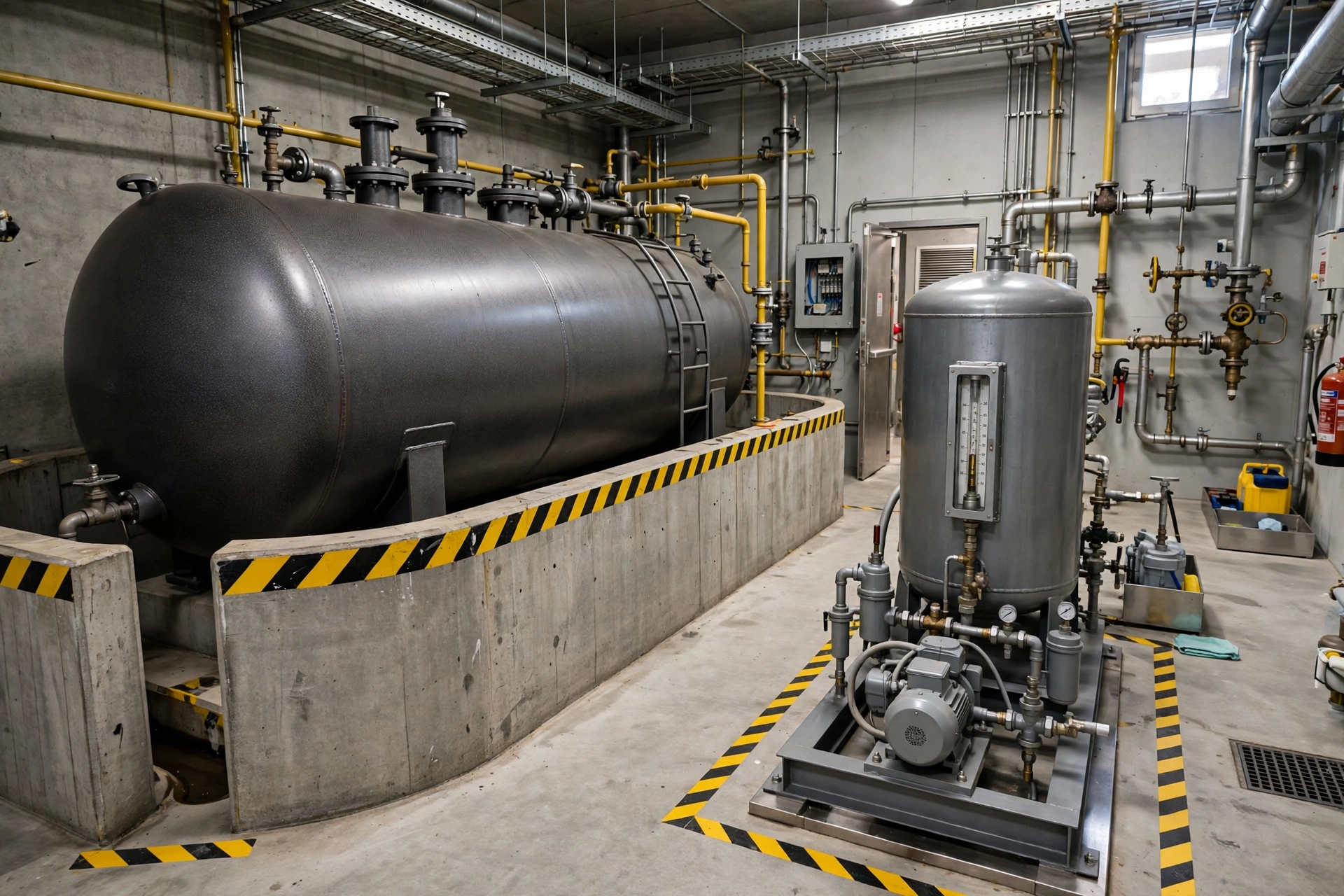
How long can a hotel run on a generator? As long as the fuel lasts, and no longer. The honest answer for most hotels is 24–72 hours on the fuel stored on site, and the difference between 24 and 72 is a tank decision made at the design stage, when a bigger tank is cheap, not after the first long outage, when it is not.
The Fuel Maths
The arithmetic is simple and unforgiving. A 400 kVA set at 75% load burns about 62 L/h. Twenty-four hours needs 1,490 litres. Seventy-two hours needs 4,460 litres. A 800 kVA set at the same load fraction burns about 123 L/h, so 72 hours needs 8,860 litres. Those are usable litres, not tank litres: the bottom 10% of a tank is sludge and water, and the top 5% is ullage, so a tank quoted at 5,000 litres holds about 4,250 usable litres.
Cross-check the figures against a published set. A 300 kW generator — 375 kVA standby — burns 16.1 gallons per hour at three-quarter load, which is 61 L/h, and 21.5 gallons (81 L/h) at full load. The 400 kVA hotel set at 62 L/h sits exactly where the published figure says it should. If a quotation shows a fuel figure far below that, the quotation is measuring at a lower load, or it is wrong.
Class and the 133% Rule
NFPA 110 does not ask how long a hotel would like to run. It asks for a Class: the number of hours the system must run at full rated load without refuelling. Class 2 is 2 hours, Class 48 is 48 hours, and Class X is whatever the authority requires. A hotel in a city with a reliable fuel supply and a 48-hour delivery contract can reasonably specify Class 48. A resort on an island where the fuel barge comes twice a week should specify Class 72 or higher, because the outage and the delivery delay will arrive together.
The standard also imposes a 133% rule on the fuel storage: the tank must hold 133% of the fuel the Class requires, to cover the fuel that cannot be used and the margin for a longer outage. A 72-hour Class on a 400 kVA set needs 4,460 litres of burn, so the tank must hold about 5,930 litres. The day tank — the small tank that feeds the engine directly — must hold at least one hour of fuel at full load, and it must refill automatically from the main tank. A day tank that has to be filled by hand at 3 a.m. is a failure waiting for a tired night manager.
The Refuelling Plan
Fuel on site is only half the answer. The other half is a contract that delivers more fuel during an outage, when every other hotel in the city is calling the same supplier. A hotel that has never tested its fuel delivery — called the supplier during a storm, confirmed the truck can reach the fill point, and confirmed the fill point is accessible when the power is out — does not have a refuelling plan. It has a phone number.
The fuel itself needs management. Stored diesel begins to degrade in as little as six months: water accumulates, microbes grow, and asphaltene sludge clogs filters. A 5,000-litre tank that sits at 90% for a year is a liability, not a reserve, and the filter that blocks at hour 30 of an outage is the filter that was never going to be checked at hour zero. Fuel polishing on a six-month cycle, and a fuel sample tested once a year, cost less than one night of refunds.
| Set size | Burn at 75% load | 24 hours | 72 hours | Tank for Class 72 (133% rule) |
|---|---|---|---|---|
| 250 kVA | 38 L/h | 920 L | 2,770 L | ~3,690 L |
| 400 kVA | 62 L/h | 1,490 L | 4,460 L | ~5,930 L |
| 800 kVA | 123 L/h | 2,950 L | 8,860 L | ~11,780 L |
| 1,500 kVA (parallel) | 231 L/h | 5,540 L | 16,630 L | ~22,120 L |
Three Hotels, Three Outages
Case 1: A 180-Room Business Hotel in Lagos
A 180-room business hotel in Lagos runs on a grid that fails for 8–12 hours a day in the dry season. The hotel’s answer is a 400 kVA prime-rated set, not standby-rated, because the annual hours are in the thousands and a standby rating is limited to about 200 hours a year under ISO 8528-1. The standby and prime power ratings are different promises, and a hotel that runs its set every day needs the prime promise.
The load list is Tier 1 and Tier 2 only: life safety, rooms, one lift, hot water, cold storage and reception. The chillers run on a staged scheme — half the plant on generator power, half shed until the load stabilises. Fuel is a 5,000-litre bulk tank with a 500-litre day tank, refilled by a contracted supplier twice a week. At 62 L/h, the tank gives 80 hours, and the contract gives the rest. The set runs about 3,000 hours a year, services every 250 hours, and the hotel’s outage cost is measured in diesel, not in refunds.
Case 2: A 320-Room Island Resort in the Caribbean
A 320-room resort on a Caribbean island lost grid power for six days after a hurricane. The resort’s answer was two 800 kVA sets in parallel, N+1, with a 20,000-litre bulk tank and a fuel barge contract. On a normal night one set carries the load alone at about 55%. On a full day both sets run, and if either fails the other carries Tier 1 and Tier 2 while Tier 3 is shed.
The salt air is the second problem. Standard steel enclosures corrode in two seasons on a coast. The resort’s sets are specified with a marine-grade coating, stainless fixings and a canopy designed for salt air, and the service contract includes a quarterly wash-down. The lesson from the hurricane week was not about kVA. It was about fuel: the barge could not reach the island for four days, and the resort ran on the 20,000 litres it already had. The tank size was decided by the delivery schedule, not by the load.
Case 3: A 90-Room Boutique Hotel in Dubai
A 90-room boutique hotel in Dubai runs a 200 kVA set in 50°C ambient temperature. The derating matters: at 50°C the alternator loses roughly 8% of its output, so the set that is 200 kVA on the datasheet is about 184 kVA on the roof in August. The specification was written for the derated figure, not the catalogue figure, and the set was bought one frame larger than the load list suggested.
Noise is the binding constraint. The set sits in a courtyard 25 metres from the nearest guest room, in a super-silent canopy rated 68 dB(A) at 7 metres. At 25 metres that reads about 57 dB(A) — inside the night boundary limit, and quiet enough that guests do not notice the weekly test. The hotel’s general manager has never received a noise complaint about the generator. That is the whole specification, working.
Frequently Asked Questions
What size generator does a hotel need?
A 60-room boutique hotel needs 100–150 kVA, a 150-room hotel needs 250–400 kVA, and a 400-room resort needs 800–1,500 kVA or two sets in parallel. The deciding loads are the chillers, the lifts and the kitchen — a hotel with a central chiller plant needs one frame size more than a hotel of the same room count with split air conditioning units.
Do hotels need a backup generator?
Yes, in practice and usually in law. Building codes require emergency power for life safety systems — emergency lighting, fire alarms, fire pumps — in hotels above a certain height or occupancy, and NFPA 110 sets the performance standard. Beyond the code, a hotel without backup power closes on the first full-weekend outage, and the refund and reputation cost exceeds the generator cost within a season.
How long can a hotel run on a generator?
As long as its fuel lasts. A 400 kVA set at 75% load burns about 62 L/h, so a 5,000-litre tank gives roughly 80 hours and a 72-hour Class requires about 5,930 litres of storage under the NFPA 110 133% rule. Longer outages need a fuel delivery contract, because no hotel tank is big enough for a week.
How quiet does a hotel generator need to be?
Quiet enough to meet the night boundary limit at the nearest bedroom window — usually 45–55 dB(A). A super-silent canopy rated 65–70 dB(A) at 7 metres, sited 25 metres or more from the rooms, typically meets that limit. An open set at 95–110 dB(A) is not an option at a hotel at any price, and the weekly test should be scheduled for a quiet weekday morning.
What should a hotel generator power during an outage?
Tier 1 life safety first — emergency lighting, fire alarm, fire pump, smoke extraction and lift recall — then Tier 2 guest comfort: rooms, one lift, hot water, cold storage, reception and Wi-Fi. Full air conditioning, spa, pool heating, laundry and ballroom lighting are Tier 3: carry them if the set is large enough, shed them first if it is not.
Specification checklist: seven lines before the deposit. 1. Which loads are Tier 1, Tier 2 and Tier 3, and which distribution boards carry them? 2. What is the largest single motor, its running kVA and its starting method — chiller, lift and fire pump figures in writing? 3. Which rating is quoted — standby or prime — and how many hours a year will the set actually run? 4. What is the night noise limit at the nearest bedroom window, and what does the set read at that distance? 5. What is the fuel Class, and does the tank hold 133% of the fuel the Class requires? 6. Is there a fuel delivery contract that has been tested during an outage? 7. Who runs the weekly 30-minute test, the monthly 30-minute load test and the annual load bank test, and where are the records kept?
A hotel generator is not bought for the night the grid works. It is bought for the Saturday in August when the building is full, the kitchen is at temperature, the chillers are running, and the grid fails at 2 a.m. The set that carries that night is the set that was sized from a load list, specified for the night noise limit, fuelled for 72 hours, and tested every week. Everything else is a quotation. For a load list and a quotation on a hotel set from 9 to 3750 kVA, in open, silent and containerised configurations, contact PAVO with the room count, the chiller size, the largest lift and the site altitude and maximum temperature.