

Diesel vs Gas Generator: Which Is Better for You? | PAVO
The fuel decision is made before the generator is bought — and it is the hardest one to reverse.
Diesel vs gas generator which is better depends on duty, fuel access and annual hours. Diesel wins for standby, remote sites and fast load acceptance; natural gas wins where pipeline gas is available and the set runs hundreds of hours a year. The wrong fuel costs more over the set’s life than the wrong kVA rating.
Contents
- The Two Machines Are Not the Same Engine
- What It Costs to Buy and to Run
- Lifespan and Maintenance: Hours Tell the Truth
- Fuel Security: The Question That Decides Standby
- Emissions and Permits
- Three Sites, Three Answers
- Frequently Asked Questions
- Specification Checklist: Five Questions Before the Deposit
The Two Machines Are Not the Same Engine
Diesel and gas generator sets look similar from the outside — engine, alternator, radiator, control panel, canopy. Inside, they are different machines. A diesel engine ignites fuel by compression. A gas engine is spark-ignited, like a car engine, and burns natural gas or propane (LPG) from a pipeline or a tank.
That difference decides power density. Diesel carries about 137,000 BTU per gallon; a cubic metre of natural gas carries far less energy in the same volume, and the engine needs more displacement to produce the same kilowatts. A gas set built on the same engine block as a diesel set is typically rated 10–15% lower on natural gas than on propane, and a small gas set can sit 20–25% below the rating of the equivalent petrol engine. Buyers who compare headline kW figures without checking the fuel behind them buy the wrong set.
Load acceptance differs too. A diesel set picks up a large block load — a 200 kW motor starting direct-on-line — and recovers voltage within the limits of ISO 8528 G2 or G3. A rich-burn gas engine accepts load more readily than a lean-burn gas engine, which runs with excess air to cut NOx and can hesitate on sudden load steps. For a hospital chiller or a quarry crusher, that hesitation is not a footnote. It is the difference between a transfer that holds and one that trips.
Speed matters as well. Industrial diesel sets run at 1,500 rpm (50 Hz) or 1,800 rpm (60 Hz). Many gas sets in the same kW class run faster, at automotive-derived speeds, which raises wear per hour and shortens the interval between major services. The exceptions are the large, slow-speed gas engines built for continuous duty — 60,000 to 90,000 hours in some converted heavy-duty designs — but those are priced as industrial plant, not as standby sets.
The rating question sits underneath all of this. Whether the set is diesel or gas, the duty — standby and prime power — decides how many hours it is designed to run and at what load. A gas set sold into prime duty on a standby rating fails exactly the way a diesel set does. Fuel does not rescue a wrong rating.
What It Costs to Buy and to Run
Purchase price: the 150 kW crossover
Below about 150 kW, both fuels use automotive-derived engines, and a natural gas set costs about the same as — or slightly less than — the equivalent diesel. A 100 kW diesel set for a warehouse typically runs $15,000–$30,000 before installation; a 100 kW natural gas set runs $12,000–$25,000. The gas train — regulator, solenoid valves, gas piping — adds $4,000–$12,000 on 60–150 kW installations, which narrows the gap on the installed price.
Above 150 kW the picture flips. Gas engines in that range are more specialised and less power-dense, so a natural gas set can cost meaningfully more than the equivalent diesel. At data-centre scale, diesel sits near $1,000 per kW while gas sits 20–30% higher, around $1,200–$1,300 per kW. One factor narrows that gap: a diesel set certified to EPA Tier 4 Final or EU Stage V needs selective catalytic reduction (SCR) and a particulate filter, and that aftertreatment adds substantially to the diesel price.
Fuel cost per kWh
The only fair comparison is cost per kilowatt-hour generated, not cost per litre or per therm. At May 2026 US average prices, a diesel set at 75% load burns about 0.058 gallons per kWh — 0.22 litres per kWh — and delivers power at $0.22–$0.28 per kWh. A natural gas set at the same load burns about 12.0 cubic feet per kWh — 0.34 m³ per kWh — and delivers power at $0.10–$0.18 per kWh. Natural gas is roughly 35–45% cheaper per kWh where pipeline gas is available.
A worked example makes the gap concrete. A 100 kW diesel set carrying a 75 kW critical load burns about 4.35 gallons per hour. At $3.85 per gallon that is about $16.75 per hour, or roughly $400 per 24 hours. The equivalent gas set burns about 900 cubic feet per hour and costs about $9.45 per hour at $10.50 per thousand cubic feet — roughly $227 per 24 hours. Over a 72-hour outage the fuel bill differs by about $520.
But the gap only matters if the set runs. A standby set that runs 40 hours a year — monthly tests plus two short outages — saves about $250 a year on gas. That saving will never repay a gas connection that costs $3,000–$8,000 to install. A prime set that runs 4,000 hours a year at 75% load saves roughly $25,000–$40,000 a year, and the fuel decision pays for itself in months. Hours decide the winner, not the price per kWh.
| Item | Diesel | Natural gas |
|---|---|---|
| Fuel cost per kWh (75% load, US May 2026) | $0.22–$0.28 | $0.10–$0.18 |
| Fuel consumption at 75% load | 0.22 L/kWh | 0.34 m³/kWh |
| 100 kW set, 75 kW load, cost per hour | ~$16.75 | ~$9.45 |
| 100 kW set, 75 kW load, cost per 24 h | ~$400 | ~$227 |
| Fuel storage | On-site tank, 6–12 months with stabiliser | Pipeline, or LPG tank |
| Purchase price, 100 kW set | $15,000–$30,000 | $12,000–$25,000 |
| Purchase price per kW above 150 kW | ~$1,000/kW | ~$1,200–$1,300/kW |
The fuel consumption figures also explain why diesel dominates the export market. A litre of diesel carries more energy than the equivalent volume of gas, so the tank is smaller, the delivery is simpler and the set runs longer on what it carries. For a buyer in a country without a gas network, that is the whole argument.
Lifespan and Maintenance: Hours Tell the Truth
A well-maintained industrial diesel set delivers 20,000–30,000 hours in standby service and 20,000–40,000 hours in prime service before a major overhaul. Industrial natural gas sets sit in a similar band — 15,000–30,000 hours — but the small, automotive-derived gas sets common in residential standby are closer to 5,000–10,000 hours. The headline “gas lasts as long as diesel” is true for industrial gas engines and false for the small sets most buyers actually compare.
Maintenance differs in kind, not just in cost. Diesel service is built around oil and filters: oil changes every 250–300 hours, fuel filters, air filters, coolant, and a load-bank test to prevent wet stacking. Gas service is built around ignition: spark plugs are a regular consumable, the ignition system needs inspection, and the gas train needs an annual leak check — natural gas is invisible and flammable, and a leak in a generator room is a different class of hazard from a diesel drip.
Gas engines often run about 1,000 hours between oil changes in standby service, against roughly 250–300 hours for diesel. That is a real saving on a prime site: a set running 4,000 hours a year needs about 14 diesel oil changes a year against 4 gas oil changes. On a standby site running 40 hours a year, the difference is one oil change a year against one every three years — barely worth pricing.
The maintenance ledger therefore points the same way as the fuel ledger. High hours favour gas. Low hours favour diesel, because the diesel’s heavier service schedule costs almost nothing when the set barely runs.
Fuel Security: The Question That Decides Standby
A standby generator exists for the day the grid fails. The fuel question is whether the generator’s own fuel supply can fail on the same day.
Diesel stores its own fuel on site. A 645-litre tank on a 500 kVA set gives about 7 hours at full load and 22 hours at 25% load; a bulk tank and a contracted delivery extend that to days or weeks. Diesel in a tank lasts 6–12 months with stabiliser, and longer with fuel polishing and testing — which is why diesel fuel ageing is a maintenance item, not a reason to change fuels. The risk is logistics, not supply: the delivery truck must be able to reach the site during the same storm that took the grid down.
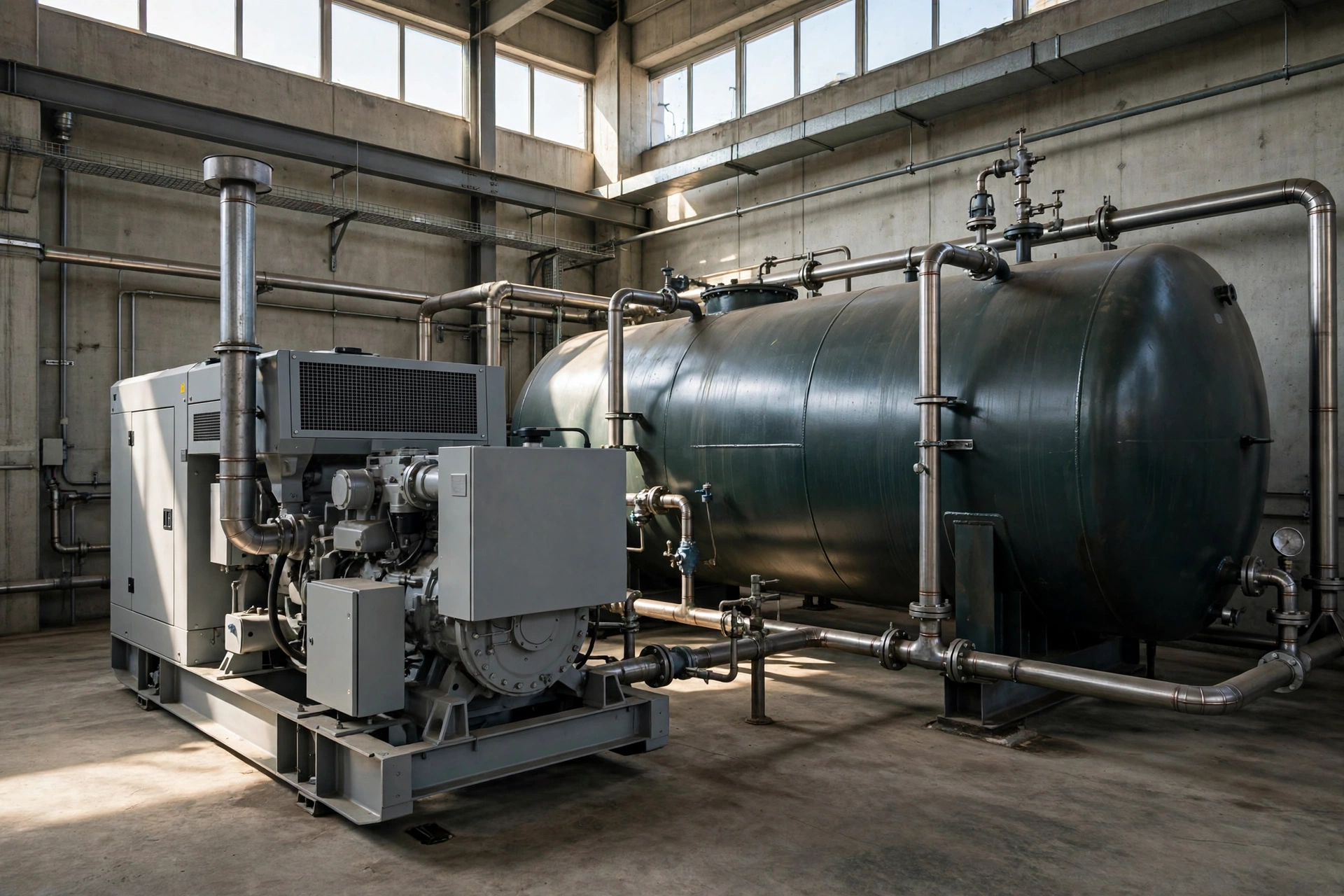
Pipeline natural gas has no tank, no delivery truck and no refuelling — until the pipeline itself fails. During the February 2021 Texas winter storm, about 4 million people lost natural gas pressure for days, at the same time as the power grid. A gas standby set on that network had unlimited fuel in theory and no fuel in practice. Propane (LPG) avoids that failure mode: it stores in a tank on site, indefinitely, and the set runs on it through a gas outage. But an LPG tank is another fuel store to size, fill and secure, and it reintroduces the logistics diesel already has.
The rule that follows is simple. If the load is life-safety — a hospital, a fire pump, a data centre — the fuel must be on site, under the buyer’s control. That points to diesel, or to propane with a tank sized for the full design outage. No authority having jurisdiction will accept a life-safety standby set whose fuel depends on a utility that can fail in the same event as the grid. The automatic transfer switch will do its job in under 10 seconds either way; it cannot conjure fuel that is not there.
Emissions and Permits
Natural gas burns cleaner than diesel at the tailpipe. A gas engine with a three-way catalyst emits lower NOx and CO and effectively no measurable particulate matter. Diesel produces the particulates that drive Tier 4 Final and Stage V aftertreatment — a diesel particulate filter and SCR — and those systems add cost, complexity and a urea supply to the installation.
The gap has narrowed. EPA Tier 4 Final, fully implemented for stationary engines above 25 kW since 2015, cut particulate matter by about 90% against Tier 1 and NOx by 45–90% depending on engine size. A modern Tier 4 diesel is a different machine from the smoky sets of twenty years ago, and it passes the same air-quality permit a gas set passes in most districts. The emissions standard on the datasheet deserves the same attention as the kVA figure: a missing certificate has turned trucks away at inspection, and no rating argument will reopen that gate.
Where the difference still bites is in non-emergency duty. In the US, an emergency diesel set can generally use a Tier 2 or Tier 3 certified engine, but a non-emergency diesel — prime power, peak shaving, continuous duty — typically needs Tier 4 Final, which narrows the cost gap with gas. In California, the Air Resources Board regulates stationary diesel sets through its Airborne Toxic Control Measure, and some air districts will permit a gas set where they will not permit a diesel set at all. A buyer who prices the set before checking the air district has the sequence backwards: the permit decides the fuel, and the fuel decides the set.
Carbon dioxide is the other half of the ledger. Per kilowatt-hour, natural gas emits roughly 25–30% less CO2 than diesel, because methane carries less carbon per unit of energy. For a company reporting Scope 1 emissions, that difference is a line in an annual report. For a set that runs 40 hours a year, the saving is measured in hundreds of kilograms a year — not a decision factor.
Three Sites, Three Answers
Case 1: Cold-storage warehouse, Cebu — diesel wins
A cold-storage warehouse outside Cebu City runs a 200 kW refrigeration load. Typhoons take the grid down two or three times a year, for 12–36 hours at a time. Annual generator hours: about 120, including tests. There is no pipeline gas on the industrial estate, and the nearest LPG depot is 40 km away on a road that floods.
The set installed is a 250 kVA diesel standby set with a 1,000-litre bulk tank — about 30 hours at 75% load without a delivery. Average load is about 150 kW, so the annual fuel bill is about $4,500. A gas set would need an LPG tank, a vaporiser and a delivery contract on a flooding road, and would save about $2,200 a year on fuel. The LPG installation alone would cost more than five years of that saving. Diesel is the only fuel that is actually available on the day it is needed.
Case 2: Food-processing plant, Wisconsin — gas wins
A food-processing plant in Wisconsin runs a 600 kW prime load — refrigeration, packaging lines, steam boilers — for 3,500 hours a year. Pipeline gas reaches the site boundary, and the plant already buys gas for its boilers at about $1.20 per therm.
The plant compared a 750 kVA diesel prime set against a gas set of the same output. The gas set cost about $28,000 more to buy and install. Fuel cost told the other story: at 75% load the diesel set would burn about $0.24 per kWh, the gas set about $0.13 per kWh. At 450 kW average load, the saving is about $49 per hour — roughly $170,000 a year. The gas set repaid its premium in about two months. Oil changes fell from 14 a year to 4. The plant kept a small diesel set for the fire pump, where the fuel must be on site. Everything else runs on gas.
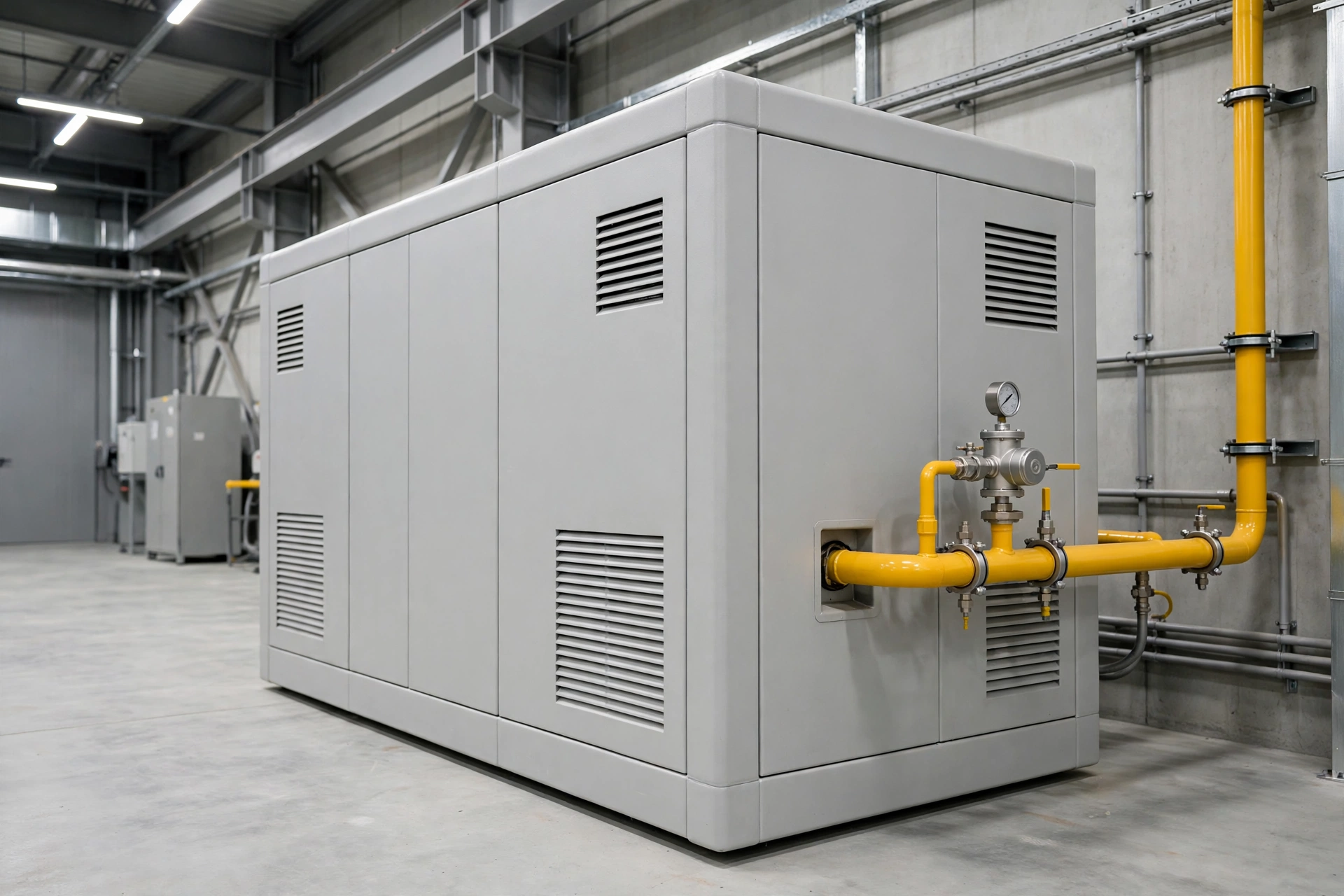
Case 3: Data centre, Frankfurt — diesel, with a gas caveat
A colocation data centre in Frankfurt specified 2,000 kVA of standby power across two sets, N+1, with a 10-second start under NFPA 110 Type 10. The design outage is 72 hours on diesel, with a contracted fuel delivery. Pipeline gas is available at the site.
Gas was considered and rejected for the standby sets. The authority having jurisdiction would not accept a life-safety load whose fuel depends on the gas network, and the gas engines’ slower load acceptance on a full step load — the entire IT load transferring in one step — failed the facility’s own acceptance test. Diesel won on fuel security and on step-load response, at a fuel cost the facility barely notices: the sets run about 60 hours a year, and the annual diesel bill is under €10,000. The Tier III data centre design counts fuel in days, not in dollars, and diesel is the only fuel that can be counted that way.
Gas was not rejected outright. The same facility runs a gas-fired combined-heat-and-power unit for base load, where the set runs 6,000 hours a year and the fuel saving is six figures — and a hybrid diesel-battery system covers the sub-second transients neither generator answers well. The lesson is not that one fuel wins. It is that one site can have two correct answers, for two different duties.
Frequently Asked Questions
Diesel vs gas generator which is better?
Neither fuel is better in general. Diesel is better for standby duty, remote sites, life-safety loads and fast load acceptance; natural gas is better where pipeline gas is available and the set runs hundreds or thousands of hours a year. Duty, fuel access and annual hours decide — in that order.
Can a gas generator replace a diesel generator?
Yes, where the duty allows it. A gas set can replace a diesel set for prime or continuous duty on a site with reliable pipeline gas, and for standby duty where the gas supply is dependable. It cannot replace diesel where the fuel must be stored on site, where the load steps are large and sudden, or where the authority having jurisdiction requires on-site fuel.
How much does a gas generator cost compared to diesel?
Below about 150 kW, a gas set costs roughly the same as or slightly less than the equivalent diesel — a 100 kW set runs $12,000–$25,000 against $15,000–$30,000 for diesel. Above 150 kW, gas typically costs 20–30% more per kW. Installation narrows the gap: the gas train adds $4,000–$12,000, while Tier 4 Final aftertreatment adds cost to the diesel side.
Is a diesel generator cheaper to run than a gas generator?
No, not where pipeline gas is available. Natural gas delivers power at about $0.10–$0.18 per kWh against $0.22–$0.28 for diesel at 75% load — roughly 35–45% cheaper. Diesel is cheaper to run only where gas must be delivered as LPG, or where the set runs so few hours that the fuel saving never repays the gas connection.
What fuel is best for a standby generator?
Diesel is the best fuel for most standby generators, because it stores on site, starts fast, accepts large load steps and works anywhere a truck can reach. Natural gas is the best fuel for standby only where pipeline gas is reliable and the set runs many hours a year. Propane sits between the two: clean and storable, but dependent on deliveries.
Specification Checklist: Five Questions Before the Deposit
- How many hours a year will this set actually run? Below 200 hours, fuel cost barely matters and diesel usually wins. Above 1,000 hours, fuel cost dominates and gas deserves a full comparison. Get the honest number — including tests — before pricing either fuel.
- Is pipeline gas available at the site boundary, and at what pressure? A gas set needs a confirmed supply at the right pressure, not a gas main “somewhere nearby”. Ask the utility for a written supply confirmation and a connection cost before the generator quotation is final.
- Is this a life-safety load? If the set protects people — hospital, fire pump, emergency lighting — the fuel must be on site and under the buyer’s control. Pipeline gas fails that test unless a second fuel or a second supply is in place.
- What is the largest single load step? A motor starting direct-on-line can draw five times its running current. Ask both suppliers for the voltage dip and recovery time on that step, in writing, against the ISO 8528 class the load requires. A gas set that hesitates on the step is the wrong set, whatever it costs.
- What does the air district allow? Check the permit before the purchase order. A non-emergency diesel set typically needs Tier 4 Final or Stage V aftertreatment, and some districts will permit gas where they will not permit diesel. The permit decides the fuel; the fuel decides the set.
The fuel decision is the one decision in a generator purchase that cannot be changed later. A set can be re-rated, re-canopied or moved to another site. It cannot be converted from diesel to gas, or gas to diesel, without a new engine. Before the deposit is paid, the buyer should be able to answer, in one sentence, why this fuel is right for this site, this duty and these hours. If that sentence is hard to write, the fuel is probably wrong — and the cheapest time to discover that is before the container leaves Wuhu, not after it arrives.
For a fuel comparison priced on your site’s duty, hours and load profile, contact PAVO — the team sizes diesel sets from 9 to 3750 kVA in open, silent and containerised configurations, and will tell you plainly when gas, or a hybrid, is the better answer for your site.