

What Size Generator Does a Cosmetics Plant Need | PAVO
A cosmetics plant does not lose money the way a warehouse does. It loses a batch — and the batch is the money.
What size generator does a cosmetics plant need? A small contract manufacturer runs on 100–150 kVA, a mid-size brand plant on 250–500 kVA, and a large multi-line plant on 750–1,500 kVA. The right size comes from the mixing, heating, filling and purified-water loads that must stay on — not from the building’s total connected load.
Contents:
- What a Cosmetics Plant Actually Runs on Power
- Sizing Bands by Plant Size
- The Batch That Cannot Sit
- Motor Starting and Power Quality on the Plant Floor
- Fuel Autonomy: How Long the Plant Can Run
- Three Plants That Lost Power
- Frequently Asked Questions
- Specification Checklist
What a Cosmetics Plant Actually Runs on Power
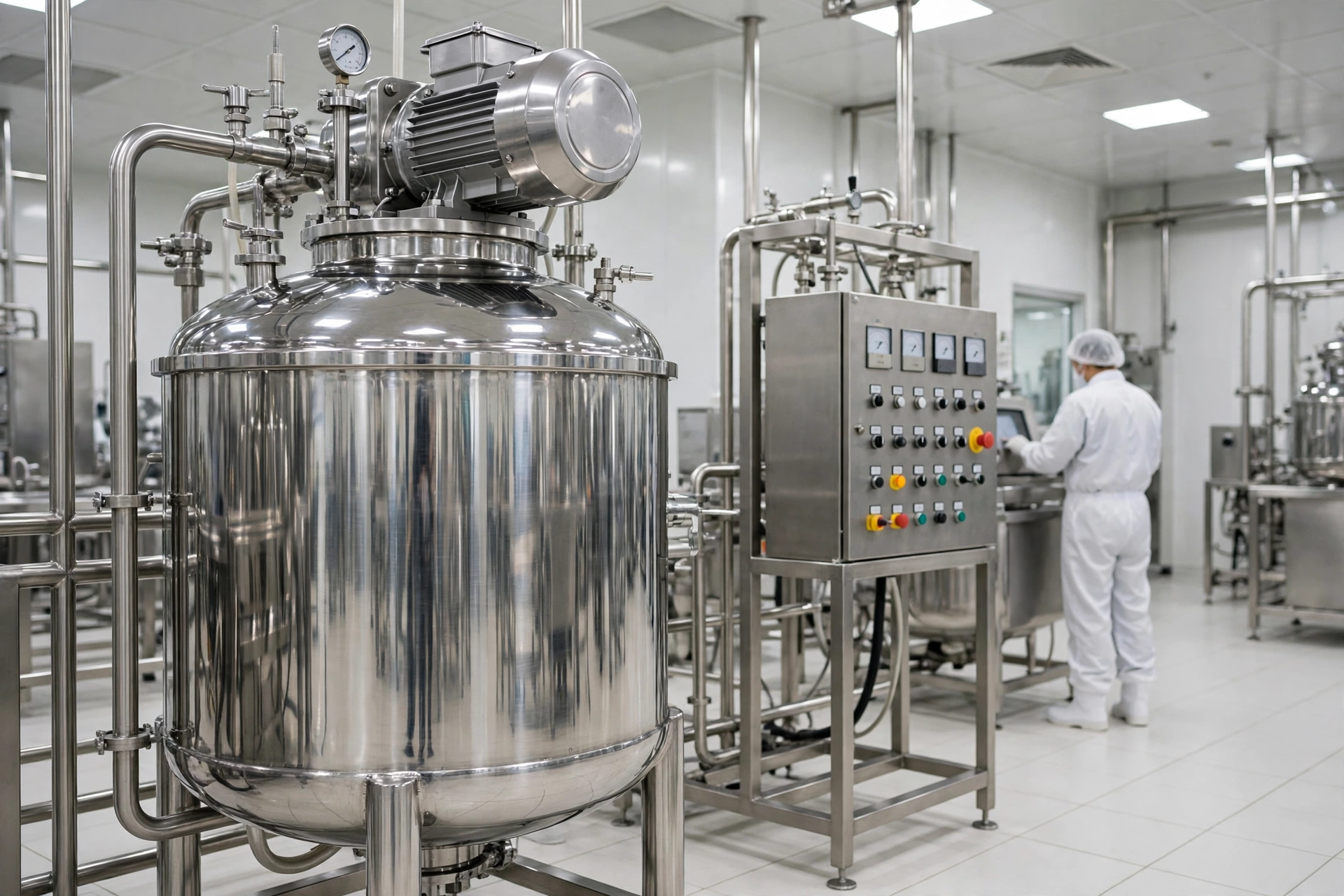
A cosmetics plant is a process plant in a clean white coat. The loads are smaller than a steel mill’s and far more time-sensitive than a warehouse’s. Mixing, heating, cooling, filling and water treatment all run at the same time, and most of them cannot be paused mid-cycle without scrapping product. The generator is sized for the process, not for the building.
The load list below covers a typical cream, lotion and shampoo plant. A colour-cosmetics plant adds powder handling and dust extraction. A perfume plant adds ethanol storage and explosion-protected areas. The numbers are the running loads a buyer should collect from equipment nameplates before any sizing conversation starts.
| Equipment | Typical size | Duty |
|---|---|---|
| Vacuum emulsifying mixer, 500 kg | Homogenizer 11 kW + anchor agitator 4 kW | Intermittent |
| Vacuum emulsifying mixer, 1,000 kg | Homogenizer 15 kW + anchor agitator 5.5 kW | Intermittent |
| Oil and water phase vessels | 18–27 kW heating each | Intermittent |
| Chiller | 30–60 kW | Continuous |
| Air compressor | 11–37 kW | Intermittent |
| RO/DI purified-water plant | 5–15 kW | Continuous |
| Filling line | 5–12 kW | Continuous during shifts |
| HVAC and cleanroom air handling | 30–120 kW | Continuous |
| Steam boiler or hot-water system | 18–60 kW electric equivalent | Intermittent |
| Pumps, CIP, lighting, IT, QC laboratory | 10–25 kW | Mixed |
Two loads surprise first-time buyers. The first is heating. A 500 kg cream batch heats two phase vessels to 70–80 °C, and the electric heating elements draw 18–27 kW while they do it. The second is cooling. The chiller that brings the same batch down to 35–40 °C draws 30–60 kW continuously, and it cannot be shed mid-batch without the emulsion drifting out of specification.
Mixing and Homogenising
Mixing is the heart of the plant. A vacuum emulsifying mixer combines the oil phase and the water phase under vacuum, homogenises the emulsion at up to 3,000 rpm, and shears droplets to 0.2–5 μm. The homogenizer motor on a 500 kg vessel draws 11 kW; on a 1,000 kg vessel, 15 kW. The anchor agitator adds 4–5.5 kW. These are not large motors, but they are the most sensitive loads in the plant: stop the homogenizer mid-batch and the emulsion starts to separate within minutes.
Heating and Cooling
Heating and cooling are the two ends of the same batch. The oil phase and the water phase are heated separately, combined at 70–80 °C, then cooled under agitation to 35–40 °C before fragrance and heat-sensitive actives are added. Lose power during heating and the batch sits hot, losing volatile ingredients. Lose power during cooling and the emulsion cools unevenly, which shows up later as graininess, separation or a failed viscosity test. The chiller and the heating elements rarely run at full load at the same time, which is why diversity matters in the sizing calculation.
Filling and Packaging
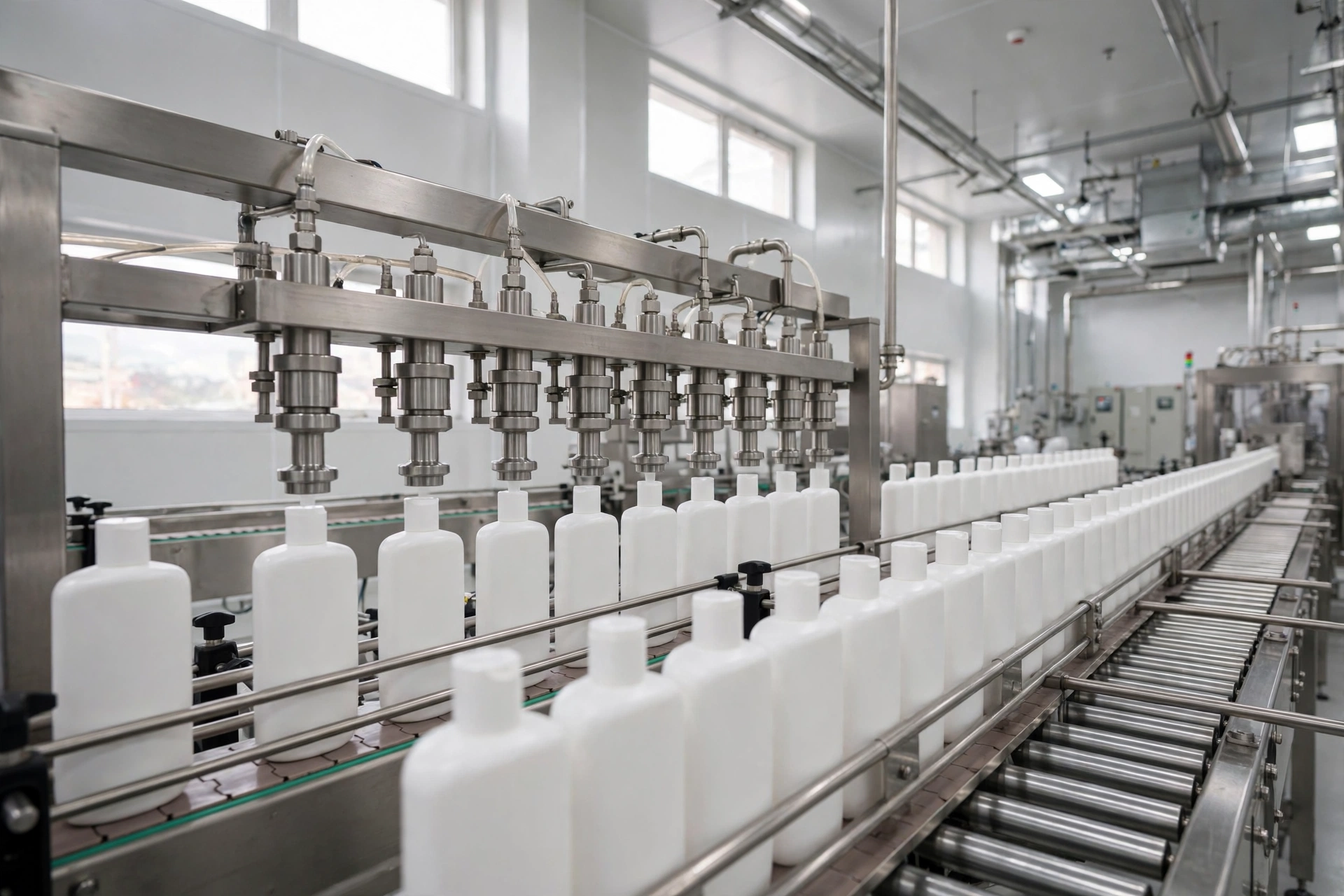
A filling line is the least power-hungry part of the plant and the most visible when it stops. A rotary or linear filler runs at 3,000–6,000 bottles per hour, drawing only 5–12 kW, but every minute of downtime is 50–100 bottles not filled. Half-filled bottles on a stopped line must be emptied, cleaned and re-run. Capping, labelling and cartoning add a further 3–8 kW and the same restart penalty.
Purified Water, HVAC and Utilities
Purified water is a utility and a quality system at the same time. A reverse-osmosis and deionised-water plant draws 5–15 kW and must keep the loop circulating. Under ISO 22716, the cosmetics good manufacturing practice standard, water quality is a controlled parameter, and a stagnant loop is a microbial risk. HVAC is the other continuous load: 30–120 kW of air handling keeps the production rooms at 20–25 °C and the required humidity, and in a classified area it also holds the pressure cascade. The cleanroom discipline is the same discipline described in the pharmaceutical cleanroom backup power guide, at a lower classification but with the same audit logic.
Sizing Bands by Plant Size
The table below gives the sizing bands a buyer can quote against. The critical load is the load that must stay on during an outage — mixing, cooling, filling, water and HVAC — not the total connected load of the building. Office air conditioning, the warehouse and the canteen are shed.
| Plant type | Batch size | Critical load | Generator size | Example set |
|---|---|---|---|---|
| Small contract manufacturer | 50–500 kg | 40–80 kW | 100–150 kVA | 125 kVA Cummins silent set |
| Mid-size brand plant | 500–1,000 kg | 120–220 kW | 250–500 kVA | 375 kVA Weichai silent set |
| Large multi-line plant | 1,000–5,000 kg | 400–900 kW | 750–1,500 kVA | 1,125 kVA Perkins silent set |
| Perfume and alcohol plant | 50–1,000 L | 60–150 kW | 150–250 kVA | 200 kVA silent set, ATEX placement |
The bands assume a 0.8 power factor and a 25% allowance for motor starting, which is the standard approach in the generator sizing guide. A plant that buys on nameplate total alone will oversize by 30–40% and then run the set at light load, which causes wet stacking. A plant that buys on average load alone will undersize and trip on the first homogenizer start.
Small Contract Manufacturer: 100–150 kVA
A contract manufacturer with one or two mixing lines, 50–500 kg batches and a single filling line typically carries 40–80 kW of critical load. A 125 kVA silent set covers it with room for a second mixer. The set runs two or three shifts a week, waits the rest of the time, and must start unattended at 2 a.m. when the grid fails. The standby rating is the right rating here, and the standby and prime ratings article explains why a standby set must not be run as a prime set.
Mid-Size Brand Plant: 250–500 kVA
A brand plant with three to five lines, 500–1,000 kg batches, its own filling hall and a purified-water loop carries 120–220 kW of critical load. The worked example below is a real mid-size layout:
- Two 500 kg vacuum emulsifiers: homogenizer 11 kW + anchor 4 kW each — 30 kW
- Two phase vessels, heating at 18 kW each, 75% duty — 27 kW
- Chiller — 40 kW
- Air compressor — 22 kW
- RO/DI purified-water plant — 12 kW
- Filling line — 8 kW
- HVAC and air handling — 45 kW
- Pumps, CIP, lighting, IT and QC laboratory — 14 kW
Total running load: 198 kW. Apply 0.85 diversity, because heating and cooling rarely peak together: 168 kW. Add 25% for motor starting: 210 kW. Divide by 0.8 power factor: 263 kVA. A 300 kVA standby set covers it with margin for one more line. The same calculation on nameplate totals without diversity would have specified 375 kVA and cost roughly 20% more for a set that runs at 55% load.
Large Multi-Line Plant: 750–1,500 kVA
A large plant with six or more lines, 1,000–5,000 kg batches, bulk storage, a tank farm and a warehouse carries 400–900 kW of critical load. The set is usually 1,000–1,500 kVA, and at this size the question becomes whether to buy one large set or two smaller sets in parallel. Two 750 kVA sets give redundancy: one set down for service leaves the plant at half capacity instead of dark. The paralleling decision is a cost and risk decision, and it should be made before the switchgear is ordered, not after.
The Batch That Cannot Sit
The reason a cosmetics plant needs a generator is not the building. It is the batch. A batch in progress is a chemical process with a clock on it, and the clock does not stop when the grid fails. The damage window is measured in minutes for the emulsion and in hours for the water loop, and both windows are shorter than most people expect.
| System | What happens on power loss | Time to damage |
|---|---|---|
| Emulsion in the mixer | Agitation stops, temperature drifts, emulsion breaks | 30–60 minutes |
| Purified-water loop | Circulation stops, loop stagnates, microbial risk rises | 4 hours |
| Filling line | Half-filled bottles, line must be emptied and re-run | Immediate |
| Chilled raw-material store | Refrigeration stops, waxes and actives warm | 2–4 hours |
| HVAC and cleanroom | Pressure cascade lost, particle counts rise | 15–30 minutes |
The Emulsion Window
An emulsion is oil and water held together by shear and temperature. The oil phase is heated to 70–80 °C, the water phase to 70–75 °C, the two are combined under vacuum at up to 3,000 rpm, and the emulsion is cooled to 35–40 °C before fragrance and actives go in. Stop the agitator and the homogenizer at 68 °C and the droplets start to coalesce. After 30–60 minutes without agitation, the emulsion has separated enough that no amount of re-mixing restores the original droplet size. The batch fails viscosity and stability testing, and it is scrapped. A 500 kg batch of moisturising cream carries $6,000–$12,000 of raw materials; with labour, energy and lost shift time, a scrapped batch costs $15,000–$25,000.
The Purified-Water Loop
Purified water is the largest single ingredient in most cosmetics, and it is the hardest to defend in an audit. The RO/DI loop must circulate continuously. When circulation stops, the water in the loop stagnates, temperature drifts into the range where bacteria grow fastest, and the next sample can fail the microbial limit. The rule most plants work to is simple: a loop that has been stagnant for more than 4 hours is sampled before use, and a failed sample means the loop is sanitised and the water discarded. That is a day of production lost to a two-hour outage. The water system is also the reason the generator must cover utilities, not just production: a plant that saves the mixer and loses the water loop has still lost the day.
Filled Stock and the Warehouse Clock
Finished stock is more forgiving than a batch in progress, but it is not immune. A chilled raw-material store holding waxes, butters and heat-sensitive actives warms at roughly 1–2 °C per hour once refrigeration stops. After 2–4 hours the store crosses the threshold where the materials must be quarantined and re-tested. The warehouse itself needs only lighting and the warehouse management system, but the cold store needs the generator. This is the load that buyers most often forget, because it sits in a different building from the production hall.
Motor Starting and Power Quality on the Plant Floor
A cosmetics plant is a motor plant. Homogenizers, agitators, pumps, compressors and fans all start as motors, and motors draw 5–7 times their running current for a few seconds at start. The generator must absorb that surge without the voltage dipping far enough to trip a PLC or reset a drive. The motor starting article covers the calculation in full; the points below are the ones that matter on a cosmetics floor.
Homogenizer Starting Surge
The homogenizer is the largest single motor in the mixing hall. A 15 kW homogenizer on a 1,000 kg vessel draws about 90–105 kVA for 2–3 seconds at direct-on-line start. On a 250 kVA set that is a 40% step load, and the voltage dip can reach 15–20%. The fix is a variable-frequency drive, which ramps the motor up over 10–15 seconds and cuts the starting surge to 1.5 times running current. Most modern emulsifiers ship with a VFD as standard. If the plant’s mixers are direct-on-line, the generator must be sized for the surge, not the running load — and that is where most undersizing mistakes happen.
Chillers, Compressors and Air Handling
Chillers and air compressors are the second surge problem. A 40 kW chiller compressor and a 22 kW air compressor starting together draw 300–370 kVA for a few seconds. The control sequence matters more than the arithmetic: the automatic transfer switch should be programmed with staged load pickup, so the chiller starts first, the compressor second, and the filling line last, with 5–10 seconds between steps. A plant that dumps every load onto the generator at once will see the same voltage dip as a plant with a set one size too small.
PLCs, Sensors and the Controls That Trip First
The most fragile loads in the plant are the smallest. PLCs, temperature controllers, flow meters and the vacuum system run on 24 V DC through power supplies that drop out below 180 V AC on the input side. A voltage dip that the motors ride through will reset a PLC, and a reset PLC loses the batch recipe, the temperature profile and the vacuum sequence. The defence is a small UPS on the control circuits — 2–5 kVA covers a whole mixing hall — and a generator with a fast-responding AVR. The UPS is not a substitute for the generator; it is the bridge that holds the controls up during the 10 seconds between grid failure and generator power.
Fuel Autonomy: How Long the Plant Can Run
A generator that runs for six hours is a different asset from one that runs for three days. The difference is the fuel tank, and the fuel tank is the cheapest part of the system to get wrong. The table below uses 0.21 litres per kWh, the standard consumption figure at 75% load, and it assumes the set runs at its typical critical load.
| Generator size | Load | Fuel use | 8 hours | 24 hours | 72 hours |
|---|---|---|---|---|---|
| 125 kVA | 75 kW | 16 L/h | 128 L | 384 L | 1,152 L |
| 250 kVA | 150 kW | 32 L/h | 256 L | 768 L | 2,304 L |
| 500 kVA | 300 kW | 63 L/h | 504 L | 1,512 L | 4,536 L |
| 1,000 kVA | 600 kW | 126 L/h | 1,008 L | 3,024 L | 9,072 L |
One Shift: 8 Hours
Eight hours covers a single shift and the most common outage. A 500 kVA set at 300 kW burns 504 litres in a shift, which fits in a 1,000-litre sub-base tank with margin. Most plants start here, and most plants discover that eight hours is not enough the first time an outage runs into the night.
A Full Day: 24 Hours
Twenty-four hours needs a bulk tank. A 500 kVA set needs 1,512 litres for a full day, which means a 2,000-litre bulk tank alongside the sub-base tank. The fuel must be fresh: diesel left in a bulk tank for a year grows water and microbes, and the diesel fuel ageing article explains the polishing and testing regime that keeps it usable. A plant that buys a 72-hour tank and fills it once a year has bought a problem, not autonomy.
Three Days: 72 Hours
Seventy-two hours is the figure most retailers and brand owners ask for in a supplier audit. A 500 kVA set needs 4,536 litres for three days, which is a 5,000-litre bulk tank and a fuel delivery contract. The contract matters more than the tank: a supplier that delivers in 24 hours turns a 2,000-litre tank into 72-hour autonomy, while a plant with a 5,000-litre tank and no contract runs dry on day three and waits. Fuel logistics, not tank size, is the usual failure point.
Three Plants That Lost Power
Case 1: A 500 kg Cream Batch in Guangzhou
A contract manufacturer in Guangzhou runs two 500 kg vacuum emulsifiers and a single filling line for three skincare brands. In March 2026 the grid failed at 14:20, in the middle of a moisturising cream batch. The oil phase was at 72 °C, the water phase at 70 °C, and the homogenizer had been running for 11 minutes. The plant had no generator. Power returned after 47 minutes. The emulsion had separated. The batch — 500 kg, $7,400 of raw materials — was scrapped, the vessel was cleaned and sanitised, and the shift lost 4 hours. Total cost: about $18,000. The plant installed a 250 kVA silent set six weeks later, sized for both emulsifiers, the chiller and the filling line. It has run 11 times since, and the longest run was 3 hours 40 minutes.
Case 2: A Shampoo Filling Line in Ho Chi Minh City
A shampoo plant in Ho Chi Minh City fills 4,000 bottles per hour on a single line, two shifts a day, six days a week. In June 2026 a substation fault cut power for 3 hours. The filling line stopped with 2,400 bottles half-filled. The batch in the 1,000 kg mixer held temperature on residual heat and was saved, but the filling line had to be emptied, cleaned and re-primed, which took 2 hours after power returned. The plant lost 12,000 bottles of production — a full shift — and paid a $6,500 late-delivery penalty to its largest retailer. The generator that would have covered the line, the mixer and the water loop was a 375 kVA set. The plant’s management had deferred it twice as a capital saving. The penalty alone was a quarter of the set’s price.
Case 3: A Colour-Cosmetics Plant in Istanbul
A colour-cosmetics plant in Istanbul runs powder pressing, lipstick moulding and a perfume blending room on one site. The perfume room stores ethanol, which has a flash point of 13 °C, and the whole area is classified as a hazardous zone. In September 2026 a 90-minute outage stopped the dust extraction on the powder line and the ventilation in the blending room. The plant’s 200 kVA set started correctly, but it had been sized for the mixing hall only, and the extraction fans were on the shed load. Production stopped for the day, and the batch in the blending room was held for 6 hours while QC re-tested it for contamination. It passed. The lesson the plant took was about scope, not size: a generator that does not cover the extraction and ventilation loads is a generator that protects the product and leaves the people unprotected. Solvent and ethanol handling follows the same hazardous-area rules as a chemical plant, and the set, the fuel store and the cable routes must be placed accordingly.
Frequently Asked Questions
What size generator does a cosmetics plant need?
A small contract manufacturer needs 100–150 kVA, a mid-size brand plant needs 250–500 kVA, and a large multi-line plant needs 750–1,500 kVA. The exact size comes from a load list of the mixing, heating, cooling, filling and purified-water loads that must stay on, with a 25% allowance for motor starting and a 0.8 power factor. Buying on the building’s total connected load oversizes the set by 30–40%.
Do cosmetics plants need a backup generator?
Yes, if the plant runs batches that cannot be paused. A batch in progress is lost after 30–60 minutes without agitation and temperature control, and a single scrapped 500 kg batch costs $15,000–$25,000. Brand owners and retailers also audit suppliers for backup power, and a plant without a generator can lose a contract faster than it loses a batch.
How long can a cosmetics plant run on a generator?
As long as the fuel lasts. A 500 kVA set at 300 kW burns 63 litres per hour, so a 1,000-litre tank gives about 16 hours and a 5,000-litre bulk tank gives about 72 hours. The practical limit is usually the fuel delivery contract, not the tank: a supplier that delivers in 24 hours turns a one-day tank into three-day autonomy.
What happens to a cosmetics plant during a power outage?
The emulsion in the mixer starts to separate within 30–60 minutes, the purified-water loop stagnates after 4 hours, the filling line stops with half-filled bottles, and the HVAC pressure cascade is lost within 15–30 minutes. The first ten seconds are covered by the automatic transfer switch; the first hour is decided by which loads the generator is wired to carry.
Can a diesel generator power a cosmetics plant?
Yes. A diesel set from 100 kVA to 1,500 kVA covers every cosmetics plant from a single-line contract manufacturer to a multi-line brand plant, provided the set is sized on the critical process loads and the automatic transfer switch is programmed with staged load pickup. The set must sit outside the production area, away from the cleanrooms, and in a perfume or alcohol plant it must respect the hazardous-area classification for ethanol storage.
Specification Checklist
- List every critical load from equipment nameplates — mixers, heaters, chiller, compressor, water plant, filling line, HVAC — and total them in kW.
- Apply 0.85 diversity and add 25% for motor starting, then divide by 0.8 power factor to get kVA.
- Confirm the rating: standby for backup duty, prime if the set will run more than 200 hours a year.
- Specify a 250–500 kVA set for a mid-size plant, 100–150 kVA for a small contract manufacturer, 750–1,500 kVA for a large multi-line plant.
- Fit a variable-frequency drive on the homogenizer and programme staged load pickup into the automatic transfer switch.
- Put the control circuits on a 2–5 kVA UPS so the PLCs survive the 10-second transfer gap.
- Size the fuel tank for the autonomy the brand owner audits — 24 hours minimum, 72 hours with a delivery contract.
- Place the set outside the production area, with exhaust and vibration isolated from the cleanrooms, and respect the hazardous-area classification in any ethanol or solvent room.
- Test monthly under load, not at no load, and keep a written maintenance schedule with oil, filters, coolant and battery checks.
- Record the whole system — generator, transfer switch, fuel, test results — as a controlled document under ISO 22716, so the next audit finds evidence, not a machine.
A cosmetics plant buys a generator for the same reason it buys a homogenizer: because the batch depends on it. The set that covers mixing, cooling, filling and water — and nothing it does not need to cover — is the set that pays for itself the first time the grid fails. For a sizing calculation on a specific plant, with the load list and the batch sizes, contact PAVO.