

What Size Generator Do I Need for an Air Conditioner? | PAVO
An air conditioner asks a generator for three times its running power in the first second — and that one second decides whether the house stays cool or the breaker trips.
What size generator do I need to run an air conditioner? A 3-ton central unit needs 9,000–12,000 starting watts even though it runs on only 3,000–3,500 watts, so a 14–20 kW standby generator — or a 9–12 kW set fitted with a soft starter — is the realistic answer for most homes.
Contents:
- Why an Air Conditioner Is the Hardest Load in the House
- How Many Watts Does an Air Conditioner Need to Start?
- What Size Generator for a 3 Ton Air Conditioner?
- Can a Generator Run a Central Air Conditioner?
- Window, Portable and RV Units: Smaller Numbers, Same Rule
- Do I Need a Soft Start Kit for My Air Conditioner on a Generator?
- Frequently Asked Questions
- Generator Sizing Checklist Before You Buy
Why an Air Conditioner Is the Hardest Load in the House
Air conditioning is the largest single load in most homes, and it is also the hardest to start. A refrigerator draws a few hundred watts. A water heater draws a steady 4,500 watts with no surge at all. A central air conditioner combines a large motor with a compressor that must push refrigerant against system pressure from a dead stop — and that combination produces the biggest starting surge of any common household appliance.
The surge lasts less than a second. That is what makes it dangerous to a generator. A set sized for running watts will carry the air conditioner all afternoon, then collapse at the exact moment the thermostat calls for cooling. The lights dim, the compressor stalls, the breaker trips, and the owner concludes the generator is faulty. In most cases the generator is fine. It was sized for the wrong number.
The first second decides everything
A compressor motor at rest has no back-EMF. Back-EMF is the voltage a spinning motor generates that opposes the supply and limits current. With the rotor stationary, nothing opposes the supply, so current rushes in at the motor’s locked-rotor value. Electricians call this figure locked-rotor amps (LRA), and it is printed on the compressor nameplate for exactly this reason.
The surge decays fast. Within 0.2–0.5 seconds the rotor is turning, back-EMF builds, and current falls toward the running value. But a generator has to survive that half second. Its alternator must deliver the surge without voltage collapsing below the point where the compressor stalls — roughly 200 V on a 240 V circuit. If voltage sags further, the motor draws even more current trying to start, the engine lugs, and the protection trips. The failure takes one second and the diagnosis takes a week.
Running watts vs starting watts
Every motor load has two numbers, and generator sizing uses both. Running watts are the steady draw once the motor is up to speed. Starting watts are the peak draw in the first second. For a central air conditioner the ratio between them is typically 3–5 times; some older compressors reach 5–7 times.
A 3-ton unit illustrates the gap. Running watts: 3,000–3,500 W. Starting watts: 9,000–12,000 W. A buyer who reads only the running figure and buys a 3,500 W portable generator has bought a set that will trip every time the compressor starts. A buyer who reads both figures and buys a 12,000 W set has bought one that starts the unit and still has room for a refrigerator and lights.
The same logic governs every motor on the property, which is why motor starting is treated as a sizing discipline of its own rather than a footnote. Compressors, pumps and fans all surge; the air conditioner simply surges hardest, and the same starting-watts maths behind air compressor sizing applies here with bigger numbers.
How Many Watts Does an Air Conditioner Need to Start?
The honest answer is that it depends on the unit — but the range is narrow enough to size from a table, and exact enough to confirm from the nameplate. One ton of cooling equals 12,000 BTU per hour, so a 3-ton unit moves 36,000 BTU per hour. Tonnage is cooling capacity, not weight, and it is the first number to find on the condenser label.
| Central AC size | Cooling capacity | Running watts | Starting watts | Typical LRA at 240 V |
|---|---|---|---|---|
| 1.5 ton | 18,000 BTU | 1,500–1,800 W | 4,500–5,400 W | 40–50 A |
| 2 ton | 24,000 BTU | 2,200–2,800 W | 7,000–9,000 W | 40–55 A |
| 3 ton | 36,000 BTU | 3,000–3,500 W | 9,000–12,000 W | 60–80 A |
| 4 ton | 48,000 BTU | 4,000–4,500 W | 11,000–14,000 W | 75–95 A |
| 5 ton | 60,000 BTU | 5,000–5,500 W | 13,000–16,000 W | 90–110 A |
These figures assume a standard-efficiency fixed-speed compressor of 14–16 SEER. An older 10 SEER unit of the same tonnage draws more running watts and surges harder, because its compressor is less efficient and its motor is older. A modern inverter-driven unit draws far less at start, because it ramps the compressor up instead of switching it across the line — a difference covered in the window and mini-split section below.
Honda’s published wattage guide gives the same picture from the manufacturer’s side: a 10,000 BTU central unit at 1,500 running / 2,200 starting watts, a 24,000 BTU unit at 3,800 / 4,950 W, and a 40,000 BTU unit at 6,000 / 7,800 W. Honda’s starting figures are lower than the table above because they assume newer, higher-efficiency equipment. Older equipment is the reason the table uses ranges, and the reason the nameplate always wins over any table.
Reading LRA off the nameplate
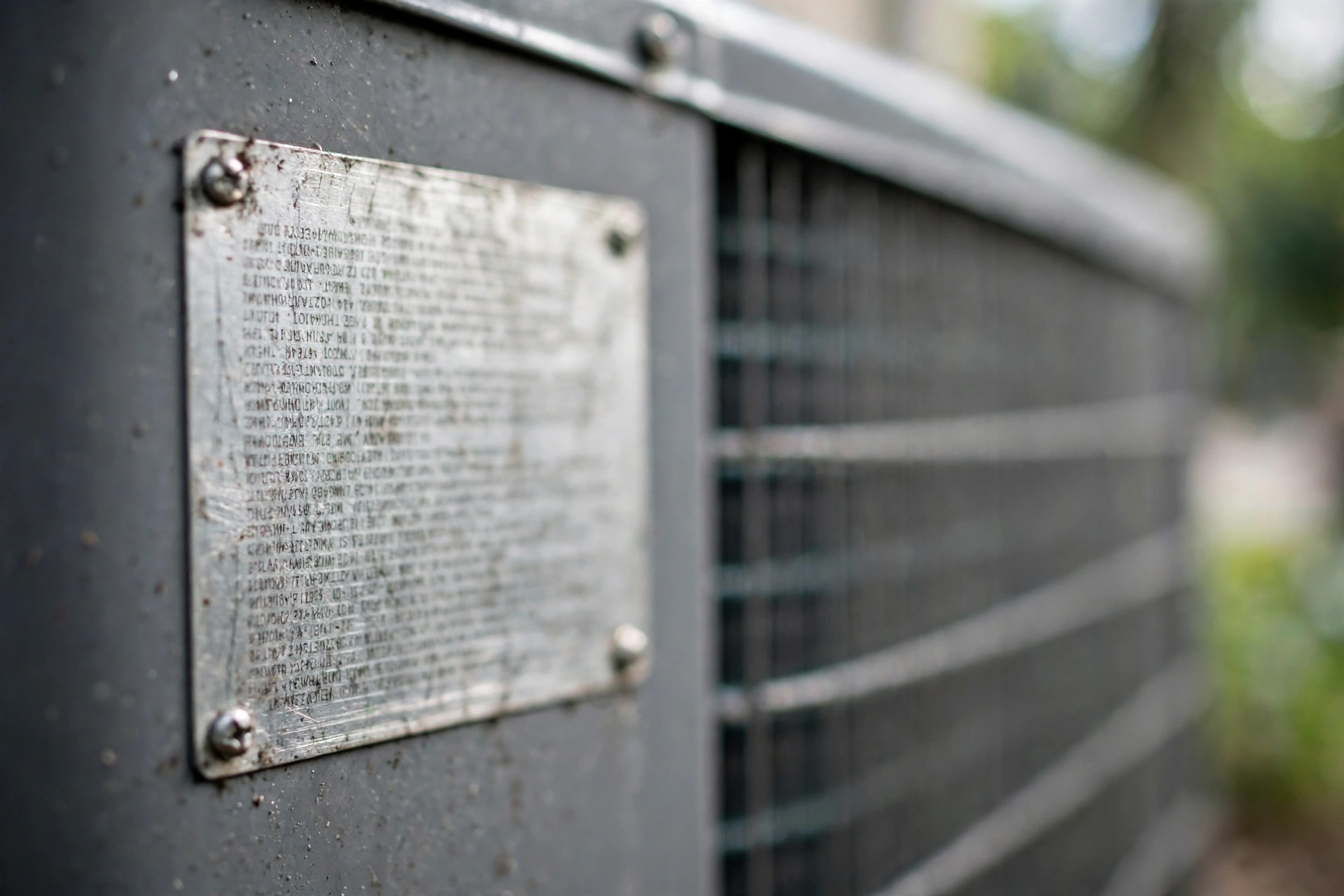
The exact starting figure for a specific unit is stamped on the outdoor condenser. Three values matter: RLA (rated load amps), the running current; LRA (locked-rotor amps), the starting current; and MCA (minimum circuit ampacity), the circuit size the installer used. Starting watts come from a single multiplication: LRA × volts. A 3-ton compressor with 78 LRA on a 240 V supply gives 78 × 240 = 18,720 W of apparent starting power.
That number looks alarming next to the 9,000–12,000 W in the table, and the difference is worth understanding. LRA × volts is apparent power — the maximum the motor could draw at zero power factor in the first cycle. Real inrush on a warm day is usually lower, and it lasts only a few cycles before the rotor turns. Generator manufacturers size for the practical surge, not the theoretical maximum, which is why a 12,000 W starting rating handles a unit whose nameplate maths says 18,720 W. The nameplate still rules: if the LRA is 109 A on a 4-ton Copeland scroll compressor, that unit will need a bigger set than a 4-ton unit printing 75 A. Same tonnage, different generator.
Why two 3-ton units need different generators
Age and efficiency move the numbers more than tonnage does. A 2008 3-ton unit at 10 SEER runs at about 3,800 W and prints an LRA near 90 A. A 2024 3-ton unit at 16 SEER runs at about 3,000 W with an LRA near 70 A. The older unit needs roughly 30% more starting power for the same cooling, and it will also draw more running power all afternoon — which means more fuel from the generator for the same comfort.
Compressor type matters too. Scroll compressors, now standard in most central units, generally print higher LRA than the reciprocating compressors they replaced. A 4-ton Copeland scroll at 109 LRA needs about 26,000 W of apparent starting power by nameplate maths, while a 4-ton reciprocating unit at 80 LRA needs about 19,200 W. Both are sold as 4-ton. Only the nameplate tells the generator what it is dealing with.
What Size Generator for a 3 Ton Air Conditioner?
The 3-ton unit is the most common central air conditioner in American single-family homes, and it is the size where most generator purchases go wrong. It sits exactly on the boundary between a large portable and a small standby set, which means the wrong choice in either direction is expensive.
The sizing method used by Generac, Honda and Champion is straightforward: minimum generator size = total running watts of everything running at once + the highest single starting watts, then add 20% headroom. Take a typical house: 3-ton air conditioner at 3,200 running watts, refrigerator 700 W, lights 400 W, indoor blower fan 500 W. Total running watts: 4,800 W. Highest starting watts: the air conditioner at 10,500 W. Sum: 15,300 W. Add 20% headroom: 18,360 W. That points to a 20 kW standby generator if everything runs together and nothing is shed at start-up.
Without a soft starter
Without any starting aid, a 3-ton central air conditioner needs a generator with at least 12,000 starting watts for the air conditioner alone, and a 14–20 kW standby set for a normal house with the air conditioner plus essentials. Generac’s own guidance puts the minimum standby size for a home with a 3-ton air conditioner at 14 kW, and that assumes the installer manages the load — the refrigerator and other motors do not start in the same second as the compressor.
A portable generator can do the job, but it has to be a large one: 12,000 starting watts or more, which in practice means a 9,500–12,000 W portable running with nothing else on it at the moment of start. A 7,500 W portable rated 9,500 starting watts will start some 3-ton units and trip on others, depending on the LRA printed on the condenser. That is not a margin to gamble a summer outage on.
The standby rating of the set matters here as well as its size. A standby-rated set is built for up to 200 hours a year at variable load. A house that runs its air conditioner on generator power for a week-long hurricane outage can burn 100–150 of those hours in a single event, so the rating and the fuel plan have to be checked together — a set that is big enough but wrongly rated will still fail early.
With a soft starter
A soft starter changes the answer by a full generator size. Fitted to the condenser, it cuts the compressor’s starting surge by 65–75%, dropping a 3-ton start from roughly 10,500 W to about 4,000–6,200 W. Run the same house maths again: 4,800 running watts + 5,000 starting watts = 9,800 W, plus 20% headroom = 11,760 W. A 12 kW standby set now covers the whole house, and a 9,500 W portable becomes workable with careful load management.
The saving is real money. The step from a 14 kW to a 20 kW standby set typically costs $1,500–$3,000 installed, including the larger transfer switch and gas line. A soft starter costs $300–$400. For a house whose generator is marginal on the air conditioner, the soft starter is the cheapest kilowatt ever bought — which is why the soft-start section below treats it as a sizing tool, not an accessory.
Can a Generator Run a Central Air Conditioner?
Yes — if three conditions are met. The generator must deliver the starting watts, it must supply 240 V single-phase power, and it must connect to the house through a proper transfer switch or interlock. Miss any one of the three and the answer becomes no, however large the generator is. That is the same decision behind every home standby generator purchase: size, voltage and connection, in that order.
Central air conditioners are hardwired into the house electrical panel. They cannot be plugged into a portable generator with an extension cord. Connection requires a transfer switch or a breaker interlock installed by a licensed electrician, and the air conditioner circuit must be on the backed-up panel. A house with a 200 A main panel and a 100 A backed-up sub-panel needs the condenser wired into the sub-panel, or it will simply never see generator power.
The transfer-switch rule
The automatic transfer switch is the device that decides whether the air conditioner ever runs on generator power. It watches the grid, starts the generator on failure, waits for voltage and frequency to stabilise, then switches the backed-up circuits across. The ten-second gap between grid failure and generator power is the reason the air conditioner restarts from a dead stop — and the reason its starting surge hits the generator at full force, with no utility grid to absorb it.
Sizing the transfer switch is part of sizing the generator. A 20 kW standby set needs a 200 A service-rated switch on most homes; a 14 kW set can often use a 100 A switch feeding a sub-panel. The switch must also be rated for the motor load: a compressor start is an inductive load, and an undersized switch will weld its contacts or chatter under the surge. This is a job for the installing electrician, not a homeowner decision, and it is one of the reasons generator sizing is quoted as a system — set, switch and wiring together — rather than as a box with a wattage sticker.
Load management on a 10 kW set
A 10 kW standby set can run a 3-ton air conditioner, but only with discipline. The maths: air conditioner 3,200 W running, refrigerator 700 W, lights 400 W, blower 500 W — 4,800 W total, or 48% of a 10 kW set. Comfortable. The problem is the start: 10,500 W of surge against a set whose maximum is 10,000 W. Without help, the set trips.
Load management solves it two ways. A soft starter on the condenser cuts the surge to about 5,000 W, inside the set’s capacity. A load-shed module on the transfer switch drops the water heater and the second refrigerator for the three seconds the compressor starts, then restores them. Many modern standby sets ship with load-shed contacts built in, and an installer can wire two or three heavy loads through them for a few hundred dollars. Either route works; both together make a 10 kW set boringly reliable on a 3-ton unit.
Three houses, three answers
A 2,400 sq ft house in Houston, Texas, runs a 3-ton Trane XR16 with 72 LRA on a 22 kW Generac standby set. The compressor starts in under a second, voltage dips about 8%, and the set carries the air conditioner, two refrigerators and the lights at roughly 45% load. The owner never thinks about the generator. That is the correct outcome, and it cost the price of a 22 kW set to achieve it.
A single-storey house in Tampa, Florida, runs a 2-ton Goodman on a 10 kVA diesel set after Hurricane Milton. The condenser carries a Micro-Air EasyStart, fitted for $340. The set ran nine days on generator power, averaging about 1.1 litres of diesel per hour across the outage — roughly 240 litres in total — because the air conditioner cycled at about 60% duty and the house load was managed by hand. Without the soft starter the same set would have tripped on the first compressor start of the outage.
A villa in Dubai runs a 5-ton unit on a 30 kVA standby set. At 50°C ambient the air conditioner works harder — running watts climb roughly 15% above nameplate — while the generator itself derates in the heat. The installer fitted a soft starter and sized the set for the hot-day load, not the catalogue load. The villa stays at 24°C through a grid outage in August. Sized from the catalogue alone, the set would have been 5 kVA short on the hottest day of the year.
Window, Portable and RV Units: Smaller Numbers, Same Rule
Not every air conditioner is a 3-ton central unit, and the smaller units follow the same rule at smaller numbers. A window unit is a compressor all the same, and it surges the same way — just from a lower base.
Window air conditioners
Window units are the easiest air conditioners to run on a generator, because their numbers are small and their starting surge is manageable. A 5,000 BTU window unit runs at about 500 W and starts at about 1,500 W. An 8,000 BTU unit runs at 750 W and starts at 2,250 W. A 12,000 BTU unit runs at 1,200 W and starts at 3,600 W. A 2,000–3,500 W portable generator handles any single window unit with room to spare, which is why window units are the standard answer for keeping one room cool during an outage.
Two window units change the maths. Two 8,000 BTU units draw 1,500 W running and surge to 4,500 W if both compressors start together — which they will not, unless the thermostats synchronise. Stagger the starts by thirty seconds and a 3,500 W portable covers both. Start them together and the same set trips. The rule is the same as for central units: size for the highest single start, then add the running watts of everything else.
Portable air conditioners
A portable air conditioner — the floor-standing unit with an exhaust hose through a window — behaves like a window unit of the same BTU rating, with one difference: the exhaust hose leaks heat back into the room, so a 12,000 BTU portable cools like a 10,000 BTU window unit while drawing the same power. Running watts for a 12,000 BTU portable are about 1,300 W, starting watts about 3,900 W. A 3,500 W portable generator runs it, provided nothing else large starts at the same moment.
Portable units also have a weakness on generator power: their condensate pumps and electronic controls are sensitive to voltage dip. A generator that sags below 200 V during a compressor start can reset the unit’s control board, which then restarts the compressor — and surges again. A set with a genuine 20% headroom above the starting watts avoids the cycle entirely.
RV rooftop units
RV rooftop air conditioners are the best-documented small case in the generator world, because thousands of RV owners have measured them. A 13,500 BTU rooftop unit draws 12–13 A running at 115 V — about 1,400–1,600 W — and prints an LRA of 45–60 A, a peak of 40–60 A for 0.2–0.5 seconds. A 15,000 BTU unit draws 13–16 A running with an LRA of 55–75 A. Without help, neither starts reliably on a 2,000 W inverter generator.
With a soft starter fitted, the peak falls to 15–25 A, and a 13,500 BTU unit starts and runs on a 2,000 W Honda EU2200i — a combination documented by Micro-Air and repeated across RV forums. The same physics scales up: the soft starter that lets a 2,000 W generator run an RV air conditioner is the same device that lets a 9,500 W portable run a 4-ton central unit. The tonnage changes; the ratio does not.
Inverter-driven mini-splits are the exception that proves the rule. A 12,000 BTU mini-split runs at about 1,000 W and starts at roughly 1,200–1,500 W, because its variable-speed compressor ramps up over several seconds instead of switching across the line. The starting surge is barely larger than the running draw, so a 2,000–3,000 W generator runs it easily. Anyone replacing a fixed-speed central unit should weigh this: the mini-split costs more to buy and far less to back up.
Do I Need a Soft Start Kit for My Air Conditioner on a Generator?
Strictly, no. A generator large enough to start the compressor without help does not need a soft starter. But “large enough” costs thousands of dollars, and a soft starter costs a few hundred — so for most houses the real question is whether the money is better spent on a bigger generator or on a smaller surge.
What a soft starter actually does
A soft starter is an electronic module wired into the compressor’s start circuit. Instead of applying full line voltage the instant the contactor closes, it ramps the voltage up over 0.3–1 second, letting the rotor begin turning before full current flows. Micro-Air’s EasyStart Flex, the most widely used unit, uses a microprocessor that learns the compressor’s characteristics over its first five starts and then optimises the ramp for that specific motor. Published inrush reduction is 65–75%.
The measured numbers are consistent across sources. A 3-ton Copeland scroll at 78 LRA starts at 26 A with an EasyStart — 6,240 W instead of 18,720 W apparent. A 4-ton unit at 109 LRA starts at 34 A, a 69% reduction, and runs on a 10,500 W inverter generator that could not have started it before. A 5-ton unit at 134 LRA starts at 42 A. Micro-Air rates the Flex for home air conditioners and heat pumps up to 6 tons, and the enclosure is IP65 weatherproof for mounting inside the condenser.
Hard start kit vs soft starter
The two devices are often confused, and they do opposite things. A hard start kit — a start capacitor and relay — increases starting torque by pushing more current into the start winding. It helps a tired compressor start on utility power, and it does nothing for a generator: the peak current stays the same or rises. A soft starter reduces peak current by ramping the voltage. It helps the generator and does nothing for a tired compressor.
Fitting a hard start kit to solve a generator problem is a common and expensive mistake. The compressor still surges, the generator still trips, and the owner concludes the generator is undersized — then buys a bigger set to solve a problem a $340 soft starter would have fixed. Anyone advising on generator sizing should ask which device is fitted before recommending a larger set.
Cost, install and the five learning starts
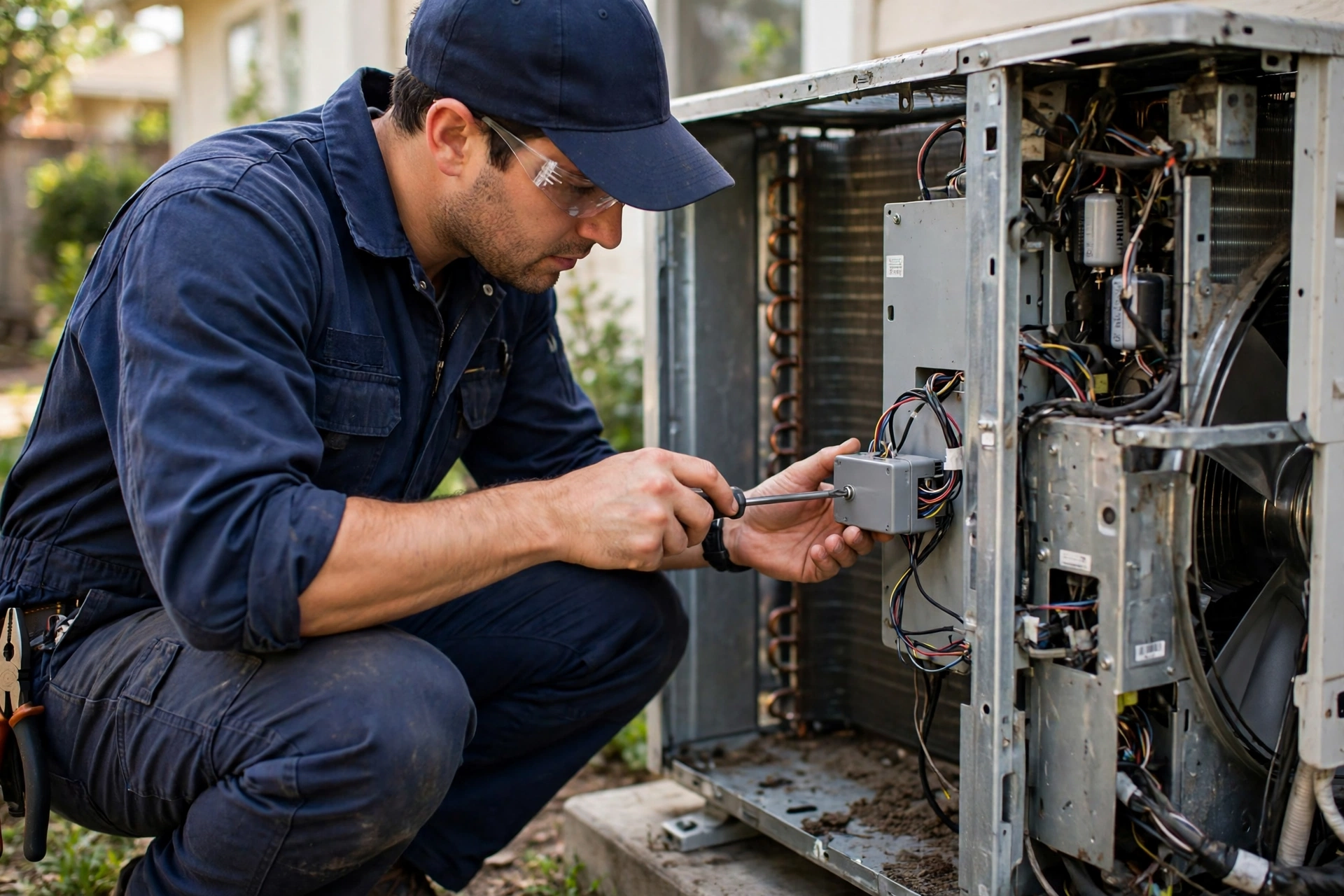
A Micro-Air EasyStart 364 lists at about $322, and the Flex home version at $300–$400 depending on model and retailer. Installation takes a competent HVAC technician 30–60 minutes: four wire terminations inside the condenser contactor box, mounting the IP65 enclosure, and five learning starts on utility power with three-minute rests between them. The learning starts matter — the unit calibrates to the compressor during those five cycles, and testing on generator power before they are complete gives a false reading of what the soft starter can do.
The payback is straightforward. If a soft starter lets a house use a 12 kW standby set instead of a 20 kW set, the saving is $1,500–$3,000 installed. If it lets a 9,500 W portable replace a 14 kW standby set, the saving is larger still. Against a $340 device, the return is measured in weeks, not years — provided the generator is genuinely marginal on the air conditioner and not undersized for the whole house. A soft starter fixes the compressor surge. It does not fix a set that is too small for the running load.
Frequently Asked Questions
What size generator do I need to run an air conditioner?
Size for the starting watts, not the running watts. A 3-ton central unit needs 9,000–12,000 starting watts, which points to a 14–20 kW standby generator for a normal house, or a 9–12 kW set if a soft starter is fitted. A 2-ton unit needs 7,000–9,000 starting watts, and a 5-ton unit needs 13,000–16,000. Check the LRA on the condenser nameplate for the exact figure.
Can a generator run a central air conditioner?
Yes, provided the generator delivers enough starting watts, supplies 240 V single-phase power, and connects through a transfer switch or interlock installed by a licensed electrician. Central units are hardwired and cannot be plugged into a portable generator. A soft starter makes the combination far more practical by cutting the starting surge 65–75%.
How many watts does an air conditioner need to start?
A fixed-speed compressor needs 3–5 times its running watts for the first second — a 3-ton unit at 3,000–3,500 running watts needs 9,000–12,000 starting watts. The exact figure is LRA × volts from the condenser nameplate: a 78 LRA compressor at 240 V draws 18,720 W apparent at the first cycle. Inverter-driven mini-splits are the exception, starting at only 1.2–1.5 times running watts.
What size generator for a 3 ton air conditioner?
Without a soft starter, at least 12,000 starting watts for the unit alone, and a 14–20 kW standby set for the unit plus normal household loads. With a soft starter, the start drops to roughly 4,000–6,200 W, so a 12 kW standby set or a 9,500 W portable becomes workable. Generac recommends a minimum 14 kW standby for homes with a 3-ton air conditioner.
Do I need a soft start kit for my air conditioner on a generator?
Not if the generator is large enough to start the compressor without help — but a $300–$400 kit cuts the surge 65–75% and can save $1,500–$3,000 on generator size, so it pays for itself whenever the set is marginal. Fit the kit before buying a bigger generator, complete the five learning starts on utility power, and confirm the compressor still starts cleanly on generator power before the next outage.
Generator Sizing Checklist Before You Buy
Read the nameplate first
Find the condenser label before shopping for a generator. Note the tonnage, the RLA and the LRA, and the voltage — 240 V single-phase for most residential units, 208 V or 480 V three-phase for commercial. Multiply LRA by volts for the apparent starting watts, then use the tonnage table in this article as a cross-check. If the two disagree by more than 30%, trust the nameplate: it describes the unit on the wall, not the average unit in a table.
Add up the whole house
List every load that runs at the same time as the air conditioner: refrigerator, freezer, lights, blower fan, well pump, internet router, medical equipment. Add the running watts, then add the highest single starting watts — almost always the air conditioner — and multiply by 1.20 for headroom. That total is the minimum generator size. A set that covers the air conditioner but not the refrigerator will trip the first time both compressors start together, usually at 2 a.m.
Check the fuel math
A diesel generator burns roughly 0.25–0.30 litres per kilowatt-hour delivered. A 3-ton air conditioner running at 3,200 W burns about 1 litre of diesel per hour on its own; a house drawing 4.8 kW burns about 1.6–2.0 L/h. Over a 72-hour outage that is 115–145 litres — more than the 100-litre sub-base tank on most small standby sets. Size the tank, or the refuelling plan, for the longest outage the site has actually experienced, not the average one. Fuel logistics end more generator runs than engine faults do.
Size the generator for the first second, not for the afternoon. The air conditioner will run happily on modest power for hours — but it will only start if the set can deliver the surge, and it only gets one chance per thermostat cycle. Read the nameplate, do the starting-watts maths, fit a soft starter if the set is marginal, and test the combination on generator power before the grid fails. For a set matched to the site’s real loads, contact PAVO with the condenser tonnage, LRA and running load list, and the right frame can be quoted against numbers instead of guesses.