

Factory Acceptance Test for Diesel Generator | PAVO
The factory test certificate on the control panel door says “passed”. The question is whether the report behind it says anything at all.
What is a factory acceptance test for a diesel generator? It is a documented set of tests run on the finished set at the manufacturer’s factory — load steps, electrical checks, protection trips and a full-load heat run — witnessed and signed off before the set ships. The report is the evidence; without it, the test is only a claim.
Contents
- What a FAT Is — and What the Report Is For
- The Six Sections of a Real FAT Report
- Reading the Load-Test Pages
- Reading the Electrical, Fuel and Protection Pages
- Three Reports, Three Verdicts
- Witnessed, Remote or Unwitnessed?
- Frequently Asked Questions
- Specification Checklist: Nine Lines Before You Pay the Balance
What a FAT Is — and What the Report Is For
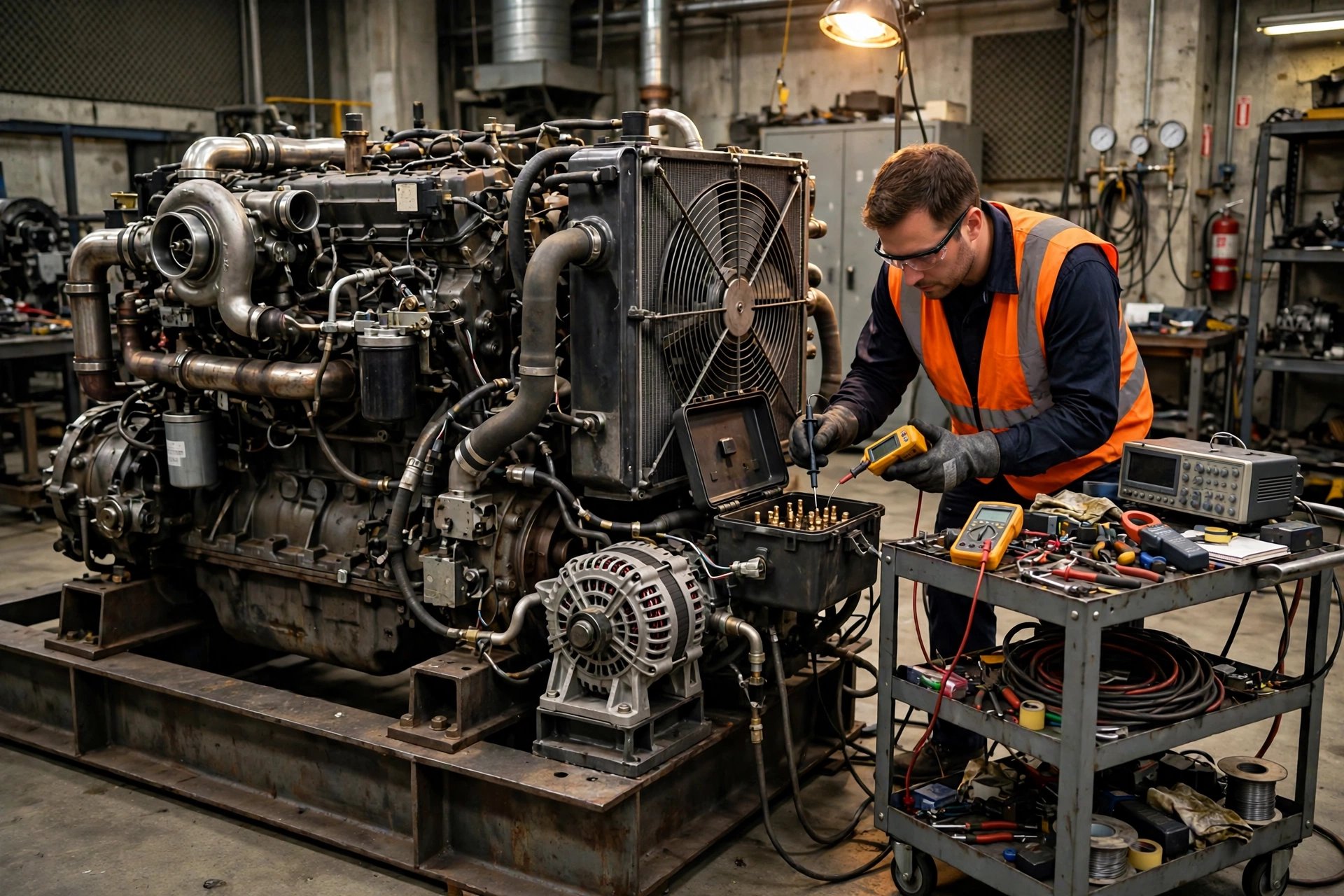
A factory acceptance test is the last time a generator set is tested before it leaves the factory. The set is built, filled, wired and run on a load bank while somebody records every reading. It catches assembly mistakes while the crane, the spare parts and the engineer who built the set are still in the same building. A fault found in the test bay costs an afternoon. The same fault found on site costs a crane, a flight, a shutdown and a warranty argument.
The test itself is only half the product. The other half is the report — the signed document that records what was tested, what was measured, what the acceptance limits were, and whether each result passed. A FAT report is the only evidence a buyer has that the set they ordered is the set that was built, and that it performs the way the datasheet promises. Without the report, a “passed FAT” is a sentence on a certificate. With it, it is a defensible record that can settle a warranty claim two years later.
The report also has a commercial function that most buyers underestimate. Payment terms on export generator contracts commonly release the bulk of the contract value against shipment, with a retention of 5–10% held until site acceptance testing passes. The FAT report is the document that justifies releasing the shipment payment. A buyer who releases 90% of the money on the strength of a one-page certificate has given away their leverage before the set has crossed the ocean. The time to read the report properly is before the balance is paid, not after the container arrives.
Two distinctions matter before the report is opened. First, a FAT is not a site acceptance test. The FAT proves the set as it left the factory; the SAT proves the set as installed at the site, on the site’s fuel, breathing the site’s air, pulling the site’s loads. PAVO’s guide to commissioning covers the site half of that story in detail — the shutdown tests, the insulation test, the step loads and the baseline numbers that should be recorded on commissioning day. Second, a FAT is not a load bank testing exercise in isolation. The load bank is one instrument inside the FAT, not the whole test. A report that shows four hours at full load and nothing else is a load bank report, not a FAT report.
The Six Sections of a Real FAT Report
A professional FAT report for a diesel generator set runs to multiple pages and follows a consistent structure. The exact headings vary between manufacturers, but the content falls into six sections, and a report missing any one of them is incomplete.
| Section | What it must contain |
|---|---|
| 1. Configuration and documentation | Contract reference, model, serial numbers, nameplate rating, duty class, calibration certificates, as-built drawings, controller firmware version, protection settings |
| 2. Electrical tests | Insulation resistance, hi-pot test, winding resistance, earth continuity, earthing resistance, phase sequence |
| 3. Load and performance tests | No-load baseline, load steps at 25%, 50%, 75% and 100%, sustained full-load run, transient response, fuel consumption at each step |
| 4. Controls and protection | Governor and AVR function, alarms, shutdown trip tests, emergency stop, automatic transfer switch operation, synchronising and communications |
| 5. Physical checks | Fluid leaks, wiring terminations, base frame, fasteners, paint, belts, radiator, noise and vibration readings |
| 6. Sign-off and evidence | Signed test matrix, deviation log, witness signatures, calibration certificates, test curves, nameplate photographs, time-stamped video where applicable |
Three rules apply to every section. Every test must show a measured value — a number — not a tick or the word “pass”. Every measured value must sit next to its acceptance criterion, the limit or tolerance it was judged against, and the standard clause it comes from. And every page must carry a name, a signature and a date. A report with numbers but no acceptance limits is a data sheet. A report with limits but no numbers is a promise. A report with neither is a brochure.
The first page deserves the closest read. The serial numbers on the report must match the serial numbers on the nameplate of the set that arrives — engine serial, alternator serial, controller serial. The rating on the report must match the purchase order exactly: kVA, kW, voltage, frequency, power factor and duty class. The standby and prime power ratings are different promises, and a report that records a prime test against a standby order — or the reverse — is testing the wrong machine. The test conditions must also be recorded: ambient temperature, barometric pressure and humidity during the test, and the make, model and calibration date of every instrument used. A voltage reading is only as credible as the meter that produced it.

Reading the Load-Test Pages
The load-test pages are the heart of the report, and they are where thin reports are easiest to spot. The test follows the method in ISO 8528-6: load applied in steps, with readings recorded at each step, and a sustained run at full load.
The 25–50–75–100% steps
The standard sequence is 25%, 50%, 75% and 100% of rated load, with readings at each step — voltage on all three phases, frequency, current, power factor, oil pressure, coolant temperature, exhaust temperature and fuel consumption. The steps exist because a generator behaves differently at each load. At 25% load the report should show whether the engine is stable and the voltage is steady; at 75% it should show whether temperatures are still climbing or have stabilised; at 100% it should show whether the cooling system can hold the set inside its limits.
A report that jumps from no-load to 100% in one step has skipped the evidence that matters most. The intermediate steps are where a weak AVR, a fuel restriction or a cooling problem first appears. A report that records only the final full-load numbers is telling the buyer the set survived, not that it performed.
The full-load heat run
After the steps, the set runs at 100% load for a sustained period. Lloyd’s Register works trials require 100% power for at least 60 minutes, with the readings at rated power taken twice, at least 30 minutes apart. Many generator manufacturers run two to four hours. The duration matters because temperature is the slowest reading to stabilise: coolant temperature, oil temperature and alternator winding temperature keep climbing long after voltage and frequency have settled. A set that passes a 15-minute full-load run and overheats at 45 minutes has not passed anything.
The heat-run pages should show coolant temperature stabilised — flat, not still rising, at the end of the run — and oil pressure within the engine maker’s limits at full operating temperature. If the coolant temperature curve is still climbing when the test ends, the test ended too soon. Ask for the run to be extended, or ask why it was not.
Transient response and the G3 limits
The most valuable numbers in the whole report are the transient ones: what happens to voltage and frequency when load is applied suddenly, and how fast they recover. ISO 8528-5 grades generator sets into performance classes G1, G2 and G3, and the limits are precise. For a G3 set — the class most industrial and data centre specifications demand — the frequency dip on load acceptance must stay within −7%, the voltage dip within −15%, frequency must recover within 3 seconds and voltage within 4 seconds. Steady-state, G3 requires voltage within ±1% and frequency within ±0.5%. The full class table is set out in PAVO’s guide to the ISO 8528 G1 / G2 / G3 classes.
A report that records no transient data has not tested the characteristic that decides whether a hospital set, a data centre set or a set feeding motor starting loads will actually work. The load rejection test belongs on the same page: full load removed in a single step, voltage overshoot within +20% and frequency overshoot within +12% for a G3 set. A set that accepts load cleanly but surges on rejection will trip its own protection the first time a large load drops off.
Reading the Electrical, Fuel and Protection Pages
The load-test pages prove the set can work. The electrical, fuel and protection pages prove it is safe, economical and able to protect itself.
Insulation resistance and hi-pot
Before the engine is ever started, the alternator windings are tested with a 500-volt DC insulation tester — a megger. The report should record the insulation resistance in megohms, measured with the windings near ambient temperature. Field practice wants comfortably into double digits; single digits are a minimum, and below that the windings must be dried first. A report that records “insulation OK” without a number has recorded nothing. The hi-pot test — a high-voltage withstand test applied to the windings — should also be recorded with its test voltage and duration. These two numbers are the cheapest insurance in the report: a winding flashover on day one, on a machine still under warranty, produces an argument that lasts months.
Fuel consumption at every step
The report should record fuel consumption in litres per hour at each load step, measured — not copied from the datasheet. For reference, a Cummins C500D5 burns 93.2 L/h at full prime load and 69.9 L/h at 75%. If the report’s measured figures differ from the datasheet by more than about 5%, something is wrong: a fuel restriction, an injector fault, a calibration error, or a datasheet that was never accurate. Fuel consumption is also the number that decides the site’s running cost, so a report without it leaves the buyer pricing a machine they have not measured. The altitude derating of the site matters here too: a FAT is run at the factory’s altitude and temperature, and the report’s figures are factory figures, not site figures.
Shutdown trip tests
The protection pages should record each shutdown being tripped on purpose: low oil pressure, high coolant temperature, overspeed, overcrank and emergency stop. Each trip needs a recorded result — the engine stopped, the alarm sounded, the controller logged the event. The overspeed trip is usually set around 115% of rated speed. A report that lists shutdowns as “checked” without recording the trip is the most common gap in the whole document, and the most dangerous: a shutdown circuit that was never proven is a shutdown circuit that may not work when the engine needs it.
The ATS and synchronising checks
If the order includes an automatic transfer switch, the report should record a full transfer-and-retransfer cycle: mains failure simulated, set started, load transferred, mains restored, load transferred back, set cooled down. NFPA 110 requires life-safety loads to be carried within 10 seconds of a utility failure, and the report should record the measured transfer time against that limit. For paralleling sets, the report should record synchronising checks and load sharing at a stated load. A FAT that never transferred a load has not tested the component that fails most often in service.
Three Reports, Three Verdicts
The difference between a good FAT report and a bad one is not academic. Three sets, three reports, three outcomes.
Case 1: A hospital set saved by one line
A 1,500 kVA set was ordered for a data centre, specified G3, with a witnessed FAT. On the transient page, the report recorded a 19% voltage dip on a 50% load step — beyond the G3 limit of 15%. The set ran, the load held, and a report without transient limits would have shown a pass. Because the limit was printed next to the number, the failure was visible. Diagnostics traced it to the AVR’s under-frequency roll-off setting: the knee point was too low. The setting was adjusted to 48 Hz, the step was repeated, and the dip improved to 13% with a 1.8-second recovery — inside G3. The fix took an afternoon in the factory. Had the set shipped with the original setting, the first real step load on site would have tripped the UPS and dropped the load. The report did its job because it carried both the number and the limit.
Case 2: A mine set and a two-page report
A gold mine in western Ghana ordered a 1,000 kVA prime set for a processing plant, 3,000 hours a year, with a 40-foot container journey from Wuhu to Tema and a 400 km road haul to site. The FAT report arrived as two pages: a cover sheet, a list of tests with ticks, and a signature. No load-step table. No fuel consumption figures. No transient data. No insulation resistance number. The buyer, under pressure to release the shipment payment, signed.
On site, the set started cleanly and ran. At 75% load, fuel consumption measured 12% above the datasheet figure — about 118 L/h against a stated 105 L/h. Over 3,000 hours a year, that is roughly 39,000 extra litres, about $43,000 a year at local diesel prices. The cause was a partially blocked fuel line fitting, installed at the factory and never caught because the FAT never measured fuel at load. The warranty claim was argued for five months: the manufacturer pointed to the signed FAT certificate, the buyer pointed to a report that contained no fuel numbers at all. The fitting was replaced under warranty in the end, but the mine paid for the extra fuel, the lost production and the argument. A report with one fuel-consumption table would have caught the fault in the test bay, where the fix was a ten-minute job.
Case 3: A data centre set tested at the wrong voltage
A colocation data centre in Malaysia ordered four 2,000 kVA sets at 380 V, 50 Hz, with a witnessed FAT by a third-party inspector. The inspector’s first act was to read the nameplate page of the report against the purchase order. The report recorded the test at 400 V. The sets had been built and tested to the factory’s standard configuration, not the order. Voltage was corrected before shipment — a tap change and a retest, one day’s work. Had the error been found on site, after the sets were installed and cabled, the correction would have meant de-energising the switchgear, re-terminating and re-testing four sets, with the data centre’s commissioning programme delayed by weeks. The inspector’s fee was a fraction of that cost. The lesson is on the first page of every FAT report: check the nameplate data before reading anything else.
Witnessed, Remote or Unwitnessed?
A FAT can be witnessed in person, witnessed remotely by live video, or unwitnessed — run by the factory alone, with the report sent afterwards. The choice is a cost decision, and it should be made at order time, not at test time.
What a witness actually does
A witness does three things the report alone cannot do. First, the witness verifies identity: the set on the test bay is the set on the report, with the serial numbers the purchase order names. Second, the witness watches the transient points in real time — the voltage dip, the frequency recovery, the slow climb of coolant temperature — and can ask for a step to be repeated. Third, the witness signs the test matrix, which turns the report from a manufacturer statement into a jointly agreed record. A FAT nobody from the buyer attends is, in the strict sense, a shop test. The discoveries it makes belong to the manufacturer alone.
For a single set, a witnessed FAT typically takes one to two days at the factory. Larger projects — multiple sets, paralleling switchgear, a full data centre order — take three to ten days, with a continuous performance run of four to eight hours at guaranteed capacity. Travel and accommodation for a witness run to a few thousand dollars, and a third-party inspector’s day rate is comparable. Against a set costing tens or hundreds of thousands of dollars, and against the cost of a fault found on site, that is a small premium.
What remote witnessing can and cannot prove
Remote witnessing by live video is now common, and for most orders it is a reasonable compromise. The witness can watch the meters, see the load steps applied, hear the engine, and ask questions in real time. It costs nothing in travel and it creates a time-stamped video record that belongs in the evidence pack.
What remote witnessing cannot do is verify identity with the same certainty — the camera shows what the factory points it at — and it cannot check the physical details: the wiring terminations, the fastener torque marks, the paint, the leaks. A remote witness should therefore ask for close-up video of the nameplate, the serial numbers and the test instruments, including their calibration stickers, and should ask for the recorded readings to be read aloud against the instruments rather than typed into a chat window. For a hospital, a data centre or any order above roughly $100,000, the case for attending in person is strong. For a standard 100 kVA standby set, remote witnessing is usually enough.
Frequently Asked Questions
What is a factory acceptance test for a diesel generator?
A factory acceptance test is the full set of tests run on a finished diesel generator at the manufacturer’s factory before shipment, covering configuration and documentation, electrical tests, load and performance tests, controls and protection, physical checks and formal sign-off. It verifies that the set was assembled correctly, performs to its rated output under simulated load, and that its controls and protection work — and it produces a signed report recording the measured results against agreed acceptance limits.
What should a generator FAT report include?
A genuine FAT report includes the contract reference and nameplate data with matching serial numbers, the test conditions and instrument calibration details, insulation resistance and hi-pot results, load-step readings at 25%, 50%, 75% and 100% with fuel consumption at each step, a sustained full-load run of at least 60 minutes, transient voltage and frequency dip and recovery figures against the ISO 8528 class limits, shutdown trip test results, ATS transfer times where applicable, a deviation log, and signatures from the tester and the witness. Every test must show a measured number next to its acceptance limit.
How long does a factory acceptance test take for a generator?
A single standard set typically takes one to two days at the factory, including the load steps, the sustained full-load run and the protection tests. Larger projects with multiple sets or paralleling switchgear take three to ten days, with a continuous performance run of four to eight hours at guaranteed capacity. The pre-shipment documentation package — the report, certificates, drawings and manuals — takes a further one to two weeks to assemble, so the report should be requested before the set ships, not after it arrives.
Should I witness the factory acceptance test for my generator?
Yes, for any critical application — hospitals, data centres, prime-power sites and orders above roughly $100,000 — either attend in person or appoint a third-party inspector. A witness verifies the set’s identity, watches the transient tests in real time, and signs the test matrix, turning the report into a jointly agreed record. For a standard small standby set, remote witnessing by live video is usually sufficient, provided the witness asks for close-up video of the nameplate, serial numbers and instrument calibration stickers.
What is the difference between FAT and SAT for a generator?
The FAT is run at the manufacturer’s factory before shipment and proves the set as it left the factory, under simulated load on a load bank. The SAT is run at the buyer’s site after installation and proves the set as installed — on the site’s fuel, breathing the site’s air, connected to the site’s transfer switch and pulling the site’s real loads. The FAT catches factory faults; the SAT catches shipping damage and installation faults. A set needs both, and the FAT report is the baseline the SAT is judged against.
Specification Checklist: Nine Lines Before You Pay the Balance
1. Does the report match the order? Serial numbers, model, kVA, kW, voltage, frequency, power factor and duty class — every line against the purchase order before reading further.
2. Does every test show a number and a limit? A measured value next to its acceptance criterion and the standard clause. Ticks and the word “pass” are not results.
3. Are the load steps complete? Readings at 25%, 50%, 75% and 100%, with a sustained full-load run of at least 60 minutes and temperatures stabilised, not still climbing.
4. Are the transient figures inside the class limits? Voltage dip within −15% and frequency dip within −7% for G3, with recovery inside 4 and 3 seconds. No transient data means no transient test.
5. Is fuel consumption measured at each step? Measured in litres per hour, not copied from the datasheet. More than 5% above the datasheet figure is a fault to investigate.
6. Were the shutdowns actually tripped? Low oil pressure, high coolant temperature, overspeed, overcrank and emergency stop — each recorded as tripped and observed, with the overspeed trip around 115% of rated speed.
7. Is the insulation resistance a number? Recorded in megohms, with the windings near ambient temperature. Double digits is the target; single digits is the minimum.
8. Is the deviation log empty or explained? Every deviation must have a description, an owner and a re-test record. A blank deviation log on a first test is possible; a missing deviation log is not.
9. Is the retention still held? Confirm that 5–10% of the contract value remains held until the site acceptance test passes. The FAT report justifies releasing the shipment payment — it does not justify releasing all of it.
The certificate on the control panel door is not the evidence. The report is. Read it before the balance is paid, check the nameplate page first, the transient page second and the fuel page third — and if any of those three pages is thin, hold the payment and ask for the test to be repeated. A manufacturer that tests every set under load before it ships will not object to being asked to prove it.
For a factory acceptance test on a set built for a specific site — witnessed, with the full report package, load-step data and transient figures recorded against the ISO 8528 class the application demands — contact PAVO with the set size, the duty and the site conditions, and ask for the FAT procedure before the order is placed.