

Should I Rent or Buy a Diesel Generator? The Math | PAVO
Rent or Buy a Diesel Generator? The Math Behind a 200 kVA Set on a Two-Year Construction Job
A two-year construction job needs a 200 kVA set for roughly 5,000 hours. Renting costs about $5,000 a month. Buying costs about $32,000 once. The right answer is not the cheaper number — it is the number that matches how the job actually runs.
Should I rent or buy a diesel generator? For a 200 kVA set on a two-year construction job, buying usually wins on total cost — the break-even month falls between month 5 and month 11 at typical rental rates. Renting wins on cash flow, speed and flexibility, and it wins outright in low-cost rental markets.
Contents
- What Renting and Buying Actually Mean
- The 200 kVA Set: What a Two-Year Job Actually Needs
- The Break-Even Month: Rent vs Buy in Numbers
- The Costs Neither Quote Shows
- Three Jobs, Three Answers
- The Rental Contract: Five Lines to Read Before Signing
- Frequently Asked Questions
- Specification Checklist: Seven Lines Before You Sign Either Way
What Renting and Buying Actually Mean
Renting and buying are not two prices for the same thing. They are two different allocations of risk, and the quote rarely makes that visible.
Renting means paying for use. The supplier owns the machine, delivers it, services it and collects it at the end. The renter pays a monthly rate, buys the fuel, and returns a machine that is not theirs. Hire periods run from a single day to three years — YorPower’s UK fleet, for example, hires sets from small single-phase units to 1,000 kVA on terms as short as a day. A 200 kVA canopy set from a hire fleet such as Aggreko’s arrives on a trailer, with a 993-litre tank, a published fuel consumption of 45.0 litres per hour at full load, and a 24/7 monitoring option.
Buying means paying capital and taking the risk. The buyer owns the machine, carries the service schedule, holds the warranty, and at the end of the job owns either an asset or a problem. A new 200 kVA silent set costs $20,000 to $45,000 depending on engine, enclosure and certification, according to current buying guides. A Cummins-powered 200 kVA set — the C200D5e, built on the QSB7-G5 engine — is rated 200 kVA / 160 kW standby and 182.5 kVA / 146 kW prime. That distinction matters here: a two-year construction job running ten hours a day is prime duty, not standby, and the set must be bought and warranted on its prime rating. The standby and prime power ratings decide whether the warranty survives the job.
What a rental quote usually includes
A rental quote usually includes the machine, delivery and collection, routine maintenance, breakdown support and a replacement set if the hired unit fails. It usually excludes fuel, and frequently excludes cables, distribution boards, fuel polishing and any damage beyond fair wear. The monthly rate is the headline; the exclusions are the contract.
What a purchase quote usually includes
A purchase quote usually includes the set, the base tank, the controller and a warranty — commonly one year or 1,000 hours, whichever comes first. It usually excludes freight, installation, cabling, the first fuel fill, commissioning and the service visits that start at 250 hours. A buyer comparing a $28,000 purchase price against a $5,000 monthly rental is not comparing like with like until both quotes carry the same inclusions.
The 200 kVA Set: What a Two-Year Job Actually Needs
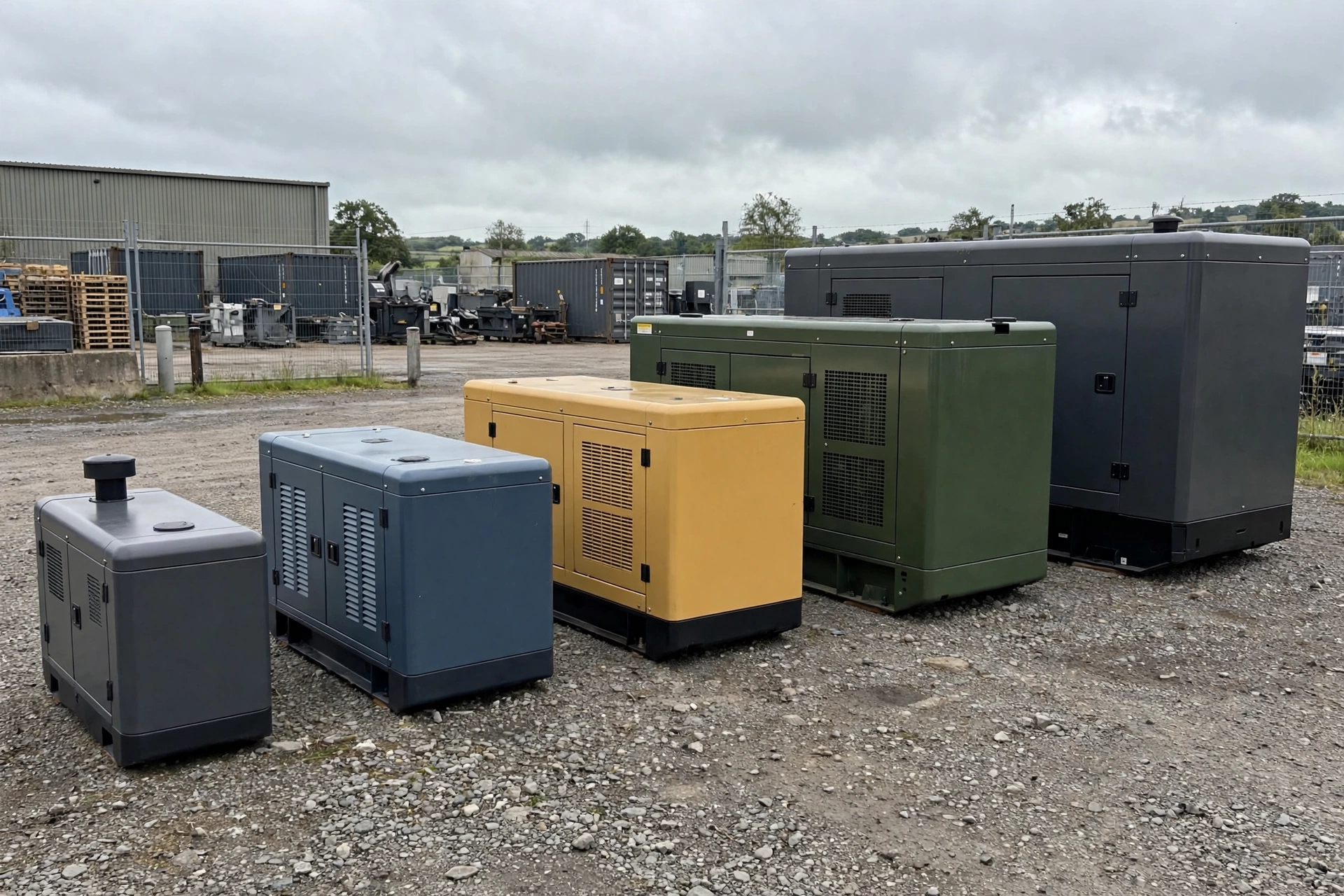
A 200 kVA set is the workhorse size for mid-scale construction. It is large enough to run a tower crane and a site compound together, and small enough to arrive on a standard flatbed. The load list for a typical two-year residential or commercial build looks like this:
| Load | Running demand |
|---|---|
| Tower crane, 55 kW motor | 55 kW |
| Concrete mixer and batching | 30 kW |
| Site offices, lighting, welfare | 25 kW |
| Welding sets, intermittent | 20 kW |
| Dewatering and sump pumps | 15 kW |
| Small tools, chargers, miscellaneous | 15 kW |
| Total running load | 160 kW = 200 kVA at 0.8 pf |
That total is the running load. The starting load is higher: the tower crane motor draws several times its running current for the first seconds, and the set must ride through it without dropping voltage far enough to trip contactors. A 200 kVA set covers this load list with a small margin. A 150 kVA set does not, once the crane starts while the mixer is running.
Over 24 months the set runs about ten hours a day, 22 days a month — 5,280 hours. That figure is the whole decision in one number. At 5,280 hours the set is a prime-power machine doing prime-power work, and it will consume roughly 143,000 litres of diesel. The Cummins C200D5e burns 25.5 L/h at 50% load and 42.3 L/h at full prime load; at the job’s average of about 55% load, call it 27 L/h. Ten hours a day, 22 days a month, 24 months: 5,940 litres a month, 142,560 litres over the job. At $1.10 a litre that is $6,534 a month in fuel, $156,816 over two years. Fuel is the largest single cost on either side of the rent-or-buy decision, and it is identical on both sides — which is precisely why most quotes leave it out. The fuel consumption and tank sizing calculation belongs in the budget before either quote is signed.
The Break-Even Month: Rent vs Buy in Numbers
Strip fuel out of the comparison, since both sides burn the same diesel, and the arithmetic becomes clear. The worked figures below use a purchase price of $28,000 for a 200 kVA silent set, plus $2,500 freight and $1,500 installation and cabling — $32,000 all-in. The rental rate is $5,000 a month on a 24-month term, inside the published range: medium sets of 100–300 kW hire at $6,000–$12,000 a month on short terms, with long-term contracts typically discounted 30–50%. Service on the owned set runs about $210 a month averaged over the job — oil and filters every 250 hours, plus coolant, belts and one battery. Resale values assume a Cummins-powered set sold after the job, with hours and condition as stated.
| Horizon | Rent: $5,000/mo + $2,000 transport | Buy: $32,000 + service − resale |
|---|---|---|
| 3 months | $17,000 | $32,000 + $630 − $22,400 (70%) = $10,230 |
| 6 months | $32,000 | $32,000 + $1,260 − $20,800 (65%) = $12,460 |
| 12 months | $62,000 | $32,000 + $2,520 − $17,600 (55%) = $16,920 |
| 18 months | $92,000 | $32,000 + $3,780 − $16,000 (50%) = $19,780 |
| 24 months | $122,000 | $32,000 + $5,040 − $14,400 (45%) = $22,640 |
On pure cash cost, buying wins at every horizon in this table — by about $7,000 at three months and by nearly $100,000 at 24 months. That result surprises most buyers, and it is the reason the question needs a better answer than a price comparison. Buying wins on cost. Renting wins on everything else: no $32,000 out of the door on day one, no eight-to-sixteen-week manufacturing and shipping lead time, no resale to arrange, and no service schedule to manage.
The rental rate that moves the answer
The break-even month is a function of the local rental rate, and rental rates vary by a factor of ten between markets. At $5,000 a month, the owned set pays for itself in about five months. At $2,000 a month, break-even moves to about eleven months. At the Indian market rate of ₹50,000 a month — roughly $570 — for a 200 kVA CAT set, renting costs $13,680 over 24 months against a net buy cost of $22,640: renting wins outright, and by nearly $9,000. In South Africa, by contrast, a 200–300 kVA set hires at R10,000–10,500 a day — roughly $560 a day — which makes even a three-month hire more expensive than buying. The question is never “rent or buy” in the abstract. It is “rent or buy, at this rate, in this market, for this many months.”
The resale value that moves the answer
Resale is the most uncertain number in the table, and the one buyers overestimate most often. A two-year-old set with 5,280 hours is worth 45–55% of its purchase price if it is a recognised engine brand, has a full service history, and is sold in a market where that brand has parts and dealers. A no-name set with no service records and 5,280 hours can be worth 25% or less — and can take six months to sell. Two rules follow. First, buy a brand the resale market recognises — Cummins, Perkins or Weichai with a dealer network in the country where the set will be sold. Second, keep every service invoice, because the buyer of a used set pays for the paper trail as much as for the machine.
The Costs Neither Quote Shows
Three cost lines sit outside both quotes, and together they are larger than the rental-versus-purchase difference.
Fuel
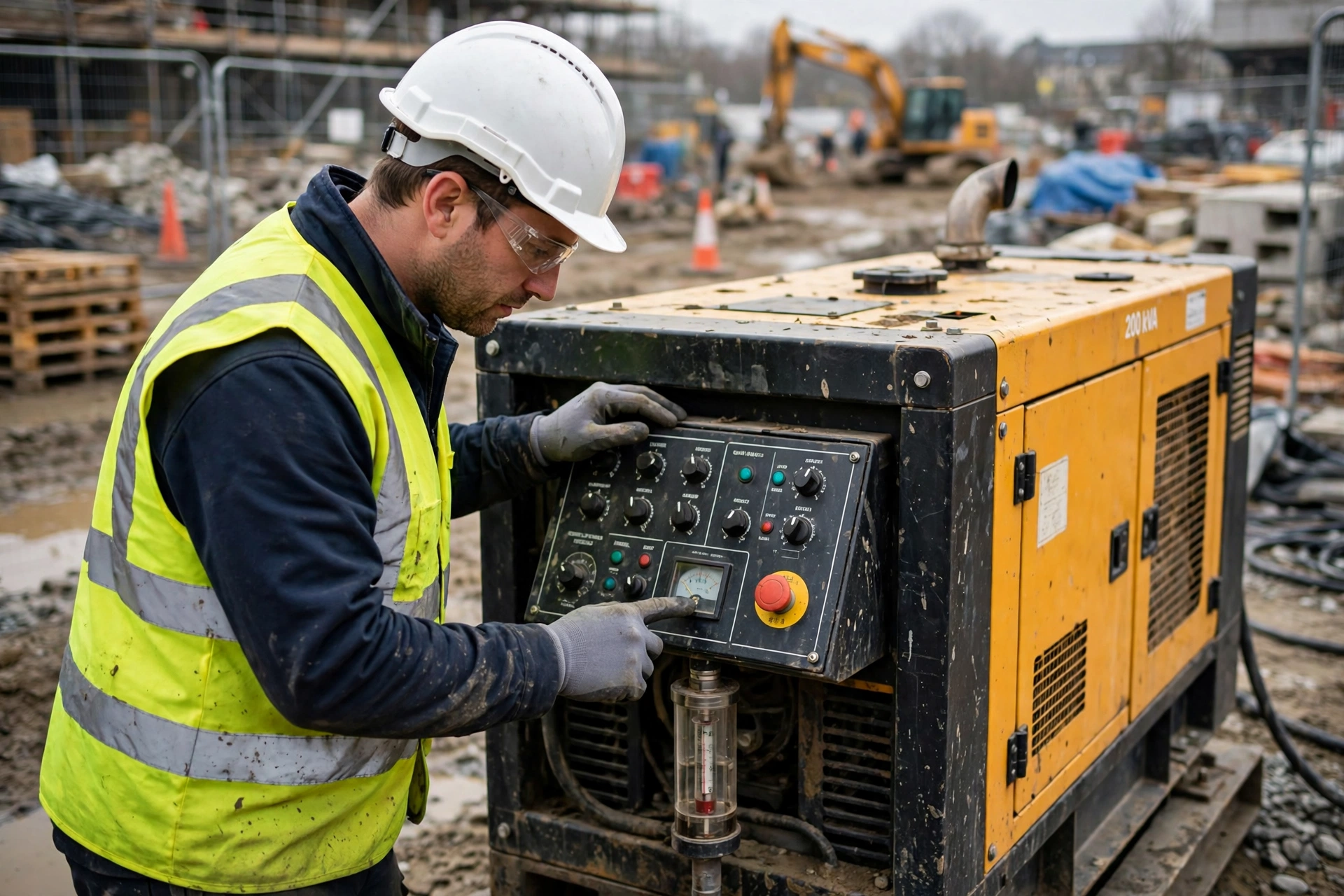
Fuel is the largest cost on the job and the one most often forgotten. At 27 L/h average, the job burns 5,940 litres a month. At $1.10 a litre that is $6,534 a month — more than the $5,000 rental rate itself. Rental quotes exclude fuel in almost every market. A contractor who budgets the rental rate and forgets the fuel discovers, at month three, that the generator line in the project accounts is running at more than double the expected figure. The Aggreko 200 kVA hire set carries a 993-litre tank, good for about 22 hours at full load — so the job needs a bulk tank and a delivery contract from week one, on either side of the decision.
Delivery, cabling and installation
A 200 kVA silent set weighs roughly 2,500–3,000 kg and measures about 3.3 × 1.3 × 1.8 metres. Moving it needs a flatbed, a crane or forklift, and a prepared plinth. Rental contracts usually include one delivery and one collection; every move after that is charged. A road project that relocates the set eight times pays eight delivery charges on a rental — or eight transport charges on an owned set, plus the labour to disconnect and reconnect. Cabling, distribution boards and earthing are charged separately on both sides, typically $1,500–$3,000 for a 200 kVA installation, and they are not recovered on resale.
Service, breakdowns and downtime
An owned set needs oil and filter changes every 250 hours — 21 services over 5,280 hours — plus coolant, belts, a battery at around year two, and a technician who knows the controller. Budget roughly $5,000 over the job, plus the cost of a day’s lost production if the set fails and no loaner is available. A rental contract includes routine service and, on a good contract, a replacement set within 24 hours. That replacement guarantee is worth real money on a job where a dead generator stops a tower crane, a concrete pour and forty workers. A service contract on an owned set can buy the same cover, but it is a separate line item, not part of the purchase price.
Three Jobs, Three Answers
The same 200 kVA set, the same 24-month question, three different answers — because the jobs are different.
Case 1: High-rise residential, Lagos, 24 months — buy
A contractor building a 14-storey residential tower in Lagos needs 200 kVA of prime power for 24 months. Grid supply is unreliable, the site is fixed, the load is steady at 130–160 kW, and the contractor has a depot with a workshop. The set is bought: $28,000 purchase, $2,500 freight from the port, $1,500 installation. Over 24 months it runs 5,280 hours, burns 142,560 litres, and is serviced 21 times at $5,000 total. At handover the set is sold locally for $14,400 — 45% residual — to a buyer who wants a Cummins-powered set with a documented service history. Net cost excluding fuel: $22,640. The rental alternative would have cost $122,000. The saving is just under $100,000, and the contractor still owns a machine that could serve the next job instead of being sold.
Case 2: Road project, nine months, site moves every six weeks — rent
A civil contractor is building 18 km of rural road over nine months. The site compound moves every six weeks as the work front advances — eight moves in total. The power need is 150–200 kVA, the load is variable, and the contractor has no depot and no generator technician. Buying would mean eight transport and reconnection operations at roughly $800 each, a service schedule managed from a moving site office, and a used set to sell at the end from a location with no resale market. Renting at $5,000 a month costs $45,000 for nine months plus moves included in the contract, with breakdown cover and a replacement set guaranteed. The rental company moves the set, services it and takes it away. The contractor’s project manager never touches a spanner. On pure cash the two options are close at nine months; on operational reality, renting is the only sensible answer.
Case 3: Factory waiting 14 months for a grid connection — rent first, then buy
A manufacturing plant has a permanent 200 kVA set on order, but the grid connection is 14 months away and the factory must start production in six weeks. Buying a second set to cover 14 months makes no sense — the permanent set is already coming. Renting bridge power for 14 months at $5,000 a month costs $70,000, against a permanent set that would have cost $32,000 and then sat redundant. The rental is the expensive option per month and the right option overall, because the need has a defined end date. This is the same logic data centre developers now use routinely: rent bridge power with a defined exit date, and place the permanent order early enough that the two overlap at commissioning. When the permanent set arrives, it is commissioned, tested under load bank testing, and the rental is collected. No asset is left over, no resale is needed.
The Rental Contract: Five Lines to Read Before Signing
A rental contract is where the cheap monthly rate turns expensive. Five lines deserve a read before signature.
1. The hours cap. Many contracts include a monthly hours allowance — commonly 200–250 hours — with excess hours charged per hour. A construction set running ten hours a day, 22 days a month runs 220 hours, inside a 250-hour cap. A set running twelve-hour days runs 264 hours, and the excess 14 hours a month are charged at a premium rate. Confirm the cap against the real working pattern, in writing.
2. Fuel and refuelling. Confirm who supplies fuel, who refuels, and what happens when the set runs dry. A set that shuts down on low fuel at 2 a.m. is a contract question, not a technical one. Some contracts include a fuel-management service; most do not. The automatic transfer switch on a standby installation has the same dependency — no fuel, no power, whatever the contract says.
3. Breakdown response and replacement. The contract should state a response time and a replacement guarantee. “Best endeavours” is not a guarantee. A 24-hour replacement commitment, in writing, is the line that protects a concrete pour. Ask what happens on a public holiday, and who pays for the crane if the replacement set is a different size.
4. Damage, theft and insurance. Construction sites lose equipment. Confirm whether the rental rate includes insurance, what the excess is, and who carries the risk for theft, vandalism and damage by other trades. A hired set left unfenced on a road project is a theft waiting to happen, and the hire company’s excess can run to several thousand dollars.
5. Termination and notice. Confirm the minimum term, the notice period, and the early-termination charge. A 24-month contract with a 12-month minimum and a three-month termination penalty is a different commitment from a rolling monthly hire. If the job finishes early, the penalty is the price of the flexibility the contract appeared to offer. The same discipline applies to the emissions standard on the hired set: a Stage V or Tier 4 Final machine is required on many urban and European sites, and a rental fleet unit that does not carry the certificate can be turned away at the gate.
Frequently Asked Questions
Should I rent or buy a diesel generator?
For a 200 kVA set on a two-year construction job, buying usually wins on total cost, with break-even between month 5 and month 11 at typical rental rates. Renting wins on cash flow, speed and flexibility, and it wins outright in low-cost rental markets or when the job is shorter than six months.
How much does it cost to rent a 200 kVA generator per month?
Medium sets of 100–300 kW hire at $6,000–$12,000 a month on short terms in North American and European markets, with long-term contracts typically discounted 30–50%, bringing a 200 kVA set to roughly $3,000–$7,000 a month. In lower-cost markets the same size hires for far less — about ₹50,000 a month in India — and fuel, delivery and insurance are usually extra.
How long should you rent a generator before buying one?
As a working rule, rent when the need is under six months, buy when it is over twelve, and treat six to twelve months as the grey zone where the local rental rate and the resale value decide. If the rental rate is under $1,500 a month, renting can stay cheaper for the full two years; if it is over $5,000, buying pays for itself in about five months.
What does generator rental include?
A rental quote usually includes the machine, delivery and collection, routine maintenance, breakdown support and a replacement set if the hired unit fails. It usually excludes fuel, cables, distribution boards and damage beyond fair wear, and it may cap monthly running hours — read the contract for those four exclusions before comparing it with a purchase price.
Can you rent a generator for a construction site?
Yes — construction is the most common rental use case, and hire fleets supply towable and skid-mounted sets from 20 kVA to over 1,000 kVA for exactly this purpose. Confirm the set is prime-rated for the hours the job will run, that it carries the emissions certificate the site requires, and that the contract covers delivery, refuelling and breakdown replacement on a moving site.
Specification Checklist: Seven Lines Before You Sign Either Way
1. How many months, honestly? Count the job from first power to last, including the fit-out and snagging months when the set still runs. A 24-month job that becomes 30 months changes the answer.
2. How many hours a month? Multiply the working day by the working days. Over 200 hours a month is prime duty, and the set — rented or bought — must be rated and warranted for it.
3. What is the real monthly rental rate, all-in? Get the rate in writing with delivery, insurance, the hours cap and the excess-hour charge stated. A $5,000 rate with a 200-hour cap is not a $5,000 rate on a 220-hour job.
4. What is the purchase price, all-in? Add freight, installation, cabling, the first fuel fill and commissioning to the set price. A $28,000 set is a $32,000 installation.
5. What is the resale value, in this market? Price a used set of the same brand and hours in the country where it will be sold, before buying. If there is no resale market, the buy case loses its largest credit.
6. Who services it, and who covers a breakdown? An owned set needs a technician and a service schedule; a rented set needs a replacement guarantee in writing. Either way, somebody must answer the phone at 2 a.m.
7. Can the job grow? If the load may rise — a second crane, a second shift — confirm the set can grow with it, or that the rental contract allows a swap to a larger unit. On an owned installation, the option to add a second generator in parallel is worth specifying from the start, because retrofitting paralleling switchgear later costs far more than provisioning for it now.
The price on a rental quote states what a generator costs this month. The price on a purchase quote states what it costs once. Neither figure answers the question on its own. The job’s duration, the local rental rate, the fuel bill and the resale value answer it — and on a two-year construction job, those four numbers point the same way in almost every market: buy the set, budget the fuel, and keep the service records, because the resale buyer will pay for them. If the job is short, the site moves, or the cash is not there, rent — and rent knowing that the premium buys speed and flexibility, not cheap power.
For a priced comparison on a 200 kVA set for a specific job — rental rate in the local market, purchase price with freight, and the break-even month worked out against the real load list — contact PAVO with the job duration, the daily running hours and the site location.