

How Long Does Diesel Fuel Last in a Generator Tank? | PAVO
Your Fuel Is Going Bad in the Tank: Diesel Ageing, Water and Microbes in Standby Sets
A generator can be mechanically perfect and still fail on the night it is needed, because the fuel in its tank stopped being diesel months ago.
How long does diesel fuel last in a standby generator tank? Untreated diesel in a vented tank remains usable for 6 to 12 months. With stabiliser, regular water removal and fuel polishing, that window extends to 18 to 24 months — beyond it, oxidation, water and microbes turn fuel into sludge that clogs filters and stops the set starting.
Contents
- Diesel Fuel Has a Shelf Life — and It Is Shorter Than You Think
- Water: The Contaminant That Starts Everything
- Diesel Algae: Bacteria and Fungi at the Fuel–Water Line
- Three Sites, Three Fuel Failures
- What Fuel Testing Actually Measures
- Fuel Polishing: What It Does and What It Cannot Fix
- Frequently Asked Questions
- Fuel Checklist: Five Actions Before the Next Outage
Diesel Fuel Has a Shelf Life — and It Is Shorter Than You Think
Diesel is not a stable liquid. From the day it leaves the refinery it begins to oxidise. Oxygen reacts with the fuel’s hydrocarbons to form gums, varnishes and insoluble particles. The process is slow at first and then accelerates. Fresh diesel is clear and bright. Aged diesel darkens, smells sour, and leaves a sticky residue on a white filter paper.
The practical window is well documented. Cummins technical guidance puts typical diesel shelf life at 6 to 12 months in normal storage, and notes that properly maintained fuel may remain suitable for 1.5 to 2 years. Other industry guidance converges on the same range: 6 to 12 months untreated, up to 18 months with stabiliser and good tank hygiene. These are planning ranges, not guarantees. Heat, humidity, tank condition and contamination can shorten them sharply.
What changes inside stored diesel
Three processes run in parallel. Oxidation creates gums and sediment that coat injectors and plug filters. Thermal cycling drives condensation, adding water to the tank. Microbial growth, fed by that water, produces acids and biomass that corrode steel and block fuel passages. Each process feeds the next: oxidation products provide food for microbes, microbes produce acids that attack the tank, and corrosion particles add to the sediment load.
Ultra-low sulphur diesel (ULSD), mandated in most markets since 2006, stores worse than the high-sulphur diesel it replaced. Sulphur acted as a natural antioxidant and biocide. Removing it improved exhaust emissions and shortened storage life in the same stroke. A tank that held fuel safely for two years in 2005 may not hold it for one year today.
The storage-life table: plan by condition, not by hope
| Storage condition | Typical usable life | Main risk |
|---|---|---|
| Sealed indoor day tank, clean and dry, moderate temperature | 12-24 months | Additive depletion, slow oxidation |
| Outdoor vented tank, temperate climate, regular water removal | 6-12 months | Condensation, microbial growth |
| Outdoor tank, hot and humid climate, no water removal | 3-6 months | Rapid microbial growth, corrosion |
| Biodiesel blend B5-B20, typical standby tank | 3-6 months | Oxidation, moisture absorption, filter plugging |
| Treated with stabiliser and biocide, polished annually | 18-24 months | Residual sediment, tank corrosion |
Biodiesel blends deserve a separate warning. B5 and B20 oxidise faster than straight diesel and absorb moisture more readily. A site that switched to a B20 blend without changing its fuel management programme has quietly cut its storage life in half. The delivery note, not the tank label, tells the buyer what blend is in the tank — and most buyers never read it.
Water: The Contaminant That Starts Everything
Almost every fuel failure in a standby set begins with water. Water is the one contaminant that enables all the others. Without water, microbes cannot grow, corrosion slows to a crawl, and oxidation products stay dissolved rather than settling as sludge. With water, the tank becomes a habitat.
Where the water comes from
Water enters a generator tank through four routes. Condensation is the largest. A vented tank breathes: warm daytime air enters, cools overnight, and deposits moisture on the tank walls. A half-empty tank breathes hardest, because the air volume above the fuel is largest. A 1,000-litre tank kept half full in a climate with 15°C day–night swings can accumulate litres of water in a year without a single drop of rain entering it.
Delivery is the second route. Fuel arrives with dissolved water already in it, and a supplier’s wet storage or a contaminated tanker adds free water on top. The third route is a leaking filler cap, a cracked vent, or rainwater running down a poorly sealed tank neck. The fourth is the fuel itself: diesel absorbs moisture from humid air, and biodiesel blends absorb more.
How much water is too much
Any free water at the tank bottom is too much. Microbial colonies need remarkably little: research published by the US National Renewable Energy Laboratory notes that less than 1% water by volume can support microbial growth when fuel is stored over time. In a 1,000-litre tank, that is 10 litres — a quantity that accumulates silently in a humid climate within months.
The practical test is simple. A water-finding paste on a dipstick turns colour on contact with free water at the tank bottom. A clear sample drawn from the tank drain should be bright, not hazy. Haze means emulsified water. A dark layer at the bottom of a sample jar means free water and, almost certainly, microbes. Any of these findings means the fuel programme has already failed, and the question is how much damage has been done, not whether treatment is needed.
“Diesel Algae”: Bacteria and Fungi at the Fuel–Water Line
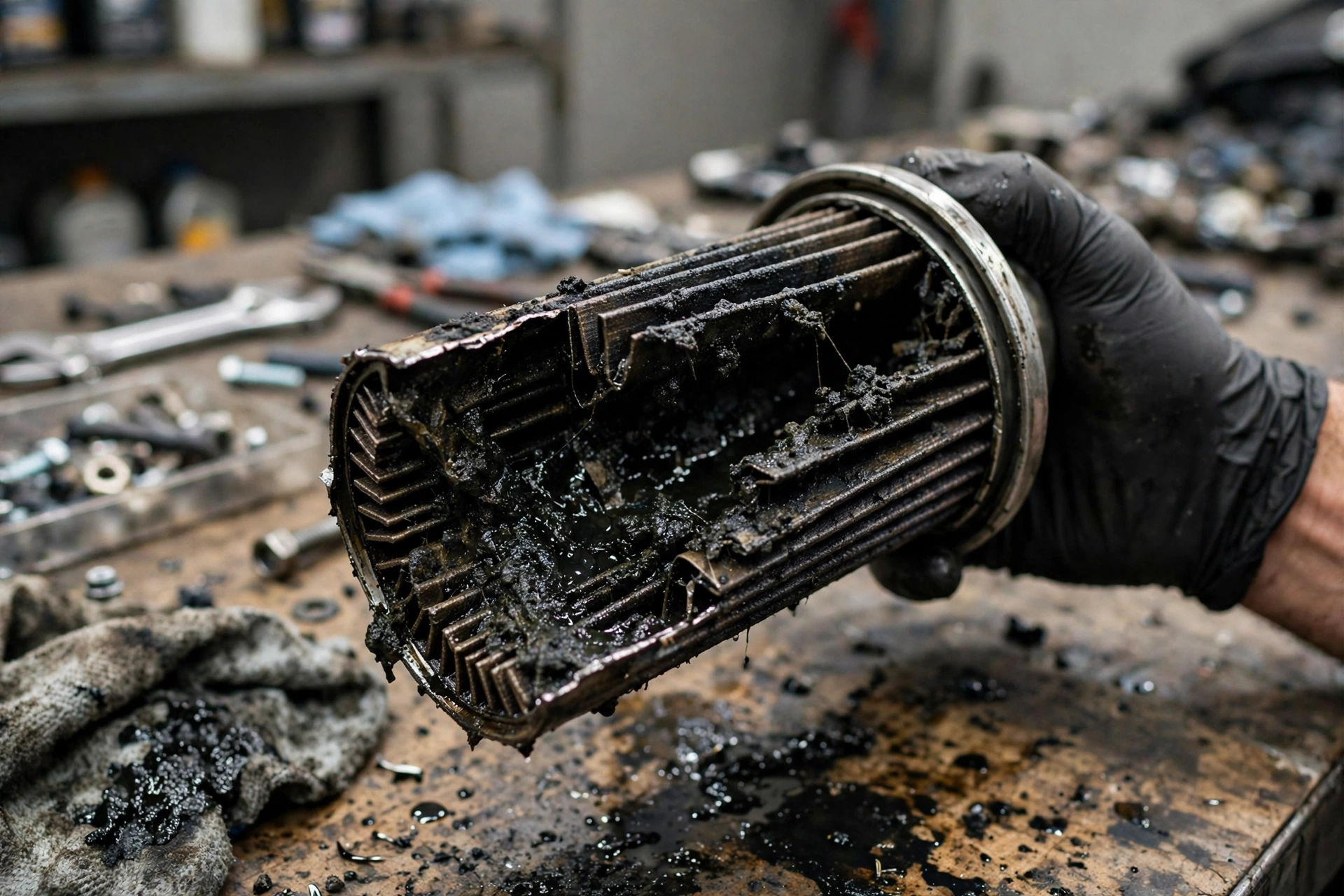
Operators call it algae. It is not algae. True algae needs sunlight, and there is none inside a sealed fuel tank. What grows in stored diesel is a colony of bacteria, fungi and yeast, living at the boundary where water settles beneath the fuel. The black, slimy material that clogs filters is microbial biomass — dead and living organisms, their waste products, and the sludge they produce.
What actually grows, and what it does
The organisms feed on hydrocarbons at the fuel–water interface. Bacteria dominate first, producing acids as a by-product. Fungi follow, forming mats and filaments that trap sediment. The acids attack steel tank walls, fuel lines and injector components. The biomass itself is the immediate operational threat: it is soft, sticky and exactly the right size to plug a 10-micron fuel filter.
The damage is not limited to filters. Microbial acids cause pitting corrosion in steel tanks and in the fuel system. Biomass that passes a partially blocked filter reaches the injection system, where modern common-rail injectors operate at pressures above 1,800 bar with clearances measured in microns. A single injector failure on a six-cylinder set costs thousands of dollars in parts; a full set replacement, plus labour and downtime, can exceed the cost of five years of fuel maintenance.
The signs, in order of appearance
Fuel problems announce themselves in a sequence, and each stage is cheaper to fix than the next. First, the fuel darkens and the filter change interval shortens. A filter that used to last a year now lasts three months, then one. Second, the set cranks longer before starting, or hunts and surges under load — the first sign that fuel flow is restricted. Third, the set starts, runs for ten seconds, and dies, because the filter is blocked and the fuel system has lost its prime. Fourth, it does not start at all.
Most sites discover the problem at stage three or four. A monthly no-load test does not catch it, because a 30-minute run at light load draws little fuel and never stresses the filter. The failure waits for a real outage, at full load, when fuel demand is highest and there is no time to fix it.
Three Sites, Three Fuel Failures
Fuel ageing is not a theoretical risk. It is the most common preventable cause of standby generator failure, and industry estimates put fuel-related problems behind roughly 20% of emergency generator outages. Three site types show how it happens.
Case 1: Hospital — the set that started, then died at hour six
A hospital outside Lagos runs a 350 kW load on a standby-rated set with a 1,000-litre base tank. Grid outages total about 40 hours a year. The set is tested monthly, 30 minutes, no load. Fuel is delivered once a year, 1,000 litres, and topped up only when the gauge reads low.
The arithmetic is the problem. Monthly testing at light load burns roughly 25 litres per test, about 300 litres a year. The tank holds 1,000 litres. More than two-thirds of the fuel sits in the tank for over a year, in a hot, humid climate, in a vented outdoor tank. By the fourteenth month the fuel is dark, the filters are changed twice as often, and nobody connects the two facts.
During a rainy-season outage the set started cleanly, took full load, and ran for six hours — then stopped. The primary filter was blocked solid with black sludge. The spare filter, changed in the dark, blocked again within forty minutes. The hospital ran on flashlights for the remaining nine hours of the outage. The engine was undamaged. The fuel was the failure.
Case 2: Data centre — a 72-hour test that exposed 18-month-old fuel
A colocation data centre specified a 1,125 kVA silent set with a 2,000-litre bulk tank, sized for 72 hours of runtime. The set was commissioned, filled, tested under load bank, and then left on standby. The site’s maintenance contract covered engine servicing. It did not cover fuel.
Eighteen months later, a planned 72-hour resilience test began. The set ran for 31 hours, then began surging under load. Fuel samples showed heavy microbial contamination and a water layer 40 mm deep at the tank bottom. The test was abandoned at hour 34. The remediation — fuel polishing, tank cleaning, biocide treatment and a full filter change — cost more than three years of a proper fuel maintenance programme would have. The site now tests fuel every six months and polishes annually. Its standby and prime power ratings were correct; its fuel programme was not.
Case 3: Telecom tower — prime duty, no fuel turnover plan
A telecom tower in northern Nigeria runs a 75 kVA set 8 to 12 hours a day, 300 days a year, because grid supply is unreliable. That is a prime duty, and the engine is serviced on schedule. But the site is remote, fuel is delivered in 200-litre drums by road, and drums sit in the sun for weeks before use.
Drum-stored fuel in a hot climate degrades fast. Condensation inside half-empty drums, dust around the filler, and no filtration at the transfer point meant contaminated fuel went into the tank at every fill. The set’s filters clogged every few weeks. Injector wear appeared at 4,000 hours — early for a set of that class. The site’s problem was not the generator. It was a fuel supply chain with no quality control at any point between the depot and the tank.
What Fuel Testing Actually Measures
Fuel testing is the only way to know what is in the tank. Visual inspection catches the worst cases and misses the rest. A laboratory test, or a field test kit used correctly, measures five things that matter.
| Test | What it finds | Standard | Action threshold |
|---|---|---|---|
| Visual clarity and colour | Oxidation, gross contamination | ASTM D4176 | Dark, hazy or particulate-laden fuel |
| Free water and sediment | Water at tank bottom, solids | ASTM D2709 | Any free water; sediment above 0.05% |
| Microbial contamination | Bacteria and fungi count | ASTM D7464 | Any significant growth; ATP test positive |
| Particle count | Cleanliness of fuel as dispensed | ISO 4406 | Above 18/16/13 — polish or filter |
| Stability / oxidation | Gum formation, remaining life | ASTM D2274 | Failing stability — treat or replace |
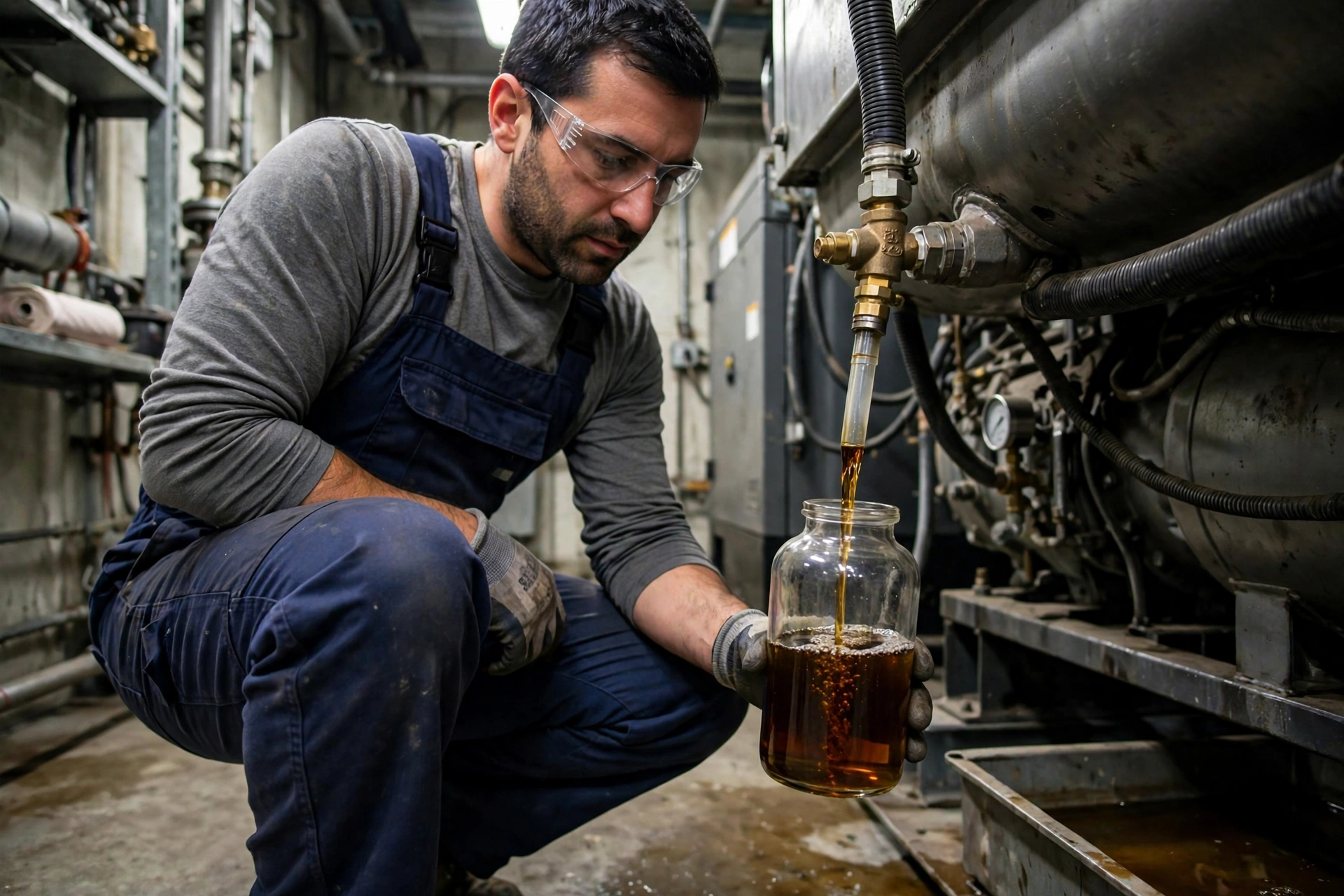
Sampling technique decides whether the result means anything. A sample taken from the top of the tank tells the tester about the cleanest fuel in the system. The correct sample comes from the tank bottom, where water and contamination concentrate, and from mid-depth for comparison. ASTM D4057 sets out the sampling method. A test on a bad sample is worse than no test, because it produces false confidence.
How often should generator fuel be tested? NFPA 110, the standard for emergency and standby power systems, requires a fuel quality test at least annually, using appropriate ASTM standards. That is the minimum. High-reliability sites — hospitals, data centres, facilities in hot and humid climates — test every six months, and quarterly where fuel is held longer than a year or contamination has been found before. A test costs a fraction of a filter change. A failed start costs everything the generator was bought to protect.
Fuel Polishing: What It Does and What It Cannot Fix
Fuel polishing is a cleaning process, not a chemical treatment. A mobile polishing unit circulates stored diesel through a series of filters and water separators, removing water, sediment and microbial biomass, and returns clean fuel to the tank. A thorough service addresses the tank bottom, where contamination concentrates, rather than skimming the clean fuel in the middle.
The polishing process, step by step
First, the tank bottom is sampled and the free water drained. Second, the fuel is circulated through progressively finer filtration — typically down to 10 microns, then 3 microns — with a water separator at each stage. Third, the tank walls and floor are agitated or scrubbed where access allows, because biomass clings to surfaces and re-contaminates polished fuel within weeks if left in place. Fourth, the fuel is re-tested. A polishing job that ends without a re-test has not demonstrated anything.
Polishing is effective for water, sediment and biomass. It does not reverse oxidation. Fuel that has formed heavy gums and lost its stability will not regain it by filtration. Polishing also does not repair a corroded tank or a cracked filler neck. Where testing shows failed stability, or where polishing and re-testing fail to bring the fuel back into specification, the correct action is to remove and replace the fuel — and to fix the tank condition that caused the problem.
When polishing is not enough
Three conditions call for tank cleaning or fuel replacement instead of polishing alone. Heavy sludge that resists circulation, because it sits below the suction point and will not move. Failed oxidation stability, because the fuel itself has degraded beyond recovery. Recurrent contamination after polishing, because the source — a leaking cap, a corroded tank, a bad delivery — is still feeding the problem. In each case, polishing first and diagnosing second wastes the polishing fee.
Frequently Asked Questions
How long does diesel fuel last in a standby generator tank?
Untreated diesel in a typical vented standby tank lasts 6 to 12 months. With a stabiliser, regular water removal and annual fuel polishing, usable life extends to 18 to 24 months. Biodiesel blends last less — 3 to 6 months — and hot, humid climates shorten every figure. Fuel older than 12 months without treatment should be tested before it is relied on for emergency operation.
What causes algae in diesel fuel and how do you get rid of it?
So-called diesel algae is bacteria and fungi growing at the fuel–water interface, fed by water that enters through condensation, delivery or leaks. Removal starts with draining free water, then a shock dose of an EPA-registered dual-phase biocide, circulated through the system, followed by filter changes. Dead biomass still plugs filters, so biocide treatment must be followed by filtration or fuel polishing and, in severe cases, tank cleaning.
What is fuel polishing and how often should it be done?
Fuel polishing circulates stored diesel through fine filters and water separators to remove water, sediment and microbial biomass, returning clean fuel to the tank. It should be done when testing shows water, microbial activity or sediment above threshold — not on a fixed calendar — and annually as a precaution on critical sites. Polishing does not reverse oxidation, so fuel that has failed a stability test must be replaced, not polished.
How often should generator fuel be tested?
NFPA 110 requires a fuel quality test at least annually, using ASTM methods. High-reliability facilities test every six months, and quarterly where fuel is stored longer than a year or contamination has been found before. Water checks — paste on a dipstick, or a bottom sample — should be monthly, because water is the earliest warning and the cheapest to fix.
How do you know if diesel fuel has gone bad?
Bad diesel is dark rather than clear and bright, smells sour, leaves residue on filter paper, and produces sludge in the tank. Operational signs appear earlier than visual ones: shorter filter life, longer cranking, surging under load, or a set that starts and dies after seconds. The only certain answer is a laboratory test — appearance alone cannot confirm fuel that looks acceptable but has failed stability.
Fuel Checklist: Five Actions Before the Next Outage
- Date the fuel. Write the delivery date on the tank. If the fuel is older than 12 months and has never been tested, treat it as suspect until a test says otherwise. A tank with no delivery date is a tank with no fuel programme.
- Drain water monthly. Open the tank drain or use water-finding paste on a dipstick. Any free water comes out, every month, in every climate. This single action prevents most microbial growth.
- Test every six months. A laboratory test for water, microbes, sediment and stability, sampled from the tank bottom. Annually is the NFPA 110 minimum; six-monthly is the practical standard for any site that cannot afford a failed start.
- Size the tank to the fuel’s life, not just the runtime. NFPA 110 states the principle directly: tanks shall be sized so that fuel is consumed within its storage life, or provisions shall be made to remediate or replace stale fuel. A 2,000-litre tank on a set that burns 300 litres a year in tests holds fuel for more than six years. That is a design error, not a reserve. Match tank size to realistic consumption, and plan a turnover or polishing schedule for the rest. The fuel consumption and tank sizing figures for the set should be calculated before the tank is ordered, not after it is installed.
- Treat at delivery, not at failure. Stabiliser and biocide added when fuel is fresh cost a few dollars per hundred litres. The same treatment applied to contaminated fuel costs more, works worse, and still requires filter changes. Prevention is the only cheap stage in fuel management.
Fuel is the cheapest part of a standby power system and the most common reason it fails. A set that costs tens of thousands of dollars, installed to protect a facility worth millions, depends on a few hundred litres of liquid that quietly expires in its own tank. The maintenance schedule already covers oil, filters, coolant and batteries. Fuel belongs on the same list, with the same discipline — because the automatic transfer switch will do its job in ten seconds, and the engine will start — a black start — but neither can compensate for fuel that stopped being diesel a year ago.
Any buyer specifying a new set should ask the supplier three questions: what tank size matches the site’s real consumption, what fuel maintenance the warranty expects, and what filtration the set carries as standard. A manufacturer that knows its business — PAVO included, with a range of 9 to 3750 kVA in open, silent diesel generator sets, powered by Cummins, Weichai, Yuchai and Shanghai Diesel — will answer all three before a deposit is paid. A supplier that treats the tank as an afterthought has already shown how it thinks about reliability.
The price on a quotation states what a generator costs today. The fuel in its tank states whether it will start when it matters. Check the fuel date before the next outage, not during it. For a specification, a tank size, or a fuel maintenance plan matched to the site, contact PAVO — the team that builds the set can size the tank and the programme with it.