

How Long Will a Diesel Generator Run on a Full Tank? | PAVO
A generator’s runtime is not printed on its nameplate. It is printed on its fuel curve — and most buyers never ask to see it.
How long will a diesel generator run on a full tank? Divide the usable litres in the tank by the litres per hour the set burns at the actual load. A 100 kVA set at 75% load burns about 15 litres an hour, so a 500-litre tank lasts roughly 30 hours.
Contents
- The Only Formula That Matters
- What a Generator Actually Burns at 25, 50, 75 and 100% Load
- The 8-Hour Tank: What the Base Tank Really Gives You
- Sizing for 24 Hours
- Sizing for 72 Hours
- Prime Sites: When the Tank Is a Weekly Routine
- Frequently Asked Questions
- Specification Checklist: Five Questions Before You Order the Tank
The Only Formula That Matters
Runtime is one division: usable fuel in litres, divided by consumption in litres per hour. Both numbers are routinely wrong, and each error compounds the other. A buyer who takes the brochure tank size and the brochure consumption figure at full load can be out by a factor of two before the set has run a single hour.
Consumption comes from the engine datasheet, at the load the site will actually carry — not at full load, and not at the rating on the quotation. A set that carries 60% load burns far less per hour than the same set at 100%, but far more per kilowatt-hour produced. Load is the variable that decides the answer, which is why every honest fuel calculation starts with a load profile, not a tank size.
The formula behind the datasheet figures is simple. Litres per hour equals load in kilowatts, multiplied by specific fuel consumption in grams per kilowatt-hour, divided by diesel density and 1,000:
L/h = (kW × SFOC g/kWh) ÷ (0.84 kg/L × 1,000)
A modern diesel engine runs at roughly 210 g/kWh at full load. A 400 kW load therefore burns about 100 litres an hour: 400 × 210 ÷ 840. At part load the specific consumption rises, because the engine still has to overcome its own friction, drive its cooling fan and alternator, and keep itself warm. That is why the litres-per-hour figure falls more slowly than the load does.
Two traps sit inside that formula. The first is kVA. Fuel burn follows kilowatts, not kilovolt-amperes. A 500 kVA set at 0.8 power factor is a 400 kW set. Size the tank from 500 and the fuel estimate comes out about 25% high. The second trap is the rating. standby and prime power ratings change the fuel figure for the same engine: the Cummins C500D5 burns 93.2 L/h at full prime load and 107.1 L/h at full standby load — about 15% more, because the standby rating pushes the same engine harder. A tank sized from the prime figure will run short if the set is actually run at its standby rating.
For quick planning, the industry rule of thumb is 0.25–0.30 litres per kilowatt-hour at full load — roughly one litre per hour for every 4 kW of output. Cummins publishes a similar shortcut: about 0.07 US gallons per hour for each rated kilowatt at full standby load, which puts a 100 kW set near 26.5 L/h and a 500 kW set near 132.5 L/h. These are planning figures. The datasheet for the exact engine governs the order.
None of this matters if the set never starts. Runtime is measured from the moment the load transfers, and how long a generator takes to start — about 10 seconds on a healthy standby system — is a separate question with its own timers. Fuel sizing assumes the set is running. The two numbers belong in the same specification, but they are not the same number.
What a Generator Actually Burns at 25, 50, 75 and 100% Load
The table below gives typical planning figures for modern diesel sets. They are compiled from published industry averages and manufacturer datasheets, and they are close enough to price fuel and size tanks. They are not a substitute for the fuel curve of the exact engine on the quotation — two engines with the same kVA rating can differ by 10% or more.
| Generator size | 25% load | 50% load | 75% load | 100% load |
|---|---|---|---|---|
| 20 kVA (16 kW) | ~2 L/h | ~3 L/h | ~4 L/h | ~6 L/h |
| 50 kVA (40 kW) | ~5 L/h | ~8 L/h | ~12 L/h | ~16 L/h |
| 100 kVA (80 kW) | ~6.5 L/h | ~10.5 L/h | ~15 L/h | ~20.5 L/h |
| 200 kVA (160 kW) | ~12.5 L/h | ~20.5 L/h | ~29 L/h | ~40 L/h |
| 500 kVA (400 kW) | ~30 L/h | ~50 L/h | ~71 L/h | ~97 L/h |
| 1,000 kVA (800 kW) | ~60 L/h | ~100 L/h | ~142 L/h | ~194 L/h |
Three patterns in that table decide most fuel arguments. First, consumption is roughly proportional to size: a 500 kVA set burns about five times what a 100 kVA set burns at the same load percentage. Second, consumption does not fall in proportion to load. A 500 kVA set at 25% load still burns 30 L/h — about 31% of its full-load figure while producing 25% of its output. At 25% load it burns roughly 40% more fuel per kilowatt-hour than at full load. Third, the absolute numbers are large. A 1,000 kVA set at full load drinks nearly 200 litres an hour. Over 24 hours that is 4,656 litres — more than most sites keep on hand.
The published Cummins figures for the C500D5 sit close to the generic row: 29.2 L/h at 25%, 49.0 at 50%, 69.9 at 75% and 93.2 at 100% on prime rating. That agreement is reassuring, and it is also the point: when the generic table and the datasheet agree within a few percent, the planning figure is safe to use for budgeting. When they disagree by 20%, the datasheet wins and the quotation needs a question.
Light load deserves its own warning. A set run for long periods below about 30–40% of its rating suffers wet stacking: unburned fuel and carbon build up in the exhaust, cylinder glazing follows, and oil consumption rises. The fuel penalty is the smaller problem. The larger problem is a set that has been idling at 20% load for a year and then fails to take full load when the grid drops. Sites with genuinely light loads should specify a smaller set, or schedule regular load-bank runs that push the engine above 70% for long enough to clear the exhaust system.
The 8-Hour Tank: What the Base Tank Really Gives You
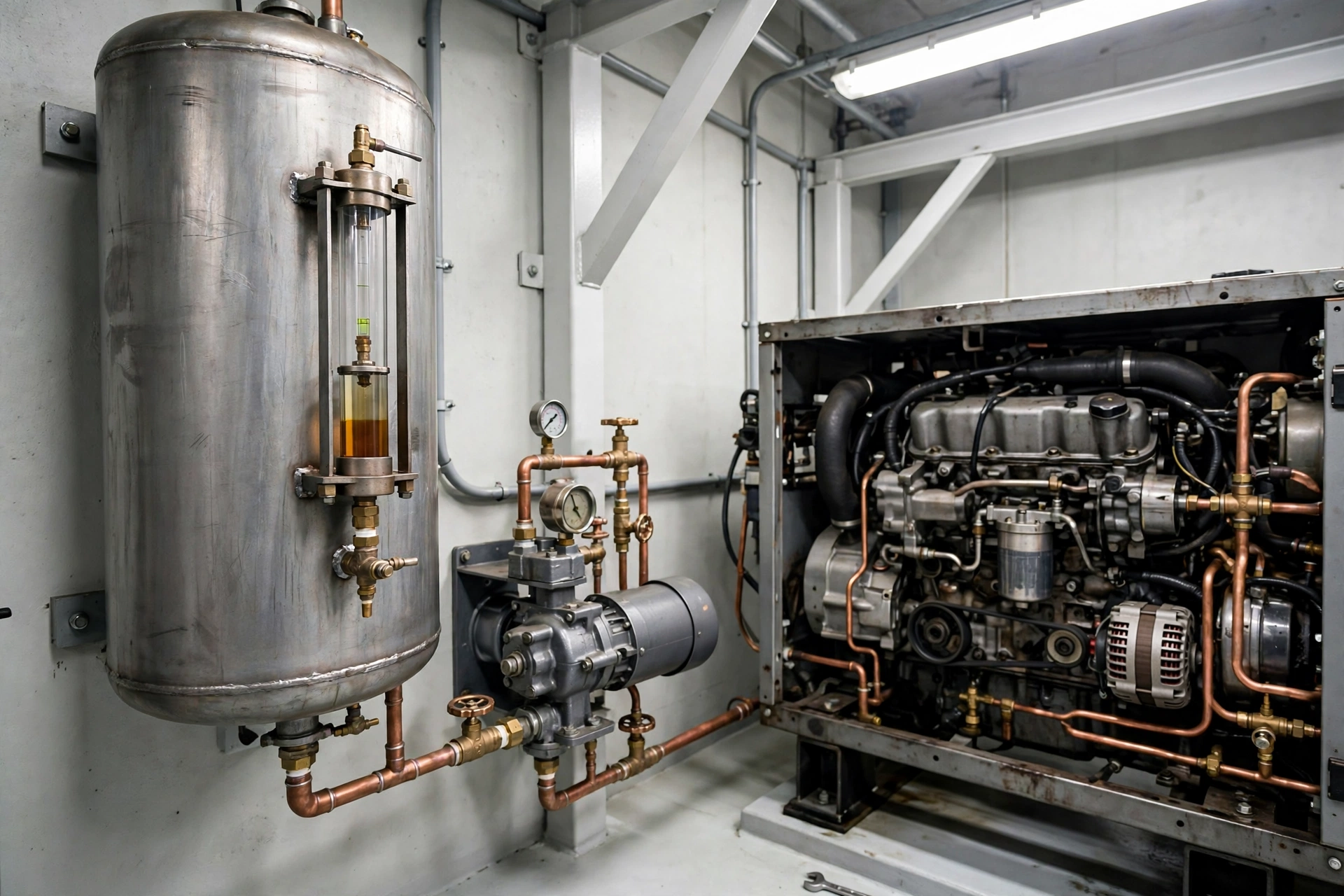
Most generator sets leave the factory with a base tank — a steel tank built into the skid under the engine of open and silent diesel generator sets, typically 100 to 4,000 litres depending on the size of the set. The common convention is an 8-hour tank: enough fuel for eight hours of running. The convention is real. The number of hours it delivers is not.
An 8-hour tank is usually sized at full load. A 500 kVA set burning 97 L/h at full load needs about 776 litres for eight hours, so it ships with an 800-litre base tank. At 75% load the same tank lasts 11 hours. At 25% load it lasts more than a day. The tank did not change. The load did. Any quotation that states “8-hour tank” without stating the load it was calculated at has stated nothing useful.
The Cummins C500D5 illustrates the gap precisely. Its 645-litre base tank gives 22.1 hours at 25% load, 13.2 hours at 50%, 9.2 hours at 75% and 6.9 hours at full load on prime rating. On standby rating the same tank gives 6.0 hours at full load. A buyer who reads “645-litre tank” and assumes a full working day of backup has assumed wrong by a factor of three if the set runs flat out.
| Generator size | Typical base tank | Hours at 75% load | Hours at 100% load |
|---|---|---|---|
| 100 kVA | 200 L | ~13 hours | ~10 hours |
| 200 kVA | 400 L | ~14 hours | ~10 hours |
| 500 kVA (C500D5) | 645 L | ~9 hours | ~7 hours |
| 1,000 kVA | 1,500 L | ~11 hours | ~8 hours |
Eight hours covers the median outage comfortably. Uptime Institute’s 2025 outage analysis puts the median significant outage at 53 minutes. Most grid failures are over before a base tank is half empty. The base tank fails the site in the other direction: the outage that lasts a day, the storm that takes down the grid for a weekend, the site where the fuel truck cannot get through until Monday. Eight hours is a starting point, not a resilience strategy.
Usable Litres, Not Nameplate Litres
A 645-litre tank does not hold 645 usable litres. The fuel pickup sits above the bottom of the tank, because the bottom is where water and sediment collect. The low-fuel sensor trips before the pickup runs dry, because running a diesel dry air-locks the fuel system and the set will not restart without priming. Between the pickup height, the sensor point and the reserve the operator is supposed to keep, roughly 10% of the nominal capacity is unusable.
The honest calculation is therefore: runtime equals usable litres divided by litres per hour, where usable litres are about 90% of the nameplate figure. The C500D5’s 645-litre tank holds about 580 usable litres. At 75% prime load that is 8.3 hours, not 9.2. At full load it is 6.2 hours, not 6.9. The difference is one hour of runtime that exists on paper and does not exist in the tank. Sites that plan refuelling on the nameplate figure discover the difference at the worst possible moment.
Sizing for 24 Hours
Twenty-four hours is the first serious autonomy target, and it is the one most often specified for hospitals, offices and light industrial sites. It covers a full day of outage, a full night of refuelling delay, and a full shift of decision-making. NFPA 110, the standard for emergency and standby power systems, classifies systems by the minimum time they must run at full rated load without refuelling: Class 2, Class 6, Class 48, and Class X for any other duration the application requires. A 24-hour requirement is a Class 24 system, and the standard sizes the fuel for it at full rated load — not at the load the site expects, but at the load the set is rated for.
The sizing calculation for 24 hours follows the same formula, with two additions. First, NFPA 110 requires the main tank to hold at least 133% of the quantity at which the low-fuel sensor trips (2022 edition; the 2025 edition keeps 133% for classes up to 24 hours). Second, the day tank — the small tank that feeds the engine directly — must hold at least one hour of fuel at full load, with the bulk tank refilling it automatically.
Take a hospital outside Lagos running a 500 kVA set at about 75% load. The C500D5 burns 69.9 L/h at 75% prime load. Twenty-four hours needs 1,678 litres of usable fuel. The 133% rule pushes the specified tank to about 2,230 litres, and the 10% unusable allowance pushes it further. The correct specification is a 2,500-litre bulk tank with a day tank, not a 1,700-litre tank that matches the arithmetic and fails the standard. At a planning price of $1.00 per litre, the fuel sitting in that tank costs about $1,700 — the price of one day of independence.
The Hospital That Sized for 24 Hours
The hospital runs a 350 kW load — lighting, air conditioning, imaging, refrigeration and life-support circuits — on a 500 kVA standby set. Grid outages total about 40 hours a year, and the longest single outage on record lasted eleven hours, through a rainy-season night. A base tank would have covered it. The hospital specified 24 hours anyway, for two reasons the arithmetic supports.
The first reason is refuelling lead time. During the rainy season, the fuel supplier needs up to 48 hours’ notice, and the hospital’s own procurement process adds a day. A 24-hour tank does not cover a 48-hour lead time — but it covers the first 24 hours of it, which is the difference between an orderly delivery and an emergency call at 3 a.m. The second reason is load growth. The hospital adds a ward every few years. Each addition raises the load and shortens the runtime. A tank specified with margin absorbs two additions before it needs replacing.
The installation is a day tank beside the set, fed by a 2,500-litre bulk tank outside the generator room, with a transfer pump, high and low level alarms, and a low-fuel signal wired into the building management system. The set is tested monthly under load. The fuel is sampled annually. Nothing about the arrangement is exotic. It is simply sized from the load, the standard and the delivery reality, in that order.
The 133% Rule and the Day Tank
The 133% rule exists because fuel gauges lie. A float gauge in a 2,500-litre tank can be wrong by 5% without anyone noticing, which is 125 litres — nearly two hours of runtime on a 500 kVA set. The low-fuel sensor is the last honest instrument in the system, and the standard sizes the tank so that the sensor’s trip point still leaves the full Class runtime available. A tank sized exactly to the arithmetic has no room for a gauge error, a pump that stops, or a delivery that arrives a day late.
The day tank is the other half of the arrangement, and it is where most 24-hour installations are actually built. A day tank of 100–200 litres sits beside the engine, gravity-feeds or pump-feeds the injection system, and is refilled automatically from the bulk tank. The engine never sees the bulk tank directly. That separation matters twice: it keeps the engine’s fuel supply short, clean and simple, and it means the bulk tank can sit outside, underground, or in a separate fire compartment. NFPA 110 limits diesel storage inside or on the roof of a structure to 660 US gallons — about 2,500 litres — which is another reason the bulk tank for a 24-hour system usually lives outside the building.
Sizing for 72 Hours
Seventy-two hours is the data centre number. It is three days of grid failure, three days of fuel-truck queues, three days of a storm system sitting over the region. Uptime Institute sets a 12-hour minimum of on-site fuel at N load for all Tiers, and treats anything beyond 12 hours as an operational decision. In practice, hyperscale operators hold 48–72 hours on site, and many Tier III and Tier IV facilities specify 96 hours at full load. The spread is wide because the risk is different: a colocation site with a 72-hour contractual commitment cannot borrow fuel from a neighbour’s tank.
The arithmetic scales directly. A 1125 kVA silent set — 900 kW — at 75% load carries 675 kW. At 0.25 litres per kilowatt-hour that is about 169 litres an hour. Seventy-two hours at 75% load needs about 12,200 litres. At full rated load the same set burns about 225 litres an hour, and 72 hours needs 16,200 litres. NFPA sizes at full load, so the specification is a 20,000-litre bulk tank, not a 12,000-litre one. At a planning price of $1.00 per litre, the fuel for 72 hours costs about $12,200 at 75% load — and the tank that holds it costs considerably more than the fuel. Extended outages also raise the question of black start — whether the grid can be restored at all without generator support — and sites that plan for it size fuel for the worst case, not the median.
There is a second rule that catches data centre buyers. Uptime counts only the fuel that survives the loss of a redundant component. Two 24-hour tanks do not give 48 hours of concurrently maintainable fuel; they give 24 hours, because losing one tank loses half the fuel. A genuine 72-hour installation is therefore usually two tanks of 36 hours each, or a single tank with a redundant transfer path — and the specification should say which. A buyer who counts both tanks and claims 72 hours has claimed a number the Tier standard does not recognise.
The Data Centre That Sized for 72 Hours
A colocation site outside Johannesburg runs two 1125 kVA sets in N+1, each with its own 20,000-litre bulk tank. The client contract requires 72 hours of autonomy at full load per set, with refuelling to begin within 24 hours of an outage starting. The load is steady: servers do not sleep, and the cooling load rises in the afternoon heat. Fuel burn at 75% load is about 169 L/h per set, so one tank holds roughly five days at the actual load — and 72 hours at the rated load, which is the number the contract states.
The site tests each set monthly under load bank, and the annual test runs four hours at 100% — about 900 litres per set, per year, burned in testing alone. That consumption is budgeted, not discovered. The fuel is polished on a six-month cycle, sampled annually, and turned over by scheduling the monthly tests to draw from the oldest tank first. The arrangement works because it is maintained as a fuel system, not as a tank that was filled once and forgotten.
The Delivery Contract That Makes 72 Hours Real
Seventy-two hours of fuel on site is a buffer, not a plan. The plan is the delivery contract behind it. During a widespread outage, every site with a generator calls the same fuel suppliers on the same day, and the suppliers serve their contracted customers first. A site without a contract joins the queue behind hospitals, data centres and government buildings that have one.
The contract should state a response time, a minimum delivery volume, a priority level, and a trigger. The trigger matters most: refuelling should start when the tank falls to 50%, not 10%. A 20,000-litre tank at 50% still holds 36 hours of fuel at full load. At 10% it holds seven hours, and a delivery truck delayed by flooded roads or a closed bridge turns a manageable outage into a shutdown. The fuel gauge should be read daily during an outage, by a named person, with the reading logged. A tank that is not measured is a tank that runs dry without warning — and the warning it gives is the engine stopping.
Prime Sites: When the Tank Is a Weekly Routine
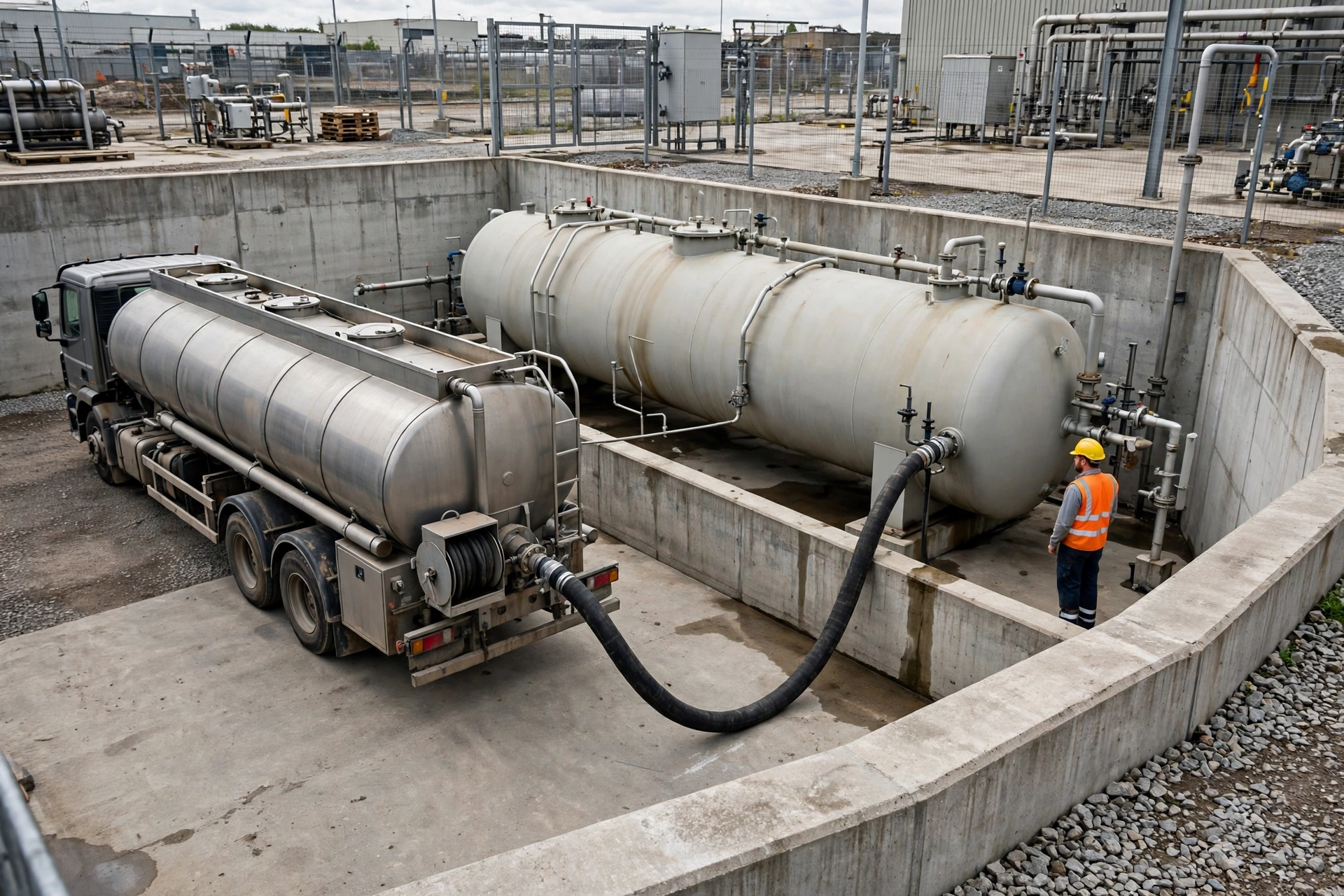
Standby sites size tanks by outage. Prime sites size them by refuelling interval. A telecom tower, a mine camp or a remote construction site runs its generator every day, and the tank question becomes: how many days between deliveries, and how much can the truck carry?
The arithmetic is the same, but the answer is smaller and the discipline is different. A 75 kVA Cummins silent set on a tower in northern Nigeria runs 10 hours a day, 300 days a year, at about 50% load. It burns roughly 8 litres an hour — 80 litres a day, 560 litres a week. A 1,000-litre bulk tank gives about 12 days between refills, and the site refuels every 10 days on a fixed schedule, before the tank falls below a third. The routine is the system: fixed day, fixed volume, dipstick reading logged, locking cap checked.
Fuel theft is the largest single loss on prime sites, larger than evaporation, larger than spillage, larger than the engine’s own consumption variance. A bulk tank without a locking cap, a dipstick log and a named custodian will lose fuel to siphoning, and the loss will be blamed on the generator. The fix costs almost nothing: a lock, a log, and a weekly reconciliation of litres delivered against litres burned. A site that cannot reconcile its fuel cannot manage its power.
Fuel Ageing: The 72-Hour Tank That Went Stale
Diesel does not keep indefinitely. Stored diesel has an effective shelf life of 6–12 months under normal conditions: it oxidises, absorbs water from condensation, and grows microbes at the fuel-water interface. Fuel quality also affects the emissions standard the set must meet: degraded fuel raises particulate output and can push an engine outside its certified emissions band. A 20,000-litre data centre tank that is filled once and drawn down only by monthly tests will hold the same fuel for years. That fuel will still burn — and it will also clog filters, corrode injectors and grow the black sludge that maintenance crews find in the bottom of neglected tanks.
The defence is turnover and treatment. Fuel should be sampled and tested annually, polished on a regular cycle, and turned over by design: schedule load-bank tests to draw from the oldest tank first, or burn down and refill on a planned cycle. Water should be drained from the bottom of the tank quarterly — water is where the microbes live, and a tank that is never drained is a tank that is growing them. A 72-hour tank that has not been touched in two years is not 72 hours of fuel. It is 72 hours of a chemistry experiment.
Frequently Asked Questions
How long will a diesel generator run on a full tank?
Divide the usable litres in the tank by the litres per hour the set burns at the actual load. A 100 kVA set at 75% load burns about 15 litres an hour, so a 500-litre tank lasts roughly 30 hours. A 500 kVA set with a 645-litre base tank lasts about 9 hours at 75% load and 7 hours at full load.
How much fuel does a diesel generator use per hour?
About 0.25–0.30 litres per kilowatt-hour at full load, or roughly one litre per hour for every 4 kW of output. A 100 kVA set burns about 15 litres an hour at 75% load, and a 500 kVA set about 71 litres an hour. The exact figure comes from the engine datasheet at the actual load.
How to calculate diesel generator fuel tank size?
Multiply the required runtime in hours by the consumption in litres per hour at the expected load, then add margin: NFPA 110 requires the main tank to hold at least 133% of the low-fuel sensor quantity, and about 10% of any tank is unusable. A 24-hour requirement at 70 litres an hour needs about 1,680 litres of usable fuel — and a 2,500-litre tank once the margins are applied.
How much fuel does a 500 kVA generator use per hour?
About 30 litres an hour at 25% load, 50 at 50%, 71 at 75% and 97 at full load, as planning figures. The Cummins C500D5 datasheet gives 29.2, 49.0, 69.9 and 93.2 litres an hour at the same points on prime rating, and up to 107.1 litres an hour at full standby load. Always confirm from the datasheet for the exact engine.
How big should a diesel generator fuel tank be for 72 hours?
A 100 kVA set needs about 1,100 litres of usable fuel for 72 hours at 75% load — specify a 1,500-litre tank. A 500 kVA set needs about 5,100 litres usable — specify 6,000 to 7,000 litres. A 1125 kVA set needs about 16,200 litres at full rated load — specify 20,000 litres. Check local fire code limits before fixing the tank size.
Specification Checklist: Five Questions Before You Order the Tank
1. What load will the set actually carry? State it in kilowatts, with the load profile — steady, variable, or step loads. Tank sizing from kVA instead of kW overstates fuel by about 25%.
2. How many hours of autonomy — at full load or at expected load? NFPA 110 sizes at full rated load. A 72-hour tank sized at 75% load is a 54-hour tank when the load rises. State which basis the number uses.
3. What is the usable capacity, not the nameplate? Deduct about 10% for the unusable bottom volume, and confirm where the low-fuel sensor trips. The runtime that matters is usable litres divided by litres per hour.
4. What does the 133% rule require for your Class? NFPA 110 requires the main tank to hold at least 133% of the low-fuel sensor quantity for classes up to 24 hours. A tank sized exactly to the arithmetic fails the standard.
5. How will the fuel be kept fresh and delivered? A turnover plan, annual sampling, fuel polishing, a delivery contract with a stated response time, and a refuelling trigger at 50% — not 10%. A tank is a fuel system, and a fuel system that is not maintained is a countdown.
A generator’s runtime is decided long before the grid fails: in the load profile, the fuel curve, the tank size and the delivery contract. The sites that stay powered through a long outage are not the ones with the largest generator. They are the ones that did the division — usable litres divided by litres per hour — before they ordered, and then built in the margin the standard requires. For a fuel system sized to a specific site, load and autonomy target, contact PAVO.