

What Size Generator Do I Need for a Welder? | PAVO
A welder is the only load on a construction site that asks a generator for half again its rated power in the first tenth of a second — and then punishes it again every time the arc restarts.
What size generator do I need for a welder? Size the generator to the welder’s maximum input current, not its welding amps: a 120 V MIG welder at 140 A needs a 3,500–5,000 W generator, and a 240 V stick or MIG welder at 200 A needs 8,000–12,000 W, with automatic voltage regulation and total harmonic distortion under 6%.
Contents
- Why a Welder Is Not Just Another Load
- The Three-Step Sizing Method
- Sizing Table: What Generator for Which Welder
- Inverter Welders vs Transformer Welders
- Will a Generator Damage My Inverter Welder?
- Welder-Generator or Generator Plus Welder?
- Frequently Asked Questions
- Welder Generator Specification Checklist
Why a Welder Is Not Just Another Load
Most loads on a generator draw steady current. A pump starts, settles, and runs. A heater draws the same amps at 9 a.m. as at 3 p.m. A welder does neither. It draws current in bursts, restarts its arc dozens of times an hour, and pulls a sharp spike of current at every strike. Sizing a generator for a welder from the welder’s output amps alone is the single most common mistake in workshop and site power — and it is the mistake that produces tripped breakers, ruined beads and, in the worst case, a dead inverter board.
The problem has three parts, and each one changes the size of the generator required.
The arc strike: a 50% spike in under 100 milliseconds
When the electrode touches the workpiece and the arc ignites, the welder’s input current spikes to roughly 50% above its rated amperage in under 100 milliseconds. A 200 A MIG machine drawing 7,200 W at full load can demand over 10,000 W for that fraction of a second. A generator with no torque reserve cannot answer that fast. Engine speed dips, frequency sags below 58 Hz, voltage falls, and the arc goes out or burns unevenly. The welder restrikes, the spike repeats, and the cycle continues until the operator blames the welder — when the generator was the weak link.
This is the same transient problem that governs motor starting, where locked-rotor current decides the set size rather than running current. The difference is that a motor starts once. A welder starts its arc every few seconds for the whole working day.
Duty cycle: why the rating plate carries two numbers
A welder’s rating plate lists two input currents under IEC 60974-1: I1max, the maximum input current, and I1eff, the effective input current averaged over the duty cycle. A 200 A welder rated at 60% duty cycle draws full input current for six minutes out of ten and rests — or welds at lower current — for the other four. I1eff reflects that average. I1max reflects the worst case.
The generator must be sized from I1max. I1eff is useful for estimating fuel use and cable heating over a shift. It is useless for sizing, because the generator still has to survive the six minutes at full draw, and the arc strike at the start of each of them. A buyer who sizes from I1eff buys a generator that is 20–40% too small and discovers the error on the first day of real work.
A non-linear load with a poor power factor
A welder is a non-linear load. Its rectifier front end draws current in pulses rather than a smooth sine wave, which is why welding is one of the classic sources of harmonics and distortion on a generator. Typical welder power factors run 0.7–0.9, so the apparent power in kVA is always larger than the real power in kW. A welder drawing 7,200 W at a power factor of 0.8 needs 9 kVA of generator capacity before any margin is added. That arithmetic is why the kVA figure on the generator, not the watt figure on the welder, decides whether the combination works.
The Three-Step Sizing Method
The method takes two minutes with the welder’s rating plate and a calculator. It works for MIG, stick, TIG and multi-process machines, on 120 V or 240 V, single-phase or three-phase.
Step 1 — read I1max, not welding amps
Find the rating plate on the welder, usually on the rear panel or inside the wire-feed compartment. Read the maximum input current, marked I1max, and the supply voltage. Ignore the welding output amps for sizing purposes: 200 A of welding output does not mean 200 A of input. A 200 A MIG welder at 240 V typically draws 25–30 A from the supply. A 140 A MIG welder at 120 V draws about 20 A. The input current is the number that sizes the generator.
Step 2 — multiply volts by amps, then add the margin
Multiply supply voltage by I1max to get the welder’s maximum input in volt-amps. Then add a margin for arc starts: about 20% for inverter welders and 30% for transformer welders, which surge harder. A 230 V inverter welder with I1max of 25 A draws 5,750 VA; with a 20% margin that becomes 6,900 VA, so the next generator size up — an 8 kVA set — is the correct choice. Rounding up is not waste. It is the difference between a stable arc and a generator that bogs down every time the operator strikes.
Step 3 — size to running watts, not peak watts
Generator manufacturers advertise peak watts in large type and running watts in small type. For welding, only running watts count. A welding arc is a continuous load while it burns, so a set rated “5,000 W peak / 4,000 W running” is a 4,000 W generator for welding purposes. The peak figure covers a motor start of a few seconds; it does not cover an arc that burns for minutes at a time. Any sizing table that quotes peak watts is quoting the wrong column.
The worked example that catches most buyers is the Lincoln AC-225, the transformer stick welder found on half the farms and workshops in North America. Its rating plate shows 230 V and 50 A input — 11,500 W at full output. Add the 30% transformer margin and the generator needs to deliver about 15,000 running watts. A 10,000 W generator will run it at reduced output, with the amperage dial turned down and the duty cycle watched. It will not run it at 225 A. The welder is not faulty. The generator is simply too small.
Sizing Table: What Generator for Which Welder
The table below gives running-watt figures for the welders most commonly run from generators. Input currents are typical I1max values; the rating plate on the specific machine always wins over any table.
| Welder | Supply | Input (I1max) | Running watts | Recommended generator |
|---|---|---|---|---|
| 120 V MIG, 140 A | 120 V | ~20 A | ~2,400 W | 3,500–5,000 W |
| 120 V inverter stick, 100 A | 120 V | ~20 A | ~2,400 W | 4,000 W |
| 120 V MIG, 120 A | 120 V | ~18 A | ~2,200 W | 4,000 W |
| 240 V inverter stick, 125 A | 240 V | ~21 A | ~5,000 W | 5,000–6,000 W |
| 240 V TIG, 200 A | 240 V | 20–28 A | ~6,000 W | 7,000–8,500 W |
| 240 V MIG, 180–210 A | 240 V | 25–30 A | ~7,200 W | 7,000–12,000 W |
| 240 V stick, 200 A | 240 V | 30–40 A | ~8,000 W | 10,000–12,000 W |
| Multi-process, 250 A | 240 V | ~35 A | ~8,400 W | 13,000–15,000 W |
| Transformer stick AC-225, full 225 A | 230 V | 50 A | 11,500 W | 15,000–16,000 W |
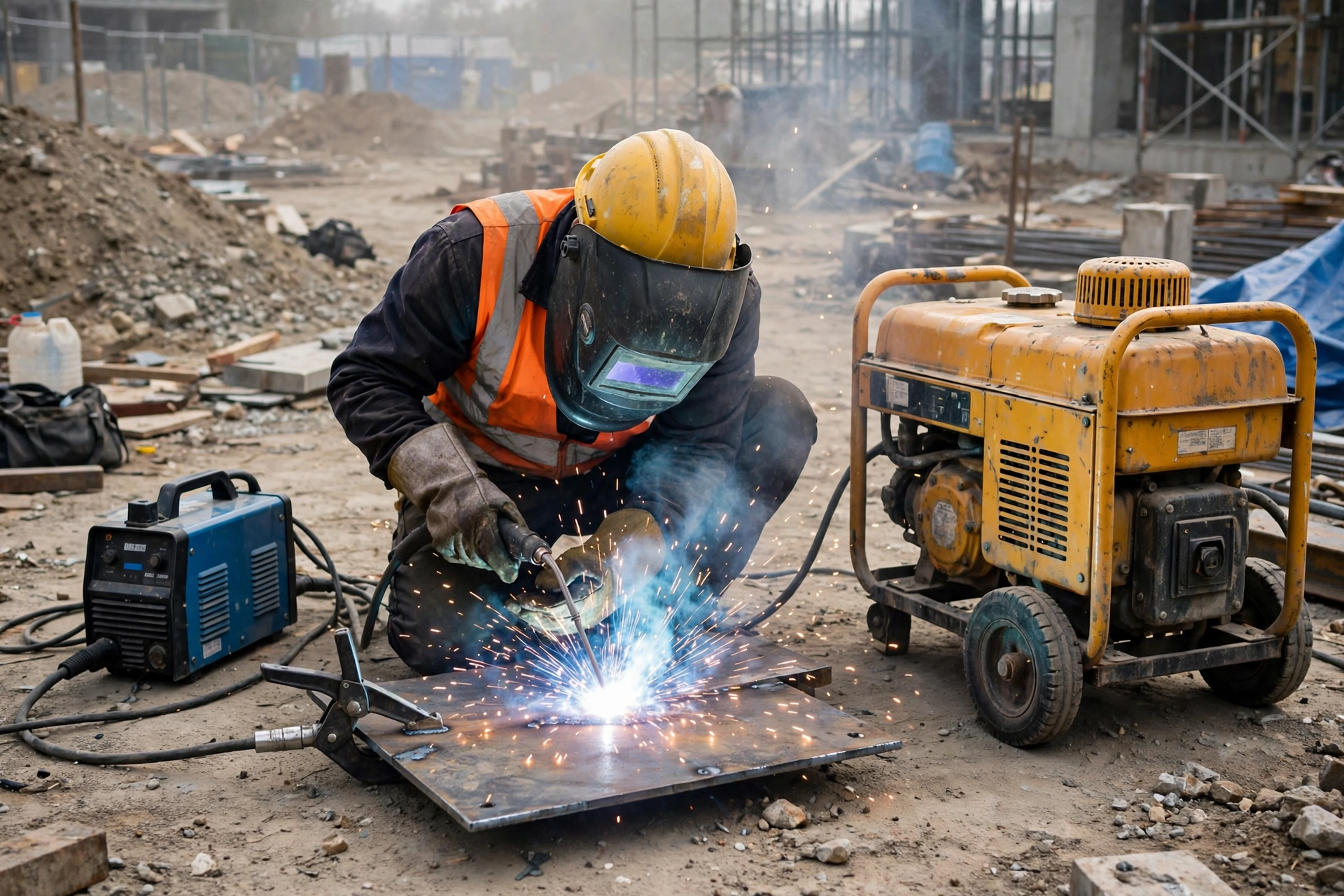
Two rules sit behind the table. First, the recommended generator is 1.5 to 2 times the welder’s rated input in most cases — the margin that absorbs arc strikes without dragging frequency down. Second, if a grinder, lights or a compressor will run on the same set, add their watts on top. A 200 A MIG welder at 7,200 W plus a 1,500 W angle grinder and 500 W of lighting needs a generator with at least 9,200 W of running power before margin, which pushes the choice from a 10,000 W set to a 12,000 W set. The generator sizing guide on this site covers the same addition for mixed site loads.
Three-phase welders change the arithmetic again. A 480 V three-phase welder needs a three-phase generator, and the small portable sets sold for home use are single-phase. A buyer who owns a three-phase welder and a single-phase generator owns two machines that cannot work together at all, whatever the watt figures say.
Inverter Welders vs Transformer Welders
The two technologies ask different things of a generator, and the wrong pairing is what damages equipment.
Inverter welders and the 6% THD rule
An inverter welder converts mains AC to DC, then chops it at high frequency through insulated-gate bipolar transistors (IGBTs) to produce the welding arc. The electronics are precise, light and efficient — and sensitive to the quality of the power feeding them. Generator power is inherently less clean than mains power: voltage and frequency wander with engine speed, and the waveform carries harmonic distortion.
The accepted limit is 6% total harmonic distortion (THD). A generator with THD above 6% will make an inverter welder misread its input waveform, trigger fault alarms, weld erratically, or overheat its input capacitors over time. Generators with automatic voltage regulation (AVR) and oversized alternators typically hold THD under 5% even near full load. A cheap unregulated generator can exceed 15% THD, which is fine for a heater and destructive for an inverter board. Welders with power factor correction (PFC) draw less input current for the same output and tolerate a smaller generator, but they are no more tolerant of dirty power. Inverter welders are not the only sensitive load with this problem: UPS–generator compatibility follows the same rules, and a set that makes a UPS switch to battery will usually upset an inverter welder too.
Transformer welders and the 30% margin
A transformer welder is a copper-and-iron machine with no sensitive electronics in the power path. It tolerates voltage swings, frequency wander and high THD without complaint, which is why the old AC-225 buzz box survives decades of abuse on farm generators. The price is surge: transformer welders draw harder at arc strike, so they need the 30% margin rather than the inverter’s 20%. They are also heavier — a 225 A transformer machine weighs roughly twice its inverter equivalent — and they waste more power as heat. For a fixed workshop with a diesel set, that trade is usually acceptable. For a mobile crew carrying the welder up a scaffold, it is not.
Will a Generator Damage My Inverter Welder?
Yes, it can — and the damage is usually silent until the repair bill arrives. Three mechanisms do the harm, and all three are preventable.
How a voltage spike reaches the inverter board
Inside an inverter welder, the input capacitors charge to approximately 1.4 times the input voltage — about 335 V on a 240 V supply. A voltage surge of 280 V charges those same capacitors to about 395 V, a swing of 155 V across components rated with far less headroom. The surge does not need to be dramatic. It happens when a large load drops off the generator and the engine over-revs before the governor catches it, or when the generator itself is undersized and its voltage swings wildly with every arc strike. The capacitors absorb the first surges. They fail after the fiftieth.
High THD does the same damage more slowly. Distorted waveform means the capacitors charge and discharge unevenly, run hot, and dry out years early. The welder still welds — until the day it does not, and the repair is a new inverter board at 40–60% of the price of a new machine.
Five checks before the welder is plugged in
1. AVR or inverter generator. Use a generator with automatic voltage regulation, or an inverter generator. A conventional generator with a capacitor-regulated alternator is the cheapest option and the riskiest for inverter welders.
2. THD under 6%. Ask the generator manufacturer for the THD figure at the load the welder will draw. If the manufacturer will not state it, treat that as the answer.
3. Size with margin. An undersized generator bogs down at every arc strike, and a bogging engine produces the voltage swings that damage electronics. The 20–30% margin is protection for the welder as much as for the weld.
4. Start the generator first. Start the set, let it stabilise at governed speed for a minute, then switch the welder on. Never start the welder and the generator together, and never plug a welder into a generator that is already loaded to its limit.
5. Read the welder manual. Most inverter welder manufacturers state whether their machine is approved for generator use and what generator size they require. A manual that forbids generator use is not a suggestion. It is a warranty condition, and ignoring it voids the cover on the most expensive part of the machine.
Earthing matters on site as well. The rules for grounding a generator on a construction site — one bond at the set, a temporary electrode that is tested every time the set moves, 30 mA RCD protection on socket circuits — apply in full when the load is a welder, because the operator is holding a live electrode in one hand and standing on the ground the generator is earthed to.
Welder-Generator or Generator Plus Welder?
At some point the question stops being “what size generator for my welder” and becomes “should the welder and the generator be one machine?” The answer depends on how the welding is done, not on the watt figures.
A dedicated engine-driven welder-generator combines a welding power source and an auxiliary generator in one frame. The best-known example is the Miller Bobcat 225: 225 A DC stick output at 25 V, with 9,500 W continuous and 11,000 W peak auxiliary generator power, driven by a 23 HP Kohler engine, carrying a 12-gallon (45-litre) fuel tank. At 150 A welding output it burns about 0.75 gallons per hour (2.8 L/h); welding with a 1/8-inch stick electrode at 20% duty cycle, the tank lasts about 20 hours, and at a continuous 4,000 W auxiliary load it lasts about 14 hours. The machine weighs 485 lb (220 kg) and fits in the bed of a pickup.
Case 1: pipeline repair crew — the welder-generator wins
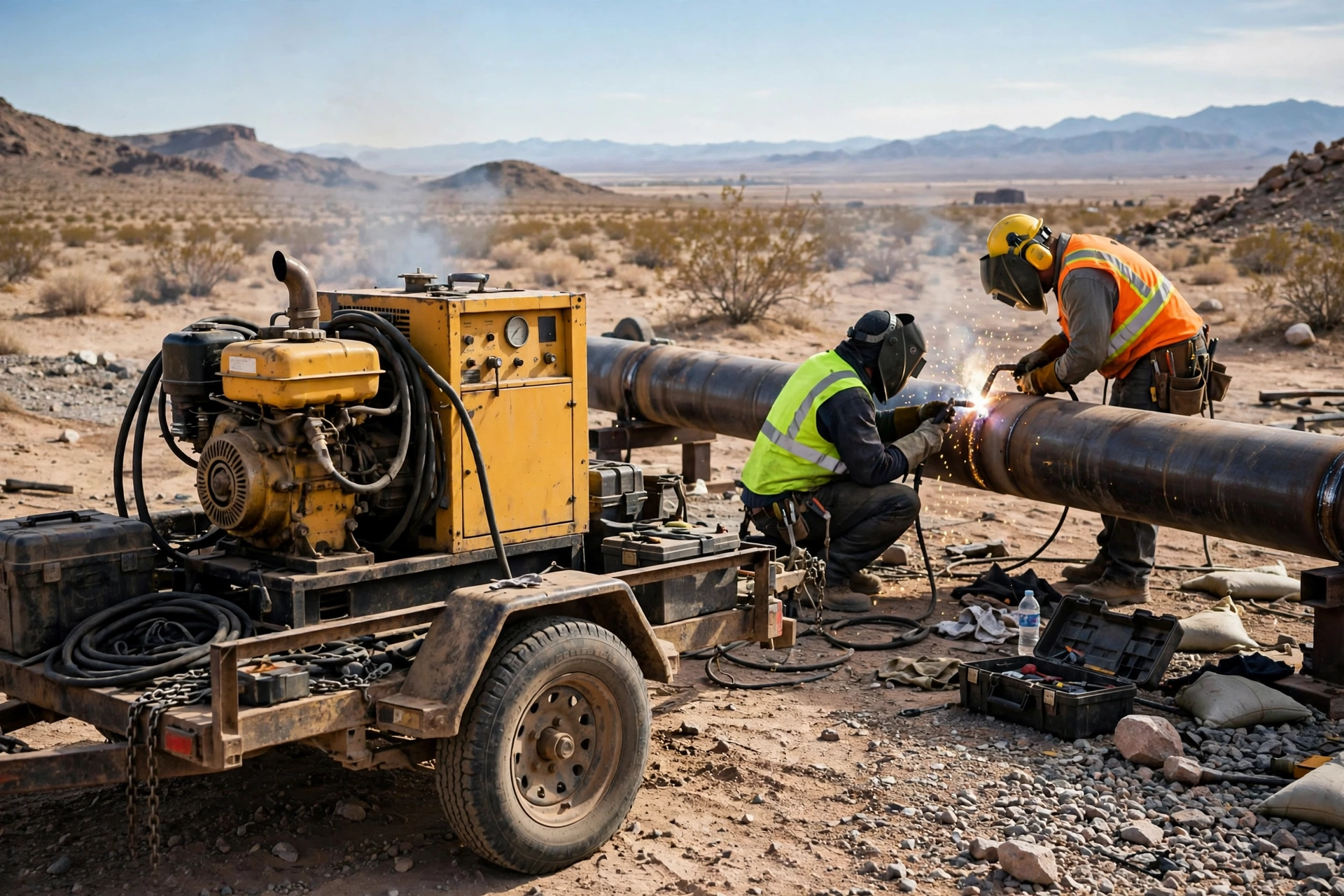
A pipeline contractor in West Texas runs a two-man crew repairing gathering lines at sites 40 miles from the nearest mains supply. The crew welds stick, runs a grinder, and powers a small compressor from the same machine. One engine, one fuel tank, one maintenance schedule, one machine to load on the truck. The Bobcat’s 9,500 W of auxiliary power runs the grinder and the lights while the welding output runs the arc — but not both at full power at once, which is the limitation every buyer must understand. A welder-generator is a welding machine first and a generator second. For a crew whose whole day is welding, that is the right priority, and the separate-generator alternative would mean a second engine, a second fuel supply and a second machine to maintain.
Case 2: fabrication workshop — a 30 kVA diesel set and separate welders
A fabrication workshop in Nairobi runs two 200 A MIG welders, a plasma cutter, a 3 kW air compressor and lighting from a single 30 kVA diesel set — 24 kW prime. The set burns roughly 5–7 L/h at 75% load (the Cummins 4B3.9-G1 in this class is rated 6.9 L/h), and with a 100-litre tank the workshop gets a full 14-hour shift without refuelling. The load maths is what decides the size: two MIG welders at 7,200 W each, a plasma cutter at 4,000 W and the compressor at 3,000 W total 21,400 W — but the welders never strike at the same instant, and the compressor cycles. The workshop staggers arc starts, keeps running load under 80% of prime rating, and the set has run 6,000 hours in three years without a major repair.
The same workshop learned the wet-stacking lesson the hard way. Its first set was a 60 kVA machine bought “for growth”. It spent two years running at 25–30% load, glazing its cylinders and fouling its exhaust, until a load bank testing session and a change to the smaller set fixed a problem that had cost two injector replacements. Oversizing a diesel set for welding loads is as expensive as undersizing it — the standby and prime power ratings article on this site explains why the rating, not the headline kVA, decides service life.
Case 3: farm and site maintenance — the small set that does both jobs
A mixed farm in Queensland keeps a 12 kVA diesel set in the workshop for two jobs: welding repairs on gates, trailers and machinery, and backup power for the bore pump and the house during storm outages. A 12 kVA set delivers about 9.6 kW — enough for a 140 A MIG welder at full output plus lights, with nothing left over. The farmer welds at 120–140 A, never at the machine’s maximum, and the set covers both jobs for the price of one machine. The compromise is real: on the one day a year the farm needs a 200 A stick welder at full output, the 12 kVA set cannot deliver it. The farm hires a welder-generator for that day instead of buying a bigger set for a job that happens annually.
The choice, in short: buy a welder-generator when welding is the whole job and the site moves; buy a diesel set and separate welders when welding is one of several loads, when more than one welder runs at once, or when the same set must also back up a building. A trailer-mounted generator suits the second case better than the first, because a workshop set rarely needs to move and a trailer adds weight, cost and a towing licence to a machine that will sit in one place for years. Buyers who need to move a set between sites should read the trailer rules before they buy, not after the set arrives on a flatbed with no way to tow it.
Frequently Asked Questions
What size generator do I need for a welder?
Size the generator from the welder’s maximum input current (I1max) on its rating plate, not from its welding amps. A 120 V MIG welder at 140 A needs 3,500–5,000 W of running power; a 240 V MIG or stick welder at 200 A needs 8,000–12,000 W. Add 20% margin for inverter welders and 30% for transformer welders, and always size to running watts, not peak watts.
Can you run a welder off a generator?
Yes, provided the generator is large enough and clean enough. It needs running watts at least 1.5 times the welder’s rated input, automatic voltage regulation, and total harmonic distortion under 6%. Inverter welders are the sensitive case: a cheap unregulated generator can damage their electronics. Transformer welders tolerate poor power quality but need a larger margin for arc-strike surges.
What size generator do I need for a 200 amp welder?
A 200 A MIG or stick welder at 240 V draws 25–40 A of input current, or roughly 6,000–9,600 W, and needs a generator with 8,000–12,000 W of running power. A 200 A inverter welder sits at the lower end of that range; a 200 A transformer stick welder sits at the upper end and needs closer to 12,000–15,000 W at full output. The rating plate’s I1max figure gives the exact number for the specific machine.
Will a generator damage my inverter welder?
It can, if the generator is undersized, unregulated, or produces high harmonic distortion. Voltage spikes charge the welder’s input capacitors beyond their rating, and THD above 6% overheats them over time. Use a generator with AVR, keep THD under 6%, size with a 20% margin, and check the welder manual — some manufacturers void the warranty if the machine is run from an unapproved generator.
What is a welder generator and do I need one?
A welder-generator is a single engine-driven machine that produces welding current and auxiliary generator power — for example, the Miller Bobcat 225, which welds at 225 A and provides 9,500 W of continuous auxiliary power. Buy one when welding is the main job and the site moves, such as pipeline or farm repair work. Buy a separate diesel set and welder when several welders run at once or the set must also back up a building.
Welder Generator Specification Checklist
1. What is the welder’s I1max? Read it from the rating plate. Every other number in the purchase follows from it.
2. Running watts, not peak watts? Confirm the generator’s continuous rating covers the welder’s input plus margin. Peak watts do not count for welding.
3. Inverter or transformer welder? Inverter needs THD under 6% and AVR; transformer needs a 30% margin and tolerates dirty power.
4. Is the generator AVR-regulated? If the manufacturer cannot state the THD figure, choose a different generator.
5. Single-phase or three-phase? A three-phase welder needs a three-phase generator. Check before ordering, not on delivery day.
6. What else runs on the same set? Add grinder, compressor and lighting watts to the welder’s input before sizing.
7. Which rating — standby or prime? A set that welds eight hours a day is on prime duty. A standby-rated set at that duty will not last, whatever its kVA figure says.
8. Is the set the right size, not just big enough? A set running at 25% load all day will wet-stack. A set running at 95% load all day will overheat. Aim for 60–80% of prime rating at normal welding load.
9. Earthing and RCD protection? One bond at the set, a tested electrode, and 30 mA RCD protection on socket circuits — the operator is holding a live electrode.
10. Welder-generator or separate set? One machine that welds and generates suits a mobile crew. A diesel set plus separate welders suits a workshop with several loads.
A welder asks more of a generator than any other load its size, and it asks for it in bursts a hundred times a day. The generator that answers that demand is not the biggest one on the quotation, and not the cheapest one in the hire yard. It is the one sized from the welder’s input current, regulated well enough to protect the welder’s electronics, and rated for the duty the site actually runs. Get those three decisions right and the arc strikes cleanly every time. Get any one of them wrong and the welder, the generator or the weld itself will pay for it — usually in that order.
For a quotation on a diesel set sized for welding loads, or for help matching a PAVO set to a specific welder model, contact PAVO with the welder’s rating plate figures — voltage, I1max and process — and the other loads the set must carry. A set specified from those numbers arrives ready to weld. A set specified from kVA alone arrives as a problem to solve on site.