

What Size Generator Does a Solar Farm Need? | PAVO
A solar farm makes its own electricity, and still needs a diesel generator. The panels cannot power the equipment that keeps the farm alive.
What size generator does a solar farm need? A 5 MW farm needs a 30–60 kVA set, a 20 MW farm needs 100–150 kVA, and a 100 MW farm needs 250–400 kVA. The set powers trackers, inverter stations, SCADA and the substation — never the panels’ output — and must start within 10 seconds.
- What a Solar Farm Actually Needs Power For
- Sizing Bands by Farm Capacity
- The Tracker-Stow Window: What Happens in the First Hours
- Three Solar Farms That Lost Power — and What They Teach
- Black Start: Can a Solar Farm Restart the Grid?
- Fuel Autonomy and Placement: How Long It Runs and Where It Sits
- Frequently Asked Questions
- Specification Checklist
What a Solar Farm Actually Needs Power For
A solar farm is a power station that cannot power itself. That sentence sounds wrong until the grid fails. The panels produce direct current when the sun shines. The inverters turn it into alternating current for the grid. Everything else on the site — the motors that move the panels, the fans that cool the inverters, the computers that watch the plant, the lights that keep it secure at night — runs on alternating current drawn from the grid connection. When the grid goes down, the farm’s own output stops too, because grid-tied inverters shut down the instant they lose the grid reference. The farm goes dark in the middle of a sunny day.
The loads fall into four tiers, and only the first three are on the generator.
| Load tier | Systems | Share of farm auxiliary load | On the generator? |
|---|---|---|---|
| Trackers and inverter stations | Tracker drive motors, inverter cooling fans, inverter station controls, combiner-box monitoring | 35–45% | Yes — always |
| SCADA, control and communications | SCADA servers, plant controller, weather station, fibre and microwave links, CCTV, security | 15–25% | Yes — always |
| Substation and BESS auxiliaries | Battery chargers, protection relays, breaker trip and close coils, transformer cooling, BESS HVAC | 20–30% | Yes — always |
| Site facilities | Offices, workshop, water pumps, general lighting, vehicle charging | 15–25% | No — shed on transfer |
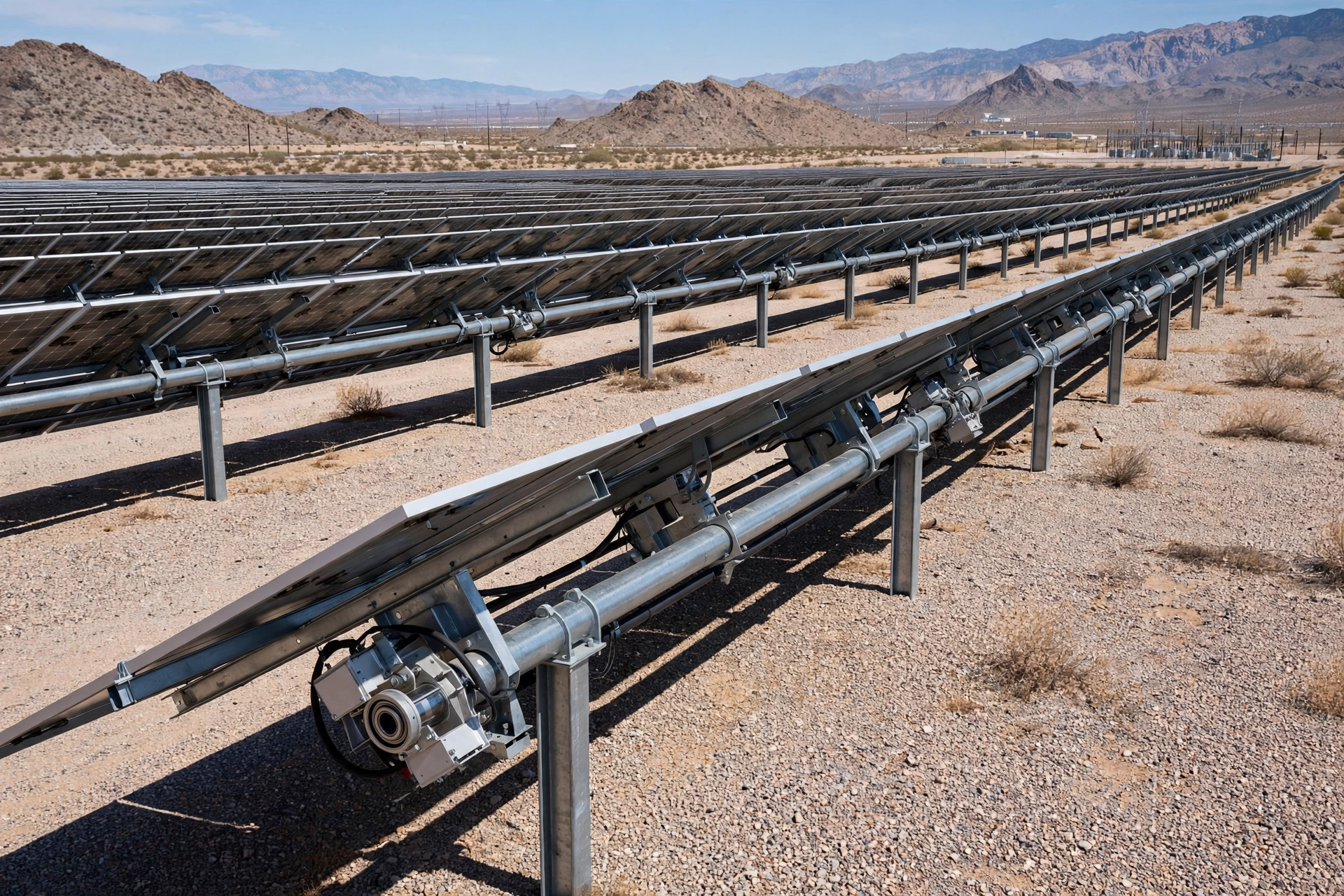
Trackers and inverter stations are the tier that surprises buyers. A single-axis tracker row carries up to 90 modules on one torque tube, driven by a 24 VDC motor of 140–160 W. One motor is trivial. A 100 MW farm has roughly 1,800 tracker rows. The motors never all run at once — each row moves for a minute or two every fifteen minutes — but the coincident draw when the whole field stows for a storm is real, and the control power for every row is continuous. The inverter stations are the larger draw. A 120 MW plant in a published 2025 field study ran 1,292 inverters; each central inverter station carries cooling fans, a station controller and a step-up transformer with its own cooling, drawing 3–5 kW per station while operating. Thirty inverter stations on a 100 MW farm draw 90–150 kW between them — more than the entire SCADA building.
SCADA, control and communications is the smallest tier and the one that must never stop. The plant controller is the brain of the farm: it tells every inverter what to do, watches every string, and reports to the grid operator. Lose it and the farm is blind — no alarms, no production data, no remote commands. The weather station matters more than it looks: irradiance, wind speed and panel temperature decide whether the trackers stow, and a controller that cannot see the wind cannot protect the field. The load is small — 10–20 kW for a 100 MW farm — but it is continuous, 24 hours a day, and it is the first load the generator must carry.
Substation and battery auxiliaries are the tier that grid operators care about. The substation’s protection relays, battery chargers and breaker coils are the equipment that lets the farm reconnect to the grid after an outage. A substation without control power cannot close a breaker, and a farm that cannot close its breaker cannot export a single watt, however much sun is shining. Where the farm has a battery, the battery’s own HVAC and battery management system draw 10–30 kW continuously, and a lithium battery that overheats because its cooling stopped is a fire risk, not a storage asset. The station-service loads that electrical substations carry are the same loads, at the same priority — the substation article covers them in full.
Site facilities get shed. The offices, the workshop, the water pumps and the general lighting all go dark on transfer. A solar farm does not need its workshop during a grid outage. It needs its trackers stowed, its inverters cooled, its controller awake and its breakers ready to close.
Trackers and Inverter Stations
The tracker is the farm’s moving part, and the moving part is the vulnerable part. A single-axis tracker follows the sun from east to west, gaining 15–25% more energy than a fixed array. It does that with a motor, a gearbox and a controller on every row. The motors are small — 140–160 W each — and they run for minutes a day. The controllers are always on, drawing a watt or two each, and there are thousands of them. The field’s total tracker power is small in kilowatts and large in consequences: without it, the rows cannot move, and a row that cannot move cannot stow.
Stowing is the tracker’s defence. In high wind the controller drives every row flat, to the horizontal position, where the wind load on the panels is lowest. Tracker manufacturers rate their systems for wind survival up to 60 m/s — but only in the stow position. A row left tilted at 45 degrees in a 30 m/s gust sees several times the design load. The stow command needs power, and it needs it while the storm is already blowing. A farm that loses grid power in the same storm that takes down the transmission lines is exactly the farm that needs its trackers stowed most.
SCADA, Control and Communications
The plant controller and the SCADA system are the farm’s memory and its voice. The controller holds the operating setpoints: the reactive power the grid operator demands, the curtailment limit, the ramp rate. The SCADA system holds the alarms: a string down, an inverter faulted, a tracker stuck. Both run on the station-service supply, and both are backed by a UPS that lasts minutes, not hours. The UPS is there to bridge the 10-second gap while the generator starts. It is not there to run the control room through the night.
The communications link is the farm’s connection to the grid operator. Most utility-scale farms report to the transmission system operator over fibre, with a microwave or 4G backup. The fibre multiplexers, the routers and the remote terminal units all draw power from the same station-service board. A farm that loses its communications link during a grid event is a farm the operator cannot dispatch — and in several grid codes, a farm that cannot be dispatched gets disconnected first when the system is restored.
Substation and BESS Auxiliaries
The substation is the farm’s front door, and its auxiliaries are the lock and the key. The protection relays watch current and voltage and trip the breakers when something is wrong. The battery chargers keep the 110 V DC station battery full — the battery that trips and closes every breaker in the yard. The transformer cooling fans and pumps keep the step-up transformer inside its temperature limits. None of these loads is large. Together they draw 15–30 kW on a 100 MW farm. Together they are the difference between a farm that reconnects in minutes and a farm that waits for a crew to drive out with a portable generator.
Where the farm has a battery energy storage system, the auxiliaries grow. A 100 MW / 200 MWh battery needs its containers cooled, its battery management system awake and its fire suppression armed. The cooling load alone runs 20–40 kW on a hot day. The battery is the farm’s most expensive asset after the panels, and its cooling is the load that decides whether the battery survives the outage or becomes the second casualty of it. For a site with no grid at all, the off-grid solar-diesel hybrid article covers how panels, battery and generator share one bus — a different problem from the grid-connected farm in this article, but the same three sources.
Sizing Bands by Farm Capacity
Solar farms do not size by megawatts of panels. They size by the auxiliary load — the kilowatts the farm itself consumes. The panels’ output is irrelevant to the generator: a 100 MW farm’s generator never carries 100 MW. It carries the 150–250 kW the farm needs to stay alive, stow its trackers, cool its inverters and reconnect. The table below gives the bands that cover most farms. The generator figure is the standby-rated set for the essential tiers, with a 20% margin for starting transients and load growth — not the full site load.
| Farm capacity | Essential auxiliary load | Generator size | Fuel at 75% load |
|---|---|---|---|
| 5 MW community farm | 10–20 kW | 30–60 kVA | 8–14 L/h |
| 20 MW farm | 40–80 kW | 100–150 kVA | 22–32 L/h |
| 50 MW farm | 80–150 kW | 150–250 kVA | 32–52 L/h |
| 100 MW utility farm | 150–250 kW | 250–400 kVA | 52–85 L/h |
| 200 MW and above | 250–400 kW | 400–750 kVA | 85–150 L/h |
The pattern is consistent: the generator is roughly 0.25–0.4% of the farm’s nameplate capacity. A buyer who quotes a generator at 1% of nameplate is buying a set four times too large, which will run at a quarter load, wet-stack, and cost four times as much to fuel and maintain. A buyer who quotes at 0.1% is buying a set that will trip on the first tracker-stow command. The generator sizing guide covers the general method — load list, starting surge, margin — and the bands above are the solar-farm application of it.
The Small Farm: 5 MW
A 5 MW community farm has one or two inverter stations, a few hundred tracker rows and a small control building. The essential load is 10–20 kW: the inverter station fans, the tracker controllers, the SCADA and the substation battery charger. A 30–60 kVA set covers it, and the set is usually a silent canopy unit on a concrete plinth beside the inverter station. Fuel is a 500-litre day tank — enough for 35–60 hours at 75% load. The farm’s owner is usually a community trust or a small developer, and the generator is the smallest line on the budget. It is also the line that gets cut first, and the line whose absence is discovered only during the first storm outage.
The Mid-Size Farm: 50 MW
A 50 MW farm has ten to fifteen inverter stations, roughly 900 tracker rows and a substation with its own control building. The essential load is 80–150 kW. The set is a 150–250 kVA unit, usually a 250 kVA silent set with a 1,000-litre sub-base tank, good for 20–30 hours at 75% load. At this size the fuel logistics start to matter: a 250 kVA set at 75% load burns roughly 45 L/h, or 1,080 litres a day. A 72-hour outage needs 3,200 litres — a bulk tank, not a day tank, and a fuel delivery contract that works when the roads are blocked.
The Utility Farm: 100 MW and Above
A 100 MW farm has thirty or more inverter stations, roughly 1,800 tracker rows, a 132 kV or 220 kV substation and usually a battery. The essential load is 150–250 kW and the set is 250–400 kVA. At 200 MW the load reaches 250–400 kW and the set grows to 400–750 kVA, sometimes as two paralleled sets for redundancy. The fuel bill is the number that shocks owners: a 500 kVA set at 75% load burns 69.9 L/h — 1,678 litres a day, 5,000 litres for 72 hours. That is a road tanker, not a jerry can, and it has to be ordered before the outage, not during it.
The Tracker-Stow Window: What Happens in the First Hours
The first hours of a solar farm outage are a race between the weather and the battery. The grid is down. The inverters are off. The trackers are wherever they were when the power failed. The control room is on UPS, and the UPS has 15–30 minutes. The generator has 10 seconds to start and take the load. If it does, the farm stows its trackers, keeps its inverters cool and waits out the outage in an orderly state. If it does not, the farm spends the outage in whatever position the wind finds it.
The Tracker Left Facing the Wind
A tracker row that loses power mid-day is frozen at its last angle — often 45–60 degrees from horizontal, facing the afternoon sun. In calm weather that is harmless. In a storm it is the worst possible position. The wind load on a tilted panel is several times the load on a flat one, and the torque tube, the bearings and the slew drive were designed to hold the row flat in a storm, not tilted. Tracker manufacturers publish their wind survival ratings for the stow position only. A row left tilted in a 30 m/s gust can twist its torque tube, snap a bearing or tear a panel off its clamps. The damage is not one row: a storm that catches a whole field tilted damages rows across the site, and each damaged row is a string offline until it is repaired.
The stow command itself is cheap. One motor per row, 140–160 W, running for two to three minutes. The whole field stows in under ten minutes if the power is there. Unlike a quarry crusher or a borehole pump, where motor starting decides the set size, a tracker’s motor is small and the load is spread across hundreds of rows — the sizing question is the coincident stow load, not a single motor’s starting transient. The cost of not stowing is measured in damaged rows, and the cost of a damaged row is a crew, a crane and a week of lost generation for that string. The generator’s first job, in the first ten minutes, is to give every row the power to lie flat.
The Inverter Station Without Cooling
A central inverter station is a steel container full of power electronics, and power electronics make heat. While the inverters are generating, their cooling fans run continuously. When the grid fails and the inverters shut down, the fans stop too — and the residual heat in the IGBT modules and the transformer has nowhere to go. The station’s internal temperature climbs. On a 45°C desert day, a closed inverter station can reach 70°C inside within an hour. The electronics are rated for it, but the station’s control boards, the DC disconnects and the transformer insulation age faster with every hot soak.
The generator’s second job is to keep the station-service supply alive so the cooling fans can run at low speed and the station controller can watch its own temperatures. The load is small — 3–5 kW per station — but it is the difference between a station that restarts cleanly when the grid returns and a station that comes back with a faulted controller and a tripped breaker. A farm with thirty inverter stations has thirty stations to keep cool, and the generator that feeds them is the cheapest insurance on the site.
The Night Load That Drains the Battery
A solar farm at night consumes power and produces none. The night load is 20–40 kW on a 100 MW farm: security lighting, CCTV, the SCADA system, the communications link, the substation battery charger and the inverter stations’ standby draw. During a normal night the grid supplies it. During a grid outage the farm’s own station battery supplies it — and the station battery is sized for 8 hours of protection and control load, not for a multi-day outage. A battery that drains to zero leaves the farm with no protection, no control and no way to close a breaker. Worse, a lead-acid station battery discharged to zero is often damaged beyond recovery, and a lithium station battery that hits its low-voltage cut-off needs a controlled recharge before it will accept a charge at all.
The generator’s third job is the night load. A 250 kVA set running at 20–25% load through the night burns roughly 25 L/h and keeps the station battery full, the lights on and the farm ready to restart at dawn. A farm without a generator spends the night draining its station battery, and spends the morning waiting for a crew to bring a portable set before it can reconnect. The sun is up. The panels are ready. The farm is not.
Three Solar Farms That Lost Power — and What They Teach
The Iberian Blackout — 28 April 2025
On 28 April 2025, at about 12:30 in the afternoon, the Iberian Peninsula lost its grid. Wind and solar were supplying roughly 70% of Spanish generation at the time, with solar alone near 60%. Two oscillations — 0.63 Hz at 12:03, traced to a 250 MW photovoltaic plant in Badajoz, and 0.21 Hz at 12:19 — preceded the collapse. At about 12:32 a substation in Granada tripped. Within five seconds Spain lost approximately 15 GW of generation, close to 60% of national demand. About 55 million people in Spain, Portugal and parts of France lost power. Restoration took about ten hours, with 99% of demand back by 06:00 the next morning, helped by 900 MW from Morocco and 2 GW from France.
The lesson for solar farms is not that solar caused the blackout — the investigation found the cause in voltage control and a shortage of conventional plants providing dynamic support, not in the panels. The lesson is what happened to the solar farms themselves. Every grid-tied inverter in the peninsula shut down the instant the grid reference disappeared. The farms went from generating gigawatts to generating nothing in seconds, and their own auxiliary loads went with them. A farm with a generator kept its trackers stowed, its inverters cool and its SCADA alive, and was ready to reconnect when the grid returned. A farm without one spent the night dark, its station battery draining, and needed a crew on site before it could export again. The blackout lasted hours. The recovery gap between the two kinds of farm lasted days.
Bhadla — Heat, Dust and 2,245 MW
Bhadla Solar Park in Rajasthan is the largest solar farm in the world: 2,245 MW, more than 10 million panels across 14,000 acres of Thar Desert, built for $2.175 billion between 2015 and December 2018, with average irradiance of 5.72 kWh/m² per day. The desert that makes Bhadla productive also makes it hostile. Summer temperatures reach 48°C. Dust storms — andhi — sweep across the park with winds above 25 m/s, carrying sand that scours panel glass and clogs inverter filters.
Bhadla’s auxiliary load is the load of a small town: dozens of inverter stations, thousands of tracker rows, a 220 kV substation and a control centre. The park’s generators are not sized for the panels. They are sized for the dust storm that arrives with a grid fault. When the transmission lines trip in a storm, the trackers must stow — 1,800-plus rows on a 100 MW block — and the inverter stations must keep their fans running so the electronics do not bake in their own heat. A generator that fails to start in that moment does not lose a day’s generation. It loses rows, and rows in a desert are expensive to repair: a crew, a crane, a replacement torque tube, and a string offline for a week in the highest-irradiance months of the year.
Winter Storm Uri — Texas, February 2021
Winter Storm Uri hit Texas on 14 February 2021. About 4.5 million customers lost power, some for four days or more, in temperatures that fell below −10°C across much of the state. Solar output fell sharply as panels iced over and the grid that would have carried their power went down with everything else. The storm is remembered for gas plants and coal plants tripping. The solar lesson is quieter and more practical: a solar farm in a cold climate needs the same auxiliary power as a solar farm in a desert, for the opposite reason. Trackers iced at an angle cannot stow or shed their snow load. Inverter stations without heat cannot restart their electronics in sub-zero temperatures. The station battery drains faster in the cold, and a battery at −10°C delivers a fraction of its rated capacity.
A Texas solar farm with a generator kept its trackers moving, its inverter stations warm and its control room awake through four days of grid failure. A farm without one waited for the thaw, and then waited for a crew, and then waited for the grid. The panels were fine. The farm was not ready.
Black Start: Can a Solar Farm Restart the Grid?
A solar farm cannot restart the grid on its own. That is the honest answer, and it is the answer the grid codes give. A grid-tied inverter needs a voltage and frequency reference before it will produce power. No grid, no reference, no output. The panels can be shining at noon and the farm will produce nothing. The inverter is a follower, not a leader.
Why a Solar Farm Cannot Black-Start Itself
The physics is straightforward. A conventional generator — a diesel set, a gas turbine, a hydro unit — creates its own voltage and frequency. It is a voltage source. A grid-following solar inverter measures the grid’s voltage and frequency and synchronises to them. Remove the grid and the inverter has nothing to measure. It shuts down by design, in milliseconds, because feeding power into a dead network is dangerous: it can energise lines that repair crews believe are dead.
The farm’s own auxiliary load makes the problem worse. The inverters need station-service power to wake up, the plant controller needs power to issue commands, and the substation needs power to close its breakers. All of that power comes from the grid connection — the same connection that is dead. A solar farm without a local power source is a power station that cannot start itself. It is a car with a full tank and a flat battery. The same auxiliary-load problem faces wind farms, where yaw and pitch motors, nacelle heating and the substation all need power when the grid is down.
Grid-Forming Inverters and the Diesel Bridge
Grid-forming inverters change the answer, but they do not remove the diesel. A grid-forming inverter creates its own voltage and frequency reference, like a conventional generator. A solar farm with grid-forming inverters and a battery can, in principle, energise its own network and restart. The catch is the first few seconds: the battery and the inverters need a stable reference to start from, and the plant controller needs power before any of it works. That is where the diesel set comes in. The generator starts, energises the station-service board, and gives the battery and the inverters a reference to synchronise to. Once the battery is online and the inverters are forming the grid, the generator can stop — or stay running as the reserve.
The arrangement is already in service. Utility-scale PV plants are specified with generator capacity of 5–15% of total plant capacity, running 200–500 hours a year, for exactly this role: station service, black start support and grid stability during cloud transitions. The generator is not the farm’s power source. It is the farm’s ignition key.
What the Grid Code Asks For
Grid codes are catching up with the reality. Several transmission system operators now require large solar farms to demonstrate black-start capability, or to contribute to system restoration, as a condition of connection. The requirement is usually framed as a station-service obligation: the farm must be able to keep its own control, protection and communications alive for 48–72 hours without grid supply, and must be able to re-energise its own network on command. A farm that meets that obligation with a diesel set and a station battery is a farm that can be restored in minutes. A farm that meets it with a battery alone is a farm whose restoration window is the battery’s autonomy — and a battery that has spent the outage powering the night load has nothing left for the restart.
Fuel Autonomy and Placement: How Long It Runs and Where It Sits
A solar farm’s generator runs rarely and must run reliably. The duty is standby: a few hundred hours a year, mostly monthly tests and the occasional outage. The rating matters. A set bought on its standby figure and run for a 72-hour outage is a set run beyond its rating, and the standby and prime ratings article explains why that ends in an early overhaul. Most solar farms buy standby-rated sets, and most solar farms are right to — provided the outage never exceeds the rating’s annual hour allowance. A farm in a region with frequent multi-day outages should buy prime.
Fuel Autonomy in Numbers
Fuel autonomy is the number of hours the farm can run without a delivery, and it is decided by the tank, not the set. The table below uses the Cummins C500D5 — 500 kVA standby / 455 kVA prime, burning 93.2 L/h at full prime load, 69.9 L/h at 75%, 49.0 L/h at 50% and 29.2 L/h at 25% — as the reference frame. Smaller sets scale roughly in proportion.
| Generator size | Fuel at 75% load | 24-hour autonomy | 72-hour autonomy |
|---|---|---|---|
| 60 kVA | 12 L/h | 290 L | 870 L |
| 150 kVA | 30 L/h | 720 L | 2,160 L |
| 250 kVA | 48 L/h | 1,150 L | 3,460 L |
| 500 kVA | 70 L/h | 1,680 L | 5,040 L |
| 750 kVA | 105 L/h | 2,520 L | 7,560 L |
A 100 MW farm with a 250 kVA set needs 3,460 litres for 72 hours. That is a 5,000-litre bulk tank with a margin, and a fuel delivery contract with a supplier who can reach a remote desert site in a storm. A farm that relies on a 1,000-litre sub-base tank has 20 hours of autonomy, and a farm with 20 hours of autonomy in a region where outages last three days is a farm that will go dark on the second night. The fuel ages too: diesel in a standby tank degrades, grows water and microbes, and the article on diesel fuel ageing covers the testing and polishing schedule that keeps a rarely-used tank ready.
Placement: Dust, Heat and Distance
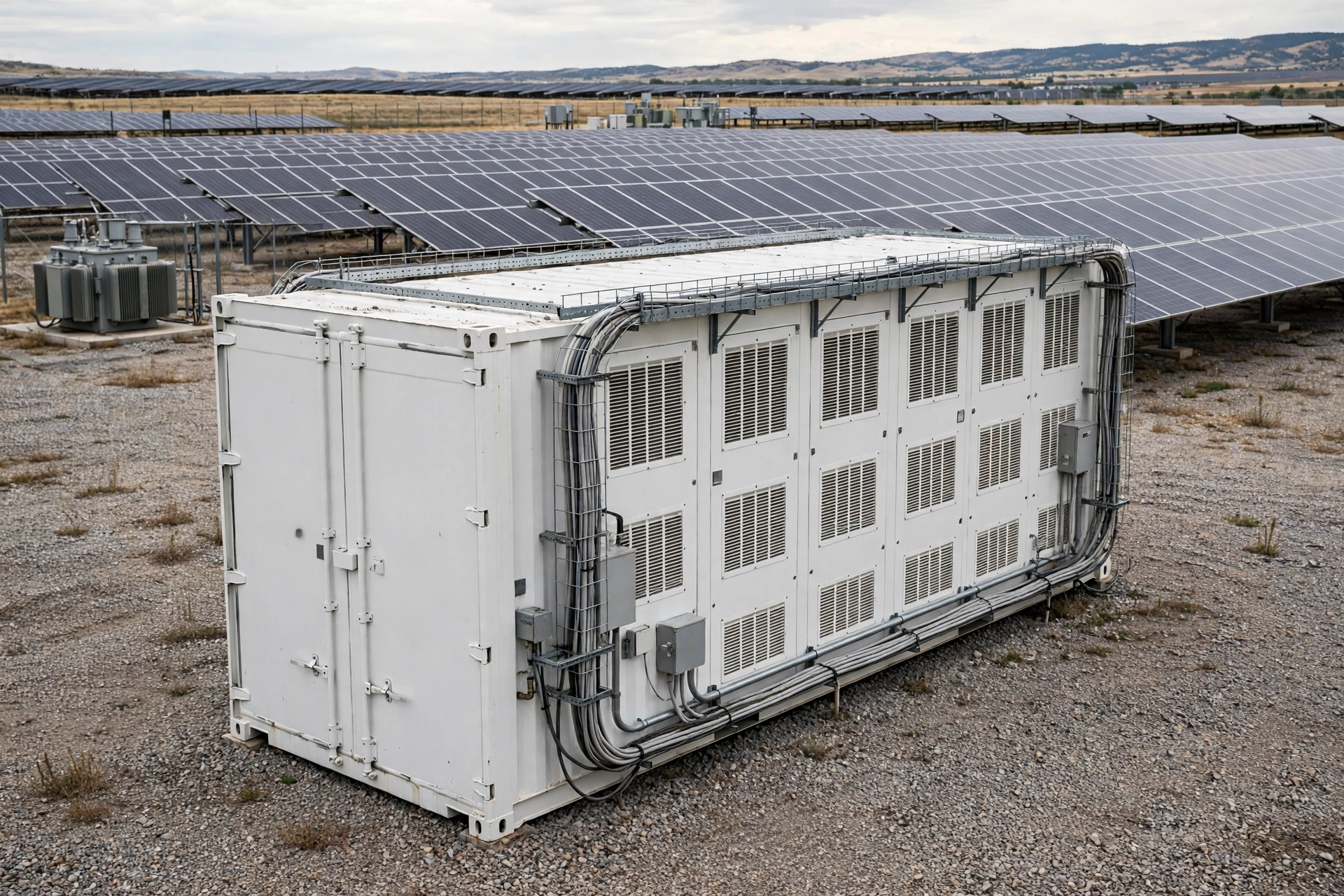
A solar farm’s generator sits in the worst place on the site for a diesel engine: a dusty, hot, open field, kilometres from the nearest workshop. The placement rules follow from that. The set goes on a raised concrete plinth, above the flood line and above the dust drift, with its air intake facing away from the prevailing wind and the panel rows. The enclosure is a silent canopy, not an open set: the canopy keeps the dust out of the alternator and the rain off the control panel, and it keeps the set’s 65–75 dB(A) at 7 metres from carrying across an empty landscape to the nearest village.
Distance is the hidden cost. A 100 MW farm covers 400–600 hectares. The generator usually sits beside the substation, at the farm’s edge, and the station-service cable runs from there to the inverter stations — sometimes 2–3 km of cable. Voltage drop on a long low-voltage run is real, and the cable must be sized for it, or the inverter stations at the far end will see low voltage and trip on undervoltage. The alternative is a second, smaller set at the far end of the farm, or a medium-voltage station-service supply. Either way, the placement decision is made at design time, not after the first outage shows the far inverter stations going dark.
The heat derates the set. A 250 kVA set rated at 25°C delivers roughly 230 kVA at 45°C, and a desert site that reaches 48°C in summer needs the next frame up or a radiator sized for the site. The derating article covers the numbers; the practical rule is to ask for the derated figure at the site’s maximum temperature before the order is placed, not after the container arrives.
Frequently Asked Questions
What size generator does a solar farm need?
A 5 MW farm needs a 30–60 kVA set, a 20 MW farm needs 100–150 kVA, a 50 MW farm needs 150–250 kVA, and a 100 MW farm needs 250–400 kVA. The set is sized from the farm’s auxiliary load — trackers, inverter stations, SCADA and substation — which runs at roughly 0.25–0.4% of the farm’s nameplate capacity, never from the panels’ output.
Do solar farms need a backup generator?
Yes, in practice. A solar farm’s panels cannot power the farm’s own equipment, because grid-tied inverters shut down when the grid fails. Without a generator the trackers cannot stow in a storm, the inverter stations cannot cool themselves, the SCADA system dies when the UPS runs out, and the substation cannot close its breakers to reconnect.
How long can a solar farm run on a generator?
As long as the fuel lasts. A 100 MW farm with a 250 kVA set and a 5,000-litre bulk tank runs about 100 hours at 75% load; a 20 MW farm with a 150 kVA set and a 2,000-litre tank runs about 65 hours. The limit is the tank and the fuel delivery contract, not the engine, provided the set is rated for the duty.
What happens to a solar farm during a power outage?
The inverters shut down immediately and the farm stops exporting, even in full sun. The trackers freeze at their last angle, the control room runs on UPS for 15–30 minutes, and the station battery drains over 8 hours. With a generator the farm stows its trackers, keeps its inverters cool and waits in an orderly state; without one it waits in whatever position the weather finds it.
Can a diesel generator power a solar farm?
A diesel generator can power a solar farm’s auxiliary loads — trackers, inverter stations, SCADA, substation and battery cooling — but it cannot power the farm’s output. The panels’ megawatts are not the generator’s job. The generator’s job is the 150–250 kW a 100 MW farm needs to stay alive, stow its trackers and reconnect when the grid returns.
Specification Checklist
1. What is the essential auxiliary load in kW? List trackers, inverter stations, SCADA, substation and BESS auxiliaries separately. Size the set from that list, not from the farm’s megawatts.
2. Which rating — ESP or PRP — and how many hours a year? A standby-rated set covers testing and occasional outages. A farm in a region with multi-day outages needs prime, or a larger standby set with a fuel plan to match.
3. Does the set start within 10 seconds? The automatic transfer switch must restore station-service power before the UPS runs out. Test it monthly, under load, and log the start time.
4. Can the whole field stow on generator power? Confirm the coincident tracker-stow load, including every row’s motor and controller, is inside the set’s capacity with a 20% margin.
5. Is the fuel autonomy 72 hours or more? Size the bulk tank for three days at 75% load, and hold a delivery contract with a supplier who can reach the site in bad weather.
6. Is the set derated for the site’s maximum temperature? Ask for the derated kVA at 45–48°C for a desert site, not the catalogue figure at 25°C.
7. Can the farm black-start, or at least re-energise its own network? Confirm the generator can energise the station-service board and give the battery and inverters a reference to synchronise to.
8. Is the set monitored remotely? With remote monitoring the operator sees the start, the load, the fuel level and the alarms from anywhere, and a failed monthly test becomes a work order instead of a discovery during the next outage.
A solar farm is a power station that cannot power itself. The panels are the asset. The generator is the equipment that keeps the asset alive through the night, through the storm and through the grid failure. Size it from the auxiliary load, fuel it for three days, test it every month, and the farm will be ready to generate again the morning after the grid comes back. To size a set for a solar farm, contact PAVO for a quotation with the farm’s capacity, tracker type, inverter station count and site temperature.