

How Many Generators Does a Data Centre Need? | PAVO
An AI hall does not buy generators one at a time. It buys a power plant that arrives in steel boxes, starts in ten seconds, and keeps running for as long as the fuel trucks keep coming.
How many generators does a data centre need? Divide the full facility load by the usable prime rating of one containerised set, round up, then add one unit for N+1 redundancy. A 30 MW hall needs 13 sets of 2.5 MW; a 100 MW AI campus needs 40 or more.
Contents
- Why AI Changed the Generator Question
- How Many Generators Does a Data Centre Need?
- N+1, N+2, 2N: What Each Configuration Survives
- Why the Container Won: One Box, One Power Plant
- Paralleling: Making Many Boxes Behave as One Plant
- Fuel: The Real Limit on Runtime
- Frequently Asked Questions
- Specification Checklist: Seven Lines Before the Order
Why AI Changed the Generator Question
Five years ago, the average data centre rack drew 8.2 kW. A single NVIDIA GB200 NVL72 AI rack now draws 132 kW — more than sixteen times as much. Vertiv projects racks reaching 1 MW by 2028. The generator question changed because the load behind it changed shape: denser, hotter, and far less forgiving of a slow start.
The scale follows the rack. US data centres consumed 176 TWh in 2023, about 4.4% of all US electricity, according to the US Department of Energy. Worldwide diesel generator capacity installed for data centres rose from 20 GW in 2018 to 55 GW in 2024. The AI data centre backup power market alone is valued at $388 million in 2025 and forecast to reach $624 million by 2032, a compound annual growth rate of 7.1%.
From 8 kW racks to 132 kW racks
A traditional enterprise hall with 5–8 kW racks could lose a generator and shed non-critical load while nobody noticed. An AI training hall cannot. A single training run on a trillion-parameter model costs $5–20 million and runs for weeks. Interrupting it does not just cost downtime; it costs the run.
AI training racks draw 20–40 kW each, five to eight times a traditional rack. A hall with 1,000 AI racks carries an IT load above 20 MW before cooling, lighting and distribution losses are counted. That is the load of a town of 20,000 people, concentrated in one building.
What a 100 MW AI campus actually needs
A 100 MW AI training campus needs 30 to 100+ generators, each rated 1–3.25 MW, running in paralleled N+1 or 2N configurations. Cooling takes 35–40% of total power in an AI facility, and the generators must carry it: if the IT load is 50 MW, total facility power may be 65–75 MW once cooling and losses are included.
Power usage effectiveness (PUE) turns directly into generator count. A 50 MW IT load at a PUE of 1.5 needs 75 MW of total backup power. The same load at a PUE of 1.1 needs 55 MW. Twenty megawatts of generator plant — eight 2.5 MW sets — is the difference between an air-cooled hall and a liquid-cooled one. The cooling design is a generator decision, whether the cooling engineer knows it or not.
How Many Generators Does a Data Centre Need?
The formula has three steps, and only the third involves judgement.
First, find the total load the generators must carry, in kW or MW. That is the IT load plus cooling, plus UPS recharge, plus building systems, plus a growth margin. Second, divide by the usable rating of one generator and round up. That is N, the number needed with everything working. Third, add redundancy: N+1 adds one unit, N+2 adds two, 2N doubles the whole set.
The usable rating is the prime rating at site conditions, not the standby figure on the brochure. A set sold as 2,500 kVA standby is typically around 2,250 kVA prime, and less again at altitude or in 45°C heat. Sizing on the standby figure is the single most common error in data centre generator procurement, and it is covered in detail in the guide to standby and prime power.
The formula: N, then +1
N+1 does not mean “buy one more generator”. It means the plant carries 100% of the facility load with any single unit offline — for maintenance or for failure. A 3,000 kW load cannot be served N+1 by three 1,000 kW units: with one unit down, the remaining two run at full capacity with no margin. True N+1 for that load is three 1,500 kW units running at 67% each, with a fourth identical unit standing by.
The same logic applies at campus scale. The table below uses 2.5 MW units, the current workhorse size for large halls. Smaller units mean more boxes; larger units mean fewer, but a single failure removes a bigger slice of capacity.
Worked examples: 10, 30, 60 and 100 MW
| Facility load | Unit size | N (load ÷ unit) | N+1 | 2N |
|---|---|---|---|---|
| 10 MW | 2.5 MW | 4 | 5 | 8 |
| 30 MW | 2.5 MW | 12 | 13 | 24 |
| 60 MW | 2.5 MW | 20 | 21 | 40 |
| 100 MW | 2.5 MW | 40 | 41 | 80 |
A 30 MW facility needs 12 units to carry the load, 13 with N+1, and 24 with 2N. A 60 MW facility needs 20 units, 21 with N+1, and 40 with 2N. A 300 MW campus needs more than 100 generators, each with its own fuel tank, exhaust stack, maintenance schedule and air permit. Virginia alone holds around 10,000 generator permits for data centres, according to Virginia DEQ data from June 2025.
Unit size is a trade-off, not a free choice. A 100 MW campus on 2 MW units needs 50 sets for N and 51 for N+1 — ten more boxes, ten more fuel lines, ten more controllers to synchronise. The same campus on 3.25 MW units needs 31 for N and 32 for N+1, but each failure removes 3.25 MW instead of 2 MW, and each unit needs a larger crane, a larger fuel feed and a larger exhaust. Most AI campuses settle in the 2–3 MW band for exactly this reason.
Case: the hall that sized N on the nameplate
A 12 MW colocation hall outside Amsterdam ordered five 2.5 MW sets for a 10 MW design load, calling it N+1. The arithmetic looked right on the quotation: five units, one spare. The error was in the rating letters. The 2.5 MW figure was the standby rating. The prime rating of the same frame was 2.25 MW.
Five units at 2.25 MW prime give 11.25 MW with everything running — enough for the 10 MW load, but only just. With one unit down for service, the remaining four deliver 9 MW against a 10 MW load. The plant the operator believed was N+1 was, in reality, N-minus-something: it could not carry its own design load with one unit offline. The fix was a sixth unit, ordered after the hall was already built, at a 30% premium over the original unit price, plus a new concrete plinth and a six-week delay to the first tenant. The quotation had been correct. The reading of it had not. For the full sizing method, see the guide on how to size a diesel generator.
N+1, N+2, 2N: What Each Configuration Survives
Redundancy notation describes what the plant survives, not how many boxes it contains. N survives nothing: lose one unit and load is dropped. N+1 survives one component failure, or one unit out for service. N+2 survives one failure while another unit is down for maintenance. 2N survives the loss of an entire system, including its wiring path, because two complete independent systems each carry 100% of the load. 2N+1 survives the loss of one system plus a component failure in the other.
| Configuration | What it survives | Typical use |
|---|---|---|
| N | Nothing — any failure drops load | Non-critical sites only |
| N+1 | One unit failed or in maintenance | Tier III, most colocation halls |
| N+2 | One failure during maintenance | AI training halls, large campuses |
| 2N | Loss of an entire power path | Tier IV, financial trading, hyperscale |
| 2N+1 | Loss of one system plus one unit | Highest-availability AI campuses |
Tier III and Tier IV in generator terms
The Uptime Institute Tier system is the framework every data centre generator plant is judged against. Tier III is concurrently maintainable: any generator can be taken out for service without exposing the load, which pushes the design to at least N+1. Availability is 99.982%, or about 1.6 hours of downtime a year. Tier IV is fault tolerant: no single failure, anywhere, may interrupt the load. That demands 2N or 2(N+1), with two physically and electrically separate plants, separate fuel systems and separate exhaust paths. Availability is 99.995%, about 0.4 hours a year.
Tier III also sets the rating expectation: generator sets for Tier III and Tier IV certification are expected to carry prime (PRP) or continuous (COP) ratings, not standby. A standby-rated set is designed for up to 200 hours a year. A Tier III hall that tests monthly and rides through several real outages a year can exceed that without noticing — until the warranty claim is refused.
When N+2 beats 2N on cost
Going from N+1 to 2N roughly doubles the generator plant: twice the units, twice the fuel storage, twice the switchgear, twice the permits. For a 60 MW facility, that is 19 extra 2.5 MW sets. At roughly $400,000–$600,000 per installed megawatt for a containerised plant, the jump from N+1 to 2N costs tens of millions of dollars.
That is why many hyperscalers run N+1 or N+2 per building and rely on software to move workloads between buildings and availability zones when a whole building fails. N+2 is the pragmatic middle ground for AI halls: one unit out for its 500-hour service and one more ready to cover a trip, without paying for a second complete plant. The decision is commercial as much as technical. It should be made with the cost of an outage in front of the buyer: Uptime Institute’s 2025 analysis puts the median significant outage at 53 minutes, with 57% of operators reporting their most recent major outage cost more than $100,000, and ITIC’s 2025 survey puts median downtime at $9,000 per minute.
Why the Container Won: One Box, One Power Plant
Twenty years ago, a 2 MW generator arrived as an open set on a skid, and the site built a room around it. The room took months, the acoustic treatment took a specialist, and the first time the set ran at full load, the room turned out to be too small, too hot, or too loud. The container ended that. A containerised set arrives as a finished power plant: engine, alternator, radiator, fuel tank, silencer, controller and switchgear inside a standard ISO steel box, tested at the factory before it ships.
The container is also a logistics decision. A 40-foot high-cube container is 12,192 × 2,438 × 2,896 mm, fits on any container ship, flat-bed truck or rail wagon, and stacks in any container yard in the world. A data centre in Frankfurt and a data centre in Lagos order the same box. The box does not care which port it lands in.
What fits inside a 40-foot high cube
The Cummins C2000D5-PB is a representative containerised unit: 2,063 kVA / 1,650 kW standby and 1,875 kVA / 1,500 kW prime, built into a 40-foot high-cube container at 31,212 kg dry weight. The Weichai WPG2000 offers the same class — 2,000 kVA standby, 1,875 kVA prime — in a 40-foot high cube at 28,500 kg. The Perkins TP2000PA1 is rated 2,000 kVA prime and 2,200 kVA standby in the same footprint.
Inside the box, the layout is fixed by physics. The engine and alternator sit on a common skid at one end, the radiator at the other, with the silencer above and the day tank below. Intake air enters through acoustic louvres, passes the radiator, and leaves through the exhaust stack. The controller and paralleling switchgear occupy a sealed compartment at the door end, where an engineer can reach them without entering the engine space. A well-built containerised set holds 65–75 dB(A) at 7 metres — roughly the level of a loud vacuum cleaner — against 95–105 dB(A) for an open set at the same distance. The detail matters on a site with neighbours, and it is covered in the guide to silent diesel generator noise.
The box also solves the two problems that kill most generator rooms: heat and altitude derating. A containerised set is designed as one thermal system, with the radiator, fan and airflow path matched at the factory. The buyer does not discover on the hottest day of the year that the room’s louvres are too small. But the box cannot repeal physics: above 1,000 m altitude and above 40°C ambient, output still falls, and the derate must be applied to the containerised rating exactly as it would be to an open set.
The 3750 kVA ceiling — and what sits above it
PAVO builds containerised and open sets from 9 to 3,750 kVA. The top of that range is where the standard 40-foot box runs out of room. A single set above roughly 2,000–2,500 kVA needs a 16-cylinder engine in the 50-litre class, a larger alternator, a bigger radiator and more airflow than a 2.44 m wide box can provide with proper acoustic treatment. The ceiling is a packaging limit, not an engine limit.
Above the ceiling, the buyer has two options. The first is a larger purpose-built enclosure — a 45-foot or 53-foot container, or a custom walk-in acoustic enclosure. The second, and usually the better one for a data centre, is to stop buying bigger boxes and start buying more of them: two paralleled 2,000 kVA sets instead of one 3,750 kVA set. The pair costs little more, delivers the same capacity, and — unlike the single large set — survives the failure of one unit. The ceiling is not a problem to solve. It is the point where paralleling becomes cheaper than size.
Paralleling: Making Many Boxes Behave as One Plant
Paralleling is the technology that turns a row of containers into a power plant. Without it, a data centre would need one enormous generator. With it, the plant is as large as the sum of its boxes, and it grows one box at a time. A hall that starts at 10 MW with four sets adds a fifth when the next tenant signs, instead of replacing a single 10 MW machine with a 15 MW one.
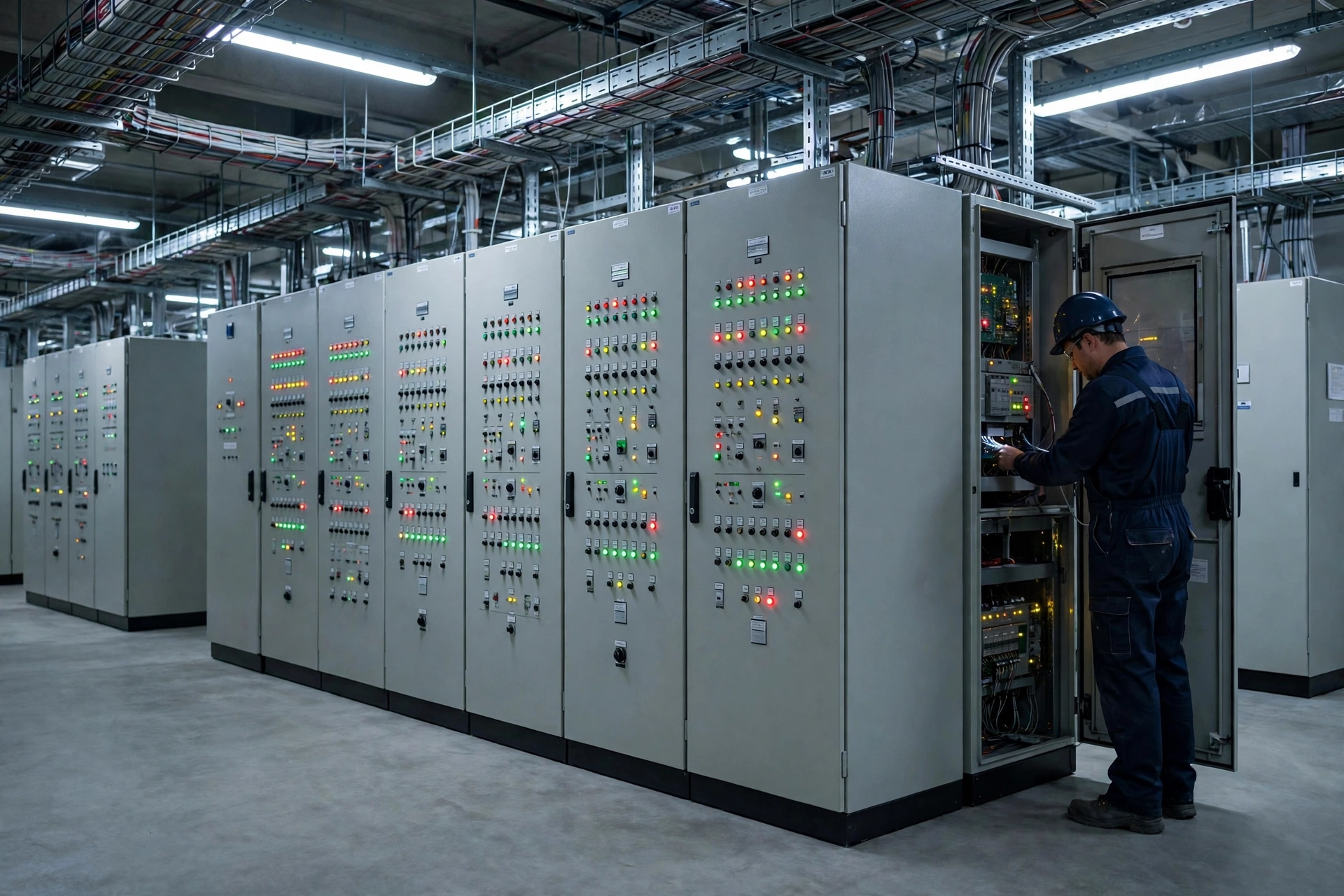
The controllers that do this — Deep Sea DSE8610, ComAp InteliGen and their equivalents — have one job: make every set behave as if it were one machine. They do it in three steps. First, synchronising: each incoming set matches the busbar voltage, frequency and phase angle before its breaker closes, typically within ±0.5 Hz and a few degrees of phase. Second, load sharing: active power (kW) is shared by governor droop or isochronous control, reactive power (kVAr) by alternator excitation control, so no single set hogs the load or circulates current against its neighbours. Third, protection: if one set trips, the controllers shed non-critical load or start the standby unit before the remaining sets overload.
Synchronising and load sharing
Load sharing is where paralleled plants are won or lost. Two sets that share kW unevenly will run at different fuel consumption and different exhaust temperatures; the harder-working set ages faster and trips first. The usual failure is not the controller. It is the settings: droop percentages that do not match, current transformers wired with reversed polarity, or a replacement controller loaded with the previous site’s configuration. A paralleled plant should be load-bank tested as a system, with all sets running together at 75–100% of plant capacity, before the first tenant moves in. Testing each set alone proves each set works. It proves nothing about the plant. Regular system-level testing is the same discipline as load bank testing for a single set, scaled up.
Step loads and the UPS handover
A data centre generator does not take load gently. When the grid fails, the UPS carries the IT load for the 10-second gap while the sets start, stabilise and close onto the busbar. NFPA 110 Type 10 requires the emergency power supply to assume the critical load within 10 seconds of grid failure, and the sets must then accept load in steps — typically 50%, then 75%, then 100% — without the voltage dipping below the limits of ISO 8528 Class G3, the performance class data centres specify.
The step matters because a UPS recharging its batteries after an outage is itself a large load, and chillers restarting after a trip draw five to seven times their running current. A plant sized exactly to the IT load, with no margin for UPS recharge and chiller restart, will take the load and then trip on overload. The correct sizing includes the recharge load and the largest single motor start, or the plant is undersized on its first real outage.
Case: the paralleling test that never happened
A 24 MW colocation campus outside Dublin ran twelve 2 MW containerised sets in N+1. Each set was factory-tested and site-tested individually, and every monthly test ran one set at a time against a load bank. The paralleling system — controllers, busbar, breakers, load-sharing settings — was never tested as a system. It was assumed to work because the components worked.
The first real grid failure, eighteen months after opening, exposed the assumption. Eleven sets synchronised and shared load correctly. The twelfth closed its breaker 12 degrees out of phase — a current transformer wired backwards during a controller replacement six months earlier, never caught because no test had ever run two sets together. The resulting current spike tripped the set’s protection and dropped 2 MW of capacity in the first minute of the outage. The remaining sets held the load, but at 96% of prime rating, and the operator spent the next forty minutes load-shedding tenants while the fault was traced. The repair took twenty minutes. The test that would have caught it would have taken an afternoon. Paralleling is a system. It must be tested as one.
Fuel: The Real Limit on Runtime
A data centre generator is limited by fuel, not by engineering. The engine will run for thousands of hours. The tank will not. Every runtime claim in a data centre specification is, underneath, a fuel claim — and it should be read as one.
The burn rates are large enough to surprise anyone who has only ever sized a 500 kVA set. A 2,000 kVA containerised unit at prime rating burns 105 L/h at 25% load, 186 L/h at 50%, 269 L/h at 75% and 353 L/h at 100%. At its standby rating, the same unit burns 388 L/h at full load. The Perkins TP2000PA1 burns 405 L/h at 100% prime and 463 L/h at 110%. A Caterpillar 3516C at 2 MW burns around 400 L/h at full load. These are not figures to estimate from a rule of thumb. They are the figures to put in the fuel contract.
| Load (prime rating) | Cummins C2000D5-PB (L/h) | Perkins TP2000PA1 (L/h) |
|---|---|---|
| 25% | 105 | — |
| 50% | 186 | 208 |
| 75% | 269 | 306 |
| 100% | 353 | 405 |
| 110% | — | 463 |
How much fuel a containerised fleet burns
Take a concrete case. A 20 MW IT load at a PUE of 1.4 is a 28 MW facility load. Size the plant so each set runs at about 75% of prime during an outage — the efficient, cool-running point — and each 1,875 kVA prime unit contributes 1,125 kW. N is 28,000 ÷ 1,125 = 24.9, so 25 units, and N+1 is 26 units. At 269 L/h each, the 25 loaded units burn 6,725 L/h. The 26th unit stands by, unloaded.
That is a fuel burn of 6.7 cubic metres an hour. A standard 30,000-litre road tanker is emptied in under four and a half hours. Any runtime claim longer than a day is a logistics claim, not a generator claim, and it needs a logistics plan behind it.
The 72-hour fuel plan
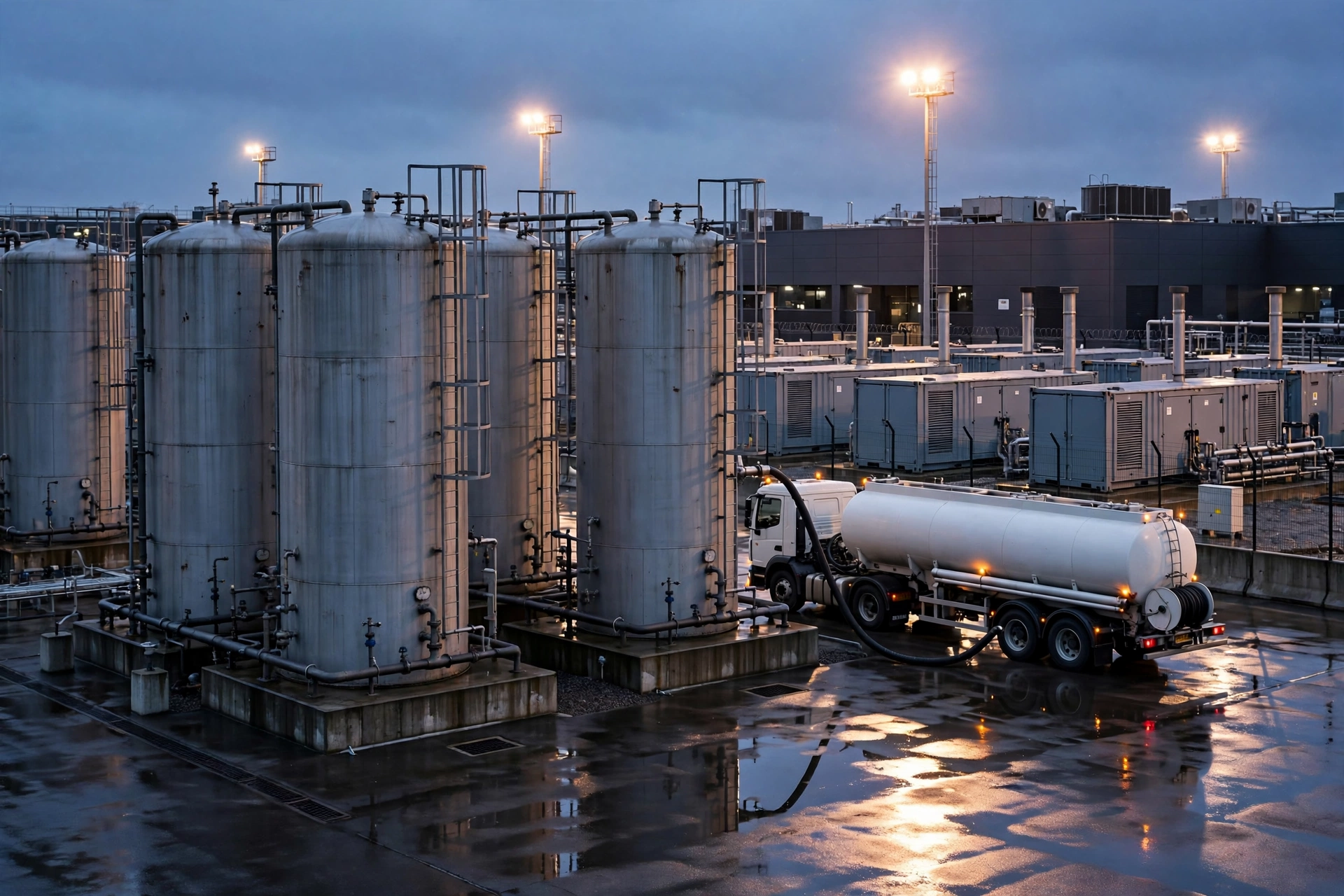
Storage is the first half of the plan. Typical AI data centre backup fuel storage covers 24–72 hours; Tier IV certification requires a minimum of 12 hours on site. For the 28 MW example above, 48 hours of storage is 322,800 litres — 323 m³ — and 72 hours is 484,200 litres — 484 m³. That is roughly the volume of a 25-metre swimming pool, held in bunded bulk tanks, and it must be ordered, delivered, tested and polished long before the outage happens.
The second half is delivery. A 30,000-litre tanker delivers 30 m³ per trip. Refilling 323 m³ takes 11 tanker loads; refilling 484 m³ takes 16. In a regional outage, every data centre, hospital and fuel station in the area is calling the same suppliers at the same time, and the supplier’s own depot may be without power. A fuel contract that does not name a guaranteed delivery window, a priority clause and a second supplier is a hope, not a plan. Fuel also ages: diesel in a standby tank lasts 6–12 months before water and microbes become a problem, which is why the storage tanks need the same testing and polishing discipline as the day tanks. The tank sizing arithmetic is covered in the guide to fuel tank sizing.
Case: the fuel contract that ran dry
A 15 MW data centre in Texas held 36 hours of fuel on site and a contract with a single local supplier for emergency top-up. The February 2021 freeze took the grid down across the state, and the data centre’s generators ran for 31 hours before the tanks reached the low-level alarm. The supplier’s depot had no power, its trucks could not load, and the roads were iced. The data centre’s fuel arrived 14 hours late — after the generators had stopped.
The site survived on the UPS and a partial load shed, but the lesson was written into the next contract: two suppliers, in different directions, with a guaranteed 12-hour delivery window, a priority clause, and a standing order that triggers automatically at 50% tank level instead of waiting for a phone call. The generator had done its job. The fuel plan had not. Runtime is a supply chain, not a specification.
Frequently Asked Questions
How many generators does a data centre need?
Divide the full facility load — IT load plus cooling, UPS recharge and growth margin — by the usable prime rating of one generator, round up, and add one unit for N+1 redundancy. A 30 MW hall needs 13 sets of 2.5 MW; a 100 MW AI campus needs 41. The count grows with PUE, so a liquid-cooled hall needs fewer sets than an air-cooled hall of the same IT load.
What is N+1 redundancy for a data centre generator?
N+1 redundancy means the generator plant carries 100% of the facility load with any single generator offline, whether for maintenance or failure. N is the minimum number of units that can carry the load; the +1 is one additional identical unit beyond that minimum. A plant that cannot carry its load with one unit down is not N+1, whatever the quotation says.
How do diesel generators work in parallel?
Each generator’s controller synchronises its voltage, frequency and phase to a common busbar before closing its breaker, then shares active and reactive load with the other sets through governor and excitation control. Deep Sea and ComAp paralleling controllers manage the synchronising, load sharing and protection automatically. The system must be tested with all sets running together, because testing sets one at a time proves nothing about the plant.
What is a containerised diesel generator?
A containerised diesel generator is a complete generating set — engine, alternator, radiator, fuel tank, silencer, controller and switchgear — factory-installed inside a standard ISO shipping container, usually a 40-foot high cube. It arrives tested, lifts straight onto a plinth, and connects to fuel, exhaust and switchgear in days rather than months. A single 40-foot container typically holds a set up to about 2,000–2,500 kVA; larger capacities use bigger enclosures or paralleled units.
How long can a data centre run on diesel generators?
As long as the fuel lasts. The engines will run for thousands of hours, so the limit is storage plus delivery: typical on-site storage covers 24–72 hours, and Tier IV certification requires a minimum of 12 hours. A 28 MW plant burns about 6,725 litres an hour, so 72 hours needs roughly 484,000 litres and 16 tanker loads to refill. Without a delivery contract, the runtime is whatever is in the tank on the day the grid fails.
Specification Checklist: Seven Lines Before the Order
1. State the load honestly, including PUE and growth. IT load, cooling load, UPS recharge, building systems and three years of growth. A plant sized to today’s IT load alone is undersized the day the next tenant signs.
2. Name the rating in letters. ESP, PRP or COP, at the site’s altitude and maximum temperature, on the datasheet and in the contract. A quotation that states only kVA should be returned for clarification.
3. Check the unit size against the container. A single 40-foot box holds about 2,000–2,500 kVA. Above that, price the job as paralleled units or a larger enclosure — and check the crane, the plinth and the road access for a 31-tonne box.
4. Specify the paralleling controller and the system test. Name the controller, require a full-plant load bank test with all sets running together, and repeat it after any controller replacement or settings change.
5. State the fuel hours and the delivery contract. Hours of storage on site, number of suppliers, guaranteed delivery window, and the tank level that triggers an automatic order. Runtime is a supply chain.
6. Confirm the noise figure at the boundary. A containerised set at 65–75 dB(A) at 7 metres still needs a boundary measurement at night, under real load, with the doors closed. Check the air permit at the same time: most jurisdictions cap emergency generator testing at about 100 hours a year.
7. Confirm start time and step-load class. Ten seconds to assume load under NFPA 110 Type 10, and ISO 8528 Class G3 voltage and frequency limits for the data centre load. Ask for the factory test report that proves both.
A data centre does not buy generators. It buys the certainty that the servers stay up when the grid goes down, for as long as the outage lasts. That certainty is built from four things: enough units, the right redundancy, a paralleling system that has been tested as a system, and fuel that will actually arrive. The container made the first three easier to buy. The fourth still depends on a contract, a supplier and a road that stays open. Price all four before the order is placed — and if the numbers need a second opinion, contact PAVO for a specification review against the site’s load, altitude and runtime requirement.