

What Size Generator Do I Need for a Food Truck? | PAVO
A food truck generator fails differently from any other generator. It does not fail at 2 a.m. in an empty building. It fails at 12:40 p.m., with forty people in the queue, the fryer at temperature, and the card machine rebooting.
What size generator do I need for a food truck? Most food trucks need a 6,000–10,000 W generator: a truck that cooks on propane runs on about 6,500 W, a truck with an electric fryer and air conditioning needs 8,000–10,000 W, and an all-electric kitchen needs 15,000 W or more.
Contents:
- Why a Food Truck Is Not a House With Wheels
- The Load List: What Every Piece of Equipment Really Draws
- Sizing the Set: The Method and Three Worked Examples
- The Fridge Surge: Why the Compressor Decides the Generator
- Diesel, Petrol or Shore Power: Choosing the Power Source
- How Much Fuel Does a Food Truck Generator Use Per Day?
- How Quiet Does a Food Truck Generator Need to Be?
- Frequently Asked Questions
Why a Food Truck Is Not a House With Wheels
A food truck is the smallest commercial kitchen in the world, and it has the worst power profile of any generator application. A house spreads its load across a day: the kettle in the morning, the washing machine in the afternoon, the lights at night. A food truck puts every load on at the same time, at the same moment, for four hours straight. The fryer is at temperature, both fridges are cycling, the griddle is hot, the hood fan is running, the air conditioning is fighting a 40°C kitchen, and the card machine is taking payments. There is no off-peak. Lunch is the peak, and it lasts the whole service.
That is why the usual domestic sizing rules fail. A 3,000 W inverter generator is a fine machine for a campsite. On a food truck it is a machine that trips at the exact moment the queue is longest. The failure is not gradual. A generator that is 10% too small does not run 10% worse. It runs until the fridge compressor starts, and then it stops — and it takes the fryer, the till and the lights with it.
The second difference is that the generator is the business. A house with a failed generator still has a house. A food truck with a failed generator has no product, no sales and no customers, because the customers in the queue leave and do not come back. One generator guide puts it bluntly: an undersized portable generator does not just inconvenience customers, it shuts down the point of sale, kills food safety compliance, and costs the operator an entire service window. A lost Saturday lunch service at a busy pitch is $800–$2,000 of revenue, against a generator that costs $1,000–$3,000 to buy right in the first place.
The Simultaneous Peak
The trap has a name in the generator trade: coincident peak demand. Each appliance on its own is modest. The fryer draws 2,000 W. The fridge draws 800 W. Together they draw 2,800 W, and any 3,500 W generator should carry them easily. But the fridge does not draw 800 W all the time. Its compressor starts, and for a second it draws 2,200–2,400 W. If that second arrives while the fryer is at full draw, the generator sees 4,200–4,400 W in one instant. A 3,500 W set trips. A 4,000 W set trips. The truck goes dark, and the operator learns the lesson at the worst possible time.
The rule that follows is simple and non-negotiable: size for the worst second, not for the average hour. Add up the running watts of everything that can be on at once, add the starting surge of the single largest motor-driven load, and then add 20–25% headroom. That number is the minimum generator size. Anything smaller is a gamble taken in front of a queue.
The Food-Safety Clock
There is a second reason the generator cannot be allowed to fail, and it is not about revenue. It is about the food. Under the FDA Food Code, cold food held above 41°F (5°C) for more than 4 hours must be discarded. A food truck’s fridges hold $300–$600 of perishable stock on a normal day, and a generator failure at noon means the clock starts immediately. If the generator cannot be restarted within the hour, the operator faces a choice between serving food that should have been thrown away and throwing away the day’s stock.
That is why experienced operators treat the generator as food-safety equipment, not as a power accessory. It gets the same discipline as the fridge thermometer: checked before service, fuelled before service, and never run below the level that leaves a margin for the next hour. A generator that is sized correctly and maintained properly is the cheapest insurance on the truck. A generator that is undersized is a food-safety incident waiting for a hot day.
The Load List: What Every Piece of Equipment Really Draws
Sizing starts with a load list, and the load list starts with the rating plate on each appliance. Every commercial appliance carries one, and the figures on it are the only figures that matter for the truck in question. Published ranges are a starting point. The nameplate is the specification. Two commercial fryers of the same basket size can differ by 1,000 W between brands, and that difference is the difference between a generator that works and one that trips.
The list below uses the ranges published by generator manufacturers and food-truck builders in 2026. They agree closely with each other, which is a good sign: the fryer figures, the fridge figures and the air conditioning figures recur across every source with only small variations.
| Equipment | Running watts | Starting watts | Notes |
|---|---|---|---|
| Commercial deep fryer, single basket | 1,500–2,500 | 1,500–2,500 | Resistive — no surge, runs at full draw |
| Commercial deep fryer, dual basket | 4,000–5,000 | 4,000–5,000 | Largest single continuous load on most trucks |
| Electric griddle | 1,500–3,000 | 1,500–3,000 | Resistive — no surge |
| Induction cooktop | 1,500–3,500 | 1,500–3,500 | Resistive — no surge |
| Commercial refrigerator | 600–1,200 | 1,800–2,400 | Compressor — 2–3x surge at start |
| Commercial freezer | 700–1,000 | 1,400–2,500 | Compressor — 2–3x surge at start |
| Ice maker | 300–700 | 600–1,200 | Compressor — 2x surge at start |
| Espresso machine, compact | 1,500–3,000 | 1,500–3,000 | Resistive boiler — no surge |
| Espresso machine, 2-group | 3,000–5,000 | 3,000–5,000 | Needs a 240 V outlet |
| Panini press | 1,000–1,800 | 1,000–1,800 | Resistive — no surge |
| Commercial microwave | 1,000–1,800 | 1,000–1,800 | Resistive — no surge |
| Hood / exhaust fan | 400–600 | 800–1,200 | Motor — 2x surge at start |
| Air conditioner, 13,500 BTU | 1,300–1,800 | 2,800–4,000 | Compressor — the largest surge on the truck |
| Water pump | 100–200 | 200–400 | Motor — 2x surge at start |
| LED lighting + POS + small loads | 300–500 | 300–500 | Continuous, small |
Resistive Loads: Fryers, Griddles and Heaters
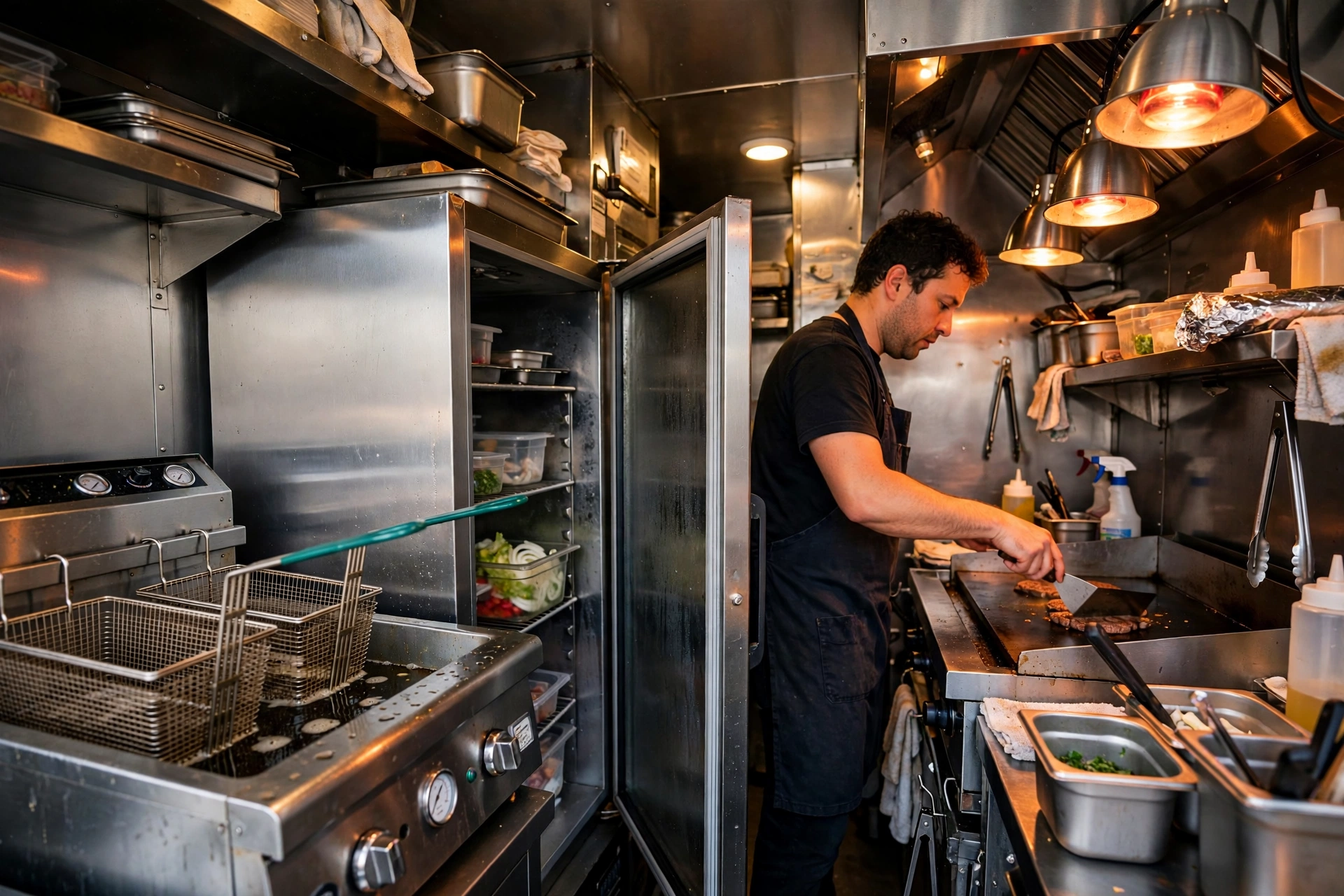
The resistive loads are the honest ones. A fryer, a griddle, an induction hob, a panini press and an espresso boiler draw what they draw, and they draw it from the moment they switch on until the moment they switch off. There is no surge, no surprise and no spike. A 2,000 W fryer draws 2,000 W at 11 a.m. and 2,000 W at 1 p.m. That makes them easy to size for — and dangerous to underestimate, because they run at full draw for the whole service. A fryer does not cycle the way a fridge does. It holds oil at 175°C for four hours, and it holds it by drawing full power for four hours.
The fryer is also the load that decides the voltage. A single-basket fryer runs on 120 V. A dual-basket commercial fryer, a large espresso machine and some air conditioners need 240 V. A generator rated at 7,000 W on paper cannot deliver all of that through one 120 V outlet, and a truck that buys a 120 V-only set and then adds a 240 V fryer has bought a generator it cannot use. The 240 V outlet belongs on the specification before the set is bought, not discovered on the first day of service.
The other decision the resistive loads force is propane versus electric. On most trucks the griddle, the fryers, the charbroiler and the water heater run on propane, so the generator only carries refrigeration, the hood fan, the water pump, lighting, the point of sale and any electric cooking or coffee equipment. That single decision — propane for heat, electricity for everything else — cuts the generator size nearly in half. A truck that cooks on propane typically needs 6,500–7,000 W. The same menu cooked entirely on electricity needs 13,000–15,000 W. Propane is not a fuel choice. It is a generator-size choice.
Motor Loads: Fridges, Freezers and Air Conditioning
The motor loads are the dishonest ones, and they are the ones that kill undersized generators. A commercial refrigerator draws 600–800 W running, and 1,200–2,400 W for the second its compressor starts. A commercial freezer draws 700–1,000 W running and 1,400–2,500 W starting. A 13,500 BTU roof air conditioner draws 1,300–1,800 W running and 2,800–4,000 W starting. The nameplate lists the running figure. The starting figure lives in the manufacturer’s manual, or on a sizing chart, and it is the figure that matters.
The reason is physics, and it is the same physics that governs motor starting on a 500 kVA industrial set: an induction motor at standstill draws locked-rotor current, typically five to seven times its running current, for the first fraction of a second. A food truck fridge is a small motor, so the surge is a small number in absolute terms — 2,400 W instead of 340 kVA — but the ratio is the same, and the consequence is the same. The generator must carry the surge, or the voltage collapses, the breaker trips, and the truck goes dark.
The air conditioner deserves special attention because it is the largest surge on most trucks and the load most often added as an afterthought. A 13,500 BTU unit needs 2,800–4,000 W to start, and on a hot day it cycles every few minutes. A truck that sizes its generator for the fryer and the fridge and then adds air conditioning in July has added a 4,000 W surge to a set that has no margin left. The air conditioner sizing figures — running watts, starting watts and the soft-start option — belong in the load list from the first day, even if the air conditioner is bought in the second season.
Sizing the Set: The Method and Three Worked Examples
The method is the same for every truck, and it takes ten minutes with a calculator. List every appliance that can run at the same time. Add the running watts. Add the starting surge of the single largest motor-driven load — usually the air conditioner or the largest fridge — on top of the running total. Then add 20% headroom so the generator is not running flat out all shift. That number is the minimum generator size. The generator sizing guide method for a building is identical in structure; the numbers are smaller, but the discipline is the same.
The headroom is not a luxury. Generators lose 3–5% of their capacity in summer heat, and a set running at 100% load all shift runs hot, loud and thirsty, with no margin for the next compressor start. A set running at 75–80% load runs cooler, quieter and longer, and it has the margin to absorb the surge when the freezer kicks in at the same moment as the air conditioner. The 20% is what stands between a working lunch service and a tripped breaker.
| Total estimated power need | Recommended generator size |
|---|---|
| Up to 3,500 W | 4,000–4,500 W inverter generator |
| 3,500–5,500 W | 5,500–7,500 W inverter or portable generator |
| 5,500–8,500 W | 7,500–10,000 W portable generator |
| 8,500 W and above | 10,000 W or more, or parallel inverter sets |
The Method: Running Watts Plus the Largest Surge
Work the method on a real truck. A taco truck that cooks on propane carries two refrigerators (1,400 W running), a freezer (850 W), a hood fan (500 W), an electric steam table (1,200 W), a water pump, lights and point of sale (400 W), and a 13,500 BTU air conditioner (1,700 W). The running total is 6,050 W. The largest single surge is the air conditioner at 2,800–4,000 W starting against 1,700 W running — a gap of roughly 1,100–2,300 W. Add the gap, add 20% headroom, and the truck needs a 7,500–9,000 W generator. The published guidance for a propane-cooking truck says 6,500–7,000 W without air conditioning, and 8,000–10,000 W with it. The arithmetic agrees with the guidance, which is how the operator knows the arithmetic is right.
The common mistake is to add every starting surge together. That over-sizes the set by thousands of watts and thousands of dollars. Compressors do not all start at the same instant — or rather, they do, about once a season, and the breaker that trips on that day is the price of not over-sizing for it. The industry-standard calculation adds only the largest single surge gap, and then relies on the 20% headroom to absorb the day the second compressor starts a second early. It is a calculated risk, and it is the right one: sizing for two simultaneous compressor starts would put a 12,000 W set on a truck that needs 8,000 W, and the oversized set would then run at 40% load all day, wasting fuel and glazing its cylinders.
Case 1: Taco Truck on Propane, Austin, Texas
A taco truck in Austin cooks on propane and runs a 7,500 W inverter generator. The load list is the one worked above: two fridges, a freezer, a steam table, a hood fan, a 13,500 BTU air conditioner, lights and point of sale — 6,050 W running, 7,500 W at the worst second, 9,000 W with full headroom. The operator chose a 7,500 W rated set with a 9,375 W starting rating, which covers the worst second and leaves the headroom to the starting rating rather than the running rating. It is a common compromise, and it works because the air conditioner cycles and the fridges cycle, and the worst second is genuinely rare.
The truck runs six days a week, 8 hours a day, in ambient temperatures that reach 38°C in July. At that temperature the generator loses about 4% of its rated output, so the 7,500 W set is effectively a 7,200 W set in August. The operator knows this and runs the air conditioner on its lowest fan speed during the lunch rush, when the fryer — propane, so no electrical load — and both fridges are at their hardest. The discipline is the margin. The truck has never tripped in three seasons.
Case 2: Burger Truck With an Electric Fryer, Manchester, England
A burger truck in Manchester runs a dual-basket electric fryer, a griddle on propane, a fridge, a freezer and an espresso machine. The fryer alone draws 4,500 W. Add the fridge (800 W), the freezer (900 W), the espresso machine (2,000 W), the hood fan (500 W) and lights and point of sale (400 W), and the running total is 9,100 W. The largest surge is the freezer at 2,500 W starting against 900 W running — a gap of 1,600 W. Add the gap and 20% headroom, and the truck needs a 12,800 W generator. The operator runs a 13,000 W diesel set in a silent canopy, mounted under the chassis.
The lesson of this truck is the fryer. A single electric fryer costs more generator than an entire propane-cooked menu. The operator priced the alternative — converting the fryer to propane — at £1,800, against the diesel set at £6,500 installed. The fryer stayed electric because the pitch, a covered market hall, does not allow propane cylinders indoors. The generator size is a consequence of the venue rules, not of the menu. Any operator choosing between electric and propane cooking should price the generator first, because the generator is where the decision shows up.
Case 3: All-Electric Coffee and Breakfast Truck, Dubai
An all-electric coffee and breakfast truck in Dubai carries a 2-group espresso machine (4,000 W), an induction cooktop (3,000 W), a 5,000 W electric fryer, two refrigerators (1,600 W), a freezer (900 W), a hood fan (500 W), an air conditioner (1,700 W) and small loads (400 W). The running total is 13,350 W. The peak, with the largest surge added, is nearly 15,000 W. The truck runs a 15,000 W diesel set, and it is the only truck of the three that cannot be served by a portable generator at all. At 15,000 W the set is a built-in unit, mounted under the chassis, with a dedicated fuel tank and a silent canopy.
The Dubai truck also shows the heat problem at its worst. In August the ambient temperature reaches 45°C, and a generator rated at 15,000 W at 25°C loses roughly 8–10% of its output — the same derating that applies to a 200 kVA set in a hotel courtyard. The truck’s set was specified at the derated figure, not the catalogue figure, and the operator runs the air conditioner on a soft-start kit that cuts its starting current by two-thirds. The soft-start kit cost $350. The next frame size of generator would have cost $2,000. That is the cheapest 2,000 W a food truck operator will ever buy.
The Fridge Surge: Why the Compressor Decides the Generator
Every food truck generator story ends the same way: the fridge. Not the fryer, which is the biggest load, and not the espresso machine, which is the most expensive appliance. The fridge, because it is the load that changes without warning. A fryer is switched on by a person. A fridge compressor starts by itself, on a thermostat, at whatever moment the temperature inside the cabinet rises past the setpoint. The operator cannot schedule it, cannot see it coming, and cannot stop it. The generator must be ready for it at any second of the service.
The numbers explain why. A commercial refrigerator draws 600–800 W running and 1,200–2,000 W starting in the smaller published ranges, and 800–1,200 W running with 1,800–2,400 W starting in the larger ones. The spread between sources is the spread between a small under-counter unit and a full reach-in cabinet, and the operator’s own nameplate settles it. What does not change is the ratio: two to three times running watts, for one to two seconds, every time the compressor cycles. On a hot day a fridge cycles every 10–15 minutes. Over an eight-hour service that is 30–45 starting surges, and the generator must absorb every one of them without dropping the voltage below the level the point-of-sale terminal and the espresso machine will tolerate.
The 2–3x Rule
The rule for motor loads is simple: allow two to three times running watts for starting, and three to four times for the largest compressors. The exact multiple depends on the motor and the starting method, and the motor starting discipline — locked-rotor current, starting method and voltage dip — is the same discipline that sizes a 500 kVA set for a chiller. The food truck version is smaller, but it is not simpler. A fridge compressor is a hermetic motor with no soft starter and no variable-speed drive, and it draws its locked-rotor current in full, every time.
The practical consequence is that the fridge and the freezer must be sized as starting loads, not as running loads, in the load list. An operator who writes “fridge 800 W” in the load list and sizes the generator for 800 W has made a 1,600 W error. Two fridges and a freezer, written as running loads, understate the worst second by 3,000–4,000 W — which is the whole margin on a 7,500 W set. The load list must carry both figures for every motor load, running and starting, and the generator must be sized for the starting figure.
Sequencing: Staggering the Starts
The cheapest protection against the fridge surge is sequencing: making sure the compressors do not all start at once. The simplest version is manual — switch the freezer on first, let it pull down to temperature, then switch the fridge on, then the air conditioner — and it costs nothing. The more reliable version is a delay timer on each compressor circuit, typically 3–5 minutes, so that after a power interruption the compressors restart one at a time instead of all together. A delay timer costs $20–$40 per circuit.
The moment that matters most is the restart after a trip or a refuelling stop. When a generator stops and restarts, every compressor on the truck tries to start at the same instant, because every cabinet has warmed by a degree or two in the meantime. That simultaneous restart is the single most common cause of a second trip immediately after the first, and it is the reason operators who restart a tripped generator and immediately switch everything back on trip it again within ten seconds. The correct restart is staged: generator on, wait 30 seconds, fridge on, wait two minutes, freezer on, wait two minutes, air conditioner on. Five minutes of patience saves a second trip and a second queue of lost customers.
Clean Power for the Till
The fridge surge causes a second problem that is easy to miss: voltage dip. When a compressor starts, the generator’s voltage sags for a fraction of a second, and the loads that notice are the electronic ones. A point-of-sale terminal, a card reader and an espresso machine’s control board all run on low-voltage electronics, and a deep voltage dip reboots them. A card reader that reboots takes 60–90 seconds to come back. At a busy lunch service, that is five lost sales.
The protection is a pure sine wave inverter generator, which produces power with less than 3% total harmonic distortion — effectively the same quality as utility power. A conventional open-frame generator produces a rougher waveform, and the difference shows up in exactly the equipment a food truck depends on: the till, the card reader and the espresso machine. The inverter generator costs more per watt, but it is the only class of portable generator that reliably powers a modern food truck’s electronics without reboots. For the same reason, the generator should never be loaded above 80% for long periods: a heavily loaded generator produces a worse waveform, and the till is the first thing to notice.
Diesel, Petrol or Shore Power: Choosing the Power Source
A food truck has three ways to get power, and the right choice depends on where the truck trades, how many hours it runs, and what the venue allows. The three options are a built-in diesel set, a portable petrol inverter generator, and shore power — a hook-up to the venue’s mains supply. Most trucks use one as the primary source and one as the backup. The trucks that fail are the ones that have only one option and no plan for the day it is unavailable.
Built-In Diesel: The Working Truck’s Choice
A built-in diesel set — mounted under the chassis or in a ventilated compartment, with a dedicated fuel tank — is the choice for a truck that trades five or six days a week. The reference machine in this class is the Cummins Onan QD 8000, an 8 kW diesel set built for mobile catering and recreational vehicles: 0.49 gallons per hour (1.85 L/h) at half load and 1.02 gallons per hour (3.86 L/h) at full load, with a 57-litre tank that gives roughly 30 hours at half load. It starts from a switch inside the truck, it runs on the same diesel the truck’s engine burns, and it is quiet enough — around 60 dB(A) — to trade in a city centre.
Can a diesel generator power a food truck? Yes, and for a full-time truck it is the best answer. Diesel is safer to store than petrol, because its flash point is 52°C against petrol’s −43°C, and it is cheaper per kilowatt-hour: a diesel set burns roughly 0.28 litres per kWh at good loading, against 0.45 litres per kWh for a petrol set. Over a 2,000-hour trading year at an average load of 5 kW, the diesel set burns about 2,800 litres and the petrol set about 4,500 litres — a difference of 1,700 litres, or roughly $2,500 a year at $1.50 a litre. The diesel set costs more to buy, typically $4,000–$7,000 installed against $1,500–$3,000 for a portable petrol inverter, but a full-time truck recovers the difference in two seasons.
PAVO builds diesel sets from 9 kVA upward in silent canopy and open configurations, and the smallest canopy sets — 10–20 kVA — are the right size for a mobile kitchen that needs more than a portable unit can give. A 10 kVA set delivers 8 kW, which covers a propane-cooking truck with air conditioning and leaves the headroom for the fridge surge. The same standby and prime power ratings that govern a hotel set apply here: a food truck set runs every day, for thousands of hours a year, so it needs a prime rating, not a standby rating limited to 200 hours a year. A standby-rated set on a food truck is a warranty claim waiting to happen.
Portable Petrol Inverter: The Part-Time Truck’s Choice
A portable petrol inverter generator is the choice for a truck that trades two or three days a week, or for a truck that needs a backup set. The reference machine is the Honda EU7000is: 7,000 W rated, 52–58 dB(A), pure sine wave output with less than 3% harmonic distortion, and a 19-litre tank that gives roughly 18 hours at quarter load. It sits on the pavement beside the truck, it is carried in and out by one person, and it is the machine that most city noise inspectors know by sight.
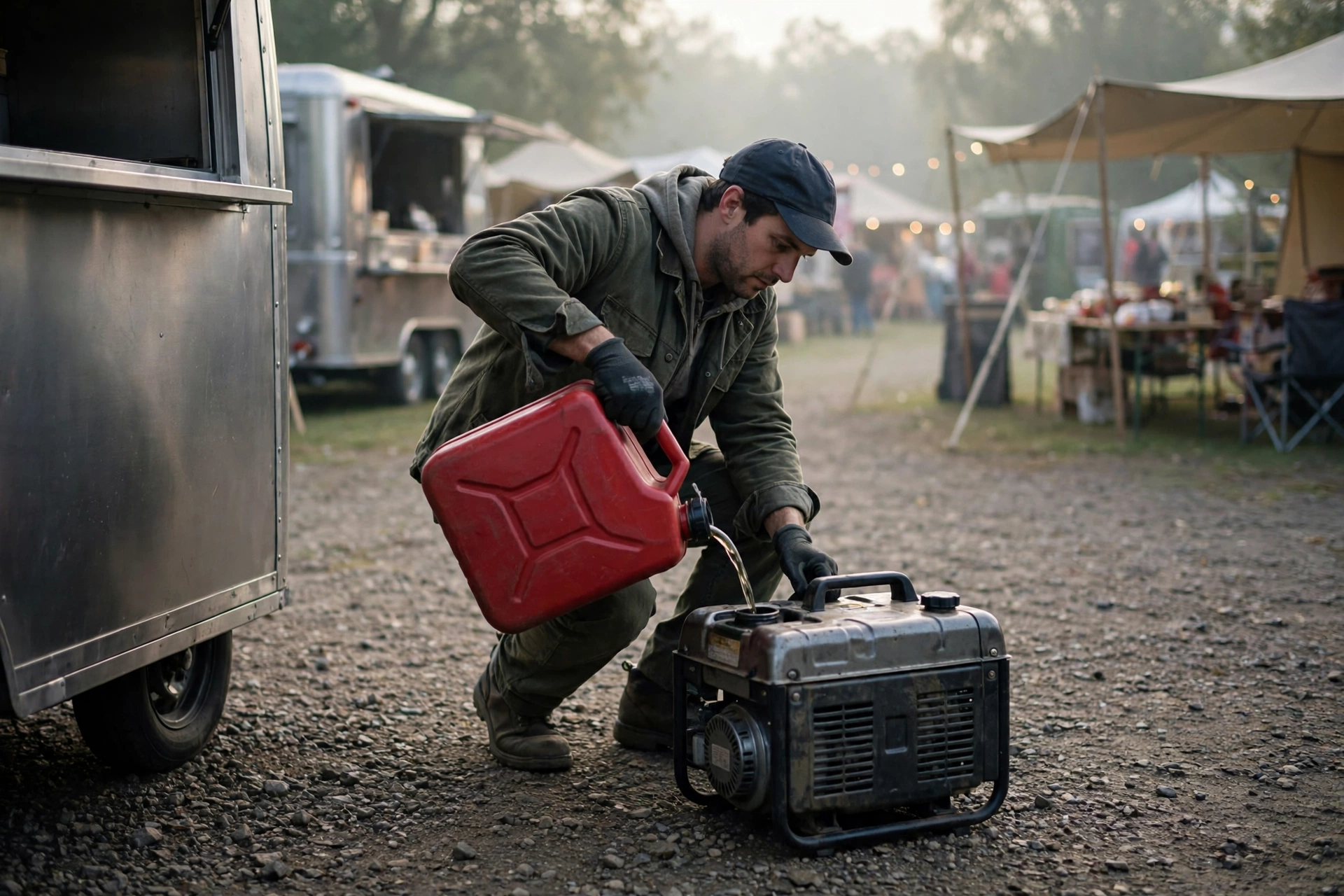
The petrol inverter’s advantages are noise, weight and clean power. Its disadvantages are fuel cost, fuel storage and runtime. Petrol costs more per kilowatt-hour, the tank is small, and a full trading day needs a refuelling stop — which means carrying a jerry can, which means carrying petrol in a vehicle full of hot cooking equipment. The fire risk is real and the regulations know it: most cities require petrol to be stored in an approved container, outside the cooking area, with a fire extinguisher within reach. A diesel set, with its higher flash point and its fixed tank, avoids the problem entirely.
The portable inverter also has a hard ceiling. The largest portable inverter generators top out around 7,000–9,500 W, and a truck that needs 10,000 W or more cannot be served by one portable unit. Two inverter generators can be paralleled, but the parallel kit, the second set and the synchronising cable cost nearly as much as a built-in diesel set, and the result is two machines to fuel, two machines to maintain and two machines to steal. A truck that needs 10,000 W should buy a built-in set.
Shore Power and the Hybrid Middle Ground
Shore power — a hook-up to the venue’s mains supply — is the cheapest power a food truck will ever buy, and the least available. A market hall or a festival site with a 32 A or 63 A three-phase hook-up gives the truck unlimited, silent, emissions-free power for the price of the pitch fee. A street pitch gives the truck nothing. The trucks that trade at the same market every week arrange a hook-up. The trucks that move every day carry a generator.
The practical answer for most full-time trucks is a hybrid: shore power where it exists, a built-in diesel set everywhere else, and a changeover switch that makes the swap in seconds. The changeover must be a proper break-before-make switch, not a plug swapped by hand, because a generator feeding back into a venue’s mains supply is a lethal fault. The same portable diesel generator discipline that governs a building’s standby set applies to the changeover on a truck: it is wired once, by an electrician, and tested every month.
The newest middle ground is a battery hybrid: a lithium battery bank charged by the generator and by solar panels on the truck’s roof, which carries the light loads — lights, point of sale, the fridge between cycles — and lets the generator shut down for part of the service. A 5 kWh battery bank costs around $2,000–$3,000 and saves roughly 30–40% of generator hours on a truck with a light overnight load. It does not replace the generator — the fryer still needs the set — but it is the option that opens the venues that have started to ban generators altogether.
How Much Fuel Does a Food Truck Generator Use Per Day?
Fuel is the food truck’s second-largest operating cost after ingredients, and it is the one most operators guess at. The guess is usually wrong in the optimistic direction, because the operator remembers the litres the generator burns at lunchtime and forgets the litres it burns during the two hours of prep before service and the hour of cleaning after it. The generator runs for the whole trading day, not for the lunch rush. The fuel bill is the whole day.
The L/kWh Maths
The arithmetic is simple. A diesel set at good loading burns roughly 0.25–0.30 litres per kWh produced. A petrol set burns roughly 0.45 litres per kWh. Multiply the average load in kilowatts by the litres per kWh, and the result is litres per hour. Multiply by the hours of the trading day, and the result is the fuel bill.
A taco truck with an average load of 5 kW on a diesel set burns 5 × 0.28 = 1.4 L/h. Over an eight-hour trading day that is 11.2 litres. At $1.50 a litre, the fuel costs $16.80 a day, or about $100 a week for a six-day trading week. The same truck on a petrol set burns 5 × 0.45 = 2.25 L/h, or 18 litres a day — $27 a day, $162 a week. The diesel advantage is $62 a week, $3,200 a year. That is the number that justifies the diesel set’s higher purchase price.
The load figure that matters is the average, not the peak. A truck with a 9,000 W peak and a 5,000 W average burns fuel for 5 kW, not for 9 kW. The way to find the average is to read the generator’s hour meter and its fuel log for a week: litres divided by hours is the real consumption, and it is always lower than the operator expects and higher than the brochure promises. A set running below 50% load burns more fuel per kilowatt-hour than a set running at 70–90%, because the engine’s fixed losses — friction, the cooling fan, the alternator’s own consumption — take the same share whatever the output. An oversized generator is a thirsty generator.
Three Service Days, Three Fuel Bills
The three trucks from the sizing section show what the fuel bill looks like in practice, because their service days are different lengths and their loads are different sizes.
Case 1: Austin Taco Truck, 8-Hour Day
The Austin taco truck runs a 7,500 W diesel inverter set at an average load of 4.5 kW for 8 hours: two hours of prep, four hours of lunch service and two hours of cleaning and driving. At 0.28 L/kWh, the set burns 1.26 L/h, or 10.1 litres for the day. The set’s 25-litre tank gives two and a half days between fills, and the operator refuels every second morning from a jerry can at the depot. The daily fuel cost is $15.15 at $1.50 a litre, and the weekly fuel cost for six trading days is $91. Fuel is 2–3% of the truck’s daily revenue. It is the smallest line on the profit-and-loss account, and the one most worth getting right, because a generator that runs out of fuel at 1 p.m. costs a whole service.
Case 2: London Coffee Van, 6-Hour Market
The London coffee van runs a 5,500 W petrol inverter set at an average load of 3 kW for 6 hours at a farmers’ market: one hour of setup, four hours of trading and one hour of packing down. At 0.45 L/kWh, the set burns 1.35 L/h, or 8.1 litres for the day. The set’s 19-litre tank covers two market days, and the operator refuels from a 10-litre jerry can carried in a sealed box outside the cooking area. The daily fuel cost is £13.40 at £1.65 a litre, and the weekly cost for three market days is £40. The van trades three days a week, so the petrol set’s higher fuel cost — roughly £20 a week more than diesel — is smaller than the saving on the purchase price. For a part-time truck, petrol wins. For a full-time truck, it does not.
Case 3: Dubai Festival Burger Truck, 12-Hour Day
The Dubai festival burger truck runs a 15,000 W built-in diesel set at an average load of 8 kW for 12 hours: a full festival day from 10 a.m. to 10 p.m., with the air conditioner fighting 45°C for the whole shift. At 0.28 L/kWh, the set burns 2.24 L/h, or 26.9 litres for the day. The set’s 60-litre tank gives just over two days, and the operator refuels from the festival’s bowser each morning. The daily fuel cost is $40.35 at $1.50 a litre. Over a three-day festival the truck burns 81 litres and spends $121 on fuel, against $9,000–$12,000 of revenue. The fuel bill is 1% of revenue. The risk is not the cost. The risk is the tank: a 12-hour day at 2.24 L/h needs 27 litres, and a set with a 20-litre tank runs dry at 9 p.m., in front of a queue, on the busiest night of the festival. The tank must be sized for the longest day, not the average day.
| Truck | Set | Average load | Hours | Fuel per day | Cost per day |
|---|---|---|---|---|---|
| Austin taco truck | 7.5 kW diesel inverter | 4.5 kW | 8 | 10.1 L | $15.15 |
| London coffee van | 5.5 kW petrol inverter | 3 kW | 6 | 8.1 L | £13.40 |
| Dubai festival burger truck | 15 kW built-in diesel | 8 kW | 12 | 26.9 L | $40.35 |
The table carries a warning with it. These are planning figures, calculated from the litres-per-kWh method and cross-checked against the Cummins Onan QD 8000 datasheet — 1.85 L/h at half load, 3.86 L/h at full load for an 8 kW set. The datasheet for the set actually bought is the authority, and any quotation that states fuel consumption without stating the load it was measured at should be returned for clarification. A set quoted at 1.4 L/h and measured at 25% load is a set that burns 2.8 L/h at the load the truck actually puts on it.
How Quiet Does a Food Truck Generator Need to Be?
A food truck generator is the only generator that has to run while its customers are standing a metre away from it, eating. The noise specification is therefore not a line in a datasheet. It is a customer-experience specification, and it is measured at the queue, not at the set. A generator that is too loud does not just annoy the neighbours. It drives customers away from the serving hatch, it draws complaints to the market organiser, and in a growing number of cities it draws a fine.
The 60–65 dB Rule
Most city street-vending ordinances limit noise to 60–65 dB(A) at 50 feet (about 15 metres) from the source. The figure is consistent across the United States, and the same range appears in municipal codes in the United Kingdom, Canada and Australia. It is the number that decides which class of generator a food truck can legally run. A conventional open-frame portable generator in the 5,000–8,000 W range produces 70–76 dB(A) at 23 feet under load — 10–16 dB above the limit. On the logarithmic decibel scale, 10 dB sounds twice as loud, so an open-frame set sounds between two and four times louder than the law allows. It is not a borderline violation. It is a violation on every service day.
An inverter generator with an acoustic enclosure produces 52–59 dB(A) — below virtually every city ordinance limit. The Honda EU7000is, the machine most inspectors know, is rated at 52–58 dB(A). The difference between the two classes is the difference between a permit and a fine. A single noise violation typically costs $250–$1,000, and in repeat cases the permit is suspended. One fine costs more than the price difference between an open-frame set and an inverter set.
The limits are tightening, and the direction is clear. Santa Monica, California banned generators for street vendors outright in July 2025, requiring battery power instead. Manchester in the United Kingdom bans petrol generators on all event sites. New York City has a proposed ordinance that would ban carbon-fuelled generators on ice cream trucks. Montréal caps food truck generator noise at 80 dBA measured at 1.5 metres from the truck — a limit a standard petrol generator fails on its own. The silent generator noise levels guide covers how the dB(A) figure is measured and what distance does to it, and both facts belong in the operator’s permit file before the first trading day.
Open Frame vs Inverter: The Noise Table
| Generator class | Noise at 7 m | City limit 60–65 dB(A) at 50 ft | Where it can trade |
|---|---|---|---|
| Open-frame portable, 5–8 kW | 70–80+ dB(A) | Fails by 10–16 dB | Construction sites, private land |
| Standard silent canopy diesel, 10 kVA | 65–75 dB(A) | Borderline — needs distance | Service yards, festivals with spacing |
| Super-silent canopy diesel, 10 kVA | 65–70 dB(A) | Passes with 15 m+ spacing | City pitches, markets |
| Inverter portable, 5–7 kW | 52–59 dB(A) | Passes | Anywhere, including quiet markets |
| Battery hybrid, generator off | 0 dB(A) | Passes | Venues that ban generators |
Sound falls by roughly 6 dB(A) every time the distance doubles, so distance is the cheapest silencer a food truck can buy. A set rated at 70 dB(A) at 7 metres reads about 64 dB(A) at 14 metres and 58 dB(A) at 28 metres. The practical answer is to park the set as far from the queue as the cable run allows, on the far side of the truck, with the exhaust pointed away from the customers. A 15-metre cable costs $40. A noise fine costs $250. The cable is the better purchase.
The siting rules that follow are simple. Never put the generator between the truck and the queue. Never put it under the serving hatch, where the exhaust drifts into the food. Never run it on a hard surface that reflects the sound toward the customers — grass and gravel absorb more than concrete. And never trust the datasheet noise figure without checking the distance it was measured at: a set rated at 65 dB(A) at 7 metres is a set rated at 71 dB(A) at 3.5 metres, and the queue stands at 3.5 metres.
Bans, Fines and the Venues That Say No
The noise rule is only half the regulatory picture. The other half is the venues that have stopped allowing generators at all. More and more, outdoor events and festivals write their power rules into the trader contract: silent inverter generators only, or battery power only, or a hook-up supplied by the organiser. A truck that arrives at a festival with an open-frame generator and no alternative does not trade. It drives home.
The pattern is spreading from the premium end of the market downward. Farmers’ markets, corporate plazas and outdoor music venues impose their own limits of 55–60 dB(A) as a contract condition, stricter than the city ordinance. Medical and educational campuses, which run their own events, commonly exclude generator-powered trucks on emissions and noise grounds. The operators who keep trading in those venues are the ones with an inverter generator, a battery hybrid, or a shore-power cable — and the ones who lose the venues are the ones who bought the cheapest open-frame set and never read the contract.
The compliance file for a food truck generator is short and worth keeping. The generator’s official noise specification, measured at 23 feet (7 metres) at 25% load and at full load. The city’s noise ordinance, with the limit and the measurement distance. The fire marshal’s rules for fuel storage. And the event organiser’s power conditions for each pitch. Four documents, kept in the cab. They are the difference between a trading day and a fine, and between a pitch kept and a pitch lost.
Frequently Asked Questions
What size generator do I need for a food truck?
Most food trucks need a 6,000–10,000 W generator. A truck that cooks on propane and runs refrigeration, a hood fan and lights works on about 6,500 W; add an electric fryer or air conditioning and the figure rises to 8,000–10,000 W; an all-electric kitchen needs 15,000 W or more. Add the running watts, add the largest starting surge, and leave 20% headroom.
Can a diesel generator power a food truck?
Yes, and for a full-time truck it is the best option. A diesel set burns about 0.28 litres per kWh against 0.45 for petrol, diesel is safer to store with a flash point of 52°C against petrol’s −43°C, and a built-in diesel set such as the Cummins Onan QD 8000 starts from a switch inside the truck. A truck that trades five or six days a week recovers the diesel set’s higher purchase price in about two seasons of fuel savings.
How much fuel does a food truck generator use per day?
A typical food truck generator burns 8–27 litres per service day, depending on the load and the hours. A taco truck at 4.5 kW average load for 8 hours burns about 10 litres of diesel; a coffee van at 3 kW for 6 hours burns about 8 litres of petrol; a festival burger truck at 8 kW for 12 hours burns about 27 litres of diesel. The tank must be sized for the longest day, not the average day.
How quiet does a food truck generator need to be?
Quiet enough to meet the local limit, usually 60–65 dB(A) at 50 feet. An inverter generator at 52–59 dB(A) passes virtually every city ordinance; an open-frame portable at 70–80+ dB(A) fails by 10–16 dB and risks a $250–$1,000 fine. Some cities and venues go further — Santa Monica banned generators for street vendors in 2025, and Manchester bans petrol generators at events.
Can I run a food truck on a portable generator?
Yes, for most trucks. A portable inverter generator of 5,500–9,500 W covers a propane-cooking truck, a coffee van and a small burger truck, and it is the only class of portable set that is quiet enough and clean enough — under 3% harmonic distortion — for city trading. A truck that needs 10,000 W or more, or that trades full-time, should move to a built-in diesel set instead of paralleling two portables.
Specification checklist: seven lines before the deposit. 1. Which appliances cook on propane and which on electricity, and what is the running total in watts? 2. What is the largest single starting surge — fridge, freezer or air conditioner — and is it in the load list? 3. Is the set sized for the worst second plus 20% headroom, not for the average hour? 4. Does the set have a 240 V outlet for the fryer or espresso machine, and pure sine wave output under 3% distortion for the till? 5. What is the noise rating at 7 metres at full load, and what is the city limit at the pitch? 6. How many litres does the tank hold, and does it cover the longest service day at the average load? 7. Is the set prime-rated for thousands of hours a year, and who services it every 250 hours?
A food truck generator is not bought for the quiet Tuesday. It is bought for the Saturday lunch service, with forty people in the queue, the fryer at temperature, the fridge cycling and the card machine taking payments — and it is bought to never trip in front of them. The set that survives that hour is the set that was sized from a load list, specified for the worst second, fuelled for the longest day and quiet enough for the pitch. Everything else is a quotation. For a load list and a quotation on a food truck set from 9 to 3750 kVA, in open, silent and containerised configurations, contact PAVO with the menu, the electric appliances, the trading hours and the noise limit at the pitch.