

What Size Generator Does a Petrol Station Need? | PAVO
A petrol station is the one business that cannot sell its main product without electricity — and it is also the one site where a generator is itself a fire risk. Sizing the set is the easy half of the job.
So what size generator does a petrol station need? Most stations need a 60–150 kVA generator: a small two-pump rural forecourt runs on 30–40 kVA, a mid-size urban station with a shop needs 60–100 kVA, and a highway service area with a car wash needs 150–250 kVA. The set must sit outside the hazardous-area zones around the dispensers and vents.
Contents
- What a Petrol Station Actually Runs on Power
- What Size Generator Does a Petrol Station Need?
- The Hazardous-Area Problem: Zones, Vapour and Ignition
- Can a Diesel Generator Be Installed at a Petrol Station?
- Fuel Autonomy: How Long the Station Stays Open
- Three Stations, Three Lessons
- Frequently Asked Questions
- Specification Checklist: Seven Lines Before the Order
What a Petrol Station Actually Runs on Power
A petrol station looks simple from the road: pumps, a canopy, a shop. The electrical load list is longer than most buyers expect, and the loads that matter most during an outage are not the ones with the biggest nameplates.
The forecourt itself draws less than the building behind it. A modern multi-product dispenser draws only 100–200 W for its electronics, card reader and display. The real forecourt load sits underground: the submersible turbine pump in each storage tank, typically 1.1–1.5 kW (1.5–2 hp) per pump, pushing fuel up to the dispensers. A four-dispenser station with two product tanks runs two submersible pumps, so 2–3 kW of pumping load, plus vapour recovery and leak-detection electronics.
Canopy lighting is the next line. LED canopy fixtures run 100–150 W each, and a four-lane canopy carries six to twelve of them — 1–1.5 kW in total. The canopy is lit all night, every night, because a dark forecourt loses customers and invites crime. During an outage, the operator faces a choice: light the canopy and keep trading, or run dark and lose the night’s trade. Most operators who buy a generator choose to keep the canopy lit.
Forecourt Loads: Small Individually, Real in Total
Add the pieces for a typical four-dispenser station and the forecourt totals 5–8 kW running load. That is the easy half. The hard half is the motor starting: a submersible pump draws five to seven times its running current for a second or two at start-up. Two pumps starting together after a transfer can pull a 15–20 kVA transient from a set that is already carrying the shop. The sizing method in the generator sizing guide exists for exactly this reason: size for the largest starting surge on top of the running load, not for the running load alone.
The air compressor in the tyre-inflation bay draws 2–5 kW and starts direct-on-line. It is a small load, but it is a motor load, and it is usually forgotten in the first load list and remembered during the first outage, when it trips the set.
Shop, Refrigeration and the Car Wash
The shop is where the load — and the money — concentrates. A walk-in cooler runs 2–4 kW, upright freezers 2–3 kW combined, beverage coolers another 1–2 kW, and an ice machine 1–2 kW. None of these loads is large alone. Together they run 6–10 kW, and they run 24 hours a day, because refrigeration does not pause for a power cut. A freezer that warms past −18°C for four hours writes off its contents. The shop’s refrigeration stock is often worth more than a day of fuel margin.
Air conditioning adds 5–15 kW depending on climate and shop size, and in the Gulf, Southeast Asia and West Africa it is the single largest shop load. A split-system compressor is another motor starting load, and two or three units starting after a transfer can add a 20–30 kVA surge. The motor starting article works through the locked-rotor arithmetic that decides whether that surge is absorbed or trips the set.
Then there is the car wash. A brush wash runs 5–15 kW of drive motors, pumps and dryers, with high starting currents and a duty cycle that peaks exactly when the station is busiest. A station with a rollover wash should treat it as a sheddable load: the generator carries it only if the set is sized for it, and most operators choose to shed it during an outage and keep the fuel and the shop running instead.
The load table below gives the working figures for a mid-size station. Every figure is a running load; starting surges sit on top.
| Load | Running load | Notes |
|---|---|---|
| Fuel dispensers (4) + electronics | 0.5–0.8 kW | Card readers, displays, vapour recovery |
| Submersible turbine pumps (2) | 2–3 kW | 1.1–1.5 kW each; 5–7x starting surge |
| Canopy + forecourt lighting | 1–1.5 kW | LED, 6–12 fixtures |
| Walk-in cooler + freezers | 4–7 kW | 24-hour load; stock loss above −18°C |
| Beverage coolers + ice machine | 2–3 kW | Cycling compressors |
| Shop air conditioning | 5–15 kW | Largest shop load in hot climates |
| POS, CCTV, ATMs, office | 1–2 kW | Must stay on; ATMs need clean power |
| Air compressor (tyre bay) | 2–5 kW | Motor starting load |
| Car wash (rollover) | 5–15 kW | Usually shed during an outage |
| Typical mid-size total | 25–50 kW | 31–63 kVA at 0.8 pf |
A station that totals 40 kW of running load needs a 50 kVA set just to carry it — and then the starting surges, the 20–30% growth margin and the derating for site temperature decide the frame that actually gets ordered.
What Size Generator Does a Petrol Station Need?
The answer depends on how many pumps the station has, how big the shop is, and whether the car wash and EV chargers are on the essential board. Three worked sizes cover most of the market.
Small Rural Forecourt: 30–40 kVA
Two dispensers, one or two underground tanks, a kiosk rather than a full shop, no car wash. Running load: pumps 1.5–2 kW, canopy 0.5–1 kW, kiosk refrigeration and lights 2–4 kW, POS and CCTV 0.5 kW. Total 5–8 kW, or 6–10 kVA. A 30 kVA standby set carries it with room for starting surges and a 25% margin, and a 30 kVA frame burns roughly 5–7 L/h at half load. This is the size most often quoted for rural stations in Africa and Southeast Asia, where the grid may fail daily and the set is the difference between trading and closing.
Where the grid is unreliable rather than merely interrupted, the rating changes. A rural station that runs its set 8–12 hours a day, 300 days a year is on prime duty, not standby duty. The standby power rating allows only 200 hours a year; a prime-rated set costs roughly 10–15% more per kVA and is the only honest specification for that duty. The Nigerian case in the cases section shows what happens when the distinction is ignored.
Mid-Size Urban Station: 60–100 kVA
Four to six dispensers, a convenience shop with walk-in cooler and freezers, air conditioning, a tyre bay. Running load 25–50 kW, or 31–63 kVA. Starting surges from the submersible pumps, the refrigeration compressors and the air conditioning add 20–30 kVA of transient demand. A 75 kVA set covers the lower end; 100 kVA covers the full list with the car wash shed. A 100 kVA set at half load burns about 11.5 L/h, and about 23 L/h at full load — the 0.23 L per kWh rule that holds across most diesel frames in this class.
This is the most common size in the market, and it matches the electrical reality of the site: a mid-size American station typically sits on a 200 A single-phase service, about 48 kVA of utility supply, and a 100 kVA standby set replaces that supply with margin to spare. A 100 kW / 125 kVA frame is the workhorse size for mid-size commercial buildings generally, and petrol stations sit squarely in that band.
Large Highway Service Area: 150–250 kVA
Eight or more dispensers, a large shop or restaurant, a rollover car wash, truck parking with showers, and — increasingly — DC fast chargers. Running load without EV charging: 80–150 kW, or 100–190 kVA. A 200 kVA set carries the fuel, the shop and the wash, and leaves the EV chargers load-shed.
EV charging changes the arithmetic completely. A single 50 kW DC fast charger draws more than the entire forecourt. A 150 kW charger draws more than a mid-size station’s whole load. A service area with two 150 kW chargers would need a 400 kVA set to back them up — a different machine, a different budget, and a different fuel store. The practical answer on almost every site is to shed EV charging during an outage and keep the fuel flowing. The chargers are labelled non-essential on the distribution board, and the transfer switch drops them the moment the generator takes over.
| Station type | Dispensers | Running load | Recommended standby set |
|---|---|---|---|
| Small rural forecourt | 2 | 5–8 kW | 30–40 kVA |
| Mid-size urban station | 4–6 | 25–50 kW | 75–100 kVA |
| Large highway service area | 8+ | 80–150 kW | 150–250 kVA |
| Service area + 2× 150 kW EV chargers | 8+ | 380–450 kW | 500 kVA or shed the chargers |
The table is a starting point, not a quotation. The load list for the actual site — counted dispenser by dispenser, compressor by compressor — is the only basis for an order, and any supplier that prices from kVA alone has not done the work.
The Hazardous-Area Problem: Zones, Vapour and Ignition
A diesel generator is an ignition source. It has a hot exhaust manifold at 400–600°C, an alternator that can spark under fault conditions, a starter motor, and a battery. A petrol station is a site where petrol vapour is present every operating day. Petrol’s flashpoint is −43°C — it gives off ignitable vapour at any temperature a station will ever see — and its explosive range is 1.4–7.6% vapour in air. Diesel, by contrast, has a flashpoint around 52°C and is hard to ignite at normal outdoor temperatures. The hazard on a forecourt is the petrol, not the generator’s own fuel.
That is why a generator cannot simply be parked next to the pumps. Every petrol station must have a hazardous-area classification, a drawing that marks where an explosive atmosphere may occur and how often. The international standard is IEC 60079-10-1, adopted across Europe, Asia, the Middle East and most export markets. The UK’s DSEAR 2002 regulations require the same assessment, and any equipment installed inside a classified zone must carry the right ATEX certification under Directive 2014/34/EU.
Zone 0, Zone 1 and Zone 2 on a Forecourt
The zones describe how often an explosive atmosphere is present. Zone 0 is where it is present continuously or for long periods: inside the underground fuel storage tanks. Zone 1 is where it is likely to occur occasionally in normal operation. Zone 2 is where it is not likely in normal operation but may occur briefly in a fault.
On a forecourt, the zones map onto the hardware. The inside of every tank is Zone 0. Around a vented tank, Zone 1 extends from ground level to 3 m above the tank shell and laterally 3 m from the shell, plus a 3 m radius around a tank vent outlet. Around a dispenser, Zone 1 covers the immediate vicinity of the nozzle and fill pipe — roughly 0.5 m — during active refuelling. Zone 2 extends outward from there: 1–4 m from the dispensing zone, and laterally 3–5 m from a tank shell depending on tank capacity — 3 m for a 1,000-litre tank, 4 m for 2,000 litres, 5 m for 4,000 litres, in the worked example published with the AS/NZS adoption of the standard.
The practical consequence is simple: the general forecourt is Zone 2, and the generator — a non-certified ignition source — must sit outside it. Equipment inside Zone 1 must be ATEX Category 2 or IECEx Gb; inside Zone 2, Category 3 or Gc. A standard diesel generator set carries neither certification, and certifying one would cost more than the set. Placement, not certification, is the answer.
What the Zones Mean for the Generator
The generator compound ends up at the back of the site, behind the shop, away from the dispensers and the tank vents. On most sites that means 5–6 m clear of the nearest dispenser and tank vent, verified against the site’s own hazardous-area drawing — never guessed from a rule of thumb, because the drawing is the document the petroleum inspector and the insurer will ask for.
Three placement rules follow from the zones. First, the exhaust must discharge away from the forecourt, not across it, and the exhaust outlet should terminate above roofline where the layout allows, so hot gas and any spark cannot drift toward a dispenser. Second, the generator’s own diesel day tank and bulk tank are a separate fire question from the petrol: diesel is low-risk at ambient temperature, but a leak onto hot ground near a petrol vapour source is still a spill the operator must contain, which is why secondary containment sized at 110% of the tank is specified. Third, the generator must not sit under the canopy or inside the shop’s ventilation path, where vapour can accumulate and where the set’s own cooling air would draw vapour through the enclosure.
The weekly test run is part of the same discipline. A generator tested at the same hour every week, with the forecourt operating normally around it, is a routine event. A generator started by hand during a fuel delivery, with a tanker venting petrol vapour metres away, is not. The test schedule and the delivery schedule should never overlap, and the site’s operating procedures should say so in writing.
Can a Diesel Generator Be Installed at a Petrol Station?
Yes — and thousands of stations run one — provided the installation follows the hazardous-area rules and the local petroleum licensing conditions. The question is not whether it is allowed, but what the installation must prove before the licence is granted.
Placement and Separation
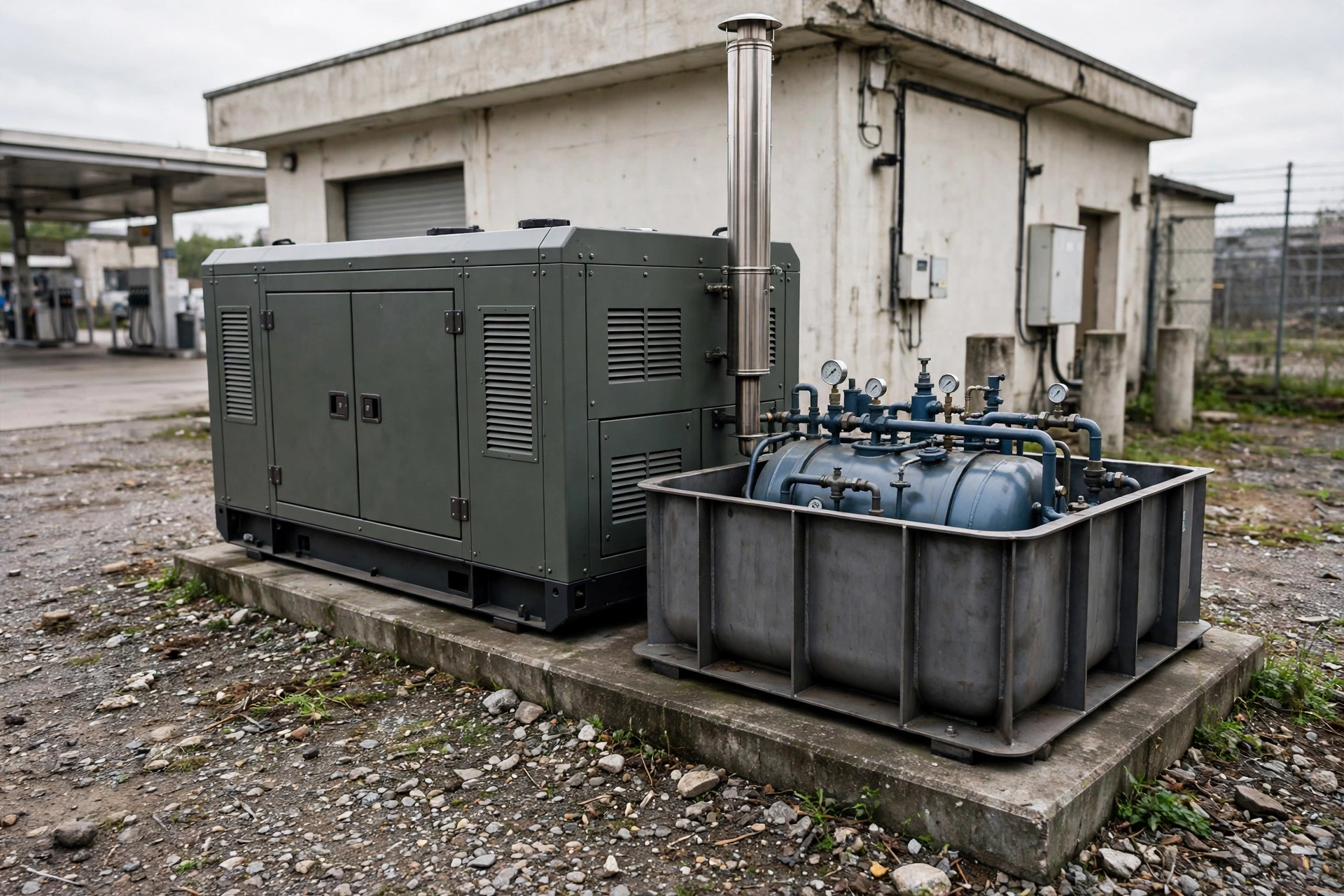
The set goes on a concrete plinth at the rear of the site, outside the Zone 2 boundary, with clear access for a service technician and a fuel delivery vehicle. A soundproof canopy is the normal enclosure: it keeps the set at 65–75 dB(A) at 7 m, which matters because the station trades next to houses in most towns, and it keeps rain off the control panel. The canopy also keeps the set’s hot surfaces behind a locked door, away from customers and staff.
Ventilation is the detail most often missed. A 100 kVA set needs roughly 5–6 m³/s of cooling and combustion air at full load, and the canopy louvres and the room they sit in must pass that air without recirculating hot exhaust back into the intake. A set that breathes its own exhaust loses power and overheats, and on a forecourt the overheating set is also the set most likely to be opened up, bypassed or run with its doors off — each of which defeats the enclosure’s purpose.
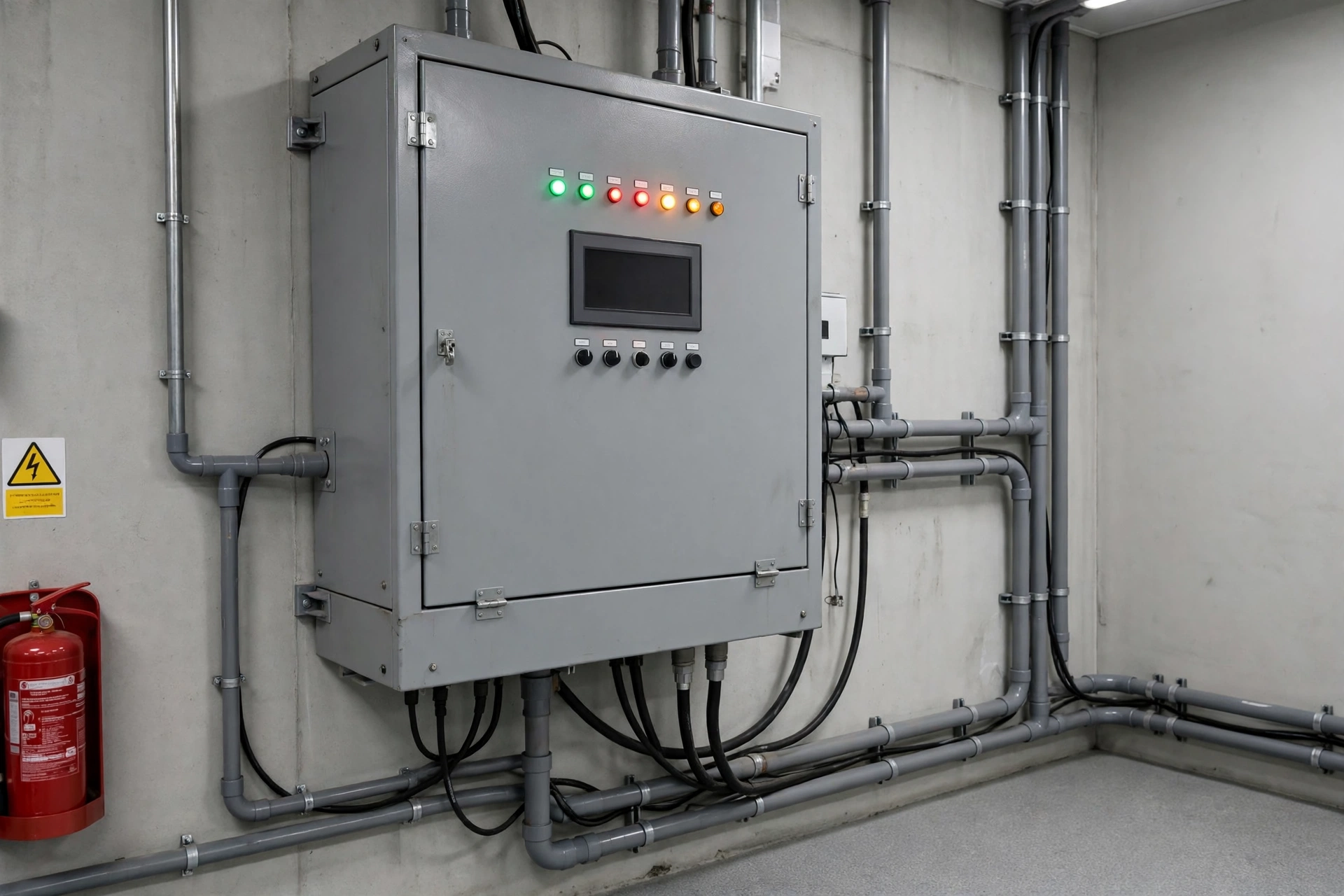
The automatic transfer switch sits in the plant room or on the shop wall, never on the forecourt, and the changeover must be break-before-make so the generator can never feed back into the dead mains. Florida’s 2006 law, passed after the hurricane seasons of 2004 and 2005 left stations dark across the state, requires stations on evacuation routes to be wired for a generator transfer switch — a legal recognition that a station without a changeover is a station that cannot be powered at all in an emergency, however large the generator parked outside it.
Exhaust, Bunding and the Fuel Store
The exhaust run deserves the same attention as the electrical design. A diesel exhaust at full load runs hot enough to ignite petrol vapour on contact, so the exhaust pipe is routed away from dispensers, tank vents and the shop’s air intakes, lagged where it passes near anything combustible, and fitted with a rain cap and drain so water cannot collect and corrode the silencer from inside. The exhaust silencer itself is a maintenance item: a corroded silencer raises backpressure, and backpressure costs power and fuel.
The generator’s fuel store is sized for the outage, not for the week. A sub-base tank of 200–400 L suits a small set; a 1,000 L bulk tank suits a 100 kVA set running two to three days. Both sit inside a bund, and the bund, the fill point and the vent are placed so that a spill during refuelling runs into containment, not across the forecourt toward the drains. Fuel quality matters here more than on most sites: a station’s generator fuel can sit for a year between outages, and diesel fuel ageing — water, microbes and sludge in a still tank — is the cheapest problem on the site to prevent, with a polishing and testing routine: filter and circulate the tank contents twice a year, test annually.
Fire protection closes the loop. A generator compound needs its own extinguishers, a clear separation from the petrol storage, and a detection arrangement that the station’s fire risk assessment covers. The generator room fire protection article sets out detection, suppression and separation in detail; on a forecourt the separation distances and the hazardous-area drawing are the two documents the fire officer will ask to see first.
Fuel Autonomy: How Long the Station Stays Open
A generator without fuel is a sculpture. The autonomy question — how many hours the station keeps trading on its own tank — decides the tank size, the refuelling contract and, in a long outage, whether the station is still open on day three when its competitors have closed.
The maths is straightforward. A diesel set burns roughly 0.23 litres per kWh of electricity produced. A mid-size station running 40 kW of average load therefore burns about 9–10 L/h. A 100 kVA set at half load burns 11.5 L/h; at full load, 23 L/h. These figures cross-check against manufacturer datasheets: the Cummins C500D5 burns 93.2 L/h at its 364 kW prime full load, or 0.26 L/kWh.
Tank Sizing for 24, 48 and 72 Hours
| Autonomy | Average load 40 kW | Fuel needed | Practical tank |
|---|---|---|---|
| 24 hours | ~10 L/h | ~240 L | 500 L sub-base tank |
| 48 hours | ~10 L/h | ~480 L | 1,000 L bulk tank |
| 72 hours | ~10 L/h | ~720 L | 1,000 L bulk tank |
| 7 days | ~10 L/h | ~1,680 L | 2,000 L bulk tank + delivery contract |
Seventy-two hours is the right planning figure for most stations. Grid outages from storms, floods and substation fires routinely run two to three days, and a station that closes on day two loses the peak of the emergency demand — the days when every vehicle in the district is queuing for fuel. A 1,000 L bulk tank gives a mid-size station three days at its real average load, and the tank costs less than a single day of lost trade in a major outage.
The load profile matters as much as the tank. A station that sheds the car wash and the EV chargers during an outage cuts its average load by a third or more, and the same tank lasts a day longer. A station that runs everything, including the wash, burns through the same tank in two days. The load-shedding list should be written on the distribution board and in the operating procedures, not decided at 2 a.m. during the outage.
Refuelling During a Grid Outage
The bulk tank is only half the plan. The other half is getting more diesel to the site while the grid is down. A road tanker can deliver to a station without grid power — the tanker carries its own pump — but only if the station’s access road is open, the delivery is booked, and the supplier knows the station is a priority customer. Stations that hold a written fuel-delivery agreement with a named supplier, a named contact and a guaranteed response time get fuel in an emergency. Stations that rely on calling around during the outage do not.
One caution applies to every site: the generator’s diesel and the station’s petrol are different fuels, stored separately, and the generator must never be refuelled from the station’s petrol tanks. It sounds obvious. It has happened, usually at 3 a.m., usually by a tired attendant, and the result is a set that will not start when it is needed most. The generator’s fill point should be labelled, locked and physically separated from the petrol fill points.
Three Stations, Three Lessons
Case 1: Florida Evacuation Route — Six Days on the Generator
A mid-size station on a Florida evacuation route, six dispensers and a convenience shop, installed a 100 kVA silent set with a 1,000 L bulk tank after the 2004–2005 hurricane seasons. The transfer switch was wired to the essential board only: dispensers, submersible pumps, canopy lighting, refrigeration, POS and CCTV. The car wash and the air conditioning in the shop were shed.
When Hurricane Ian crossed southwest Florida in 2022, the grid failed on the first night and stayed down for six days. The station ran on the generator for the whole period, dispensing fuel while the stations on either side of it sat dark. Fuel burn averaged 10 L/h, and the 1,000 L tank lasted three days; a contracted tanker delivery on day three topped it up, and a second delivery on day five kept the station open to the end of the outage. The station’s fuel margin over those six days was modest — fuel retail margin is thin — but the shop took $3,000–$4,000 a day in sales at normal margins, and the station kept every regular customer it had. The generator, the transfer switch and the tank together cost less than the shop revenue of a single hurricane week.
Case 2: UK Motorway Service Area — The DSEAR Drawing Decides the Layout
A motorway service area in northern England, eight dispensers, a large shop, a restaurant and a rollover wash, specified a 200 kVA set during a refurbishment. The DSEAR assessment and the hazardous-area drawing came first, before any equipment was ordered. The drawing put the Zone 2 boundary 4 m from the nearest dispenser and 5 m from the tank vents. The generator compound — plinth, canopy, 2,000 L bulk tank in a bund, and the transfer switch — was placed 9 m from the nearest dispenser, behind the shop, with the exhaust discharging above the shop roofline and away from the forecourt.
The set is tested weekly under load, on the same morning each week, and the test never overlaps a fuel delivery. The site’s petroleum licence, renewed annually, lists the generator installation and its separation distances. The operator’s comment to the installing contractor was that the paperwork took longer than the installation — and that the paperwork is what the inspector reads.
Case 3: Northern Nigeria — Prime Duty on an Unreliable Grid
A rural station outside Kano, four dispensers and a small shop, has no reliable grid at all. Mains power arrives for a few hours a day, sometimes not at all. The station runs a 60 kVA Weichai-powered set for 10–12 hours a day, 300 days a year — roughly 3,300 hours a year. That is prime duty by any definition, and the set was specified prime-rated from the start.
Fuel burn at the station’s 25 kW average load is about 6 L/h, or 65–70 L a day. The station holds a 2,000 L bulk tank and buys diesel in bulk from the same tanker that delivers its petrol, which keeps the fuel cost down and the supply reliable. Service intervals are measured in hundreds of hours: oil and filters every 250 hours, which at this duty means a service every three weeks. The station’s owner budgets $1,200–$1,500 a year for routine maintenance and keeps a spare AVR, fuel filters and a starter motor on the shelf — the parts that fail first on a set that works every day. The lesson is the same one the standby power rating article states in general terms: a standby-rated set on this duty would have failed inside a year, and the warranty claim would have been refused for misapplication.
Frequently Asked Questions
What size generator does a petrol station need?
Most petrol stations need a 60–150 kVA standby generator. A small two-pump rural forecourt runs on 30–40 kVA, a mid-size urban station with a shop and refrigeration needs 75–100 kVA, and a large highway service area needs 150–250 kVA. Size from a counted load list, including motor starting surges, and add a 20–30% margin.
Can a diesel generator be installed at a petrol station?
Yes, provided it sits outside the hazardous-area zones around the dispensers and tank vents, with its exhaust routed away from the forecourt and its fuel in a bunded tank. The site needs a hazardous-area classification drawing under IEC 60079-10-1 and, in the UK, a DSEAR assessment. The petroleum licence and the insurer will both ask for the drawing.
How far should a generator be from a petrol pump?
The generator must sit outside the Zone 2 boundary, which extends 1–4 m from the dispensing zone and 3–5 m from a tank shell depending on capacity. In practice the compound ends up 5–6 m clear of the nearest dispenser and tank vent on most sites, and further where the site’s own hazardous-area drawing requires it. The drawing, not a rule of thumb, is the authority.
Do petrol stations need a backup generator?
A station without one cannot sell fuel during a power cut, because dispensers, submersible pumps, POS and refrigeration all need power. Stations on evacuation routes in Florida are legally required to be wired for a generator transfer switch. For any station, the generator is what keeps the shop trading and the fuel flowing while competitors sit dark.
What happens to a petrol station during a power cut?
Everything stops at once: the dispensers cannot pump, the submersible pumps cannot lift fuel from the underground tanks, the POS cannot take payment, the refrigeration warms, and the canopy goes dark. Fuel in the underground tanks is useless without power to move it. A station with a generator and a transfer switch is trading again in under a minute; a station without one waits for the grid, however long that takes.
Specification Checklist: Seven Lines Before the Order
1. Count the load, dispenser by dispenser. List every load with running kW and starting surge. Do not accept a quotation sized from kVA alone.
2. Get the hazardous-area drawing first. The Zone 0/1/2 drawing under IEC 60079-10-1 decides where the set can sit. Order nothing until the drawing exists.
3. Confirm the rating — ESP or PRP. A station with a reliable grid needs a standby power rating; a station that runs its set daily needs prime. The letters must appear on the datasheet and the contract.
4. Size the tank for 72 hours. A 1,000 L bulk tank covers a mid-size station for three days at real average load. Add a written fuel-delivery agreement for longer outages.
5. Shed the right loads. Car wash and EV chargers go on the non-essential board. The transfer switch drops them automatically; the fuel, the shop and the refrigeration stay on.
6. Plan the test and the delivery. Weekly load-bank or load testing, never overlapping a fuel delivery. Fuel polishing twice a year and an annual fuel test, because the generator’s diesel can sit for a year between outages.
7. Check the licence and the insurer. The petroleum licence and the insurance policy both need to list the generator installation, its separation distances and its fuel store. A set installed without either is a liability, not an asset.
A petrol station buys a generator for the worst week in the year, not the average one. The set that earns its keep is the one sized from a real load list, placed outside the hazardous zones, fuelled for three days, and tested every week without fail. Get those four things right and the station trades through the outage that closes its competitors.
For a quotation sized to your station — dispensers, shop, car wash and site conditions included — contact PAVO with your load list and your hazardous-area drawing, and the correct frame will be priced from those two documents.