

Cummins vs Weichai vs Perkins Generator Compared | PAVO
Cummins vs Weichai vs Perkins: Which Diesel Generator Engine Should You Buy for Export?
Three engines, three prices, three very different answers to the same question: who fixes it when it stops, and what does that cost?
Cummins vs Weichai vs Perkins diesel generator — which is better? Cummins wins on global service coverage, Weichai wins on purchase price and parts cost in Asia and Africa, and Perkins wins on quiet operation and European acceptance. The right choice depends on the duty, the country it will work in, and how many hours a year it will run.
That is the honest answer, and it is also the reason so many export quotations go wrong. A buyer compares three prices for “500 kVA” and picks the lowest, without asking which engine sits under the canopy, how far the nearest authorised dealer is, or what the set will be worth in five years. This article compares the three brands on the six factors that decide total cost: price, fuel, service intervals, parts availability, lifespan and resale value — with real model numbers, hours and costs.
Contents
- What Each Brand Actually Sells You
- Price: What the Same 500 kVA Costs With Each Engine
- Fuel Consumption and Running Cost
- Parts and Service in Your Market
- Three Sites, Three Decisions
- Resale Value: What the Second Owner Pays For
- Frequently Asked Questions
- Specification Checklist: Seven Questions Before the Deposit
What Each Brand Actually Sells You
The three names sit on the same kind of machine — a diesel engine driving an alternator inside a canopy — but they come from different industrial histories, and those histories shape what the buyer actually receives.
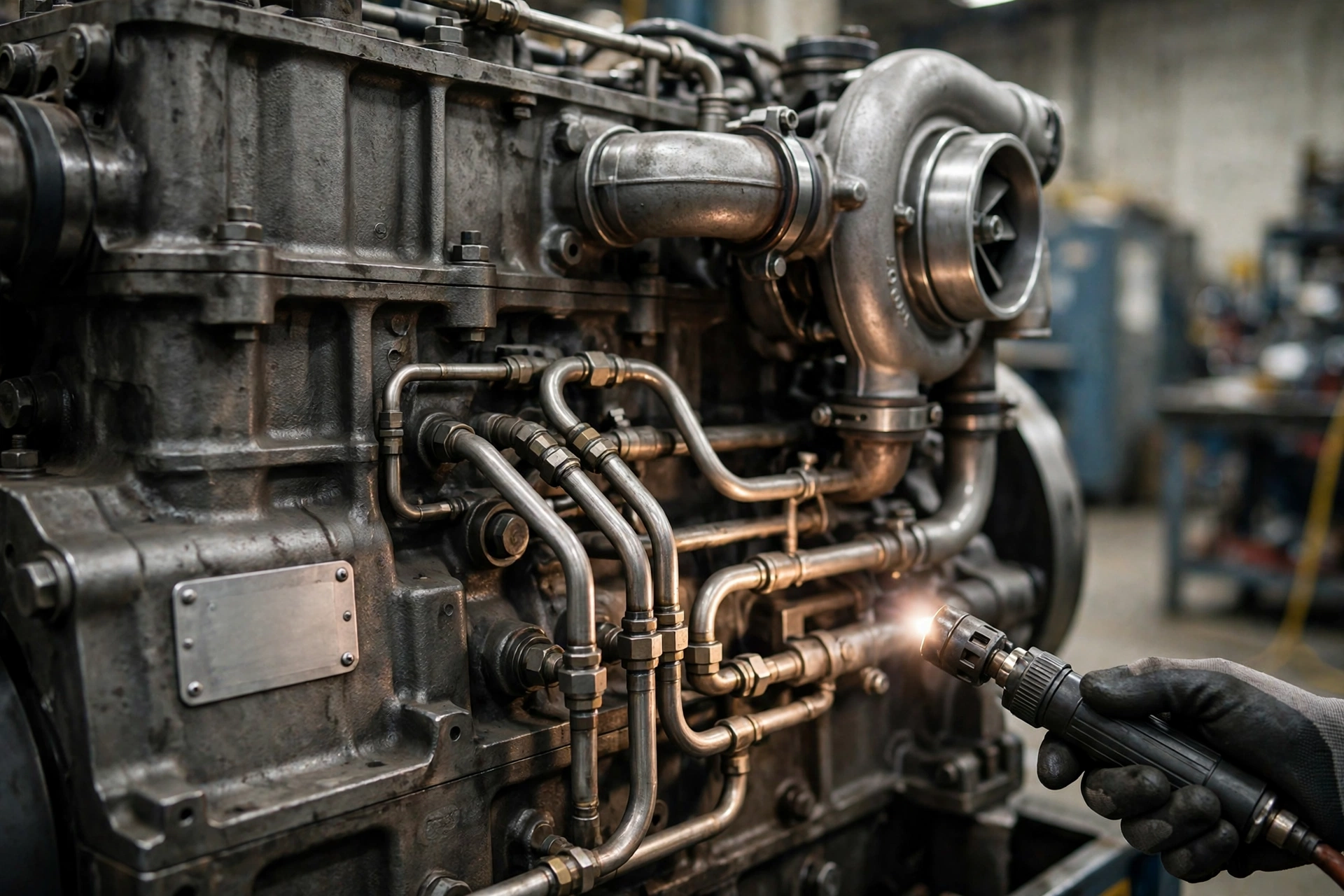
Cummins: The Global Default
Cummins was founded in 1919 in Columbus, Indiana, and is the largest independent diesel engine manufacturer in the world. Its generator range runs from 15 kVA to 3,750 kVA, and its distribution network covers 190 countries and territories through about 600 distributors and 7,200 dealer locations. For an export buyer, that network is the product as much as the engine.
Cummins builds engines in China through two joint ventures — Dongfeng Cummins (DCEC) and Chongqing Cummins (CCEC) — so a “Chinese Cummins” set is a genuine Cummins engine, built under licence, not a copy. The distinction matters at customs and at warranty time: a genuine engine carries a Cummins serial number that any dealer in the network can look up. A copy does not, and the price gap between the two is the first warning sign in a quotation that looks too cheap.
The engines most often specified in export sets are the 6LTAA8.9-G2 (220 kW prime, the workhorse of the 250 kVA class), the QSZ13-G5 in the Cummins C500D5 (500 kVA standby / 455 kVA prime), and the KTA19 and KTA38 series above 500 kVA. All are turbocharged, electronically governed, and built to meet Stage IIIA, Stage V or Tier 4 Final emissions depending on the market. For data centres and hospitals, Cummins is the default specification — not because it is the cheapest, but because the consultant who signs the design has seen a Cummins set pass a factory acceptance test before.
Weichai: The Value Challenger
Weichai Power is China’s largest engine manufacturer by domestic sales volume, and the fastest-growing of the three brands in export markets. In the first half of 2026, Weichai sold 65,000 power generation products, up 31.3% year on year, and more than 1,400 data centre generators — a category that was, until recently, a two-horse race between Cummins and Caterpillar. Weichai’s large-bore M-series engines now sit on the approved vendor lists of hyperscale data centre operators.
The technology behind that growth is not new. Weichai acquired the French engine maker Baudouin, collaborated with Deutz in its early years, and holds the current world record for diesel brake thermal efficiency at 53.09%. The engines most often specified in export sets are the WP4D152E200 (150 kVA class), the WP10D264E200 (312 kVA class, the engine in PAVO’s 312 kVA Weichai silent set), and the WP13 series above 400 kVA. Weichai engines are mechanically simpler than their Cummins and Perkins equivalents — fewer electronic sensors, more mechanical fuel systems in the smaller sizes — which is a disadvantage in emissions certification and an advantage in a workshop 400 km from the nearest city.
Weichai’s weakness is perception. In markets where the buyer has never owned one, the brand still has to prove itself against Cummins and Perkins. In markets where Weichai sets have been running for a decade — much of West Africa, Southeast Asia and the Middle East — that argument is already settled.
Perkins: The Quiet European
Perkins, founded in Peterborough, England in 1932 and now part of Caterpillar, is the smallest of the three by volume and the most specialised. Its generator engines run from 7 kVA to 2,500 kVA, and its reputation rests on two qualities: quiet operation and long service intervals.
The engines most often specified in export sets are the 1104D-E44TAG2 (100 kVA class, the engine in PAVO’s 100 kVA Perkins silent set), the 1206A-E70TTAG3 (200 kW class, with a 500-hour service interval), and the 4006 and 4008 series above 800 kVA. Perkins builds the 403, 1104 and 1106 series in China, so a Chinese-built Perkins set uses the same engine as a UK-built one, with the same parts numbers.
Perkins is the brand most often specified where noise is the binding constraint — hotels, hospitals, residential developments and commercial real estate — and where the buyer wants a European brand name on the datasheet for a tender. Its dealer network is strongest in Europe and southern Africa, and thinner than Cummins in Latin America and parts of Central Asia. That geography, more than any engineering difference, decides whether Perkins is the right choice for a given export order.
Price: What the Same 500 kVA Costs With Each Engine
Price is where the comparison starts, and where it is most often misunderstood. Three quotations for “500 kVA” are not three prices for the same machine. They are three prices for three different engines, three different alternators, three different canopies and three different warranty terms.
At the 250 kVA class, the pattern is consistent across exporters. A Weichai-powered set is typically 25–35% cheaper than the equivalent Cummins-powered set, and a Perkins-powered set sits 5–15% above Cummins. At the 500 kVA class, the gap narrows slightly — Weichai typically 20–30% below Cummins — because the alternator, canopy, controller and export packing are the same regardless of engine, and those fixed costs dilute the engine price difference. At the 1,000 kVA class and above, the gap narrows further, to roughly 15–25%, because the engine is a smaller share of the total set cost.
| Cost item (500 kVA silent set, FOB China) | Cummins | Weichai | Perkins |
|---|---|---|---|
| Engine share of set cost | Highest | Lowest | High |
| Typical price index (Cummins = 100) | 100 | 70–80 | 105–115 |
| Lead time, standard configuration | 25–30 working days | 15–20 working days | 25–30 working days |
| Warranty, standard export | 12 months / 1,000 hours | 12 months / 1,000 hours | 12 months / 1,000 hours |
| Service interval, typical | 250–500 hours | 250–500 hours | Up to 500 hours |
The price gap is real, but it is not the whole story. A Weichai set that costs 30% less and runs 3,000 hours a year in prime duty will consume roughly the same fuel, need the same oil and filters, and — if maintained properly — last 15,000–25,000 hours. A Cummins or Perkins set in the same duty typically lasts 20,000–40,000 hours. The cheaper set is still cheaper over its life, but the margin is smaller than the purchase price suggests, because the expensive set runs longer before its first major overhaul.
The other cost that buyers forget is the cost of waiting. A Cummins or Perkins engine ordered to a specific configuration takes 25–30 working days to build and ship, against 15–20 working days for a standard Weichai configuration. On a construction project where the generator is on the critical path, ten working days of delay costs more than the price difference between the engines.
Fuel Consumption and Running Cost
Fuel is the largest running cost of any diesel generator, and it dwarfs the purchase price over the life of the set. A 500 kVA set running at 75% load for 3,000 hours a year burns roughly 210,000 litres of diesel annually. At $1.00 per litre, that is $210,000 a year — more than the purchase price of the set itself. A 3% difference in fuel efficiency is worth $6,300 a year, every year.
The honest news is that the three brands are closer on fuel than their marketing suggests. Modern turbocharged diesel engines in the 200–500 kVA class all burn roughly 198–210 g/kWh at full load. Weichai’s 53.09% thermal efficiency record is a laboratory figure on a large-bore engine, not a promise for a 250 kVA set. Cummins and Perkins publish similar specific fuel consumption figures for their equivalent models.
What differs is not the headline figure but the shape of the consumption curve. The clearest published example is the Cummins C500D5, powered by the QSZ13-G5 engine: 29.2 L/h at 25% load, 49.0 L/h at 50%, 69.9 L/h at 75% and 93.2 L/h at 100% on prime rating. That curve matters because most sets spend most of their life at 50–75% load, not at full load. A set that is efficient at 100% but thirsty at 50% will cost more in practice than its datasheet suggests.
Three practical points follow. First, fuel consumption should always be compared at the load the set will actually run at — usually 50–75% — not at full load. Second, an oversized set is a fuel penalty: a 500 kVA set running at 25% load burns roughly 29 L/h to deliver 100 kW, while a correctly sized 200 kVA set delivers the same load at roughly half the fuel. Third, wet stacking — carbon build-up from sustained light-load running — affects all three brands equally, and is a maintenance cost, not a brand difference. A load bank test once or twice a year costs far less than the overhaul that light-load running eventually demands.
Service costs tell a similar story. Oil, filters and coolant for a 500 kVA set cost roughly $300–$500 per service, and all three brands need a service every 250–500 hours depending on model and duty. Perkins’ 500-hour interval on the 1206 series is the longest in the class, which saves one service a year on a prime-duty site — roughly $400 a year, or $2,000 over five years. It is a real saving, but it does not decide the purchase.
Parts and Service in Your Market
The engine that is cheapest to buy is not always the cheapest to own. The deciding factor is what happens on a Tuesday morning when the set will not start, and the site is 400 km from the nearest city.
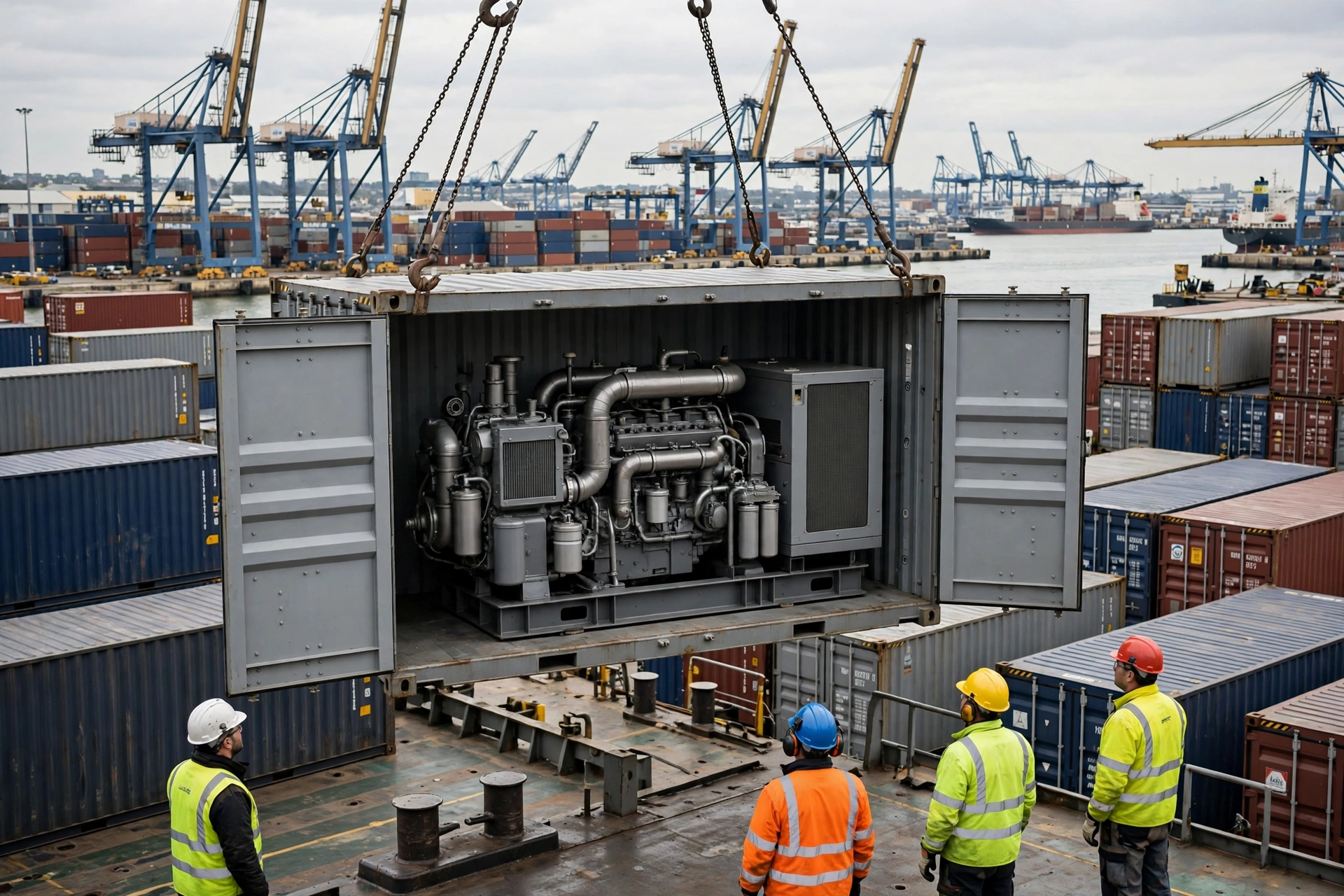
Africa: Perkins and Weichai Have the Ground Game
Africa is the largest export market for Chinese-built generator sets, and it is where the three brands diverge most sharply. Cummins has the widest formal network — distributors and dealers in most African capitals — but a formal network and a parts shelf are different things. A Cummins dealer in Lagos or Nairobi stocks common service items, but a fuel injector for a QSZ13 may still take a week to arrive from the regional parts hub.
Perkins has a strong position in southern Africa, where authorised dealers such as PenPower in Cape Town stock genuine parts for next-day delivery, and service intervals follow Perkins factory specifications. A 22 kVA Perkins set in South Africa starts at about R153,800 ex VAT, and the parts supply chain behind it is the reason buyers accept the premium.
Weichai’s advantage in Africa is different: volume. So many Weichai engines are already running in West and East Africa — in trucks, construction machinery and generators — that filters, injectors and fuel pumps are available from independent parts traders in most major cities, not only from authorised dealers. A Weichai fuel filter in Lagos costs a fraction of the equivalent Cummins or Perkins part, and it is on the shelf the same day. For a remote site, that availability is worth more than any warranty document.
Middle East and Southeast Asia: Cummins Leads, Weichai Catches Up
In the Gulf states, Cummins is the default specification for commercial and industrial projects, and its dealer network in the UAE and Saudi Arabia is the deepest of the three brands. Perkins is well represented through FG Wilson packagers, and Weichai is growing fast on price — particularly for construction and rental fleets, where the buyer owns ten or twenty sets and the parts cost multiplies.
In Southeast Asia, Weichai’s position is strongest. The brand’s truck and marine heritage means service technicians in Vietnam, Indonesia and the Philippines already know the engine before they see the generator. Cummins remains the specification for data centre generators and hospitals, where the consultant’s preference outweighs the price difference. Perkins sits between the two: specified where noise or European certification matters, and less common where price decides.
Latin America and Europe: The Network Decides
In Latin America, Cummins has the deepest network of the three, built over decades of truck and industrial engine sales. Weichai is present but thinner, and a buyer in Peru or Colombia should confirm the local parts supply before ordering. In Europe, the position reverses: Perkins and Cummins both have dense dealer coverage, Weichai is a niche brand, and EU emissions certification — Stage V — is the binding constraint. A set that cannot produce a Stage V certificate will not clear customs, whatever engine it carries.
The rule is simple: buy the brand your market can support. A Cummins set in a country with no Cummins dealer is a worse purchase than a Weichai set in a country where every mechanic knows the WP10.
Three Sites, Three Decisions
A Hospital in Lagos: Perkins, for the Noise
A private hospital outside Lagos runs a 350 kW load, 438 kVA at 0.8 power factor, with grid outages totalling about 40 hours a year. The set is standby-rated, with a transfer switch starting it automatically after an outage, and sits 15 metres from a ward window. The deciding factor is not price or fuel — it is noise. The Perkins-powered silent set, with its lower engine noise signature and 500-hour service interval, costs roughly 10% more than the Cummins equivalent and 35% more than the Weichai equivalent. The hospital buys Perkins, because a generator that wakes patients is a generator that gets switched off, and a generator that gets switched off is useless.
A Gold Mine in Zambia: Weichai, for the Parts
A gold mine in Zambia’s Copperbelt runs two 500 kVA sets in prime duty, 16 hours a day, six days a week — roughly 5,000 hours a year. The nearest authorised dealer of any brand is 350 km away in Lusaka. The deciding factor is parts availability and simplicity. The Weichai-powered sets cost roughly 30% less than the Cummins equivalents, their filters and injectors are available from independent traders in Kitwe, and the mechanical fuel system can be serviced by the mine’s own diesel mechanics without diagnostic software. The mine buys Weichai, and budgets for an engine overhaul at 18,000 hours rather than 25,000 — a cost it has already priced into the purchase saving.
A Warehouse in Dubai: Cummins, for the Specification
A logistics warehouse in Dubai’s Jebel Ali Free Zone needs a 1,125 kVA standby set for a new cold-storage facility. The consultant’s specification names Cummins or Caterpillar, and the client will not accept a substitution without a redesign of the approval documents. The deciding factor is the specification itself. The Cummins-powered set costs more than the Weichai equivalent by roughly 20%, and the client pays it without negotiation — because the cost of re-approval exceeds the saving, and the facility’s insurance requires a named brand on the generator schedule.
Three sites, three different right answers. The engine is the same question in each case; the market, the duty and the specification give different answers.
Resale Value: What the Second Owner Pays For
A generator is a depreciating asset, but the rate of depreciation depends on the engine. A five-year-old Cummins-powered set in good condition typically retains 35–45% of its original price on the second-hand market. A Perkins-powered set retains a similar figure, 30–40%, with European buyers paying a premium for Perkins in particular. A Weichai-powered set of the same age typically retains 20–30%.
The gap has two causes. The first is brand recognition: a second-hand buyer in Kenya or the Philippines knows what a Cummins engine is worth, and prices it accordingly. The second is parts: a buyer will pay more for a set whose engine they can service, and the Cummins and Perkins service networks are wider than Weichai’s in the second-hand market’s core countries.
On a $60,000 set, the difference between 40% and 25% residual value is $9,000 — roughly a third of the original price gap between Cummins and Weichai. A buyer who plans to sell the set in five years should subtract the residual value from the purchase price before comparing brands. A buyer who plans to run the set until it dies should ignore resale entirely and compare fuel and parts instead.
There is one exception to the resale rule: rental fleets. Rental companies buy Weichai-powered sets in volume because their customers rent by the week, not by the brand, and the lower purchase price means the set pays for itself in fewer rental weeks. A rental set that earns $1,500 a week recovers a $25,000 price difference in 17 weeks. For rental, the cheapest reliable engine wins.
Frequently Asked Questions
Cummins vs Weichai vs Perkins diesel generator which is better?
There is no single best brand. Cummins is the best choice where global service coverage and consultant specifications matter, Weichai is the best choice where purchase price and local parts availability matter, and Perkins is the best choice where low noise and European acceptance matter. Match the brand to the duty, the country and the specification — not to the price alone.
How much does a Cummins generator cost compared to Weichai?
At the 500 kVA class, a Cummins-powered set typically costs 20–30% more than the equivalent Weichai-powered set, and a Perkins-powered set costs 5–15% more than Cummins. The gap narrows at higher ratings because the alternator, canopy and controller cost the same regardless of engine. Always compare the full set price, not the engine price, and subtract the expected resale value before deciding.
Are Weichai diesel generators reliable for prime power?
Yes, provided the set is specified correctly and maintained on schedule. Top Chinese brands, including Weichai, typically deliver 15,000–25,000 hours of service life with good maintenance, against 20,000–40,000 hours for Cummins and Perkins. Weichai’s own data supports the claim: power generation product sales reached 65,000 units in the first half of 2026, and its engines now power data centre standby installations. The risk is not the engine — it is buying a standby-rated set for prime duty, or skipping services in a remote location.
Where to buy Perkins generator spare parts in Africa?
Perkins parts are available through authorised dealers in most African capitals, with the strongest coverage in South Africa, where dealers stock common service items for next-day delivery. Outside the major cities, parts are available from independent traders in Nairobi, Lagos, Accra and Kampala, and from the packager’s export spares kit — which every export buyer should order with the set. Always order a two-year spares kit with the generator: filters, belts, injectors and a water pump. It costs a fraction of one emergency air-freight shipment.
Which diesel generator engine lasts the longest?
On published lifespan figures, Cummins and Perkins engines typically last 20,000–40,000 hours before a major overhaul, against 15,000–25,000 hours for top Chinese brands including Weichai. But lifespan depends more on duty and maintenance than on brand: a Cummins set run beyond its standby vs prime power rating will fail sooner than a Weichai set run within it. Correct rating, clean fuel and on-schedule servicing add more hours than any brand choice.
Specification Checklist: Seven Questions Before the Deposit
1. Which engine is quoted, with model number and serial number? The quotation must name the engine — for example, Cummins QSZ13-G5, Weichai WP10D264E200 or Perkins 1104D-E44TAG2 — not just the brand. A quotation that says “Cummins engine” without a model number should be returned for clarification.
2. What is the rating — ESP, PRP or COP — at the site’s altitude and temperature? A 500 kVA standby set at sea level is a different machine from the same set at 1,500 m and 45°C. Ask for the derated figure at the actual site conditions. Altitude derating costs roughly 1% per 100 m above 1,000 m, and it applies to every brand equally.
3. Who is the nearest authorised dealer, and what do they stock? Get the dealer’s name, distance from the site, and a list of the parts they hold. If the answer is “we can order it”, ask how long the order takes and what it costs by air freight. A week’s wait for a fuel filter is a week’s outage.
4. What is included in the export spares kit? A two-year kit — filters, belts, injectors, water pump, alternator AVR and a set of gaskets — should be quoted with the set, not discovered as an extra after the deposit is paid.
5. What are the service intervals and the cost of each service? Compare the cost per 1,000 hours, not the cost per service. A 500-hour interval that costs $500 is cheaper per hour than a 250-hour interval that costs $300.
6. What is the warranty, and who honours it in your country? A warranty honoured only by the factory in China is worth less than a warranty honoured by a dealer 200 km from the site. Get the warranty terms in writing, with the dealer named.
7. What is the set worth in five years? Ask the supplier for the expected residual value, and subtract it from the purchase price before comparing brands. A $9,000 resale difference changes the answer on a $60,000 set.
The engine is the most expensive single component in a generator set, and the easiest to get wrong. Price, parts, service, fuel, lifespan and resale pull in different directions, and the brand that wins on one factor loses on another. The buyers who get it right are the ones who start from the site — the duty, the country, the distance to the nearest dealer — and choose the engine that fits that site. Everything else is a brochure.
To specify the right engine for your site, duty and market — and to compare genuine Cummins, Weichai and Perkins configurations with full datasheets and export pricing — contact PAVO. PAVO builds generator sets from 9 to 3750 kVA in open, silent and containerised configurations, including a 450 kVA Cummins set, powered by Cummins, Weichai, Yuchai and Shanghai Diesel, and ships to more than 20 countries with export packing, certification and a two-year spares kit quoted with every set.