

How to Ship a Diesel Generator Overseas Safely | PAVO
Most export generators are not damaged by the sea. They are damaged by the packing that was supposed to protect them from it.
To ship a diesel generator overseas, drain the fuel and coolant, bolt the set to a heat-treated timber skid inside a plywood crate, seal it with VCI film and desiccants, declare it under HS code 8502 by kVA, and load it into a 20 ft or 40 ft container with CTU-Code lashing.
Contents
- What Export Packing Has to Survive
- The Crate: Timber, Plywood and ISPM 15
- Inside the Crate: Blocking, Fluids, Batteries and Corrosion Protection
- Choosing the Box: 20 ft, 40 ft, Flat Rack or Open Top
- HS Code 8502: The Classification That Decides Duty
- Documents, Cost and the 2026 Freight Bill
- Frequently Asked Questions
- Pre-Shipment Checklist: Ten Lines Before the Crate Leaves Wuhu
What Export Packing Has to Survive
A generator leaves the factory in Wuhu as a tested, painted, working machine. It arrives at a site in Lagos, Mombasa or Rotterdam after a journey that treats it as freight. The packing is the only thing standing between those two states. A quotation that prices the set and treats packing as a line item to be cut has already decided how the story ends.
The voyage itself is the gentlest part. A container ship rolls, pitches and vibrates, but a properly blocked set barely notices. The damage happens at the edges: the forklift at the consolidation warehouse, the crane at the transshipment port, the week the container sits on a dock in 38°C heat, and the night the temperature inside the steel box drops below the dew point.
Container rain and salt air
Inside a sealed container, humidity routinely exceeds 90% relative humidity on ocean routes, and temperature swings from −5°C to 65°C are documented on long voyages. Warm, damp air enters through the container vents during the day. At night the steel walls cool, the air inside reaches its dew point, and water condenses on the coldest surfaces — the roof, then the cargo. This is container rain. It drips onto the canopy, runs into the alternator terminal box, and sits in the control panel.
A 500 kVA silent set shipped from Shanghai to Mombasa in 2024 arrived with its paint intact and its alternator windings reading 0.4 MΩ insulation resistance — effectively a short circuit to earth. The crate had been sound. The failure was the absence of a sealed moisture barrier and desiccant inside it. Three weeks in a Kenyan yard, a megger test, a drying oven and a rewound exciter later, the set ran. The repair cost more than the packing would have cost four times over.
Salt air is the second enemy. A container is not airtight, and a crate stored on a dock at a coastal port breathes salt-laden air for days. Unprotected machined surfaces — the engine flywheel, the alternator shaft, the radiator cap threads — rust in a week. Vapour-phase corrosion inhibitor (VCI) paper and film exist precisely for this exposure. They are cheap, and they are the first thing a low packing price removes.
The five-handling rule
A full-container-load (FCL) shipment is handled about five times between factory and site: forklift onto the truck, crane into the container, container onto the vessel, container off the vessel, forklift out at destination. A less-than-container-load (LCL) shipment is handled more often — into a consolidation warehouse, into a shared container, out at the destination container freight station, and then onto a truck.
Every handling event is a chance to drop, tilt or puncture the cargo. A bare skid is a poor idea for LCL cargo. The crate is not packaging for the voyage; it is packaging for the forklift driver at the third port who has never seen a generator before and has twelve minutes to move it. Forklift pockets, lifting points, centre-of-gravity marks and gross-weight stencils on two sides are not decoration. They are the instructions that keep the set upright.
The Crate: Timber, Plywood and ISPM 15
Export crates are built from two materials that look similar and behave differently at a border: solid wood and processed wood. Confusing them is the most common packing failure in generator exports, and it is entirely avoidable.
Solid wood vs processed wood
ISPM 15 — the International Standard for Phytosanitary Measures No. 15, administered under the International Plant Protection Convention — applies to all solid wood packaging material thicker than 6 mm used in international trade. Crates, pallets, skids, dunnage, blocking and bracing are all covered. The rule exists to stop wood-boring insects and plant diseases crossing borders inside packaging.
Processed wood is exempt. Plywood, oriented strand board (OSB) and particle board are manufactured under heat and pressure that kills pests, so they need no treatment and carry no stamp. Solid wood does not get that exemption. A crate built from plywood panels on a solid-wood base still needs the base treated and stamped. A pallet of solid wood under a plywood box is not exempt either. The mixed construction is the trap: the panels pass inspection and the base fails it.
The practical answer is to build the crate from plywood panels on a heat-treated solid-wood skid, or from solid wood throughout with every piece treated. Either way, the treatment certificate travels with the shipment file, and the stamp is photographed before the crate is sealed.
Reading the IPPC stamp
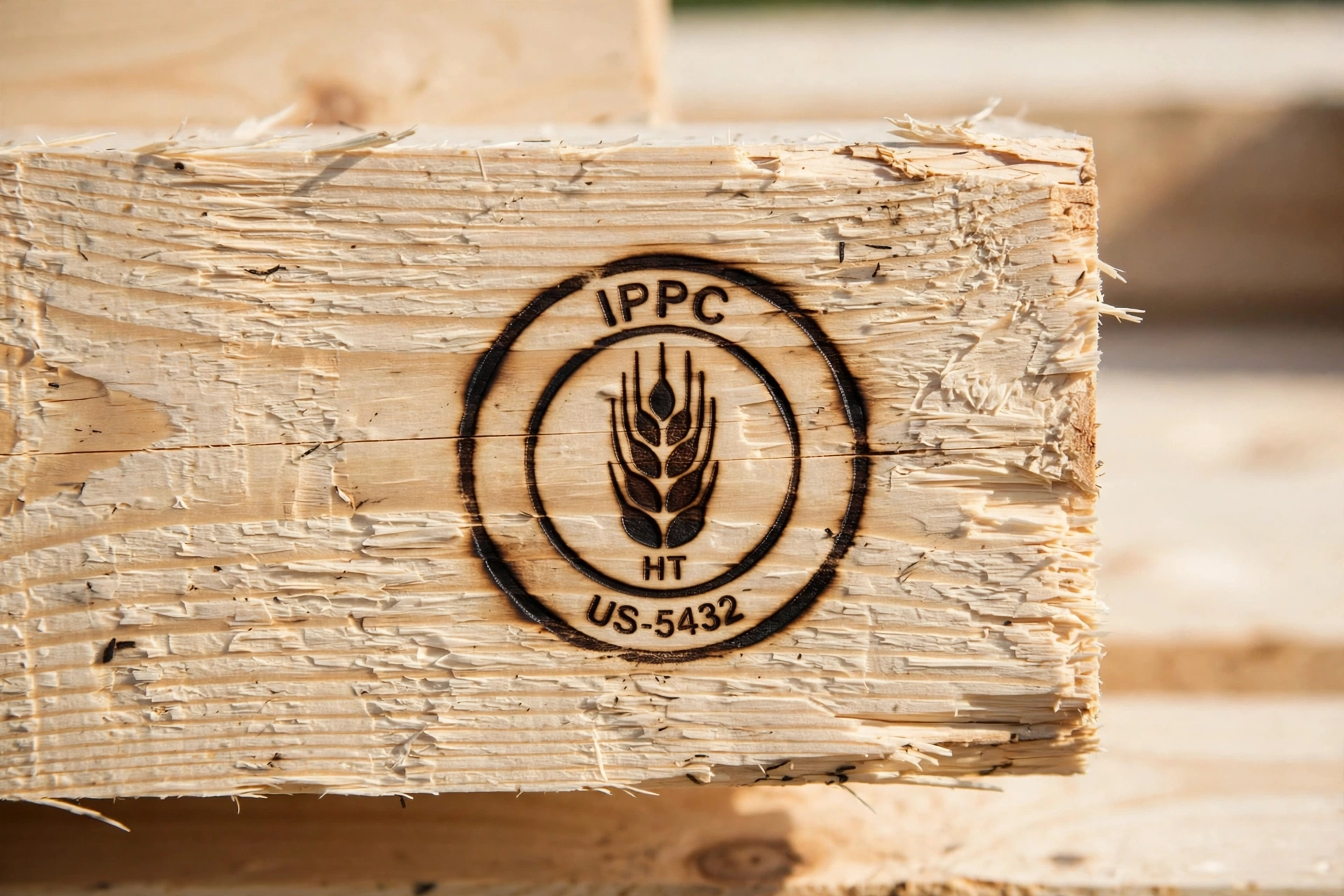
The IPPC mark is the passport for treated wood. It must appear on at least two opposite sides of every treated component, as a permanent, legible stamp — burned, ink-stamped or stencilled, never hand-drawn, and preferably not in red or orange. A compliant mark carries four elements: the IPPC wheat-stalk symbol, the two-letter ISO country code (CN for China), the facility code assigned by the national plant protection organisation, and the treatment code — HT for heat treatment, DH for dielectric heating, MB for methyl bromide, which is being phased out globally.
Heat treatment means the core of the wood, not the surface, reaches at least 56°C and holds it for a minimum of 30 continuous minutes, with all bark removed. Dielectric heating requires 60°C for one continuous minute throughout the profile. Only facilities authorised by the exporting country’s plant protection authority may apply the treatment and the mark. Self-treatment is not permitted.
The consequence of a missing or illegible stamp is decided at the destination border, not at the factory. The authority can order treatment, fumigation or re-export at the importer’s cost, with the cargo held until it is resolved. A 250 kVA set bound for a hospital project in Rotterdam in 2025 sat for eleven days while its crate was fumigated, because one skid board had been replaced after treatment and carried no stamp. The hospital’s commissioning date moved. The fumigation bill was $1,900. The replacement board had cost $14.
Inside the Crate: Blocking, Fluids, Batteries and Corrosion Protection
A crate that looks strong from the outside can still destroy its contents. The set inside is a 2,000–11,000 kg mass on a steel base frame, and the crate’s job is to hold it still while the world moves around it.
Blocking and bracing
The generator is bolted to the skid, not laid on it. Through-bolts pass through the base frame into the skid, with steel washers and lock nuts. Timber blocking is nailed around the base frame on all four sides to prevent sliding, and diagonal bracing ties the crate walls to the skid so the walls cannot rack under load. Steel strapping over the top of the set, tensioned with a ratchet, holds the unit down against vertical shock. A 500 kVA silent set weighs about 4,800 kg; its crate and skid add another 600–800 kg. The blocking that restrains that mass is not a few offcuts. It is sized for the load, and it is photographed before the lid goes on.
The control panel deserves its own protection. The deep-sea controller, the most expensive single electronic component on many sets, is braced internally and wrapped separately. The radiator is the most frequently damaged component in transit: a bent fin or a cracked header shows up as an overheating set on its first loaded run, months after delivery, and is then argued about as a warranty claim. Foam panels at every contact point between machine and crate cost almost nothing and prevent most of it.
VCI film, desiccants and the 40% rule
Corrosion protection inside the crate works as a system. VCI paper is wrapped directly around exposed metal surfaces. VCI poly film is heat-sealed around the whole set, creating an enclosed microenvironment. Container desiccant units are placed inside the sealed film — six to eight units for a standard 20 ft container load — to hold internal humidity below 40% relative humidity, under the corrosion threshold. Each desiccant unit absorbs up to 300% of its own weight in moisture.
The film must be sealed, not draped. A loose sheet of plastic over the canopy is not a moisture barrier; it is a tent that traps condensation against the paint. The desiccant must be inside the sealed envelope, not scattered in the crate outside it. And the film must be intact on arrival — a tear from a forklift tine voids the whole system. This is why the packing photographs matter: they prove the barrier was sealed before the crate left the factory.
Fuel, coolant and batteries
Generators are shipped with fuel and coolant drained. Carriers require the tank drained to their stated limit, and a set that arrives with 40 litres of diesel in a day tank is a hazardous-goods problem that can hold a whole container. The customer sources fuel locally on arrival. Coolant is drained for the same reason, and the buyer adds the correct specification locally — which also avoids the mismatch of a glycol mix frozen solid in a container on a northern route.
Starter batteries are the third item. They are often shipped separately, properly packaged and labelled, or excluded entirely for local purchase. A battery shipped inside the crate must be isolated, its terminals protected, and its dangerous-goods declaration in order. The simplest and most common practice is to exclude the battery from the shipment and have the buyer fit a locally sourced one. It removes a hazardous-materials declaration, a weight line and a failure mode in one decision. The packing list must say which choice was made, so the site team is not standing beside a silent set on commissioning day wondering where the battery is.
Choosing the Box: 20 ft, 40 ft, Flat Rack or Open Top
Most generator shipments travel in a standard dry container. The choice is which size, and when the standard box stops being honest.
| Container | Internal length | Internal width | Internal height | Capacity | Max payload |
|---|---|---|---|---|---|
| 20 ft GP | 5.90 m | 2.35 m | 2.39 m | about 33 CBM | about 28,200 kg |
| 40 ft GP | 12.03 m | 2.35 m | 2.39 m | about 67 CBM | about 26,500 kg |
| 40 ft HQ | 12.03 m | 2.35 m | 2.69 m | about 76 CBM | about 26,500 kg |
| 20 ft open top | 5.90 m | 2.35 m | 2.34 m | about 32.7 CBM | about 28,220 kg |
| 40 ft open top | 12.03 m | 2.35 m | 2.34 m | about 66.7 CBM | about 26,500 kg |
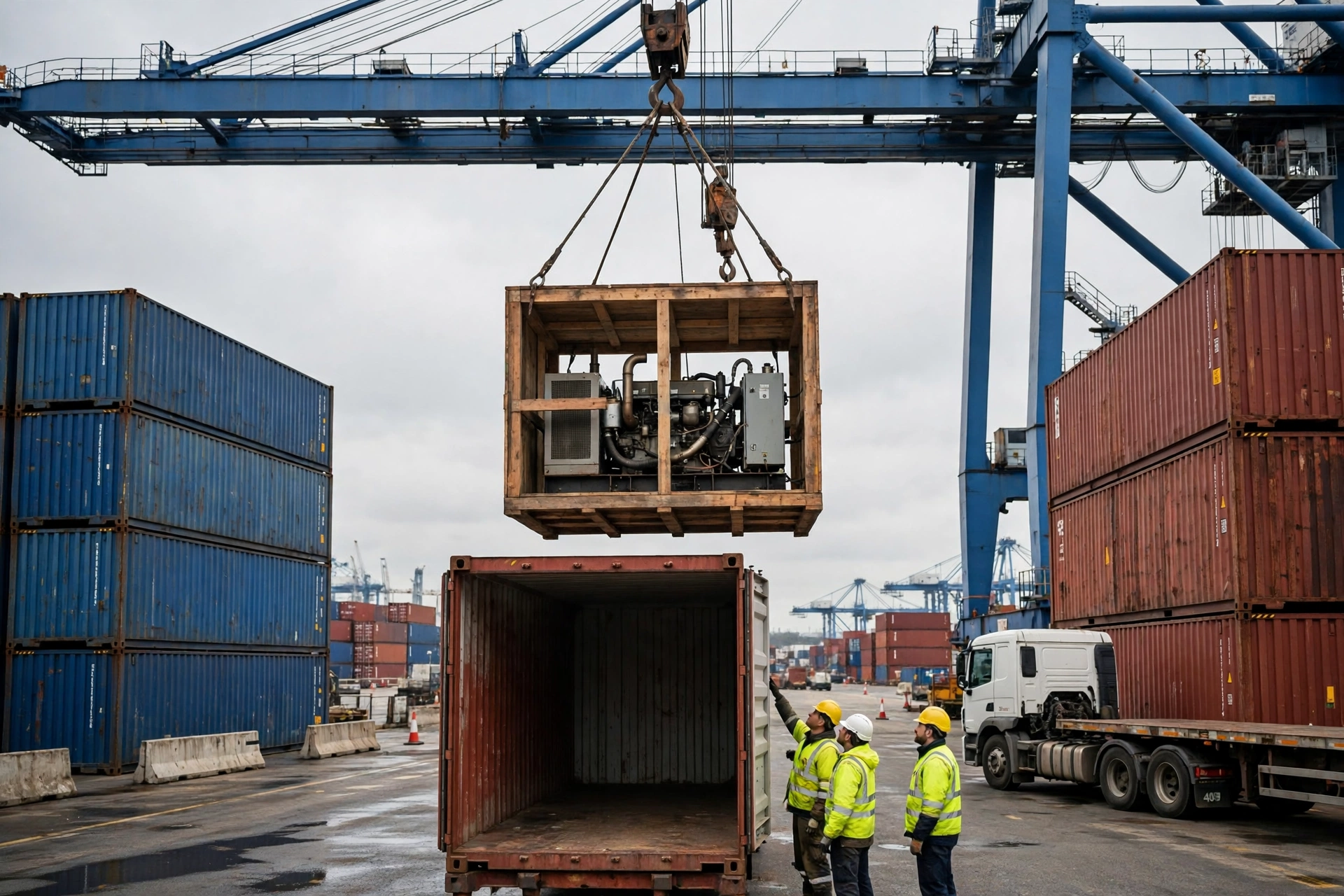
The 20 ft box wins when the cargo hits the weight limit before it fills the volume — dense machinery, in other words. A single 500 kVA silent set at 4,800 kg plus crate fits a 20 ft container with room for spare parts, cables and a day tank. A 1125 kVA silent set, at roughly 9,500 kg crated, still fits a 20 ft box on weight, but the crate leaves little room for anything else — most buyers of that size take a 40 ft container and use the spare volume for the transfer switch, cables and spares. The 40 ft box is cheaper per cubic metre and suits two or three smaller sets, or one large set with its full accessory package. A 40 ft high-cube, with its extra 30 cm of height, takes a tall canopy or a set on a raised skid that a standard box will not.
The door is the constraint buyers forget. The container door opening is about 2.34 m wide and 2.28 m high on a standard box. A set that fits inside the container on paper but cannot pass through the door is a flat-rack shipment, not a container shipment. Measure the crated dimensions against the door, not the internal volume.
When a flat rack is the only honest option
A 1250 kVA containerised genset is a container in its own right and ships as one. An open set of 2000 kVA or above, or a silent set whose crated height exceeds 2.59 m, does not fit a standard box at any price. The options are an open-top container, loaded by crane through a removable roof, or a flat rack — a container floor and end walls with no roof or sides, lashed and tarpaulined.
Flat-rack cargo is out-of-gauge, and the freight rate reflects it: an out-of-gauge open-top shipment from China to Rotterdam runs $7,000–$11,000 or more, against $4,000–$6,000 in-gauge, and the rate depends on the approved dimensions and vessel stowage. The lashing on a flat rack follows the CTU Code — the Code of Practice for Packing of Cargo Transport Units — with steel straps, turnbuckles and corner braces. A flat rack that arrives with a shifted load is not a freight problem. It is a lashing problem that was decided at the factory.
HS Code 8502: The Classification That Decides Duty
Every import declaration turns on a single box: the commodity code. For a diesel generating set, that code is a subheading of HS 8502, and the subheading depends on output, not on engine brand.
Heading 8502 covers electric generating sets and rotary converters. A generating set is the combination of an electric generator and a prime mover other than an electric motor, mounted together as one unit or on a common base, and presented together. That definition matters: the engine and the alternator must travel as one unit. A diesel engine imported alone falls under 8408. An alternator alone goes to 8501. The set only earns 8502 when the two are mounted together and presented together.
| HS subheading | Output | US HTS general rate | EU third-country duty |
|---|---|---|---|
| 8502.11 | Not exceeding 75 kVA | 2.5% | up to 2.7% |
| 8502.12 | Over 75, not over 375 kVA | 2.5% | up to 2.7% |
| 8502.13 | Over 375 kVA | 2% | often 0% |
The six-digit code is harmonised across the United States, the United Kingdom and the European Union. The duty rate on top of it is not. The same set can be duty-free in the United Kingdom, 2% in the United States and 2.7% in the European Union. The declaration must state kVA, not kW: a set sold as 400 kW at 0.8 power factor is a 500 kVA set for customs purposes, and kVA goes on the declaration. Writing only “8502” on a pro forma invoice is not a classification. Customs will ask for the subheading, and the subheading is what carries the rate.
The trailer trap
A containerised set stays in 8502, but the trailer under it is a separate customs line. United States customs ruled on this directly: a generating set on a semi-trailer was classified under 8502.13 at 2%, while the trailer itself went under 8716.39 at zero duty. The two lines are declared separately, with separate values. A single combined value for set and trailer invites reclassification, delay and a duty reassessment on the whole shipment.
The same discipline applies to the accessories in the crate. Spare parts, cables, a day tank and an automatic transfer switch travel on their own lines with their own codes. The packing list must match the crate markings exactly, line for line, or the destination inspector has a reason to open the crate. An opened crate at a port is a repacking job, a delay and a bill.
Regional changes in 2025 added work for exporters. Gulf Cooperation Council countries moved to 12-digit HS codes from 1 January 2025. The United States ended its de minimis threshold on 29 August 2025, so low-value shipments now need full HS declarations. The codes themselves are stable — no major World Customs Organization revision is due until 2027 — but the paperwork around them is not.
Documents, Cost and the 2026 Freight Bill
A shipment is held at a port by paperwork more often than by weather. The document set is part of the packing, and it should be checked with the same care as the crate.
The document set
| Document | What it proves | Who issues it |
|---|---|---|
| Commercial invoice | Value, HS code 8502 subheading, kVA | Seller |
| Packing list | Contents, weights, dimensions, crate marks | Seller |
| Bill of lading | Receipt of goods, contract of carriage | Carrier |
| Certificate of origin | Country of manufacture | Chamber of commerce |
| ISPM 15 treatment certificate | Wood packaging treated and stamped | Treatment facility |
| Factory acceptance test (FAT) report | Set tested to the specified step load | Manufacturer |
| CE / ISO 8528 conformity documents | Rating and compliance | Manufacturer |
The invoice and the packing list must agree with each other and with the crate markings — serial number, rating, gross weight — on two sides of the crate. The FAT report should be in the file before the crate is sealed, not emailed after the vessel sails. Under Incoterms 2020, the terms decide who carries the risk and when: EXW leaves almost everything to the buyer; FOB means the seller delivers the goods on board the vessel, and risk passes to the buyer when the goods are on board at the load port; CIF adds insurance and freight to the destination port, but risk still transfers at the load port, not on arrival. A buyer who thinks CIF means the seller carries the risk until delivery has misunderstood the term, and will discover that misunderstanding at the worst possible moment.
What a container costs in late 2026
Freight rates move weekly, and every figure below is a market snapshot, not a quotation. The pattern, however, is stable: the freight is rarely the largest cost, and it is almost never the cost that goes wrong.
| Lane | 20 ft FCL, port-to-port | Transit |
|---|---|---|
| Shanghai – Los Angeles | $4,400–$5,200 | 12–16 days |
| Shanghai – Rotterdam | about $4,000–$6,000 (open top, in-gauge) | about 30 days |
| China – Egypt (Alexandria) | $2,300–$3,300 | 18–30 days |
| China – Southeast Asia | $1,500–$2,500 (open top, in-gauge) | about 10–14 days |
LCL runs $75–$160 per cubic metre on most lanes, with a minimum charge, and door-to-door DDP service for a 20 ft container from China to Egypt runs $6,500–$9,500 all-in before Egyptian duties and VAT. Destination charges, customs duty and VAT routinely add 25–50% to the freight figure. A buyer who budgets only the ocean freight has budgeted about half the landed cost.
The packing itself is a small fraction of the total. A proper export crate for a 500 kVA set — heat-treated timber, plywood panels, VCI film, desiccants, blocking, strapping and stencilling — runs in the low hundreds of dollars in China, against a set worth tens of thousands and a freight bill of several thousand. It is the cheapest insurance on the shipment, and it is the line buyers most often try to delete. The sets that arrive damaged are almost never the ones that were packed too well.
Frequently Asked Questions
How to ship a diesel generator overseas?
Drain the fuel and coolant, isolate or exclude the battery, bolt the set to a heat-treated timber skid inside a plywood crate, seal it with VCI film and desiccants, declare it under HS code 8502 by kVA, and load it into a 20 ft or 40 ft container with CTU-Code lashing. Photograph the crate, the stamp and the lashing before it leaves the factory.
What is HS code 8502 for diesel generators?
HS 8502 is the Harmonized System heading for electric generating sets. Diesel sets fall in 8502.11 up to 75 kVA, 8502.12 from 75 to 375 kVA, and 8502.13 above 375 kVA. The subheading depends on output in kVA, not kW, and the duty rate — 2% to 2.5% in the United States, 0% to 2.7% in the EU — depends on the destination.
Do wooden crates need ISPM 15 for export?
Yes, if they contain solid wood thicker than 6 mm. Solid wood packaging must be heat-treated to a 56°C core for 30 minutes and carry the IPPC stamp on at least two opposite sides. Plywood, OSB and particle board are exempt, but a solid-wood skid or pallet under a plywood crate still needs treatment and the stamp.
How much does it cost to ship a generator in a container?
A 20 ft container from Shanghai to Los Angeles cost $4,400–$5,200 port-to-port in late 2026, with 12–16 days transit; China to Egypt ran $2,300–$3,300 over 18–30 days. LCL costs $75–$160 per cubic metre. Destination charges, duty and VAT typically add 25–50% on top of the ocean freight.
How are diesel generators packed for export shipping?
The set is bolted to a timber skid, blocked and braced inside a plywood crate, wrapped in VCI film with desiccants, and strapped for handling. Fuel and coolant are drained, batteries are isolated or shipped separately, and the crate is stencilled with weight, dimensions, centre of gravity and the IPPC stamp. The packing is photographed against the serial number before shipment.
Pre-Shipment Checklist: Ten Lines Before the Crate Leaves Wuhu
1. Crated dimensions checked against the container door, not just the internal volume. A set that cannot pass through a 2.34 m door is a flat-rack shipment.
2. IPPC stamp legible on at least two opposite sides, treatment certificate in the file. A replaced board without a stamp can hold a shipment for eleven days.
3. Set bolted to the skid, blocking nailed on four sides, strapping tensioned. Photograph the blocking before the lid goes on.
4. VCI film heat-sealed, desiccants inside the sealed envelope, film intact. A draped sheet is not a moisture barrier.
5. Fuel and coolant drained to the carrier’s limit, battery decision recorded on the packing list. The site team must know whether a battery is coming.
6. HS code 8502 subheading by kVA on the invoice — 8502.11, 8502.12 or 8502.13. Trailer and accessories on separate lines.
7. Invoice, packing list and crate markings agree — serial number, rating, gross weight. Any mismatch is a reason to open the crate at the port.
8. FAT report in the shipment file before the crate is sealed. A load bank test result after the vessel sails is not evidence.
9. Incoterm understood in writing — who carries risk, and from which point. FOB and CIF both transfer risk at the load port.
10. Packing photographs filed against the serial number. They are the evidence for any damage claim, and the proof the packing was done at all.
A generator that survives the sea is not lucky. It was crated by a factory that treats packing as engineering, not as an afterthought — the same discipline that decides the standby vs prime power ratings, sizes the fuel consumption for a 72-hour outage, and closes the ATS gap between grid failure and generator power. Before the next set leaves the factory, ask the supplier for the packing photographs of the last one. A factory that cannot produce them has already told the buyer everything necessary about its export packing.
For a quotation that includes the crating, the documents and the loading plan — not just the set — contact PAVO with the destination port, the set rating and the site conditions. A 9 to 3750 kVA range in open, silent and containerised configurations, powered by Cummins vs Weichai vs Perkins engines, ships from Wuhu through Shanghai to more than 20 countries. The packing is part of the product.