

What Size Generator Does a Commercial Laundry Need? | PAVO
A commercial laundry does not sell washing. It sells a promise that clean linen arrives on the truck tomorrow morning, and a power cut turns that promise into a pile of wet sheets that nobody can use.
What size generator does a commercial laundry need? A 300-room hotel laundry runs on 200–300 kVA, a 5 t/day tunnel-washer plant needs 400–500 kVA, and a 20 t/day plant needs 1,500–2,000 kVA. Size depends on daily throughput, whether the dryers and ironers run on steam or electricity, and which motors start together.
This article works through the load list of a real commercial laundry, the linen and energy numbers per kilogram that set the running cost, the starting surge of washer-extractors and dryer fans, the damage windows that turn a short outage into a condemned load, and the steam, water and placement rules that decide where the set may stand. It covers hotel laundries, hospital laundries and large tunnel-washer plants, with the fuel, placement and specification numbers a buyer needs before paying a deposit.
Contents
- The Laundry’s Clock: Wet Linen and the Eight-Hour Window
- What a Commercial Laundry Actually Runs: The Load List
- Sizing by Laundry Type: From a Hotel Laundry to a 20 t/day Tunnel Plant
- Starting Surge: Washer-Extractors, Dryer Fans and the Restart Sequence
- Three Outages That Show What a Laundry Loses
- Steam, Water and Placement: Running a Generator in a Hot, Humid Plant
- Frequently Asked Questions
- Specification Checklist: Ten Lines Before the Deposit
The Laundry’s Clock: Wet Linen and the Eight-Hour Window
A commercial laundry runs on a clock that most buyers never see. The linen arrives soiled in the morning, moves through the wash, the press, the dryer and the ironer, and leaves folded and packed the same day. The buffer between a late delivery and a missed one is measured in hours, not days, and the buffer is the linen itself: the stock of clean sheets, towels and uniforms held on the shelves, counted in “pars”. An off-site commercial laundry should hold at least three pars, and its customer should hold at least four, according to the contingency guidance published by American Laundry News. One par is in use, one is in the laundry, one is on the shelf, and the fourth is the reserve. A plant that runs at three pars has one day of slack. A plant that runs at two has none.
The reason the clock is short is the wet load. A tunnel washer moves linen through a series of compartments, and a washer-extractor spins it to about 50% residual moisture before it goes to the dryer. Linen that stops mid-process sits wet, warm and still, and that is the exact condition in which mildew and bacteria grow. Laundry experts put the safe window at eight to twelve hours: damp clothes should not sit in a washer longer than that before a musty odour develops, according to the Whirlpool Institute of Fabric Science. A microbiologist at the University of South Florida puts the bacterial clock at about sixteen hours under perfect conditions, with good mould growth within about twenty-four hours. The practical rule from the trade press is simpler and harsher: eight hours is the magic number, and once linen is dried past the point of no return, the dryer bakes the mildew in.
That window decides what an outage costs. A power cut of two hours is an inconvenience: the tunnel stops, the press holds its cake, the dryers cool, and the crew restarts in sequence. A power cut of twelve hours is a loss: every load that was wet when the power failed has to be rewashed, and every load that was in the tunnel has to be pulled out, sorted and re-run, because the chemistry that was supposed to happen in the wash happened in a stagnant drum instead. A power cut of two days is a contract failure: the customer runs out of pars, the hotel puts guests in rooms with no clean towels, the hospital starts rationing gowns, and the laundry pays for replacement linen from a competitor or loses the account. American Laundry News put the recovery figure plainly: following a true emergency, it could take forty-eight hours or longer to respond with the linen. The generator is what keeps a two-hour outage from becoming a forty-eight-hour one.
The second clock is the steam clock, and it runs even when the power is on. Most of the heat in a commercial laundry comes from steam, not electricity. A tunnel washer uses 0.25 to 0.4 kg of steam per kilogram of linen, a washer-extractor 0.6 to 0.9 kg, and a 3.3 m three-roll flatwork ironer about 300 kg of steam per hour — as much as four or five 100 kg washer-extractors combined. Field figures from hotel-linen laundries put whole-plant steam use at roughly 2 kg of steam per kilogram of linen. The boiler that makes that steam is usually gas- or oil-fired, and it needs electricity for its burner, its feedwater pumps and its controls. A laundry that loses power loses its steam in the same minute it loses its motors, and a boiler that cools down does not come back in seconds. The Clayton steam generators at Addenbrooke’s NHS Trust laundry in Cambridge start from cold in about five minutes, which is fast for a boiler and still five minutes in which no steam is being made. The generator board has to carry the boiler house as a first-priority load, or the plant restarts with motors running and no heat to run them with.
The third clock is the delivery clock, and it is the one the customer feels first. A hotel laundry that serves a 300-room property produces about 3,000 kg of linen a day at the international benchmark of 10 kg per room. A hospital laundry serving 400 beds produces about 2,700 kg a day at 15 lb (6.8 kg) per bed. The trucks leave at a fixed hour, and the linen they carry has to be washed, dried, ironed, folded and packed before that hour. A plant that loses four hours of production does not lose four hours of output; it loses the whole day’s delivery, because the line cannot run twice as fast to catch up. Tunnel washers run at a fixed cycle time — a 60 kg batch every two to two and a half minutes — and the ironer runs at a fixed speed of one to nine metres per minute. There is no overtime setting. The only way to recover lost hours is to run longer, and a plant that normally runs ten hours a day has no ten hours left after a four-hour outage. The generator does not buy speed. It buys the hours back.
| Linen stage | Safe window without power | What is lost when the window closes |
|---|---|---|
| Load in the tunnel washer, mid-cycle | 2–4 hours | Batch must be pulled, sorted and re-run; wash chemistry wasted |
| Wet load in a washer-extractor or press | 8–12 hours | Mildew odour develops; load must be rewashed |
| Wet load left overnight (24 hours) | 24 hours | Mould growth established; load may be condemned |
| Clean linen on the shelf (par stock) | 1–3 days, by par level | Customer runs out; deliveries missed; contract penalties |
| Steam boiler, cold after shutdown | 5 minutes to re-fire (Clayton EOG) | No heat for washing, drying or ironing until steam returns |
What a Commercial Laundry Actually Runs: The Load List
A commercial laundry looks like a simple building from the outside: a shed, a boiler house, a loading dock and a row of trucks. Inside, the electrical load splits into five groups that behave very differently, and the generator has to be sized for the way they start, not just the way they run.
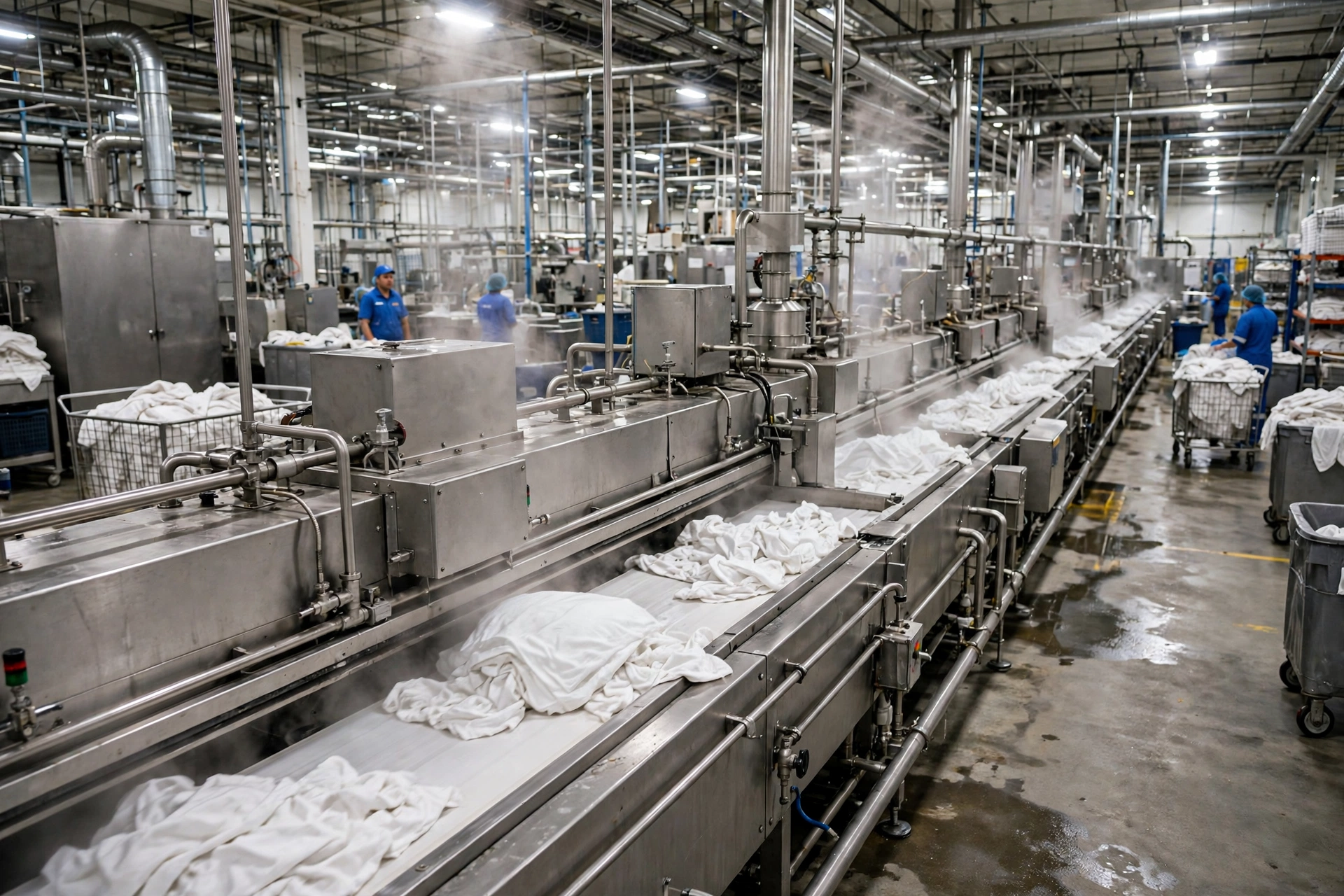
The first group is the wash line. In a large plant this is a continuous tunnel washer: a long stainless-steel machine of ten or more compartments through which linen is pulled in 50 to 100 kg batches every two to three minutes. A Sea Lion SDX60 tunnel, for example, takes 60 kg per compartment on a 2 to 2.5 minute cycle, with a 24.2 kW power supply and a 22 kW drive motor. The tunnel itself is not the largest electrical load in the building, because most of its heat comes from steam — 0.25 to 0.4 kg of steam per kilogram of linen, against 0.020 to 0.035 kWh of electricity per kilogram. A tunnel processing 1,000 kg an hour therefore draws roughly 20 to 35 kW of electricity and 250 to 400 kg of steam an hour. The US EPA puts the top end of tunnel capacity at 2,000 lb (907 kg) per hour, with water use of two gallons or less per pound of fabric, against 15 to 25 litres per kilogram for a washer-extractor. The tunnel is efficient precisely because it reuses its water counter-current, from the last rinse back to the first wash, and because it never stops: the load is continuous, so the electrical demand is steady rather than spiky.
The second group is the washer-extractors, and these are the starting-surge problem. A 100 kg washer-extractor uses about 68 kg of steam an hour and a drive motor in the 15 to 25 kW range, but the figure that matters is the spin: the drum accelerates a 100 kg wet load to several hundred G, and the motor draws four to seven times its running current while it does so. The JENSEN L-Tron open-pocket washer-extractor, a common machine in large plants, carries a 50 hp (37 kW) motor on the 450 lb (204 kg) model and a 55 hp (41 kW) motor on the 800 lb (363 kg) model. A plant with four 100 kg washer-extractors that spin together can present a starting surge of 300 kW or more for a few seconds, and a generator sized only for the running load will see its voltage dip below the level at which the machine controls drop out. The motor starting figures for the plant have to be worked out machine by machine, with the spin cycles staggered, before the generator size is fixed.
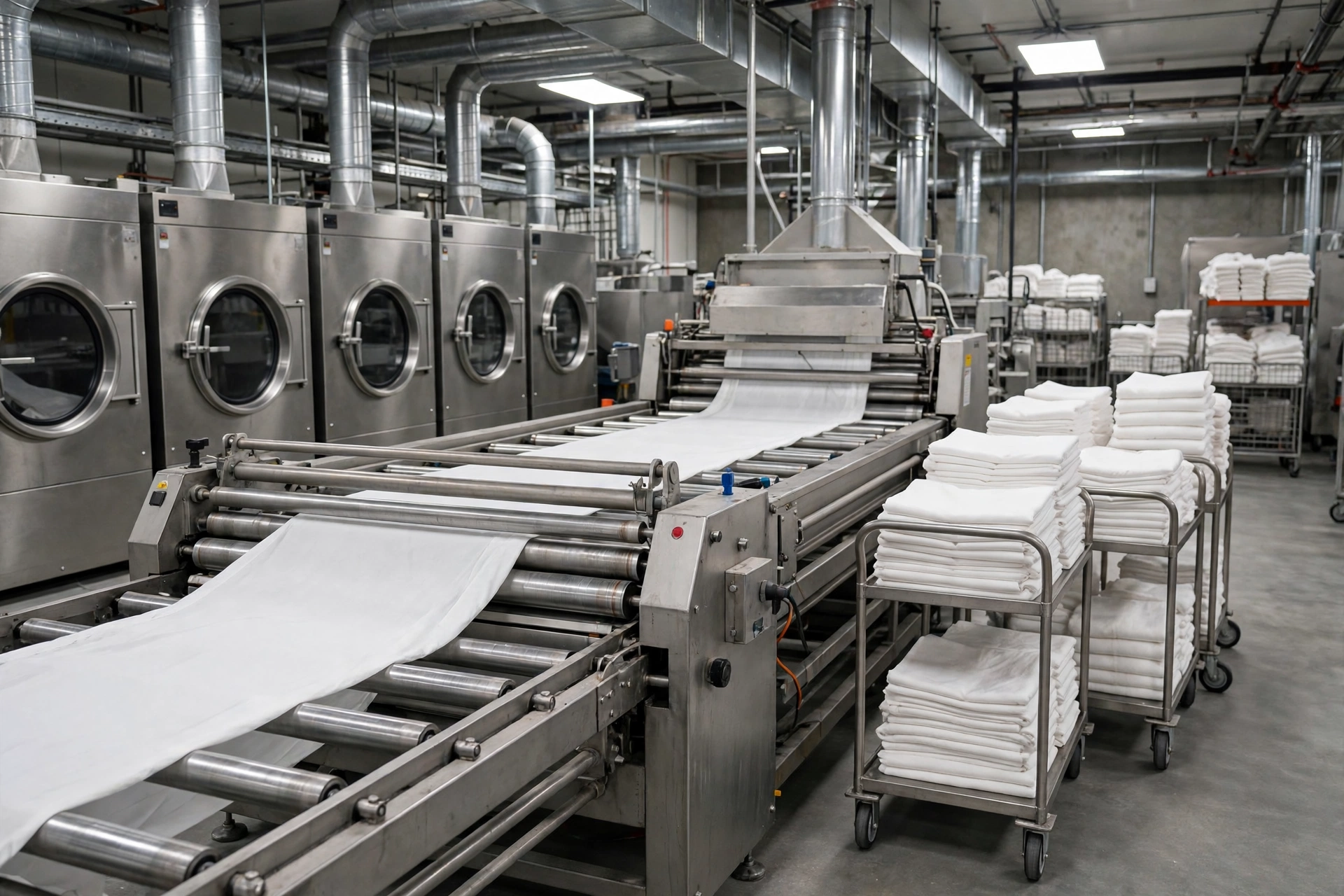
The third group is the drying and finishing line, and this is where the steam-versus-electricity decision changes the generator size by a factor of two or three. A 100 kg tumble dryer uses 90 to 120 kg of steam an hour when steam-heated, or 72 kW of electric heating when electrically heated — the Brentareno CD100 is rated at exactly 72 kW electric, 95 kg/h steam. A 50 kg dryer is 43.2 kW electric or 55 kg/h steam. A flatwork ironer is larger still: a Powerline PMCM 3200, with a 3,135 mm roller, draws 61.2 kW of electric heating, 68 kW of gas heating, or 125 kg of steam an hour, and produces about 80 kg of finished flatwork an hour. A three-roll 3.3 m ironer uses about 300 kg of steam an hour. The ironer is the biggest single steam consumer in the building, and it is also the most sensitive to a voltage dip: a roller that slows mid-sheet leaves a crease that cannot be ironed out, and the sheet goes back through the line.
The fourth group is the boiler house and the water plant. A plant processing 1,500 kg of linen a day — a typical hospital laundry — needs about 925 kg of steam an hour across its washers, dryers and ironer, and a boiler rated at one tonne of steam an hour covers it with a small margin. That boiler needs electricity for its burner fan, its feedwater pump, its chemical dosing pumps and its controls: typically 15 to 30 kW for a one-tonne boiler, and 40 to 60 kW for a four-tonne boiler like the Clayton EOG-254 units at Addenbrooke’s, each of which produces nearly four tonnes of steam an hour. The water plant matters just as much: a 5 t/day tunnel laundry uses about 15,000 litres of fresh water a day, and heating that water from 15 °C to 60 °C takes about 785 kWh a day. The borehole pump, the softener, the hot-well pumps and the condensate return pumps all sit on the generator board, and a laundry that loses its water treatment loses its wash quality even if the machines keep turning.
The fifth group is the building itself: compressed air, lighting, ventilation, the monorail and bag systems, the folding and packing lines, and the offices. Compressed air runs at 4 to 8 bar for the tunnel’s pneumatic controls and the press, and the compressor is a 7.5 to 15 kW motor that cycles on and off all day. The laundry hall is hot and humid by design — steam, wet linen and open water — so the ventilation fans run continuously, and the dehumidification load in a tropical plant can be as large as the wash line itself. The lighting is modest, but the folding machines, the conveyor and the packing line are all small motors that add up to 20 to 40 kW in a large plant. None of these loads is large on its own. Together they are the difference between a generator that carries the plant and one that trips on the first simultaneous start.
| Machine | Typical size | Electric load | Steam load | Notes |
|---|---|---|---|---|
| Tunnel washer, 10–16 compartments | 500–2,000 kg/h | 22–30 kW drive | 250–900 kg/h | Continuous load; 0.25–0.4 kg steam/kg linen |
| Washer-extractor, 100 kg | 100 kg per load | 15–25 kW motor | 68 kg/h | Spin surge 4–7x running current |
| Washer-extractor, 200 kg (JENSEN L-Tron 450 lb) | 204 kg per load | 37 kW motor | 85 kg/h | 50 hp drive; largest single motor in many plants |
| Tumble dryer, 100 kg (Brentareno CD100) | 100 kg per load | 72 kW electric / 5 kW motors | 95 kg/h | Electric heating triples the generator size |
| Flatwork ironer, 3.3 m, 3-roll | 80–150 kg/h | 61 kW electric | 300 kg/h | Biggest single steam consumer in the building |
| Steam boiler, 1 t/h | 1,000 kg/h steam | 15–30 kW | — | Burner, feedwater and dosing pumps |
| Steam boiler, 4 t/h (Clayton EOG-254) | 4,000 kg/h steam | 40–60 kW | — | Cold start about 5 minutes |
| Compressed air, ventilation, lighting | Plant-wide | 30–60 kW | — | Compressor cycles; fans run continuously |
A worked example makes the totals concrete. Take a hospital laundry processing 1,500 kg a day, the HOZO worked example: two 100 kg barrier washer-extractors, three 50 kg barrier washer-extractors, two 100 kg tumble dryers, three 50 kg tumble dryers and one three-roll 3.3 m flatwork ironer. The steam total is 925 kg an hour, served by a one-tonne boiler. The electrical total, counting washer motors, dryer fans, ironer drives, boiler auxiliaries, compressed air and lighting, is roughly 150 to 180 kW running, with a starting surge of 250 to 300 kW when two washer-extractors spin together. A 250 kVA set carries the running load with margin; a 300 kVA set carries the surge without a voltage dip that drops the ironer. The difference between the two is the difference between a plant that restarts cleanly and one that restarts twice.
Sizing by Laundry Type: From a Hotel Laundry to a 20 t/day Tunnel Plant
The size of the generator follows the linen, and the linen follows the customer. The planning figures for how much linen hotels, hospitals and restaurants produce are well established, and they are the starting point for every sizing calculation in this section.
A hotel produces 8 to 12 lb (3.6 to 5.4 kg) of linen per occupied room per day, according to the Maytag on-premises laundry planning guide: 8 lb for a budget motel, 10 lb for a midrange or suite hotel, 12 lb for a resort or luxury hotel. The JLA guide, working in kilograms, gives 5 kg a room a day for a small budget hotel, 7 kg for a mid-scale hotel, 8 kg for a large hotel and 10 kg for a luxury hotel. A 200-room large hotel at 90% occupancy therefore produces about 1,440 kg a day; a 300-room luxury hotel at 90% occupancy produces about 2,700 kg a day. A 300-room hotel at the international benchmark of 10 kg per room produces 3,000 kg a day at full occupancy. The same guide’s rule of thumb for drying is 60% of the washing capacity, pressing 20% and ironing 40%, which is why the ironer, not the washer, sets the finishing load.
A hospital produces more linen per bed and produces it every day without a weekend break. The B&C Technologies planning guide gives 15 lb (6.8 kg) per bed per day for hospitals, and 50 lb per bed per week for nursing homes, rising to 60 lb where a high proportion of patients are incontinent. A 400-bed hospital therefore produces about 2,700 kg a day, every day of the year, and the laundry that serves it cannot take a weekend off to catch up. That daily, unbroken demand is why hospital backup power plans treat the laundry as an essential load rather than a discretionary one. A prison produces about 6 lb per inmate per day. A restaurant produces about 0.31 lb per cover, plus its table linen, and a banquet hall produces a full day’s linen in a single evening.
The sizing bands below are built from those figures, using the machine loads from the previous section and the rule that the generator must carry the running load at 70 to 80% of its prime rating, with the starting surge of the largest motor on top.
| Laundry type | Daily throughput | Typical equipment | Generator size (prime) | Fuel at 75% load |
|---|---|---|---|---|
| Small hotel laundry (100 rooms) | 500–800 kg/day | 2 × 50 kg washer-extractors, 2 × 50 kg dryers, 1 small ironer | 100–150 kVA | 15–22 L/h |
| Mid-size hotel laundry (300 rooms) | 2,000–3,000 kg/day | 4 × 100 kg washer-extractors, 4 × 100 kg dryers, 1 × 3.3 m ironer | 200–300 kVA | 30–45 L/h |
| Hospital laundry (400 beds) | 2,700 kg/day | Barrier washers, 5 dryers, 1 × 3-roll ironer, 1 t/h boiler | 250–350 kVA | 38–52 L/h |
| Commercial tunnel plant, 5 t/day | 5,000 kg/day | 1 tunnel washer, press, 4 dryers, 1 ironer, 1–2 t/h boiler | 400–500 kVA | 60–75 L/h |
| Commercial tunnel plant, 10 t/day | 10,000 kg/day | 2 tunnels or 1 large tunnel, 8 dryers, 2 ironers, 2–3 t/h boiler | 750–1,000 kVA | 110–150 L/h |
| Commercial tunnel plant, 20 t/day | 20,000 kg/day | 2 large tunnels, 12+ dryers, 3 ironers, 4–6 t/h boiler | 1,500–2,000 kVA | 220–300 L/h |
The fuel figures use the Cummins C500D5 as the reference: 500 kVA standby, 455 kVA prime, 93.2 L/h at full prime load. A 500 kVA set running at 75% load burns roughly 70 L/h, so a 24-hour outage on a 5 t/day plant needs about 1,700 litres, and a 72-hour outage needs about 5,000 litres. A 2,000 kVA plant at 75% load burns roughly 280 L/h, so 24 hours needs about 6,700 litres and 72 hours needs about 20,000 litres — a bulk tank, not a day tank, and a fuel delivery contract that works during a storm. The diesel fuel ageing rules for that bulk tank are the same as for any standby set: test the fuel, polish it, and do not let a 20,000-litre tank sit for a year without a plan, because the fuel that powers the plant for three days is the fuel that has been sitting in the tank for eleven months.
The most common sizing mistake in laundries is the electric dryer. A plant that buys steam-heated dryers and ironers needs a generator sized for motors and fans — roughly 0.35 to 0.45 kVA per tonne of daily throughput. A plant that buys electrically heated dryers and ironers needs a generator sized for the heating elements as well — roughly 0.7 to 0.9 kVA per tonne, about double. The Brentareno CD100 makes the arithmetic visible: 72 kW of electric heating against 5 kW of motors and fans. Four electrically heated 100 kg dryers draw 288 kW of heating and 20 kW of motors; four steam-heated dryers of the same size draw 20 kW of motors and 380 kg of steam an hour, which the boiler supplies. The electrically heated plant needs a generator roughly 300 kVA larger, and it burns roughly 45 L/h more diesel, for the same linen. The steam plant needs a boiler and a steam main, and the boiler needs its own fuel, but the generator is half the size and the fuel bill is a third lower. The choice is made at the equipment order, not at the generator order, and it is the most expensive choice in the whole project if it is made wrong.
How the load list becomes a generator size
The sizing method is the same as for any industrial site, and the generator sizing guide sets out the full procedure. The laundry version of it runs in five steps. First, list every machine with its running kW, its starting kVA and its steam demand, from the manufacturer’s data plate, not from a catalogue estimate. Second, decide which machines run together: the tunnel runs continuously, the dryers cycle in batches, the ironer runs when there is flatwork to finish, and the washer-extractors spin in turn, not together. Third, add the boiler house, the water plant, the compressed air and the building loads. Fourth, apply the starting surge of the largest motor that can start while everything else is running — usually a washer-extractor spin or a dryer fan — and check the voltage dip against the ironer’s tolerance. Fifth, choose the rating: standby if the set runs only during outages and for less than 500 hours a year, prime if it runs regularly or for long outages, and continuous if the laundry is off-grid. The standby and prime ratings article explains the difference in full, and the short version is that a laundry that runs its set for 72 hours straight, three times a year, is already at 216 hours and heading for prime.
The 70–80% rule, and why laundries break it
A diesel generator should run at 70 to 80% of its prime rating under normal load. Below 30% it wet-stacks: unburned fuel coats the exhaust, the cylinders glaze, and the set loses power and reliability. Laundries break this rule in both directions. A plant that sizes for the full electric-dryer load and then runs on steam for half the year will run its set at 40% load for months. A plant that sizes for the running load and forgets the spin surge will run its set at 100% load for the first ten minutes of every restart, and then wonder why the ironer drops out. The fix is the same in both cases: size for the surge, run the set on a load bank during the weekly test, and keep the load factor honest. A 500 kVA set that carries a 350 kW laundry load is correctly sized. A 1,000 kVA set carrying the same load is not generous; it is a wet-stacking problem with a delivery date.
Starting Surge: Washer-Extractors, Dryer Fans and the Restart Sequence
The hardest ten seconds in a laundry’s life are the ten seconds after the automatic transfer switch closes. The generator is running, the switch has transferred, and every machine that was running when the power failed tries to restart at once. The tunnel washer’s drive motor, the extraction press, four dryer fans, the ironer, the boiler burner fan, the feedwater pump, the compressed-air compressor and the ventilation fans all present their starting current in the same second, and the generator sees a load that is three to five times the running load. A set that is sized for the running load alone will dip its voltage, and the machines will tell the operator about it in the worst possible way: the ironer roller slows and creases a sheet, the tunnel drive faults on undervoltage, and the boiler burner fails to light because its fan cannot reach speed.
The restart sequence is the answer, and it is programmed into the control system, not left to the operator. The sequence that works in practice is five steps. First, the boiler house: burner fan, feedwater pump and controls, because without steam nothing else can run. Second, the water plant: softener, hot-well pumps and condensate return, because the tunnel needs water at temperature. Third, the tunnel washer and the extraction press, because the wet linen in the tunnel is the most perishable load in the building. Fourth, the dryers, one at a time, with a ten-second gap between fan starts. Fifth, the ironer and the finishing line, last, because flatwork can wait twenty minutes and wet linen cannot. The whole sequence takes three to five minutes, and a plant that follows it restarts cleanly on a set sized for the running load plus one large motor start. A plant that does not follow it needs a set twice as large, and still restarts badly.
The numbers behind the sequence are the starting currents. A washer-extractor motor draws four to seven times its running current at spin-up, and a 37 kW JENSEN L-Tron motor therefore presents roughly 150 to 260 kVA of starting demand for a few seconds. A dryer fan motor draws five to seven times its running current: a 7.5 kW fan motor presents 40 to 50 kVA. A boiler burner fan is smaller, typically 5 to 11 kW, but it is the first load on the board and it has to start against a cold boiler. The rule is to stagger the starts so that no more than one large motor starts at a time, and to use soft starters or variable-frequency drives on the largest motors. A soft starter on a 37 kW washer-extractor motor cuts the starting current from seven times to about three times, and that single device can be the difference between a 500 kVA set and a 750 kVA set. The cost of the soft starter is a few hundred dollars. The cost of the extra 250 kVA is several thousand, plus the fuel it burns for the life of the plant.
What the voltage dip does to the ironer
The ironer is the machine most sensitive to a voltage dip, and it is also the machine the customer sees first, because every sheet that leaves the plant passes through it. A flatwork ironer runs its roller at one to nine metres per minute on the Powerline PMCM 3200, and the speed is set by a drive that expects a stable 400 V. A dip to 340 V slows the roller, the sheet spends longer on the heated surface, and the result is a scorched edge or a crease that the folder cannot remove. A dip below 320 V drops the drive out entirely, and the sheet stops on the roller, where it scorches in seconds. The ironer is therefore the machine that sets the voltage-dip limit for the whole plant: the generator must hold its voltage within 10% during the largest motor start, and the ironer must be the last machine to start, not the first. A plant that starts its ironer first and its washer-extractors second will restart with a creased sheet and a faulted tunnel, and the operator will blame the generator for a sequencing error.
Three Outages That Show What a Laundry Loses
Addenbrooke’s NHS Trust laundry, Cambridge: the steam that never stops
Addenbrooke’s Hospital in Cambridge serves a district of 480,000 people, and its laundry at Fulbourn Hospital washes 4.5 million pieces of linen a year. The laundry is, in the words of the hospital’s estates manager, “one of the essential back-up services which are needed to support the medical work of the Trust”, and the steam supply is treated accordingly. Two Clayton EOG-254 steam generators were installed side by side, each capable of producing nearly four tonnes of steam per hour, designed to operate unattended, and able to start from completely cold within approximately five minutes. The feedwater treatment equipment — hot well, chemical injection and transfer pumps — was mounted on a pre-assembled skid, and the hot well doubles as a partial deaerator, removing the oxygen that causes corrosion in feedwater.
The case matters because it shows what a hospital laundry actually protects. The laundry does not wash sheets for comfort; it washes gowns, drapes, theatre linen and patient bedding for a hospital that cannot admit a patient without clean linen. A power cut that stops the laundry stops the flow of clean linen to the wards within a day, and the hospital’s par stock — the clean linen held on the shelves — is measured in days, not weeks. The Clayton generators were chosen because they start fast, run unattended and produce steam at the pressure the ironers and dryers need, and the lesson for a buyer is that the boiler is part of the backup-power system, not separate from it. A generator that carries the wash line but not the boiler house leaves a laundry with motors turning and no heat to wash with, which is the same as no laundry at all.
The Gulf Coast and Tornado Alley: contingency as a contract
The second case is not a single plant but a region, and it comes from the American Laundry News contingency series, written with Kannegiesser USA’s engineers for the laundries of Texas, Oklahoma and the Gulf Coast — the states the article calls “Tornado Alley” and the hurricane coast. The laundries in that region do not ask whether a disruptive event will happen; they ask when, and under what circumstances. Their contingency plans have multiple layers: electrical power generators, large propane storage tanks, extra water-storage capacity, a safety par of new linen, a one-day supply of processed clean linen held in reserve, and a prearranged reciprocal agreement with another laundry to take over production during a catastrophic event.
The detail that matters most is the reciprocal agreement. The article’s advice is to partner with a facility slightly out of the area, on a different power supply, because the disaster that takes out one plant will very likely take out the other if they share a grid. The same article records the cost of getting it wrong: service providers that looked good on paper and could not perform when called, contingency plans that existed only to pass an inspection, and customers who discovered after a true emergency that it could take forty-eight hours or longer to get their linen back. The generator is the first layer of that plan, but it is not the whole plan: a laundry that owns a generator and holds no reserve linen, no water storage and no reciprocal agreement has bought the most expensive layer and skipped the cheap ones.
A 300-room hotel laundry: the worked example
The third case is a worked example, built from the published sizing figures, because it shows the arithmetic that a buyer actually does. Take a 300-room hotel at 80% occupancy, with a restaurant serving 60 covers an evening. At the Maytag benchmark of 10 lb (4.5 kg) per occupied room per day, the rooms produce about 1,080 kg a day; the restaurant adds about 0.3 to 0.6 kg per cover, another 18 to 36 kg, plus table linen. The laundry therefore processes roughly 1,100 to 1,200 kg a day, and the JLA table for a mid-scale 100-room hotel at 75% occupancy gives 525 kg a day, which scales to about 1,575 kg a day for 300 rooms — the two methods agree within 30%, and the higher figure is the one to size for.
The equipment for that load is four 100 kg washer-extractors, four 100 kg tumble dryers and one 3.3 m three-roll ironer, plus a one-tonne boiler. The running electrical load is about 120 to 150 kW: washer motors 60 to 100 kW, dryer fans 20 kW, ironer drives 5 kW, boiler auxiliaries 15 to 30 kW, compressed air and lighting 20 kW. The starting surge, with two washer-extractors spinning together, is 250 to 300 kW. A 250 kVA set carries the running load at 60 to 70% of its prime rating and the surge with a soft starter on the largest motor. A 300 kVA set carries it with margin for a second ironer or a fifth dryer. The fuel bill at 75% load is about 35 L/h, so an eight-hour outage needs about 280 litres, a 24-hour outage about 840 litres, and a 72-hour outage about 2,500 litres. The tank that holds that fuel is a 3,000-litre bunded tank, and the maintenance schedule for the set is the weekly test, the monthly load-bank run and the annual service — the same schedule as any standby set, and the one that most laundries skip until the first outage proves they should not have.
The hotel case also shows the cost of not having a generator. At the 2026 commercial rate of $0.25 to $0.60 per pound for hotel flatwork, a 300-room hotel’s laundry processes about 2,400 lb a day, worth $600 to $1,440 a day in processing value. A two-day outage that forces the hotel to buy in linen from a competitor costs $1,200 to $2,900 in processing alone, before the cost of the emergency delivery, the rewash of the wet loads, and the linen that is condemned. A 250 kVA set costs less than that two-day outage, and it lasts twenty years. The arithmetic is not close.
Steam, Water and Placement: Running a Generator in a Hot, Humid Plant
A laundry is a hard place to put a generator. The hall is hot, humid and full of steam, the floor is wet, the air carries lint and detergent, and the boiler house next door runs at 60 °C. The set has to be placed, ventilated and protected for that environment, or it will fail in the same conditions that make the laundry need it.
The first rule is separation. The generator does not go in the laundry hall. It goes in its own room or outside in a silent canopy, with its own ventilation, its own fuel supply and its own exhaust. The reason is lint: the air in a laundry hall carries cotton fibre, and cotton fibre clogs a radiator in weeks. A set that breathes laundry-hall air will overheat on the first long outage, and the overheating will look like a generator fault when it is a placement fault. The ventilation figures are the same as for any generator room — the room needs enough air for combustion and for cooling, with louvres sized for the set’s heat rejection — and the laundry’s own ventilation system must not be used as the generator room’s ventilation, because the two systems fight each other and the generator loses.
The second rule is the steam main. A laundry’s steam main runs at 0.4 to 0.6 MPa (4 to 6 bar) at the machine inlet, and the boiler that feeds it is usually gas- or oil-fired. If the boiler is oil-fired, it shares the site’s fuel storage with the generator, and the fuel system has to be sized for both: the boiler burns far more fuel than the generator, and a shared tank that is sized for the generator alone will run dry in a day. If the boiler is gas-fired, the generator still needs its own diesel supply, and the gas supply to the boiler needs its own backup — a laundry that loses its gas supply loses its steam even if the generator is running. The practical answer in most plants is a diesel generator with its own bunded day tank, a gas or oil boiler with its own supply, and a written procedure for which one is started first. The boiler starts first, because the steam main takes minutes to come up to pressure and the machines cannot run without it.
The third rule is the wet floor. A laundry floor is wet for most of the day, and the generator’s cabling, its ATS and its fuel lines all have to be protected against water. The ATS goes on the wall above the flood line, not on the floor. The fuel lines run overhead, not in a trench that fills with water. The generator’s own bund holds 110% of its tank, because a fuel spill in a laundry is a fire risk and a slip risk at the same time, and the laundry’s drains run to the sewer, not to a soakaway. The exhaust stack goes up through the roof, away from the ventilation intakes, because diesel exhaust and laundry steam look the same on a cold morning and the staff should never have to guess which one they are breathing.
The fourth rule is noise. A laundry is a noisy building, but the neighbours are not always industrial. A hotel laundry sits in a hotel, a hospital laundry sits in a hospital, and a commercial laundry often sits on the edge of a residential area. A silent canopy at 75 dB(A) at seven metres is the standard for a set that runs at night, and the exhaust silencer, the intake attenuators and the canopy itself all have to be specified together. A set that meets the noise limit in the factory and fails it on site has usually been installed without its attenuators, or with its exhaust pointed at the neighbour’s bedroom window. The noise check is done on site, at night, with the set under load, and the result is written down before the deposit is paid.
| Placement rule | What to do | What happens if it is skipped |
|---|---|---|
| Separation from the hall | Own room or outdoor canopy, own ventilation | Lint clogs the radiator; set overheats on a long outage |
| Boiler first | Start boiler house before wash line | Motors run with no steam; plant cannot wash |
| Wet-floor protection | ATS above flood line, fuel lines overhead, 110% bund | Water in the ATS; fuel spill into the drains |
| Exhaust routing | Stack above roof, away from intakes | Diesel exhaust drawn into the hall |
| Noise | Silent canopy, attenuators, night test under load | Neighbour complaints; night running banned |
Frequently Asked Questions
What size generator does a commercial laundry need?
A 300-room hotel laundry runs on 200–300 kVA, a 5 t/day tunnel-washer plant needs 400–500 kVA, and a 20 t/day plant needs 1,500–2,000 kVA. Size by daily throughput in kilograms, then add the starting surge of the largest washer-extractor motor and the boiler house load, and check the result against the steam-versus-electric dryer decision.
Do commercial laundries need a backup generator?
Yes, if the laundry serves customers who cannot wait. A hotel, a hospital or a restaurant chain runs out of clean linen in one to three days, and a wet load left in a stopped tunnel has eight to twelve hours before mildew sets in. A laundry that processes 5 t a day and loses two days of production loses about $1,200 to $2,900 of processing value per day at 2026 commercial rates, before rewash and replacement costs.
How long can a commercial laundry run on a generator?
As long as the fuel lasts. A 500 kVA set at 75% load burns about 70 L/h, so a 5,000-litre tank runs it for about 72 hours. A 250 kVA hotel laundry set at 75% load burns about 35 L/h, so a 3,000-litre tank runs it for about 85 hours. The limit is usually the fuel delivery, not the set: a prime-rated set can run for weeks if the fuel, oil and filters are planned for it.
What happens to a commercial laundry during a power outage?
The tunnel washer stops mid-cycle, the washer-extractors stop mid-spin, the dryers cool and the ironer stops with a sheet on the roller. Wet linen has eight to twelve hours before mildew odour develops, and the boiler loses its burner, pumps and controls at the same moment as the machines. A plant with a generator and a restart sequence is back in production in five minutes; a plant without one loses the day’s delivery and rewashes every wet load.
Can a diesel generator power a commercial laundry?
Yes, and it is the standard solution. The generator carries the wash line, the dryers, the ironer, the boiler house, the water plant and the building loads, and the set is sized for the running load plus the starting surge of the largest motor. Steam-heated dryers and ironers roughly halve the generator size compared with electrically heated ones, because the heat comes from the boiler rather than from the set.
Specification Checklist: Ten Lines Before the Deposit
- Daily throughput in kilograms, by customer type — hotel rooms, hospital beds, restaurant covers — with the Maytag or JLA planning figure written down, not guessed.
- Machine list with data-plate loads — every washer-extractor, dryer, ironer, press and tunnel, with running kW, starting kVA and steam kg/h.
- Steam or electric heating — the decision written down, because it doubles or halves the generator size.
- Starting surge calculation — the largest motor start, with soft starters or VFDs specified where they save a generator size.
- Restart sequence — boiler house first, then water plant, then tunnel, then dryers one at a time, then ironer last, programmed into the controls.
- Rating — standby, prime or continuous, chosen on annual hours and outage length, not on price.
- Fuel autonomy — tank sized for 72 hours at 75% load, bunded to 110%, with a delivery contract that works during a storm.
- Placement — separate room or outdoor silent canopy, lint-free ventilation, ATS above the flood line, exhaust above the roof.
- Noise — 75 dB(A) at seven metres, tested on site at night under load, result written down.
- Weekly test and annual service — the maintenance schedule agreed in writing, with a load-bank run every month, because a set that is never tested is a set that fails on the first outage.
A commercial laundry that loses power loses more than electricity. It loses the day’s delivery, the wet loads in the machines, and the customer’s trust, in that order. The generator that prevents that is sized from the linen, not from the catalogue, and it is tested every week, not once a year. To size a set for a hotel laundry, a hospital laundry or a tunnel-washer plant, contact PAVO with the daily throughput, the machine list and the boiler size, and the quotation will carry the numbers this article works through.