

What Size Generator Does an Industrial Ice Plant Need | PAVO
An industrial ice plant does not sell cold. It sells a promise that the fish stays at 0 °C, the concrete pours at the right temperature and the bags leave on the truck — and a power cut turns that promise into water.
What size generator does an industrial ice plant need? A 10 t/day tube-ice plant runs on 100–150 kVA, a 50 t/day flake-ice plant needs 250–350 kVA, and a 100 t/day port plant needs 500–750 kVA. Size depends on daily tonnage, ice type, and whether the ammonia compressors start together or in sequence.
This article works through the load list of a real industrial ice plant, the energy and floor-space numbers per tonne that set the running cost, the starting surge of ammonia compressors, the melt and spoilage windows that turn a short outage into a lost catch or a cancelled pour, and the ammonia, water and placement rules that decide where the set may stand. It covers fishing-port flake plants, packaged-ice tube plants and concrete-cooling plants, with the fuel, placement and specification numbers a buyer needs before paying a deposit.
Contents
- The Ice Plant’s Clock: Melt, Spoilage and the Customers Who Cannot Wait
- What an Industrial Ice Plant Actually Runs: The Load List
- Sizing by Plant Capacity: From a 5 t/day Packaged-Ice Plant to a 100 t/day Port Plant
- Starting Surge: Ammonia Compressors, Ice Cutters and the Restart Sequence
- Three Outages That Show What an Ice Plant Loses
- Ammonia, Water and Placement: Running a Generator in a Humid, Corrosive Plant
- Frequently Asked Questions
- Specification Checklist: Ten Lines Before the Deposit
The Ice Plant’s Clock: Melt, Spoilage and the Customers Who Cannot Wait
An industrial ice plant runs on a clock that most buyers never see. The ice is made in the night, stored in an insulated room at −10 °C to −12 °C, and sold in the morning. The buffer between a normal day and a failed one is the stock in that room, counted in tonnes, and the buffer is the ice itself: a 50 t/day plant with a 100-tonne store holds two days of sales. A plant that stops making ice does not stop selling it at once. It sells from the store while the store melts, and every hour without power takes from both ends at once — no new ice is made, and the ice already made gets warmer.
The reason the clock is short is that ice is a perishable product with no shelf life once the refrigeration stops. Flake ice leaves the drum at −5 °C to −8 °C, thin flakes 1.5–3 mm thick with a huge surface area, which is exactly why it cools fish so fast — and exactly why it melts first. Block ice melts slowest per kilogram, tube ice sits in between, and the store’s insulation only slows the loss. In a well-insulated store the melt is measured in a few percent a day; in a store whose doors open every twenty minutes for loading, and whose refrigeration has stopped on a 35 °C tropical morning, it is measured in hours. The plant does not get to choose which hours. The boats land at dawn, the concrete pour starts at six, and the retail trucks leave at eight.
The first customer who cannot wait is the fishing port. The Food and Agriculture Organization’s rule for icing fish is blunt: in the tropics, 1 kg of ice for every 1 kg of fish; in a temperate climate, 1 kg of ice for 2 kg of fish. A landing station handling 20 tonnes of fish a day in the tropics needs 20–40 tonnes of ice a day, and the boats do not wait for a plant that is dark. The ice-to-fish ratio is not a suggestion. Fish at 30 °C needs 0.34 kg of ice just to chill one kilogram down to 0 °C, before a single hour of storage has been counted, and tropical landing stations work on 1.5–2 kg of ice per kilogram of fish once handling, transport and warm boxes are included. A plant that misses one morning’s production has not lost one morning’s sales. It has lost the catch, because the boats either buy ice from a competitor forty kilometres away or land their fish un-iced and take the price for it.
The second customer is the concrete pour. Flake ice goes into the mixer at 30–70 kg per cubic metre of concrete and pulls the mix temperature down by 6–11 °C, which is the difference between a pour that meets specification and a pour that cracks as it cures. A 500 m³ pour at 50 kg/m³ needs 25 tonnes of ice, and a large dam or high-rise project runs flake machines of 10–40 tonnes a day for exactly this reason. The pour is scheduled days ahead, the batching plant, the pump trucks and the finishing crew are booked for a fixed window, and the ice has to be in the store the night before. A plant that loses power overnight does not deliver late. It delivers nothing, and the pour is cancelled or poured hot, which is the same thing with a different invoice.
The third customer is the packaged-ice buyer, and the clock there is the weekend. Retail ice plants size their machines at peak daily sales plus 25–30%, and hold 2–4 days of sales in storage, because demand doubles on a hot Friday and there is no second shift to catch up. A 10 t/day tube plant that loses power on a Friday afternoon loses the weekend, and the weekend is the week. The ice in the store melts, the bagging line stands still, and the petrol stations and supermarkets that buy the bags buy them from the plant down the road instead. Three customers, three clocks, and one generator standing between them and the water on the floor.
What an Industrial Ice Plant Actually Runs: The Load List
An ice plant looks simple from the road — a low building, a cooling tower, a few trucks — and the load list inside it is not. The refrigeration plant is the load, and everything else is support for it. The table below is a working load list for a mid-size plant, built from the equipment figures published for real ice plants in India, where the Bureau of Energy Efficiency measured a 10-tonne-a-day tube plant and a block plant side by side.
| Equipment | Typical running load | What it does | Starting behaviour |
|---|---|---|---|
| Ammonia screw compressor | 37–110 kW | The refrigeration heart; a 10 t/day tube plant runs a 50 HP (37 kW) compressor, a block plant a 45 kW unit | 6–7× running current on direct-on-line start |
| Flake-ice drum and scraper | 3–7 kW | Rotating refrigerated drum, scraper blade, ice discharge | Small motor, starts with the compressor |
| Tube-ice cutter and chilled-water pump | 1 HP each | Cuts the frozen tube, circulates chilled water | Small, but must restart in sequence |
| Brine agitator and condenser pump (block plant) | 5 HP each | Keeps brine moving, feeds the condenser | Start with the compressor |
| Cooling tower fan and pump | 5–15 kW | Rejects the plant’s heat; a 10 t/day tube plant uses a 50 TR tower | Fan starts after the compressor |
| Water treatment: softener, RO, pumps | 5–15 kW | Food-grade water for ice; make-up water temperature drives kWh per tonne | Pumps cycle |
| Ice handling: conveyors, crusher, rake | 5–20 kW | Moves ice from machine to store, levels the store, crushes block ice | Conveyors start one at a time |
| Cold-store evaporator fans | 5–15 kW | Hold the store at −10 °C to −12 °C | Cycle on thermostat |
| Bagging line and air compressor | 5–10 kW | Bags, seals and stacks retail ice | Intermittent |
| Lighting, offices, controls | 5–10 kW | Plant lighting, PLC, ammonia detection, alarms | First load back on the generator |
The numbers that matter most are the FAO planning figures, because they are the ones a buyer can check against a supplier’s quotation. Making a tonne of ice takes 40–60 kWh in a temperate climate and 55–85 kWh in the tropics, depending on the ice type, and the peak power demand is 1.5–3.8 kW for every tonne made each day. A 50 t/day flake plant therefore draws 75–190 kW at peak, before a single conveyor or store fan is counted, and a 10 t/day tube plant draws about 34 kW at 80% load on the machine alone, measured on the Bureau of Energy Efficiency’s test plant. The gap between the machine’s draw and the plant’s draw is the reason so many ice plants are undersized on paper: the quotation lists the ice machine, and the buyer forgets the tower, the pumps, the store and the bagging line, which together add 30–50% to the running load.
The second number that matters is the energy cost, because it decides whether the generator is a standby set or a prime-power set. A 50 t/day flake plant in the tropics makes ice at roughly 70–85 kWh per tonne, which is 3,500–4,250 kWh a day — the daily consumption of about 150 average homes. At a diesel cost of roughly 0.22 litres per kWh from the generator, that is 770–935 litres of diesel a day to make ice on generator power, against a grid bill that is usually a third of the price. The generator is not a cheap way to make ice. It is the way to keep making ice when the grid cannot, and the fuel bill is the price of the morning’s catch, the pour and the weekend’s bags.
The third number is the floor space, because it decides where the generator can stand. At 50 tonnes a day, a block-ice plant needs 190 m² of floor for the ice maker alone, a rapid-block plant 30 m², a tube plant 3.3 m² and a flake plant 2.7 m². The flake plant is the most compact machine and the hungriest on energy; the block plant is the largest and the slowest. The generator, its fuel tank and its radiator need their own space on top of that, and a plant that was built tight around a block-ice tank has nowhere to put a 500 kVA set without moving the store wall. The site survey has to happen before the order, not after the set arrives on a flatbed.
Sizing by Plant Capacity: From a 5 t/day Packaged-Ice Plant to a 100 t/day Port Plant
Sizing a generator for an ice plant starts with the daily tonnage and the ice type, and the two numbers interact. Flake ice is the most energy-hungry per tonne in the tropics, tube ice the least, and block ice the slowest to make — and the generator has to cover the peak of whichever type the plant runs, not the average. The generator sizing guide method still applies — list every load, convert to kVA at 0.8 power factor, add the starting surge of the largest motor — but the ice type sets the running load, and the running load sets the set.
Flake ice — the fishing-port workhorse
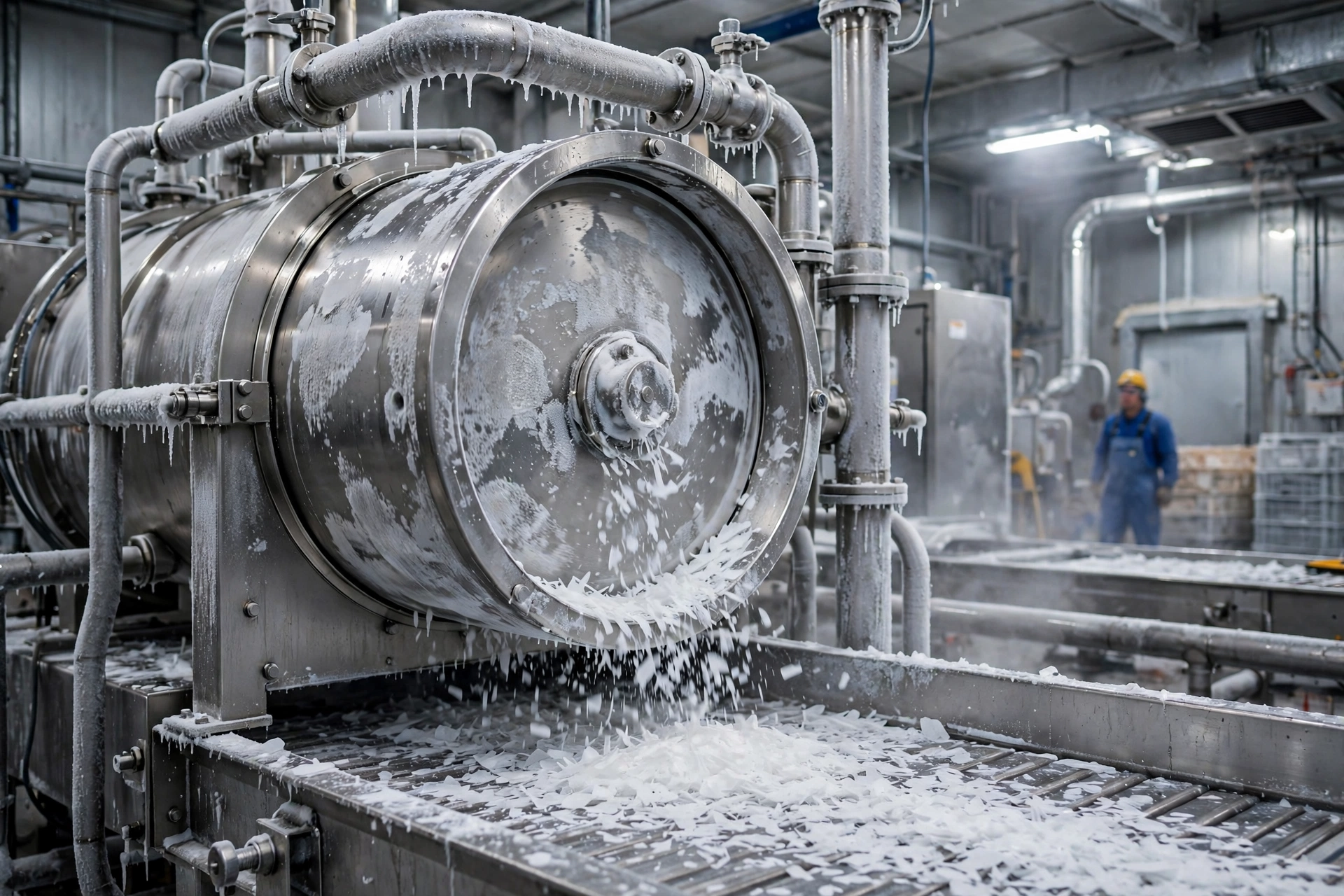
Flake ice is the ice of the fishing port: thin flakes 1.5–3 mm thick at −5 °C to −8 °C, dry and subcooled, that pack around a fish and pull heat out of it faster than any other form. It is also the most expensive ice to make in a hot climate, at 70–85 kWh per tonne in the tropics against 50–60 kWh in a temperate one, because the drum has to stay cold while the make-up water arrives warm. A 50 t/day flake plant in the tropics therefore needs 3,500–4,250 kWh a day and a peak supply of 75–190 kW, and the generator for it is a 250–350 kVA set. The flake machine itself is small — a drum motor of a few kilowatts — so the load is almost all compressor, tower and pumps, and it is steady once it is running. The risk is not the surge. It is the duration: a flake plant that loses power for a day loses a day’s production, and the boats that land the next morning have no ice to buy.
Tube ice — the packaged-ice and drinks plant
Tube ice is the ice of the bag and the bottle: hollow cylinders about 50 mm in diameter with 10–12 mm walls, frozen on the inside of vertical tubes and cut into lengths. It is the cheapest ice to make per tonne in the tropics at 55–70 kWh, and the Bureau of Energy Efficiency’s measured 10 t/day plant ran at 73.88 kWh per tonne on a 50 HP compressor, a 1 HP cutter, a 1 HP chilled-water pump and a 50 TR cooling tower — drawing 34.11 kW at 80% load and making 138.5 kg every 18 minutes. A 10 t/day tube plant runs on 100–150 kVA once the store fans, the bagging line and the starting surge are counted, and a 20 t/day plant on 150–250 kVA. Tube ice is also the ice that stores best in a retail store, because the cylinders stack and drain, and a packaged-ice plant that runs tube machines can hold 2–4 days of sales in the store — the longest buffer of the three types, and the reason a tube plant can survive a four-hour outage that would close a flake plant.
Block ice — the boat and long-haul plant
Block ice is the oldest form and the slowest: water frozen in metal cans immersed in a brine tank at about −10 °C, in blocks of 5–150 kg that melt slowest per kilogram of any ice type. It is the ice of the fishing boat and the long road, because a block in an insulated hold is still a block three days later, and it is crushed at the point of use. It is also the most expensive to make per tonne in practice: the Bureau of Energy Efficiency measured a block plant at 120.7 kWh per tonne, against 73.88 for the tube plant that replaced it, on a 45 kW compressor with a 5 HP agitator and a 5 HP condenser pump. A 20 t/day block plant needs 150–250 kVA, and a 50 t/day plant 300–400 kVA, because the brine tank has to be held cold around the clock and the cans have to be lifted, thawed and refilled in a batch cycle that cannot be paused halfway. Block plants also take the most floor — 190 m² for the ice maker at 50 t/day, against 2.7 m² for flake — which is why new plants rarely choose block ice unless the customer is a boat.
| Plant size | Ice type | Running load (kW) | Generator size (kVA) | Fuel at 75% load (L/h) | 72-hour fuel (L) |
|---|---|---|---|---|---|
| 5 t/day packaged ice | Tube | 15–25 | 30–50 | 8–12 | 600–900 |
| 10 t/day packaged ice | Tube | 40–60 | 100–150 | 12–18 | 900–1,300 |
| 20 t/day fishing port | Flake | 60–100 | 150–250 | 20–30 | 1,500–2,200 |
| 50 t/day fishing port | Flake | 160–220 | 250–350 | 40–55 | 2,900–4,000 |
| 50 t/day block plant | Block | 180–240 | 300–400 | 45–60 | 3,300–4,300 |
| 100 t/day port plant | Flake | 350–500 | 500–750 | 85–120 | 6,100–8,600 |
The fuel column uses the planning figure of roughly 0.22 litres per kWh from the generator, and the 72-hour column is the reason the fuel tank is a design decision, not an accessory. A 50 t/day flake plant at 40–55 L/h needs about 3,000–4,000 litres for three days, which is a bulk tank, not a day tank, and the tank has to be filled before the outage, not during it. The diesel fuel ageing rule applies here with force: a standby set in a coastal ice plant can sit for months between runs, and diesel that has sat in a warm, humid tank grows water and microbes. The fuel in the bulk tank is the plant’s third day of production, and it has to be tested and polished on a schedule, not discovered to be bad at two in the morning.
Two sizing rules deserve emphasis. The first is the reserve: ice-machine makers advise sizing at peak daily sales plus 25–30%, and the generator should carry the same reserve, because a plant that runs at 100% of its generator’s rating on a normal day has no room for a hot afternoon, a second compressor start or a store fan that cuts in at the wrong moment. The second is the rating: a set that runs 12–16 hours a day through a long outage is a prime-power set, not a standby set, and the standby and prime ratings decide how long it can hold that load without shortening its life. A 500 kVA standby set is a 455 kVA prime set — the Cummins C500D5 carries exactly those two numbers — and a plant that sizes on the standby figure and then runs prime duty will find the difference in the engine’s oil analysis a year later.
Starting Surge: Ammonia Compressors, Ice Cutters and the Restart Sequence
The starting surge is where ice plants catch buyers out, because the largest motor in the plant is also the one that has to start first. An ammonia screw compressor of 75 kW draws 450–525 kVA for a few seconds on a direct-on-line start — 6–7 times its running current — and a 110 kW compressor draws 660–770 kVA. A generator sized for the running load alone will dip, the voltage will sag, the compressor’s contactor will drop out, and the set will be standing in a dark plant with a compressor that will not stay running. The motor starting rule is the same as in any industrial plant, but the stakes are higher here, because the compressor is not one load among many. It is the plant.
The fix is a combination of three things, and all three belong in the specification before the order is placed. The first is the starter: a star-delta starter cuts the surge to about 3 times running current, a soft starter to about 2.5–3 times, and a variable-speed drive to about 1.5 times. A 75 kW compressor on a soft starter asks the generator for roughly 225 kVA instead of 500 kVA, and the difference is a smaller set, a smaller fuel bill and a smaller price. The second is the sequence: the automatic transfer switch transfers the load in stages, not all at once — controls and store fans first, then compressor one, then compressor two 10–15 seconds later, then the ice machine, then the conveyors and the bagging line. The third is the load-shedding rule: the bagging line, the air compressor and the office air conditioning do not start until the compressors are running and stable, and the controller sheds them automatically if the frequency dips.
The restart after an outage has one more trap that does not exist in other plants: the brine and the ice in the machine. A flake machine that stops mid-cycle leaves a drum half-covered in ice and a scraper frozen to it, and a tube machine leaves tubes half-frozen with water standing in them. Restarting the drum motor against a frozen load draws a locked-rotor current that the generator has to absorb, and a block plant that stops mid-freeze leaves cans of half-frozen water in a brine tank that has started to warm. The restart sequence has to include a thaw and a check — the drum turns freely, the tubes are clear, the brine is at temperature — before the compressor is loaded, and the operator has to be trained to do it. A plant that restarts by throwing every breaker at once will trip the generator, and the second start is always harder than the first, because the first one has already warmed the brine and melted the ice that was holding the store cold.
The NFPA 110 10-second rule is the standard that decides how fast the set has to be there. Life-safety and critical loads must be back within 10 seconds of a mains failure, and an ice plant that serves a fishing port or a hospital’s cold chain is effectively a critical load, even if no code calls it one. The set has to crank, reach speed, accept the first load stage and hold voltage within that window, and the only way to know it will is to test it under the real load — once a month, transfer the actual plant onto the generator and watch it for an hour. The weekly fifteen-minute no-load exercise proves the engine starts. It proves nothing about the compressor.
Three Outages That Show What an Ice Plant Loses
Case 1 — The fishing port that ran out of ice before the boats came in
A 30 t/day flake plant serves a tropical landing station where the daily catch is 20 tonnes. At the tropical rule of 1.5–2 kg of ice per kilogram of fish, the port needs 30–40 tonnes of ice a day, and the plant makes it through the night and holds it in a 60-tonne store. The mains fail at 02:00, in the middle of the production run. The store holds 35 tonnes of ice, the plant stops making more, and the boats land at 06:00. By then the store has lost a few tonnes to melt in the warm morning, and the first boats take what is there. The second wave of boats, landing at 09:00, finds the store empty, and the fish goes into boxes with half the ice it needs or no ice at all. The catch that is not iced at 0 °C within hours loses value by the hour, and the boats that cannot buy ice do not come back tomorrow — they land at the next port, where the plant has a generator. The plant’s own loss that day is 30 tonnes of production, about 2,100–2,550 kWh of electricity it did not use and the revenue on the ice it did not sell. The port’s loss is larger: a day’s catch sold at a discount, and a reputation that takes a season to rebuild. A 250 kVA set, running the compressors and the store fans at about 35 L/h, would have held the plant through the outage for less than the price of one boat’s catch.
Case 2 — The concrete pour that could not wait
A ready-mix plant in the Gulf is pouring the raft foundation of a tower: 500 m³ of concrete, specified to place at no more than 20 °C in 42 °C ambient heat. The mix design calls for 50 kg of flake ice per cubic metre, which is 25 tonnes of ice, and the flake plant on the batching site makes 20 tonnes a day and holds the rest in an insulated bin sized at half a day’s production. The mains fail at 22:00, eight hours before the pour. The flake machine stops, the bin holds 12 tonnes, and the batching plant’s own 200 kVA set — bought for the office and the batching controls — cannot carry the ice machine’s compressor as well. At 06:00 the pour is called off, because 12 tonnes of ice cools 240 m³, not 500 m³, and a half-cooled pour is a rejected pour. The batching plant loses the day, the pump trucks and the finishing crew are paid to stand, and the tower’s programme slips a day. The ice plant’s loss is 13 tonnes of ice it did not make. The project’s loss is the programme, and the programme is the money. A 150 kVA set dedicated to the flake machine, at about 25 L/h, would have made the 13 tonnes overnight for roughly 200 litres of diesel.
Case 3 — The packaged-ice plant in a heatwave weekend
A 10 t/day tube plant in a coastal city sells bagged ice to petrol stations, supermarkets and bars. The plant sizes its machines at peak daily sales plus 25%, holds 2–4 days of sales in the store, and the store is full on a Friday afternoon in a heatwave — 25 tonnes of tube ice, bagged and stacked. The mains fail at 17:00 on the Friday, the bagging line stops, and the store’s refrigeration stops with it. The ice in the store is tube ice, which holds better than flake, but the store doors open every time a truck is loaded, and the store warms through the night. By Saturday morning the top of the stack is wet, the bags at the edge are soft, and the plant has lost the two days of sales that are its best days of the year. The plant’s own numbers are small — a 10 t/day tube plant draws about 34 kW on the machine and runs on a 100–150 kVA set at 12–18 L/h — and the loss is large, because the weekend is the week. The plant that had a generator delivered its 25 tonnes and took the competitor’s customers as well. The plant that did not spent the weekend watching its store turn to water.
Ammonia, Water and Placement: Running a Generator in a Humid, Corrosive Plant
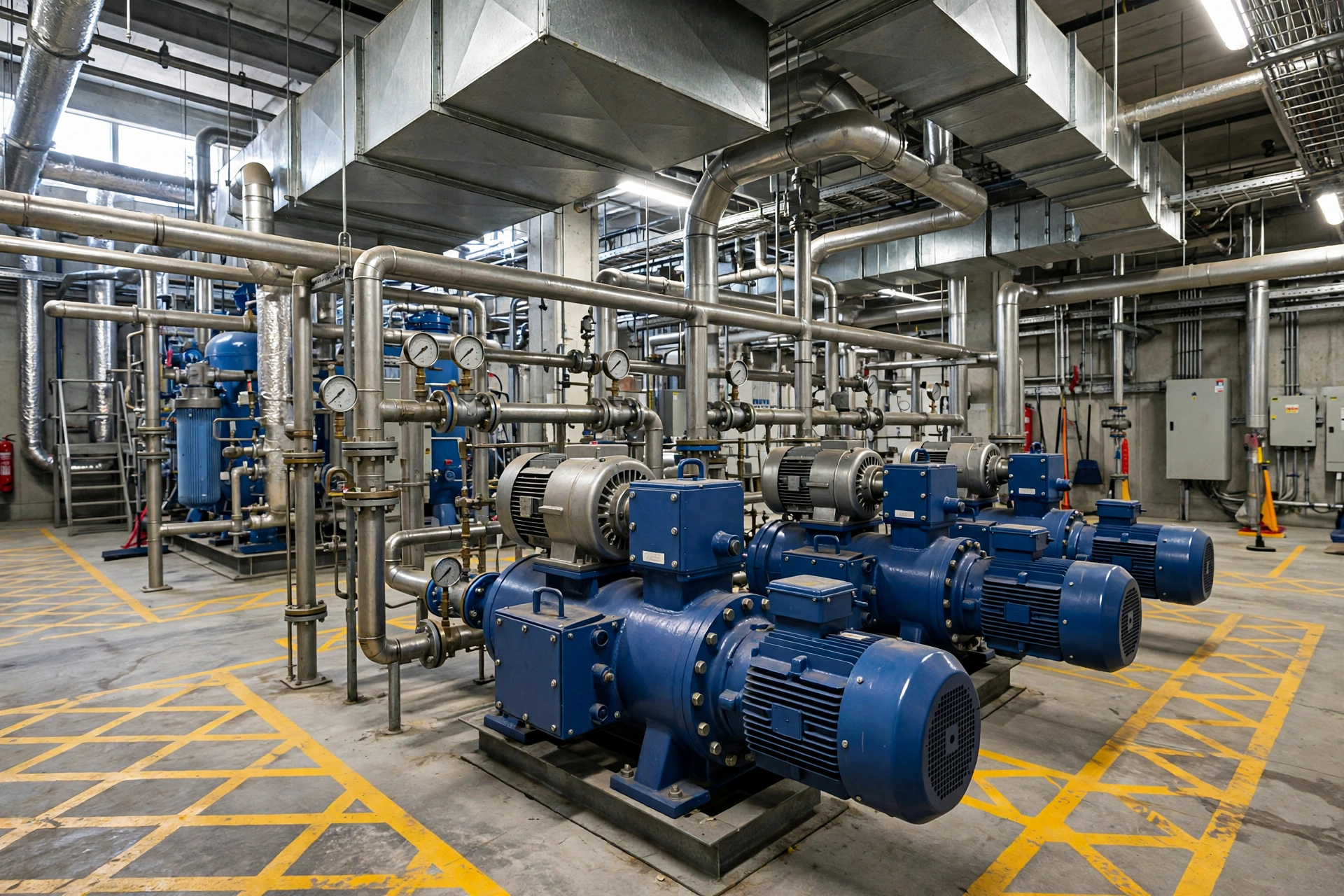
An ice plant is a hard place to put a generator, because the two things the plant runs on — ammonia and water — are both hostile to it. The refrigeration is almost always ammonia, and ammonia is a toxic gas with a sharp smell that fools people into trusting their nose. The exposure numbers are the ones that decide the placement, and they are not negotiable.
Ammonia safety is a generator-placement rule
Ammonia’s permissible exposure limit is 50 ppm as an eight-hour average, and the level immediately dangerous to life or health is 300 ppm. The industry standard sets the alarms lower: a warning at 25 ppm, emergency ventilation at 150 ppm, and a full shutdown of compressors, pumps and valves at 10,000 ppm, which is 1% by volume. The lower explosive limit is 15%, and any facility holding more than 10,000 lb of ammonia must file a risk management plan with the environmental regulator. The generator must not sit in the machinery room’s air path, downwind of a relief vent, or anywhere a leak can reach its air intake. Ammonia vapour is lighter than air and rises, so the set belongs outside the machinery room, on the far side of the building from the relief stack, with its own ventilation and its own air supply. The machinery-room ventilation fans, the ammonia detectors and the alarm panel are first-priority loads on the generator board, because a power cut that stops the ventilation in a room with a slow leak is worse than a power cut that stops the ice machine. A generator that breathes ammonia will not last long, and a generator room that fills with ammonia is a room nobody can enter to restart the set.
Water, salt air and corrosion
The second hostile thing is water. An ice plant makes ice from food-grade water, and the make-up water temperature is one of the main reasons the energy per tonne varies so much between plants: warm make-up water in the tropics is why flake ice costs 70–85 kWh per tonne there and 50–60 kWh in a temperate climate. The water treatment — softener, reverse osmosis, pumps — is a load on the generator board, and it has to restart with the compressors, because a plant that makes ice from untreated water makes ice that no food customer will buy. The plant is also wet everywhere else: condensation on every cold surface, washdown water on the floor, and salt air if the plant is on the coast, which most fishing-port plants are. A generator in that environment needs a canopy that is genuinely weatherproof, a radiator that is cleaned on schedule, and an air filter that is changed more often than the manual says. Stainless fasteners, a raised plinth and a bunded fuel tank are not luxuries in a coastal ice plant. They are the difference between a set that starts in year five and a set that has rusted through its own base frame.
Fuel, placement and the cold-store lesson
The third rule is the one the cold storage article states for frozen warehouses, and it applies to ice plants word for word: the store is the buffer, and the generator is what keeps the buffer from melting. An ice store held at −10 °C to −12 °C is a cold room, and the same load-cycling rule applies — compressors cycle, the load at night with the doors shut can drop to 30–40% of the rated load, and a generator that runs for hours at light load will wet-stack. The maintenance schedule has to include a monthly loaded test, not just the weekly no-load exercise, and the test has to transfer the real plant — compressors, tower, store fans — onto the set and hold it there for an hour. The fuel tank belongs in a bund, away from the ammonia relief stack, with the transfer pump on the generator board so the day tank fills during an outage. A 50 t/day plant that needs 3,000–4,000 litres for three days cannot be refuelled by jerry can, and the fuel truck that delivers during a regional outage is the truck that is already booked by every other plant on the road.
Frequently Asked Questions
What size generator does an industrial ice plant need?
A 10 t/day tube-ice plant runs on 100–150 kVA, a 50 t/day flake-ice plant needs 250–350 kVA, and a 100 t/day port plant needs 500–750 kVA. The size depends on daily tonnage, ice type and the starting surge of the ammonia compressors, and the only reliable way to set it is a load list that includes the cooling tower, the pumps, the store fans and the bagging line, not just the ice machine.
Do industrial ice plants need a backup generator?
Yes, if the plant serves customers who cannot wait — fishing ports, concrete pours and packaged-ice retail. Ice is a perishable product with no shelf life once the refrigeration stops, and the plant’s customers lose their catch, their pour or their weekend in the same hours the plant loses its production. A plant that sells only to a cold store with days of buffer can manage without one; a plant that sells to boats landing at dawn cannot.
How long can an industrial ice plant run on a generator?
As long as the fuel holds out. A 50 t/day flake plant burns roughly 40–55 litres an hour at 75% load, so a 4,000-litre bulk tank gives about 72 hours, and a 10 t/day tube plant at 12–18 L/h runs three days on about 1,000–1,300 litres. The limit is the fuel contract and the fuel quality, not the engine, and a standby set run for days on end is doing prime-power duty and should be rated for it.
What happens to an ice plant during a power outage?
Production stops at once, the store starts to warm, and the ice already made begins to melt — fastest for flake ice, slowest for block ice. The brine in a block plant warms, the drum of a flake machine freezes to its scraper, and the tubes of a tube machine stand half-frozen with water in them. The customers who were due that morning — the boats, the pour, the retail trucks — buy from a competitor or go without, and a plant that restarts by throwing every breaker at once will trip the generator and make the second start harder than the first.
Can a diesel generator power an industrial ice plant?
Yes, and it is the standard backup for plants from 5 t/day packaged-ice operations to 100 t/day port plants, from 30 kVA to 750 kVA. The set has to be sized for the ammonia compressor’s starting surge — 6–7 times running current on a direct start, less with a soft starter or variable-speed drive — and the load has to transfer in stages, with the compressors starting one at a time and the bagging line last.
Specification Checklist: Ten Lines Before the Deposit
- Daily tonnage and ice type in writing — flake, tube or block, at t/day, with the FAO energy figure for that type in your climate, not the supplier’s best-case number.
- Full load list, not just the ice machine — compressor, cooling tower, brine and condenser pumps, store fans, water treatment, conveyors, crusher, rake and bagging line, each with running and starting kW.
- Compressor starting method specified — direct-on-line, star-delta, soft starter or variable-speed drive, with the surge in kVA at the generator’s terminals.
- Generator rating matched to duty — standby or prime, with the standby and prime ratings in the quotation and the expected running hours per outage stated.
- Staged transfer and load shedding in the controller — store fans and controls first, compressors one at a time 10–15 seconds apart, bagging line and air conditioning last, with automatic shedding if the frequency dips.
- Fuel autonomy in litres, not hours — 72-hour bulk tank sized from the measured L/h at 75% load, with a transfer pump on the generator board and a fuel-testing and polishing schedule in the contract.
- Ammonia safety in the placement — set outside the machinery room and away from relief vents, detectors and ventilation fans on the generator board, alarms at 25 ppm and ventilation at 150 ppm.
- Monthly loaded test in the maintenance contract — transfer the real plant onto the set under load for an hour, not a fifteen-minute no-load exercise, with the results logged.
- Cold-store and fish-farm loads covered — the store’s cycling load and the fish farms that buy the ice are in the load list, so the set is not surprised by a night load of 30–40% or a dawn surge.
- Factory acceptance test witnessed — full load-bank test at the factory, step loads recorded, voltage and frequency dip measured at compressor start, report in hand before the balance is paid.
An ice plant’s generator is not bought for the day the power fails. It is bought for the morning after — the boats at the quay, the pour at six, the trucks at eight — and the only test that matters is the one that runs the real plant, under the real load, before the outage happens. For a sized quotation on a set for your ice plant, with the load list and the fuel autonomy worked out for your tonnage and ice type, contact PAVO.