

What Size Generator Does a Seafood Plant Need? | PAVO
A seafood processing plant does not make a product that waits. The fish starts dying the moment it leaves the water, and a plant that loses power on a Friday afternoon has a weekend of spoiling stock and a Monday of rejected containers to answer for.
What size generator does a seafood processing plant need? A 5 t/day shrimp line runs on 200–250 kVA, a 10 t/day line needs 400–500 kVA, and a 50 t/day plant needs 1,500–2,000 kVA. Size depends on daily throughput, whether the plant blast-freezes, and which refrigeration compressors start together.
This article works through the load list of a real seafood processing plant, the energy numbers per tonne that set the running cost, the starting surge of ammonia compressors and IQF tunnel fans, the damage windows that turn a short outage into a condemned lot, and the HACCP and ammonia rules that decide where the set may stand. It covers shrimp lines, whitefish filleting plants and large integrated plants, with the fuel, placement and specification numbers a buyer needs before paying a deposit.
Contents
- The Seafood Plant’s Clock: Spoilage Measured in Hours
- What a Seafood Processing Plant Actually Runs: The Load List
- Sizing by Plant Type: From a 5 t/day Shrimp Line to a 100 t/day Plant
- Starting Surge: Ammonia Compressors, Blast Freezer Fans and the Restart Sequence
- Three Outages That Show What a Seafood Plant Loses
- Cold Chain, HACCP and Placement: Running a Generator in a Wet, Corrosive Plant
- Frequently Asked Questions
- Specification Checklist: Ten Lines Before the Deposit
The Seafood Plant’s Clock: Spoilage Measured in Hours
Fresh fish spoils within two to four hours without cooling. That figure comes from the refrigeration industry, not from a brochure: once the compressors stop, the product on the receiving dock, in the filleting hall and in a half-loaded blast freezer starts warming immediately, and the bacteria that cause spoilage double every twenty minutes once the temperature enters the danger zone of 40 to 140 °F (4.4 to 60 °C). A seafood plant is therefore one of the few industrial sites where the cost of a power cut is measured in hours rather than days, and where the generator is a food-safety device before it is a power device.
The regulatory clock is even shorter than the biological one. Under the US FDA food-safety rules that most export buyers apply, refrigerated perishable food held above 40 °F (4.4 °C) for four hours or more must be discarded, and food left at room temperature for more than two hours — one hour if the air is above 90 °F — goes the same way. A refrigerator keeps food cold for about four hours if the door stays shut. A full freezer holds its temperature for approximately 48 hours, a half-full one for about 24 hours. Those numbers describe a domestic fridge, but the principle scales directly to a processing plant: the chilled raw material has hours, the frozen stock has days, and the batch sitting in a blast freezer at the moment the power fails has minutes.
The distinction matters because it decides what the generator must protect first. The receiving dock holds the day’s catch on flake ice, and the ice is the first thing to go: ice machines stop with the power, and the two tonnes of flake ice that accompany every tonne of fish through a typical Indian plant (TERI Veraval cluster data) start melting the moment the machine stops. The filleting hall holds fish that has already been opened, washed and graded — the most perishable stock in the building, because the protective skin is gone and the surface area is large. The blast freezer holds a batch that is half-frozen, and a half-frozen batch cannot be finished later; it has to be thawed, re-graded and sold at a lower grade, or discarded. The cold store, by contrast, holds finished product at −18 °C or below in a room set near −24 °C, often for up to three months before dispatch, and a well-insulated, full cold store buys the plant one to two days. The generator board must reflect that order: cold store compressors and blast freezers first, then ice machines and water pumps, then the filleting line, then the offices and the yard lights.
There is a second clock that buyers often miss, and it is the one the export contract enforces. Most seafood plants sell to buyers who audit the temperature log. A gap in the log — four hours with no recorded temperature, or a cold-store trace that climbs above −18 °C and comes back down — is enough for a buyer to reject the lot, even if the product tests clean afterwards. The rejection is not a negotiation; it is a clause. A plant in Veraval, Cochin or Bhubaneswar that ships to the EU or the US runs a HACCP plan that treats temperature as a critical control point, and a power cut that breaks the record breaks the shipment. The generator does not only keep the fish cold. It keeps the paperwork continuous, and the paperwork is what gets the container through the port.
| Product stage | Safe window without power | What is lost when the window closes |
|---|---|---|
| Fresh fish on ice, receiving dock | 2–4 hours | Quality grade falls, then spoilage; the lot is downgraded or rejected |
| Chilled fillets and peeled shrimp, processing hall | 2–4 hours above 40 °F | FDA 4-hour rule: discard; HACCP lot condemned |
| Batch in a blast freezer or IQF tunnel | Minutes to 1 hour | Half-frozen batch cannot be finished; re-grade or discard |
| Frozen stock, full cold store at −24 °C | About 48 hours, doors shut | Temperature rises above −18 °C; buyer rejects on the temperature log |
| Frozen stock, half-full cold store | About 24 hours, doors shut | Same as above, in half the time |
| Flake ice in the ice store | Hours | Melts; the next day’s catch cannot be iced |
The rest of this article follows the same order a buyer should follow. First the load list, then the sizing table, then the starting surge and the restart sequence, then three outages that show what the losses look like in practice, then HACCP, ammonia and placement, then the specification checklist.
What a Seafood Processing Plant Actually Runs: The Load List
A seafood plant’s electrical load looks simple on a single-line diagram and behaves badly in practice. Almost everything on the list is either a refrigeration compressor or a motor, the two largest compressors start with a surge that can pull the voltage down by a fifth, and the whole line has to start in sequence — receiving before filleting, filleting before freezing, freezing before cold storage. A generator that cannot carry the starting sequence cannot carry the plant, however generous its running rating looks on paper.
The energy split is the first thing to understand, because it decides where the money goes. In the TERI cluster profile of Veraval, one of India’s largest seafood processing centres, a tonne of fish takes 930 to 1,060 kWh to process, against a cluster average near 1,100 kWh per tonne. Cold storage takes about 40% of that electricity, freezing 30%, and ice making 13%. Water supply and treatment take 5%, air conditioning of the processing hall 5%, lighting 2%, and the remaining 5% is everything else. The split is the plant’s signature: seven tenths of the bill is refrigeration, and refrigeration is what the generator must carry.
The Norwegian figures tell the same story from the other end of the industry. SINTEF’s energy study of fish processing found a whitefish plant using 794 kWh per tonne of product — 661 kWh for filleting and 133 kWh for freezing — and a salmon plant using 701 kWh per tonne, 568 kWh for filleting and 133 kWh for freezing, an average of 748 kWh per tonne. The filleting figure is high because it includes the whole processing hall: conveyors, filleting machines, wash water pumps, grading and packing. The freezing figure is low because it is only the freezer’s share of a plant that freezes a modest part of its output. A shrimp plant in Bhubaneswar, which freezes almost everything it processes, averages about 1,520 kWh per tonne — from 1,100 kWh per tonne in a large plant in season to 2,850 kWh per tonne in a small one off-season — and the diesel generator sets on those sites supply under 10% of the plant’s energy. The per-tonne figure is a cost metric, not a sizing metric: cold stores run 24 hours a day whether the line is running or not, so a plant at 40 to 60% utilisation, which is the Bhubaneswar average, burns far more per tonne than a plant running flat out. The generator is sized on the connected load, not on the energy bill.
Receiving, washing and icing: small motors, constant running
Fish arrives by truck or boat, is weighed, sampled and tipped into a receiving tank, then washed, graded and iced. None of these motors is large — a wash-water pump runs 5.5 to 15 kW, a grader 3 to 7.5 kW, a conveyor 2.2 to 7.5 kW — but they run for most of the shift, and they all start at the same time when the line starts. The ice machines are the largest load in this group, and the easiest to underestimate. The Bureau of Energy Efficiency guideline for block ice is 70 to 100 kWh per tonne of ice, and a plant that uses two tonnes of flake ice for every tonne of fish needs an ice machine sized on the next day’s catch, not on today’s. A 10 t/day plant needs 20 tonnes of flake ice a day, which is 1,400 to 2,000 kWh of ice-making electricity — a 15 to 25 kW machine running 16 hours, or a larger machine running in a shorter window. The ice machine must be on the generator board. A plant that can freeze fish but cannot ice the next morning’s catch is a plant that cannot receive fish.
Refrigerated seawater (RSW) tanks, used on larger plants and on factory trawlers’ shore bases, sit in the same group. The RSW system chills the catch to near 0 °C within hours of landing, and its pumps and compressors run continuously from the moment the first truck arrives. It is a small load and a large quality item: fish chilled in RSW within four hours of capture keeps its grade, and fish that waits on the dock does not.
Filleting, peeling and grading: the hall that never stops moving
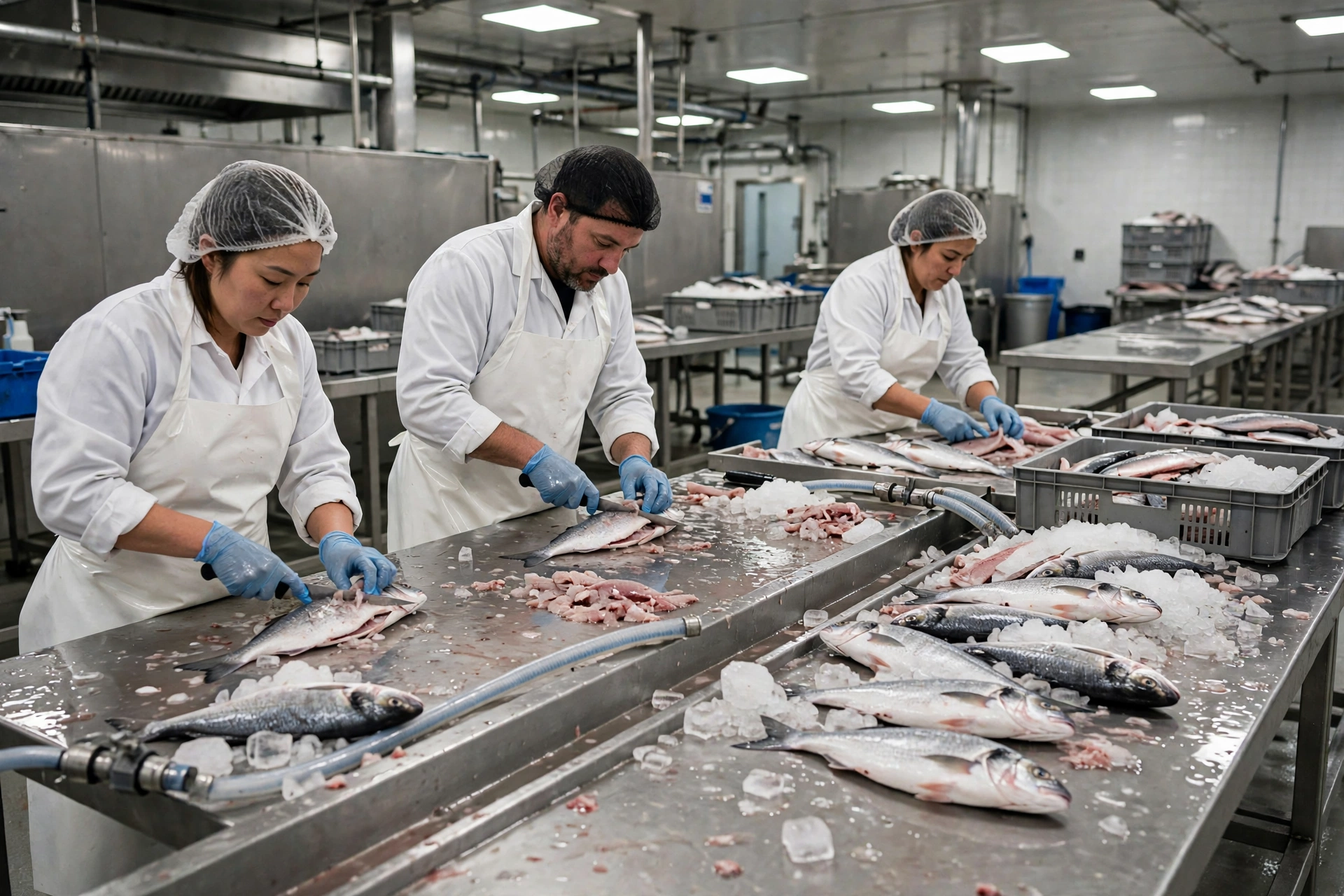
The processing hall is where the per-tonne energy goes. Filleting machines, shrimp peeling lines, skinning machines, graders, conveyors and wash-water pumps run together for the whole shift, and the load is steady rather than spiky — which is good for the generator, because a steady load is easy to carry, and bad for the fuel bill, because there is no quiet period to recover in. A workshop-scale example published by a refrigeration supplier puts the numbers in perspective: blast freezing 80 kW, cold storage 40 kW, processing 30 kW, about 150 kW in total for a small plant. The processing hall is the smallest of the three, and it is also the load that must restart first after a transfer, because the fish on the line cannot wait for the freezers to catch up.
Shrimp peeling deserves a note of its own, because it is the labour-intensive heart of the export shrimp trade and the reason many plants run two shifts. A peeling line is a row of tables with wash water, conveyors and grading belts, and its electrical load is modest — 15 to 30 kW for a line handling 5 tonnes a day — but its water load is not. The plant’s water pumps, effluent treatment and ice supply all scale with the peeling line, and they all sit on the same generator board. A generator specification that covers the peeling tables but forgets the effluent pumps will be undersized by a margin that shows up the first time the plant restarts after a transfer.
Freezing: the load that decides the generator
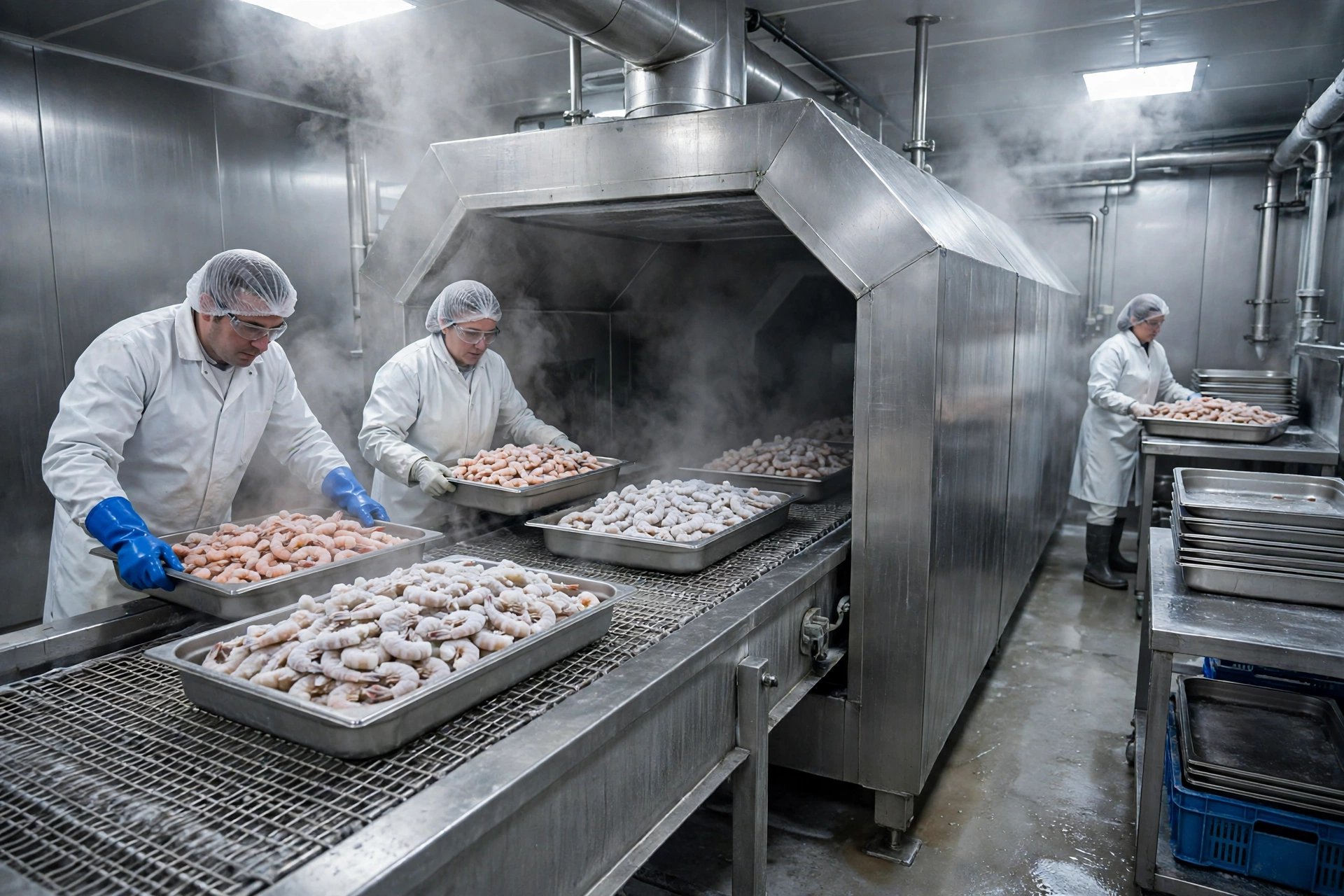
Freezing is the largest single electrical load in a seafood plant and the hardest to start. A blast freezer blows air at −40 °C across the product for two to four hours a batch. An IQF tunnel freezer runs continuously at −30 to −40 °C, carrying shrimp or fillets on a mesh belt through a stream of high-velocity cold air, and freezes them individually in five to ten minutes for shrimp, about fifteen minutes for an IQF line running EU orders. A plate freezer presses consumer packs of seafood between refrigerated plates. A brine tunnel freezes sardines in a salt solution at −25 °C in about 26 minutes. Each type has its own load profile, and each one punishes a generator that was sized on the average.
The numbers come from the equipment manufacturers. A mesh-belt IQF tunnel runs 50 to 400 kW in total depending on size, with evaporator fan power of 5 to 30 kW per row and four to twelve rows. A small tunnel handling 500 to 800 kg/h draws about 50 kW; a medium tunnel at 1,500 to 2,500 kg/h draws about 120 kW; a large tunnel at 2,500 to 4,000 kg/h draws about 180 kW; a spiral tunnel at 3,500 to 5,000 kg/h draws about 220 kW. The fans are the trap: they run continuously, they add heat to the tunnel as they run — SINTEF’s study specifically warns against unnecessary fan use inside freezing tunnels, because the fans use energy and add heat — and they all start at once when the tunnel restarts. A tunnel that draws 120 kW running can draw 300 kW for the first seconds of a restart, and a generator that was sized on the running figure will trip on the restart.
The refrigeration plant behind the freezers is usually ammonia, R717, and its compressors are the largest single motors on the site. A study of deep freezing in the Indian seafood industry modelled a blast freezer with 60 kW (17.1 TR) of cooling capacity operating at −42 °C, and found an ammonia/CO2 cascade system running at a COP of 1.33 to 1.42 against 0.81 to 0.95 for an R404A system — a 35% improvement. The same study records a real installation at NAS Fisheries in Cochin: a Bitzer compressor providing 350 kW (99.5 TR) of refrigeration at −40 °C, with ammonia condensing CO2 at −5 °C and CO2 pumped at −40 °C to the IQF flooded evaporators. A 350 kW refrigeration compressor driven by a 200 to 250 kW electric motor is a normal size for a mid-size plant, and its starting current is the number that sizes the generator’s alternator, not the running load. The companion guide to cold storage backup power covers the cold-store side of this load in detail, and the motor starting guide covers the starting-current arithmetic.
Cold storage, water and the air compressor
The cold store is the load that never switches off. Stores are set near −24 °C to keep product at −18 °C or below, often for up to three months before dispatch, and the compressors cycle day and night to hold that temperature. A 10 t/day plant typically holds 200 to 800 tonnes in cold store, and the store’s share of the electricity bill — 40% in the Veraval profile — reflects that it runs while the line sleeps. On the generator, the cold store is a base load of 40 to 150 kW depending on the size of the store, and it is the first load the transfer switch must pick up, because it is the only load whose failure destroys three months of finished product in a single day.
Water supply and treatment take about 5% of the plant’s electricity, and the air compressor is the load most often forgotten. A mid-size plant’s air compressor consumes 30 to 75 kW, running the pneumatic conveying, the packing lines and the dust-collection pulse jets. It starts on its own timer and draws a surge of its own. A generator specification that omits the compressor will be undersized by a margin that shows up the first time the plant restarts after a transfer. The fish farms guide covers the aeration and pumping loads that feed a plant from the farm side, and the food processing plants guide covers the production-line loads that a seafood plant shares with other food factories.
| Process step | Share of plant electricity | Typical load, 10 t/day plant | Notes |
|---|---|---|---|
| Cold storage | About 40% | 60–150 kW | Runs 24 h; first load on the generator board |
| Freezing (blast, IQF, plate) | About 30% | 120–250 kW | Fans 5–30 kW per row; restart surge 2–3× running |
| Ice making | About 13% | 15–30 kW | 70–100 kWh/t of ice; ~2 t ice per tonne of fish |
| Processing hall (filleting, peeling, grading) | 10–15% | 30–60 kW | Steady load; must restart first after transfer |
| Water supply and treatment | About 5% | 10–20 kW | RSW tanks, wash water, effluent pumps |
| Air conditioning, lighting, other | About 7% | 15–30 kW | Hall cooling, offices, yard lights |
| Whole plant, shrimp, 10 t/day | 100% | 300–400 kW running | 930–1,520 kWh per tonne processed |
Sizing by Plant Type: From a 5 t/day Shrimp Line to a 100 t/day Plant
The sizing rule for a seafood plant is simple to state and easy to get wrong: add up the connected load, add the starting surge of the largest motor, and apply the site derating for heat, altitude and the age of the set. The per-tonne energy figure — 930 to 1,520 kWh per tonne — is a cost metric, not a sizing metric, because the cold store runs 24 hours a day and the plant runs at 40 to 60% utilisation in the off-season. A plant that sizes its generator from the energy bill will buy a set that is too small by a third, and will discover the error the first time the ammonia compressors and the IQF fans try to start together.
The worked example below is a 10 t/day shrimp line, and it is the figure a buyer should be able to reproduce on one page. The IQF tunnel draws 120 kW, the blast freezer 80 kW, the cold-store compressors 60 kW, the ice machines 25 kW, the processing hall 45 kW, and the water pumps, lighting and hall cooling 20 kW. That is 350 kW of running load, which at a power factor of 0.8 is 437 kVA before any starting surge is added. The largest single motor is a 75 kW ammonia screw compressor, which on direct-on-line starting draws six times its running current — about 450 kW of transient demand, or roughly 560 kVA for the first seconds. A 500 kVA set with a modern alternator, subtransient reactance around 0.12 per unit, dips about 20% on that step, which is inside the ISO 8528 G2 limit and will not drop out the compressor contactors. Fit a soft starter or a variable-frequency drive to that compressor, and the step falls to about 150 kVA, and the same plant runs comfortably on a 400 kVA set. The generator sizing guide explains how to build the load list and add the starting surge; the standby and prime ratings guide explains why the duty rating matters as much as the size.
Duty is the part of the decision that costs the most when it is wrong. A shrimp plant that runs two shifts, six days a week, through a six-month season is a prime-power application, not a standby one, and a standby-rated set run at prime duty will age fast and fail early. The rating on the datasheet is not a marketing number: a 500 kVA standby set is a 455 kVA prime set on the Cummins C500D5, and the prime rating is the one that applies when the set runs more than a few hundred hours a year. A plant on an unstable grid in a coastal district of India, Vietnam or West Africa, where the mains fails weekly and the set runs 1,500 to 2,000 hours a year, must buy on the prime rating, and must budget for the maintenance schedule that goes with it — oil and filters every 250 to 500 hours, not once a year.
| Plant type | Capacity | Typical running load | Generator size | Duty |
|---|---|---|---|---|
| Small shrimp line | 5 t/day | 120–160 kW | 200–250 kVA | Standby / prime |
| Mid-size shrimp or fish line | 10 t/day | 300–400 kW | 400–500 kVA | Prime |
| Large shrimp plant | 25 t/day | 700–900 kW | 1,000–1,250 kVA | Prime |
| Integrated plant, blast + IQF + cold store | 50 t/day | 1,200–1,500 kW | 1,500–2,000 kVA | Prime |
| Mega plant, multiple lines | 100 t/day | 2,400–3,000 kW | 3,000–3,750 kVA, or 2 × 1,500–2,000 kVA in parallel | Prime |
The table is a starting point for a load list, not a substitute for one. Every figure assumes the set carries the full plant, including the ice machines, the water pumps and the air compressor, and every figure assumes the largest compressor starts on a soft starter or a variable-frequency drive. A plant that starts its ammonia compressors direct-on-line needs a set one size larger than the table shows, and a plant at 1,500 metres altitude or in 45 °C heat needs a further derating of 10 to 15%.
Fuel is the second half of the sizing decision, because the generator does not get tired — the fuel tank is the clock. A 500 kVA prime set burns 93.2 litres an hour at full prime load, which is the Cummins C500D5 datasheet figure, and about 70 litres an hour at 75% load. At that rate a 72-hour outage needs about 5,000 litres, which is a day tank by the engine plus a bulk tank of 4,000 to 5,000 litres, or a refuelling contract that actually answers the phone at 3 a.m. The table below gives the working figures; the diesel fuel ageing guide covers the storage life of that fuel, which matters when a bulk tank sits through a six-month off-season.
| Generator size | Fuel at 75% load | 24 hours | 72 hours | Tank to order |
|---|---|---|---|---|
| 250 kVA | About 40 L/h | About 960 L | About 2,900 L | 3,000 L bulk tank |
| 500 kVA | About 70 L/h | About 1,700 L | About 5,000 L | 5,000 L bulk tank |
| 1,250 kVA | About 175 L/h | About 4,200 L | About 12,600 L | 13,000 L bulk tank |
| 2,000 kVA | About 280 L/h | About 6,700 L | About 20,000 L | 20,000 L bulk tank |
Starting Surge: Ammonia Compressors, Blast Freezer Fans and the Restart Sequence
The starting surge is where seafood plants lose generators. The running load is manageable — 350 kW for a 10 t/day line — but the starting load is not, because the three largest loads in the plant all want to start in the same ten seconds: the ammonia screw compressors, the IQF tunnel fans, and the blast freezer fans. A transfer switch that throws the whole plant onto the generator in one step is asking a 500 kVA set to absorb a step load of 800 kVA or more, and the set will do one of two things: dip the voltage far enough to drop out the compressor contactors, or trip on overload and leave the plant dark. Either way, the fish warms up.
The ammonia compressor is the worst of the three. A screw compressor motor of 75 to 250 kW, started direct-on-line, draws five to seven times its running current for the first seconds, and the inrush is almost entirely reactive, which is what pulls the voltage down. The alternator’s subtransient reactance decides how far the voltage falls: a 500 kVA alternator with 0.12 per unit subtransient reactance dips about 20% on a 560 kVA step, and a 25% dip is enough to drop out a contactor that is rated to hold at 80% voltage. The compressor then sits idle while its oil cools and its discharge pressure falls, and the restart has to be attempted again, this time against a system that has already partially warmed. The fix is mechanical and cheap: a soft starter cuts the starting current to two to three times running, and a variable-frequency drive cuts it to one and a half times, and either one removes the problem entirely. The motor starting guide covers the starting methods in detail, and the starting method should be written into the generator specification, not left to the refrigeration contractor.
The IQF tunnel fans are the second problem, and they are easier to miss because each fan is small. A tunnel has four to twelve rows of evaporator fans at 5 to 30 kW per row, and a large tunnel carries 60 to 120 kW of fan load that starts together when the tunnel restarts. The fans are also a load that adds heat to the tunnel as they run, which is why the SINTEF study warns against running more fans than the product needs. On the generator, the fan load is a step of 100 to 200 kW that arrives at the same moment as the compressor step, and the two together are what trips the set. The fix is sequencing: start the cold-store compressors first, then the blast freezers, then the IQF tunnels one at a time, with a ten to fifteen second gap between each step. A Deep Sea or Smartgen controller with staged load outputs does this automatically, and it is a standard feature on a properly specified set — but only if the buyer asks for it.
The restart sequence is the part of the specification that separates a plant that survives an outage from a plant that survives the outage and then loses the product anyway. The sequence that works is: cold-store compressors first, because they protect three months of finished stock; blast freezers second, because they hold the batch that is half-frozen; IQF tunnels third, one at a time; ice machines fourth, because the next day’s catch depends on them; then the processing hall, the water pumps and the air compressor. The whole sequence takes two to three minutes, and during those minutes the plant is not producing — but it is also not losing product, which is the point. A transfer switch with load-shedding outputs, wired to the same controller that starts the generator, does this without an operator standing at the panel. A plant that relies on an operator to start the loads by hand, in the dark, in the middle of the night, will get the sequence wrong the first time it matters.
There is one more starting problem, and it is the one that shows up after the set is installed: the restart after a failed start. An ammonia plant that has tripped on low voltage does not restart cleanly, because the compressors need oil pressure before they can load, and the oil needs time to warm. A second start attempt made thirty seconds after the first will draw the same inrush against a system that has already lost its oil pressure, and the result is a second trip. The controller must be set to wait — two to three minutes between attempts, with the compressors unloaded — and the plant’s operating procedure must say so in writing. A generator that has been specified correctly will still fail if the restart procedure is wrong, and the procedure is free.
Three Outages That Show What a Seafood Plant Loses
The losses below are not hypothetical. Each one is a documented event, with a named plant, a named storm and a named figure, and each one shows a different way a seafood plant loses money when the power fails: the frozen stock that nearly melts, the fresh catch that cannot be moved, and the plant that is destroyed outright.
Raffield Fisheries, Port St. Joe, Florida: the generator that shorted out
Raffield Fisheries is a fish processor, producer and global wholesaler on the Gulf Coast of northwest Florida, established in 1889, and its warehouse freezer holds up to 10 million pounds of product. The company refrigerates product around the clock and sells it three months down the road, timing sales to meet customer demand — which means the freezer is not a buffer, it is the business. When Hurricane Michael battered the coast in October 2018, with sustained winds reaching 155 mph, it knocked out the power and wrecked the plant’s own backup generator: the storm sprayed saltwater into the air ducts of the set, and when the operators attempted to start it, the generator shorted out and was rendered inoperable.
The plant then went nearly two days without power, with $4 million in frozen seafood at risk. Two days is inside the 48-hour window a full freezer buys, but only just, and only if the doors stay shut — which they cannot, in a plant that is trying to work. Raffield called the rental power division of Thompson Tractor, the Caterpillar dealer in Mobile, Alabama, and within 24 hours a 1,000 kW Caterpillar mobile generator set was delivered. The owner, Eugene Raffield Jr., called it the best birthday present he ever had: the set got the plant back up and running, got the freezer making ice again, and — because the containerised set could mass-produce ice — let the plant supply ice to residents of Bay County who were reeling from the storm. The product was saved, and the family business, which employs the town, survived when many buildings around it were flattened.
The lesson is not that rental power works. It is that the plant’s own generator failed for a reason that was entirely foreseeable: saltwater in the air ducts. A generator installed at ground level on a coast, with its air intake facing the sea, will ingest salt spray in a hurricane, and a set that has never been tested under load in those conditions will fail the first time it is needed. The set that saved Raffield was a containerised rental unit, delivered in a day, and it worked because it arrived after the storm, not during it. A plant that depends on rental power must accept that the rental set may take 24 hours to arrive, and that the 48-hour freezer window is the budget it has to spend.
Wood’s Fisheries, Port St. Joe, Florida: 48 hours to move 700,000 pounds
Next door to Raffield, Wood’s Fisheries faced the same storm and the same arithmetic. About 700,000 pounds of wild-caught and farm-raised shrimp was at risk of spoiling, and the company president, Ed Wood, put the window plainly: about 48 hours to get the power back on and get the product cold, or truck it out. Trucking it out became a logistics nightmare, because most of the roads were not open. The only way was mobile generator power, and after a full day of making phone calls to procure a set, Wood found his solution at the same Caterpillar dealer. Within five minutes of the call, delivery of the generator set was confirmed.
Wood did not only save his own plant. He also supplied generators for the company’s shrimp farm, which held about 150,000 pounds of live shrimp — stock that, without aeration and pumping, dies in hours rather than days, as the companion guide to fish farms explains. The shrimp farm’s generators kept the ponds aerated while the grid was down, and the plant’s generator kept the frozen stock cold. The two sets together cost less than the product they saved, and the plant was back in business while its neighbours were still waiting for the utility.
The lesson is the 48-hour number. A full cold store buys about 48 hours, a half-full one about 24, and a plant that spends a full day finding a rental set has already spent half its budget before the set arrives. A plant that owns its generator, tests it monthly under real load, and keeps 72 hours of fuel on site does not spend that day on the phone. The rental market is a second line of defence, not a plan.
Sea Pearl and Omega Protein, Hurricane Katrina: the plant that did not reopen
Hurricane Katrina, on 29 August 2005, shows the other end of the scale: the outage that destroys the plant rather than merely stopping it. Omega Protein’s fish processing facility and adjacent shipyard at Moss Point, Mississippi, were severely damaged by the storm, and the company told the SEC that the facility would not reopen for the remainder of the 2005 fishing season, which ends in late October. The Moss Point facility accounted for 16% of the company’s total production tonnage in 2004. The company’s other two Gulf Coast plants, in Abbeville and Cameron, Louisiana, escaped material damage, and its Virginia operations were unaffected — but the Moss Point plant, and the season it served, were gone.
In Bayou La Batre, Alabama, the Sea Pearl processing plant took six feet of water. A day after the storm, trucks hauled away millions of dollars’ worth of rotting shrimp from a plant that sat by the docks, and the owner, Greg Ladnier, estimated it would be four months before he could reopen and his employees could return to work. Seventy jobs depended on that plant, in a town that was already one of the poorest in Mobile County before Katrina. The shrimp industry of the Gulf Coast, which produced 40 to 50% of the domestic catch, was devastated, and the National Fisheries Institute expected the Louisiana shrimp and oyster fisheries to be out of commission for the foreseeable future.
The lesson is placement, and it is the same lesson as Raffield’s, at larger scale. A generator that stands at ground level in a plant that floods to six feet is a generator that drowns with the plant. The set must be elevated above the flood line, its fuel tank must be bunded and anchored so it does not float, and its switchgear must be above the water. A plant on a coast that floods will lose its building in a Katrina-scale storm whatever it does, but a plant that keeps its generator dry can be back in business in weeks rather than months, and the difference between weeks and months is the difference between a plant that reopens and a plant that closes. The automatic transfer switch guide covers the switchgear side of this, and the flood-damage article covers what can be saved after the water goes down.
Cold Chain, HACCP and Placement: Running a Generator in a Wet, Corrosive Plant
A seafood plant is a wet, corrosive, ammonia-filled building, and a generator installed in it as if it were a warehouse will not last the season. The rules that decide where the set stands come from three different directions — food safety, ammonia safety and corrosion — and they all point to the same conclusion: the generator belongs outside the processing building, on a raised, drained, ventilated plinth, with its exhaust and its intake air kept away from the plant’s air.
HACCP comes first, because it is the rule the buyer enforces. A seafood plant that exports to the EU or the US runs a HACCP plan in which temperature is a critical control point, and the plan requires continuous temperature monitoring, a written corrective action for every excursion, and a record that survives an audit. The generator is part of that plan, whether the plan says so or not: it is the corrective action for a power failure, and the temperature log is the evidence that the corrective action worked. A plant that cannot show a continuous log — because the monitoring system lost power with the compressors, or because the generator took an hour to start — has a gap in its record, and a gap in the record is a rejected lot. The monitoring system, the data loggers and the alarm panel must therefore be on the generator board, on the same priority as the cold-store compressors, and the controller must log the transfer time. A generator that starts in ten seconds and a monitoring system that restarts in ten minutes are not the same thing, and the audit will notice the difference.
Ammonia comes second, because it is the rule that kills people. Most seafood plants run on ammonia, R717, which is toxic and flammable in air at concentrations of 15 to 28%, and the machinery room that houses the compressors is a classified area with leak detection, ventilation and emergency shutdown. The generator must not be the ignition source for an ammonia leak, and it must not be the reason a leak goes undetected. That means the set stands outside the ammonia machinery room, its exhaust is routed away from the room’s air intakes, and its own air intake does not draw from the room. The exhaust is also a heat source: a 500 kVA set rejects about 100 kW of heat through its radiator and its exhaust, and that heat must not be dumped into a room that is trying to stay at −24 °C. The set needs its own ventilation, sized on the radiator airflow, and its own louvres, sized on the same numbers as the generator-room ventilation guide. A set installed in a corner of the ammonia room, because the yard was full, is a set that will be moved after the first safety audit — at the plant’s expense, and during the season.
Corrosion comes third, and it is the slow killer. A seafood plant washes down with water every day, the air carries salt from the sea and from the product, and the fish waste is acidic. A generator canopy with mild-steel fasteners will rust through in two seasons on a coast, and a set with its air filter at ankle height will ingest wash water and fish waste. The specification should call for a stainless or hot-dip-galvanised canopy, stainless fasteners, an air filter raised above the washdown splash line, and a plinth that drains — not a concrete pad that ponds water around the base. Raffield’s generator failed because saltwater got into its air ducts in a hurricane; a plant that washes down daily gives salt water a chance to get into the ducts every day, and the set that survives is the one whose intake is high, dry and facing away from the sea.
Fuel storage has its own rules in a seafood plant. The bulk tank must be bunded, because a diesel spill into a yard that drains to the sea is an environmental incident as well as a fire risk, and the day tank must be sized so the set can run through the night without a manual transfer. Diesel fuel ageing is a real problem on a seasonal plant: a bulk tank that sits through a six-month off-season grows water and microbes, and the fuel that was clean in April is not clean in October. Fuel polishing, water drains and a test before the season starts are part of the generator’s maintenance schedule, not an afterthought. A plant that keeps 72 hours of fuel on site — 5,000 litres for a 500 kVA set, 12,600 litres for a 1,250 kVA set — and tests it before the season, does not discover its fuel problem during the first outage of the season.
Noise is the last placement rule, and it is the one the neighbours enforce. A seafood plant often runs two shifts, which means the generator runs at night, and a plant on the edge of a town will face a noise complaint before it faces a fuel bill. A silent canopy at 75 dB(A) at 7 metres is the norm for a plant near housing, and the set should be sited so the exhaust faces away from the nearest house and the radiator airflow does not carry the noise across the yard. The cost of a silent canopy is a fraction of the cost of a noise abatement order, and it is cheaper to buy the canopy with the set than to retrofit it later.
Frequently Asked Questions
What size generator does a seafood processing plant need?
A 5 t/day shrimp line runs on 200–250 kVA, a 10 t/day line needs 400–500 kVA, a 25 t/day plant needs 1,000–1,250 kVA, and a 50 t/day integrated plant needs 1,500–2,000 kVA. The size depends on daily throughput, whether the plant blast-freezes or runs an IQF tunnel, and which compressors start together. Build the load list first, add the starting surge of the largest ammonia compressor, and buy on the prime rating if the set runs more than a few hundred hours a year.
Do seafood processing plants need a backup generator?
Yes, in practice every plant that sells to an export buyer or runs on an unstable grid needs one. Fresh fish spoils within two to four hours without cooling, the FDA 4-hour rule requires refrigerated product held above 40 °F for four hours or more to be discarded, and a gap in the HACCP temperature log is enough for a buyer to reject the lot. A plant that processes 10 tonnes a day at $5,000 to $8,000 a tonne of finished product has $50,000 to $80,000 of daily output at risk, and a generator costs less than a single lost day.
How long can a seafood processing plant run on a generator?
As long as the fuel holds out. A 500 kVA set burns about 70 litres an hour at 75% load, so 5,000 litres buys about 72 hours, and a 1,250 kVA set burns about 175 litres an hour, so 12,600 litres buys the same 72 hours. The fuel tank is the clock, and the contract with the fuel supplier — in writing, before the outage, with a phone number that answers at 3 a.m. — is what extends it. The set itself does not get tired; the maintenance schedule does, so oil and filters must be changed every 250 to 500 running hours during a long outage.
What happens to seafood during a power outage?
Fresh fish on the receiving dock starts spoiling within two to four hours, and chilled fillets and peeled shrimp held above 40 °F for four hours or more must be discarded under the FDA rule. A batch in a blast freezer or an IQF tunnel at the moment the power fails is lost, because a half-frozen batch cannot be finished later. Frozen stock in a full cold store holds for about 48 hours if the doors stay shut, and about 24 hours if the store is half-full. The flake ice melts, the next day’s catch cannot be iced, and the HACCP temperature log gains a gap that can cost the plant the shipment even if the product tests clean.
Can a diesel generator power a seafood processing plant?
Yes, provided the set is sized on the connected load plus the starting surge, and the restart is sequenced. Ammonia screw compressors draw five to seven times their running current on direct-on-line starting, and IQF tunnel fans add a further step of 100 to 200 kW, so the transfer switch must start the cold-store compressors first, then the blast freezers, then the IQF tunnels one at a time, with ten to fifteen seconds between steps. A soft starter or a variable-frequency drive on the largest compressor removes the worst of the surge, and a prime-rated set with 72 hours of fuel on site will carry the plant through any outage the grid can produce.
Specification Checklist: Ten Lines Before the Deposit
- Load list in writing. Every motor and compressor on the plant, with running kilowatts, starting method and starting current — including the ice machines, the water pumps and the air compressor. No load list, no order.
- Prime rating, not standby. If the set runs more than a few hundred hours a year, buy on the prime rating. A 500 kVA standby set is a 455 kVA prime set, and the difference is the set’s life.
- Soft start on the largest compressor. A soft starter or a variable-frequency drive on the ammonia screw compressor, written into the specification, not left to the refrigeration contractor.
- Staged restart. A Deep Sea or Smartgen controller with staged load outputs: cold store first, blast freezers second, IQF tunnels one at a time, ten to fifteen seconds apart. The sequence must be written down and tested.
- ISO 8528 G2 or G3. G2 for a plant with standard compressors and fans, G3 for a plant with sensitive controls and variable-frequency drives. The voltage dip on the largest step must stay inside the class limit.
- 72 hours of fuel on site. A bunded bulk tank sized from the fuel table — 5,000 litres for a 500 kVA set, 12,600 litres for a 1,250 kVA set — plus a day tank, a fuel-polishing plan and a test before the season.
- Ammonia-safe placement. The set stands outside the ammonia machinery room, its exhaust routed away from the room’s air intakes, its own intake high, dry and facing away from the sea. No set inside the ammonia room.
- Elevated, drained plinth. Above the flood line, with drainage, stainless or galvanised canopy and fasteners, and an air filter above the washdown splash line. Salt air and wash water kill a set in two seasons.
- HACCP monitoring on the generator board. Temperature loggers, the alarm panel and the data loggers on the same priority as the cold-store compressors, with the controller logging the transfer time. The audit will ask for the record.
- Monthly test under real load. Once a month, transfer the actual plant onto the generator, under real load, and run it for an hour. A no-load weekly run tells the buyer nothing, and a set that has never carried the blast freezers will not carry them the first time it matters.
A seafood processing plant buys a generator for the same reason it buys a blast freezer: because the product does not wait. The set that is specified on a load list, started in sequence, fuelled for 72 hours and tested every month is the cheapest insurance the plant will ever buy. The set that is bought on a brochure rating, started all at once and never tested is the most expensive lesson the plant will ever learn. For a load list and a quotation on a set sized for your plant’s throughput, contact PAVO with the daily tonnage, the freezer types and the cold-store size, and the set will be specified on the numbers, not on a guess.