

What Size Generator Does a Blood Bank Need? | PAVO
A blood bank sells nothing but time — the hours a unit of red cells stays between 1 and 6 degrees, the five days a platelet stays alive, and the year a unit of plasma stays frozen.
What size generator does a blood bank need? A hospital blood bank typically needs a 20–60 kVA set, a regional blood centre 60–150 kVA, and a national blood service centre 150–400 kVA. The figure covers refrigerators, plasma freezers and platelet agitators, plus the compressor restart surge and the alarms that prove the blood stayed cold.
- What a Blood Bank Actually Needs Power For
- The Temperature Window: What an Outage Actually Costs
- Sizing the Set: Three Blood Bank Sizes
- The First Ten Seconds: ATS, UPS and the Restart Surge
- Platelets, Plasma and the Loads That Cannot Wait
- Fuel, Noise and the Hospital Problem
- Frequently Asked Questions
- Specification Checklist
What a Blood Bank Actually Needs Power For
A blood bank’s electrical load looks small on a schedule and behaves unlike any other healthcare load. There are no operating theatres, no imaging suites, no large air-handling plants. The load is dozens of small, always-on loads — refrigerators, freezers, agitators — plus a small number of testing and IT loads that cannot tolerate a single second without power. That combination is what makes the sizing easy to get wrong in both directions: a set sized from the hospital’s total demand is far too large, and a set sized from the benches alone is far too small.
The loads fall into four tiers. The first tier is cold storage: blood bank refrigerators, plasma freezers and walk-in cold rooms. The second tier is platelet agitation: the agitators and incubators that keep platelets alive at room temperature. The third tier is processing and testing: refrigerated centrifuges, grouping analysers, nucleic-acid testing systems and the laboratory information system that tracks every unit from donor to patient. The fourth tier is the building: lighting, HVAC, water and the rooms the people work in. A set that covers the first three tiers keeps the blood safe. A set that covers all four keeps the blood bank comfortable. The specification has to state which one the buyer is paying for, because the difference between them is roughly half the set size.
The scale of what is at stake is visible in the numbers. In the United States, someone needs blood every two seconds, and about 29,000 units of red blood cells are needed every day. A single unit of red cells is 450 millilitres of donated blood, collected, tested, processed and stored at a cost of roughly $200–$300 before it ever reaches a patient. A hospital blood bank holding 300 units holds about $75,000 of inventory on its shelves. A regional centre holding 5,000 units holds more than $1 million. The generator is not protecting a building. It is protecting inventory that took thousands of donors to collect and cannot be replaced on the day it is needed.
| Blood product | Storage temperature | Shelf life | What fails first in an outage |
|---|---|---|---|
| Red blood cells | 1–6°C | 42 days | Warming above 6°C |
| Platelets | 20–24°C, continuous gentle agitation | 5 days | Agitation stops |
| Fresh frozen plasma | −18°C or colder | 12 months | Thawing |
| Cryoprecipitate | −18°C or colder | 12 months | Thawing |
The table is the whole sizing problem in four rows. Red cells need cold, and only a little of it — a refrigerator holds 1–6°C with a compressor that draws a few hundred watts. Platelets need warmth and movement, and they need it continuously. Plasma needs deep cold for a year. Each product fails in a different way, on a different clock, and the generator has to cover all four clocks at once.
Red Cell Refrigerators: The Load That Never Sleeps
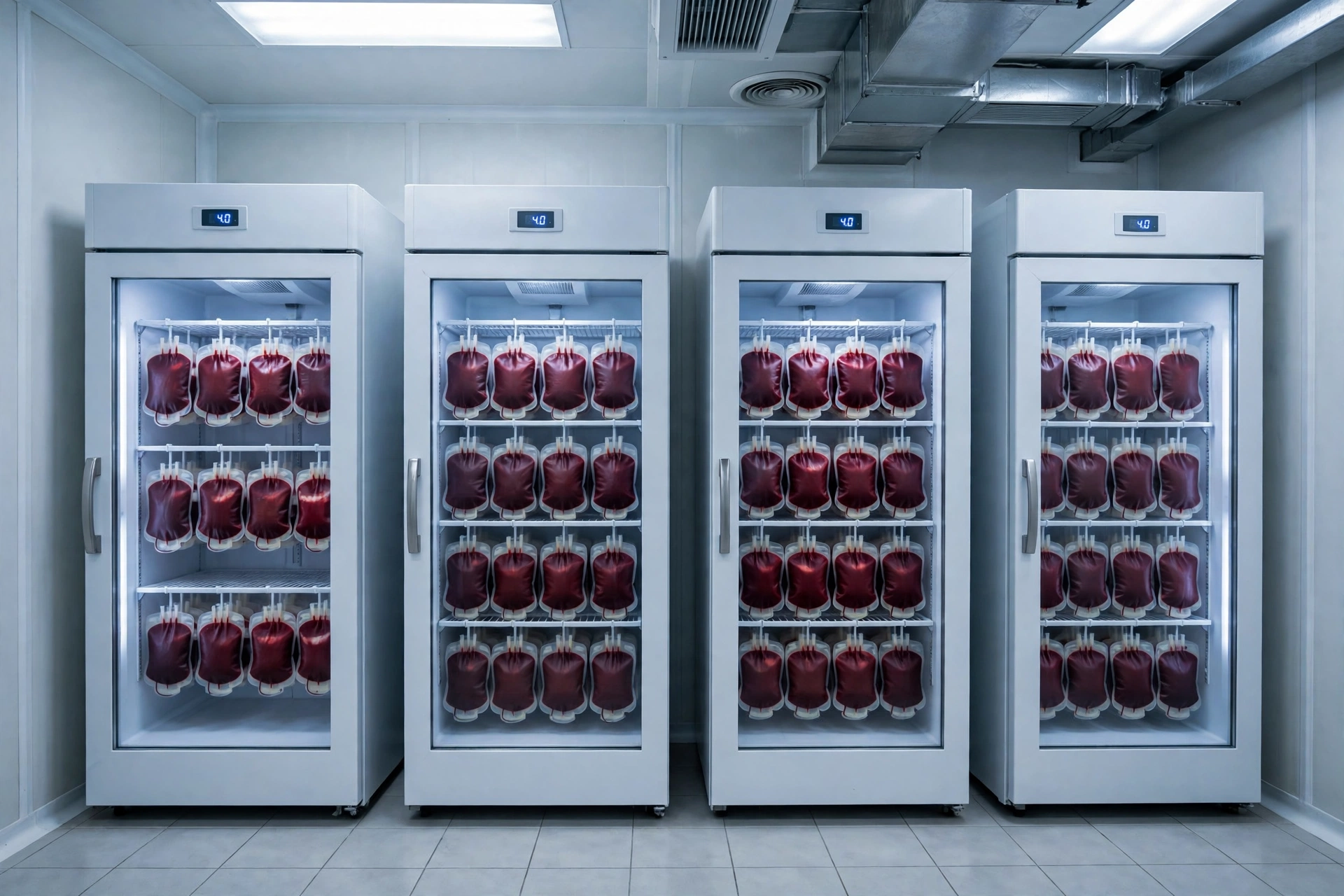
A blood bank refrigerator is the most demanding load in the building, and the easiest to underestimate. A modern 400–600 litre blood bank refrigerator draws 300–500 W running, with a compressor start that pulls 1,500–2,500 W for a fraction of a second. A hospital blood bank with eight refrigerators draws 2.5–4 kW continuously, day and night, weekends included. The load never drops, because the refrigerators never switch off. A set sized for a blood bank’s daytime load and not its 24-hour load is undersized from the first night.
The refrigerator load is also almost perfectly flat, which is good news for the engine. A diesel set likes a steady load, and a blood bank gives it one: the compressors cycle, but the room total stays within a few percent of its average for weeks at a time. The problem is the restart. When the power returns after an outage, every compressor in the room tries to start at once, and the combined starting surge is three to four times the running load. A blood bank drawing 4 kW running can demand 15–20 kVA of starting apparent power for a second. The motor starting sequence has to stagger the restarts, or the set has to be sized for the surge. Most quotations do neither, and the first real outage is when the buyer finds out.
The refrigerator is also the load with the least tolerance for error. The AABB Standards for Blood Banks and Transfusion Services and the FDA require red blood cells to be stored at 1–6°C. A full, unopened refrigerator holds that range for 2–4 hours after power loss. A refrigerator that is opened once during an outage, to check on the units or to move them, warms twice as fast. The generator has to be running within the first hour, or the blood bank is working against a clock it cannot stop.
Plasma Freezers: Cold, Deep and Heavy
A plasma freezer is a different kind of load. A −30°C chest freezer holding 200 units of fresh frozen plasma draws 800–1,500 W running, and its compressor is larger, heavier and harder to start than a refrigerator compressor. A regional centre with six plasma freezers draws 5–9 kW continuously, and the starting surge on a simultaneous restart can reach 25–35 kVA. The freezer room is the single largest electrical load in most blood banks, and it is the load most quotations get wrong, because they size from the nameplate of one freezer and forget that the room holds six.
The freezer load is more forgiving on time than the refrigerator load. A full, unopened −30°C freezer holds below −18°C — the legal limit for frozen plasma — for 12–24 hours after power loss. The mass of frozen plasma is its own thermal battery. But that forgiveness has a limit, and the limit is the door. Every opening lets in warm, humid air, and every opening shortens the hold time. A freezer room that is opened repeatedly during an outage, because staff are moving units to a working freezer, loses its margin in hours, not days. The outage plan has to say which freezer is opened first, and who is allowed to open it.
Plasma is also the product with the longest shelf life and the lowest urgency, which makes it the easiest load to shed — and the worst load to shed. A unit of fresh frozen plasma costs roughly $50–$80 to collect and process, and it sits in the freezer for up to a year. Losing 200 units of plasma is a $10,000–$16,000 loss that nobody notices on the day, because no patient was waiting for it. The loss shows up six months later, when the centre’s plasma stock is short and the hospital has to buy plasma from another region at a premium. The generator that protects the plasma freezer is protecting next year’s supply, not today’s.
Platelet Agitators and the Five-Day Clock
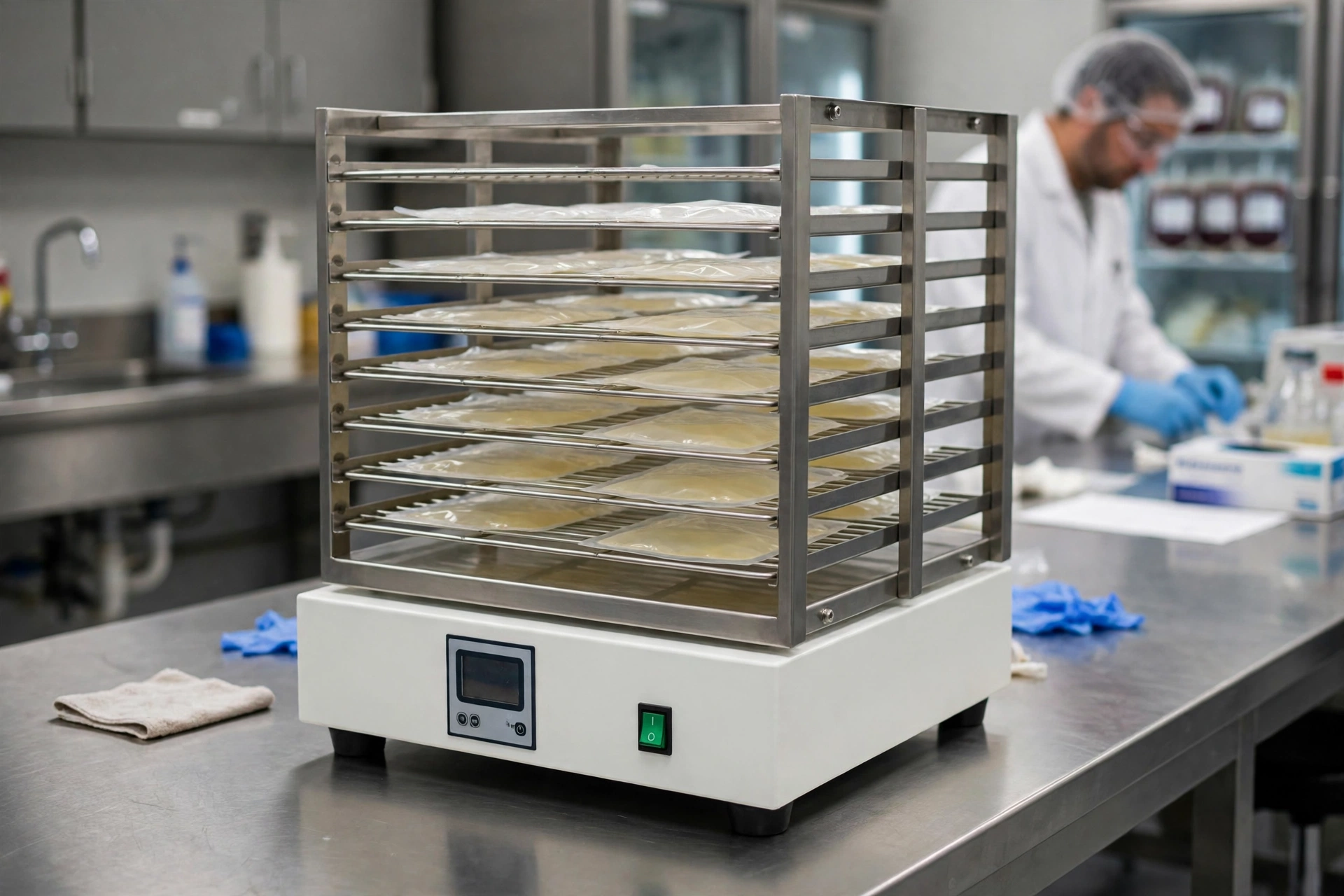
A platelet agitator is the smallest load in the blood bank and the most unforgiving. A standard agitator-incubator holding 48 platelet units draws 100–300 W — less than a domestic light bulb — and it does two things: it holds the platelets at 20–24°C and it rocks them gently, continuously, so they do not clump. Stop the rocking and the platelets begin to aggregate within hours. Stop the temperature control and they lose viability within a day. A platelet unit has a shelf life of five days. There is no margin to recover.
The agitator load is small, but the consequence of losing it is the largest in the building. Platelets are the product a hospital runs out of first, because five days is not enough time to build a stockpile. A hospital keeps one to two days of platelets on the shelf, and a regional centre keeps two to three days. An outage that stops collection for two days empties the shelf, and an outage that stops the agitators empties it in hours. A platelet unit costs roughly $500–$700 to collect, test and process — the most expensive unit in the blood bank — and it is also the unit that a bleeding trauma patient or a leukaemia patient cannot wait for.
Two details matter here. The first is that platelets are stored at room temperature, which means they need no refrigeration and no freezer — and no thermal mass to protect them. A refrigerator buys the blood bank two to four hours. A platelet agitator buys nothing. The moment the power fails, the platelets start dying, and the only thing that saves them is a generator that starts within ten seconds and a UPS that bridges the gap.
The second detail is that the agitator is an electronic load, not a motor load. It needs clean, stable power, and a generator that hunts in frequency or sags in voltage will trip the agitator’s own protection, or worse, stop the rocking without tripping anything. The set has to hold ±1% frequency and ±2% voltage under a step load, which means a properly sized alternator and a fast governor, not the cheapest set that meets the kVA figure.
The Temperature Window: What an Outage Actually Costs
A blood bank measures an outage in units, not in kilowatt-hours. The grid fails, the automatic transfer switch moves the essential bus to the generator, and if everything works, the refrigerators never notice. If anything in that chain fails, the blood bank starts losing its inventory within hours, and the cost of that inventory is measured in donors, not in electricity. The arithmetic is worth doing before the outage, because it is the arithmetic that justifies the generator.
The window is the number that decides everything. A blood bank refrigerator, full and never opened, warms from 4°C to 6°C — the top of the legal range — in about 2–4 hours. It reaches 10°C in 4–8 hours, depending on how full it is and how often the door is opened. A unit that warms above 6°C is quarantined. In practice it is discarded, because no test can prove that the bacteria that may have grown in the warm unit are absent. The AABB standard is explicit: there is no validated way to return a warmed unit to the shelf. A single warm night can cost a hospital blood bank its entire inventory — 300 units, $75,000, and the donors who gave them.
The cost of missing the window is not the cost of the refrigerator. A blood bank refrigerator costs $5,000–$12,000. The units inside it are worth far more: a single refrigerator in a regional centre can hold blood from 200 donors, collected over six weeks under a screening programme that cannot be repeated on demand. A hospital that loses its blood bank inventory does not just lose blood. It loses the ability to do surgery, to treat trauma, to support chemotherapy. The operating theatres close, the elective list is cancelled, and the hospital starts calling other centres for units that those centres also need.
Case 1: Hurricane Maria and Banco de Sangre de Servicios Mutuos
On 20 September 2017, Hurricane Maria made landfall in Puerto Rico as a category 4 storm, with wind gusts of up to 120 mph battering the island for about 12 hours. The entire island lost power. Banco de Sangre de Servicios Mutuos (BSSM), Puerto Rico’s largest blood centre, collects approximately 60,000 units of blood a year, distributes 75,000 manufactured blood components a year to 35 hospitals, and runs a centralised transfusion service for 10 hospitals in the San Juan metro area. It is the island’s blood supply, and the storm hit it at full strength.
Both of BSSM’s main sites kept working as the storm passed through the island. Carriers delivered blood components to hospitals in the middle of the storm, driving in very bad conditions, with roads blocked by debris and traffic lights dead. The centre’s generators ran, and the blood stayed cold. But the days after the storm were harder than the storm itself. Hospitals across the island reported that their backup generators were beginning to fail, and the lack of diesel had become an immediate concern. Medical staff waited in seven-hour lines at the island’s few functioning petrol stations, or stayed home. The US Department of Health and Human Services set up makeshift hospital units at Centro Médico in San Juan because the hospitals could not sustain themselves.
The lesson is not about the wind. It is about the fuel. BSSM’s generators worked, but the island’s fuel supply did not, and a blood centre that runs out of diesel loses its blood exactly as surely as a blood centre whose generator never starts. The centre’s fuel autonomy — the number of hours its tanks hold — was the number that mattered, and it was measured in days, not weeks. Puerto Rico’s grid took months to restore. The blood centre survived on generators, fuel convoys and blood flown in from the mainland United States.
Case 2: Winter Storm Uri and Gulf Coast Regional Blood Center
In February 2021, Winter Storm Uri cut power to about 4.5 million customers in Texas. The cold was the problem, and the cold was the problem for blood, too. Gulf Coast Regional Blood Center in Houston, the sole provider of blood to more than 170 hospitals across a 26-county region, normally collects about 1,000 units a day. During Uri, it collected nothing from Sunday onwards. Power was out at most of its facilities for two days or more, and its chief executive told the press that the centre had not been able to collect since the storm began.
The numbers from the other Texas centres were worse. In San Antonio, South Texas Blood reported that the community needs about 400 units a day and the centre had been collecting fewer than 50. All blood drives were cancelled for three days, and only three donor rooms were open on the Tuesday. In Austin, We Are Blood reported that the community’s blood and platelet supply was critically low, with donation centres and mobile drives closed since the Saturday, and that platelet donations, with their shorter shelf life, were especially low after several days of closures. The American Red Cross reported that the winter storms had cancelled blood drives in more than 30 states, costing about 21,000 blood, platelet and plasma donations. Versiti Blood Centers in Milwaukee received an urgent call from a Texas hospital that was about to cancel two transplant surgeries on critically ill patients because it did not have the blood products it needed.
Uri hit the blood supply twice. It hit the storage, because centres lost power and their refrigerators and agitators stopped. And it hit the collection, because donors could not travel, drives were cancelled, and the centres themselves were dark. A blood centre’s generator protects the storage. Nothing protects the collection except a grid that stays up, which is why the centres that recovered fastest were the ones whose generators kept their processing and testing running, so that the first donors back through the door could be bled, tested and processed the same day.
Case 3: Hurricane Irma and OneBlood
Three weeks before Maria, Hurricane Irma made landfall in Florida as a category 4 storm, cutting power to about 6.5 million customers. OneBlood, Florida’s largest blood centre, serves about 200 hospitals across the state. Its donor centres closed for days, its collections stopped, and its hospitals kept needing blood — trauma cases, surgeries, cancer treatments — at exactly the moment the supply stopped arriving.
The Irma case is the one that shows the national arithmetic. Harvey hit Texas in late August 2017. Irma hit Florida in early September. Maria hit Puerto Rico two weeks later. Three major hurricanes in four weeks, and each one hit a blood centre that serves hundreds of hospitals. Blood was shipped between states to cover the gaps, and the national supply — which normally runs at three to five days of inventory — tightened everywhere. A blood centre’s generator is a local machine, but the blood supply it protects is a national system, and the system has less slack than most people assume.
The three cases share one detail. In none of them did the blood run out because a refrigerator failed mechanically. In all three, the blood ran out because the power failed, the collections stopped, and the fuel ran short. The generator is the only part of that chain that the blood centre controls, and it is the part that has to work the first time, because there is no second chance to keep a unit of platelets alive.
Sizing the Set: Three Blood Bank Sizes
Sizing a blood bank generator starts with the load list, and the load list starts with the refrigerators. Everything else — freezers, agitators, centrifuges — is added after the refrigerators are counted, because the refrigerators are the load that never switches off and the load that cannot be shed. A set sized from the refrigerators up is a set that works. A set sized from the building’s total demand down is a set that is either too large or too small, and the buyer only finds out which on the first real outage. The step-by-step load-list method is set out in the generator sizing guide.
| Blood bank type | Running load | Starting surge | Recommended set | Typical fuel use at 75% load |
|---|---|---|---|---|
| Hospital blood bank, 200–400 units, 4–8 refrigerators | 15–30 kW | 40–70 kVA | 20–60 kVA | 5–12 L/h |
| Regional blood centre, 2,000–5,000 units, processing + testing | 40–100 kW | 120–220 kVA | 60–150 kVA | 12–30 L/h |
| National blood service centre, 10,000+ units, walk-in cold rooms | 120–300 kW | 300–650 kVA | 150–400 kVA | 30–80 L/h |
The table is a starting point, not a specification. Every blood bank has to be measured, because the load depends on the equipment schedule, not on the floor area. A 200-square-metre hospital blood bank with eight refrigerators and two plasma freezers draws more power than a 500-square-metre donor centre with two. The measurement has to be done at the distribution board, with a clamp meter, over a full week — because the load at 3 a.m. on a Sunday is the cold-storage load, and the load at 2 p.m. on a Tuesday is the cold-storage load plus processing, testing and donor collection.
The Hospital Blood Bank
A hospital blood bank — a district general hospital, a private hospital, a trauma centre with its own bank — typically needs a 20–60 kVA set. The load is 15–30 kW running, and the set is small enough to sit in a canopy outside the building, with a sub-base tank that holds 8 hours of fuel. The cost is $12,000–$20,000 installed, and the set can be delivered, installed and commissioned in a week. A Cummins C40D5, rated 40 kVA standby and 36 kVA prime, covers most hospital blood banks with room for the compressor restart surge, and it burns about 8–11 L/h at 75% load.
The mistake hospital blood banks make is sharing the hospital’s generator and assuming that is enough. A hospital generator covers the hospital’s essential bus, and the blood bank is one load among many on that bus — operating theatres, ICU, lifts, fire systems. The hospital side of that calculation is set out in the hospital backup power guide. When the hospital’s generator is loaded to 90% by the theatres and the ICU, the blood bank’s refrigerators are competing for the last 10%. A blood bank that shares a hospital set needs its own load calculation, signed off by the hospital’s electrical engineer, showing that the essential bus has capacity for the blood bank’s refrigerators, freezers and agitators — plus their starting surge — on top of everything else. The standby and prime ratings of the set have to match the duty: a set that runs for 72 hours on a long outage is running on its prime rating, not its standby rating, and the difference is 10% of the kVA figure.
The Regional Blood Centre
A regional blood centre — a city or provincial centre that collects, tests, processes and distributes blood to dozens of hospitals — typically needs a 60–150 kVA set. The load is 40–100 kW running, and the set is large enough to need a dedicated plant room or a containerised enclosure, with a bulk fuel tank that holds 24–72 hours of fuel. The cost is $35,000–$75,000 installed, and the lead time is 8–12 weeks.
The sizing decision for a regional centre is not the kVA figure. It is the processing decision: which loads go on the essential bus, and which do not. The refrigerators, the plasma freezers, the platelet agitators and the testing laboratory go on the essential bus. The donor collection rooms, the offices and the non-essential HVAC do not. The difference between the two lists is roughly half the set size, and the centre’s medical director has to sign the essential-bus list, because it is a clinical decision, not an engineering one. The processing loads are the ones most quotations miss: a refrigerated centrifuge draws 2–4 kW running and 8–12 kW starting, and a centre with four centrifuges has a starting surge of 30–45 kVA from the centrifuges alone. The cold storage backup power article sets out the cold-room side of the same calculation.
The National Blood Service Centre
A national blood service centre — a central processing site that holds 10,000 or more units, runs walk-in cold rooms and fractionates plasma — typically needs a 150–400 kVA set, and often two sets in parallel. The load is 120–300 kW running, and the set has to hold its voltage and frequency within the limits the testing instruments demand. The cost is $120,000–$200,000 installed, and the commissioning includes a full load-bank test, a witnessed factory acceptance test, and a validation file that the quality department signs off.
The centre’s sizing decision is redundancy, not capacity. A single set is a single point of failure, and a centre that holds 10,000 units cannot accept a single point of failure. Two 200 kVA sets in parallel, each able to carry the essential load alone, cost roughly 60% more than one 400 kVA set — and the centre buys them anyway, because the cost of losing the inventory is a hundred times the cost of the second set. A Cummins C200D5, rated 200 kVA standby and 182 kVA prime, burns 48.9 L/h at full load and 36.7 L/h at 75% load, which means a 72-hour outage needs about 2,650 litres of fuel per set. The parallel configuration also lets one set be serviced while the other carries the load, which is the only way a blood centre can do maintenance without taking its refrigerators off backup power.
The First Ten Seconds: ATS, UPS and the Restart Surge
The first ten seconds of an outage decide whether a blood bank keeps its inventory or loses it. The grid fails, the automatic transfer switch senses the loss, the generator cranks, the engine reaches speed, the alternator builds voltage, and the switch transfers the essential bus to the generator. The whole sequence takes 8–10 seconds on a properly maintained set, and it is the longest ten seconds in the blood bank’s year — because every load on the essential bus is without power for that time, and every load without a UPS is off.
The ten-second rule is not a target. It is a standard. NFPA 110 requires Level 1 emergency power systems — the classification that covers blood banks, hospitals and any facility where the loss of power threatens life — to start and accept load within 10 seconds. A set that takes 15 seconds is not a slow set. It is a set that does not meet the standard, and the blood bank’s accreditation body and its insurer both know it. The UK’s HTM 06-01 sets the same expectation for healthcare electrical systems, and most national blood services write the 10-second requirement into their own specifications.
The UPS Bridge
The ten seconds are bridged by the UPS, and the UPS is the part of the system that most blood banks undersize. The refrigerators themselves do not need a UPS — a refrigerator that is off for ten seconds loses nothing. The loads that need a UPS are the electronic ones: the temperature monitoring system, the alarm panel, the laboratory information system, the agitator controllers and the access-control system that keeps the blood bank secure. A 10 kVA UPS, with a battery that holds 15–30 minutes, covers the monitoring and IT loads of a hospital blood bank. A regional centre needs 20–40 kVA.
Two details matter here. The first is that the UPS battery has to be sized for the generator’s actual start time, not its nameplate start time. A generator that is specified to start in 10 seconds and actually starts in 25 seconds — because the starting battery is weak, or the fuel is cold, or the crank is slow — needs a UPS battery that holds for 25 seconds plus a margin. The battery that holds for 10 seconds and no more is a battery that fails at the exact moment it is needed.
The second detail is that the UPS has to be on the generator’s essential bus, so that it recharges when the generator is running. A UPS that is not on the essential bus runs its battery flat during a long outage, and when the battery is flat, the monitoring system goes dark — which means the blood bank no longer knows whether its refrigerators are at 4°C or at 10°C. A blood bank that cannot prove its blood stayed cold has to discard it, even if it was cold. The temperature record is the product, and the UPS protects the record.
The Restart Surge
The restart is the part of the sequence that most specifications forget. When the generator takes the load, every compressor in the blood bank tries to start at once — every refrigerator, every plasma freezer, every cold-room compressor. The combined starting surge is three to five times the running load, and it lasts for a second or two. A hospital blood bank drawing 20 kW running can demand 60–80 kVA of starting apparent power for a second. A regional centre drawing 80 kW can demand 250–350 kVA.
There are two ways to handle the surge. The first is to size the set for it, which means buying a larger set than the running load needs. The second is to stagger the restarts, so that the refrigerators start in groups, a few seconds apart, and the peak never reaches the full surge. Staggering is done with the automatic transfer switch load-sequencing function, or with the generator controller’s load-shed and load-add steps, and it is the cheaper option — but it has to be designed, programmed and tested. A set that is sized for the running load and never tested under a full restart will trip on its first real outage, and the blood bank will find out that its generator works perfectly and its blood is still lost.
Platelets, Plasma and the Loads That Cannot Wait
Not every load in a blood bank can wait for the generator. The refrigerators can wait ten seconds. The plasma freezers can wait an hour. The platelet agitators cannot wait at all, and the testing laboratory cannot wait for the results to be released. The specification has to rank the loads by how long they can tolerate an outage, and the generator has to be sized and sequenced for the shortest tolerance, not the longest.
The ranking is simple. Platelet agitation: zero seconds without a UPS, because the rocking must never stop. Temperature monitoring and alarms: zero seconds, because the record must never break. Testing and IT: minutes, because a unit cannot be released without a result. Refrigerators: ten seconds, because the thermal mass buys two to four hours. Plasma freezers: hours, because the frozen mass buys twelve to twenty-four. A set that is sized for the refrigerators and not for the platelets is a set that protects the cheapest product and loses the most expensive one.
Platelets: Five Days and No Second Chance
Platelets are the product that decides whether a blood bank’s generator is good enough. A platelet unit has a shelf life of five days in the United States and most of Europe, and seven days in a small number of countries that use bacterial testing. A hospital keeps one to two days of platelets on the shelf. A regional centre keeps two to three days. There is no stockpile, and there is no time to build one.
The five-day clock is what makes the Uri case so sharp. When the Texas centres stopped collecting, the platelet supply did not fall over a week. It fell over two days, because the platelets on the shelf were already two or three days old, and no new platelets were arriving. The Austin centre’s platelet supply was described as critically low by the Wednesday — four days after the storm began — and the platelets that were left were at the end of their life. A generator that keeps the agitators running does not fix the collection problem, but it stops the storage problem from making it worse. A centre that loses its agitators loses the platelets it already has, and the platelets it already has are the only platelets its hospitals will get that day.
The cost of a platelet unit — roughly $500–$700 to collect, test and process — is the highest in the blood bank, and the volume is the lowest. A regional centre might hold 200 platelet units at any time, worth $100,000–$140,000. The agitator that holds them draws 100–300 W. The generator that protects them costs less than the platelets in one agitator.
The 30-Minute Rule
Blood that leaves the blood bank is governed by the 30-minute rule: a unit issued to a ward must be transfused within 30 minutes of leaving controlled storage, or returned to the blood bank. The rule exists because a unit sitting on a ward trolley warms up, and a warmed unit cannot be proven safe. During an outage, the rule becomes harder to follow, because the wards are dark, the lifts are stopped, and the porters are moving blood through a hospital that is running on emergency power.
The blood bank’s answer is the validated transport box: an insulated box with cold packs that holds 2–6°C for several hours, validated for the centre’s own conditions. A hospital blood bank keeps four to six transport boxes ready, and the outage plan says which wards get them first. The generator does not change the 30-minute rule, and it does not change the transport box. It changes whether the blood bank has any blood to put in the box.
The transport chain is also the reason the blood bank’s generator has to cover the alarms and the monitoring, not just the refrigerators. A unit that is moved during an outage has to be tracked, and the tracking system has to be running. A blood bank that loses its laboratory information system during an outage cannot issue blood, because it cannot prove which unit went to which patient. The generator that covers the servers is protecting the traceability, and the traceability is the product.
Testing, Labelling and the Paper Trail
A unit of blood cannot be released until it has been tested: blood grouping, antibody screening, infectious-disease screening and, in most large centres, nucleic-acid testing. The testing laboratory draws 5–15 kW — analysers, centrifuges, incubators and the computers that control them — and it is the load that most blood bank specifications put last, because it is not a cold-storage load. It should be first, because a blood bank that cannot test cannot release, and a blood bank that cannot release cannot supply its hospitals.
The testing load is also the load with the worst power-quality requirement. A nucleic-acid testing system draws 1–2 kW and takes two to four hours to restabilise after a power cut: the thermal cycler has to be re-calibrated, the run has to be repeated, and the samples have to be re-tested before a single result can be released. A run in progress is lost when the power fails — a run that took a day to prepare and costs $1,000–$3,000 in reagents alone. The laboratory’s outage plan has to list every analyser, who restarts it, and in what order — because the generator can only protect the instruments that are on its essential bus, and the instruments on the non-essential bus are lost the moment the grid fails.
The paper trail is the final load. Every unit is tracked from donor to patient, and the tracking system is the blood bank’s legal record. A blood bank that loses its records loses its accreditation, and a blood bank that loses its accreditation loses its licence. The generator that covers the servers is not protecting a convenience. It is protecting the licence.
Fuel, Noise and the Hospital Problem
A blood bank’s generator is a hospital problem before it is an engineering problem. It sits next to a hospital, or inside one, and it has to run without disturbing the patients, without endangering the staff, and without running out of fuel at the moment it is needed most. The fuel calculation and the noise calculation are as important as the kVA calculation, and they are the two calculations most often left until after the set is ordered.
The fuel calculation starts with the autonomy standard. NFPA 110 defines classes by how long the set must run: Class 48 is 48 hours, Class 72 is 72 hours. Most national blood services specify 72 hours of fuel autonomy, because a blood bank that runs out of fuel on the third day of an outage loses its blood on the third day — and the third day is when the hospitals need it most. The Maria case is the reason: Puerto Rico’s grid was down for months, and the blood centre’s fuel autonomy was measured in days.
Fuel Autonomy: 48 or 72 Hours
| Set size | Fuel use at 75% load | Fuel for 24 hours | Fuel for 48 hours | Fuel for 72 hours |
|---|---|---|---|---|
| 40 kVA | 8 L/h | 192 L | 384 L | 576 L |
| 100 kVA | 20 L/h | 480 L | 960 L | 1,440 L |
| 200 kVA | 37 L/h | 888 L | 1,776 L | 2,664 L |
| 400 kVA | 70 L/h | 1,680 L | 3,360 L | 5,040 L |
The table assumes the set runs at 75% load, which is the realistic figure for a blood bank on generator power — the refrigerators and freezers run continuously, and the processing loads cycle. A 100 kVA set needs a 1,500-litre bulk tank for 72 hours, and a 200 kVA set needs a 3,000-litre tank. The tank has to be sized for the autonomy the blood bank specifies, not for the tank the supplier happens to have in stock.
Fuel quality is the second half of the calculation. Diesel stored in a bulk tank degrades, grows water and breeds microbes, and a blood bank’s generator is the worst case for fuel quality: it sits for months without running, then has to run for three days without stopping. The fuel has to be tested, polished and turned over on a schedule because of diesel fuel ageing, and the tank has to be kept full — a half-empty tank breathes moist air, and moist air grows water, and water grows microbes. A generator that fails on bad fuel fails at the same moment as the grid, which is the one moment it is needed.
The third half of the calculation is the delivery. A blood bank that specifies 72 hours of fuel autonomy and has no fuel-delivery contract has specified 72 hours and bought 72 hours — and after 72 hours, it has nothing. The contract has to guarantee delivery within 24 hours, and it has to be tested, because a fuel supplier that cannot reach the hospital during a storm is a supplier that does not exist. The Maria case is the evidence: seven-hour lines at petrol stations, and hospitals waiting for fuel that did not arrive.
Noise at the Hospital Boundary
A blood bank’s generator is usually next to a hospital, and a hospital is a place where people are trying to sleep. A silent-canopy set produces 65–75 dB(A) at 7 metres, which is the level of a loud conversation. The night-time limit at a hospital boundary is typically 45–55 dB(A), which is the level of a quiet room. The difference is 20 dB(A), and 20 dB(A) is a factor of ten in sound energy — which means the set has to be 20–30 metres from the nearest ward window, or behind an acoustic barrier, or both. Sound falls by 6 dB(A) for every doubling of distance, so a set that measures 70 dB(A) at 7 metres measures about 58 dB(A) at 28 metres and about 52 dB(A) at 56 metres.
The noise calculation is the reason the set’s location is a clinical decision, not a facilities decision. A set placed next to the maternity ward because the space is free will be the subject of a complaint on its first test run, and a complaint on the first test run becomes a restriction on testing — and a restriction on testing becomes a generator that is never tested under load. The set has to be far enough from the wards to be tested monthly, under load, for 30 minutes, without disturbing a patient. If it cannot be tested, it cannot be trusted.
Placement has a second rule, and it is the one the hospital article’s Hurricane Sandy case proves. A generator in a flood zone is a generator that fails at the same time as the grid, which is the one moment it is needed. NYU Langone Medical Center put its emergency generators in the basement, and Hurricane Sandy flooded the basement, and the hospital evacuated 215 patients down dark stairwells. A blood bank that puts its generator in the basement because the space is free is making the same bet, and the odds are the same. The set goes above the flood line, on a plinth, with the fuel tank protected — and the blood bank’s refrigerators go above the flood line too.
Frequently Asked Questions
What size generator does a blood bank need?
A hospital blood bank typically needs a 20–60 kVA set, a regional blood centre 60–150 kVA, and a national blood service centre 150–400 kVA. The figure comes from a load list — refrigerators, plasma freezers, platelet agitators and testing — not from the building’s floor area. A set sized from the load list up is a set that works; a set sized from the building’s total demand down is either too large or too small.
Do blood banks need a backup generator?
Yes. A blood bank’s refrigerators hold 1–6°C for only 2–4 hours without power, and a unit that warms above 6°C is quarantined and in practice discarded. Platelet agitators have no thermal margin at all — the moment the power fails, the platelets start dying. NFPA 110 classifies blood banks as Level 1 emergency power systems, which means the generator must start and accept load within 10 seconds.
How long can a blood bank run on a generator?
As long as it has fuel. Most national blood services specify 72 hours of fuel autonomy — a 100 kVA set needs about 1,440 litres of diesel for 72 hours at 75% load. The practical limit is not the engine, which can run for weeks with oil top-ups, but the fuel delivery: a blood bank with a 72-hour tank and no delivery contract has 72 hours and nothing after it.
What happens to a blood bank during a power outage?
The refrigerators start warming within 2–4 hours, the platelet agitators stop immediately, and the testing laboratory stops releasing units. Collections stop as well — during Winter Storm Uri, Gulf Coast Regional Blood Center collected nothing for days, and South Texas Blood collected fewer than 50 units a day against a need of 400. The blood bank’s generator protects the storage; nothing protects the collection except a grid that stays up.
Can a diesel generator power a blood bank?
Yes, and it is the standard solution. A diesel set covers the refrigerators, plasma freezers, platelet agitators, testing laboratory and monitoring systems, provided it is sized for the compressor restart surge, started within 10 seconds by an automatic transfer switch, and bridged by a UPS for the electronic loads. A portable generator cannot do the job — it has no automatic start, no automatic transfer and no fuel autonomy, and a blood bank that loses power at 2 a.m. has nobody on site to start it by hand.
Specification Checklist
1. Load list by tier. Count every refrigerator, plasma freezer, platelet agitator, centrifuge, analyser and server, with running watts, starting watts and power factor. Measure at the distribution board over a full week. No load list, no quotation.
2. Set size with starting surge. Size for the simultaneous compressor restart — three to five times the running load — or programme a staggered restart sequence in the automatic transfer switch. State which one the quotation uses.
3. Rating matched to duty. A set that runs for 72 hours on a long outage is running on its prime rating, not its standby rating. Check the rating on the nameplate, not on the quotation.
4. Start time of 10 seconds or less. Specify NFPA 110 Level 1, Type 10 in the contract, and test the start time under load every month. A set that takes 15 seconds does not meet the standard.
5. UPS for the electronic loads. A 10–40 kVA UPS for temperature monitoring, alarms, agitator controllers and the laboratory information system, with a battery that holds longer than the generator’s actual start time. The UPS must sit on the essential bus so it recharges on generator power.
6. Fuel autonomy of 72 hours. Size the bulk tank for 72 hours at 75% load — 1,440 litres for a 100 kVA set, 2,664 litres for a 200 kVA set — and hold a fuel-delivery contract that guarantees delivery within 24 hours. Test the fuel, polish it and turn it over on a schedule.
7. Remote monitoring and alarms. Temperature alarms on every refrigerator and freezer, with SMS and remote alerts, so that a temperature excursion at 2 a.m. reaches a person who can act. The difference between a warning and a loss is remote monitoring, and it is the cheapest item on this list.
8. Monthly load test and battery replacement. Test the set under load for 30 minutes every month, with the starting battery tested under cranking load, and replace the battery on a two-year schedule regardless of condition. The battery is a consumable, not a component.
A blood bank that loses power loses more than electricity — it loses the units that patients are waiting for, and it loses the donors who gave them. If the sizing, the fuel autonomy or the restart sequence is still an open question, contact PAVO for a load schedule and a quotation built around the blood bank’s actual inventory.