

50 Hz vs 60 Hz Generator: What Changes and Why | PAVO
Frequency is the one line on a generator quotation that buyers skip and engineers never do. It decides engine speed, alternator size, motor life and whether the set can be connected at all.
What is the difference between 50 Hz and 60 Hz generator sets? The engine speed. A four-pole 50 Hz set runs at 1,500 rpm; the same frame at 60 Hz runs at 1,800 rpm, producing about 20% more power. The wrong frequency makes motors run at the wrong speed, overheat, and fail. Match it to the site grid first.
Contents
- Frequency Is Engine Speed: The 120f/P Rule
- What Frequency Does to the Alternator — and the Price
- What Frequency Does to the Load
- The 50 Hz World and the 60 Hz World
- Three Jobs Where Frequency Decided the Outcome
- Converting a Generator Between 50 Hz and 60 Hz
- Frequently Asked Questions
- Specification Checklist: Eight Lines Before the Deposit
Frequency Is Engine Speed: The 120f/P Rule
A diesel generator does not choose its frequency. The frequency is fixed arithmetic: engine speed multiplied by the number of alternator poles, divided by 120. Written as a formula, f = P × N / 120, where f is frequency in hertz, P is the number of poles and N is engine speed in revolutions per minute.
That single equation explains every 50 Hz and 60 Hz figure on a datasheet. A four-pole alternator — the standard for industrial sets from 10 kVA to 3,750 kVA — must turn at 1,500 rpm to produce 50 Hz and at 1,800 rpm to produce 60 Hz. There is no other way to get there with the same alternator. Change the speed and the frequency follows, immediately and exactly.
The governor holds that speed. Under load, a mechanical governor allows a small droop — typically 3–5% from no load to full load — and an electronic governor holds it tighter, within about 1%. When a large motor starts and the engine dips, frequency dips with it. A 50 Hz set that sags to 47 Hz during a step load is not broken; it is an engine recovering from a transient. The size of that dip, and how fast the governor recovers, is part of generator sizing, and it is why motor starting calculations include a frequency check alongside the voltage dip.
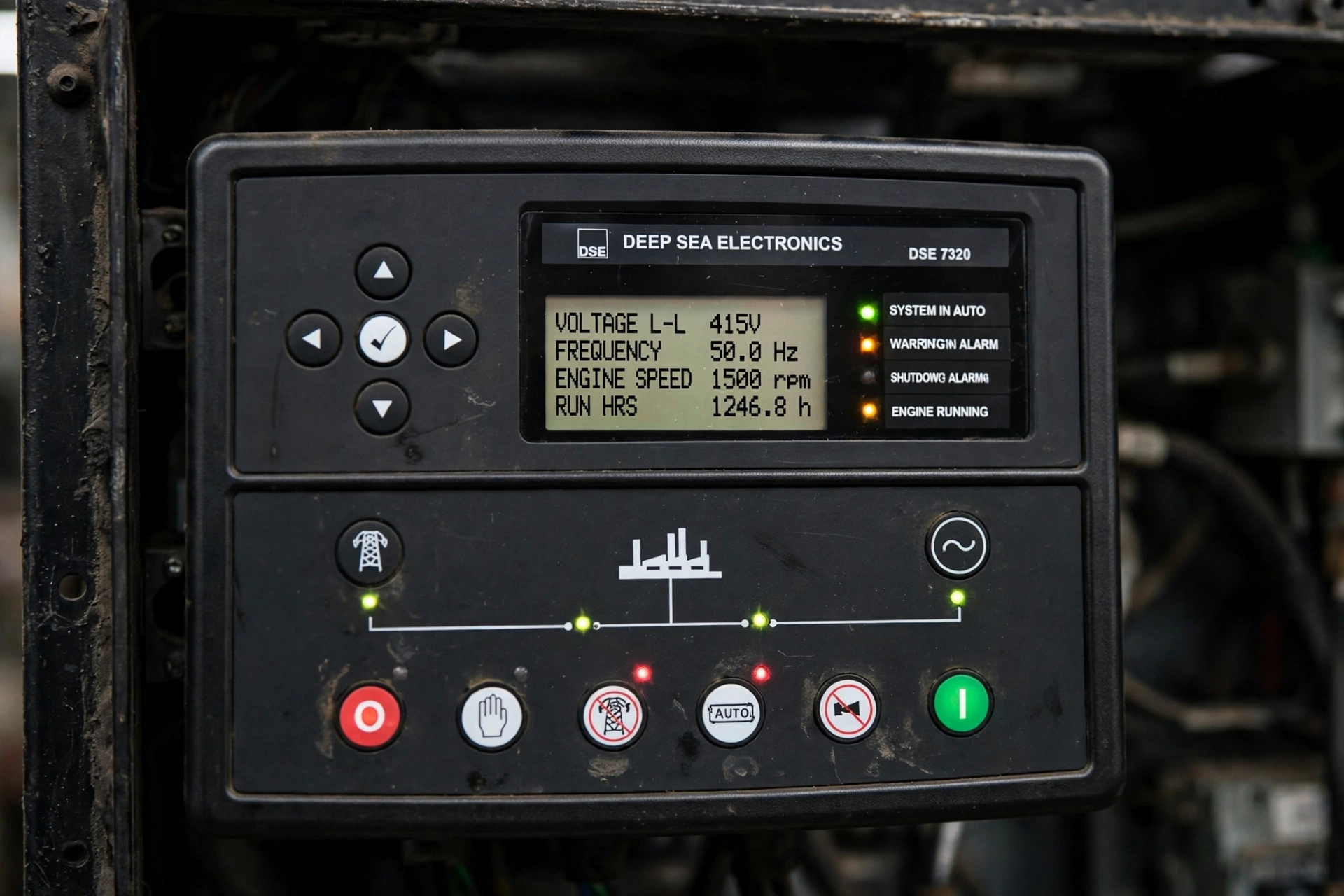
The pole-count table
Pole count sets the speed for any frequency. The table below covers the combinations a buyer will actually meet.
| Poles | Speed at 50 Hz | Speed at 60 Hz | Where it is used |
|---|---|---|---|
| 2 | 3,000 rpm | 3,600 rpm | Small portable and air-cooled sets, up to about 20 kVA |
| 4 | 1,500 rpm | 1,800 rpm | Almost every industrial diesel set, 10–3,750 kVA |
| 6 | 1,000 rpm | 1,200 rpm | Large slow-speed marine and heavy-duty sets |
Two-pole sets spin fast and wear fast. They are light, cheap and loud, which suits a portable site set and disqualifies them from prime duty. Six-pole sets spin slowly and last long, but the alternator is large and heavy for its output, so they appear mainly in marine and continuous-duty plant. Four poles are the compromise the whole industry settled on: fast enough to be compact, slow enough to last 20,000 hours or more between overhauls.
Why 1,500 and 1,800 rpm are not arbitrary
Engine makers design their blocks around those two speeds. A Cummins QSZ13, a Weichai WP13 or a Perkins 2206 is developed, tested and warranted at 1,500 rpm for 50 Hz markets and 1,800 rpm for 60 Hz markets. The piston speed, the turbocharger match, the cooling system and the fuel injection timing are all tuned for one of those two numbers. Run a 1,500 rpm engine at 1,800 rpm and it is not the same engine any more: bearing loads rise, oil temperature rises, and the warranty terms change.
That is also why “50/60 Hz” on a product page needs reading carefully. It usually means the set is built to order at either frequency — the factory sets the governor and the alternator voltage regulator before the set leaves the floor. It does not mean the same set can be switched between frequencies on site without work. Some controllers offer a frequency selection in software, but the governor, the AVR under-frequency roll-off setting and the overspeed trip must all be changed to match, or the set will run at the wrong voltage, trip on overspeed, or both.
What Frequency Does to the Alternator — and the Price
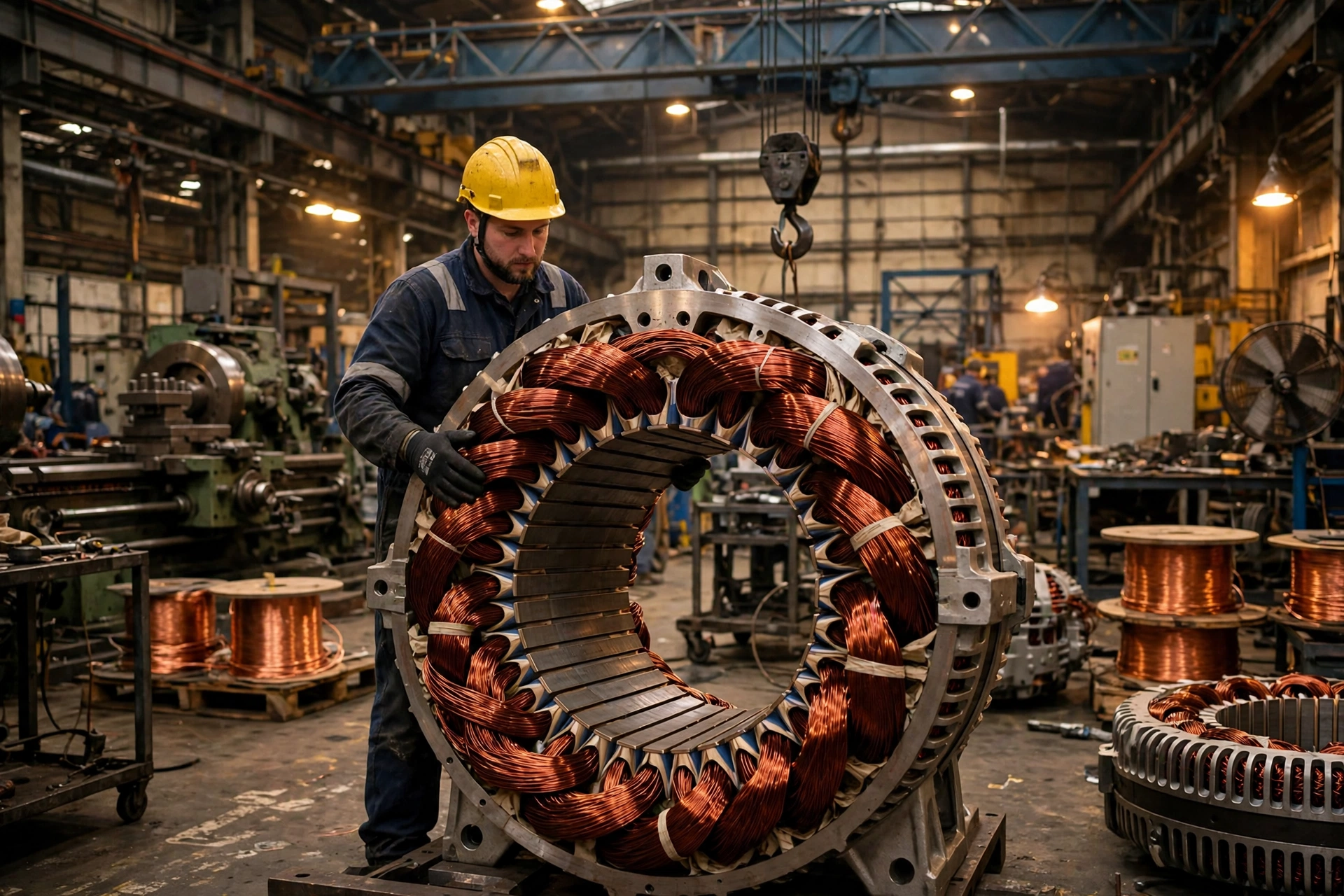
Power is torque multiplied by speed. Hold the torque constant and raise the speed by 20%, and the power rises by 20%. That is what happens when the same engine and alternator frame moves from 50 Hz to 60 Hz: the engine turns 20% faster, the alternator turns 20% faster, and the set produces about 20% more kVA from the same iron and copper.
The worked example below uses a 400 kVA frame. The figures are the arithmetic of the speed change, not a separate datasheet.
| Item | 50 Hz, 1,500 rpm | 60 Hz, 1,800 rpm |
|---|---|---|
| Engine speed | 1,500 rpm | 1,800 rpm |
| Output from the same frame | 400 kVA / 320 kW | ~480 kVA / 384 kW |
| Typical voltage | 400 V | 440 V |
| Volts per hertz | 8.0 V/Hz | 7.3 V/Hz |
| Fuel per kWh | Baseline | Roughly the same, within a few percent |
Voltage rises with speed in the same proportion, which is why the AVR matters. An alternator spinning 20% faster generates 20% more voltage unless the excitation is reduced. The automatic voltage regulator holds the terminal voltage at the set point — 400 V at 50 Hz, 440 V or 480 V at 60 Hz depending on the market — by trimming the field current. The volts-per-hertz ratio is the number that must stay inside the design band: push it 20% high and the magnetic circuit saturates; push it low and the set cannot hold voltage under load.
For the buyer, the practical consequence is price per kVA. A 60 Hz set of a given frame is cheaper per kVA than its 50 Hz twin, because the same steel, copper and engine produce more output. A buyer comparing a 500 kVA quotation from a 50 Hz market with a 500 kVA quotation from a 60 Hz market is not comparing like with like: the 60 Hz set is a smaller frame doing the same job. That is a legitimate saving when the site is 60 Hz. It is a trap when the site is 50 Hz and the “saving” is a set that cannot be connected.
Fuel and wear at 1,800 rpm
Fuel consumption per kilowatt-hour is roughly flat across the two frequencies. The engine burns slightly more fuel at 1,800 rpm because friction and pumping losses rise with speed, but it also produces more power, and the two effects largely cancel. A 500 kVA set at prime load burns around 93 L/h at 50 Hz; its 60 Hz twin burns a similar figure per kWh delivered, not 20% more. Fuel consumption figures should therefore always be compared per kWh, never per hour across frequencies.
Wear is different. An hour at 1,800 rpm is 108,000 revolutions; an hour at 1,500 rpm is 90,000. That is 20% more piston travel, 20% more bearing cycles and 20% more valve events for every hour on the clock. Engine makers account for this in service intervals, and some shorten the oil-change interval for 60 Hz duty. Over a 20,000-hour life the difference is real but manageable — it is one reason 60 Hz sets in continuous service are watched more closely on oil analysis than their 50 Hz equivalents.
What the price difference really buys
The 60 Hz premium, or discount, is not a quality difference. It is a speed difference. A buyer who pays less per kVA for a 60 Hz set is buying a smaller frame spinning faster, with shorter service intervals and a different spare-parts list. A buyer who pays more per kVA for a 50 Hz set is buying more iron and copper for the same output — and a set that will run for decades at 1,500 rpm in a market where every motor, pump and transformer expects 50 Hz. Neither is better in the abstract. The site frequency decides which one is correct, and the price comparison only makes sense after that decision.
What Frequency Does to the Load
The generator is only half the story. Frequency governs everything connected to it, and the load is usually less forgiving than the generator.
An induction motor’s synchronous speed follows the same formula as the generator: n = 120 × f / p. A four-pole motor runs at 1,500 rpm on 50 Hz and 1,800 rpm on 60 Hz, minus a few percent of slip. Feed a 60 Hz motor with 50 Hz and it runs about 17% slower. That alone would be survivable — a slower fan moves less air, a slower pump moves less water. The damage comes from the volts-per-hertz ratio. A motor designed for 220 V at 60 Hz expects 3.67 volts per hertz. Feed it 220 V at 50 Hz and the ratio rises to 4.4 volts per hertz, 20% high. The magnetic circuit saturates, current rises faster than load, and the extra energy appears as heat in the windings rather than torque at the shaft.
Induction motors: the 17% that burns windings
Whether that heat destroys the motor depends on the load. A centrifugal fan or pump follows the affinity laws: flow falls with speed, but power falls with the cube of speed. At 83.3% speed, a centrifugal load needs only about 58% of its rated power, so the motor is heavily underloaded and has thermal headroom to absorb the saturation loss. It runs hot and slow, but it usually survives.
A constant-torque load has no such headroom. A compressor, a conveyor or a positive-displacement pump demands the same torque at any speed. At 50 Hz the motor turns slower, delivers less cooling from its own fan, and carries a saturated magnetic circuit at the same time. Winding temperature climbs past the insulation class — typically 155°C for Class F — and the motor fails in weeks rather than years. The failure looks like a bad motor. It is a frequency mismatch.
The reverse direction is safer but not harmless. A 50 Hz motor on 60 Hz runs 20% faster. The magnetic circuit is under-stressed, so there is no saturation heat, but the motor spins faster than its bearings, fan and driven equipment were designed for. A pump delivers more flow than the pipework expects, a fan runs louder, and a machine tool cuts faster than its rating. Overspeed is a mechanical risk rather than a thermal one, and it is the reason manufacturers still refuse warranty claims on motors run at the wrong frequency in either direction.
Transformers: the iron-core problem
Transformers follow the same physics. A transformer designed for 60 Hz and fed 50 Hz at the same voltage sees its magnetic flux rise by 20%. The iron core saturates, magnetising current climbs, and the transformer overheats — sometimes quietly, sometimes with melted insulation and a tripped breaker. This is the most dangerous mismatch in the field, because a transformer gives no warning until it fails. A 50 Hz transformer on 60 Hz is the safe direction: the core is under-stressed, the transformer runs cooler, and the only penalty is that it is heavier and more expensive than a 60 Hz design of the same rating. That is why 50 Hz transformers need more iron, and why they cost more per kVA.
What does not care: rectified electronics and resistive loads
Not everything on a site cares about frequency. Any device with a switch-mode power supply — a laptop charger, a phone charger, an LED driver, a modern television, an inverter charger — rectifies the incoming alternating current to direct current before doing anything useful. Frequency is irrelevant to it, provided the voltage is within its rated range, which is usually a wide 100–240 V. Resistive loads — heaters, incandescent lamps, kettles — do not care at all. A heater makes the same heat at 50 Hz and 60 Hz.
The dividing line is simple: if a device uses frequency as a clock or a speed reference, it cares. Synchronous clocks count cycles and lose ten minutes per hour on the wrong frequency. Induction motors use it as a speed reference. Transformers use it to size their iron. Everything else either rectifies it away or ignores it. That distinction decides whether a mixed-frequency site can be managed with a converter for one circuit, or needs the whole installation re-specified.
The 50 Hz World and the 60 Hz World
Roughly two-thirds of the world runs at 50 Hz and one-third at 60 Hz, and the split follows history rather than logic. The 50 Hz world is Europe, the United Kingdom, China, India, most of Africa, Australia, Russia and most of the Middle East. The 60 Hz world is the United States, Canada, Mexico, Brazil, Saudi Arabia, South Korea, Taiwan and much of the rest of South America. A generator exported from Wuhu to Lagos is a 50 Hz set. The same set exported from Wuhu to Riyadh is a 60 Hz set. The factory, the engine and the alternator are the same; the governor setting, the AVR configuration and the nameplate are different.
| Region | Frequency | Typical voltage |
|---|---|---|
| Europe, UK, China, India | 50 Hz | 230 V / 400 V |
| Africa (most countries) | 50 Hz | 230 V / 400 V |
| Australia, New Zealand | 50 Hz | 230 V / 400 V |
| Middle East (most) | 50 Hz | 230 V / 400 V |
| United States, Canada | 60 Hz | 120 V / 240 V, 480 V |
| Mexico, Brazil | 60 Hz | 127 V / 220 V, 220 V / 380 V |
| Saudi Arabia | 60 Hz | 127 V / 220 V, 220 V / 380 V |
| South Korea, Taiwan | 60 Hz | 220 V |
| Japan (east / west) | 50 Hz / 60 Hz | 100 V / 200 V |
Voltage travels with frequency, and the combination is what catches buyers. Saudi Arabia is 60 Hz but 220 V — the same voltage as a 50 Hz market, at the wrong frequency. A buyer who checks voltage only and skips frequency will order a 220 V set and receive a machine that cannot run the site’s motors. Brazil is the same trap in reverse for European buyers: 220 V looks familiar, 60 Hz is not. The same check applies to data centre generators: a hyperscale site in Virginia orders 60 Hz at 480 V, while an identical hall in Frankfurt orders 50 Hz at 400 V, and the two sets are not interchangeable despite carrying the same kVA figure.
Japan: one country, two frequencies
Japan is the only major market with both frequencies inside one border. Eastern Japan, including Tokyo, runs at 50 Hz. Western Japan, including Osaka and Kyoto, runs at 60 Hz. The boundary runs roughly along the Fuji River and the Itoigawa–Shizuoka line, a legacy of the 1890s, when Tokyo bought generators from the German company AEG and Osaka bought from the American company General Electric. Neither side ever converted.
The two grids are joined by frequency converter stations — Shin-Shinano at 600 MW, Sakuma at 300 MW and Higashi-Shimizu at 300 MW — which convert power between the two frequencies for the national grid. For a generator buyer, the lesson is sharper: a set that works in Tokyo does not work in Osaka, and a contractor moving equipment across the boundary must reconfigure the set or leave it behind. Japan is the clearest proof that frequency is a site condition, not a generator feature.
Voltage travels with frequency
A generator quotation states voltage and frequency together because the two are linked by the volts-per-hertz ratio. The common pairs are 400 V at 50 Hz and 440 V or 480 V at 60 Hz for three-phase industrial supply, and 230 V at 50 Hz against 120 V or 220 V at 60 Hz for single-phase supply. Change the frequency without changing the voltage and the ratio breaks. Change the voltage without changing the frequency and the same thing happens. Any conversion between frequencies must reset both numbers, and the AVR’s under-frequency roll-off setting must be moved to match, or the set will hold the wrong voltage under load and trip its own protection.
Three Jobs Where Frequency Decided the Outcome
Case 1: Lagos cold-storage warehouse — the load was wrong, not the generator
A cold-storage warehouse in Lagos ordered a 250 kVA set, correctly specified at 50 Hz and 400 V for the Nigerian grid. The generator was right. The refrigeration plant was not. The compressors had been imported from the United States, nameplated 220 V, 60 Hz, and installed without anyone checking the frequency line.
On 50 Hz supply the compressor motors ran 17% slow. The compressors are constant-torque loads, so there was no affinity-law headroom to absorb the extra heat. Winding temperatures rose past the insulation limit, and two of the four compressor motors burned out within six weeks of commissioning. The warehouse lost a full cold room of frozen fish — about $18,000 of stock — before the cause was found.
The fix cost more than the motors. Replacing all four compressor motors with 50 Hz equivalents was quoted at $4,800 per motor, $19,200 in total, plus a week of downtime. Fitting a variable frequency drive to each compressor cost $1,900 per drive, $7,600 in total, and let the 60 Hz motors run at their correct speed from the 50 Hz supply. The warehouse chose the drives. The generator, which had been blamed for the first month, was never at fault. The lesson is that frequency must be checked on every nameplate on the site, not only on the generator quotation.
Case 2: Riyadh hospital — the right frequency, the wrong UPS window
A hospital in Riyadh ordered a 500 kVA set at 60 Hz, correctly specified for the Saudi grid, with a standby and prime power ratings review that confirmed standby duty at about 60 hours a year. The set started in under ten seconds, accepted full load, and passed its load-bank test. The failure appeared later, during a real outage, when the hospital’s UPS refused to accept generator power and stayed on battery.
The cause was frequency, not power. During the step load of the hospital’s chillers, the generator frequency dipped to 57 Hz for a few seconds while the governor recovered. The UPS was configured with a ±5% frequency window — 57 to 63 Hz — and 57 Hz is the edge of that window. The UPS treated the dip as an out-of-tolerance supply, rejected the generator, and cycled back to battery. The batteries, sized for fifteen minutes, lasted eleven. The hospital’s imaging suite went dark for four minutes before the generator was re-synchronised manually.
The fix was a configuration change, not new equipment. The UPS was switched to generator mode, widening its frequency acceptance window, and the generator’s governor gain was adjusted to reduce the transient dip. Total cost: one technician day and a re-test. The case is a reminder that frequency is a system question. The generator, the automatic transfer switch and the UPS each have a frequency tolerance, and the narrowest one decides whether the site stays powered.
Case 3: Tokyo to Osaka — a set that crossed the line
A Japanese contractor owned a 100 kVA set that had worked for three years on sites around Tokyo, at 50 Hz and 200 V. A new contract took it to Osaka, where the grid and every motor on site run at 60 Hz. The contractor’s first instinct was to order a new set. The correct answer was a morning’s work.
The conversion followed the factory procedure: the governor setting was changed from 1,500 rpm to 1,800 rpm, the under-frequency roll-off jumper on the AVR was moved from the 50 Hz position to the 60 Hz position, the output voltage was reset, and the overspeed shutdown was re-set for the higher speed. The set was then load-tested at 60 Hz, where it produced about 20% more kVA from the same frame — a bonus the contractor had not expected, and one that let a 100 kVA set cover a load that would have needed a larger frame at 50 Hz.
The cost was one technician day and a test report. The alternative — a new 100 kVA set delivered to Osaka — was quoted at just over $11,000. The contractor kept the converted set in Osaka and ordered a second set for Tokyo, this time with the frequency line on the order confirmed in writing before the deposit was paid.
Converting a Generator Between 50 Hz and 60 Hz
Conversion is possible, routine, and frequently misunderstood. There are three methods, and they solve different problems.
Method 1: governor and AVR — the factory way
The standard conversion changes the engine speed and re-configures the voltage regulator. The steps are: change the governor setting from 1,500 rpm to 1,800 rpm or the reverse; move the under-frequency roll-off jumper on the AVR to the new frequency; reset the output voltage to the correct value at the new frequency; and reset the overspeed shutdown circuit, which is set as a percentage above rated speed and must move with it. The current rating of the alternator stays the same — current causes heat and is one of the limiting factors — so the kVA rating rises by about 20% going from 50 Hz to 60 Hz and falls by about 17% going the other way.
This is a factory or dealer procedure, not a site adjustment. It takes a technician half a day, it requires the alternator manufacturer’s data for the new frequency, and it should be followed by a load test and a new nameplate. A set converted this way and re-tested is a correct set at its new frequency. A set with only the governor changed — the shortcut sometimes attempted on site — will run at the wrong voltage, trip its protection, or saturate its alternator.
Method 2: static frequency converter — power electronics
A static frequency converter takes the generator’s output, rectifies it to direct current, and inverts it back to alternating current at the required frequency. It is the right answer when the generator cannot be changed — a hired set, a set under warranty, or a site where the load is mixed-frequency. It is also the standard solution for shore power at ports and for aircraft ground power at 400 Hz.
The cost is the constraint. A small single-phase converter rated around 700 W costs about $2,000. Industrial three-phase converters are priced per kVA and quickly cost more than a small generator set. A converter also introduces harmonics into the supply and has a lower short-circuit current capability than a generator, so downstream protection must be checked against the converter’s fault rating rather than the generator’s. For most export buyers, specifying the correct frequency at order time is cheaper than converting later by an order of magnitude.
Method 3: VFD per motor — for motor loads only
A variable frequency drive sits between the supply and a single motor, rectifies the supply and rebuilds it at the frequency the motor needs. It is the right answer when the generator is correct and one or two motors are not — the Lagos cold-storage case, where four drives at $1,900 each saved a $19,200 motor replacement. It is not a general solution: it converts power for one motor, not for a site, and each drive adds harmonics that the generator’s alternator must absorb. For a site with many mismatched motors, converting the generator or replacing the motors is cheaper than a drive on every circuit.
What conversion cannot fix
Conversion changes the generator. It does not change the load. A 60 Hz motor fed from a converted 50 Hz generator is still a 60 Hz motor, and it still needs 60 Hz. Conversion also does not change the nameplate, the warranty terms or the emissions certification unless the manufacturer re-issues them. A set converted in the field and not re-tested carries no factory warranty at its new frequency, and an insurer or inspector who finds a 60 Hz nameplate on a set running at 50 Hz will ask questions the owner cannot answer. The cheapest conversion is the one done before the order is placed, when the frequency line is still a line on a quotation rather than a technician’s day rate and a test report.
Frequently Asked Questions
What is the difference between 50 Hz and 60 Hz generator sets?
The engine speed. A four-pole 50 Hz generator runs at 1,500 rpm; the same frame at 60 Hz runs at 1,800 rpm and produces about 20% more power. The alternator, governor setting, voltage and service intervals all change with the frequency, so the two are different specifications of the same machine, not two sizes of it.
Can you run 60 Hz equipment on a 50 Hz generator?
Sometimes, but not safely as a rule. Electronics with switch-mode power supplies and resistive loads do not care about frequency. Induction motors run 17% slower and, at the same voltage, carry 20% more magnetic flux, which overheats constant-torque loads such as compressors and conveyors. Transformers designed for 60 Hz saturate and overheat on 50 Hz. Check every nameplate before connecting, and use a VFD or a frequency converter where the load cannot be changed.
How to change a diesel generator from 50 Hz to 60 Hz?
Change the governor setting from 1,500 rpm to 1,800 rpm, move the under-frequency roll-off jumper on the AVR to the 60 Hz position, reset the output voltage, and reset the overspeed shutdown for the higher speed. Follow with a load test and a new nameplate. This is a dealer or factory procedure taking about half a day. Changing the governor alone, without the AVR and protection settings, will produce the wrong voltage and trip the set.
What countries use 50 Hz and which use 60 Hz?
Most of Europe, the UK, China, India, Africa, Australia and the Middle East use 50 Hz. The United States, Canada, Mexico, Brazil, Saudi Arabia, South Korea and Taiwan use 60 Hz. Japan is split: eastern Japan including Tokyo is 50 Hz, western Japan including Osaka is 60 Hz. Always confirm the site frequency in writing — voltage alone is not enough, since Saudi Arabia and Brazil are 220 V at 60 Hz.
Is a 60 Hz generator more powerful than a 50 Hz generator?
Yes, from the same frame, by about 20%. Power is torque multiplied by speed, so the same engine and alternator produce about 20% more kVA at 1,800 rpm than at 1,500 rpm. Fuel consumption per kilowatt-hour is roughly the same at either frequency. The extra output is not free power: the set spins faster, wears faster per hour, and needs the site — motors, transformers, UPS — to be rated for 60 Hz.
Specification Checklist: Eight Lines Before the Deposit
1. What is the site frequency, in writing? Get it from the grid operator or the site’s electrical drawings, not from the voltage. Confirm it against the load nameplates on the largest motors.
2. Does the datasheet state 50 Hz or 60 Hz? A datasheet that says “50/60 Hz” without stating which frequency the set is built to should be returned for clarification. The factory setting must be named.
3. Does the engine speed match? 1,500 rpm for 50 Hz, 1,800 rpm for 60 Hz on a four-pole set. If the speed and the frequency disagree, one of them is wrong.
4. Is the kVA quoted at the site frequency? A 500 kVA figure from a 60 Hz datasheet is about 420 kVA at 50 Hz. Ask for the rating at the frequency the site will actually use.
5. Is the voltage correct at that frequency? Check the volts-per-hertz ratio. 400 V at 50 Hz and 440 V at 60 Hz are the usual three-phase pairs; a mismatch here saturates motors and transformers.
6. Which rating applies at that frequency — ESP, PRP or COP? The standby and prime power ratings change with frequency as well as with duty, and the warranty must be valid at the stated frequency, duty and annual hours.
7. Do the UPS and transfer switch accept the generator’s frequency? A UPS with a narrow frequency window will reject a generator that dips during step loads, and an automatic transfer switch must be set for the site frequency. Confirm both windows in writing.
8. Is the frequency on the contract, not only on the quotation? The order should state, for example: “500 kVA ESP / 455 kVA PRP, 60 Hz, 1,800 rpm, 440 V, ISO 8528-1.” A supplier who will not write the frequency into the contract has not understood the order.
Frequency is the cheapest line on a generator order to get right and one of the most expensive to get wrong. It costs nothing to write “60 Hz, 1,800 rpm” on a purchase order. It costs a motor replacement, a converter, or a new set to fix it after the container arrives. Once the frequency is settled, the set still has to survive the journey — export packing that protects a 60 Hz set bound for Riyadh is the same crate that protects a 50 Hz set bound for Lagos; the difference is the nameplate inside. Check the frequency before the deposit, check it against every motor nameplate on the site, and check it again when the set arrives. The Cummins, Weichai and Perkins engines in PAVO’s range from 9 to 3,750 kVA are all built to order at either frequency — the factory needs one line on the order to build the right set, and the site needs that line to be correct.
For a quotation with the frequency, voltage, rating and site conditions stated in full, contact PAVO — the team will confirm the specification against the site grid before pricing, so the set that arrives is the set the site can use.