

What Size Generator Does a Restaurant Need? | PAVO
A restaurant sells perishable stock cooked to order, in a room full of paying guests, on a Friday night. A power cut does not pause that. It ends it — and the clock on the food in the walk-in starts at the same moment.
What size generator does a restaurant need? A small café needs 20–30 kVA, a neighbourhood bistro 40–60 kVA, and a full-service restaurant 100–125 kVA or more. The cold chain sets the floor: the set must start the largest refrigeration compressor and hold the walk-in below 5°C through the whole outage.
Contents
– Why a Restaurant Loses More per Hour Than Almost Any Other Small Business – What a Restaurant Generator Has to Power — and in What Order – Sizing Bands: From a 40-Seat Café to a 300-Seat Kitchen – The Four-Hour Clock: Cold Chain, the FDA Rule and the Inspector – Gas or Electric Cooking Changes the Answer – Noise, Fuel and the Weekly Test That Proves It Works – Frequently Asked Questions – Specification Checklist: Ten Lines Before You Order
Why a Restaurant Loses More per Hour Than Almost Any Other Small Business
Hurricane Beryl knocked out power to 2.7 million CenterPoint customers in Houston in July 2024. In the hardest-hit ZIP codes, average restoration stretched past 100 hours. The Greater Houston Restaurant Association reported that more than 60% of its member operators lost at least four full service days, and roughly one in five was dark for a week or longer. Food spoilage alone ran into the tens of millions of dollars across the metro, because walk-in coolers lost temperature inside 6 to 12 hours and most operators had no generator on site.
A restaurant is not an office. An office that loses power sends people home. A restaurant that loses power loses its stock, its revenue and its reputation in the same hour, and the stock is the part that cannot be recovered. A typical full-service restaurant carries $8,000 to $20,000 of inventory in its walk-in at any time. Once that stock crosses the temperature limit, it is not discounted. It is thrown away, and the supplier has to be paid again before the next service.
The Revenue Stops First
Small businesses in Texas lose $500 to $3,000 for every hour of unplanned downtime, according to Small Business Administration figures from 2023, with restaurants and medical practices at the high end. The National Restaurant Association puts the restaurant numbers higher: a quick-service restaurant during the Friday lunch rush clears about $1,500 an hour in lost gross revenue, and a full-service restaurant with a packed dinner shift pushes past $2,400 an hour. Other commercial-generator data puts full-service downtime at $2,000 to $8,000 an hour, with spoiled food and walk-in stock as the main driver.
One worked example makes the point concrete. A 15-seat restaurant loses power at 6 p.m. on a Friday. The outage runs four hours. Lost dinner revenue is about $3,600. Spoiled walk-in inventory adds $4,000. A $24,000 standby generator pays for itself after three events like that. A $35,000 installed 50 kW system pays back after two full-day outages, where the average full-day outage costs about $18,000 in lost revenue plus spoiled food.
The Stock Starts Dying at the Same Time
The average spoilage cost per major outage for a restaurant is about $12,000. A single eight-hour winter outage costs a small restaurant $5,000 to $12,000 in lost inventory and revenue, and a fully stocked walk-in cooler alone represents $3,000 to $8,000 of inventory gone in half a workday. In the 90 days after Beryl, the average per-location event cost for Houston restaurant operators broke down as 38% food and inventory spoilage, 34% lost gross revenue, 19% labour paid without revenue, and 9% equipment damage and restart costs.
The walk-in is the weak point because it is warm, full and sealed. A domestic refrigerator holds its temperature for about four hours with the door shut. A commercial walk-in, opened every few minutes by a cook reaching for stock, loses temperature faster. The Beryl site walks found walk-ins losing temperature inside 6 to 12 hours. A restaurant that reopens after a long outage without a generator does not reopen with its old stock. It reopens with an empty walk-in and a supplier invoice.
The Costs That Keep Running
Rent, wages and loan payments do not stop when the power stops. Staff are paid for a shift that produces nothing. A booked-out Saturday night cannot be moved to Sunday; the guests go to the restaurant across the street, and some of them do not come back. Business-interruption insurance rarely rescues the operator: standard policies carry 12 to 72 hour waiting periods and outage sublimits of $5,000 to $25,000, which leaves most small-restaurant outage losses uninsured. The generator is the only item on the list that turns a four-day closure into a four-hour inconvenience.
What a Restaurant Generator Has to Power — and in What Order
A restaurant load list looks simple until the motors are counted. Refrigeration compressors, HVAC compressors, pumps and fans all draw three to seven times their running current for a fraction of a second when they start. That motor starting surge is what decides the set size, not the running watts. A set sized on running watts alone will start, take the load, and then trip when the second compressor cycles on.
| Load | Running | Starting | Notes |
|---|---|---|---|
| Walk-in cooler | 1,500 W | 4,500–6,000 W | Compressor, cycles all day |
| Walk-in freezer | 1,200 W | 3,600–4,800 W | Compressor, cycles all day |
| Reach-in cooler | 600 W each | 1,800 W each | Two or three per kitchen |
| Electric fryer | 3,000–5,000 W | Same as running | Resistive load, no surge |
| Induction hob | 3,000 W per hob | Same as running | Resistive load, no surge |
| Conveyor oven | 5,000–8,000 W | Same as running | Resistive load, no surge |
| Electric griddle | 1,500–3,000 W | Same as running | Resistive load, no surge |
| Kitchen extraction fan | 750–2,200 W | 2,250–6,600 W | Motor, must run while cooking |
| HVAC / air conditioning | 5,000–15,000 W | 15,000–45,000 W | Largest single motor on site |
| Dishwasher | 2,000–3,000 W | 4,000–6,000 W | Heating element plus pump |
| POS, tills and network | 500 W | 500 W | Small but business-critical |
| Lighting | 1,000–3,000 W | 1,000–3,000 W | LED or fluorescent |
| Water heater and booster pump | 1,000–2,000 W | 3,000–6,000 W | Pump motor surge |
The loads fall into three tiers, and the tiers decide what the set carries when it cannot carry everything. A restaurant that tries to back up the whole building on a set sized for the cold chain alone will trip on the first hot Friday. A restaurant that sizes for the whole building pays for a set it never fully uses. The honest answer sits between the two, and the tiers are how it is found.
Tier 1: The Cold Chain — the Load That Must Never Drop
Refrigeration is the only load with a legal deadline. The walk-in cooler, the walk-in freezer and the reach-ins hold stock that becomes waste the moment it crosses the temperature limit, and the limit is measured in hours, not days. Tier 1 is the floor of the specification: whatever else the set does, it must start the largest refrigeration compressor and hold the cold chain through the whole outage. The worked example below is the standard reference case for a small restaurant: a walk-in cooler at 1,500 W, a walk-in freezer at 1,200 W, three reach-in coolers at 600 W each, a POS system at 500 W and emergency lighting at 300 W. Running total: 5,300 W. Starting surge, with the largest motor first: 9,800 W. Required generator, after the 25% safety margin and the 0.8 power factor: 15.3 kVA. A 17 kVA diesel set protects the refrigeration investment.
Tier 2: Cooking and Extraction — the Difference Between Open and Closed
Tier 2 is the kitchen itself. A gas kitchen draws almost no electricity to cook: the burners need a spark, the fryer needs a thermostat, and the load that matters is the extraction fan. An electric kitchen is a different building electrically. One electric fryer draws 3,000 to 5,000 W running, one conveyor oven 5,000 to 8,000 W, one induction hob 3,000 W, and none of them surge — they draw their full load the instant they switch on. The extraction fan is the load that is most often forgotten. It draws 0.75 to 2.2 kW running, surges to three times that on start, and it must run whenever cooking runs. A kitchen without extraction cannot legally cook, so the fan is a Tier 2 load even though it is small.
Tier 3: Guest Comfort and the Till — HVAC, Lighting and POS
Tier 3 is everything the guest sees. The air conditioning is the largest single motor on most restaurant sites, at 5 to 15 kW running and three times that on start, and it is the load that most often pushes a set from one size band to the next. Lighting is small with LEDs, at 1 to 3 kW for a whole dining room. The POS system, the tills, the network and the card terminals draw about 500 W between them, and they are the load that decides whether the restaurant can take money. A restaurant that can cook but cannot take payment is a charity, not a business. Tier 3 is where the operator chooses: full air conditioning, or fans and open doors; full lighting, or the dining room at half brightness. The set is sized for the choice, and the choice is written into the load list before the order is placed.
Sizing Bands: From a 40-Seat Café to a 300-Seat Kitchen
Restaurant sets cluster into five bands, and the band is set by seat count, by whether the cooking is gas or electric, and by whether the air conditioning is on the generator. The figures below are standby ratings, which is the rating a restaurant set works at: the set runs for the duration of an outage and then rests. A set that runs for days at a time, for example at a remote lodge with no grid at all, needs a prime power rating instead, and the difference between the two ratings is a full article on its own.
| Restaurant type | Seats | Typical set | Carries |
|---|---|---|---|
| Café, coffee shop | 20–40 | 20–30 kVA | Cold chain, POS, lighting, one HVAC unit |
| Small restaurant, gas cooking | 40–80 | 30–50 kVA | Cold chain, gas kitchen, extraction, lighting, POS |
| Neighbourhood bistro | 80–150 | 50–80 kVA | Cold chain, mixed cooking, HVAC, full lighting |
| Full-service restaurant | 150–300 | 100–125 kVA | Whole kitchen, HVAC, cold chain, POS, lighting |
| Large restaurant, banquet hall | 300+ | 150–250 kVA | Whole building, two HVAC units, two walk-ins |
The bands come from published sizing practice, where restaurant and retail loads are quoted at 30,000 to 80,000 W for the mid-range, and where a 100 kW set — 125 kVA at 0.8 power factor — is the workhorse size for a large restaurant, carrying HVAC and refrigeration together. A 15 kVA set, delivering about 12 kW of usable prime power, covers a busy small restaurant as long as heavy loads do not all start at once, and it is the size where buyers usually move from a portable petrol generator to a fixed diesel set. The band is a starting point. The load list is the answer, and the load list is taken from the rating plates on the actual equipment, not from a brochure.
Case 1: A 40-Seat Café in Bristol
A 40-seat café in Bristol runs a walk-in cooler, two reach-ins, a coffee machine, a small gas range and a single 5 kW air-conditioning unit. The running load on the essential board is 7.2 kW, and the largest motor is the walk-in compressor at 1.5 kW running and 4.5 kW starting. The operator fitted a 30 kVA standby set with an automatic transfer switch, a 250-litre sub-base tank and a silent canopy. In November 2025 the street lost power for five hours over lunch. The set started in 9 seconds, carried the cold chain, the coffee machine and the till, and burned 34 litres of diesel — 6.8 litres an hour at about three-quarter load. The café served 62 covers that lunch, took £1,140 at the till, and lost nothing from the walk-in. The café two doors down, with no generator, closed at noon and threw away £900 of dairy and prepared stock.
Case 2: A 120-Seat Neighbourhood Bistro in Toronto
A 120-seat bistro in Toronto runs a mixed kitchen: gas ranges, one electric fryer at 4 kW, one induction hob at 3 kW, a walk-in cooler, a walk-in freezer, three reach-ins and a 9 kW rooftop HVAC unit. The running load on the essential board is 24 kW, and the HVAC compressor is the largest motor at 9 kW running and 27 kW starting. The operator fitted a 60 kVA standby set, a 500-litre tank and a residential-grade muffler. In January 2026 an ice storm cut power for nine hours. The set ran for the whole outage at about 70% load, burned 117 litres — 13 litres an hour — and the bistro served dinner to a full room while the street outside was dark. The walk-in held $9,400 of stock, and none of it was lost. The operator’s own figure for the night: $6,800 of dinner revenue against $143 of diesel.
Case 3: A 280-Seat Full-Service Restaurant in Dubai
A 280-seat full-service restaurant in Dubai runs two walk-in coolers, two walk-in freezers, six reach-ins, an all-electric kitchen with two conveyor ovens at 6 kW each, and two 22 kW HVAC units. The running load on the essential board is 86 kW. The operator fitted a 200 kVA standby set, derated by about 8% for the 50°C summer ambient, a 1,000-litre bulk tank and a super-silent canopy rated at 68 dB(A) at 7 metres. In April 2026 a storm cut power for 26 hours. The set burned 1,080 litres — 41.6 litres an hour at three-quarter load, the published figure for a 200 kW set — and the restaurant served three full services. The fuel bill for the outage was about $1,190 at $1.10 a litre. The stock in the four walk-ins was worth about $22,000. The set paid for its fuel 18 times over in stock alone, before a single dirham of dinner revenue was counted.
The Four-Hour Clock: Cold Chain, the FDA Rule and the Inspector
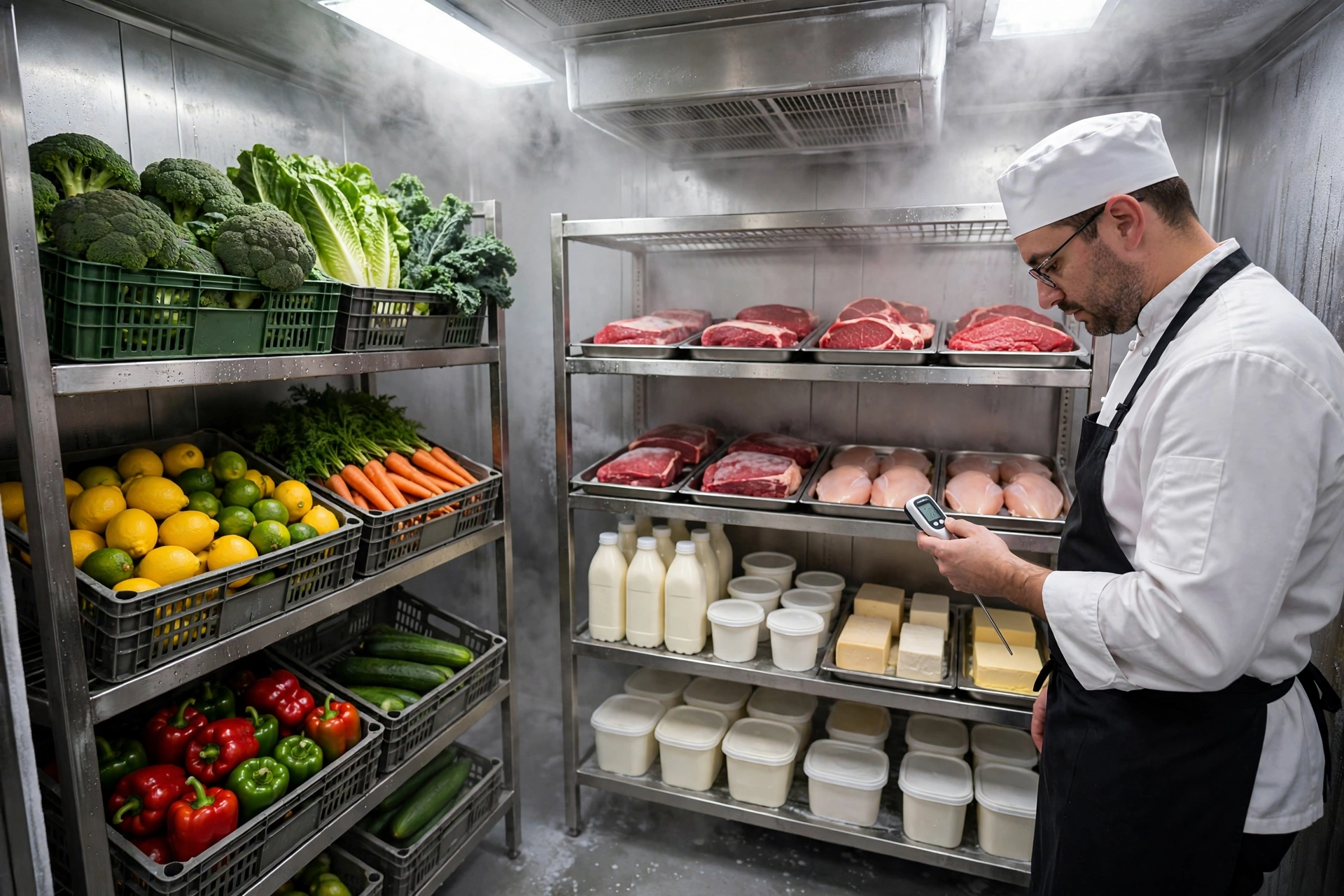
Every restaurant generator is bought against a clock, and the clock is set by food safety law. The US Food and Drug Administration sets the rule that every restaurant operator works to: refrigerators must be kept at or below 40°F (4°C), a closed refrigerator keeps food cold for about four hours without power, and perishable food that has been above 40°F for four hours or more must be discarded. Food held at room temperature is discarded after two hours, or one hour when the temperature is above 90°F (32°C). The FDA Food Code sets the cold-holding limit at 41°F for food on service. UK guidance sets the chill limit at 5°C. The numbers differ by a degree. The clock does not.
| Unit | Time without power, door shut | What happens next |
|---|---|---|
| Refrigerator / walk-in cooler | About 4 hours | Discard perishables above 40°F for 4 h or more |
| Full freezer / walk-in freezer | About 48 hours | Safe if still at 40°F or below, or ice crystals visible |
| Half-full freezer | About 24 hours | Safe if still at 40°F or below |
| Food at room temperature | 2 hours (1 h above 90°F) | Discard, whatever it looks or smells like |
A generator that starts in 10 seconds makes the four-hour rule irrelevant. A generator that is never fitted makes the four-hour rule the whole business. The difference between the two is not the price of the set. It is the price of the stock, the price of the closure, and the price of the inspection that follows.
The Walk-In Cooler: 6 to 12 Hours to a Full Clear-Out
The walk-in cooler is the most valuable room in the building and the most fragile — a small cold storage room with a door that opens every few minutes. A full-service restaurant holds $8,000 to $20,000 of stock in it, and a small restaurant holds $3,000 to $8,000. The Beryl site walks found walk-ins losing temperature inside 6 to 12 hours, and a walk-in that is opened every few minutes by a cook loses temperature faster than a sealed domestic fridge. The cooler is also the unit the health inspector checks first, because it holds the meat, the dairy, the prepared food and the leftovers — the stock that sickens people when it warms. A thermometer in every unit, a written temperature log, and a generator that holds the cooler below 5°C through the outage are the three items that keep a restaurant open after a power cut. Two of the three cost almost nothing. The third is the set.
The Walk-In Freezer: 48 Hours of Grace, Then the Same Problem
The freezer is the forgiving unit. A full freezer holds a safe temperature for about 48 hours with the door shut, and a half-full freezer for about 24 hours. Food that still contains ice crystals, or that measures 40°F or below when the power returns, is safe to refreeze or cook. The grace period is real, and it is the reason a restaurant with a small set can choose to carry the cooler and the reach-ins and leave the freezer to its own insulation for the first day. The grace period is also the trap. A freezer that has been opened repeatedly during a long outage, or that was half empty when the power failed, does not hold for 48 hours. The operator who assumes it does finds out at the temperature log, and the log is the document the inspector asks for.
What the Inspector Writes Down
A health inspector can shut a restaurant down on the spot when cold-holding fails, and the FDA Food Code is the standard the inspector measures against. The inspection after an outage is a short list: the temperature of every unit, the time the power failed, the time it returned, and the temperature log that connects the two. A restaurant with a generator has a short story to tell: the set started in 10 seconds, the units never left their range, the log shows it. A restaurant without one has a long story, and the long story usually ends with a disposal record and a closure notice. The set is not only a power supply. It is the evidence that the food stayed safe.
Gas or Electric Cooking Changes the Answer
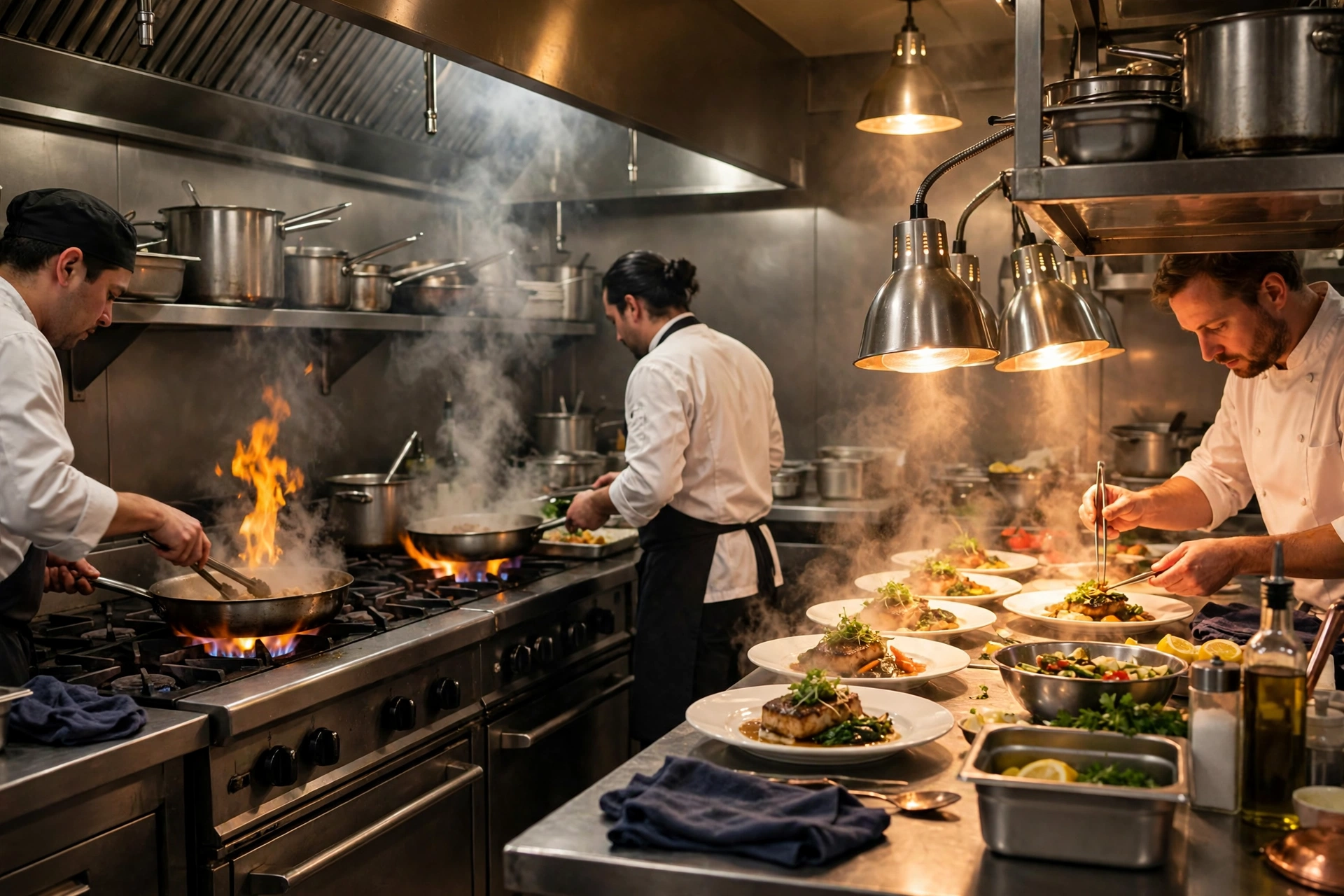
The single biggest variable in restaurant generator sizing is not the seat count. It is the fuel in the kitchen. A gas kitchen and an all-electric kitchen of the same size need sets that differ by 30 to 50 kVA, and the difference is the reason two restaurants on the same street get two different quotations for what looks like the same job.
A Gas Kitchen
A gas kitchen draws almost no electricity to cook. The ranges need a spark, the fryers need a thermostat, and the ovens need a fan. The electrical load that matters is the extraction fan, at 0.75 to 2.2 kW, and the refrigeration. A 15 kVA set delivering 12 kW of prime power carries a busy small restaurant with gas cooking, as long as heavy loads do not all start at once. The set is small, the tank is small, the fuel bill is small, and the installation is simple. Gas is the reason the smallest restaurant band starts at 20 kVA rather than 50 kVA. The trade is that the gas supply itself must be reliable, and the kitchen needs a gas safety interlock that shuts the gas off if the extraction fan stops. A generator that carries the fan carries the interlock. A generator that does not carry the fan cannot legally keep the kitchen cooking.
An All-Electric Kitchen
An all-electric kitchen is a different building electrically. One electric fryer draws 3,000 to 5,000 W, one conveyor oven 5,000 to 8,000 W, one induction hob 3,000 W, one electric griddle 1,500 to 3,000 W, and every one of them draws its full load the instant it switches on — resistive loads do not surge, but they do not wait either. A kitchen with two fryers, one conveyor oven and two induction hobs adds 19 to 24 kW of cooking load to the set, before refrigeration, before HVAC, before lighting. The 60 kVA bistro in the case above would need 100 kVA if its cooking were all electric. The sizing rule is the same either way: add the running loads, add the largest starting load, add 25% for headroom, and size for the largest motor starting while everything else is already running. The method is set out in the generator sizing guide, and it is the method that keeps a set from tripping on the first busy Friday.
The Extraction Fan Nobody Counts
The extraction fan is the smallest load that can close a kitchen. It draws 0.75 to 2.2 kW running and surges to three times that on start, and commercial kitchen fans are published at 65 to 82 dB(A) depending on size and speed. The fan must run whenever cooking runs, because it removes heat, steam and grease-laden air, and because the gas interlock depends on it. A load list that forgets the fan will size the set correctly and still fail, because the set will be ordered without the fan on the essential board and the kitchen will not be allowed to cook. The fan is also the noisiest item in the kitchen, and it is the reason the generator is not the only noise source the neighbours hear. A restaurant that fits a silent canopy and then runs an un-silenced extraction fan has solved half the problem.
Noise, Fuel and the Weekly Test That Proves It Works
A restaurant generator has three jobs after sizing: stay quiet enough that the guests stay, run long enough that the stock stays cold, and start every time it is asked. The three jobs are tested on different days, and the set that passes two of them and fails the third is the set that fails on the night it matters.
Noise at the Patio
An open diesel set produces 95 to 105 dB(A) at 7 metres. A silent canopy set produces 60 to 75 dB(A) at the same distance, about the level of normal conversation. An inverter generator runs at 50 to 65 dB, but it is a portable unit, not a fixed restaurant set. The difference between 95 and 65 is the difference between a generator that clears a patio and a generator that nobody notices. Sound falls by 6 dB every time the distance doubles, so a set at 75 dB(A) at 7 metres is 69 dB(A) at 14 metres and 63 dB(A) at 28 metres — but only if nothing reflects the sound back. A set in a walled courtyard is louder than the same set in an open yard.
City ordinances for food-service sites typically sit at 60 to 65 dB(A) at 50 feet, and fines for breaches run from $250 to $1,000. A residential-grade muffler cuts exhaust noise by 25 to 35 dB, and it is the cheapest noise measure on the list. Placement matters as much as the canopy: the set goes at least 20 feet from doors, windows and vents, with the exhaust pointed away from the dining area, and never under the patio canopy where the sound reflects straight down onto the tables. The restaurant that fits a silent set, a residential muffler and a sensible position has a generator the guests never hear. The restaurant that fits an open set behind the kitchen wall has a generator the neighbours hear in their bedrooms.
Fuel Use and the Tank
Fuel is the clock, and the clock is measured in litres per hour. The rule for modern turbocharged diesel engines is 0.28 to 0.33 litres per kWh at three-quarter load, and the published figures for the common sizes are consistent with it.
| Set size | Load | Fuel use | 24-hour fuel | 72-hour fuel |
|---|---|---|---|---|
| 30 kVA | 18 kW at 75% | 6.8 L/h | 163 L | 490 L |
| 60 kVA | 36 kW at 75% | 13 L/h | 312 L | 936 L |
| 125 kVA / 100 kW | 75 kW at 75% | 22 L/h | 528 L | 1,584 L |
| 250 kVA / 200 kW | 150 kW at 75% | 41.6 L/h | 998 L | 2,995 L |
The 125 kVA figure is published data: a 100 kW set burns 5.8 US gallons an hour at three-quarter load, which is 22 litres an hour, and 7.4 gallons — 28 litres — at full load. The 250 kVA figure is also published: a 200 kW set burns 11.0 US gallons an hour at three-quarter load, or 41.6 litres an hour. At a diesel price of $1.10 a litre, the 60 kVA bistro set costs about $14 an hour in fuel, and the 125 kVA set costs about $24 an hour. The tank follows the outage, not the set: 24 hours at 13 L/h needs 312 litres, so a 500-litre sub-base tank covers a day with margin; 72 hours needs 936 litres, so a 1,000-litre bulk tank is the honest answer. Fuel that sits for months goes stale, and diesel fuel ageing is the reason the tank is polished, tested and turned over rather than simply filled and forgotten.
The Weekly Run
NFPA 110 sets the standard for emergency power: a Level 1 system starts within 10 seconds of a mains failure, is tested for 30 minutes every week, is load-tested for 30 minutes every month, and is load-bank tested every year. The weekly run is the test that matters most for a restaurant, because a restaurant set spends most of its life idle and is then asked to start, take load and run for hours with nobody standing next to it. The test is run on load, not off load, because an off-load run proves the engine starts and nothing else — it does not prove the set carries the walk-in, the extraction fan and the HVAC together. The test is logged with the date, the hours, the load and the fuel level, and the log sits next to the temperature log, because the two documents together are what the inspector and the insurer ask for after an outage. A set that is tested weekly, serviced on hours and on the calendar, and fitted with a standby power rating that matches the load list will start on the night it is needed. A set that is not tested will start on the night it is tested, and the difference between those two nights is the whole business.
Frequently Asked Questions
What size generator does a restaurant need?
Most restaurants need 30 to 125 kVA. A café needs 20–30 kVA, a small restaurant with gas cooking needs 30–50 kVA, a neighbourhood bistro needs 50–80 kVA, and a full-service restaurant needs 100–125 kVA or more. The exact figure comes from a load list taken from the rating plates on the actual equipment, with 25% headroom and the largest motor starting while everything else is already running.
Do restaurants need a backup generator?
A restaurant needs a backup generator when the cost of one outage exceeds the cost of the set, and for most restaurants that point is passed after a single long outage. A full-service restaurant loses $2,000 to $8,000 an hour while dark and carries $8,000 to $20,000 of stock in its walk-in, so a $24,000 set pays for itself after about three four-hour Friday outages. A restaurant that never loses power does not need one. A restaurant that has lost power once knows the answer.
How long can a restaurant run on a generator?
A restaurant can run on a generator for as long as the fuel lasts, and the fuel is the only limit. A 60 kVA set at three-quarter load burns about 13 litres an hour, so a 500-litre tank runs it for about 38 hours and a 1,000-litre tank for about 76 hours. The practical limit is refuelling and service: the set needs an oil and filter check after the first long run, and the fuel supplier needs to be able to reach the site during the same storm that caused the outage.
How quiet does a restaurant generator need to be?
A restaurant generator needs to be quiet enough that the guests on the patio do not notice it, which in practice means a silent canopy set at 60 to 75 dB(A) at 7 metres, with a residential-grade muffler and placement at least 20 feet from doors, windows and the dining area. An open set at 95 to 105 dB(A) at 7 metres will clear a patio and breach most city ordinances, which typically sit at 60 to 65 dB(A) at 50 feet. The canopy is not a luxury item for a restaurant. It is the item that decides whether the generator saves the dinner or ruins it.
What should a restaurant generator power during an outage?
A restaurant generator should power the cold chain first — the walk-in cooler, the walk-in freezer and the reach-ins — then the cooking and the extraction fan, then the POS system and the lighting, and then the air conditioning if the set is large enough. The order is set by the cost of losing each load: the cold chain loses stock by the hour, the kitchen loses the service, the till loses the money, and the air conditioning loses comfort. A set that cannot carry the cold chain is not a restaurant generator, whatever else it powers.
Specification Checklist: Ten Lines Before You Order
- Load list from rating plates — every load with running watts and starting watts, not a brochure estimate.
- Tier order in writing — cold chain first, cooking and extraction second, till and lighting third, HVAC last.
- Standby rating matched to the load list — with 25% headroom and the largest motor starting while everything else runs.
- Automatic transfer switch — 10-second start, with a weekly 30-minute load test written into the maintenance contract.
- Silent canopy — 60 to 75 dB(A) at 7 metres, residential-grade muffler, set at least 20 feet from doors, windows and the patio.
- Fuel autonomy in litres, not hours — tank sized for the longest outage in the area’s history, with a refuelling plan for a longer one.
- Fuel quality plan — polishing, testing and turnover, because diesel that sits for months goes stale.
- Temperature logging — a thermometer in every unit and a written log that records the time of the outage and the temperature of every unit.
- Gas interlock — the extraction fan on the essential board, so the gas supply stays live while the kitchen cooks.
- Service contract on hours and calendar — oil, filters, coolant, batteries and an annual load-bank test, with the service dates in the diary before the set is ordered.
A restaurant generator is bought once and judged on the worst night of the year. Size it from the load list, fit the canopy, test it weekly on load, and keep the cold chain below 5°C through the whole outage. For a set sized to a real restaurant load list, with the standby power rating, the automatic transfer switch and the silent canopy specified before the order is placed, contact PAVO.