

What Size Diesel Generator Does a School Need? | PAVO
A school has no stock to sell and no production line to stop — but it has 1,000 children in one building, and a power cut at 9 a.m. is a safety problem before it is a teaching problem.
What size generator does a school need? Most primary schools run on 100–150 kVA, most secondary schools on 250–400 kVA, and a large campus with boarding on 800–1,250 kVA. The set must cover life-safety loads first, then teaching and the canteen, and start the largest motor without dropping voltage.
Contents
– What a School Loses When the Power Goes Out – What Size Generator Does a School Need? – Do Schools Need a Backup Generator? – How Long Can a School Run on a Generator? – How Quiet Does a School Generator Need to Be? – Three Schools, Three Answers – Frequently Asked Questions – Specification Checklist: Ten Lines Before You Order
What a School Loses When the Power Goes Out
Three schools lost power in two days in November 2026. Harlow College in Essex closed on 18 November after a power cut, sent hundreds of students home, and reopened the next day. Spittal Primary School outside Glasgow closed on the morning of 17 November for the same reason. On the same day, the College of Staten Island suffered a campus-wide outage at 8:35 a.m., evacuated students and staff, and moved the rest of the day online. None of the three had a generator carrying the site. Each one lost a full teaching day, and each one had to tell parents, at short notice, to collect their children.
A school is not a factory. A factory that loses power loses production. A school that loses power loses supervision of hundreds of minors in a building that is suddenly dark, silent and warm. The order of the losses matters, because it decides what the generator must carry first.
Life Safety First: Lights, Alarms and Exits
The first loads are the ones the fire code already demands. NFPA 101 requires emergency lighting to switch on automatically within 10 seconds of a mains failure and hold the escape route for at least 90 minutes, at an average of 1 foot-candle at the start and no less than 0.6 foot-candle at the end of that period. In the UK, BS 5266-1:2025 sets a 3-hour duration for schools, because schools are classed as premises requiring early reoccupation. Battery packs can meet those durations on their own, and in many schools they do. The generator’s job is to take over after the batteries would have run out, and to power everything the batteries cannot: the fire alarm panel, the public-address system, the access-control gates, CCTV, the lift that carries a wheelchair user down from the second floor, and the booster pump that keeps water pressure up for the toilets.
A secondary school of 1,200 pupils typically has six to eight stair cores, three lift shafts in a modern block, and a fire alarm system with 200 or more detection points. The life-safety board alone draws 3–5 kW. It is a small load, and it is the one load that cannot be negotiated away. A set that cannot carry it is not a school generator; it is a garden ornament.
Teaching Stops: IT, Exams and the 3-Hour Rule
The second loss is teaching itself. A modern classroom runs on power: interactive panels, projectors, Wi-Fi access points, the server room that holds the attendance register, the management information system and the safeguarding records. A computer lab of 30 machines draws 4–5 kW. A school server room draws 5–10 kW. None of it is life safety, but all of it is the school day. When it stops, the timetable stops with it, and the school’s only honest option is to send pupils home early — which is why Harlow College lost the whole day rather than the morning.
Exams make the stakes sharper. Under the UK JCQ exam contingency rules, if the power fails during a public examination, candidates must stop writing immediately and stay silent while the invigilator notes the time. Candidates working on laptops must save their work to a USB key at once. The examination session has a hard limit of 3 hours (3 hours 45 minutes for Cambridge International), and if the interruption pushes the session past that limit, the examination is terminated and the awarding body decides what happens next. A generator that keeps the exam hall lit and the laptops charged for two hours is not a luxury. It is the difference between an exam that counts and an exam that does not.
The Canteen Clock: 4 Hours to a Full Fridge Clear-Out
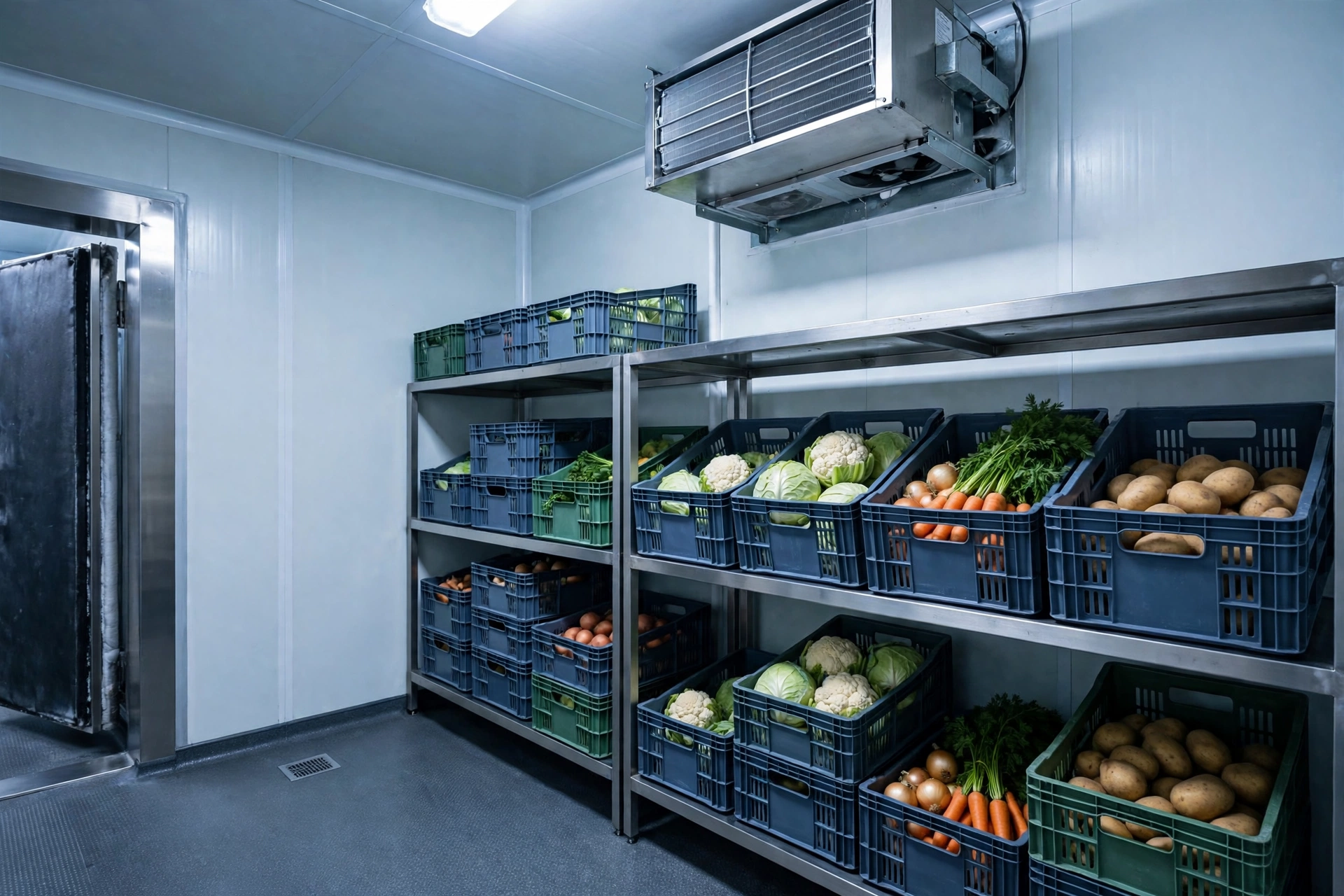
The third loss is the one with a clock on it. The US FDA and USDA rule is simple: a refrigerator keeps food safe for about 4 hours if the door stays shut. After that, perishable food held above 40°F (4°C) for two hours or more must be thrown away. A full freezer holds for 48 hours; a half-full freezer for 24 hours. A secondary school canteen serves 800–1,000 lunches a day and holds a walk-in cold room of 2–4 kW plus freezers, chilled display counters and a milk fridge. Four hours without power turns that stock into waste, and the next morning the kitchen has nothing to serve. The medical room adds a smaller, sharper risk: insulin and some emergency medicines must stay refrigerated, and a warm fridge is a safeguarding incident, not a catering problem.
The pattern is consistent. Life safety is small and non-negotiable. Teaching is medium and decides whether the day continues. The canteen is a 4-hour fuse. A school generator is sized against all three, in that order.
What Size Generator Does a School Need?
School sets cluster into four bands, and the band is set by pupil numbers and by whether the site has boarding, a swimming pool or a large sports hall. The figures below are running loads at 0.8 power factor, and they assume a standby-rated set carrying the whole school or the essential board as stated.
| School type | Typical set | What it usually covers |
|---|---|---|
| Small primary, single building, 200–400 pupils | 60–100 kVA (50–80 kW) | Emergency lighting, fire alarm, PA, canteen fridges, server, essential lighting |
| Primary or small secondary, 400–800 pupils | 100–150 kVA (80–120 kW) | As above, plus IT labs, kitchen, water pumps, one lift |
| Full secondary, 800–1,500 pupils | 250–400 kVA (200–320 kW) | Full teaching load, HVAC, lifts, sports hall, exam hall |
| Large campus or boarding school, 1,500–2,500+ pupils | 500–1,250 kVA (400–1,000 kW) | Whole campus, boarding houses, kitchens, laundry, central plant |
The bands come from US campus-generator practice, where schools typically need 40–65 kW for a small building, 100–150 kW for an elementary school covering life safety and partial HVAC, 150–400 kW for a full K-12 school with labs, a server room and a kitchen, and 500–2,000 kW for a central plant serving several buildings. The kVA figures above convert those bands at 0.8 power factor and add the margin a standby set needs for motor starting.
Two decisions sit inside the table, and both are made before any catalogue is opened. The first is scope: does the set carry the whole school, or only the essential board? The second is the standby power rating question. A school set is a standby set. It waits, sometimes for months, and then runs for hours. Buying a prime-rated set for that duty wastes money; buying a standby set and then running it as the school’s main supply for a term will shorten its life. The rating must match the duty, and the duty for a school is standby.
A Worked Example: An 800-Pupil Secondary School
Take an 800-pupil secondary school in a three-storey block, built in 2010, with a canteen, two IT labs, a server room, a sports hall and one chiller for the science block. The load list for the essential board looks like this.
| Load | Running load | Notes |
|---|---|---|
| Emergency lighting and exit signs | 3 kW | NFPA 101 / BS 5266 duration, 90 minutes to 3 hours |
| Fire alarm, PA, CCTV, access control | 3 kW | Continuous, cannot be shed |
| Server room and network | 8 kW | UPS-backed, generator takes over after 10 minutes |
| Two IT labs, 60 machines | 6 kW | 100 W per machine including monitors |
| Canteen cold rooms and freezers | 10 kW | Walk-in cold room plus freezers, cycling load |
| Kitchen, gas cooking, fans and pumps | 8 kW | Electric fans, dishwashers, water heaters |
| Water booster pumps | 5 kW | Two 2.5 kW pumps, one duty, one standby |
| Essential lighting, classrooms and corridors | 12 kW | LED, about 40% of full lighting load |
| Passenger lift, 1,000 kg | 7.5 kW | Starting current 5–7 times running current |
| Essential total | 62.5 kW | 78 kVA at 0.8 power factor |
Apply a 25% margin for load growth and starting transients, and the essential board needs 98 kVA. The next standard size up is 100 kVA. That is the essential-only answer: a 100 kVA silent set keeps the school safe, fed and teaching, without air conditioning.
Add the chiller and the answer changes. The science-block chiller draws 45 kW running, and the full building then needs 107.5 kW running, or 134 kVA. The running figure is not the problem. The starting figure is. The method in the generator sizing guide is to size for the largest motor starting while everything else is already running, because that is the moment of greatest demand that actually occurs.
The Motor-Starting Trap: Chillers and Pumps
A direct-on-line induction motor draws 5–7 times its running current for a second or two at start-up. A 45 kW chiller starting direct-on-line can pull 225–315 kVA of transient demand. Add the 78 kVA already running on the essential board, and a set rated below 300 kVA will drop its voltage far enough to stall the chiller, drop out contactors and trip the board. That is how a school buys a 200 kVA set for a 134 kVA load and still loses the building.
The fix is cheaper than the extra iron. A soft starter or a variable-frequency drive brings the chiller’s starting demand down to 1.5–2 times running current — about 90 kW, or 112 kVA. Add the 78 kVA of essential load, and a 200 kVA set carries the whole building, chiller included. A star-delta starter, at about 3 times running current, needs 250 kVA. The lesson is the same one the motor starting guide states in full: size for the starting case, not the running case, and spend the money on the starter before spending it on a bigger set.
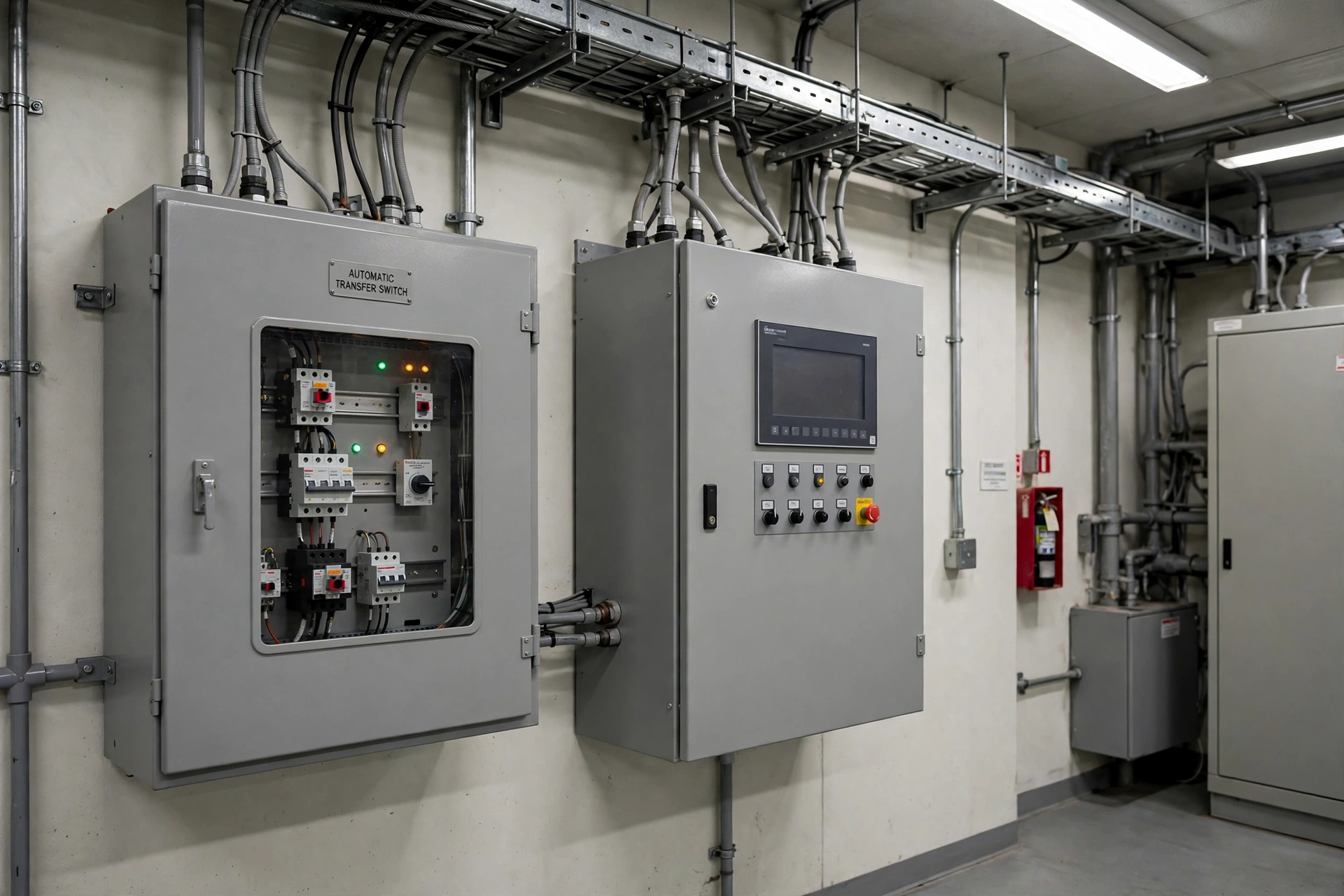
Lifts deserve the same check. A 1,000 kg passenger lift motor draws 7.5 kW running and 35–50 kVA for a second at start. Two lifts starting together after a transfer add 70–100 kVA of transient to a board that is already loaded. Sequence the lifts in the automatic transfer switch panel — one lift, then the other, ten seconds apart — and the transient halves. It costs nothing but a timer in the control panel, and it is the kind of detail that separates a set that works on the day from a set that only works on paper.
Do Schools Need a Backup Generator?
The short answer is that the law rarely requires a generator, and the school usually buys one anyway. The two statements are both true, and confusing them is the most common mistake in a school generator specification.
What the Codes Actually Require
In the United States, NFPA 110 places a school in Level 1 — the highest class of emergency power system — when its occupant load exceeds 1,000 persons. Level 1 is a performance standard, not an equipment list: the generator must start and accept its full load within 10 seconds of a mains failure. It must then be tested under load for 30 minutes every month, with an annual load-bank test of at least 2 hours. That testing regime is the part schools most often neglect, and it is the part that decides whether the set starts on exam day. The maintenance schedule for a school set is not an admin chore. It is the compliance record, and an insurer or an inspector will ask for it first.
The lighting code is separate and older. NFPA 101 requires emergency lighting on the escape route for 90 minutes. BS 5266-1:2025 requires 3 hours for schools in the UK. Both codes are satisfied by battery packs in the luminaires themselves, and in most schools that is exactly how they are satisfied. The generator is not there to replace the batteries. It is there to take over when the batteries are exhausted and the outage is still running, and to power the loads no battery can carry: the alarm panel, the PA, the pumps, the fridges.
Nothing in either code says a school must own a generator. A school can comply with the letter of the law using battery emergency lighting, a battery-backed fire alarm and a decision to close the building when the grid fails. Many schools do exactly that, and their fire risk assessment accepts it. The question is not whether the code requires a generator. The question is what the school loses by closing, and whether that loss is acceptable.
What the Codes Do Not Require — and Why Schools Buy More Anyway
A secondary school of 1,200 pupils loses about 7,200 pupil-hours for every day it closes. The cost is not measured in the school’s budget. It is measured in parents leaving work to collect children, in exam candidates losing revision days in the final weeks before public examinations, and in the trust a school spends years building with its community. Harlow College closed for one day in November 2026 and reopened the next. The disruption was a single day. If the same outage had fallen in the middle of the GCSE examination window in June, the same single day would have been a contingency case for the awarding bodies and a headline in the local press.
Boarding schools have a harder version of the same argument. A day school can send its pupils home. A boarding school cannot. Two hundred boarders need hot water, cooking, lighting and heating through the night, and the school is legally responsible for them around the clock. A generator for a boarding school is not a teaching aid. It is part of the duty of care, and the governors who sign the order know it.
The third reason is safeguarding. A school that loses power loses its access-control gates, its CCTV and its intercoms at the same moment. The site is still full of children, and the perimeter is suddenly open. Most schools accept that risk for an hour. Few accept it for a day. A 100 kVA set that keeps the gates, the cameras and the phones working is cheap insurance against the one incident no head teacher wants to explain.
How Long Can a School Run on a Generator?
A generator does not get tired. The fuel tank is the clock. The honest way to answer the question is with litres per hour, not with a brochure figure.
| Set size | Load at 75% | Fuel at 75% load | 8-hour school day | 24 hours | 72 hours |
|---|---|---|---|---|---|
| 100 kVA (80 kW) | 60 kW | ~18 L/h | 144 L | 432 L | 1,296 L |
| 250 kVA (200 kW) | 150 kW | 41.6 L/h | 333 L | 998 L | 2,995 L |
| 500 kVA (400 kW) | 300 kW | ~90 L/h | 720 L | 2,160 L | 6,480 L |
The 250 kVA figure is published data: a 200 kW set burns 11.0 US gallons per hour at three-quarter load, which is 41.6 litres per hour. The other two rows use the standard rule of 0.28–0.33 litres per kWh at three-quarter load, which holds across the range for modern turbocharged diesel engines. At a diesel price of $1.10 a litre, the 250 kVA set costs about $46 an hour in fuel at three-quarter load, or about $366 for a full school day. That is the number to put in the budget, not the purchase price. The purchase price is paid once. The fuel is paid every time the set runs.
The School Day Is 8 Hours; the Storm Is 72
Most grid outages that close a school last less than a school day. A tree falls on a line at 7 a.m., the utility restores it by 3 p.m., and the school needs 8 hours of autonomy plus a margin. A 250 kVA set with a 1,000-litre sub-base tank covers that with room to spare: 1,000 litres at 41.6 litres per hour is 24 hours. That is the standard specification for a day school, and it is the right one for most sites.
Boarding schools and remote schools need a different number. A storm that takes down a rural line can take 72 hours to repair, and a boarding school cannot send its pupils home. Seventy-two hours on a 250 kVA set needs about 3,000 litres, which is a bulk tank, a bund, and a fuel delivery contract that works at 2 a.m. on a Sunday. The tank from the Article 1 worked example makes the point: the Cummins C500D5 carries a 645-litre tank and burns 69.9 litres per hour at 75% prime load, which is 9.2 hours. Nine hours is a school day. It is not a storm. Any school that wants 72 hours of autonomy must buy the tank as well as the set, and must have the delivery number on the wall of the plant room before the storm, not during it.
Fuel delivery is the part of the plan that fails most often. A school that has never ordered diesel in an emergency discovers, during the emergency, that its supplier’s tanker is booked solid, that the access road is blocked by the same fallen tree that took the power line down, or that the school’s account needs a purchase order signed by a bursar who is at home without power. A written fuel contract, a named supplier, a 24-hour telephone number and a delivery route that does not cross the playground are worth more than an extra 500 litres of tank capacity.
Holiday Fuel: The Set That Sits for Six Weeks
A school generator spends most of its life doing nothing. The summer holiday is six weeks of silence, and the Christmas holiday adds two more. Diesel left standing in a tank absorbs water from condensation, and water breeds microbes that clog filters and corrode injectors. The set that started perfectly in July may not start in September, and the first person to discover that is the caretaker, on the first morning of term, with 1,200 pupils arriving in an hour.
Three habits prevent it. Keep the tank full over the holidays, so there is less air space for condensation to form. Test the fuel before term starts, and polish or replace it if water or microbes show up. And run the set under load at least once a month, even in August, because a monthly test finds dead batteries, a seized fuel solenoid and a transfer switch that will not transfer. A set that is tested monthly starts on exam day. A set that is tested never does not.
How Quiet Does a School Generator Need to Be?
Noise is the constraint that surprises school buyers most, because the limit is set by the classroom, not by the generator. The World Health Organization’s guideline for community noise is 35 dB(A) LAeq inside a classroom during teaching, and 55 dB(A) LAeq on an outdoor playground. Washington State’s school rules set the same idea in law: noise from any source at a school site must not exceed 55 dBA Leq over an hour, or 75 dBA maximum, while the school is in session, and the background noise inside a classroom must not exceed 45 dBA. A teacher speaking at a normal level produces about 55 dB(A) at one metre. A classroom needs a signal-to-noise ratio of about 15 dB for children to understand speech, which is where the 35 dB(A) target comes from. Children with hearing difficulties need quieter still.
A silent canopy set is typically rated at 65–75 dB(A) at 7 metres. An open set is typically 85–95 dB(A) at the same distance. The difference is the difference between a set that can sit behind the kitchen block and a set that cannot sit anywhere near a classroom. No school should buy an open set for a site where children are taught within 50 metres of it. The canopy costs more, and it is the only option that works.
The Distance Rule: 6 dB per Doubling
Sound falls by 6 dB for every doubling of distance in free field. That single rule decides where the set can stand, and the arithmetic is worth doing before the plinth is poured.
| Distance from the set | Sound level, 70 dB(A) set at 7 m | Sound level, 65 dB(A) set at 7 m |
|---|---|---|
| 7 m | 70 dB(A) | 65 dB(A) |
| 14 m | 64 dB(A) | 59 dB(A) |
| 28 m | 58 dB(A) | 53 dB(A) |
| 56 m | 52 dB(A) | 47 dB(A) |
Take a 70 dB(A) set standing 28 metres from the nearest classroom. Outside the classroom window, the level is 58 dB(A). A closed window and a brick wall take off 15–25 dB, which brings the classroom down to 33–43 dB(A) — inside the target. Open the windows on a warm day, and the wall takes off only about 10 dB, leaving 48 dB(A) in the room — well above the 35 dB(A) WHO target, and loud enough to force the teacher to raise their voice for every lesson. The same set at 56 metres leaves 42 dB(A) inside with the windows open. Distance is the cheapest silencer a school can buy, and it costs nothing but a longer cable run and a longer fuel line.
A barrier helps where distance is not available. A solid wall or an acoustic fence between the set and the classroom takes off 5–10 dB if it breaks the line of sight between the set and the window. A bund wall, a bin store or the kitchen block itself can serve. What does not help is a hedge, a fence with gaps in it, or a canopy that is left open for ventilation. Sound goes through gaps the way water goes through a hole in a bucket.
Where to Put the Set: Placement, Fencing and Safeguarding
A school is a safeguarding environment, and a generator is a machine with hot surfaces, rotating parts, a fuel tank and an exhaust that reaches 400–500°C. The set must be fenced, locked and out of reach, and the fence must be a real fence: 2.4 metres high, with a locked gate, no horizontal rails a child can climb, and no gap a small hand can reach through. The fuel delivery point must be reachable by a tanker without crossing the playground, and the exhaust must point away from classroom windows, air intakes and the playground itself. A set that vents across the playground will fill it with diesel smell every time it tests, and the complaints will arrive before the test has finished.
The best position is usually behind the kitchen block or the plant room, on the service side of the site, where the delivery lorries already go. The worst position is the one that is easiest to reach: the corner of the car park nearest the main entrance, where the cable run is short and the set is on display to every parent at drop-off. A short cable run saves a few hundred pounds of copper. A set that children can touch costs a school its safeguarding audit. The plant room, the kitchen block and the service yard exist for exactly this reason. Use them.
Three Schools, Three Answers
The specification follows the school, not the catalogue. Three real specification patterns show how the same decision is made differently at three sizes.
Case 1: A 320-Pupil Primary School in Kent
A single-storey primary school with 320 pupils, a small canteen, one IT suite and no lift. The essential board totals 38 kW: emergency lighting, fire alarm and PA, the server and the office network, the canteen cold rooms and the essential lighting. With a 25% margin, the set is 60 kVA, and the school orders a 125 kVA silent set — the next standard size above the requirement, and the size that covers a second IT suite the school plans to add in two years. The set is rated 68 dB(A) at 7 metres and stands 40 metres from the nearest classroom, behind the kitchen block, inside a 2.4-metre fence with a locked gate. At 75% load it burns about 22 litres per hour, so the 500-litre sub-base tank gives it 22 hours — three school days. The set costs less than a single classroom refurbishment, and the head teacher’s reason for signing the order is simple: a primary school cannot send 320 five-to-eleven-year-olds home at 10 a.m. and expect their parents to be there.
Case 2: A 1,200-Pupil Secondary School in Manchester
A three-storey secondary school with 1,200 pupils, a canteen serving 900 lunches, two IT labs, a server room, a sports hall and a chiller for the science block. The essential board is the 62.5 kW worked example above, and the full building with the chiller needs 107.5 kW running. The school orders a 250 kVA set with a Cummins QSB7 engine, and spends the money on a soft starter for the chiller rather than on a 300 kVA set. The set is rated 70 dB(A) at 7 metres and stands 56 metres from the nearest classroom, behind the plant room, with an acoustic fence breaking the line of sight to the science block. At three-quarter load it burns 41.6 litres per hour, so the 1,000-litre sub-base tank gives it 24 hours. The exam hall, the server room and the canteen cold storage are all on the essential board. When the grid failed for six hours during mock examinations, the school finished the day on the generator, the canteen served lunch, and no candidate lost a paper.
Case 3: A 2,400-Pupil International Campus with Boarding in Dubai
A campus with 2,400 pupils, 300 boarders, three classroom blocks, a central kitchen, a laundry and a swimming pool plant room. The load is 900 kW at peak, and the site cannot close: boarders sleep on site, the kitchen serves three meals a day, and the ambient temperature reaches 50°C in summer, which derates the set by about 10%. The campus orders two 625 kVA sets in parallel, so that one set carries the campus at 60% load while the other stands by, and both together cover the peak. A 7,000-litre bulk tank gives the campus 72 hours on one set at 60% load, with a fuel delivery contract and a 24-hour number on the plant room wall. The sets sit in a dedicated plant building 80 metres from the nearest boarding house, behind a bund wall, with the exhaust stacks above the roofline. The capital cost is a fraction of one term’s boarding fees. The governing body’s reason is the same as the primary school’s: the school is responsible for children around the clock, and a power cut at 2 a.m. is not an excuse.
Frequently Asked Questions
What size generator does a school need?
Most primary schools need 100–150 kVA, most secondary schools need 250–400 kVA, and a large campus with boarding needs 800–1,250 kVA. The exact figure comes from a load list, not a rule of thumb: add up the essential loads, add 25% for growth and motor starting, and size for the largest motor starting while everything else is running.
Do schools need a backup generator?
The law rarely requires one. Battery emergency lighting, a battery-backed fire alarm and a decision to close the building satisfy most codes. Schools buy generators anyway because closing costs a teaching day, breaks exam sessions, wastes canteen stock and leaves the perimeter open — and because a boarding school cannot send its pupils home.
How long can a school run on a generator?
As long as the fuel lasts. A 250 kVA set burns about 41.6 litres per hour at three-quarter load, so a 1,000-litre tank gives it 24 hours and a 3,000-litre bulk tank gives it 72 hours. A day school should plan for at least a full school day plus a margin; a boarding school should plan for 72 hours and hold a fuel delivery contract.
How quiet does a school generator need to be?
The WHO guideline is 35 dB(A) inside a classroom and 55 dB(A) on a playground, and some jurisdictions set 55 dBA as the hourly limit at the school site. A silent canopy set rated at 65–75 dB(A) at 7 metres, placed at least 28–56 metres from the nearest classroom, meets that target. An open set does not, and should not be bought for a school site.
What should a school generator power during an outage?
Life safety first: emergency lighting, the fire alarm, the PA, access control and CCTV. Then teaching: the server room, IT labs and the exam hall. Then the canteen: cold rooms, freezers and the kitchen. Air conditioning, sports hall floodlights and non-essential lighting come last, and are the first loads to shed when fuel runs low.
Specification Checklist: Ten Lines Before You Order
- Pupil numbers and boarding: state the pupil count, the number of boarders and whether the site must stay open overnight, because that sets the scope and the fuel autonomy.
- Load list in writing: list every load with running kW and starting kVA, and name the largest motor, because the starting case sizes the set.
- Standby rating, not prime: confirm the quotation states the standby (ESP) rating and the hours it is rated for, because a school set is a standby set.
- Chiller and lift starters: specify soft starters or variable-frequency drives on the chiller and sequence the lifts in the transfer panel, because starting transients decide the set size.
- Noise at the classroom window: require the sound level in dB(A) at 7 metres, and calculate the level at the nearest classroom with windows open, because the WHO target is 35 dB(A) inside.
- Placement and fencing: agree the position, the 2.4-metre fence, the locked gate and the fuel delivery route in writing, because a set children can reach fails the safeguarding audit.
- Fuel autonomy in hours: state the hours required — 8, 24 or 72 — and the tank size that delivers them at three-quarter load, because the tank is the clock.
- Testing regime: write the monthly 30-minute load test and the annual 2-hour load-bank test into the facilities contract, because an untested set is a decoration.
- Fuel contract: hold a written delivery contract with a 24-hour number and a route that does not cross the playground, because the first emergency order is the one that fails.
- Holiday procedure: keep the tank full over the summer holiday, test the fuel before term starts and run the set under load once a month even in August, because diesel left standing grows water and microbes.
A school generator is bought once and judged on one morning: the morning the grid fails during examinations, with 1,200 pupils already in the building. The set that was sized from a load list, tested monthly and fuelled for the storm carries that morning. The set that was bought on price alone does not. If the next outage lands on exam day, the set ordered now is the one that carries it — so contact PAVO with the pupil count, the load list and the distance to the nearest classroom, and the specification can be settled before the term starts.