

What Size Generator Does a Police Station Need? | PAVO
A police station does not go dark like an office. It goes silent — and in the minutes that follow, the emergency calls still come in, the radios still key up, and the cells still hold people who cannot be left in the dark.
What size generator does a police station need? A small neighbourhood station needs a 60–150 kVA set for dispatch, radio and custody; a district headquarters needs 150–400 kVA; and a large city headquarters needs 400–750 kVA. The set must restore power within 10 seconds under NFPA 110 and hold at least 96 hours of fuel.
- What a Police Station Actually Needs Power For
- Sizing Bands by Station Size
- The Dispatch Window: What Happens in the First Ten Seconds
- Three Police Stations That Lost Power — and What They Teach
- Custody, Evidence and the Loads Nobody Sizes For
- Fuel Autonomy and Placement: How Long It Runs and Where It Sits
- Frequently Asked Questions
- Specification Checklist
What a Police Station Actually Needs Power For
A police station is four buildings sharing one address. The first is a communications centre: the 911 call-takers, the dispatchers, the radio room and the computer-aided dispatch system that tells every patrol car where to go. The second is a custody suite: cells, interview rooms, booking desks and the CCTV that watches all of them. The third is a records and evidence store: servers, case files, drug safes and the refrigerators that hold blood and DNA samples. The fourth is everything else — offices, a kitchen, a gym, vehicle bays and a car park full of patrol cars.
Only the first three matter when the grid fails. The fourth can wait. That distinction is the whole sizing exercise, and it is the distinction most police-station specifications get wrong. A station that tries to back up the entire building buys a set two or three times larger than it needs, pays for the fuel and the maintenance of that set for twenty years, and runs it at a quarter load — where wet stacking and carbon build-up quietly shorten its life. A station that backs up only the functions the public depends on gets a set half the size, at half the price, that actually works on the night it is needed.
The governing standard leaves no room for argument. NFPA 110 classifies police stations and other emergency response facilities as Level 1 systems — failure could result in loss of human life or serious injuries. Level 1 systems must restore power within 10 seconds (Type 10), and for emergency response facilities the design target is Class 96 hours: four days of fuel on site without a delivery. Those three numbers — Level 1, Type 10, 96 hours — are the skeleton of every police-station generator specification, and any tender that does not state them has not been written by someone who has read the standard.
The loads fall into five tiers, and the first three are non-negotiable.
| Load tier | Systems | Share of station load | On the generator? |
|---|---|---|---|
| Dispatch and communications | 911 call-taking, radio base stations, CAD servers, telephony, microwave links | 15–25% | Yes — always |
| Custody and life safety | Cell lighting and ventilation, electronic locks, intercoms, CCTV, fire alarm, emergency lighting | 10–20% | Yes — always |
| Evidence and records | Evidence refrigeration, servers, records room, drug safes, case-file storage | 10–15% | Yes — always |
| Building services | HVAC, general lighting, lifts, water pumps | 25–35% | Yes — staged |
| Non-essential | Vehicle bays, offices, kitchen, gym, training rooms, car park | 20–30% | No — shed on transfer |
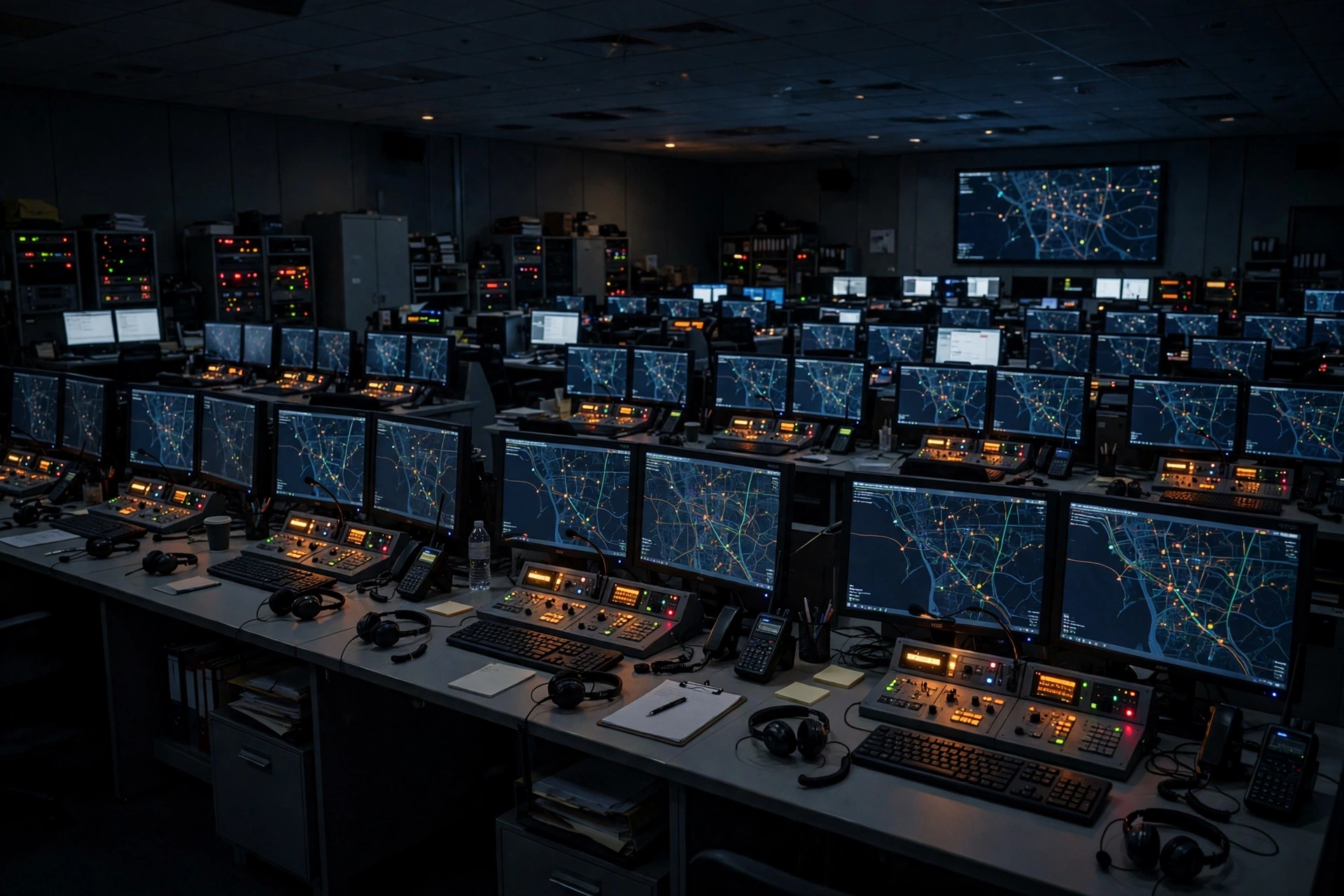
Dispatch and communications is the tier that decides everything. A public safety answering point — the PSAP that answers 911 calls — is governed by NFPA 1225, which requires the communications centre to remain operational through a power failure. The call-takers sit in front of two or three screens each, wearing headsets, with a radio console at their elbow. Behind them, the radio base stations, the repeaters on the roof and the microwave links to the neighbouring counties all draw power continuously. None of that load is large — a dispatch floor of twelve positions draws 15–25 kW — but none of it can stop, even for a minute. A 911 call that goes unanswered because the call-taker’s screen is dark is not a facilities failure. It is a missed response to a burglary in progress, a road collision, a domestic incident. The dispatch floor is the reason the generator exists.
Custody and life safety is the tier that carries the legal risk. A custody suite holds people who cannot leave. The cells need light and ventilation by law. The electronic locks need power to open and to stay locked. The CCTV needs power so that every minute of every detention is recorded — and a gap in the recording is a gap in the evidence chain that a defence lawyer will find. The fire alarm and the emergency lighting need power so that the building can be evacuated. A station that loses power to its custody suite does not just go dark. It creates a liability that lasts for years.
Evidence and records is the smallest tier and the easiest to forget. The evidence refrigerator holds blood samples, DNA swabs and seized drugs at 2–8°C. The freezer holds samples at −20°C. A refrigerator that warms up for six hours does not just spoil the samples — it destroys the case. The servers hold the case management system, the body-camera footage and the records database. A server room without power is a station without its memory. The load is small — a few kilowatts — but the consequence of losing it is measured in collapsed prosecutions.
Building services is the tier that gets staged. The HVAC compressors are the largest motors in the building, and they start at five to six times their running current. On transfer, the generator starts the dispatch floor and the custody suite first, then brings the HVAC in one compressor at a time, minutes apart. The lifts stay off unless the station has a custody suite above the ground floor. General lighting comes on in the corridors and the operational areas, not in the gym.
Non-essential loads get shed. The vehicle bays, the offices, the kitchen, the gym and the training rooms all go dark on transfer, and nobody apologises for it. A police station that loses its grid supply does not close. Its officers still go out on patrol. But the offices do not need lights for that to happen. The distinction between the five tiers is what keeps the generator affordable — and what keeps it small enough to actually start when it is needed.
Sizing Bands by Station Size
Police stations do not size by floor area. They size by the number of dispatch positions, the number of cells, the size of the radio system and whether the building is a headquarters or a neighbourhood station. A 3,000-square-metre headquarters with a 24-position dispatch floor and forty cells has a very different load profile from a 3,000-square-metre neighbourhood station with four cells and no dispatch floor at all. The table below gives the bands that cover most stations. The generator figure is the standby-rated set for the essential tiers plus staged building services — not the full building load.
| Station type | Essential load | Generator size | Fuel at 75% load |
|---|---|---|---|
| Small neighbourhood station | 30–60 kW | 60–100 kVA | 12–20 L/h |
| District / suburban station | 60–150 kW | 150–250 kVA | 30–50 L/h |
| City headquarters | 150–350 kW | 300–500 kVA | 60–100 L/h |
| Large metropolitan HQ / combined EOC | 350–600 kW | 500–750 kVA | 100–150 L/h |
The published municipal figures line up with those bands. Turnkey Industries, which supplies generators to US municipalities, puts a small department at 65 kW, a satellite station at 65–125 kW, and a city hall or police headquarters at 150–500 kW, with a regional emergency operations centre reaching 1,200 kW. The spread is wide because the buildings are wide. A station that serves a town of 20,000 people and a headquarters that serves a city of 500,000 are not the same building, and no single number covers both.
A worked example shows how the numbers add up, using the same method as the generator sizing guide: running load first, then the largest starting surge on top. Take a district station with eight dispatch positions, twelve cells and a radio room serving forty patrol cars. The dispatch floor draws 18 kW running. The radio base stations and repeaters draw 12 kW. The custody suite — lighting, ventilation, locks, CCTV and intercoms — draws 15 kW. The evidence refrigeration and the servers draw 8 kW. Emergency lighting and the fire alarm draw 4 kW. The running total for the essential tiers is 57 kW, about 71 kVA at 0.8 power factor. Then add the staged building services: two HVAC compressors at 22 kW each, running one at a time. The total running load is 79 kW, about 99 kVA.
The starting surge is where the set is really decided. The largest HVAC compressor starts at five times its running current — 110 kW for the first second. If the compressor started at the same moment as everything else, the set would need to absorb a surge of more than 180 kVA. The answer is not a 200 kVA set. The answer is a 150 kVA set with a sequenced start: dispatch and custody first, then the first compressor, then the second, each a minute apart, with the automatic transfer switch managing the order. The set never sees more than 130 kVA at any moment, and the dispatchers never notice the sequence.
The rating matters as much as the size. A police-station generator is a standby-rated set under ISO 8528-1, and the difference between standby and prime ratings decides how long the set can run when the outage stretches into days. A standby-rated set is designed for up to 200 hours a year at variable load with an average load factor of about 70%. That covers monthly testing and a handful of real outages. A station in a hurricane zone that expects to run its set for a week at a time should be looking at a prime-rated set, or at least at a standby set derated to prime duty — a 500 kVA standby set that becomes a 455 kVA prime set, the same 9% margin the Cummins C500D5 carries between its two ratings. Buy the standby number and run it at prime duty, and the set will fail on its third long outage, not its first.
The two real cases in this article show both ends of the sizing question. In Downers Grove, Illinois, a village of 50,000 people, the police station’s old 100 kW set powered only the dispatch centre, the records division, the booking area and the phone room — and the 35-year-old 45 kW set powered a multipurpose room and a handful of light fixtures. Most of the building went dark in every outage. The council approved a 350 kW diesel generator for $281,410.48, and kept the old 100 kW set as an additional backup for the dispatch centre alone. In Lakeland, Florida, a city of 115,000 people, the police department’s 500 kW set had reached the end of its useful life at nearly 30 years old and could only power parts of the building. The replacement was a 600 kW Blue Star generator with a 1,600-amp Asco 300G automatic transfer switch and a 4,000-gallon fuel tank, at a cost of $488,527 — a set sized to power the entire building, not just part of it.
One more sizing rule, learned the hard way: size for the station as it will be in ten years, not as it is today. Police stations grow. A new dispatch floor, a new custody suite, a new evidence store, a body-camera server room — each one adds load. The station that buys a 250 kVA set for a 240 kVA load has no room for the next expansion. The station that buys a 300 kVA set for the same load has room for one more dispatch floor and a margin for a hot summer day when the HVAC works hardest. The extra 50 kVA costs a few thousand dollars at purchase. Adding a second set later costs ten times that.
The Dispatch Window: What Happens in the First Ten Seconds
The grid fails at 2:14 a.m. on a Tuesday. In the dispatch room, the screens stay lit — the UPS carries them. The radio consoles stay live — the UPS carries those too. The automatic transfer switch senses the loss of mains, waits out its programmed delay of one to three seconds to make sure the outage is real, and then signals the generator to crank. The engine turns over, reaches speed, the voltage stabilises, and the switch transfers the load. The whole sequence takes 10 seconds or less. That is the NFPA 110 Type 10 requirement, and it is the number the entire system is built around.
Ten seconds sounds fast. It is not fast enough on its own, which is why the UPS exists. The UPS bridges the gap between the grid failing and the generator taking the load, and it carries the dispatch floor, the radio consoles and the servers through those ten seconds without a flicker. A UPS that holds 15–30 minutes is standard for a dispatch floor, and it is the only part of the system that works in milliseconds. The generator works in seconds. The two together are what keep the 911 call-taker’s screen lit through the transfer.
The 911 call that cannot drop
A mid-size public safety answering point handles 300,000–500,000 calls a year, and during a major storm the call volume triples in an hour. Every one of those calls is answered by a person sitting at a desk with a headset, two or three screens and a radio console. The call-taker’s computer runs the computer-aided dispatch system, which shows the location of every patrol car, every fire appliance and every ambulance in the area. Lose that screen and the call-taker is working blind — taking an address on paper and shouting it across the room.
The PSAP’s power chain has three layers, and each one covers the failure of the one before it. The UPS covers the first ten seconds. The generator covers the next four days. And the redundant dispatch centre — a second PSAP in a neighbouring county, or a backup floor in the same building — covers the failure of the whole station. NFPA 1225, the standard for emergency services communications, requires the communications centre to have emergency power, and most large PSAPs now run dual power paths: two separate feeds, two UPS systems and two generators, so that no single failure takes the floor down. The standard is written that way because the cost of a missed 911 call is not measured in dollars.
The load is small, and that is the point. A twelve-position dispatch floor draws 15–25 kW. The servers behind it draw another 10–15 kW. The whole PSAP can be carried on a 60 kVA set with room to spare. The reason stations buy larger sets is not the dispatch floor. It is everything else in the building.
The radio network
The radio system is the second half of the dispatch window, and it is the half that fails most often in a real outage. The patrol cars carry mobile radios, but the system that connects them — the base stations, the repeaters on the roof and on the hill outside town, the microwave links between sites — all needs mains power. A P25 trunked radio system, the standard for US public safety, runs its base stations from the station’s emergency power, and its remote repeater sites from their own batteries and generators. If the repeater on the hill has no generator, the patrol cars in the valley cannot talk to dispatch, even though the dispatch floor has power.
The repeater sites are the weak link. A hilltop repeater with a 48-volt battery bank holds 8–24 hours on batteries alone, depending on how much traffic it carries. After that it needs a generator, and most repeater sites have a small 10–20 kVA set with a 200-litre tank — enough for a day, not a week. The station that plans its own generator and forgets its repeater sites has planned half a system. The officers in the field will tell the rest of the story, on a radio that does not answer.
New Orleans learned that lesson in Hurricane Katrina in 2005. The police department’s communications system failed for days — the 911 centre, the radio network and the dispatch system all went down together, and officers in the field could not reach each other or their commanders. The failure was not a single generator. It was the whole chain: the radio sites, the dispatch centre and the fuel supply all failed at once, and there was no second path for any of them.
Custody and cells
The custody suite has its own ten-second problem, and it is governed by a different rule: the people in the cells cannot leave. The electronic locks on the cell doors are designed to fail secure — they stay locked when the power fails, so that a detainee cannot walk out in the dark. But the same failure that keeps the doors locked also kills the cell lighting, the ventilation, the intercoms and the CCTV. A cell block without light or ventilation is a life-safety failure, and a cell block without CCTV is a gap in the record that a defence lawyer will find.
The custody load is not large — 10–20 kW for a twelve-cell suite — but it must be on the generator from the first second, not staged in later. The ventilation fans in the cells are not comfort equipment. They are the air supply for people who cannot open a window. The intercom is the only way a detainee can call for help. The CCTV is the only record of what happened in the cell during the outage. All three need power before the HVAC compressors get it, and the transfer sequence should be written that way.
Three Police Stations That Lost Power — and What They Teach
Three stations, three different failures, three different lessons. The first bought too little generator. The second bought a generator that could only power part of the building. The third lost its communications entirely. None of them lacked a generator. All of them lacked a system.
Case 1: Downers Grove, Illinois — the station that went dark in pieces
In June 2011, a storm hit the village of Downers Grove, Illinois, and the police station lost grid power. The station’s backup power consisted of two generators: a 35-year-old 45 kW set that powered a multipurpose room and a small number of light fixtures, including exit and stairway lighting, and a 13-year-old 100 kW set that powered the dispatch centre, the police records division, the booking area, the phone room and a limited number of electrical outlets. The HVAC system ran only in limited portions of the station. Most of the facility was left without lights or access to computers or other electronic devices during the outage.
The village staff took extraordinary measures to keep emergency services running, but the lesson was plain: two small sets, installed decades apart for different parts of the building, do not add up to one working system. The village council approved the installation of a 350 kW diesel generator for $281,410.48, built by F. H. Paschen, to provide complete emergency power coverage for the whole station. The old 100 kW set was kept as an additional backup unit for the dispatch centre alone — a second layer for the one room that must never go dark.
The case is a textbook example of incremental backup power. Each set was bought for a specific need at a specific time, and nobody ever asked whether the whole building could run on them together. The answer, on the night of the storm, was no. The fix cost $281,410 and a new 350 kW set. The cheaper fix, ten years earlier, would have been a single set sized for the whole station.
Case 2: Lakeland, Florida — the set that could only power part of the building
In January 2023, the City of Lakeland, Florida, brought a recommendation to its city commission: replace the emergency generator at the Lakeland Police Department. The existing 500 kW generator and its automatic transfer switch had reached the end of their useful life at nearly 30 years old, and the set could only power parts of the building. The recommended replacement was a 600 kW Blue Star generator, able to provide emergency power for the entire building, with a 1,600-amp Asco 300G series automatic transfer switch, at a cost of $488,527. The project included removing the old 500 kW generator and its 4,000-gallon fuel tank, and installing the new set with a belly fuel tank in its place.
The Lakeland case is the opposite failure from Downers Grove. The station had a large set — 500 kW is a serious generator — but the building had grown around it. New dispatch positions, new servers, new evidence storage, new HVAC: each addition took a slice of the set’s capacity, and after thirty years the set could no longer carry the building it was bought to protect. The replacement was sized for the building as it is now, with the whole-building coverage the old set could not provide. The $488,527 price included the 1,600-amp transfer switch, the removal of the old set and the new fuel tank — a reminder that the generator itself is only part of the cost. The switchgear, the fuel system and the installation are the other half.
The lesson is about time, not size. A 500 kW set bought in 1993 was the right size for a 1993 police station. It was the wrong size for a 2023 police station, because the building had changed and the set had not. Every police-station generator specification should include a growth allowance — 20–25% headroom above the current load — and a review date. A set that is exactly the right size today is undersized in five years.
Case 3: New Orleans, Louisiana — the communications failure
Hurricane Katrina struck New Orleans on 29 August 2005. The police department’s headquarters flooded, the 911 system failed, and the radio network that connected the city’s officers went down for days. Officers in the field could not reach dispatch. Dispatch could not reach the officers. The command structure that depends on radio contact simply stopped working, and the department resorted to runners, personal mobile phones and face-to-face orders in a city where the streets were under water.
The failure was not a generator problem. It was a systems problem. The dispatch centre, the radio repeaters, the 911 call centre and the fuel supply chain all depended on infrastructure that the storm destroyed, and there was no second path for any of them. The generators that did exist could not help, because the equipment they were meant to power was under water, or because the fuel to run them could not be delivered through flooded streets.
The lesson has shaped every police-station specification written since. The generator must sit above the flood level, not in the basement. The radio repeater sites must have their own generators, not just batteries. The dispatch centre must have a backup site in a different part of the city, or in a neighbouring county. And the fuel plan must assume that no delivery will arrive for four days — because in Katrina, no delivery arrived for far longer than that. A police station that plans for a 24-hour outage is planning for a storm that does not happen.
Custody, Evidence and the Loads Nobody Sizes For
Every police-station load list has the same three lines at the bottom, written in small type and rarely questioned: custody, evidence, vehicles. They are small loads — a few kilowatts each — and they are the loads that cause the most trouble when they are missed, because each one carries a legal or operational consequence that is out of all proportion to its size.
Custody cells
A twelve-cell custody suite draws 10–20 kW: lighting, ventilation, electronic locks, intercoms and CCTV. The lighting is not a comfort item. Custody regulations in most jurisdictions require the cells to be lit and ventilated at all times, and the duty officer must be able to see every detainee, at all times, on the CCTV monitors. A cell that goes dark is a cell that cannot be supervised, and a detainee who cannot be supervised is a risk to themselves and to the officers on duty.
The electronic locks deserve a paragraph of their own. Modern custody doors use magnetic locks or electric strikes that draw power continuously to stay locked. When the power fails, a fail-secure lock stays locked — the detainee cannot leave — but the lock also cannot be released from the control room. The duty officer needs a manual override, and the override needs to work in the dark. The generator restores power to the locks within ten seconds, but the ten seconds matter: in that window, the control room cannot open any cell door. The specification should put the custody suite on the first transfer block, ahead of the HVAC and ahead of the general lighting, so that the window is as short as the system allows.
Evidence refrigeration
The evidence refrigerator is the smallest load in the building and the most expensive to lose. A standard evidence fridge holds blood samples, DNA swabs and seized drugs at 2–8°C. A freezer holds samples at −20°C. The load is 1–2 kW — less than a kettle. But a refrigerator that warms up for six hours does not just spoil the samples. It destroys the evidence chain. A blood sample that spent six hours at 15°C is a blood sample a defence lawyer can challenge, and a challenged sample is a collapsed case.
The evidence store has a second problem: it is usually in the basement, or in an internal room with no windows, and it is usually the last room anyone thinks about when the generator is being specified. The fridge plugs into a standard wall socket, and nobody checks which circuit that socket is on. The specification should name the evidence refrigeration circuit explicitly, put it on the generator’s first transfer block, and fit it with a temperature alarm that reports to the remote monitoring system. A fridge that warms up silently is a fridge that destroys cases silently.
The same logic applies to the servers. The case management system, the body-camera footage and the records database all sit on servers that draw 5–10 kW. The servers have their own UPS, which holds them for 15–30 minutes, but the UPS is a bridge, not a destination. The servers must be on the generator, and the generator must be sized to carry them plus their starting surge when the UPS hands the load over.
Vehicle bays and fuel
The vehicle bays are the load that gets shed first, and the one that causes the most argument. The bay doors are electrically operated — a roller door that weighs half a tonne does not open by hand — and a station that cannot open its bay doors cannot deploy its patrol cars. The fuel pumps in the station’s own fuel store are electrically driven too, and a patrol car with an empty tank is a patrol car that stays in the bay.
The answer is not to put the whole vehicle bay on the generator. The answer is to put one bay door, and the fuel pump, on the generator, and to leave the rest of the bay dark. A single door, on a 3 kW motor, is enough to get the cars out. The fuel pump draws 1–2 kW. Together they cost less than 5 kW of generator capacity, and they are the difference between a station that can deploy and a station that cannot. The specification should name them: one bay door, one fuel pump, on the first transfer block, with a manual override for the door if the motor fails.
Fuel Autonomy and Placement: How Long It Runs and Where It Sits
A generator without fuel is a very expensive piece of garden furniture. The fuel plan is the part of the specification that gets the least attention and causes the most failures, because it is the part that depends on things outside the building: the fuel supplier, the roads, the storm.
The 96-hour rule
NFPA 110 Class 96 hours — four days of fuel on site — is the design target for emergency response facilities, and it is the number that should appear in every police-station tender. Four days is not an arbitrary figure. It is the longest most grids take to restore after a major storm, and it is the longest a fuel supplier can be expected to be unable to deliver. The Lakeland replacement included a 4,000-gallon (15,100-litre) fuel tank for its 600 kW set. At 75% load a 600 kW set burns about 110 litres an hour, so 15,100 litres is about 137 hours — five and a half days, comfortably beyond the 96-hour target.
The fuel math is simple, and it should be done in the specification, not left to the installer. Runtime in hours equals usable tank volume in litres divided by consumption in litres per hour at the expected load. The table below gives the figures for the four sizing bands.
| Generator size | Fuel at 75% load | 72 hours of fuel | 96 hours of fuel |
|---|---|---|---|
| 100 kVA | 20 L/h | 1,440 L | 1,920 L |
| 250 kVA | 45 L/h | 3,240 L | 4,320 L |
| 500 kVA | 95 L/h | 6,840 L | 9,120 L |
| 750 kVA | 140 L/h | 10,080 L | 13,440 L |
The numbers carry two warnings. The first is that the tank must hold the fuel the table says, plus a margin: a tank that is 90% full is a tank that holds 90% of its rated volume, and the last 10% is the unusable heel at the bottom that the fuel pickup cannot reach. A 10,000-litre tank holds about 9,000 litres of usable fuel. The second warning is that fuel ages. Diesel stored for more than 12 months without treatment grows water and microbes, and the fuel that was clean when it was delivered is not clean a year later. The station that tests its fuel every six months and polishes it when the water content rises will have a generator that starts. The station that does not will have a generator that cranks, coughs and stops.
Urban noise and placement
A police station sits in a town, not in a field, and its generator sits next to the neighbours. A 250 kVA set in an open canopy produces 75–80 dB(A) at 7 metres — about as loud as a vacuum cleaner running all night. A residential area at night expects 45–55 dB(A). The gap between those two numbers is the reason the set goes in a silent canopy, behind a wall, with the exhaust pointed away from the nearest house. A good silent canopy brings the set down to 65–70 dB(A) at 7 metres, and an acoustic enclosure with a hospital-grade silencer brings it lower still. The canopy costs money. The noise complaint costs more.
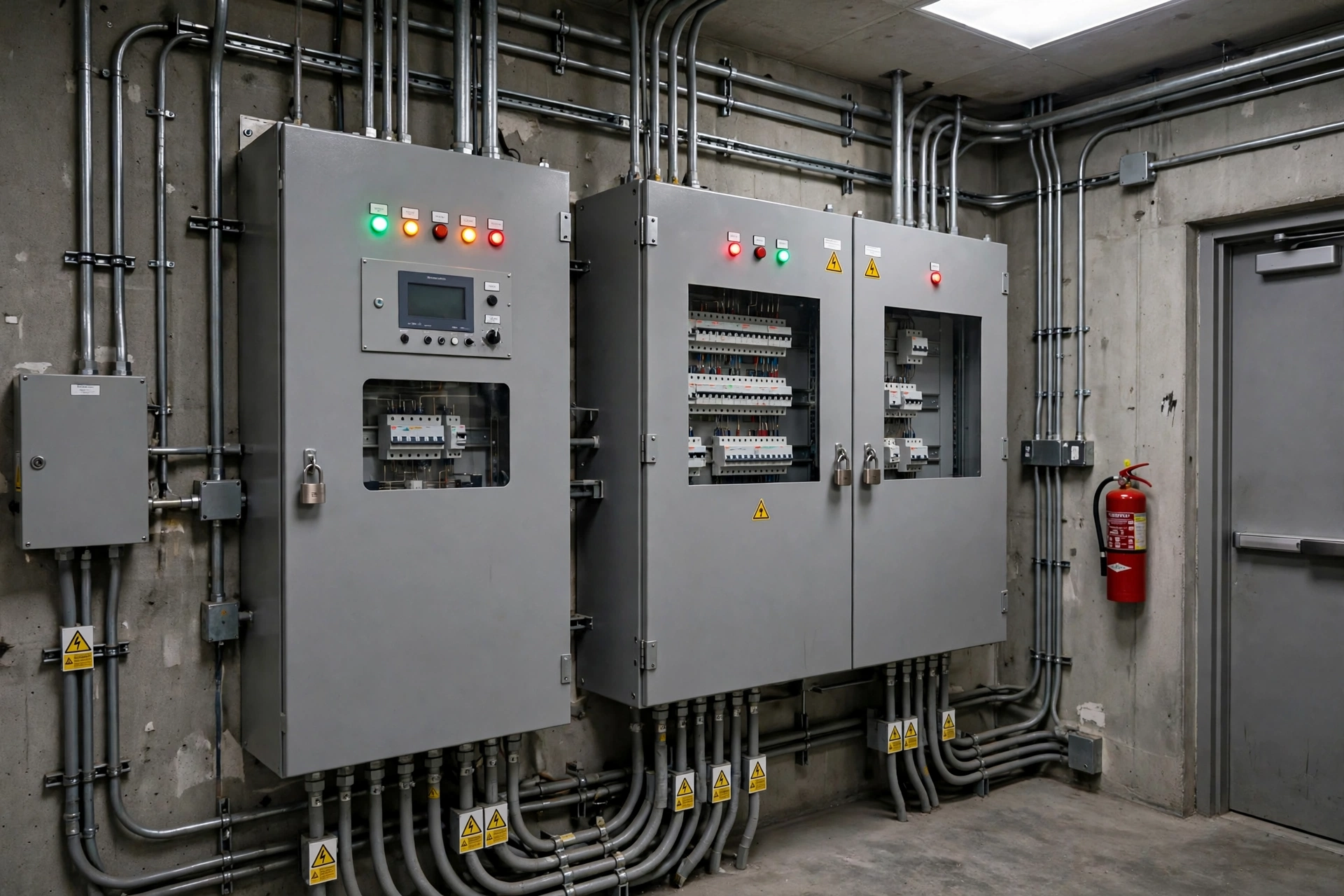
Placement has three other rules. The first is height: the generator, the switchgear and the fuel tank must sit above the highest water the site has ever seen, plus 500 mm. New Orleans taught that lesson, and it is now written into the specification of every emergency facility in a flood zone. The second is security: the generator compound must be fenced, lit and covered by CCTV, because a police station’s generator is a target — for theft, for vandalism and, in the worst case, for sabotage. The third is access: the fuel delivery truck must be able to reach the tank without blocking the bay doors, and the service engineer must be able to reach the set without moving a patrol car.
Fire stations face the same placement problem, and the same rules apply — the bay doors, the dispatch floor and the crew quarters all need power within ten seconds, and the set sits in the same kind of urban compound. Broadcast stations face the same problem from the other side: their transmitters must stay on the air, and their generators sit on hilltops where the noise does not matter but the access does. The three building types share the same standard, the same ten seconds and the same 96 hours.
Frequently Asked Questions
What size generator does a police station need?
A small neighbourhood station needs a 60–150 kVA set, a district headquarters needs 150–400 kVA, and a large city headquarters needs 400–750 kVA. The size is decided by the essential loads — dispatch, radio, custody and evidence — plus the staged HVAC, never by the full building load. A set sized on the full load is two to three times larger than it needs to be, and it will run at a quarter load, where wet stacking shortens its life.
Do police stations need a backup generator?
Yes, and in most jurisdictions it is not optional. NFPA 110 classifies police stations as Level 1 emergency systems, which must restore power within 10 seconds and hold at least 96 hours of fuel. NFPA 1225 requires the 911 communications centre to remain operational through a power failure. A station without a generator cannot answer emergency calls, cannot dispatch patrol cars and cannot hold detainees safely — and the liability for any of those failures lasts for years.
How long can a police station run on a generator?
As long as it has fuel. A 250 kVA set at 75% load burns about 45 litres an hour, so a 4,320-litre tank gives 96 hours of running. The generator itself can run indefinitely if it is maintained, refuelled and given a rest for oil checks — the limit is the fuel in the tank, not the engine. Stations in hurricane zones should hold 96 hours of fuel on site, because that is the longest a fuel delivery can be expected to be delayed after a major storm.
What happens to a police station during a power outage?
The dispatch floor keeps working on UPS power for the first ten seconds, then the automatic transfer switch moves the load to the generator. The 911 calls keep being answered, the radios keep working, and the custody suite stays lit and ventilated. What stops is everything non-essential: the offices, the gym, the kitchen and the general lighting go dark. In Downers Grove in 2011, most of the station went dark because the old sets could only power part of the building — the dispatch centre worked, but the rest of the station did not.
Can a diesel generator power a police station?
Yes, and it is the standard answer. A diesel set provides the sustained, high-power output that dispatch, radio, custody and HVAC need, and it runs for days on a fuel tank the station controls. Battery systems and UPS units bridge the ten-second gap while the generator starts, but no battery bank can run a 22 kW HVAC compressor for a day. For the critical loads, diesel is the only practical answer — which is why Lakeland replaced its 500 kW set with a 600 kW diesel generator rather than any other technology.
Specification Checklist
- Classify the loads into five tiers — dispatch, custody, evidence, building services, non-essential — and size the set on the first three plus staged building services, never on the full building load.
- Specify NFPA 110 Level 1, Type 10, Class 96 hours in the tender, and require the supplier to certify all three.
- Sequence the start: dispatch and custody first, then the HVAC compressors one at a time, then the general lighting — never everything at once.
- Size the largest motor starting surge into the set, not just the running load — an HVAC compressor starts at five to six times its running current.
- Hold 96 hours of fuel on site, test it every six months, polish it when the water content rises, and never let fuel sit longer than 12 months.
- Place the generator, the switchgear and the fuel tank above the highest water the site has ever seen, plus 500 mm — and fence the compound, light it and cover it with CCTV.
- Put the custody suite, the evidence refrigeration and one bay door plus the fuel pump on the first transfer block, ahead of the HVAC.
- Fit a silent canopy and a hospital-grade silencer for any station in a residential area, and check the noise at the nearest property line, not at the set.
- Install remote monitoring with fuel level, coolant temperature, battery voltage and transfer-switch status, so the duty officer knows within a minute that the set has started.
- Test the whole system under load every month, including the transfer sequence, following the station’s maintenance schedule — and test it at the load the station will actually carry, not at idle.
A police station is a promise to a town that help will answer when it calls, whatever the grid does. That promise is kept by a generator that is sized on the right loads, that restores power in ten seconds, that holds four days of fuel and that is tested every month. The three stations in this article all had generators. What they did not have, on the night it mattered, was a generator that could carry the whole station, or a communications chain that could survive the storm. If your station is planning its backup power, or reviewing a system that has not been tested under load in months, contact PAVO — the team can size the set, specify the transfer sequence and build the fuel plan that keeps the dispatch floor lit.