

Silent vs Open Generator Cost: Is the Canopy Worth It | PAVO
The canopy is the most expensive sheet metal on a generator quotation — and the cheapest building a buyer will ever not have to build.
How much more does a silent generator cost than an open generator? A silent canopy adds 15–25% to the price of the same engine and alternator — roughly $2,000–$4,000 on a 100 kVA set and $20,000–$25,000 on a 500 kVA set. Whether it pays for itself depends on the room, the permit and the site the open set would need.
Contents:
- What the Canopy Premium Actually Buys
- The Open Set’s Hidden Bill: Building a Generator Room
- Permits and Neighbours: When the Canopy Is the Cheaper Compliance Route
- Weather, Dust and Salt: What the Enclosure Does to Service Life
- What the Canopy Costs Back: Fuel, Cooling and Service Time
- Weight, Freight, Resale and the Five-Year Total
- Frequently Asked Questions
- Specification Checklist: Seven Questions Before the Deposit
What the Canopy Premium Actually Buys
The engine and alternator are identical. A 200 kVA set carries the same diesel engine, the same alternator frame and the same controller whether it leaves the factory open or canopied. The price difference buys steel, insulation, airflow engineering and a factory noise test — nothing else.
Published manufacturer price bands put the standard silent premium at 15–25% of the open-set price. A super-silent configuration, with thicker insulation, a larger silencer and tighter door seals, adds 30–50%. A containerised unit adds 40–60%. The table below uses published 2026 manufacturer-direct ranges for diesel sets with standard features.
| Set size | Open set | Standard silent canopy | Super silent |
|---|---|---|---|
| 30 kW | $6,000 | $7,500 | $9,000 |
| 100 kW | $18,000 | $22,000 | $28,000 |
| 200 kW | $15,000–$20,000 | $18,000–$25,000 | — |
| 500 kW | $70,000 | $90,000 | $120,000 |
The premium is not markup. The canopy is typically 500–1,000 kg of additional steel on a mid-size set: 1.5 mm galvanised panels over a Q345 steel base frame, lined with mineral wool or acoustic foam, fitted with baffled intake and discharge louvres, lockable access doors, and a powder-coated finish. Each panel is cut, folded, lined and sealed. Then the finished set is noise-tested at the factory before it ships.
Two points are commonly misunderstood. First, the canopy does not change the engine’s output. A 500 kVA set is a 500 kVA set in either configuration; the rating letters — ESP, PRP, COP — are what decide duty, as explained in the article on standby and prime ratings. Second, “silent” is not a specification. The figure that matters is the stated sound level at a stated distance and load, and how that figure is read is covered in PAVO’s silent generator noise guide. This article does not repeat that guidance. It answers a different question: what the enclosure costs, and what it saves.
The Open Set’s Hidden Bill: Building a Generator Room
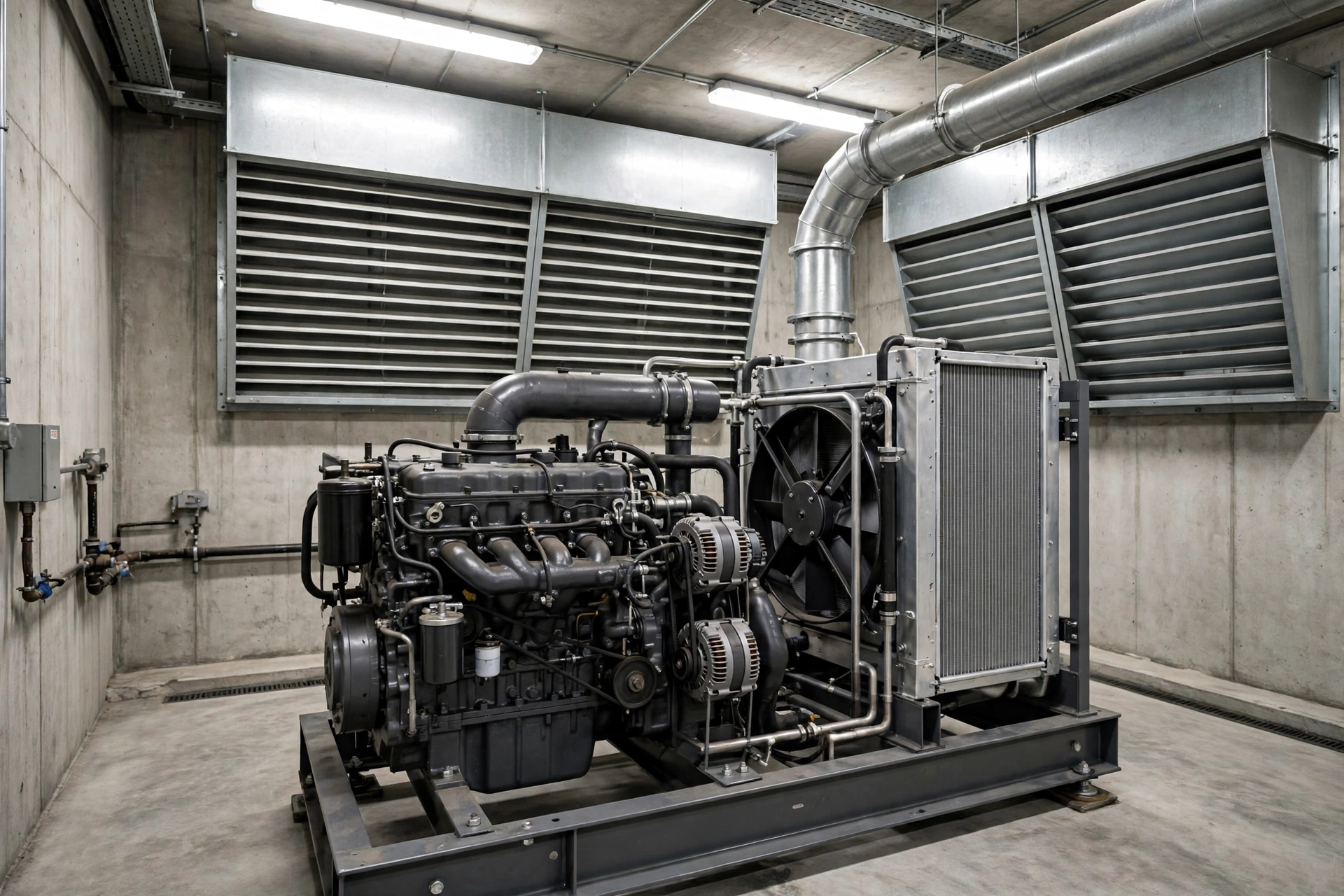
An open set cannot sit in the rain, and it cannot run next to people without a room around it. The quotation for an open set is therefore only half the project. The other half is a building.
The structure itself
A generator room for a 200 kVA set is typically 6 × 4 metres of floor, 3.5 metres high, with a concrete plinth, a bunded floor for fuel containment, a fire-rated door and a roof that carries the exhaust stack. Published manufacturer figures put a sound-attenuated generator room at $50,000–$180,000 depending on size, ventilation and fire suppression. A plain masonry room without acoustic treatment sits at the low end of that range — and then fails the noise test, which is why the acoustic version is the honest comparison.
The room also consumes floor area the building owner could otherwise use. In a city-centre commercial building, 24 m² of plant room at $3,000–$5,000 per m² of construction cost is $72,000–$120,000 of structure before a single louvre is fitted. A canopy set on an outdoor pad needs a concrete plinth of about 8 m² and a bund — roughly $3,000–$4,000 all in.
Ventilation and acoustic louvres
A room needs the same air the engine needs, plus somewhere for the heat to go. A 200 kVA set at full load rejects roughly 200 kW of heat through its radiator and exhaust. The room’s intake and discharge openings must pass that air without strangling the radiator, and every opening is a hole in the acoustic treatment. Acoustic louvres — deep, baffled, mineral-wool-lined — cost several times plain louvres and still cut the free area by 40–60%. The sizing rules are unforgiving: undersize the louvre and the set derates on a hot day; oversize it and the noise escapes. The full calculation is set out in the article on generator room ventilation.
A canopy set has this engineering done at the factory. The louvres, the radiator discharge path and the fan are matched to the set before it leaves Wuhu. The buyer does not pay an acoustic consultant to repeat that work on site.
Fire protection, fuel storage and the permit file
A room holding a diesel set and its day tank is a fire compartment. That means a fire-rated enclosure, a fuel spill bund sized to 110% of the largest tank, a fire extinguisher or suppression system, and a separate permit submission for the fuel store. Each item is small. Together they add $4,000–$8,000 and three to six weeks to the schedule on a typical commercial project.
A canopy set outdoors still needs a bund and a fire extinguisher, but the fuel store is the set’s own base tank, the compartment is the open air, and the permit file is one page shorter. The difference is not dramatic in money. It is dramatic in time: a room needs structural, electrical, fire and acoustic sign-offs; a pad needs a plinth and a cable trench.
Permits and Neighbours: When the Canopy Is the Cheaper Compliance Route
Most urban noise ordinances cap equipment noise at 55–65 dB(A) at the property boundary. India’s CPCB limit for diesel sets is 75 dB(A) at 1 metre. An open set at 95–110 dB(A) cannot meet either figure without a room. A standard canopy set at 65–75 dB(A) at 7 metres usually can, with distance doing the rest.
The cost of failing a noise test is rarely the fine. It is the delay. A hospital project outside Lagos specified an open 350 kVA set in a plant room, submitted the acoustic calculation with the building permit, and received a query: the room’s discharge louvre faced a ward block 12 metres away, and the calculation had not accounted for it. The redesign — a discharge attenuator, a re-routed exhaust and a second acoustic test — cost $9,000 and six weeks. The canopy alternative, quoted at $7,500 more than the open set, would have passed on the first submission because the factory test certificate was already in the file.
A residential estate in India tells the same story from the other side. The housing society’s bylaws required CPCB-compliant sets under 75 dB(A). Three open sets were installed in a basement plant room, the society measured 88 dB(A) at the stairwell door, and the developer paid for acoustic doors, duct attenuators and a retest — ₹4,50,000 in total, more than the canopy premium on all three sets combined.
None of this means a canopy is always the right answer. On a remote site with no neighbours and no ordinance, the permit argument disappears entirely. But where a permit exists, the canopy is often the cheapest compliance document a buyer can purchase: a factory test certificate costs nothing extra, and it answers the regulator’s question before it is asked.
Weather, Dust and Salt: What the Enclosure Does to Service Life
A canopy is a weatherproof box. An open set is an engine standing in the weather. Over ten years, that difference shows up in the maintenance log and the paint.
Coastal salt air
Salt air corrodes untreated steel fast. Manufacturers recommend aluminium or stainless steel enclosures, or galvanised steel with a powder-coated finish, for sites within 50 miles of the coast. A standard steel canopy with a proper powder coat will hold up for a decade with annual touch-ups. An open set on the same site needs the same protection applied to the engine, the alternator, the control panel and the base frame — and the control panel, with its electronics, is the part that suffers first.
A 120-room hotel on a Caribbean island learned this the expensive way. The open 250 kVA set sat in a beachfront plant room with louvres open to the sea breeze. Within three years the control panel’s terminals were green with corrosion, the battery charger had failed twice, and the alternator’s windings needed a clean and re-varnish. The replacement was a canopy set in aluminium, specified with stainless fasteners and hinges. The canopy premium was $6,500. The corrosion repairs over three years had cost $11,000.
Desert dust and mining sites
A quarry in Western Australia runs two 500 kVA sets in prime duty, 3,000 hours a year, in air that carries fine silica dust. The open set in the workshop needed air-filter changes every 150 hours instead of the scheduled 500, and the radiator core needed blowing out weekly. The canopy set, with its filtered intake and baffled louvres, held the 500-hour filter interval and a monthly radiator clean. Dust still gets in — no enclosure is sealed — but the canopy turns a weekly job into a monthly one, and the air filter is the cheapest part on the set.
Tropical rain and humidity
In tropical West Africa, a canopy set’s value is less about noise than about rain. An open set under a lean-to roof still gets wind-driven rain on the alternator and the control panel. Condensation forms inside the alternator windings overnight and the insulation resistance falls. A canopy with an IP44–IP45 rating keeps driven rain off the set; an IP65 option keeps out dust and low-pressure water jets as well. The canopy does not eliminate humidity — nothing does — but it keeps the set dry enough that the weekly test actually starts the engine instead of tripping the insulation alarm.
What the Canopy Costs Back: Fuel, Cooling and Service Time
The canopy is not free to own. It charges rent in three currencies: fuel, cooling margin and technician time.
The fuel penalty
A canopy restricts airflow. The engine works slightly harder to pull cooling air through baffled louvres, and fuel consumption rises by 2–5% compared with the open version of the same set. On a standby set that runs 100 hours a year, the penalty is invisible — a few dozen litres. On a prime set, it is a line item.
Take the Cummins C500D5: 500 kVA standby / 455 kVA prime, burning 93.2 L/h at full load on prime rating. A 3% canopy penalty adds 2.8 L/h. Over 3,000 prime hours a year, that is 8,400 litres. At $1.10 per litre, the canopy costs $9,240 a year in extra fuel on that set. Over five years, $46,200 — more than the canopy premium itself. This is the one argument that can genuinely overturn the canopy decision on a prime-duty site, and it should be calculated, not assumed away. The figures depend on duty and load; a standby set at 100 hours a year pays under $350 a year for the same penalty. The right question is not whether the penalty exists, but how many hours the set will run. Fuel tank sizing for the same set shows how quickly those hours add up.
Cooling and derating
The same restricted airflow narrows the cooling margin. A canopy set in a 50°C ambient site runs hotter than its open twin, and the alternator derates by about 3% per 10°C above 40°C. In practice this means a canopy set specified for a hot site should be ordered one frame larger, or with a high-temperature radiator option, where an open set in a ventilated room might not need it. The derating is small — a few percent — but it is real, and it is the reason manufacturers publish separate canopy and open-set derating curves. A buyer who compares the two quotations on catalogue kVA alone is comparing different machines.
Maintenance access
An open set can be serviced from any side. A canopy set is serviced through doors. Oil and filter changes are usually fine — the doors are placed for them. Injector work, alternator inspection and radiator removal are slower: panels come off, the service aisle needs 1 metre clear on all sides, and the front and end need 3 feet (0.9 m) of clearance. A routine 250-hour service takes roughly 30–60 minutes longer on a canopy set than on the same open set. Over five years of quarterly servicing, that is 10–20 extra technician hours — about $1,000–$2,000 at contract rates. It is a real cost, and it is also the smallest number in this article. The access complaint is the most common objection to canopies, and the least expensive one.
Weight, Freight, Resale and the Five-Year Total
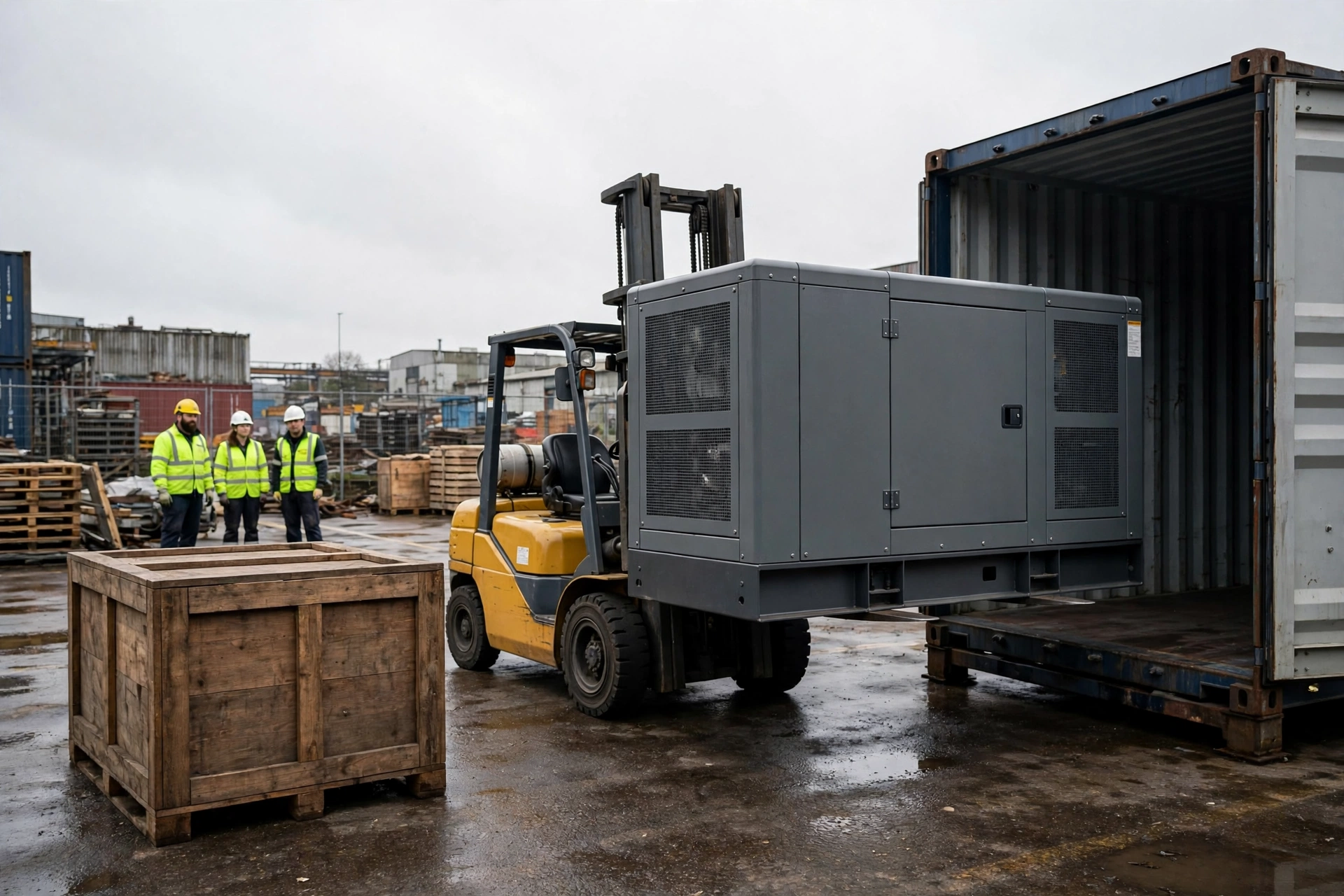
The canopy adds weight, and weight is freight. It also adds resale value, and resale is the last line of the total-cost calculation.
Weight and freight
A canopy adds 500–1,000 kg to a mid-size set. A 200 kVA open set ships at roughly 2,200 kg; the canopy version at 2,900–3,200 kg. That changes the forklift, the crane, and sometimes the truck. It rarely changes the container: a 200 kVA canopy set still fits a 20-foot container, and a 500 kVA set still fits a 40-foot high cube — the same format used for containerised data centre sets. Above 1,000 kVA, the canopy’s extra height and width start to matter, and the set may need a flat rack or an open-top container at a higher freight rate. The freight difference on a Shanghai-to-Lagos 40-foot container is typically $300–$800 for the extra weight and handling — small against the set’s price, but it belongs in the quotation, not discovered at the port. The full export picture, including crates, HS code 8502 and ISPM 15 timber rules, is covered in the guide to export shipping.
Resale value
Used generator buyers fall into two groups: those with a room, and those without. A canopy set sells to both. An open set sells to the first group only. In practice, a five-year-old canopy set in good condition holds 5–10% more of its purchase price than the same open set, and it sells faster — typically within four to six weeks against eight to twelve for an open set in the same market. The reason is simple: the second-hand buyer is usually a small business or a site with no plant room, and the canopy is what makes the set installable for them. On a $22,000 canopy set, that is $1,100–$2,200 recovered at resale, plus the months of storage and insurance saved by a faster sale.
The five-year total
The table below compares a 200 kVA standby set for a commercial building — 300 running hours a year, five years, diesel at $1.10 per litre, maintenance at contract rates. Figures are indicative, built from the published price bands and costs in this article.
| Five-year cost | Open set + room | Silent canopy set |
|---|---|---|
| Equipment | $17,500 | $21,500 |
| Room / outdoor pad | $55,000 | $3,500 |
| Permits and noise testing | $4,000 | $1,000 |
| Fuel, 1,500 hours at 30 L/h | $49,500 | $51,000 |
| Maintenance, 5 years | $7,500 | $9,000 |
| Resale value at year 5 | −$7,000 | −$10,500 |
| Five-year total | $126,500 | $75,500 |
The room decides the result. Where a building must be constructed to house the set, the canopy wins by roughly $51,000 over five years — more than twice the price of the set itself. Where a suitable room already exists, the arithmetic reverses: the open set wins by roughly $4,000–$6,000 over five years, because the room is a sunk cost and the canopy’s fuel and maintenance penalties are the only differences left. That is the whole decision in one sentence: if the room exists, buy open; if it does not, buy the canopy.
Frequently Asked Questions
How much more does a silent generator cost than an open generator?
A standard silent canopy adds 15–25% to the price of the same engine and alternator — about $2,000–$4,000 on a 100 kVA set and $20,000–$25,000 on a 500 kVA set. A super-silent configuration adds 30–50%, and a containerised unit 40–60%. The premium pays for steel, acoustic lining, baffled louvres and a factory noise test, not for a different engine.
Is a silent generator worth the extra cost?
It is worth the premium when the site has no suitable generator room, when a noise permit or neighbour complaint would cost more than the canopy, or when the set will sit outdoors in rain, dust or salt air. It is not worth the premium on a prime-duty site that already has a ventilated room, where the 2–5% fuel penalty alone can exceed the canopy’s price over five years.
Can a diesel generator be installed outside without a canopy?
Yes, but only with weather protection of some other kind — a roof, a shelter, or a plant room. An unprotected open set outdoors will suffer rain on the alternator and control panel, dust in the air filter and accelerated corrosion. A canopy is the factory-built version of that protection. An open set left fully exposed is the one installation no manufacturer will warrant.
How much does it cost to build a generator room?
A sound-attenuated generator room for a mid-size set costs $50,000–$180,000 depending on size, ventilation and fire suppression, according to published manufacturer figures. A plain masonry room is cheaper but usually fails the noise test, and the acoustic doors, duct attenuators and retest that follow cost more than building it properly the first time. An outdoor pad for a canopy set costs roughly $3,000–$4,000.
Does a silent canopy affect generator fuel consumption?
Yes, by 2–5%. The baffled louvres restrict airflow, so the engine works slightly harder to pull in cooling air. On a standby set running 100 hours a year the extra fuel is negligible. On a prime set running 3,000 hours a year, a 3% penalty on a 500 kVA set adds about 8,400 litres a year — roughly $9,240 at $1.10 per litre — and should be included in the purchase decision.
Specification Checklist: Seven Questions Before the Deposit
1. Does a suitable room already exist? If yes, price the open set. If no, price the room before comparing quotations — the room, not the set, decides the comparison.
2. What is the noise limit at the boundary, in writing? Get the ordinance figure and the measurement distance from the local authority, not from the supplier. Then check the set’s factory test certificate against it.
3. How many hours a year will the set actually run? Multiply the fuel penalty by those hours. A standby set at 100 hours a year and a prime set at 3,000 hours a year are different purchases.
4. What is the site’s worst weather? Salt air within 50 miles of the coast, desert dust, or tropical rain each point to a different canopy specification — aluminium or stainless steel, filtered intake, or a higher IP rating.
5. What does the canopy weigh, and how does it ship? Confirm the gross weight, the container type and the crane capacity at the site. Above 1,000 kVA, check whether the canopy needs a flat rack.
6. Where does the automatic transfer switch sit, and who wires it? The automatic transfer switch is part of the installation either way, but a canopy set outdoors needs a weatherproof ATS enclosure or an indoor location with a cable run — price it now, not on site.
7. What is the resale market for this configuration? A canopy set sells to any buyer. An open set sells to buyers with a room. In a market where most buyers have no plant room, that difference is worth 5–10% of the purchase price at resale.
A canopy is not a luxury option and an open set is not the cheap option. They are two different installation projects with two different total costs, and the quotation that looks cheaper is usually the one that has left the building out. Price the room, the permit, the fuel and the resale — then choose the enclosure. For a quotation that prices both configurations against the same site, contact PAVO with the load, the annual hours and the site conditions, and the engineering team will return both figures.