

What Size Generator Does a Supermarket Need? | PAVO
A supermarket does not lose money when the lights go out. It loses money when the cold chain warms up — and the clock on that starts the moment the compressors stop.
What size generator does a supermarket need? A neighbourhood supermarket typically needs 100–250 kVA, a hypermarket 400–1,000 kVA, sized from the refrigeration load and compressor starting surge rather than floor area alone. The cold chain decides the figure; tills, lighting and HVAC fill the rest.
Contents
- What a Supermarket Actually Runs on Generator Power
- Sizing Bands by Store Size
- The Refrigeration Problem: Compressors That Start Hard and Cycle All Day
- Three Outages, Three Outcomes
- Fuel Autonomy: How Long the Store Really Stays Open
- Noise, Placement and the Neighbours
- Frequently Asked Questions
- Specification Checklist: Seven Lines Before the Deposit
What a Supermarket Actually Runs on Generator Power
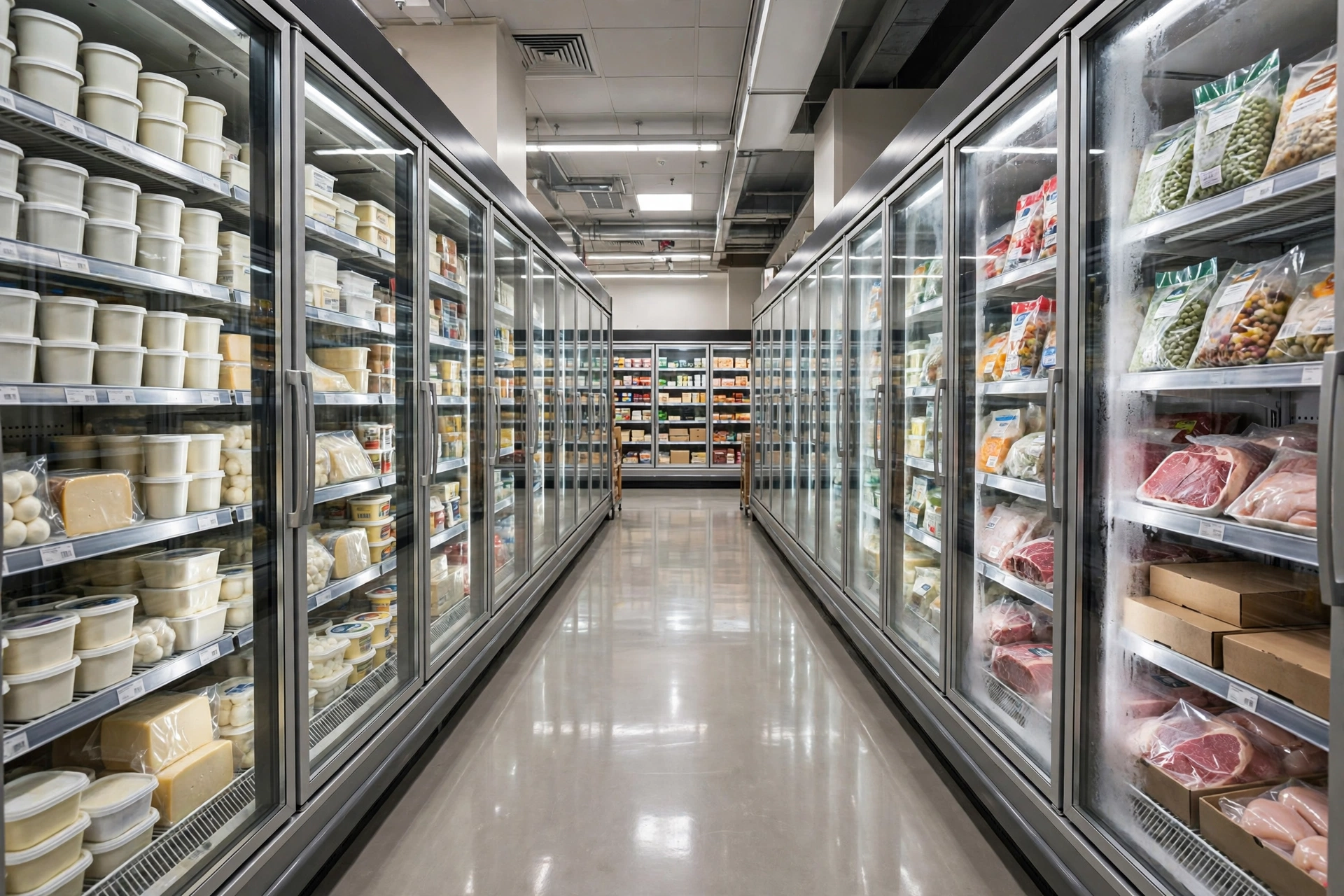
A supermarket is three businesses under one roof. The first is a cold chain: walk-in coolers and freezers, display chillers, dairy cabinets and frozen-food islands, all holding perishable stock inside a narrow temperature band. The second is a trading floor: tills, barcode scanners, card terminals, CCTV, lighting and automatic doors. The third is the building itself: air conditioning, ventilation, water pumps, lifts and fire systems. A generator specification that treats the store as one number — floor area times watts per square metre — misses the point. The three businesses fail at different speeds, and the set has to be sized for the fastest failure, not the average load.
The load list for a typical neighbourhood supermarket makes the split concrete. Refrigeration takes 40–60 kW running, depending on the number of cabinets and whether the store runs a central rack or individual condensing units. Air conditioning adds 25–40 kW. Lighting, tills, CCTV and small power take 15–25 kW. Bakery ovens, if the store bakes on site, add 20–40 kW — and most operators choose to leave them off the generator. Total connected load is often 120–180 kW, but the generator load is a decision, not a sum. What the set carries is what the operator chooses to protect.
The Cold Chain Comes First
Refrigeration is the largest single electrical load in a supermarket, and it is the only load with a legal clock on it. The FDA Food Code requires cold food to be held at 41°F (5°C) or below, and the FDA advises that an unopened refrigerator holds safe temperature for about four hours without power. A full freezer holds for about 48 hours if the doors stay shut, 24 hours if it is half full. Perishable food held above 40°F for more than four hours is discarded — not discounted, not inspected, discarded. That rule turns a six-hour outage into a stock write-off, and it is why the cold chain is always the first load on the generator and the last load to be shed.
The four-hour figure is also the reason a supermarket cannot treat backup power as optional in the way an office can. An office that loses power sends people home. A supermarket that loses power for six hours can discard $15,000 to $40,000 of refrigerated and frozen products, according to commercial-generator planning data — and that is before the lost trading, the disposal cost and the food-safety inspection that follows. A single restaurant faces the same four-hour rule with a smaller stockroom; the restaurant backup power guide works through the same arithmetic for one kitchen. The stock in the chillers is worth more than the generator that protects it. A 125 kVA standby set, installed, typically costs less than one bad outage.
Tills, Lighting and the Trading Floor
The second load tier is what keeps the store trading. Tills and card terminals draw little power — a few hundred watts each — but they cannot tolerate a gap. The automatic transfer switch takes up to 10 seconds to start the generator and transfer the load, the NFPA 110 limit for emergency power, and a till that loses power mid-transaction loses the sale and the queue. The standard answer is a small online UPS on the till and CCTV circuits, sized for 2–5 kVA, which bridges the ten seconds and rides through the transfer. The generator then carries the tills for the rest of the outage, and the store keeps selling.
Lighting is the third tier, and it is where operators save money. Full sales-floor lighting is 10–15 kW in a mid-sized store, and most of it is not needed to keep trading safely. Emergency lighting, aisle lighting over the cold chain and the till area stay on the generator; decorative lighting, feature displays and car-park floodlights do not. The difference is 5–8 kW of generator capacity — small on its own, but it is the difference between a 150 kVA set and a 200 kVA set in a marginal case.
What Stays Off
Every supermarket generator specification should carry a load-shed list, agreed in writing before the set is ordered. Bakery ovens, hot-food counters, decorative lighting, car-park lighting, non-essential air conditioning zones and the staff-room kitchen stay off the generator. The list matters because it is what keeps the set inside its rating when the store is busy and the outage is long. A set that is sized for everything and runs at 95% load for eight hours is a set that will be replaced early. A set sized for the protected loads, with 20–25% headroom, runs for years.
Sizing Bands by Store Size
The fastest way to size a supermarket generator is by store type, then check the figure against the real load list. The bands below assume a standby rating, three-phase 400 V supply, and a 25% reserve for starting surge and future growth. The full method — measuring running watts and starting watts load by load — is set out in the generator sizing guide, and it should always be the final check. The bands are the starting point, not the answer.
| Store type | Sales area | Typical generator | Running load on generator |
|---|---|---|---|
| Convenience store | 100–300 m² | 30–60 kVA | 20–45 kW |
| Neighbourhood supermarket | 500–1,500 m² | 100–250 kVA | 80–200 kW |
| Large supermarket | 2,000–4,000 m² | 250–500 kVA | 200–400 kW |
| Hypermarket | 5,000–10,000 m² | 500–1,000 kVA | 400–800 kW |
A common rule of thumb for retail sizing is 50 kW plus 10 W per square foot of sales area. A 2,000 m² store — about 21,500 sq ft — works out at roughly 265 kW of connected load by that rule, which lands in the 250–500 kVA band once the load-shed list is applied. The rule is a cross-check, not a specification. It overstates the generator load, because it counts ovens, decorative lighting and full air conditioning that the generator never carries. It is useful for one thing: it stops a buyer ordering a set half the size the store needs.
Convenience Stores: 30–60 kVA
A convenience store runs a short cold chain — two or three reach-in chillers, a freezer island, a walk-in cooler — plus tills, lighting and a small air-conditioning unit. Running load on the generator is typically 20–45 kW. The sizing risk is not the running load but the starting load: two refrigeration racks restarting at the same moment can draw three times their running current. A 40 kVA set that looks adequate on running watts can trip on the restart, and the store discovers the mistake at 2 a.m. during the first real outage. The fix is sequencing, covered below, and a set one size up from the running-load arithmetic.
Neighbourhood Supermarkets: 100–250 kVA
This is the workhorse band. A 100 kW (125 kVA) standby set is the size most often quoted for a mid-sized grocery store, and it carries refrigeration, HVAC, tills and lighting with room to spare. PAVO’s own supermarket set in this band is the PWC-150GFS, a 150 kVA / 120 kW Cummins-powered set supplied in open, soundproof or containerised form — the size a 1,000–1,500 m² store reaches when the cold chain is long and the bakery is on the generator. Fuel consumption in this band is 22 L/h at three-quarter load for a 100 kW set, rising to 28 L/h at full load. At that rate a 500 L sub-base tank gives about 22 hours of autonomy — enough for most outages, and the reason the tank, not the engine, is usually the limiting factor.
Hypermarkets: 500–1,000 kVA
A hypermarket is a different machine. The cold chain alone can be 200–300 kW, the store runs multiple refrigeration racks, and the air conditioning is a 100 kW load on its own. Sets in this band are 500–1,000 kVA, usually containerised, and often installed as two sets in parallel rather than one large unit — partly for redundancy, partly because a single 1,000 kVA set is harder to deliver, place and service than two 500 kVA sets. The Cummins C500D5 frame, 500 kVA standby / 455 kVA prime, is the building block: two of them in parallel give a hypermarket 1,000 kVA of standby capacity with N+1 cover for the cold chain. The standby and prime ratings decide which figure applies — a hypermarket set that runs for days after a storm is working prime duty, and it should be specified that way.
The Refrigeration Problem: Compressors That Start Hard and Cycle All Day
Refrigeration is the load that breaks supermarket generator sizing, and it breaks it in two ways. The first is starting surge. The second is cycling. Both are invisible in a load list that only records running watts, and both have to be designed for.
Starting Surge: Three Times Running, All at Once
A refrigeration compressor is a motor load. On start it draws 2.5 to 3.5 times its running current for a few seconds, and a supermarket has many of them. Worse, after a power cut they all try to restart at the same moment. The grid fails, the compressors stop, the automatic transfer switch starts the generator and transfers the load — and every compressor in the store demands its starting current in the same second. That simultaneous inrush is the single most common cause of a supermarket generator tripping on its first real outage. The set was sized for the running load. It was never sized for the restart.
The fix is sequenced restart. The refrigeration controller, or the generator controller, staggers the compressor starts over 30–60 seconds, so the set never sees more than one or two starting surges at once. The alternative is oversizing the set by 30–50% to absorb the simultaneous inrush — which costs more in capital, fuel and maintenance, and still leaves the set running at low load for the rest of the outage. Sequencing is the cheaper answer, and it is a line item on the specification, not an afterthought. The motor starting guide covers the starting methods — direct-on-line, star-delta and soft start — that decide how large each surge actually is.
Cycling and the Low-Load Trap
The second problem is the opposite of the first. Refrigeration compressors cycle. At night, with the doors shut and nobody moving product, the store’s refrigeration load can fall to 30–40% of its rated figure. A generator sized for the daytime peak then runs at 30% load for eight hours a night, and a diesel engine running at low load for long periods suffers wet stacking — unburned fuel and carbon building up in the exhaust, glazing the cylinder bores and shortening engine life. The cold storage backup power guide makes the same point for warehouses: size the tank for the real load profile, not the nameplate.
The answer is not a smaller set. The answer is a load profile. Size the set for the peak, then check the minimum load it will see at night, and keep it above 30% of rating. If the night load falls below that, add a load bank, a resistive load that holds the set at a healthy minimum, or put part of the air conditioning on a timer so the set has something real to do. A monthly load-bank test under 70–80% load is the other half of the same discipline: it proves the set can take the load, and it burns off the carbon that low-load running leaves behind.
Three Outages, Three Outcomes
Case 1: A Hypermarket in Lagos Loses Its Fuel Before Its Power Returns
A hypermarket outside Lagos runs a 500 kVA Cummins C500D5 set with a 645 L sub-base tank. The set was specified for an eight-hour outage: at 75% load it burns 69.9 L/h, giving 9.2 hours of autonomy. The grid failed at 6 p.m. on a Friday, at the start of the weekend trading peak. The set started, took the cold chain and the tills, and ran cleanly. At hour nine the tank ran dry. The outage lasted 14 hours. The store’s refrigeration had no power for the last five hours, and the stock in the chillers crossed the 41°F limit. The write-off was $28,000 — inside the $15,000–$40,000 range a six-hour outage costs a supermarket, and this one ran twice that long. The set did nothing wrong. The tank was sized for the outage the buyer imagined, not the outage the grid delivered. The fix was a 2,000 L bulk tank with a transfer pump, giving 28 hours at the same load, and a fuel-delivery contract that triggers at 50% tank level. The set is the same. The autonomy is three times longer.
Case 2: A Neighbourhood Supermarket in Nairobi Keeps Trading
A 1,200 m² supermarket in Nairobi runs a 150 kVA / 120 kW PAVO set on standby, with an automatic transfer switch and a 2 kVA UPS on the tills. Grid supply in the area fails two or three times a month, usually for two to six hours. The set burns about 25 L/h at the store’s normal generator load, and the 350 L tank gives roughly 14 hours of autonomy — more than twice the longest outage the store has seen. The last failure ran six hours. The tills never stopped — the UPS bridged the 10-second transfer — the chillers held temperature, and the store traded through the evening peak. The only cost was 150 L of diesel, about $180 at local prices. The set is tested monthly under load, the fuel is polished twice a year, and the store has never discarded a trolley of stock. The difference between this store and the Lagos hypermarket is not the size of the set. It is the tank, the test regime and the ten seconds the UPS covers.
Case 3: A Convenience Store in Manila Trips on the Restart
A convenience store in Manila bought a 40 kVA set on running-load arithmetic: chillers 18 kW, tills and lighting 8 kW, air conditioning 6 kW — 32 kW total, comfortably inside 40 kVA. The first real outage came on a Saturday night. The generator started, the transfer switch closed, and both refrigeration racks tried to restart in the same second. The combined inrush — roughly three times running current on the compressors — pulled the voltage down, the breaker tripped, and the store went dark again. The staff reset the breaker, the racks restarted one at a time, and the set held — but the chillers had been off for 40 minutes and the dairy cabinet had already risen past the limit. The write-off was $4,500 of dairy and prepared food. The fix cost less than the loss: a sequenced-restart relay on the refrigeration controller, and a step up to a 60 kVA set. The store has had four outages since. The set has not tripped once.
Fuel Autonomy: How Long the Store Really Stays Open
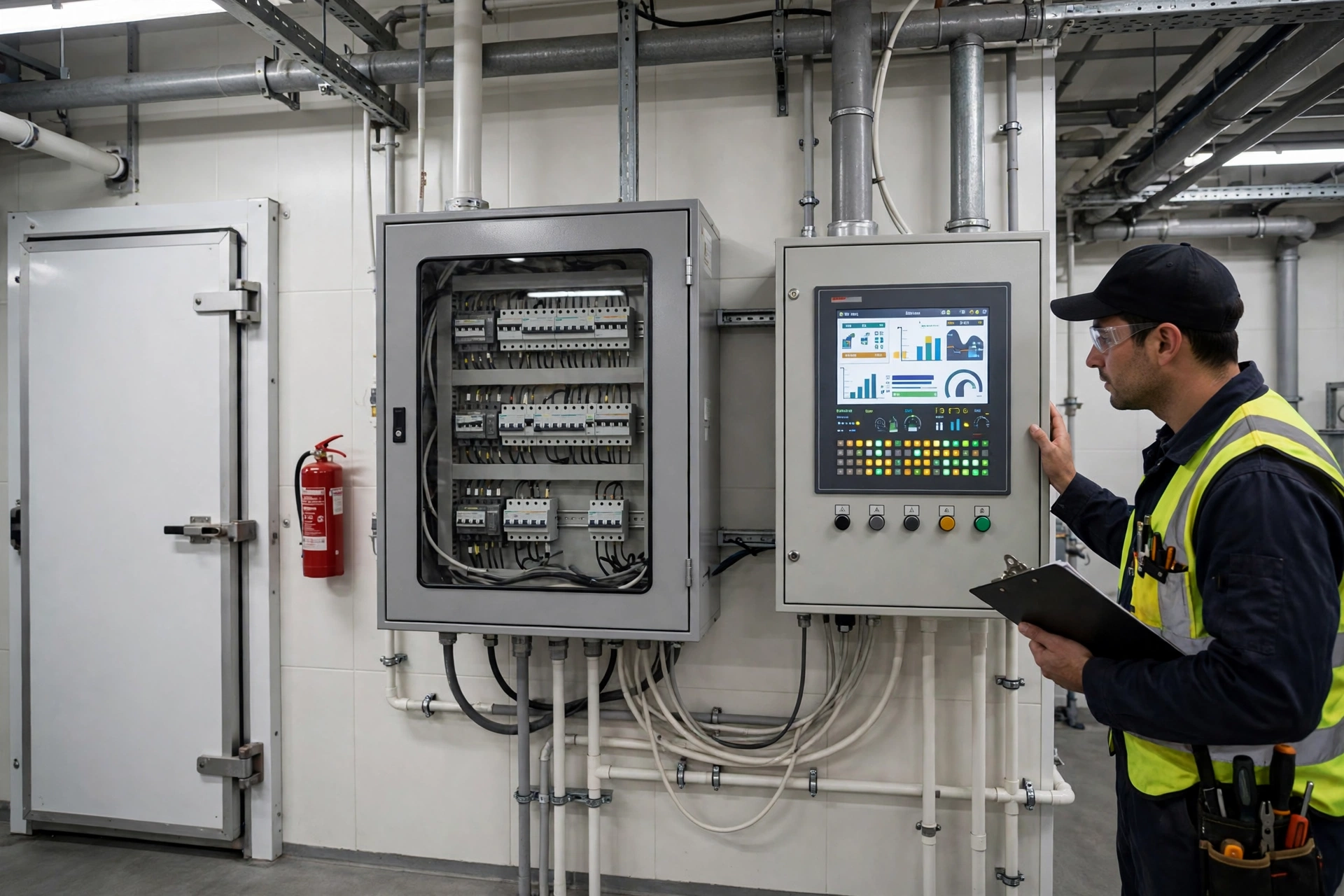
A generator does not get tired. The fuel tank is the clock. The table below uses published consumption figures — 100 kW and 200 kW sets from generator sizing data, and the Cummins C500D5 datasheet — to show what autonomy a given tank actually buys. The pattern is the point: doubling the set doubles the fuel burn, so a bigger set needs a proportionally bigger tank to hold the same hours.
| Set size | Fuel at 75% load | 500 L tank | 1,000 L tank | 2,000 L bulk tank |
|---|---|---|---|---|
| 125 kVA (100 kW) | 22 L/h | ~22 hours | ~45 hours | ~90 hours |
| 250 kVA (200 kW) | 41.6 L/h | ~12 hours | ~24 hours | ~48 hours |
| 500 kVA | 69.9 L/h | ~7 hours | ~14 hours | ~28 hours |
| 1,000 kVA | ~140 L/h | ~3.5 hours | ~7 hours | ~14 hours |
The Tank Is the Clock
Most supermarket sets are delivered with a sub-base tank of 250–650 L, which is 7–22 hours depending on the set. That covers a normal outage. It does not cover a storm, a flood or a grid failure that lasts into the second day. The decision is how many hours the store needs to stay open: 24 hours is the common target for a neighbourhood supermarket, 48–72 hours for a hypermarket or a store in a storm-prone region. The tank is sized backwards from that number, using the 75% load figure, not the full-load figure — the store rarely runs at full load, and sizing on full load buys a tank the store does not need.
Delivery Planning and Fuel Ageing
A tank that is never used is a liability. Diesel in a standby set’s tank ages: water condenses, microbes grow, and after 6–12 months untreated fuel can clog filters and stop the set when it is needed most. The diesel fuel ageing guide covers the testing and polishing regime, but the commercial point is simple: a supermarket should turn its fuel over. Test it twice a year, polish it when the water content rises, and keep a delivery contract that guarantees a tanker within 24 hours of a call. A store that has never ordered fuel in an emergency will discover, during the emergency, that the supplier’s phone is busy and the tanker is booked for three days.
Noise, Placement and the Neighbours
A supermarket generator runs where people live, shop and sleep. That makes noise and placement a planning issue, not a technical footnote. The store’s neighbours are also its customers, and a generator that wakes the street at 3 a.m. becomes a complaint, a fine and a planning condition on the next application.
What 75 dB(A) at 7 Metres Means at the Boundary
An open diesel set measures 95–105 dB(A) at 7 metres — roughly the level of a chainsaw, and far too loud for a site with neighbours. A silent canopy brings that down to 60–75 dB(A) at 7 metres, about the level of a busy street. Sound falls by about 6 dB every time the distance doubles, so a canopy rated 72 dB(A) at 7 metres is about 60 dB(A) at 28 metres — noticeable, but not a complaint. The numbers decide the placement: a set beside the loading bay, 30 metres from the nearest house, in a canopy, is a solved problem. The same set in an open frame, 10 metres from a bedroom window, is a planning dispute. The canopy costs more than the open set — the silent canopy comparison puts the premium at 15–25% — but for a supermarket it is not optional. It is the price of operating in a residential area.
Where the Set Goes
The loading bay is the natural home for a supermarket generator: it is where the fuel tanker already comes, where the refrigeration plant room usually sits, and where the noise matters least. The set needs three things there: a concrete plinth that drains, clearance for the radiator air to escape, and access for a fuel tanker and a service van. What it must not have is a position beside the fresh-air intake, where exhaust and radiator heat are drawn back into the store, or a position under a canopy that traps exhaust at head height. The exhaust stack should clear the roofline, and the fuel tank should sit in a bund that holds 110% of its contents. A supermarket that puts the set in the car park to save space discovers, at the first service, that the set is blocking customer parking and the fuel tanker cannot reach it. The loading bay is the loading bay for a reason.
Frequently Asked Questions
What size generator does a supermarket need?
A neighbourhood supermarket typically needs 100–250 kVA, a large supermarket 250–500 kVA and a hypermarket 500–1,000 kVA. The figure comes from the refrigeration load and compressor starting surge, checked against a full load list, not from floor area alone. A convenience store usually needs 30–60 kVA.
Do supermarkets need a backup generator?
Yes, in any market where the grid fails more than once or twice a year. A six-hour outage can cost a supermarket $15,000–$40,000 in discarded refrigerated and frozen stock, under food-safety rules that require food held above 40°F for more than four hours to be thrown away. The generator costs less than one bad outage.
How long can a supermarket run on a generator?
As long as the fuel lasts. A 125 kVA set burning 22 L/h runs about 22 hours on a 500 L tank; a 500 kVA set burning 69.9 L/h runs about 9 hours on a 645 L tank. For 24–72 hours of autonomy a bulk tank and a fuel-delivery contract are needed. The engine itself has no hour limit on standby duty within its rating.
How much food does a supermarket lose during a power outage?
A six-hour outage typically costs a supermarket $15,000–$40,000 in refrigerated and frozen products, depending on the size of the cold chain and how full the cabinets are. The loss is governed by the four-hour rule: an unopened refrigerator holds safe temperature for about four hours, and perishable food above 40°F for longer than that must be discarded. A full freezer holds for about 48 hours if the doors stay shut.
Can a diesel generator power a supermarket?
Yes. Diesel sets from 30 kVA to 1,000 kVA power supermarkets every day, from convenience stores to hypermarkets, and the same set can carry refrigeration, tills, lighting and air conditioning if it is sized for the compressor starting surge and fitted with an automatic transfer switch. The set should be standby-rated for a store that only runs it during outages, and the refrigeration restart should be sequenced so the compressors do not all start at once.
Specification Checklist: Seven Lines Before the Deposit
1. What is the protected load list? Refrigeration, tills, CCTV, emergency and aisle lighting, and which air-conditioning zones — in writing, with running watts and starting watts for each. No load list, no order.
2. Which rating is quoted — ESP or PRP? A supermarket set is almost always standby-rated (ESP), up to 200 hours a year. If the store runs the set daily, the rating must be prime (PRP). The letters must appear on the datasheet.
3. How does the refrigeration restart? Sequenced restart over 30–60 seconds, or a set oversized by 30–50% to absorb the simultaneous inrush. Ask for the starting-current calculation in writing.
4. How many hours does the tank buy? Autonomy at 75% load, not full load, and not the catalogue figure. 24 hours for a neighbourhood store, 48–72 hours for a hypermarket or a storm-prone site.
5. What is the noise at the boundary? A silent canopy rated 60–75 dB(A) at 7 metres, and the calculated level at the nearest house. An open set beside a residential street is a planning dispute waiting to happen.
6. What is the test regime? A weekly no-load auto-test, a monthly test under real load, and an annual load-bank test. Ask who does it, and what happens when it fails.
7. What is the fuel plan? A delivery contract with a 24-hour response, fuel testing twice a year, and a polishing regime. A tank that is never turned over is a liability, not an asset.
A supermarket generator is not bought for the day the grid works. It is bought for the Friday night the grid fails, the chillers are full, and the store is packed. The set that starts in ten seconds, takes the compressors one at a time, and runs until the fuel truck arrives is the set that pays for itself. The set that trips on the restart, or runs dry at hour nine, costs more than it saved — in stock, in trading and in the customers who found the doors shut.
For a sizing that starts from the store’s real load list — refrigeration, tills, HVAC and the starting surge — contact PAVO. PAVO builds diesel generator sets from 9 to 3750 kVA in open, silent and containerised configurations, powered by Cummins, Weichai, Yuchai and Shanghai Diesel, and sizes each set for the site it will actually work on.