

Solar + Diesel for Off-Grid Sites: Cutting Generator Hours Without Losing Power
Solar panels can cut a remote site’s diesel bill by more than half — but only if the generator is allowed to stop running.
Can a diesel generator work with solar panels? Yes — a diesel generator works with solar panels when a hybrid controller and, in most cases, a battery connect the two on one AC bus. Panels alone typically save 10–20% of diesel; panels plus a battery save 55–70%, because the generator can shut down instead of idling at light load.
This article covers off-grid and remote sites only: how the three sources share one bus, how to size the array and the battery from the daily load, the 30% minimum-load rule that decides whether the engine survives the hybrid, and three real sites with their fuel and payback numbers.
Contents
- Why Solar Alone Cannot Replace the Generator
- How a Solar-Diesel Hybrid Actually Works
- Sizing the Array and the Battery
- The 30% Rule: Why a Hybrid Can Kill a Generator
- Three Sites, Three Paybacks
- What a Hybrid Costs and When It Pays Back
- Frequently Asked Questions
- Specification Checklist: Seven Lines Before You Sign
Why Solar Alone Cannot Replace the Generator
A solar array makes power when the sun shines. A remote site needs power at 03:00, during a dust storm, and on the third consecutive cloudy day. That gap is the whole reason the generator stays.
The numbers make the point. A site with a 120 kWh per day load needs roughly 18 kWp of panels in a location with 5.5 peak sun hours — and that array still produces nothing after sunset. Without storage, the generator must run all night, and it must also be ready to take the full load the instant a cloud passes. Panels trim the daytime fuel burn. They do not remove the generator from the site.
There is a second reason, less often stated in sales material: motor starting. A bore pump, a crusher conveyor or a site air conditioner draws five to seven times its running current for a few seconds at start-up. A solar inverter sized for the average load cannot supply that surge. A diesel generator can, because its alternator and engine carry short-term overload by design. Any off-grid design that removes the generator must oversize the inverter and battery to cover starting surges — usually at a higher cost than keeping the set.
The honest framing is therefore not “solar replaces diesel” but “solar retires diesel hours”. The generator changes role: from the only source, running 24 hours a day, to the source of last resort, running five or six hours a day at a healthy load. Everything in this article follows from that change of role.
The Night Problem
Night load is the first number in any hybrid design, and it is the number most often guessed. A mining exploration camp with a 30 kW peak and a 5 kW night baseload — lighting, communications, refrigeration, security — consumes about 40 kWh between sunset and sunrise. That energy must come from the battery or the generator. There is no third option.
A battery sized for that 40 kWh at 80% depth of discharge needs 50 kWh of usable storage, or about 60 kWh of installed lithium iron phosphate (LFP) capacity. Smaller than that, and the generator starts at 02:00 to recharge the battery — which is not a failure, but it is a design the buyer did not pay for. The battery must be sized from the night load, not from the generator rating and not from the array size.
The Cloudy-Week Problem
One cloudy day is handled by the battery. Three cloudy days are handled by the generator, and the design must admit that. A hybrid sized for average sunshine will see its battery empty during a run of overcast days; the controller then starts the generator and runs it at high load to recharge the battery and carry the site at the same time.
This is normal operation, not a fault. The mistake is designing as though it never happens: an array sized only for sunny days, a battery with one day of autonomy, and a generator that has been downsized on the assumption that solar always delivers. Prudent designs carry two to three days of battery autonomy for critical loads, or accept that the generator runs longer during bad weather and size its fuel tank accordingly. Fuel logistics — delivery intervals, tank capacity, the cost of a fuel run to a site 200 km from the nearest town — decide which of those two choices is cheaper.
How a Solar-Diesel Hybrid Actually Works
Three sources share one AC bus: the solar array through its inverter, the battery through a bidirectional inverter-charger, and the diesel generator through its alternator. A single hybrid controller dispatches them in a fixed order of preference: solar first, battery second, generator last.
During the day, solar carries the load and charges the battery with the surplus. In the evening, the battery carries the load until it reaches its programmed low state of charge — typically 20% remaining for LFP. Only then does the controller start the generator, and when it starts, it runs at 70–80% load, charging the battery and carrying the site simultaneously, until the battery is full. Then it stops. That stop-start cycle is the source of the fuel saving: the generator runs fewer hours, and the hours it does run are efficient hours.
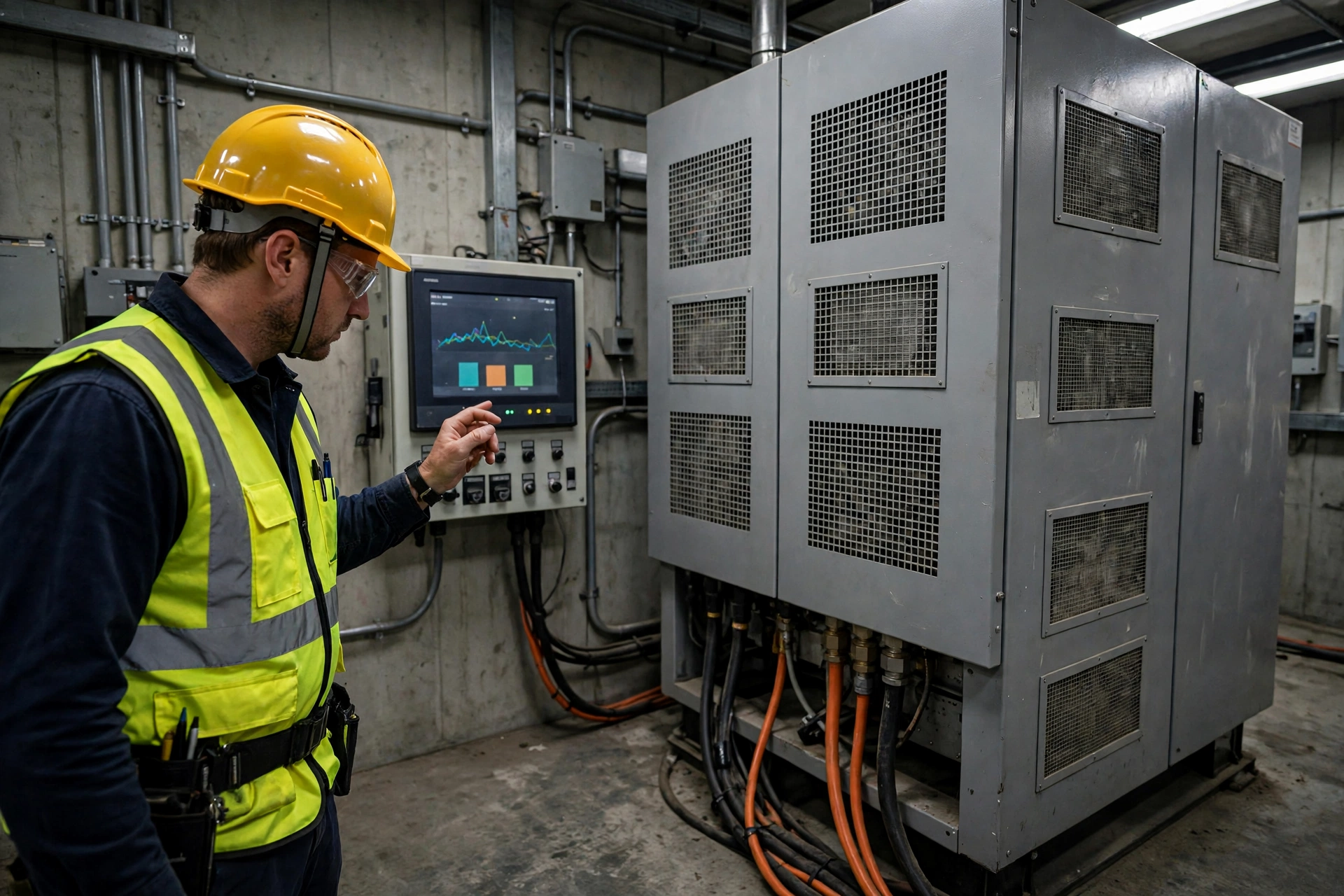
The controller is the component that makes or breaks the system. It must synchronise the generator with the inverter output, manage the transfer without dropping the load, and protect the generator from reverse power — solar pushing energy back into a generator that is not designed to absorb it. Controllers such as the ComAp InteliGen and the Deep Sea DSE8000 series, paired with a grid-forming inverter, are the standard hardware for this job. A site that tries to run a hybrid on a basic automatic transfer switch and a solar inverter with no coordination between them will trip, hunt, or damage the generator.
AC-Coupled vs DC-Coupled
In an AC-coupled system, the solar panels connect through their own grid-tied inverter directly to the AC bus, alongside the generator. This is the common choice for retrofitting panels onto an existing generator site, because the generator, its switchgear and its controller stay untouched. The trade-off is conversion losses: solar energy that goes into the battery passes through two conversions, losing roughly 8–12% on the round trip.
In a DC-coupled system, the solar array charges the battery directly through a charge controller, and a single inverter supplies the AC load. Round-trip efficiency is better by 3–5 percentage points, and the design is simpler to control. The trade-off is that retrofitting a DC-coupled array onto an existing generator installation usually means replacing the inverter and reworking the switchboard. For a new off-grid build, DC-coupled is usually the better engineering choice. For a retrofit, AC-coupled is usually the cheaper one. Either architecture works, provided one controller owns the dispatch logic. Two controllers making independent decisions about the same generator is how hybrid sites fail.
Who Decides When the Generator Starts
The controller starts the generator on one of three triggers: battery state of charge falling to its set point, load exceeding what solar and battery can supply together, or a time-of-day rule — for example, a forced run at 06:00 to guarantee a full battery before the working day. The start signal goes to the generator controller, which cranks, warms up, synchronises and takes load. A well-set system does this without anyone on site noticing.
Two settings matter more than any other. The first is the generator minimum run time, typically 30–60 minutes, which prevents the set from starting for five minutes, stopping, and starting again — short cycling that wears the starter and never lets the engine reach operating temperature. The second is the battery recharge target: charging to 100% every cycle wastes generator hours on the slow final 10% of charge. Most sites charge to 80–90% from the generator and let solar finish the last 10% the next day.
Sizing the Array and the Battery
Sizing a hybrid starts with the load, not with the hardware. The buyer needs one number first: daily energy consumption in kWh, split into day load and night load, with the peak kW and the largest single motor noted separately. Everything else is arithmetic from that number. For the generator itself, the generator sizing guide process is the same as for any off-grid set: peak load first, then duty, then site conditions.
Sizing the Solar Array
The working formula for array size is:
PV (kWp) = Daily load (kWh) × PV share ÷ (Peak sun hours × 0.75)
The 0.75 factor covers temperature losses, dust, inverter losses and panel ageing. PV share is the fraction of daily energy the array is expected to supply — 50–70% is the practical range for an off-grid hybrid. Above roughly 70%, the array produces surplus on sunny days that the battery cannot absorb, and the extra panels earn nothing.
Applied to a remote exploration camp using 120 kWh per day in a location with 5.5 peak sun hours, targeting a 60% PV share:
120 × 0.60 ÷ (5.5 × 0.75) = 72 ÷ 4.125 = 17.5 kWp, rounded to 18 kWp.
| Daily load | Peak sun hours | PV share | Array size |
|---|---|---|---|
| 40 kWh (telecom tower) | 5.5 | 60% | 6 kWp |
| 120 kWh (exploration camp) | 5.5 | 60% | 18 kWp |
| 300 kWh (small mine camp) | 5.0 | 60% | 48 kWp |
| 800 kWh (construction camp) | 5.0 | 60% | 128 kWp |
Dust is the quiet variable in this table. A panel array that nobody cleans for six months in a dry region loses 10–25% of output to soiling. Sites that cannot guarantee regular cleaning should derate the array by a further 10% or budget for a cleaning visit with every fuel delivery. Theft is the other site reality: panels at an unmanned site are a theft target, and the mounting design should assume that.
Sizing the Battery
Battery sizing is driven by the night load plus one full generator charging cycle. For the same 120 kWh per day camp, with 40 kWh of night load: 40 kWh ÷ 0.80 depth of discharge = 50 kWh usable, or about 60 kWh installed LFP. A second day of autonomy takes that to 120 kWh installed — a real cost decision, not a rounding choice.
LFP is the standard chemistry for this duty: 6,000+ cycles at 80% depth of discharge, no ventilation requirement beyond normal room cooling, and a flat voltage curve that keeps the inverter happy. Lead-acid costs less per kWh to buy and far more per kWh delivered over its life, because it should not be discharged below 50% and lasts roughly 1,200–1,500 cycles in daily cycling service. For a site cycling its battery every day, LFP pays back the premium in about two years.
The generator rating follows from the battery, not the other way around. The set must be large enough to carry the peak load and recharge the battery at the same time, while staying above its minimum load. For the 120 kWh per day camp, a 60 kVA prime-rated set is the right frame: it carries a 30 kW peak, charges a 60 kWh battery at roughly 25 kW, and runs at 70–80% load while doing both. A 100 kVA set on the same site would run at 40% load and glaze its cylinders. Oversizing the generator is the most expensive mistake in hybrid design, and it is made constantly.
The 30% Rule: Why a Hybrid Can Kill a Generator
A hybrid that saves fuel by cutting generator hours can also destroy the generator, and the mechanism is simple. Solar takes the daytime load. The generator is left with the small, steady night load — or it is left running at 15% load because nobody told the controller to stop it. A diesel engine run for long periods below 30% of its rated load does not reach operating temperature, fuel does not burn completely, and unburnt fuel and soot accumulate in the exhaust. That condition is wet stacking, and it is the single most common cause of premature engine failure in hybrid installations.
What Wet Stacking Does to an Engine
Wet stacking shows itself as black, oily liquid weeping from exhaust joints — unburnt fuel and oil mixed with carbon. Inside the engine, the damage is worse: carbon deposits on valves, pistons and the turbocharger, fuel diluting the lubricating oil, and in extreme cases polished cylinder liners that no longer hold oil. Caterpillar’s guidance puts the threshold at 30% of rated load for extended operation, and some manufacturers specify 50–85% as the designed operating band. On a modern Stage V set fitted with a diesel particulate filter, the problem compounds: without a hot exhaust, the filter cannot regenerate, clogs, and eventually forces a shutdown.
The damage is slow and invisible. A set can run at 20% load for a year and show no fault code. The failure arrives at 2,000 hours, when the set should have had 20,000 hours of life remaining — the same pattern as a standby-rated set sold into prime duty. The prime power rating on the datasheet assumes the set works at variable load averaging 70%. A hybrid that parks the generator at 15% load for eighteen hours a day violates that assumption just as surely as a prime site with a standby set.
Three Ways to Keep the Generator Above 30%
The first and best cure is to stop the generator. A battery takes the low night load while the set is off. This is the entire point of adding storage to a hybrid, and it is why panels without a battery save only 10–20% of diesel while panels with a battery save 55–70%. The generator runs only when there is real work to do, and then it runs loaded.
The second cure is to charge the battery at high load. When the controller does start the generator, it should load it to 70–80% by combining site load with battery charging. A 60 kVA set charging a 60 kWh battery at 25 kW while carrying a 15 kW site load runs at roughly 80% — exactly where the engine wants to be. Charging the battery slowly, at 10 kW, keeps the generator at 30% and defeats the purpose.
The third cure is a load bank or a deferrable load. Where the site load is genuinely small — a 5 kW telecom load on a 20 kVA set, for example — a resistive load bank switched in by the controller holds the generator above 30% during its run. A water heater, a bore pump filling a header tank, or a battery charger are cheaper versions of the same idea: give the generator useful work during the hours it runs. Load bank testing during the monthly test run serves the same purpose, burning off deposits before they harden.
Three Sites, Three Paybacks
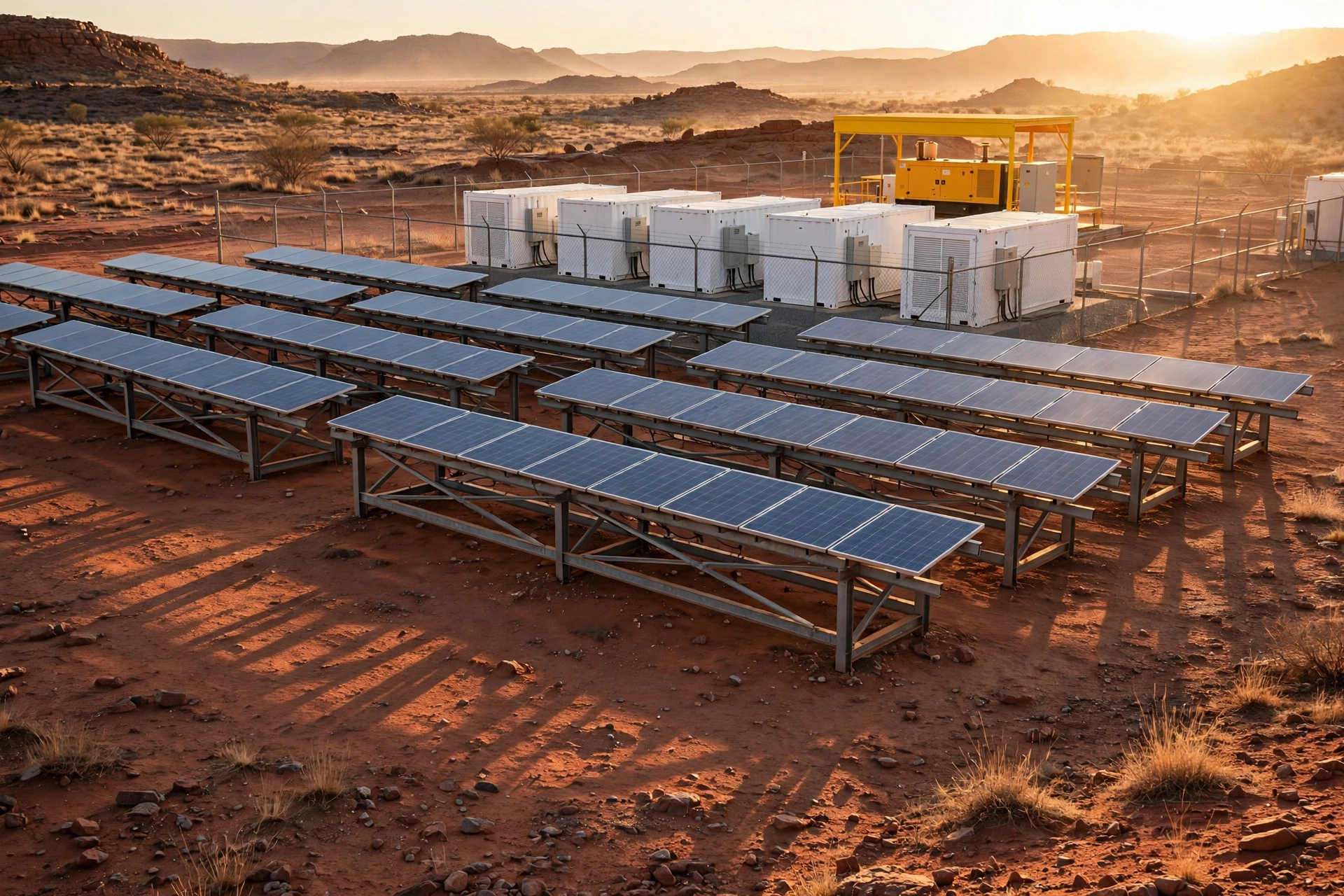
Hybrid economics depend on three site facts: how much diesel costs delivered, how many hours the generator runs today, and how sunny the site is. Three real projects show how those facts combine.
Case 1: Highway Construction Camp, Texas
A civil contractor building a highway segment in a semi-remote area of Texas needed 24-hour power for a site office, a batch plant and a small workshop. The solution was a 250 kW solar canopy over the material yard, a 500 kWh LFP battery system, and the site’s existing 400 kW diesel generator, integrated to UL 9540 and IEEE 1547 standards.
After twelve months, diesel consumption had fallen from about 145,000 litres to 62,000 litres — a 57% reduction. Generator runtime fell from near-continuous to about 6 hours per day on average. Carbon emissions fell by the same proportion, from roughly 390 tonnes to 167 tonnes of CO2e per year, and noise complaints from a nearby settlement stopped entirely. The payback period landed just under 4 years on fuel savings and reduced maintenance alone. The generator did not get smaller. It got fewer, better hours.
Case 2: Irrigation Pumping, Western Australia
A remote irrigation operation in Western Australia runs a 37 kW bore pump around the clock — about 888 kWh per day — with no grid connection. Diesel-only operation consumed roughly 355 litres per day, or about $285,000 per year at an assumed delivered diesel price of $2.20 per litre, before delivery and maintenance costs.
The hybrid design added 105 kWp of solar and 482 kWh of battery storage in two integrated modules. Projected diesel savings were approximately 70%, worth $199,655 per year — about 248 litres of diesel displaced every day. The pump never stops, the water never stops, and the generator now runs as a charger and a backstop rather than as the sole supply. For a load that is constant and predictable, the hybrid math is at its most favourable, because the array and battery can be sized to the load with almost no waste.
Case 3: Telecom Towers, Sub-Saharan Africa
Telecom towers are the smallest hybrid sites and the most numerous. A typical macro site draws 2–6 kW continuously, and operators such as Airtel Africa have deployed solar-plus-lithium hybrids across Kenya and Nigeria at scale. Reported results: fuel savings of up to 70%, about 25 tonnes of CO2 per site per year, generator runtime cut from 24 hours to 4–6 hours per day, and service intervals extended from every 250 running hours to effectively twice a year.
The payback period in high-irradiance zones runs 18–30 months, and the fuel saving per site is typically $5,000–$15,000 per year. The lesson from the tower fleet is that hybrid savings scale with the number of sites, not with the size of any one site: a thousand towers saving $10,000 each is a $10 million annual saving, and it is achieved by the same three components — panels, battery, controller — repeated a thousand times. A telecom tower generator that runs 24 hours a day at 20% load is also the classic wet-stacking case, which is why the tower hybrid always includes the battery: without it, the generator keeps running and the panels save almost nothing.
What a Hybrid Costs and When It Pays Back
A hybrid diesel generator with battery storage is a capital purchase that buys back fuel, maintenance and generator life. The cost side has four lines, and the buyer should see all four before signing.
| Component | Typical installed cost | Notes |
|---|---|---|
| Solar array | $0.80–$1.20 per Wp | Includes mounting, freight to a remote site; higher at the top end for difficult access |
| LFP battery | $300–$450 per kWh | Installed, including battery management system; 6,000+ cycles at 80% DoD |
| Hybrid inverter + controller | $8,000–$25,000 | Depends on site size; includes synchronising controller and switchgear changes |
| Generator (if new) | $150–$300 per kVA | Prime-rated set; existing set usually retained |
For the 120 kWh per day exploration camp: 18 kWp of solar at $1.00/Wp is $18,000; 60 kWh of LFP at $375/kWh is $22,500; inverter and controller $12,000; installation and freight $10,000. Total: roughly $62,500.
The saving side: diesel-only operation at that camp burns about 170 litres per day — a 60 kVA set running 24 hours at light load, where fuel consumption stays near 7–8 L/h even at 15% load, because a diesel engine burns fuel to stay running, not only to make power. The hybrid cuts that to about 60 litres per day: five hours at 70–80% load, roughly 12 L/h. Saving: 110 litres per day. At $1.50 per litre delivered, that is $165 per day, $60,000 per year — a payback of about one year. At $1.00 per litre, the saving is $40,000 per year and payback is about eighteen months. The payback is fastest exactly where diesel is most expensive: remote sites, island sites, and sites where every fuel delivery is a truck, a driver and a day. See the fuel consumption and tank sizing figures for how a 72-hour fuel reserve changes the same calculation.
Two further savings belong in the calculation and are usually left out. The first is maintenance: a generator running 1,800 hours a year instead of 8,000 needs roughly a quarter of the oil changes, filter changes and service visits. The second is generator life: a set that runs 1,800 loaded hours a year instead of 8,000 light-load hours lasts several times longer before overhaul. The US National Renewable Energy Laboratory’s REopt analysis of Alcatraz Island, which already had solar, batteries and diesel generators, found that better dispatch alone could cut diesel use by about 50% — roughly 15,000 gallons a year — while reducing wasted solar from 30% to 4%. NREL’s broader finding is that integrating storage with generators can reduce fuel consumption by up to 80% in optimal scenarios. Those are dispatch and sizing gains, not new hardware.
The comparison that matters is not hybrid against diesel-only. It is hybrid against the cost of doing nothing: 8,000 generator hours a year, a fuel delivery every week, and an engine overhaul at 6,000 hours instead of 20,000. For a buyer weighing a diesel vs gas vs solar backup power comparison, the same arithmetic applies — gas and solar both change the fuel bill, but only a hybrid with storage changes the generator’s hours.
Frequently Asked Questions
Can a diesel generator work with solar panels?
Yes. A diesel generator works with solar panels when a hybrid controller connects the two on one AC bus, with the solar inverter supplying the load first and the generator starting only when solar and battery cannot cover demand. Most off-grid hybrids also include a battery, because without one the generator cannot shut down and the fuel saving is only 10–20%.
How do you connect solar panels to a diesel generator?
Solar panels connect to a diesel generator through a hybrid inverter and a synchronising controller, not directly to the generator terminals. In an AC-coupled system the solar inverter and the generator both feed the same AC bus; in a DC-coupled system the panels charge the battery and one inverter supplies the load. The controller manages synchronisation, transfer and reverse-power protection.
How much solar do I need to cut diesel generator hours?
Size the array from daily energy use: PV (kWp) equals daily load in kWh multiplied by the PV share, divided by peak sun hours multiplied by 0.75. A site using 120 kWh per day needs about 18 kWp at a 60% PV share in a 5.5 peak-sun-hour location. An array sized to 50–70% of daily energy typically cuts diesel use by 55–70% when paired with a battery.
Is a solar diesel hybrid cheaper than diesel alone?
Yes, at most off-grid sites, with a payback of roughly 1–4 years depending on the delivered diesel price and the site’s sunshine. The Texas highway camp paid back in just under 4 years, telecom towers in Sub-Saharan Africa in 18–30 months, and a camp paying $1.50 per litre for delivered diesel can pay back in about a year. Where grid diesel is cheap and delivery is easy, the payback stretches — the hybrid case is strongest where fuel logistics are expensive.
What size solar system do I need for an off-grid generator?
Size the solar system from the daily load and the generator from the peak load plus battery charging, not the other way around. A 120 kWh per day site needs roughly 18 kWp of solar, 60 kWh of LFP battery for one night of autonomy, and a 60 kVA prime-rated generator that runs at 70–80% load while charging. Oversizing the generator is the most expensive error: a 100 kVA set on that site would run at 40% load and glaze its cylinders.
Specification Checklist: Seven Lines Before You Sign
1. Daily load in kWh, split into day and night. No array or battery can be sized without this number. A quotation that sizes the hybrid from the generator rating instead of the load should be returned.
2. Prime rating, not standby, for the generator. A hybrid generator runs fewer hours but must run loaded when it runs. The prime power rating is the correct duty, and the set should be sized so that load plus battery charging lands at 70–80% of rating.
3. Minimum-load protection in the controller. The specification must state the generator’s minimum load — 30% as an absolute floor, 40% in practice — and what the controller does when load falls below it: stop the set, charge the battery harder, or switch in a load bank.
4. Battery autonomy in days, stated in writing. One night of autonomy is the minimum. Two to three days covers a cloudy spell. The figure must be stated at 80% depth of discharge for LFP, not at 100%.
5. One controller owns dispatch. The hybrid controller, the inverter and the generator controller must be specified as one integrated system, with a single point of responsibility. Two controllers making independent start and stop decisions is a failure waiting for a cloudy day.
6. Fuel logistics priced for the hybrid, not for diesel-only. A bulk tank sized for weekly delivery on a diesel-only site becomes a monthly delivery on a hybrid site. Price the delivery saving into the payback, and confirm the tank still holds enough for a three-day cloudy spell with the generator running.
7. Remote monitoring from day one. A hybrid site is usually unmanned, and the controller’s decisions — starts, stops, state of charge, fuel level — must be visible from the buyer’s office. Remote monitoring over GSM or satellite, with low-fuel and failed-start alarms, is not an option on a site nobody visits for weeks.
Before requesting a price, a buyer should provide four lines: daily energy in kWh with the night fraction, peak kW with the largest single motor and its starting method, peak sun hours and dust conditions at the site, and the delivered diesel price including transport. Any manufacturer that knows its business — PAVO included, with a range of 9 to 3750 kVA in open, silent and containerised configurations, powered by Cummins, Weichai, Yuchai and Shanghai Diesel — will size the array, the battery and the generator from those four lines. A supplier that prices the panels without asking about the night load is selling panels, not uptime.
Solar does not retire the diesel generator at an off-grid site. It retires the generator’s wasted hours — the eighteen hours a day it used to spend idling at 15% load, burning fuel to stay warm and glazing its own cylinders. Done properly, the set runs five hours a day, loaded, efficient, and far from its overhaul date. Done badly, the panels save 10% of the fuel and cost the buyer an engine. The difference is not the hardware. It is the sizing, the battery, and the controller that decides when the generator is allowed to stop.
For a site-specific hybrid sizing — array, battery and generator matched to the daily load, the night load and the delivered fuel price — contact PAVO with the four lines above, and the engineering team will return a sized proposal with the fuel saving worked out in litres per day, not in promises.