

What Size Generator Does an Oil Refinery Need? | PAVO
An oil refinery is the one industrial site where a power cut does not stop a machine. It stops a chemical process that is running at 400°C, under pressure, full of flammable hydrocarbons — and the first thing the public sees is the flare.
What size generator does an oil refinery need? A small topping refinery typically needs 1,500–3,750 kVA on its emergency board; a medium refinery 3,750–10,000 kVA; and a large cracking complex 10,000–25,000 kVA or more in parallel — because the set covers the emergency board, not the whole plant.
Contents
- What a Refinery Actually Runs on Power
- The Damage Window: What Happens in the First Minutes
- How Big: Sizing Bands by Refinery Type
- The Flare Problem: Why a Trip Becomes a Torch
- Hazardous Areas: Where the Generator Can and Cannot Stand
- Fuel Autonomy: Running for Days When the Grid Is Gone
- Frequently Asked Questions
- Oil Refinery Generator Specification Checklist
What a Refinery Actually Runs on Power
A refinery’s electrical load is not one load. It is four different kinds of load stacked on the same bus: the process units that turn crude into products, the rotating machines that move fluids and air, the utilities that keep everything cool and inert, and the safety systems that must work when everything else has failed. The first job in sizing a refinery generator is to separate these four, because only the last two — plus a carefully chosen slice of the first two — ever go on the emergency board.
A large refinery is also one of the biggest single electricity consumers in any country. A 200,000 bpd refinery typically draws 30–60 MW of electrical power; a 600,000 bpd complex draws 100–200 MW. Most of that power comes from the refinery’s own cogeneration plant, burning refinery fuel gas and steam, with the grid as a top-up and a backup. That matters for generator sizing in one specific way: the diesel set is not sized against the refinery’s total load. It is sized against the emergency board — the loads that must stay alive while the process is shut down safely. That board is typically 2–5 MW on a medium refinery and 5–20 MW on a large one, which is 3–10% of the plant’s total electrical demand.
Crude distillation: the unit that never stops
Crude distillation is where the crude enters and where the first damage happens when power fails. The atmospheric crude distillation unit (CDU) heats crude to around 350–400°C in a fired heater, then separates it into fractions — naphtha, kerosene, diesel, gas oil and residue — in a tower that is 40–60 m tall. The vacuum distillation unit (VDU) takes the residue and separates it further under vacuum. Distillation is the largest energy user in the plant: a US Oak Ridge National Laboratory study put roughly 36% of a refinery’s total energy use into the distillation units.
The electrical loads on a CDU are large but not the largest in the plant. The crude charge pumps run 500–1,500 kW each. The reflux and product rundown pumps run 100–400 kW each. The air coolers and fin-fan coolers that condense the overhead vapours draw 200–600 kW per bank. None of these loads is life-critical on its own. Together, they decide whether the tower can be shut down in a controlled way or whether it trips — and a tripped CDU is a tower full of hot hydrocarbon at 350°C with no circulation, no cooling and no level control. The generator sizing guide explains the step-by-step method: list the loads, apply diversity, add the largest motor start, then check the voltage dip. In a refinery, the list is long, the diversity is low, and the largest motor start is usually a cooling-water pump.
Conversion units: FCC, hydrocracker and reformer
The conversion units are where a power cut turns expensive. The fluid catalytic cracking unit (FCC) cracks heavy gas oil into gasoline at 500–540°C, circulating catalyst between a reactor and a regenerator. The main air blower — the machine that feeds air to the regenerator — is a single large machine, typically 3,000–8,000 kW, driven by a steam turbine or a large electric motor. Lose the air blower and the regenerator loses its air supply in seconds. The catalyst stops circulating, the reactor temperature falls, and the unit has to be shut down and re-started — a process that takes 3–7 days and can damage catalyst worth $1–3 million per load.
The hydrocracker runs at 150–200 bar and 350–430°C, with hydrogen circulating through the reactor. Its recycle-gas compressor is a 2,000–5,000 kW machine, and its feed pumps run 500–1,000 kW. Lose power and the compressor trips, the hydrogen circulation stops, and the reactor has to be depressured and cooled under strict procedures, because hot catalyst in contact with stagnant hydrogen and hydrocarbon is a runaway risk. The catalytic reformer, the alkylation unit and the sulfur recovery unit each have their own version of the same problem: a continuous, high-temperature, high-pressure process that cannot simply be switched off and on again.
None of these units is backed up by diesel in the ordinary sense. A diesel set cannot run an FCC air blower. What the diesel set does is keep the utilities alive — cooling water, instrument air, nitrogen, lube oil — so that the units can be shut down in the right order, in the right time, without damage. That distinction, between keeping the process running and shutting it down safely, is the whole subject of refinery backup power.
Utilities, tank farm and the safety systems
The utility loads are the ones the emergency board is actually built around. Cooling water is first: a refinery’s cooling-water pumps run 500–2,000 kW each, and they serve every unit in the plant. Without cooling water, no unit can be shut down safely, because the products and the columns have nowhere to shed their heat. Instrument air is second: the air compressors run 150–400 kW each, and they drive the control valves. Lose instrument air and the valves go to their fail-safe positions — some open, some closed — and the operators lose the ability to steer the shutdown. Nitrogen is third: the nitrogen plant or the nitrogen header keeps vessels blanketed and inert, and the compressors or vaporisers that supply it need power to keep running.
The safety systems sit on their own tier. The distributed control system (DCS) and the safety instrumented system (SIS) run on UPS batteries for 30–60 minutes, long enough for the generator to start and take over. Emergency lighting, communications, access control and the firewater system — electric firewater pumps of 300–750 kW, or diesel-driven fire pumps that are independent of the grid — are on the emergency board from the first second. Gas detection, flare pilots and the flare knock-out drum pumps are on it too. The automatic transfer switch is what makes the whole sequence happen without an operator standing at the panel: it senses the mains failure, starts the set, and transfers the load in under 10 seconds, which is the NFPA 110 Level 1 requirement for life-safety loads.
The Damage Window: What Happens in the First Minutes
A refinery outage is not one failure. It is a sequence, and the sequence runs in minutes, not hours. The first ten seconds decide whether the plant shuts down in a controlled way or trips. The first hour decides whether the restart takes a day or a month.
Texas, February 2021: the freeze that took 4 million barrels a day offline
The clearest recent warning comes from Texas in February 2021, when Winter Storm Uri brought single-digit temperatures to a state built for 40°C summers. Around 4 million barrels a day of refining capacity went offline — roughly 21% of total US capacity, according to Reuters calculations, and about 5.5 million bpd of crude processing fell, according to Energy Aspects. More than 20 refineries in Texas, Louisiana and Oklahoma were affected. Motiva’s Port Arthur refinery, at 607,000 bpd the largest in the United States, shut down. ExxonMobil’s Baytown plant (580,500 bpd), Marathon’s Galveston Bay refinery (585,000 bpd), Total’s Port Arthur plant (225,500 bpd) and Shell’s Deer Park refinery (318,000 bpd) all shut down or cut runs.
The restarts took weeks. ExxonMobil’s Baytown refinery was expected to be down a month or more. Marathon’s Galveston Bay plant pushed back a scheduled turnaround to March. Shell’s Deer Park refinery was not expected back to full capacity until April. The damage was not from the cold alone. When a refinery shuts down without warning, hydrocarbons sit in piping that was never designed to hold them cold. “Dead legs” — pockets of hydrocarbon and steam in lines that do not flow — freeze and burst. Fluids harden into a wax that takes days or weeks to remove. LyondellBasell’s Houston refinery waited for nitrogen to be restored from its supplier and for permission from the grid operator to restart its big electric motors. The flaring was visible for miles: Texas Commission on Environmental Quality data put the collective refinery emissions during the freeze at 153 tons of gases, including benzene, carbon monoxide and sulfur dioxide. The lesson is not that Texas was cold. It is that a refinery that loses power without a controlled shutdown pays for it in weeks of restart, not hours.
Houston, August 2017: Harvey and the two-week restart
Four years earlier, Hurricane Harvey gave the same lesson in a different form. The storm shut down about 4.4 million barrels a day of US refining capacity — 25% of the national total, and more than Japan uses in a day. 24 refineries were affected. Motiva’s Port Arthur plant, again the largest in the country, was shut for at least two weeks. Gulf Coast refinery runs fell by 3.2–3.3 million barrels a day in a single week, and regional utilisation fell from 96% to 63%. The US Energy Information Administration recorded refinery runs of 14.5 million barrels a day in the week to 1 September — the lowest since its data series began in 1992 — and retail gasoline prices rose 28 cents a gallon in about a week.
The restart problem after Harvey was not only the floodwater in the electrical systems. It was the workforce: operators could not reach the plant, contractors were booked for months, and the “cold” restart of a unit that had been shut down in a hurry carries its own fire and explosion risk from compromised equipment. A refinery that shuts down in a controlled way, with its emergency board alive and its utilities running, restarts in days. A refinery that trips, with its columns flooded and its catalyst damaged, restarts in weeks. The difference between the two is measured in millions of dollars a day — and the generator is what buys the controlled version.
What trips first: columns, catalyst and control
The sequence inside the plant runs like this. Power fails. The DCS and SIS stay alive on UPS, and the operators see the alarms. The automatic transfer switch starts the emergency generators, and the emergency board picks up cooling water, instrument air, lube oil and firewater within 10 seconds. The process units trip in a planned order: the FCC air blower is shut down first, the hydrocracker is depressured, the crude unit is taken down step by step, and the flare takes the relieved hydrocarbons. If the emergency board holds, the shutdown takes 2–4 hours and the plant is safe to restart. If the emergency board fails — if the generator does not start, or the largest cooling-water pump start trips it on overload — the units trip uncontrolled. Columns flood, because the reflux pumps stop and the liquid has nowhere to go. Catalyst is damaged, because the FCC regenerator loses air while it is still hot. The DCS goes dark when the UPS batteries run out after 30–60 minutes, and from that point the operators are blind. A refinery that has lost its DCS has lost its eyes, and it does not restart until power, cooling water and instrumentation are all restored and verified — which is why the uncontrolled trip costs weeks and the controlled shutdown costs days.
How Big: Sizing Bands by Refinery Type
The sizing question has no single answer, because a “refinery” covers everything from a 10,000 bpd topping plant to a 600,000 bpd integrated complex. The bands below are for the emergency board — the loads that must stay alive during an outage — not for the plant’s total electrical demand. The worked example after the table shows how a real refinery lands inside its band.
| Refinery type | Crude capacity | Total electrical demand | Emergency board | Generator band |
|---|---|---|---|---|
| Small topping refinery | 10,000–30,000 bpd | 5–15 MW | 1–3 MW | 1,500–3,750 kVA |
| Medium hydroskimming refinery | 50,000–120,000 bpd | 15–40 MW | 3–8 MW | 3,750–10,000 kVA |
| Large cracking refinery | 200,000–400,000 bpd | 40–100 MW | 8–20 MW | 10,000–25,000 kVA |
| Mega integrated complex | 600,000+ bpd | 100–200 MW | 20–40 MW | 25,000 kVA and up |
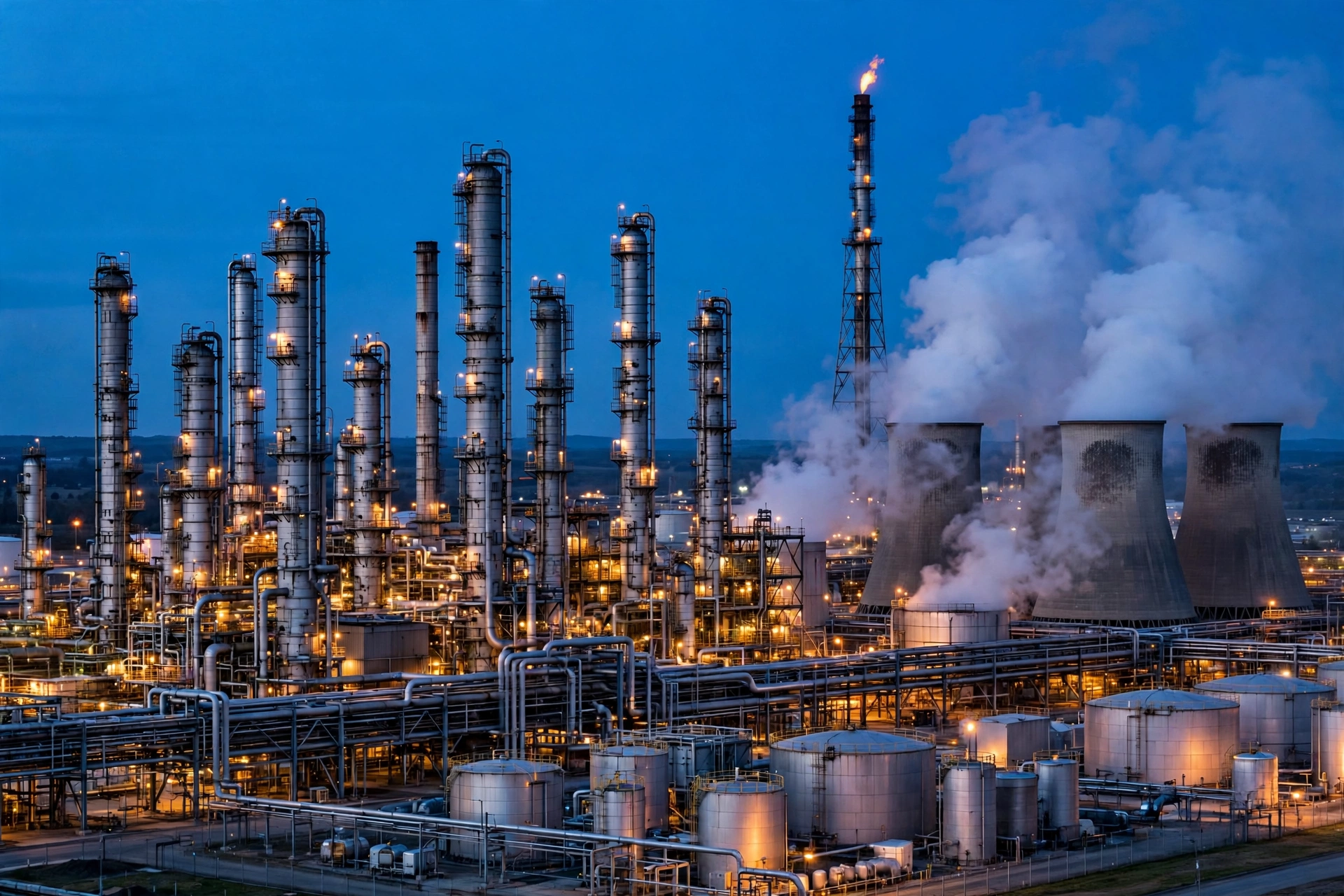
The band is not the connected load. It is the essential load — the loads that must run during an outage, after the process units are shut down and the non-essential loads are shed. A refinery’s total connected load is typically 2–3 times its emergency-board load, because the FCC air blower, the hydrocracker compressor and the crude charge pumps do not run during an outage, and they are not supposed to. The standby and prime power ratings matter here too: a set bought on its standby rating for a refinery that runs it for days at a time during a long outage is being run outside its design duty. Size to prime, not standby, if the plant expects multi-day running — and in a refinery, the outage that matters is always the multi-day one.
Worked example: a 120,000 bpd refinery at 3 × 1,250 kVA
Take a medium hydroskimming refinery — 120,000 bpd, one crude unit, one FCC, one hydrocracker, a tank farm and a marine terminal. The emergency-board load list, with diversity applied, looks like this:
- DCS, SIS and instrumentation (via UPS, then generator): 150 kW
- Cooling-water pumps, two of three running: 2 × 450 kW = 900 kW
- Crude and product rundown pumps: 600 kW
- Lube and seal-oil systems on critical rotating machinery: 200 kW
- Electric firewater pump, one of two running: 400 kW
- Flare knock-out drum pumps and flare pilots: 100 kW
- Instrument-air compressors, two running: 2 × 160 kW = 320 kW
- Emergency lighting, communications and control rooms: 180 kW
Running load totals roughly 2,850 kW. Add the largest motor start — a 450 kW cooling-water pump on direct-on-line start, drawing 6–7 times running current for a few seconds — and the transient peak reaches about 4,500 kVA. Three 1,250 kVA sets in parallel, rated at 1,000 kW prime each, give 3,750 kVA with N+1 redundancy: two sets carry the load, the third stands by, and the plant still has full emergency power if one set fails to start. A single 3,000 kVA set would carry the same load on paper, but it would be a single point of failure in a plant where the emergency board is a safety system. The rule for refineries is the same as for the chemical plants they are often built beside: the emergency supply is sized from a critical-load register built on the plant’s process-safety studies, not from a rule of thumb.
The honest limit: diesel cannot run a refinery
The limit has to be stated plainly, because it is the most common misunderstanding in refinery backup power. A diesel generator cannot keep a refinery running. A 600,000 bpd complex draws 100–200 MW; the largest single diesel sets top out at 3,750 kVA, and even a paralleled farm of ten sets reaches only 30 MW — a fifth of the plant’s demand, at a fuel burn of roughly 6,000 litres an hour. No refinery backs up its process units with diesel. The honest job of the diesel set is narrower and more important: keep the safety systems, the control systems and the utilities alive long enough to shut the plant down without damage, and to hold it safe while the grid is restored. A refinery that buys diesel generation expecting to keep producing through a grid outage has bought the wrong machine. A refinery that buys it to protect the shutdown has bought the right one.
The Flare Problem: Why a Trip Becomes a Torch
The flare is the most visible part of a refinery outage, and the least understood. When a unit trips, the hydrocarbons inside it have to go somewhere, and the somewhere is the flare system: a network of relief valves, headers and knock-out drums that routes gas to a flare stack, where it is burned at height. A flare that lights up during an outage is not a failure. It is the safety system working. A flare that does not light — or a flare that is overwhelmed — is the failure.
The flare load during a trip
A controlled shutdown flares a modest amount of gas over 2–4 hours. An uncontrolled trip flares far more, far faster. During Winter Storm Uri, the collective refinery flaring across Texas totalled 153 tons of gases in a few days, including benzene, carbon monoxide and sulfur dioxide. The volume matters because the flare system has a design capacity, set by API 521 (pressure-relieving and depressuring systems), and the flare header, the knock-out drum and the stack are sized for a defined relief case — usually the loss of cooling water or the loss of power to one unit, not the simultaneous trip of every unit in the plant. A total power failure that trips the whole refinery at once can exceed the flare system’s design case, which is why the emergency board’s first job is to keep the flare system itself alive: the knock-out drum pumps that keep liquid out of the flare header, the flare pilots that keep the flame lit, and the steam or air-assist systems that keep the flare smokeless.
The flare pilots are a small load — typically 10–30 kW for the ignition system — but they are a zero-tolerance load. A flare without a lit pilot is a stack venting unburned hydrocarbons, which is worse than flaring. The knock-out drum pumps are 50–150 kW each, and they run continuously during a trip, because liquid carried into the flare header can reach the stack and fall as burning droplets. The flare system is on the emergency board for the whole duration of the outage, not just the first ten seconds.
API 521 and the relief case the generator must protect
API 521 sets the rules for relief and flare systems: how relief valves are sized, how flare headers are designed, and what happens when more than one unit relieves at once. The standard’s power-failure relief case assumes that the plant loses power and the units trip in a defined sequence — which is exactly the sequence the emergency generators are supposed to protect. If the generators fail, the sequence breaks: units trip out of order, relief loads arrive at the flare header at the same time instead of staggered, and the header pressure rises above its design limit. The generator specification therefore has a line that does not appear on an ordinary industrial specification: the set must start and accept load within 10 seconds, and it must hold the emergency board without a second dip while the process units are being tripped. A set that starts in 30 seconds is a set that has already missed the window. The motor starting guide covers the arithmetic — the voltage dip when a 450 kW pump starts on a 1,250 kVA set — and in a refinery the dip limit is tighter than in most plants, because the DCS and the SIS drop out at around 20–25% voltage dip, and a DCS that resets mid-shutdown is a shutdown that has lost its operator.
Hazardous Areas: Where the Generator Can and Cannot Stand
A refinery is a hazardous-area site, and that changes where the generator can stand, how it is built and how it is maintained. The rules come from IEC 60079-10-1, which classifies areas by how often a flammable atmosphere is present: Zone 0 where it is present continuously, Zone 1 where it is likely in normal operation, and Zone 2 where it is unlikely and short-lived. Most of a refinery’s process area is Zone 1 or Zone 2. A diesel generator is a machine with a hot exhaust, a sparking alternator and a fuel tank — it does not belong inside a classified area unless it is built for it.
Zone 1, Zone 2 and the 15-metre rule
The practical rule is distance. The generator set, its fuel tank and its switchgear stand outside the classified area, typically in a non-hazardous utility area or in a dedicated generator building with its own ventilation and gas detection. The separation distances come from the plant’s hazardous-area classification drawings, which are drawn for each unit and each release source: pump seals, flanges, vents, loading arms. A common working figure is 15 m from a Zone 2 boundary to an unprotected ignition source, but the real number depends on the release rate, the gas density and the wind, and it is set by the classification study, not by a rule of thumb. The same distance logic applies at a smaller scale at petrol stations, where the generator must stand clear of the forecourt and the tank farm — the petrol-station article works through the zone drawings for a site most readers will recognise.
The set itself needs protection too. A refinery generator is usually supplied in a containerised or acoustic enclosure with a gas-detection system that shuts the set down on a high gas alarm, a flame-arrestor on the air intake, and an exhaust system that keeps the surface temperature below the auto-ignition temperature of the gases present — typically 135–200°C for the T3 and T4 temperature classes. The fuel tank is bunded, and the bund is sized for 110% of the tank volume, the same rule that applies to the plant’s own day tanks. The electrical installation follows the same hazardous-area rules as the rest of the plant: cable glands, junction boxes and lighting all rated for the zone they sit in.
What a refinery-safe set looks like
A refinery-safe generator set is not a standard industrial set with a different paint colour. The engine is fitted with an intake flame trap and an exhaust flame arrestor, both certified for the gas group present — usually Group IIA (propane, the reference gas for most refinery hydrocarbons) or Group IIB (ethylene). The alternator is fitted with anti-condensation heaters, because a winding that has absorbed moisture overnight will fail its insulation test in the morning, and in a refinery the morning test is done by a technician in a hazardous area, not in a workshop. The control panel is in a safe area or in a pressurised enclosure, and the battery charger, the jacket-water heater and the fuel-transfer pump are all on the same emergency board as the set itself, so that a set that has stood idle for six months still starts. PAVO’s 900 kVA (720 kW) diesel generator for refineries is built on this pattern: a three-phase set at 400/380 V or 415/440 V, 50/60 Hz, with a Deep Sea or Smartgen digital controller, supplied in an open, soundproof or containerised canopy. It is the size most often specified for a refinery’s emergency board, large enough to ride through a cooling-water pump start and economical enough to run through a long outage without burning through the fuel budget.
Fuel Autonomy: Running for Days When the Grid Is Gone
A refinery outage is rarely a one-hour event. The events that take the grid down — hurricanes, ice storms, earthquakes — take it down for days, and the refinery’s own restart takes days after that. A generator that runs out of fuel after 12 hours is a generator that was specified for the wrong outage. Fuel autonomy is a multiplication, not a guess: tank capacity divided by consumption at the actual load.
How long the set can hold
The table below uses typical consumption figures for prime-rated sets at 75% load, which is where a refinery set usually runs during an outage.
| Generator size | Fuel use at 75% load | 24 hours | 72 hours | 7 days |
|---|---|---|---|---|
| 500 kVA | ~70 L/h | ~1,700 L | ~5,000 L | ~11,800 L |
| 1,000 kVA | ~140 L/h | ~3,400 L | ~10,000 L | ~23,500 L |
| 2,000 kVA | ~275 L/h | ~6,600 L | ~19,800 L | ~46,200 L |
| 3,750 kVA | ~510 L/h | ~12,200 L | ~36,700 L | ~85,700 L |
A 3 × 1,250 kVA emergency-board installation at 75% load burns roughly 525 L/h, or about 12,600 litres a day. A 40,000-litre bulk tank — a standard size for a refinery’s emergency fuel store — gives it 3.2 days. A refinery that wants 72 hours of autonomy needs a 38,000-litre tank or a refuelling contract that actually works during a storm. The Cummins C500D5, a common emergency-board size at 500 kVA standby / 455 kVA prime, burns 93.2 L/h at full prime load — a number worth checking against any supplier’s datasheet, because a set that burns 20% more than its datasheet says will run out of fuel 20% sooner than the plan assumes.
Refuelling during an outage is the part of the plan that fails most often. The fuel supplier’s depot may be without power too, the roads to the refinery may be flooded, and the refinery’s own transfer pump needs electricity. A refinery that plans for 72 hours should store 72 hours on site, in a bunded bulk tank, and treat the refuelling contract as a bonus. Fuel that has sat in a bulk tank for a year without polishing and testing is fuel that will clog filters exactly when the set is needed most — diesel fuel ageing explains why, and a refinery that tests its emergency fuel quarterly, the way it tests its product tanks, does not discover the problem at 2 a.m. during a storm.
The fuel the refinery already has
A refinery has one advantage that no other industrial site has: it makes fuel. The emergency generator can be fed from the refinery’s own diesel product, drawn from a product tank or a dedicated emergency-fuel tank, rather than from a commercial delivery. That sounds convenient, and it is, but it carries its own rules. Product diesel drawn from a rundown tank has to be filtered and water-separated before it reaches the generator’s day tank, because product tanks accumulate water and sediment at the bottom, and the generator’s fuel system is not designed to handle it. The transfer has to be possible without grid power — which means a diesel-driven transfer pump, or a gravity feed from an elevated tank — and the fuel has to meet the engine’s specification: EN 590 or the local equivalent, with the cetane number, sulfur content and lubricity the engine manufacturer requires. A refinery that feeds its emergency set from its own product should write the fuel specification into the generator’s operating procedure, test the fuel at the day tank quarterly, and keep a commercial delivery contract as the backup. The set that runs on the plant’s own product is a good idea. The set that runs on untested product is not.
Frequently Asked Questions
What size generator does an oil refinery need?
A small topping refinery typically needs 1,500–3,750 kVA on its emergency board. A medium hydroskimming refinery needs 3,750–10,000 kVA. A large cracking refinery needs 10,000–25,000 kVA, and a mega complex needs 25,000 kVA or more, usually as several sets in parallel at 11 kV. The size is set by the emergency board — cooling water, instrument air, firewater, DCS and flare systems — not by the plant’s total electrical demand, which is 10–30 times larger.
Do oil refineries need a backup generator?
Yes, and in most jurisdictions it is not a choice. A refinery without emergency generation cannot shut down safely when the grid fails: the DCS goes dark when its UPS batteries run out after 30–60 minutes, the cooling-water pumps stop, the flare system loses its knock-out drum pumps and pilots, and the units trip uncontrolled. The cost of an uncontrolled trip — damaged catalyst, flooded columns, weeks of restart — is measured in tens of millions of dollars, against a generator installation that costs a fraction of that.
How long can an oil refinery run on a generator?
As long as the fuel lasts. A 3 × 1,250 kVA emergency-board installation at 75% load burns about 525 L/h, so a 40,000-litre tank gives roughly 3.2 days and a 38,000-litre tank gives 72 hours. Refineries in hurricane and ice-storm regions plan for 72 hours of on-site fuel as a minimum, because refuelling during a storm is unreliable. The set itself can run indefinitely on its prime rating, provided it is serviced on schedule and the load stays within the 70–80% band.
What happens to an oil refinery during a power outage?
The process units trip in a planned order if the emergency board holds: the FCC air blower is shut down, the hydrocracker is depressured, the crude unit is taken down step by step, and the flare takes the relieved hydrocarbons over 2–4 hours. If the emergency board fails, the units trip uncontrolled: columns flood, catalyst is damaged, the DCS goes dark when the UPS runs out, and the restart takes weeks instead of days. In February 2021, Winter Storm Uri took 4 million barrels a day of US refining capacity offline, and some plants did not return to full capacity until April.
Can a diesel generator power an oil refinery?
It can power the emergency board of an oil refinery, which is what matters. No practical number of diesel sets backs up a 100–200 MW refinery at full production. A correctly sized set — or several sets in parallel — covers the cooling-water pumps, instrument air, firewater, DCS and SIS, flare knock-out drum pumps and pilots, and the control rooms. The process units are shut down in a controlled way and wait for the grid. The non-essential loads, including the FCC air blower and the hydrocracker compressor, are never on the emergency board.
Oil Refinery Generator Specification Checklist
- Build the critical-load register first. Cooling water, instrument air, nitrogen, lube and seal oil, firewater, DCS and SIS, flare knock-out drum pumps and pilots, emergency lighting and communications. The process units are not on it.
- Size to the peaks, not the average. Add the largest motor start — usually a cooling-water pump at 6–7 times running current — to the running load, and check the voltage dip stays under 20–25% so the DCS does not reset.
- Specify parallel sets with N+1 redundancy. Two sets carry the load, the third stands by. A single set is a single point of failure on a board that is a safety system.
- Demand a 10-second start. The automatic transfer switch must start the set and transfer the load within 10 seconds (NFPA 110 Level 1). A set that starts in 30 seconds has already missed the window.
- Place the set outside the classified area. Zone 1 and Zone 2 boundaries come from the plant’s hazardous-area classification drawings. Fit intake flame traps, exhaust flame arrestors and gas detection that shuts the set down on a high gas alarm.
- Specify the rating for the duty. If the plant expects multi-day running during storm outages, buy on the prime rating, not the standby rating. Standby sets are designed for roughly 200 hours a year.
- Test the fuel at the day tank quarterly. Product diesel drawn from the refinery’s own tanks must be filtered, water-separated and tested to EN 590 or the local equivalent before it reaches the generator.
- Test it under load, monthly. A weekly no-load run proves the engine starts. A monthly load-bank test at 70–80% proves it carries the emergency board. Keep the test log with the set’s service record — the diesel generator maintenance schedule covers the rest.
- Write the shutdown sequence down. Which units trip first, which loads shed, and who gives the order. A generator that starts perfectly is useless if nobody has agreed what it is supposed to keep alive.
A refinery’s generator is not bought for the days the grid works. It is bought for the one night the grid fails with the crude unit at 400°C, the FCC full of hot catalyst and a storm coming in off the Gulf. Size it for that night, place it outside the classified area, and test it under load every month. For a refinery-specific sizing assessment, emergency-board load list and quotation, contact PAVO — send the crude capacity, the unit list and the hazardous-area drawings, and the set will be specified against the loads the refinery actually runs.