

What Size Generator Do I Need for a Farm? A Guide | PAVO
On a farm, backup power is not bought for the farm. It is bought for the two hours after the grid fails, when milk is warming in the tank, the fans have stopped in the poultry house and a dryer full of wet grain is going nowhere.
What size generator do I need for a farm? Most small and medium farms need a 20-60 kVA diesel set for the essential loads – milking, milk cooling, ventilation and feed – if the largest motors start one at a time and the running load stays under 80% of prime rating. Large dairies and grain dryers need 100-200 kVA.
- Why a Farm Outage Is Measured in Hours, Not Days
- The Loads That Decide the Size
- Sizing in kVA: Three Worked Examples
- Single-Phase or Three-Phase, Open or Canopy
- Fuel Use per Day and Tank Autonomy
- Three Farms, Three Lessons
- Frequently Asked Questions
- Farm Generator Specification Checklist
Why a Farm Outage Is Measured in Hours, Not Days
An office loses an afternoon when the grid fails. A farm loses animals, milk and a harvest. The loads that matter on a farm are biological, and biology keeps its own clock. A generator sized for a farm is therefore sized backwards from the damage an outage does in the first hours, not from the total connected load on the site.
Most farms also sit at the end of long overhead lines. A dairy farm on a rural feeder in Northern Ireland lost its mains supply several times in one winter before it bought a generator. Farms in India, Kenya and the Philippines deal with scheduled load shedding and storm damage as a normal part of the season. The set that protects them is the one that starts itself, carries the loads that cannot wait, and keeps running until the fuel runs out — not the one with the biggest number on the canopy.
Dairy: the two-hour milk rule
Milk must be cooled to 4°C within two hours of milking to stop bacterial growth and meet sanitary standards. That two-hour window is the whole design problem for a dairy farm. The vacuum pump and the milk cooling compressor run at the same time, twice a day, morning and evening, and the cooling compressor is the load that cannot be deferred.
A tank of warm milk is not just a spoiled batch. In most markets it is a rejected collection. The tanker does not take milk above the temperature limit, the milk board does not pay for it, and a day’s production from a 200-cow herd — roughly 4,000–6,000 litres — goes to drain. At a farm-gate price of around US$0.45–0.55 per litre, one missed collection costs US$1,800–3,300, before the cost of disposing of the milk. Two missed milkings in a 48-hour outage cost more than a year of generator servicing.
Poultry: ventilation stops in minutes
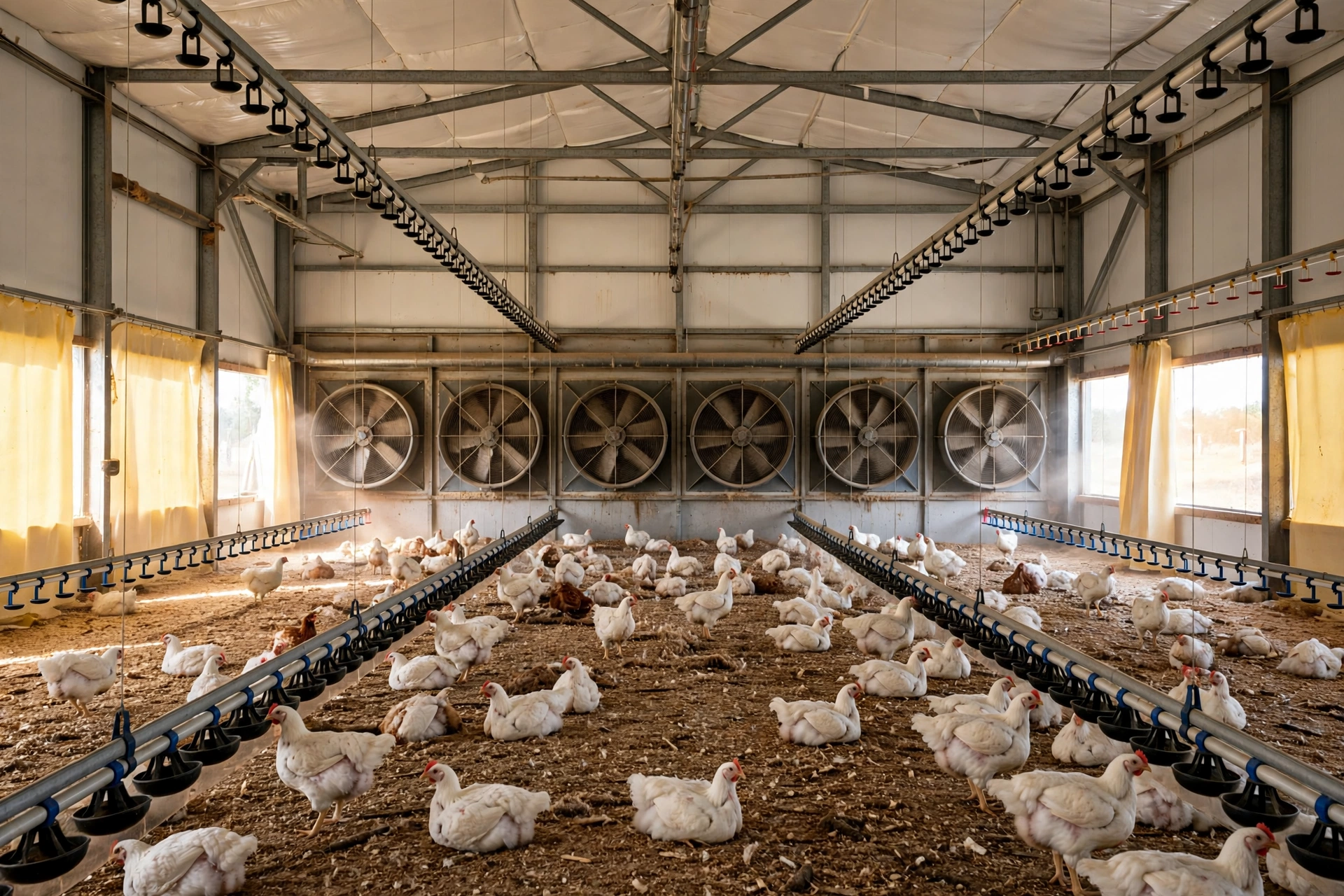
A modern broiler house is a sealed box. Tunnel ventilation pushes air through the shed at about 500 feet per minute, replacing the whole air volume roughly once a minute. When the fans stop, the birds themselves become the heater. A 2002 study published in Poultry International measured what happens next: carbon dioxide in the house rose from 0.21% to 0.90% — already in the danger zone — within 40 minutes of the fans stopping, and reached a lethal 1.40% after 80 minutes, with the temperature above 31°C. The weaker birds started dying in under two hours, starting from the upper tiers.
In summer the window is shorter still. University of Georgia Extension warns that heat and humidity in a poultry house can reach lethal levels in 10 to 20 minutes during a power outage, depending on the age of the birds, and that breaking the 89°F (31.7°C) threshold for extended periods can raise mortality by 10%. A poultry generator is therefore not a convenience. It is the ventilation system, and the ventilation system is the flock.
Grain: the harvest window
Grain has a slower clock than livestock, but it is no more forgiving. A combine harvests 30–50 tonnes of wheat or maize an hour in a good field, and that grain comes off the field at 20–25% moisture. It has to be dried to 14% or below before it goes into storage, or it heats, moulds and loses grade within days. A dryer that stops mid-batch leaves a full dryer of wet grain with nowhere to go, and a combine standing idle in the field at US$400–600 an hour while the weather closes in.
The Loads That Decide the Size
Farm sizing starts with a load list, not a catalogue. Every motor on the essential board gets two numbers: its running kilowatts and its starting multiple. The running total sets the fuel bill. The starting surge sets the generator size, because the set has to absorb the largest motor starting while everything else is already running.
| Farm equipment | Running load | Starting surge |
|---|---|---|
| Milking vacuum pump | 4–7.5 kW | 3–5× running |
| Milk cooling compressor | 3–7.5 kW | 4–6× running |
| Water heater (dairy wash) | 3–6 kW | 1× (resistive) |
| Ventilation fan, poultry house | 1.1–2.2 kW each | 3–4× running |
| Feed auger / conveyor | 2–4 kW | 3–5× running |
| Grain dryer fan | 11–15 kW | 3–5× running |
| Grain auger / elevator | 3–7.5 kW | 3–5× running |
| Lighting and small power | 1.5–3 kW | 1× |
Resistive loads such as water heaters and lighting start at their running value. Motors do not. A 7.5 kW milk cooling compressor can demand 30–45 kVA for the first second of starting. That single second is what separates a set that carries the parlour from one that stalls on the first milking of the outage.
Dairy: milking parlour and milk cooling
A dairy parlour has two peaks a day and nothing in between. The vacuum pump, the milk pump, the cooling compressor and the water heater all run together during milking, and the compressor is the load that decides the set. A medium dairy with 50–100 cows typically needs 30–60 kW of running power during milking, and a 60–100 kVA set is the common size for full-operation cover. Smaller herds fit smaller sets, but the shape of the load is the same at every size: everything starts together, and the compressor starts hardest.
The water heater deserves a line of its own. It is a 3–6 kW resistive load that many farmers leave off the essential board to save size, then regret during the first outage. Without hot water there is no proper wash-down after milking, and the parlour cannot be cleaned to standard. Size the set to carry it, or accept that the parlour runs dirty until the grid returns.
Poultry: fans, feed and water
A poultry house is a fan load with a feed system attached. A standard broiler house of 30,000 birds runs 8–12 tunnel fans of 1.1–1.5 kW each, plus feed augers, nipple drinker pumps and lighting. The fans are the critical load, but they are also the forgiving one: they start in sequence and each one is small. The sizing problem in a poultry house is not one big motor but the total of many small ones, and the discipline of starting them in stages so the set never sees them all at once.
Feed and water stop mattering in minutes, not hours. Birds can go without feed for a few hours. They cannot go without water in a hot house, and the drinker pumps and the cooling pads are on the same board as the fans. A poultry set is sized for the fan total plus the feed and water systems, and the whole house is treated as one essential load.
Grain: dryers, augers and storage
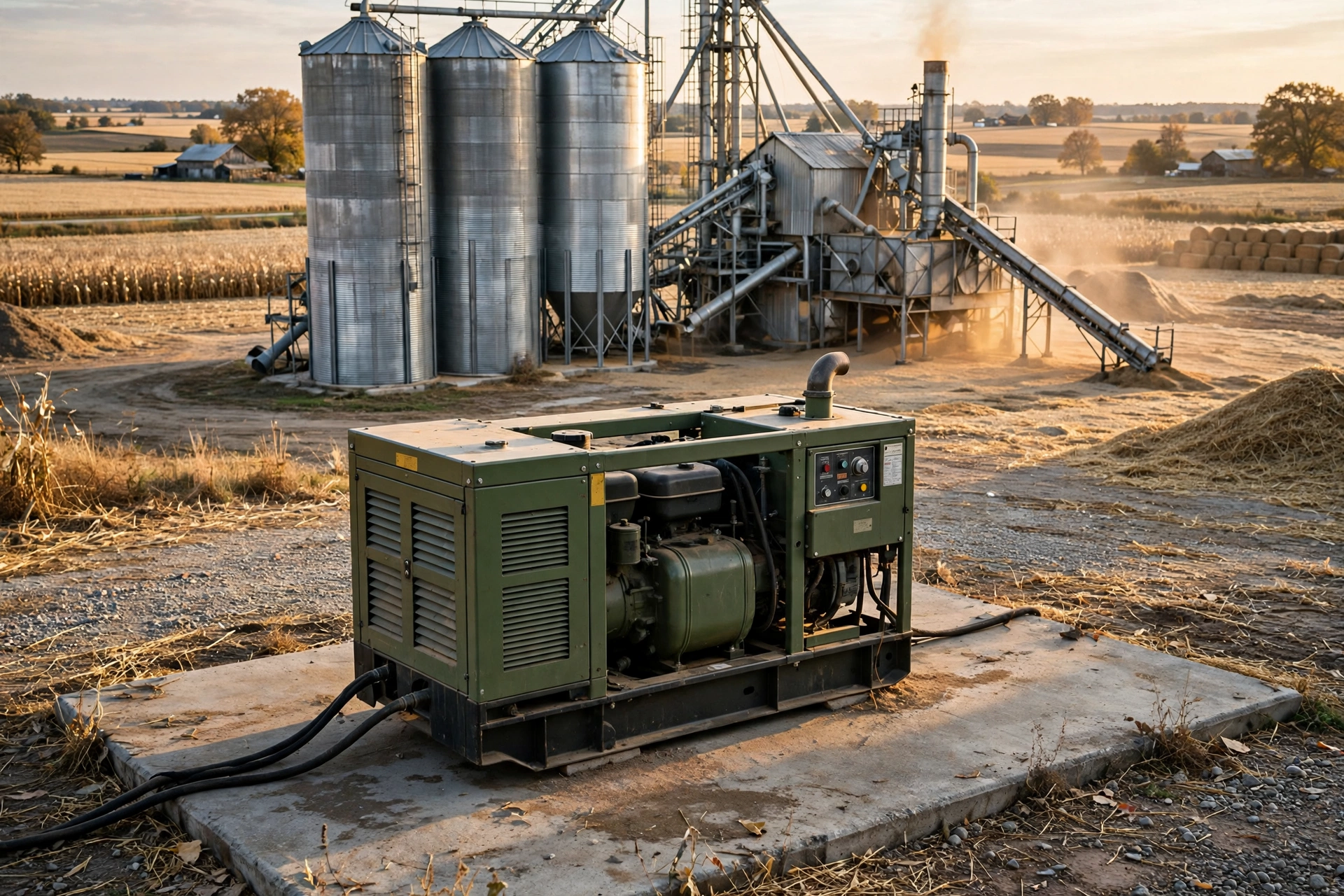
A grain dryer is the heaviest single farm load in this article. A continuous-flow dryer moving 20 tonnes an hour needs a 15 kW fan and a 7.5 kW auger set, plus the burner controls and the cleaner. The fan is a big motor with a long start, and it runs for 10–16 hours a day through harvest. Grain drying is also the one farm load that is genuinely seasonal: the set that sits idle for eleven months has to run at 70–80% load for three weeks in harvest, which is exactly the duty a standby-rated set is built for.
Storage loads are lighter but they run longer. Aeration fans in a grain store run at 2.2–5.5 kW each, around the clock, for weeks after harvest. They keep the grain at 14% moisture and stop it heating. Lose them for a week in a warm store and the centre of the bulk starts to spoil — a loss that shows up months later, when the grain comes out of the store.
Sizing in kVA: Three Worked Examples
The method is the same at every size. Add the running kilowatts of everything on the essential board. Add the starting surplus of the single largest motor — its starting kVA minus its running kVA. Multiply by 1.25 for margin. Divide by 0.8 to convert kilowatts to kVA. Then pick the next standard set size up, and check the running load against the set’s prime rating, not its standby rating. The difference between the two ratings is covered in the article on standby and prime power ratings, and it matters here: a farm set that runs for 48 hours through a storm is working on its prime rating, not its standby rating.
| Farm | Essential running load | Largest motor start | Set size | Prime rating |
|---|---|---|---|---|
| Small dairy, 40 cows | 11.5 kW | 4 kW vacuum pump | 20 kVA | 16 kW |
| Medium dairy, 120 cows | 18.2 kW | 5.5 kW vacuum pump | 30 kVA | 24 kW |
| Larger dairy, 250 cows | 28.2 kW | 7.5 kW cooler | 50 kVA | 40 kW |
| Broiler house, 30,000 birds | 22 kW | 2.2 kW fan (staged) | 40 kVA | 32 kW |
| Grain dryer + store, 500 ha | 58 kW | 15 kW dryer fan | 150 kVA | 124 kW |
The small dairy example is a real shape: a 4 kW vacuum pump, a 3 kW milk cooler, a 3 kW water heater and 1.5 kW of lighting total 11.5 kW, about 72% of a 20 kVA set’s 16 kW prime rating. That fits, with room for the compressor to start. The medium dairy — a 5.5 kW vacuum pump, 4 kW cooler, 3 kW water heater, 2.2 kW wash pump, 1.5 kW lighting and a 2 kW feed auger — totals 18.2 kW, about 76% of a 30 kVA set’s 24 kW prime rating. The larger dairy totals 28.2 kW, about 70% of a 50 kVA set, until a 15 kW grain dryer fan is added, which pushes the total to 43.2 kW and needs a 60 kVA set.
Two rules sit underneath every row of that table. Keep the typical running load under 80% of the prime rating, and keep the 24-hour average under 70%. A set that runs at 95% all harvest will do it for a season and then start costing money in injectors, oil and overhaul. The full method, with the motor-starting maths, is in the generator sizing guide.
Single-Phase or Three-Phase, Open or Canopy
Most farm buildings and smaller parlours run on a single-phase supply. Larger parlours, grain dryers and bigger motors need three-phase, and the generator has to match. A three-phase motor needs a three-phase set — there is no adapter that fixes that after the set arrives. The trap with three-phase sets is the per-phase limit: a 20 kVA three-phase set carries only about 6.7 kVA per phase for single-phase loads. A farm with a 5 kW single-phase water heater and a 4 kW single-phase cooler on the same phase can overload one phase of a 30 kVA set while the other two phases idle. Balance the single-phase loads across the three phases at the board, or buy a single-phase set for a single-phase farm.
Open or canopy is a shorter argument on a farm than it is in a town. A silent canopy costs 15–25% more than the same set open, and it earns that premium in three places: noise near livestock and neighbours, weather protection for a set that lives outdoors, and dust. A dairy herd that hears a 100 dB(A) open set start at 4 a.m. every morning of an outage does not milk well. A canopy set at 65–70 dB(A) at 7 metres is a different animal in the yard. Open sets belong in a proper generator room with generator room ventilation sized for the radiator air, not in a lean-to with a tarpaulin over it.
Dust is the farm-specific reason for a canopy. Harvest dust, straw and feed dust get into an open set’s alternator windings and radiator fins, and a radiator choked with chaff overheats a set that is otherwise healthy. A canopy with a proper air filter keeps the dust out and the cooling air clean. It also keeps the set out of the rain, which matters more than it sounds: a farm set sits outside for years between outages, and a canopy is the difference between a set that starts in year five and one that has rusted through its control wiring.
Fuel Use per Day and Tank Autonomy
A diesel generator burns roughly 0.2–0.25 litres per kVA per hour at full load, and about 65% of its full-load rate at 60% load, because fixed losses — cooling, friction, excitation — do not fall with the load. The table below uses 0.22 L/kVA/h at full load and the standard 75% load figure, which is where farm sets spend most of their running hours.
| Set size | Full load (L/h) | At 75% load (L/h) | Per 24 hours at 75% | 72-hour fuel need |
|---|---|---|---|---|
| 20 kVA | 4.4 | 3.3 | 79 L | 238 L |
| 30 kVA | 6.6 | 5.0 | 120 L | 360 L |
| 50 kVA | 11.0 | 8.3 | 199 L | 597 L |
| 100 kVA | 22.0 | 16.5 | 396 L | 1,188 L |
| 150 kVA | 33.0 | 24.8 | 595 L | 1,784 L |
The 24-hour column is the number that decides the tank. A 50 kVA set carrying a medium dairy burns about 200 litres a day. A 200-litre sub-base tank gives it one day. A 500-litre day tank gives it two and a half. A 1,000-litre bulk tank gives it five. The right answer for a farm that loses power for two or three days at a time is a bulk tank sized for 72 hours at the expected average load, not for the nameplate rating — and the maths for that is in the article on fuel consumption and tank sizing.
Fuel cost is the running cost that surprises nobody and still gets underestimated. At US$1.10 per litre, a 50 kVA set costs about US$220 a day to run at 75% load. A three-day outage costs US$660 in fuel. A 150 kVA set on a grain dryer costs about US$655 a day, or US$1,965 for three days of harvest. That is the price of keeping the harvest moving, and it is small against the value of the grain: 500 hectares of wheat at 6 tonnes per hectare is 3,000 tonnes, worth roughly US$750,000 at US$250 a tonne. The fuel bill is 0.26% of the crop value.
The fuel itself needs the same attention as the set. Diesel in a farm tank ages, grows water and microbes, and a set that has sat for eleven months can fail on bad fuel in the first hour of the outage it was bought for. Test the fuel twice a year, polish it if it fails, and keep the tank full through the off-season so condensation has nowhere to form. A farm that buys a bulk tank should also buy a lock for it: fuel theft from farm tanks is a real cost, and a 1,000-litre tank at US$1.10 a litre is US$1,100 sitting in the yard.
Three Farms, Three Lessons
Specifications are abstract. The three cases below are not. Each one is a real farm, a real outage and a real bill, and each one changed how the next farm in the same district bought its generator.
A broiler shed in Odisha, India
In May 2026, an environment-controlled broiler farm at Mundaguda, near Malkangiri town in Odisha, lost its transformer during a pre-monsoon heatwave. The outdoor temperature was 41°C. The farm had a diesel generator capable of carrying its cooling loads, burning roughly 7 litres of diesel per hour. The generator never ran. A district-wide fuel crisis meant there was no diesel to buy, and the backup line was useless.
Without mechanical airflow, the sealed shed became a heat chamber. The birds’ body heat and breath pushed the shed temperature past the outdoor reading, humidity saturated, panting stopped working, and core temperatures passed the lethal 42.5°C threshold. 5,300 broiler chickens died within three hours — 12.5 tonnes of meat, worth an estimated ₹15 lakh (US$17,000), from one shed. The lesson is not about generator size. The set was big enough. The lesson is about fuel: a generator without fuel on site is a shed ornament, and a farm that depends on just-in-time diesel delivery in a fuel crisis has no backup at all.
A dairy farm in Northern Ireland
After losing its mains supply several times the previous winter, a dairy farm on a long overhead line in Northern Ireland bought a Cummins C55D5EQ from stock — a three-phase silent set rated 55 kVA standby and 50 kVA prime, with a 200-litre tank. The set protects the milking parlour, the milk cooling and the water heating, and it starts automatically when the line drops.
The numbers are the point. The 200-litre tank gives the farm about 24 hours at its normal milking load, and the farm keeps a 1,000-litre bulk tank beside it for a longer outage. The set cost the farm roughly the value of two missed milk collections. The farm has not lost a collection since. Dairy is the farm type where the payback maths is simplest, because the loss from one bad outage is priced in litres of milk and the generator is priced in kVA.
A poultry farm near Vienna, Austria
A modern poultry farm outside Vienna ran tens of thousands of broilers in climate-controlled sheds, with a diesel generator as its backup. When the grid failed, the generator started and reached full load — but the ventilation and temperature-control systems did not restart by themselves. A worker had to walk through the whole poultry house and restart every system by hand, a process that took around two hours. For the flock, those two hours without ventilation were the dangerous part of the outage, not the seconds the generator took to start.
The farm’s answer was a battery system that bridges the gap: three 105 kW / 233 kWh storage cabinets, 699 kWh in total, paired with a 360 kWp solar array and the diesel generator, switching to off-grid mode within 20 milliseconds of a grid failure. The battery carries the critical loads while the generator starts, and the ventilation never stops. The lesson for a farm that cannot afford a battery is simpler and cheaper: specify automatic restart on the ventilation controls, test it, and put the automatic transfer switch and the load restart on the same test schedule as the generator itself. A generator that starts in ten seconds is no help if the fans take two hours to come back.
Frequently Asked Questions
What size generator do I need for a farm?
Most small and medium farms need a 20–60 kVA diesel set for their essential loads — milking, milk cooling, ventilation and feed — with the running load kept under 80% of the set’s prime rating. Large dairies, big poultry houses and grain dryers need 100–200 kVA. Size from a load list of real equipment, not from the farm’s total connected load, and add the starting surge of the largest motor.
Can a diesel generator run a dairy farm?
Yes. A diesel generator is the standard backup for dairy farms, and a 60–100 kVA set covers full operation for a medium dairy of 50–100 cows, including the vacuum pump, milk cooling compressor and water heater. The critical requirement is automatic start: milking happens twice a day whether anyone is watching the grid or not, and milk must reach 4°C within two hours.
What generator do I need for a poultry farm?
A poultry farm needs a set sized for its ventilation fans plus feed and water systems, typically 40–100 kVA for a 30,000-bird house, with an automatic transfer switch and automatic restart on the ventilation controls. The fans are the life-support system: in summer, heat and humidity can reach lethal levels in 10 to 20 minutes without ventilation, so the set must start itself and the fans must come back without a worker walking the shed.
How much fuel does a farm generator use per day?
A 20 kVA set uses about 79 litres a day at 75% load, a 50 kVA set about 199 litres, and a 150 kVA set about 595 litres. At US$1.10 per litre, that is roughly US$87, US$220 and US$655 a day. Size the tank for 72 hours at the expected average load, and keep fuel on site — a generator with an empty tank is no backup at all.
What happens to livestock when the power goes out on a farm?
Dairy cows stop being milked and warm milk is rejected if it is not cooled to 4°C within two hours. Poultry in a sealed house lose ventilation, carbon dioxide climbs to lethal levels within 80 minutes, and birds start dying in under two hours — faster in summer heat. Grain in a dryer stops drying and wet grain spoils in store. The common thread is time: on a farm, the first two hours of an outage do most of the damage.
Farm Generator Specification Checklist
- Rating: prime kVA, not standby kVA, for any set expected to run more than a few hours. Check the standby and prime power ratings before signing.
- Load list: every essential motor with running kW and starting multiple, signed off by the farm electrician. No load list, no order.
- Phase: single-phase set for a single-phase farm, three-phase for three-phase motors, with single-phase loads balanced across phases.
- Automatic start: an automatic transfer switch with automatic load restart, tested monthly under load — not a weekly no-load spin.
- Fuel: 72 hours of diesel on site in a locked bulk tank, tested twice a year. Budget the fuel cost of a three-day outage before buying the set.
- Enclosure: silent canopy for any set near livestock, housing or neighbours; open set only inside a ventilated generator room.
- Alarms: low fuel, failed start and high temperature alarms that reach a phone, not just a panel in the shed. A farm set that fails silently at 3 a.m. is worse than no set, because it looks like protection.
- Service: oil and filters every 250 hours or annually, coolant and belts on the same schedule, battery replaced every 3–4 years whether it looks tired or not.
- Irrigation: if the same set also drives borehole pumps, check the irrigation and borehole pump sizing separately — pump starting is a different sizing problem from parlour and fan loads.
- Cold chain: if the farm also runs a cold room or milk store, the cold storage backup power rules on compressor cycling and load staging apply to that board too.
A farm generator is bought once and relied on for fifteen years. The farms that get it right are the ones that sized from a load list, bought fuel autonomy with the set, and tested the whole system — generator, transfer switch and load restart — under real load before the first outage. The farms that get it wrong discover the gap at 3 a.m., with warm milk, silent fans or a dryer full of wet grain. To size a set for a dairy, poultry or grain operation, contact PAVO with the farm’s load list, and the set will be specified against the loads that actually have to run.