

Can a Diesel Generator Work With Battery Storage? | PAVO
A diesel generator is cheap energy and slow to respond. A battery is fast, quiet and efficient at part load, but stores only a few hours of energy. A hybrid system uses each for what it does best — and on the right site, the fuel bill falls by a third or more.
Can a diesel generator work with a battery energy storage system? Yes — and on prime power sites it usually should. A BESS, inverter and energy management system let the generator run only at its efficient 75–85% load band, then shut down while the battery carries the site, cutting fuel use by 30–60%.
This article explains why a generator alone wastes fuel at part load, how a hybrid genset + BESS system is wired and controlled, what the fuel and hour savings look like in numbers, how to size the battery, and where hybrid systems pay back — and where they do not.
Contents
- Why a Generator Alone Wastes Fuel at Part Load
- How a Hybrid Genset + BESS Actually Works
- What the Numbers Say: Fuel, Hours and Emissions
- Sizing the Battery: kW First, kWh Second
- Three Sites That Went Hybrid
- What Can Go Wrong
- Frequently Asked Questions
- Hybrid Specification Checklist: Seven Lines Before You Sign
Why a Generator Alone Wastes Fuel at Part Load
A prime power site rarely draws a steady load. A processing plant averages 150 kW, peaks at 400 kW for four hours, and drops to 60 kW overnight. A construction camp runs cranes and welders by day and little more than lighting and security at night. A mine runs crushers in shifts. The generator, sized for the peak, spends most of its life at a fraction of its rating — and that is where the money leaks away.
The fuel curve is not a straight line
Diesel engines burn fuel per kilowatt-hour, and that figure — brake specific fuel consumption, or BSFC — gets worse as load falls. The Cummins C500D5 datasheet makes the point plainly: at prime rating the set burns 93.2 L/h at 100% load and 29.2 L/h at 25% load. At full load, each kilowatt-hour costs about 0.23 litres. At quarter load, the same kilowatt-hour costs about 0.29 litres — roughly 25% more fuel per unit of energy delivered, before any other losses are counted.
A published worked example on a 500 kVA (400 kW prime) site puts the same effect in annual terms. At 150 kW average output — a 37.5% load factor — BSFC sits near 280 g/kWh, or 0.333 L/kWh. The site burns 1,198.8 litres a day, or 437,562 litres a year, and the engine logs 8,760 operating hours — every hour of the year. The generator is not working hard. It is working constantly, at poor efficiency, and every one of those hours counts against its overhaul interval.
Low load is where engines die slowly
Fuel waste is only half the cost of light loading. Below roughly 30% load, combustion temperatures fall, fuel does not burn completely, and unburned fuel and carbon accumulate in the cylinders and exhaust. The industry name for it is wet stacking: glazed cylinder bores, carbon-fouled injectors, oil dilution, and exhaust slobber. A set that spends its nights at 15% load is not resting. It is wearing itself out in a way that shows up months later as rising oil consumption and a rebuild bill.
This is the problem a battery solves. A BESS absorbs the light-load hours entirely. The generator starts, runs at 75–85% load — its efficient band — charges the battery with its surplus, and shuts down. The battery carries the night. The engine logs half the hours, burns fuel only at its best efficiency, and never idles at 15% load.
How a Hybrid Genset + BESS Actually Works
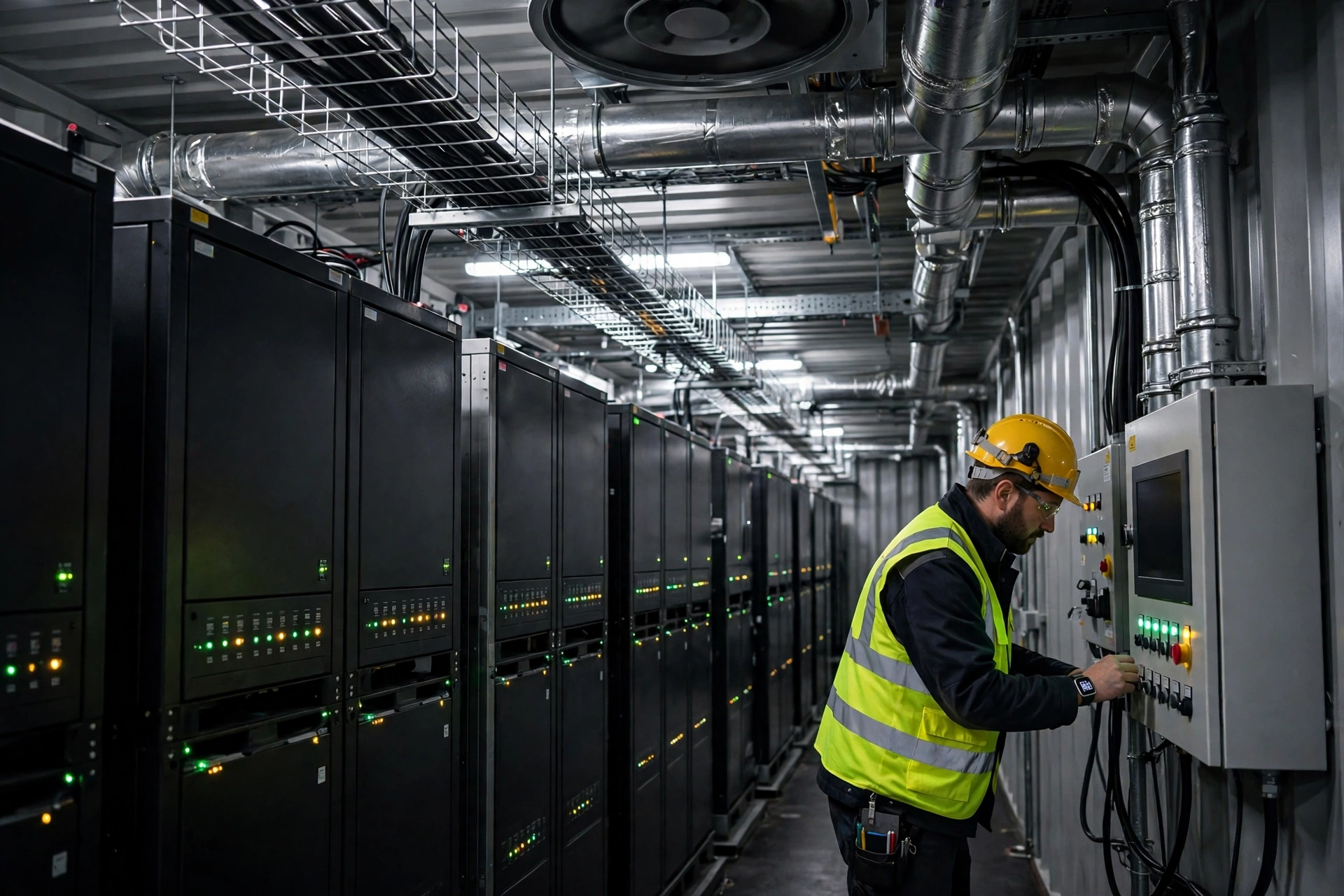
A hybrid system has four parts: the diesel generator, the battery energy storage system, a bidirectional power conversion system (PCS, the inverter/charger), and an energy management system (EMS) or microgrid controller that decides which source carries the load at any moment. Solar PV is often added, but the diesel-plus-battery core works without it.
AC-coupled and DC-coupled layouts
Most retrofit hybrid systems are AC-coupled. The generator and the BESS connect to a common AC busbar — typically 400 V or 480 V, or medium voltage at 11 kV or 33 kV on larger sites. The BESS has its own bidirectional PCS and isolation transformer. The advantage is that an existing generator can be hybridised without touching its alternator or controller; the battery is simply another source on the bus. The disadvantage is conversion losses: generator AC to battery DC and back again costs roughly 5–12% of the energy routed through storage, depending on the PCS.
DC-coupled systems connect the battery and the generator’s DC bus — common on telecom sites with 48 V DC loads — and avoid one conversion stage. They are more efficient but harder to retrofit, because the generator, rectifier and battery must be designed together. For a prime power site buying new equipment, either layout works. For a site adding storage to a generator already on the ground, AC-coupled is the practical choice in almost every case.
The energy management system decides
The EMS is the part that makes or breaks a hybrid system. It watches load, battery state of charge (SOC), generator loading and — where present — solar output, and it enforces a strategy. The common strategies are:
- Charge and stop. The generator runs at 75–85% load, powers the load and charges the battery, then shuts down. The battery carries the site until SOC falls to a set threshold — commonly 20% — and the generator restarts. On a variable-load site this cuts daily running hours from 24 to roughly 10–12.
- Peak shaving. The generator runs at a steady base load and the battery absorbs short peaks above it. This lets a site buy a smaller generator than its peak demand would otherwise require.
- Spinning reserve. The battery holds reserve capacity so the generator does not need to run lightly loaded “just in case” of a load step. The BESS responds to a step in milliseconds; a diesel engine needs seconds.
- Silent hours. The battery carries the site alone during defined windows — night shifts, noise-restricted hours, or residential areas — with zero emissions and zero noise from the generator.
The EMS also enforces the SOC window. Lithium iron phosphate (LFP) — the chemistry used in almost all commercial hybrid systems — is commonly operated between 20% and 80% SOC for cycle life, with the remaining capacity held as reserve. A battery quoted at 500 kWh nameplate therefore delivers roughly 300 kWh of usable cycling energy in daily service. Any sizing calculation that uses the nameplate figure will disappoint.
The EMS should also expose its data for remote monitoring, so fuel, SOC and generator hours are visible from the head office without a site visit. Sites with sensitive electronics should confirm UPS–generator compatibility before commissioning, because a UPS that rejects generator power will keep cycling to battery even when the hybrid system is working correctly.
What the Numbers Say: Fuel, Hours and Emissions
Hybrid vendors quote large savings, and the honest answer is that the savings depend entirely on the load profile. A site with a steady 90% load gains almost nothing from a battery. A site with a wildly varying load gains a great deal. The table below summarises the published figures behind the claims in this article.
| Source | Site | Fuel saving | Engine hours |
|---|---|---|---|
| Atlas Copco QHS (manufacturer) | Integrated hybrid generator | Up to 80% | Reduced proportionally |
| Published sizing worked example | 500 kVA processing plant | ~19% (1,199 to 967 L/day) | 8,760 to ~4,300 h/year |
| UAE desert camp comparison | 250 kVA construction camp | 50% (720 to 360 L/day) | 720 to 210 h/month |
| Belding India hybrid BESS launch | Industrial / critical sites | 40–80% | Reduced |
| Typical industry range | Variable-load prime sites | 30–60% | 40–70% fewer hours |
The spread is the point. The 19% saving in the worked example comes from a site with a relatively flat load — average 150 kW against a 400 kW prime set — where the battery mostly removes the overnight low-load hours. The 50% and 80% figures come from sites with deep overnight troughs, where the generator previously ran all night for a 60 kW load. Before believing any saving claim, ask which load profile it was measured on.
A worked calculation on a 500 kVA site
Take the published worked example and follow the arithmetic. The site needs 3,600 kWh a day — 150 kW average over 24 hours. Generator-only, the 500 kVA set runs all day at 37.5% load factor, BSFC 280 g/kWh, burning 1,198.8 litres a day.
In the hybrid configuration, a 250 kW / 500 kWh liquid-cooled BESS container is added. The EMS runs the engine only between 75% and 85% capacity — about 320 kW — to power the load and charge the battery at up to 0.5C. At 80% load, BSFC improves to 215 g/kWh (0.255 L/kWh). Roughly 1,400 kWh a day is routed through the battery at about 88% round-trip efficiency, so the engine must generate about 3,790 kWh in total. At 320 kW, that takes 11.8 hours instead of 24. Daily fuel falls to 966.5 litres — a saving of 232 litres a day, or about 84,800 litres a year.
At a delivered diesel price of $1.00 per litre — a reasonable figure for many African and Middle Eastern sites once transport is included — that is roughly $85,000 a year in fuel alone. The engine also logs about 4,300 hours a year instead of 8,760, which roughly doubles the interval between major overhauls. Service visits, oil, filters and downtime fall with the hours. Published payback figures for remote and off-grid hybrid installations cluster at 18 to 36 months, and the fuel saving is only part of it: the maintenance saving and the longer engine life carry the rest.
The same arithmetic in reverse shows where hybrid does not pay. A data centre standby set that runs 40 hours a year gains nothing from a battery. A quarry crusher running at a steady 85% load for ten hours a day gains almost nothing either. Hybrid pays on variable load, long hours and expensive fuel — the three conditions that define a prime power site.
Sizing the Battery: kW First, kWh Second
The most common hybrid sizing error is buying a battery by its kWh label. Power and energy answer different questions, and they must be sized together.
Power sizing — the largest step decides
The power rating, in kW, is how much load the battery can support at any instant. It must cover the largest transient event the system is expected to handle: the biggest single load step, the spinning reserve the site requires, and the power needed to charge from the generator without dragging the generator below its minimum safe output. A battery with enough energy but too little power will help with steady loads and fail on transients — the exact moment a crusher starts or a pump kicks in.
The PCS rating matters as much as the battery rating. A 500 kWh pack behind a 100 kW inverter can only deliver 100 kW, however large the pack. For motor and compressor sites, the PCS must also handle power factor and short overloads: a 500 kW load at 0.8 power factor is 625 kVA, and the inverter must be rated for the kVA, not just the kW. A common planning rule is to size battery power for the worst credible transient plus a margin, not for the average load.
Energy sizing — how many quiet hours
The energy rating, in kWh, is how long the battery can sustain its output. The rough estimate is usable energy divided by average load — but “usable” is doing heavy work in that sentence. A 500 kWh nameplate pack operated between 20% and 80% SOC, with round-trip losses and a reserve held back for contingencies, may deliver 250–300 kWh of genuinely available energy in daily cycling. That is the number to divide by the load.
For a diesel optimisation project, the energy requirement is shaped by three questions: how long the generator may stay stopped during light-load periods, how much energy must be reserved for spinning reserve, and how much capacity is needed to absorb generator charging during efficient running. On the 500 kVA worked example, the answer was 500 kWh of nameplate storage for a 150 kW average load — roughly three hours of average load at nameplate, or about two hours of usable energy. Sites that want the generator off for a full eight-hour night need proportionally more storage, and the battery — not the generator — becomes the dominant capital cost.
Battery life is part of the sizing decision. LFP cells in hybrid service are typically rated for 6,000 or more cycles at 80% depth of discharge, which at one full cycle a day is more than 15 years of calendar life — though calendar ageing, temperature and partial-state-of-charge cycling all reduce the real figure. A battery cycled twice a day reaches its cycle limit in half the time. The EMS strategy and the cycle count belong in the same conversation as the kWh figure.
Three Sites That Went Hybrid
Case 1: A gold mine in Western Australia — 1 MW prime, 40% fuel cut
An open-pit gold mine in Western Australia ran two 1,000 kVA prime sets around the clock for its processing plant and camp — average load 620 kW, peaks to 950 kW when the ball mill started, overnight troughs to 280 kW. Fuel arrived by road train, 600 km from the nearest depot, at a delivered cost near AUD 1.90 per litre. Annual consumption was about 1.9 million litres.
The hybrid retrofit added a 1 MW / 2 MWh LFP container and a microgrid controller, keeping both generators. The EMS runs one set at 80–85% load to carry the plant and charge the battery, shuts it down overnight, and brings the second set in only for mill starts. Generator hours fell from roughly 17,000 combined hours a year to under 9,000. Fuel consumption fell by about 40%, saving roughly 760,000 litres a year — over AUD 1.4 million at delivered prices. The battery paid for itself in under two years on fuel alone, and the mine’s maintenance contractor reported oil and filter consumption roughly halved. The second generator, previously a running spare, now sits as genuine standby — which is what standby and prime power ratings actually require. The mine’s expansion plan now relies on paralleling a second generator rather than buying a larger single set, since the battery already handles the peaks.
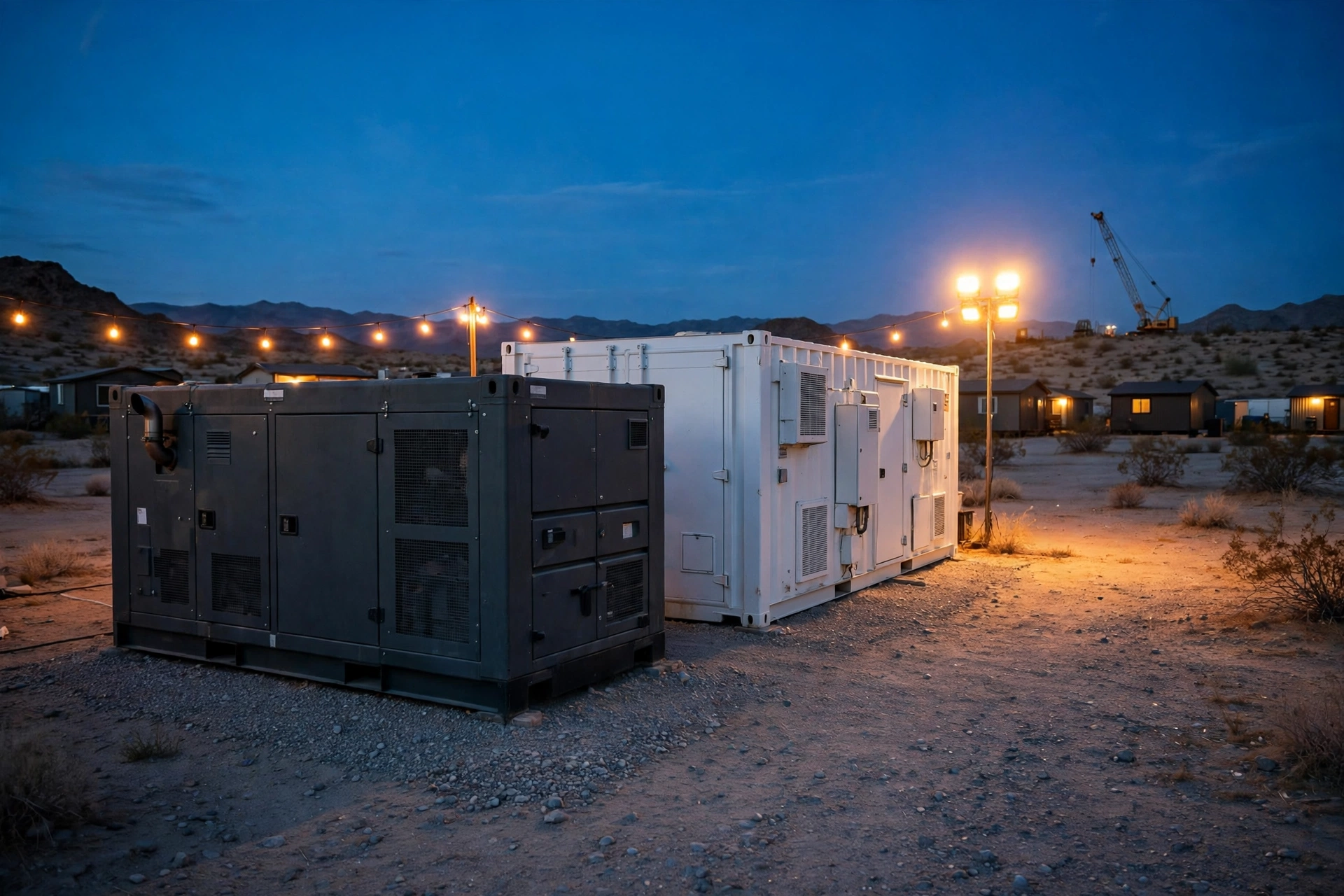
Case 2: A construction camp in the UAE desert — 250 kVA, half the diesel
A desert construction camp in the UAE ran a single 250 kVA set continuously for a 90 kW average camp load — accommodation, kitchens, site offices and a water pump. The load profile was the classic hybrid case: 160 kW during the working day, 45 kW overnight. The generator ran 24 hours a day at an average load factor under 40%, and the camp burned 720 litres a day. A 5,000-litre bulk tank needed refilling every 6.9 days, and every delivery was a tanker run through desert roads.
The hybrid configuration added a battery container and a solar array, with the generator retained as the long-duration source. Daily diesel fell to 360 litres, engine hours from 720 a month to 210, and the same 5,000-litre tank now lasts 13.8 days between deliveries. The camp’s fuel logistics — previously a delivery every week — became a delivery every fortnight, and the night-time camp went silent: no generator noise after 22:00, which mattered more to the workforce than the fuel saving. The camp’s fuel consumption figures now match what the original sizing exercise predicted, because the generator finally runs at the load it was designed for.
Case 3: An island resort in the Philippines — 500 kVA, solar plus storage
A 120-room island resort in the Philippines ran a 500 kVA prime set for 18 hours a day — the grid connection was a single submarine cable that failed two or three times a year, and the generator was the resort’s real power supply. Average load 210 kW, evening peak 380 kW when restaurants and air conditioning ran together, overnight trough 90 kW. Diesel arrived by barge at about $1.35 per litre, and the resort burned roughly 1,100 litres a day.
The hybrid design added 300 kWp of solar and a 400 kWh BESS alongside the existing generator. Solar carries the daytime load and charges the battery; the battery carries the evening peak and the night; the generator runs for four to six hours a day at 80% load, mostly in the early morning before the sun is up. Fuel consumption fell by about 55%, to roughly 500 litres a day, and the barge deliveries dropped from weekly to fortnightly. The resort’s general manager reports the change guests actually notice: no generator hum at the beach bar after dark. The generator remains on site, maintained and tested — because a battery cannot carry a resort through a three-day typhoon outage, and anyone who says it can is selling batteries, not uptime.
What Can Go Wrong
Hybrid systems fail in predictable ways, and almost all of them are sizing or integration failures rather than battery failures.
An undersized inverter
The most expensive mistake is a PCS too small for the site’s transients. The battery has the energy, the inverter cannot deliver it fast enough, the generator is forced to take a step load it was supposed to be protected from, and the voltage dips. The site blames the battery. The fix is to size the PCS for the largest step plus margin, and to test it: a witnessed step-load test, with the generator stopped, is the only proof that the inverter can carry the load it claims to carry.
Battery replacement cost
A BESS is not a fit-and-forget asset. LFP cells degrade with cycles, temperature and calendar age, and a pack that delivers 500 kWh in year one may deliver 400 kWh in year ten. The replacement cost — often 40–60% of the original battery price — must be in the business case from the start, with a clear statement of who warrants capacity and for how many cycles. A quotation that prices the battery but not its replacement is incomplete in the same way a generator quotation without a service schedule is incomplete.
Two vendors, one blame game
A hybrid system has at least two major vendors — the generator supplier and the battery supplier — and often a third, the EMS or integrator. When the system misbehaves, each vendor’s first instinct is to blame the other’s equipment. The protection against this is a single point of responsibility in the contract: one party owns the integrated system performance, including the fuel-saving figure if one was quoted. Sites that buy the generator from one supplier, the battery from another, and the integration from nobody, learn this lesson at the first fault.
There is also a standards question to settle before ordering. Hybrid prime power sites should confirm the generator’s rating basis — standby and prime power under ISO 8528-1 — and the battery’s certification for the site’s environment, particularly fire protection. LFP is the safest common lithium chemistry, but a container full of cells still needs fire detection, suppression and a thermal management design rated for the site’s maximum ambient temperature. A 50°C desert site derates batteries as surely as it derates generators.
Frequently Asked Questions
Can a diesel generator work with a battery energy storage system?
Yes. A battery energy storage system connects to a diesel generator through a bidirectional inverter and an energy management system, forming a hybrid power system. The battery carries light and variable loads and absorbs load steps, while the generator runs at its efficient 75–85% load band and shuts down when it is not needed. The combination is standard practice on prime power sites, remote mines, construction camps and island resorts.
How much fuel does a hybrid diesel generator battery system save?
Published figures range from about 19% on a relatively flat load profile to 50–80% on sites with deep overnight troughs, with a typical range of 30–60% for variable-load prime sites. The saving comes from two effects: the engine runs only at its efficient load band, and it runs fewer hours. A site with a steady 90% load will save almost nothing, so the load profile — not the brochure — decides the figure.
How to size a battery for a diesel generator?
Size power (kW) first, from the largest load step and the spinning reserve the site needs, then size energy (kWh) from how many hours the generator should stay off. Use usable energy — nameplate capacity reduced by the SOC window, round-trip losses and reserve — not the nameplate figure. For a 500 kVA set on a 150 kW average load, a published worked example uses a 250 kW / 500 kWh BESS; your site’s load profile will give a different answer.
Does a battery storage system replace a diesel generator?
No, not on a prime power site. A battery stores energy; it does not make it. A BESS can carry a site for hours, but a multi-day outage, a cloudy week or a long construction programme needs a generator’s fuel-fed endurance. The battery replaces generator running hours and low-load operation, not the generator itself. Sites that remove the generator entirely are betting their uptime on storage capacity and weather.
How long can a battery power a site before the generator starts?
It depends on usable energy divided by load. A 500 kWh nameplate battery operated between 20% and 80% SOC delivers roughly 250–300 kWh of usable energy, which carries a 100 kW load for about three hours and a 50 kW overnight load for five to six hours. The energy management system starts the generator when SOC reaches its lower threshold — commonly 20% — so the battery is never fully drained. Longer silent periods need a larger battery, not a different generator.
Hybrid Specification Checklist: Seven Lines Before You Sign
- What is the load profile? A week of logged load data — average, peak, overnight trough, largest single step — is the foundation of every hybrid decision. A quotation written without it is a guess.
- What is the generator’s rating basis? Confirm ESP, PRP or COP under ISO 8528-1, and confirm the rating still applies when the generator runs in hybrid cycling duty — frequent starts and stops — rather than continuous running.
- What are the battery’s usable kWh, not nameplate kWh? State the SOC window, the round-trip efficiency, the reserve held back, and the end-of-warranty capacity. A 500 kWh nameplate figure is not a 500 kWh promise.
- What is the PCS rating in kVA at the site’s power factor? Confirm it covers the largest load step plus margin, and require a witnessed step-load test with the generator stopped.
- Who owns integrated performance? One party in the contract must own the combined system — generator, battery, inverter and EMS — including any quoted fuel saving. Two vendors and no integrator is a dispute waiting for its first fault.
- What does the battery cost to replace? Get the replacement cost, the warranted cycle count and the capacity warranty in writing before the order, not at year eight.
- What is the fire and thermal design? Confirm fire detection and suppression, thermal management rated for the site’s maximum ambient temperature, and compliance with local storage and transport rules for lithium batteries.
A hybrid genset + BESS system is not a smaller generator or a bigger battery. It is a different way of running a prime power site: the engine does the heavy, efficient work in short runs, and the battery does the light, variable work in silence. On a site with variable load, long hours and expensive fuel, the combination pays for itself in two to three years and then keeps paying — in fuel not burned, hours not logged, and overhauls not needed. On a site with steady load and cheap fuel, it is an expensive complication. The load profile decides, as it always does.
For a hybrid design matched to your site’s load profile — generator, battery and controls sized together, with the fuel saving calculated from your logged data rather than a brochure — contact PAVO. PAVO builds diesel generator sets from 9 to 3750 kVA in open, silent and containerised configurations, powered by Cummins, Weichai, Yuchai and Shanghai Diesel, and sizes hybrid prime power systems for remote sites, construction camps and industrial plants in more than 20 countries.