

What Is a High Voltage Diesel Generator? Guide | PAVO
At 400 volts, a 2,000 kVA generator pushes nearly 2,900 amps through its cables. At 11 kV, the same power moves at 105 amps — and that single fact decides the whole design.
What is a high voltage diesel generator? It is a diesel set whose alternator produces medium voltage — usually 3.3 kV, 6.6 kV, 10.5 kV or 11 kV — directly, without a step-up transformer. It exists for large sites where 400 V cable runs become too heavy, too lossy and too expensive to be practical.
Contents:
- What “High Voltage” Actually Means for a Generator
- The Current Problem: Why 400 V Breaks Down at Scale
- When a High Voltage Generator Is the Right Choice
- Direct 11 kV vs 400 V Plus a Step-Up Transformer
- Switchgear, Protection and Earthing at Medium Voltage
- Three Sites That Moved to High Voltage
- Frequently Asked Questions
- Specification Checklist: Before You Order a High Voltage Set
What “High Voltage” Actually Means for a Generator
The phrase “high voltage generator” causes confusion because it means different things to different people. To a transmission engineer, high voltage starts at 110 kV. To a generator manufacturer, it starts at 1,000 V. Both are right within their own standards. IEC 60038 defines low voltage as up to 1,000 V AC and medium voltage as 1 kV to 35 kV. A diesel generator that produces 3.3 kV, 6.6 kV, 10.5 kV or 11 kV directly from its alternator sits inside that medium-voltage band, and the generator industry calls it a high-voltage set to distinguish it from the 400 V and 480 V machines that make up the bulk of the market.
The distinction matters because it changes what is inside the machine. A high-voltage alternator is not a 400 V alternator with a different nameplate. The windings use form-wound coils with mica-based insulation, vacuum-pressure impregnated so the insulation is void-free. The stator frame is larger for the same kVA rating — a 2,000 kVA high-voltage alternator is typically 300–400 mm longer and 15–20% heavier than its 400 V twin, because the insulation takes space that copper used to occupy. The set carries winding temperature sensors, anti-condensation heaters and surge protection as standard equipment, not as options. The duty rating is a separate decision from the voltage, and it should be settled before the set is specified: the difference between standby and prime power decides how many hours a year the set is designed to run, and a prime-rated high-voltage set at a mine runs a very different life from a standby-rated one at a hospital.
The voltage ladder: 400 V to 33 kV
The voltage a project specifies is rarely a free choice. It follows the local distribution standard, and the local standard follows the region. A set ordered for a mine in Ghana must match the 11 kV distribution the site already runs. A set for a plant in Queensland must match 6.6 kV. Ordering the wrong voltage means ordering a transformer as well, which defeats the purpose of buying a high-voltage set in the first place.
| Output voltage | Where it is the standard | Typical set size |
|---|---|---|
| 400 V / 480 V | Low-voltage generation, most buildings and small sites | 9–3,750 kVA |
| 690 V | Industrial low voltage, some European and mining sites | 500–3,750 kVA |
| 3.3 kV | Older industrial plants, some mining and marine | 800–3,000 kVA |
| 6.6 kV | Australia, Middle East, Southeast Asia, parts of Europe | 1,000–3,750 kVA |
| 10.5 kV | China and Chinese-funded projects | 1,000–3,750 kVA |
| 11 kV | Africa, South Asia, UK-derived systems | 1,000–3,750 kVA |
| 13.8 kV | North America | 1,250–3,750 kVA |
| 33 kV | Utility-scale generation, not a standard generator output | Via step-up transformer |
The top of the range is worth noting. A diesel generator alternator is not normally wound for 33 kV — the insulation and the frame become impractical at that size. Sites that need 33 kV generate at 11 kV and step up. That is the one place where a transformer remains unavoidable, and it is the exception that proves the rule: direct generation covers everything up to 13.8 kV, and the transformer handles the rest.
What changes inside the alternator
The alternator differences are the reason a high-voltage set costs more per kVA than a 400 V set of the same rating, and the reason the premium is justified. The insulation system is the first difference. Low-voltage alternators use random-wound coils with enamelled wire. High-voltage alternators use form-wound coils, each coil shaped, taped with mica, and vacuum-pressure impregnated with resin. The process removes air voids from the insulation, and air voids are what cause partial discharge — the slow erosion of insulation by tiny internal sparks that shortens an alternator’s life.
The second difference is testing. A high-voltage alternator is partial-discharge tested at the factory, and the test result is part of the acceptance documentation. A 400 V alternator is not tested this way, because at 400 V the voltage stress is too low for partial discharge to matter. The third difference is protection: surge arresters on the alternator terminals, because a medium-voltage system sees switching surges that a 400 V system never experiences, and winding temperature sensors (PT100 RTDs) embedded in the stator, because a hot spot inside a high-voltage winding is a failure that starts silently and ends expensively.
None of this makes the machine fragile. It makes the machine honest about its operating conditions. A high-voltage alternator that is tested, monitored and maintained to its own standard lasts as long as a low-voltage one. A high-voltage alternator treated like a 400 V machine — no partial discharge test, no surge protection, no winding temperature monitoring — fails early, and the failure is usually a winding fault that takes the set out of service for weeks.
The Current Problem: Why 400 V Breaks Down at Scale
The case for high voltage is a single equation: current equals apparent power divided by the square root of three times the voltage. At a fixed power, raising the voltage cuts the current in direct proportion, and the current is what decides the cable size, the losses and the cost. A 2,000 kVA set at 400 V delivers 2,887 A per phase. The same set at 6.6 kV delivers 175 A. At 11 kV it delivers 105 A. The power is identical. The copper needed to carry it is not.
| Set rating | Current at 400 V | Current at 690 V | Current at 6.6 kV | Current at 11 kV |
|---|---|---|---|---|
| 500 kVA | 722 A | 418 A | 44 A | 26 A |
| 1,000 kVA | 1,443 A | 837 A | 87 A | 52 A |
| 2,000 kVA | 2,887 A | 1,673 A | 175 A | 105 A |
| 3,750 kVA | 5,413 A | 3,138 A | 328 A | 197 A |
At 500 kVA the problem is manageable: 722 A fits in two or three parallel cable runs, and most engineers stay at 400 V without a second thought. At 2,000 kVA the problem is structural: 2,887 A needs six to eight parallel runs of 240 mm² copper per phase, eighteen cores in total, each one terminated, glanded and torqued correctly. At 3,750 kVA — the top of PAVO’s range — the current reaches 5,413 A per phase, and the cable termination alone becomes a design exercise. The alternator terminal box on a 400 V set of that size is a forest of copper bars. The same set at 11 kV terminates in three single-core cables and a set of stress cones.
Cable cost and weight at 400 V
Take a concrete case: a 2,000 kVA set feeding a load 200 metres away. At 400 V, the installation needs six parallel runs of 240 mm² copper per phase — eighteen cores. Copper at 240 mm² weighs about 2.1 kg per metre per core, so the run carries roughly 38 kg of copper per metre, or 7.6 tonnes over 200 metres, before the cable tray, the supports and the labour to pull and terminate eighteen cores. At 11 kV, the same power moves through three single-core 95 mm² XLPE cables weighing about 2.5 kg per metre in total, or 500 kg over the same distance. The copper mass falls by more than 90%.
The cost follows the copper. Cable is priced by the metre and by the core, and eighteen cores cost more than three in material, in tray, in terminations and in the hours to install them. On a 200-metre run the cable saving alone often exceeds the price premium of the high-voltage alternator. On a 1-kilometre run there is no comparison to make: the 400 V option needs a step-up transformer at the generator and a step-down transformer at the load, and the project is paying for two transformers plus the cable. The direct 11 kV set removes both.
Losses and voltage drop over distance
Cable losses scale with the square of the current, which is why the voltage change is so powerful. Halving the current quarters the loss. Raising the voltage from 400 V to 11 kV cuts the current by a factor of 27.5, and cuts the I²R loss in the same conductor by a factor of more than 750. The worked example makes the point in numbers. On the 200-metre run above, the 400 V installation loses about 10.5 kW in its eighteen copper cores at full load. The 11 kV installation, with a single 95 mm² cable per phase, loses about 1.3 kW. The low-voltage run wastes eight times the energy while carrying eighteen times the copper.
Voltage drop is the second penalty, and it is the one that shows up first on site. A 400 V system typically allows 5% voltage drop from generator to load — 20 V. The resistive component of the 200-metre low-voltage run consumes about 3% of that budget on its own, and reactance takes most of the rest, leaving almost no margin for motor starting dips. The same 200 metres at 11 kV loses well under 0.5%. The difference shows up in the load: motors start cleanly, contactors hold in, and the voltage at the far end of the site stays inside the tolerance the equipment was designed for. A motor that sees 360 V instead of 400 V draws more current, runs hotter and fails earlier. A motor that sees 10.9 kV instead of 11 kV notices nothing.
When a High Voltage Generator Is the Right Choice
High voltage is not a better generator. It is a better answer to a specific problem — moving large power over distance — and it is the wrong answer where that problem does not exist. The decision turns on two numbers: the size of the set and the distance to the load. A small set close to its load should stay at 400 V. A large set far from its load should not. The boundary between the two is well established in practice: a single set above about 1,000 kVA, or a cable run beyond 150–200 metres, is where direct high voltage starts to pay. Above 3–5 MW of total site load, it is usually the only rational choice.
The generator sizing guide is where the load calculation starts, and the voltage decision follows from it. Size the load first, work out the kVA, measure the distances, and the voltage almost chooses itself. A project that specifies the voltage before sizing the load is a project that will buy a transformer it did not need, or a cable run it cannot afford.
The 1,000 kVA / 200-metre rule of thumb
The rule of thumb has a physical basis. Below 1,000 kVA, the current at 400 V stays under 1,500 A, which fits in three or four parallel cable runs that any contractor can install and terminate without specialist tooling. Above 1,000 kVA, the parallel runs multiply, the terminations multiply, and the labour cost of the cable installation starts to exceed the premium of the high-voltage alternator. The same logic applies to distance. Below 150 metres, a 400 V cable run is short enough that its cost and losses stay small. Beyond 200 metres, the copper mass and the voltage drop grow faster than the load, and every additional metre costs more than the last one.
The rule is a guide, not a law. A 750 kVA set feeding a load 600 metres away is a high-voltage job despite being below the kVA threshold, because the distance dominates. A 2,000 kVA set feeding a switchboard 30 metres away is a 400 V job despite being above it, because the cable run is trivial. Both numbers have to be read together. The engineer who applies only one of them gets the wrong answer in exactly the cases where the decision matters most.
Sites that already run at medium voltage
The second driver is the site itself. Mines, cement plants, steel mills, refineries, ports, airports and large data centre campuses already distribute power at medium voltage. Their switchboards, their motors and their transformers all speak 6.6 kV or 11 kV. A 400 V generator on such a site is a foreign object: it needs a step-up transformer, a transformer bay, oil containment and a maintenance schedule, all to connect a machine that could have produced the right voltage directly.
The data centre case illustrates the point. A 2,500 kVA standby set at 400 V feeding an 11 kV site distribution needs a 2.5 MVA step-up transformer, and a campus with four sets needs four transformers — or one large one and a single point of failure. The same four sets wound for 11 kV connect directly to the ring main, and the data centre generator count decision stays a question of redundancy, not of transformer logistics. The same logic applies to a mine, where the pit moves and the distribution follows it: a direct 11 kV set feeds a portable substation at the pit rim, and the substation steps down to 400 V for the crushers and conveyors. The transformer sits where the load is, not where the generator is.
| Site type | Typical set size | Typical voltage | Why high voltage |
|---|---|---|---|
| Open-pit mine | 1,000–3,750 kVA prime | 6.6 / 11 kV | Kilometre-scale distribution, moving pit |
| Cement / steel plant | 2,000–3,750 kVA prime | 6.6 / 11 kV | Large motors, existing MV switchboard |
| Data centre campus | 2,000–3,750 kVA standby | 11 kV | Ring main, multiple sets, MV distribution |
| Port / airport | 1,250–2,500 kVA standby | 6.6 / 11 kV | Long cable runs across the site |
| Refinery / chemical | 1,500–3,000 kVA standby | 6.6 / 11 kV | Hazardous area, existing MV network |
| Remote construction | 1,000–2,000 kVA prime | 6.6 / 11 kV | Long temporary distribution, no grid |
Direct 11 kV vs 400 V Plus a Step-Up Transformer
The honest comparison is not between a high-voltage set and a low-voltage set. It is between a high-voltage set and a low-voltage set plus a transformer, because on a large site the low-voltage set cannot connect to the load without one. The transformer is not free, and it is not lossless. A 2 MVA oil-filled step-up transformer costs roughly $25,000–40,000, needs a bunded plinth for its oil, needs its own maintenance schedule, and runs at 98.5–99% efficiency. That 1–1.5% loss sounds small until it is multiplied by the hours the set runs.
| Factor | Direct 11 kV generation | 400 V + step-up transformer |
|---|---|---|
| Alternator cost | Premium of ~15–25% over 400 V | Standard 400 V alternator |
| Transformer | None | $25,000–40,000 for 2 MVA, plus bunding |
| Efficiency | Alternator only, ~96–97% | Alternator plus transformer, ~95–96% |
| Footprint | Generator only | Generator plus transformer bay |
| Failure points | One machine | Machine plus transformer plus two sets of terminations |
| Maintenance | Alternator and engine | Alternator, engine, transformer oil, tap changer |
| Lead time | One machine, one factory test | Two machines, two tests, interface coordination |
| Spare parts | Alternator parts | Alternator parts plus transformer oil and bushings |
The efficiency arithmetic is the part most often skipped. A 2,000 kVA prime set running 8,000 hours a year at an average of 75% load delivers about 12,000 MWh a year. A transformer losing 1.2% of that wastes about 144 MWh a year. At $0.15 per kWh of generated power — a fair figure for diesel generation at a remote site — that is about $21,600 a year burned in the transformer. Over a ten-year prime-power life, the transformer costs more in losses than it cost to buy. The direct high-voltage set recovers that energy, and it recovers it every year the set runs.
Where the transformer still wins
The transformer is not always the wrong answer. A site with an existing 400 V switchboard and short cable runs gains nothing from high voltage: the set connects directly, the loads are all low voltage, and the premium for a high-voltage alternator buys nothing. A rental or temporary installation gains nothing either, because a high-voltage set needs medium-voltage switchgear, authorised personnel and a protection study, and a rental fleet that moves from site to site cannot carry all of that. A project with mixed loads — some at 11 kV, some at 400 V — may still need a transformer for the low-voltage portion, and in that case generating at 400 V and stepping up only the medium-voltage feed can be the simpler design.
Resale is the last consideration. A 400 V set has a larger second-hand market than an 11 kV set, because every buyer can use 400 V and only some buyers can use 11 kV. A set bought for a specific project and sold after five years recovers more of its value at 400 V. The calculation is straightforward: if the set will stay on its first site for its whole life, buy high voltage. If it will move, or be sold, the transformer may be the cheaper way to reach medium voltage.
The efficiency and footprint arithmetic
The footprint argument is often the deciding one on a crowded site. A 2 MVA transformer needs a bay roughly 3 m × 2.5 m, plus clearance for oil containment, plus access for a crane to lift the lid. On a data centre campus or a mine power station where space is already allocated, that bay is space the generator compound does not have. The direct high-voltage set needs no extra bay, no oil containment and no crane access for a transformer lid. The alternator is longer and heavier than its 400 V twin — 15–20% heavier, typically 500–800 kg more on a 2,000 kVA frame — but that weight sits inside the generator’s own footprint, not in a separate bay.
The failure-point argument runs the same way. Every transformer adds two sets of terminations, a tap changer, bushings, oil and a cooling system. Every one of those is a component that can fail, and a transformer failure takes the generator offline just as completely as an engine failure. A direct high-voltage set has one machine, one set of terminations and one protection scheme. On a prime-power site where the generator is the only source of electricity, removing a failure point is worth more than the money it saves.
Switchgear, Protection and Earthing at Medium Voltage
The generator is the easy half of a high-voltage installation. The switchgear is the hard half, and it is where most high-voltage projects go wrong. A medium-voltage switchboard is not a low-voltage panel with bigger breakers. It is a different class of equipment, built to a different standard — IEC 62271 — with different clearances, different interlocks and different consequences when something goes wrong. A 400 V switchboard fault is a loud bang and a tripped breaker. An 11 kV switchboard fault is an arc flash that can destroy the board and kill anyone standing in front of it.
The switchboard for a high-voltage generator installation typically has four sections: the generator incoming cubicle with a vacuum circuit breaker, the busbar section, the outgoing feeder cubicles, and the metering and protection cubicle. The vacuum breaker is the workhorse — it interrupts the current in a vacuum bottle, needs no oil or gas, and can be racked in and out of its cubicle on a trolley. The protection lives in a multifunction relay that watches the current and voltage transformers and trips the breaker on overcurrent (50/51), generator differential (87G), earth fault (51N), reverse power (32), loss of excitation (40) and negative sequence (46). The differential protection deserves emphasis: it compares the current entering the alternator winding with the current leaving it, and trips in milliseconds on a winding fault, before the fault can burn through the stator. A 400 V set relies on its breaker and its fuses. A high-voltage set relies on its relay, and the relay settings are part of the commissioning, not an afterthought.
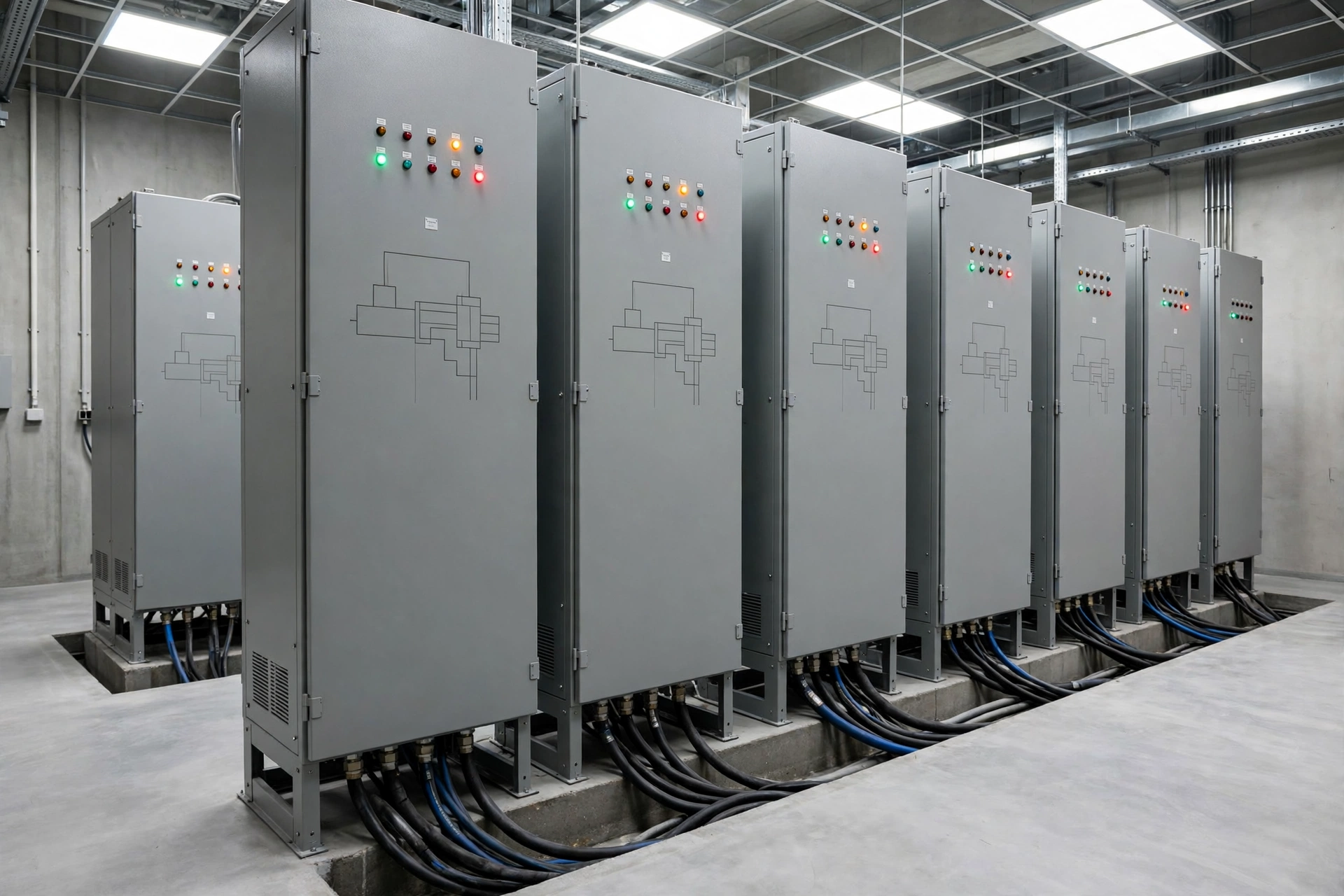
The switchboard is not an LV panel with bigger breakers
The physical differences are the ones that catch installers out. Medium-voltage switchgear needs clearances that low-voltage work never thinks about: a front operating aisle of about 2.4 metres, rear access of 1.2 metres, and a ceiling height that allows the breaker trolley to be withdrawn. The cubicles are metal-clad, which means each compartment — breaker, busbar, cable — is separated from the others by earthed steel, so a fault in one compartment cannot propagate to the next. The interlocks are mechanical, not procedural: the breaker cannot be racked in while it is closed, the earthing switch cannot be closed while the breaker is in service, and the cubicle door cannot be opened while the busbar is live.
The automatic transfer switch that moves a building onto generator power is a different device at medium voltage. A 400 V ATS is a contactor pair in a wall-mounted cabinet. An 11 kV transfer is a switchgear function: two vacuum breakers, a synchronising check relay, and a control scheme that proves the generator is stable before it closes onto the bus. It costs an order of magnitude more than the low-voltage version, and it needs a protection study to set correctly. A project that budgets for a low-voltage ATS on a high-voltage installation has missed the largest single line item in the switchgear budget after the board itself.
Earthing: the neutral earthing resistor
Earthing is the other place where medium voltage breaks low-voltage habits. A 400 V generator is usually solidly earthed: the alternator neutral connects directly to the earth grid, and an earth fault draws thousands of amps that trip the breaker instantly. A medium-voltage generator is almost never solidly earthed. The fault current would be large enough to damage the alternator winding before the breaker could clear it, so the neutral connects to earth through a neutral earthing resistor — an NER — that limits the earth-fault current to a few tens of amps, commonly 25 A or 50 A on a single-set installation.
The resistor changes the whole protection philosophy. An earth fault no longer trips the breaker on overcurrent, because there is not enough current to trip on. Instead, the earth-fault relay (51N) detects the small fault current and the residual voltage, alarms, and trips on a time delay that lets the operator decide whether to shut down or keep running. On a prime-power site, the set may keep running with a single earth fault while the maintenance team locates it — a deliberate choice, because shutting down the only power source to clear a fault that is not yet dangerous is worse than running with it. The earth grid itself needs more attention too: touch and step voltages at medium voltage are higher, the grid needs more copper, and the grid resistance must be measured and recorded at commissioning, not assumed from the design.
Personnel is the final difference, and it is not a technical detail. Medium-voltage work requires authorised persons — engineers who hold a specific authorisation for the voltage and the equipment, working under a permit system with lockout and proving-dead procedures. A technician who is fully competent on 400 V switchgear is not competent on 11 kV switchgear until they are trained and authorised for it. The maintenance schedule for a high-voltage installation includes tasks that do not exist at low voltage: partial discharge testing of the alternator windings, insulation resistance trending, vacuum bottle integrity checks, and protection relay secondary injection testing. The schedule is longer, the skills are scarcer, and the cost of getting it wrong is higher. None of that is a reason not to use high voltage. All of it is a reason to budget for it honestly.
Three Sites That Moved to High Voltage
The theory is straightforward. The practice is where the decision gets made, and three sites show how it plays out in different industries. Each one started at 400 V, each one hit the same wall — current, cable or distance — and each one solved it by moving the generation voltage up rather than by buying more copper.
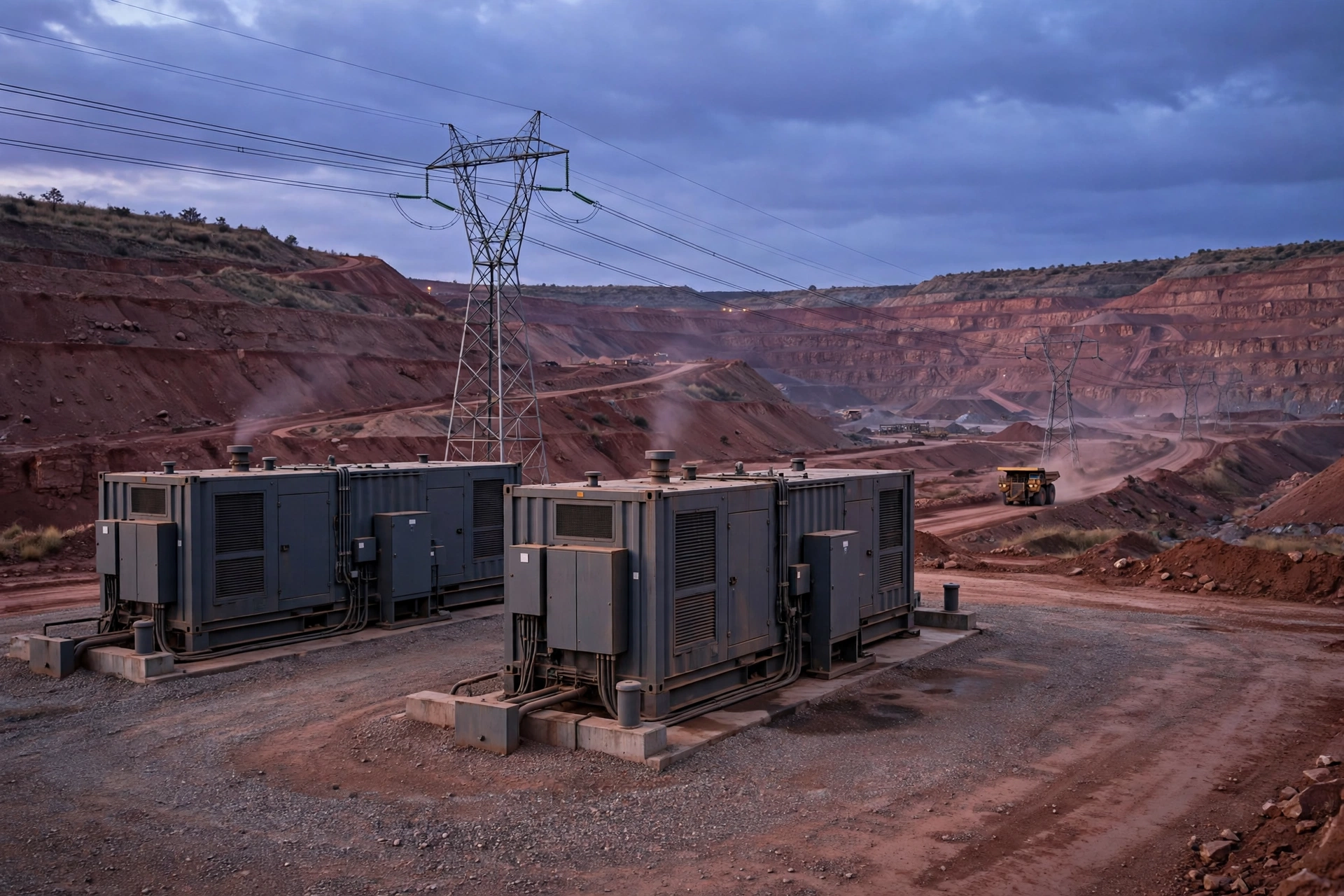
Case 1: A gold mine in Ghana — 11 kV, 2 × 2,000 kVA prime
An open-pit gold mine in western Ghana ran its crushing and processing plant from two 2,000 kVA prime sets at 400 V, with two 2 MVA step-up transformers feeding an 11 kV distribution that ran 1.2 kilometres to the pit. The system worked, but it worked badly. The 400 V cable runs from the sets to the transformers were short but enormous — eight parallel runs per phase, terminated in a cramped transformer bay — and the voltage at the pit rim sagged by 14% when the primary crusher started, tripping the conveyor drives on undervoltage. The transformers needed oil sampling, tap-changer maintenance and a bunded plinth that the mine’s environmental permit had to cover.
The replacement was two 2,000 kVA sets wound for 11 kV direct output, feeding the same 11 kV distribution without transformers. The cable mass on the installation fell by about 85% — three single-core cables per set instead of eighteen — and the voltage headroom at the pit recovered by 14%, enough that the crusher starts no longer tripped the conveyors. The transformer maintenance stopped entirely: no oil sampling, no tap changer, no bund to inspect. The two sets burn about 400 L/h each at full load, and at the mine’s average 70% load factor the pair consumes roughly 13,400 litres a day — a fuel bill that makes the 1.2% transformer loss the old system carried worth about $160 a day in wasted diesel. The mine’s engineers put it simply: the high-voltage sets did not make the power cheaper to generate, they made it cheaper to deliver.
Case 2: A cement plant in Vietnam — 6.6 kV, 3,000 kVA prime
A cement plant in northern Vietnam expanded its raw mill and kiln drives and needed 3,000 kVA of prime power for a new production line 800 metres from the generator compound. The first design put a 400 V set in the compound with a step-up transformer, an 800-metre 6.6 kV cable, and a step-down transformer at the line. The second design put a 3,000 kVA set wound for 6.6 kV in the compound and ran the same 800-metre cable directly to the line’s switchboard. The second design won on every line of the comparison: one machine instead of three, no transformer bay, no second set of terminations, and a capital saving of about $60,000 in transformer, bunding and cable.
The set runs at an average of 80% load, burning about 460 L/h, and the plant’s generator room ventilation design had to account for the larger alternator frame and its cooling air — about 14 m³/s at full load, against 11 m³/s for the 400 V equivalent. The plant’s maintenance team had to be trained and authorised for 6.6 kV work, which cost two weeks and a training course, and the protection relay settings took a day of commissioning that a 400 V installation would not have needed. The plant manager’s assessment was that the training cost was repaid in the first year by the transformer maintenance that no longer existed, and that the real benefit was operational: when the kiln drive trips, the generator is the only thing between the plant and a cold kiln, and a system with one machine in it is a system with one thing that can fail.
Case 3: A data centre campus in Johor, Malaysia — 11 kV, 4 × 2,500 kVA standby
A data centre campus in Johor, Malaysia, built four 2,500 kVA standby sets in a ring-main configuration at 11 kV, feeding the campus distribution directly. The alternative — four 400 V sets with four step-up transformers — was rejected before it reached the cost comparison, because the campus had no space for four transformer bays inside the generator compound, and because the data centre generator count decision was already complex enough without adding transformer redundancy to it. Paralleling two generators at 400 V is a solved problem. Paralleling four at 11 kV is the same problem with a protection study attached, and the study was done properly: differential protection on each alternator, a busbar protection scheme, and a synchronising check that proves each set is stable before it closes onto the ring.
The sets are standby-rated, tested monthly at 50% load for 30 minutes and annually at full load for four hours, and the test load is taken through the same 11 kV switchgear the real load uses — there is no separate low-voltage test circuit to maintain. The campus’s first full-load test found a protection relay setting error that a 400 V installation would have caught the same way, and the lesson the operations team took from it was that the switchgear, not the generator, is where high-voltage commissioning time goes. The sets themselves started, synchronised and loaded exactly as specified. The switchgear took three days of relay testing to prove. Any project that budgets commissioning time for the generator and not for the switchgear will run late.
Frequently Asked Questions
What is a high voltage diesel generator?
A high voltage diesel generator is a diesel set whose alternator produces medium voltage — usually 3.3 kV, 6.6 kV, 10.5 kV or 11 kV — directly, without a step-up transformer. It is specified for large sites where the current at 400 V becomes too large to cable economically, typically above 1,000 kVA or beyond 150–200 metres of cable run.
When do you need a high voltage generator?
A high voltage generator is needed when the set is large, the cable run is long, or the site already distributes power at medium voltage. The practical thresholds are a single set above about 1,000 kVA, a cable run beyond 150–200 metres, or a total site load above 3–5 MW. Mines, cement plants, refineries and large data centre campuses are the common cases.
What voltage is a high voltage generator?
A high voltage generator typically produces 3.3 kV, 6.6 kV, 10.5 kV, 11 kV or 13.8 kV, depending on the region: 11 kV in Africa and South Asia, 6.6 kV in Australia, the Middle East and Southeast Asia, 13.8 kV in North America and 10.5 kV in China. The voltage follows the local distribution standard, not the generator manufacturer’s preference.
How much does a high voltage generator cost?
A high voltage generator costs about 15–25% more than a 400 V set of the same kVA rating, because of the form-wound alternator, the insulation system and the factory testing. The comparison that matters is the project cost: a 2 MVA step-up transformer costs roughly $25,000–40,000 plus its bunding, and the cable saving on a long run often exceeds the alternator premium. Medium-voltage switchgear is a separate cost and must be budgeted as its own line item.
Can a diesel generator produce 11kV directly?
Yes — a diesel generator can produce 11 kV directly, provided the alternator is wound for it. The alternator uses form-wound coils with mica insulation, vacuum-pressure impregnation and partial discharge testing, and the set connects straight to an 11 kV switchboard. The limitation is the top of the range: alternators are not normally wound above 13.8 kV, so a site needing 33 kV still generates at 11 kV and steps up.
Specification Checklist: Before You Order a High Voltage Set
- Load and distance first. Size the load in kVA and measure the cable distance before choosing a voltage. Above 1,000 kVA or 150–200 metres, get a high-voltage price. Below both, stay at 400 V.
- Match the local standard. Confirm the site’s distribution voltage — 11 kV, 6.6 kV, 10.5 kV or 13.8 kV — in writing, with the utility or the site owner. Ordering the wrong voltage means ordering a transformer.
- Duty rating. Standby, prime or continuous, decided before the set is specified. A prime set at a mine and a standby set at a hospital are different machines.
- Alternator specification. Form-wound coils, vacuum-pressure impregnation, partial discharge test results in the acceptance documentation, PT100 winding sensors, anti-condensation heaters and surge arresters.
- Switchgear budgeted separately. Medium-voltage switchboard, vacuum breakers, multifunction protection relay with differential (87G), earth fault (51N) and reverse power (32), current and voltage transformers, and the transfer scheme — all as their own line items.
- Earthing design. Neutral earthing resistor sized for the installation, earth grid resistance measured at commissioning, and the earth-fault protection philosophy — alarm, or trip — agreed in writing.
- Protection study. Relay settings calculated and proven by secondary injection testing at commissioning, including the synchronising check for paralleled sets.
- Personnel and authorisation. Medium-voltage authorised persons named for operation and maintenance, permit-to-work system in place, and arc-flash PPE rated for the switchboard’s incident energy.
- Cooling air and ventilation. Radiator and alternator cooling air quantified for the larger high-voltage frame, and the generator room ventilation sized to it — a 3,000 kVA high-voltage set needs about 14 m³/s at full load.
- Maintenance schedule. Partial discharge testing, insulation resistance trending, vacuum bottle checks and protection relay testing added to the maintenance schedule — tasks that do not exist on a 400 V set, and that decide whether the alternator lasts its design life.
A high-voltage generator is not a bigger generator. It is a different answer to a different problem — the problem of moving large power over distance without drowning the site in copper. Below 1,000 kVA and inside 150 metres, 400 V is the right answer, and it will stay the right answer. Above those thresholds, the current, the cable and the losses make the decision, and the decision is usually high voltage. If you are sizing a set for a mine, a cement plant, a refinery or a data centre campus and want the voltage, the switchgear and the protection specified before the order is placed, contact PAVO — the engineering team will work through the load, the distance and the local standard, and quote the set that fits the site rather than the set that fits the catalogue.