

What Size Generator Do I Need for an Air Compressor? | PAVO
A 5 hp compressor draws about 4.5 kW while it runs and more than 30 kVA while it starts. Size for the second number, or the generator will stall every time the tank calls for air.
What size generator do I need for an air compressor? Size for starting watts, not running watts: a 1 hp compressor needs about a 4,000 W generator, a 2 hp about 6,500 W, and a true 5 hp single-phase compressor needs a 10–15 kVA diesel set. The locked-rotor surge at start-up, not the running load, decides the size.
Contents
- Why the Nameplate Lies: Running Watts vs Starting Watts
- The 5 hp Compressor, Worked in Full
- Duty Cycle: The Second Number Nobody Checks
- Will a Generator Damage My Air Compressor?
- Cutting the Surge: Soft Starters, VSDs and Unloader Valves
- Sizing the Whole Workshop, Not One Tool
- Frequently Asked Questions
- Specification Checklist: Seven Lines Before You Buy
Why the Nameplate Lies: Running Watts vs Starting Watts
An air compressor motor has two power ratings, and only one of them appears in the headline figure on the box. Running watts are what the motor draws once it is up to speed. Starting watts are what it demands in the first second, while the rotor is still locked and the magnetic field is building. For a compressor motor, the second figure is three to seven times the first.
The physics is straightforward. At standstill, an induction motor is a short circuit with a fan attached. Locked-rotor current — LRA — runs at roughly five to eight times full-load amps, and Kohler’s engineering paper on generator sizing for motor starting puts the typical figure at six times. On utility power, the grid absorbs that surge without anyone noticing. On a generator, the surge shows up instantly as a voltage dip, a frequency sag, and sometimes a stalled engine.
That is why the sizing question is so often answered wrong. A buyer reads “5 hp” on the compressor, converts it to 3.73 kW, and buys a 5 kW generator. The compressor runs — for about a second — and then the generator’s breaker trips, the engine stalls, or the motor sits humming at locked rotor until its overload relay cuts out. The generator was never too small for the compressor. It was too small for the compressor’s first second.
Honda’s generator wattage guide gives the honest figures for small compressors, and they are worth memorising:
| Compressor | Running watts | Starting watts | Generator to buy |
|---|---|---|---|
| 1/2 HP | 1,000 | 2,000 | 2,500 W |
| 1 HP | 1,500 | 4,500 | 4,000 W |
| 1-1/2 HP | 2,200 | 6,000 | 5,000 W |
| 2 HP | 2,800 | 7,700 | 6,500 W |
| 3 HP | 2,800 | 9,000 | 8,000 W |
| 5 HP | 4,500 | 12,000–15,000 | 10–15 kVA |
Two things stand out. First, the starting multiple grows with size: a 1/2 hp compressor starts at twice its running watts, a 5 hp at three to four times. Second, the generator column is sized to the starting watts with headroom, not to the running watts. A 4,000 W generator for a 1 hp compressor looks oversized on paper and is exactly right in practice. The generator sizing guide applies the same rule to every motor load: total running watts, plus the single largest starting surge, plus 20–25% headroom.
The trap is worst with the cheapest compressors. Budget single-stage units often carry optimistic horsepower figures — “6 hp peak” on a motor that delivers 3 hp continuously — and no locked-rotor code letter on the nameplate. A buyer who sizes from the peak figure buys too much generator; a buyer who sizes from the running figure buys too little. The nameplate, not the box, is the authority.
The 5 hp Compressor, Worked in Full
The 5 hp single-phase compressor is the most common workshop size in the world, and the most commonly mis-sized. It is worth working through in full, because every number below can be read off a real nameplate.
The nameplate maths
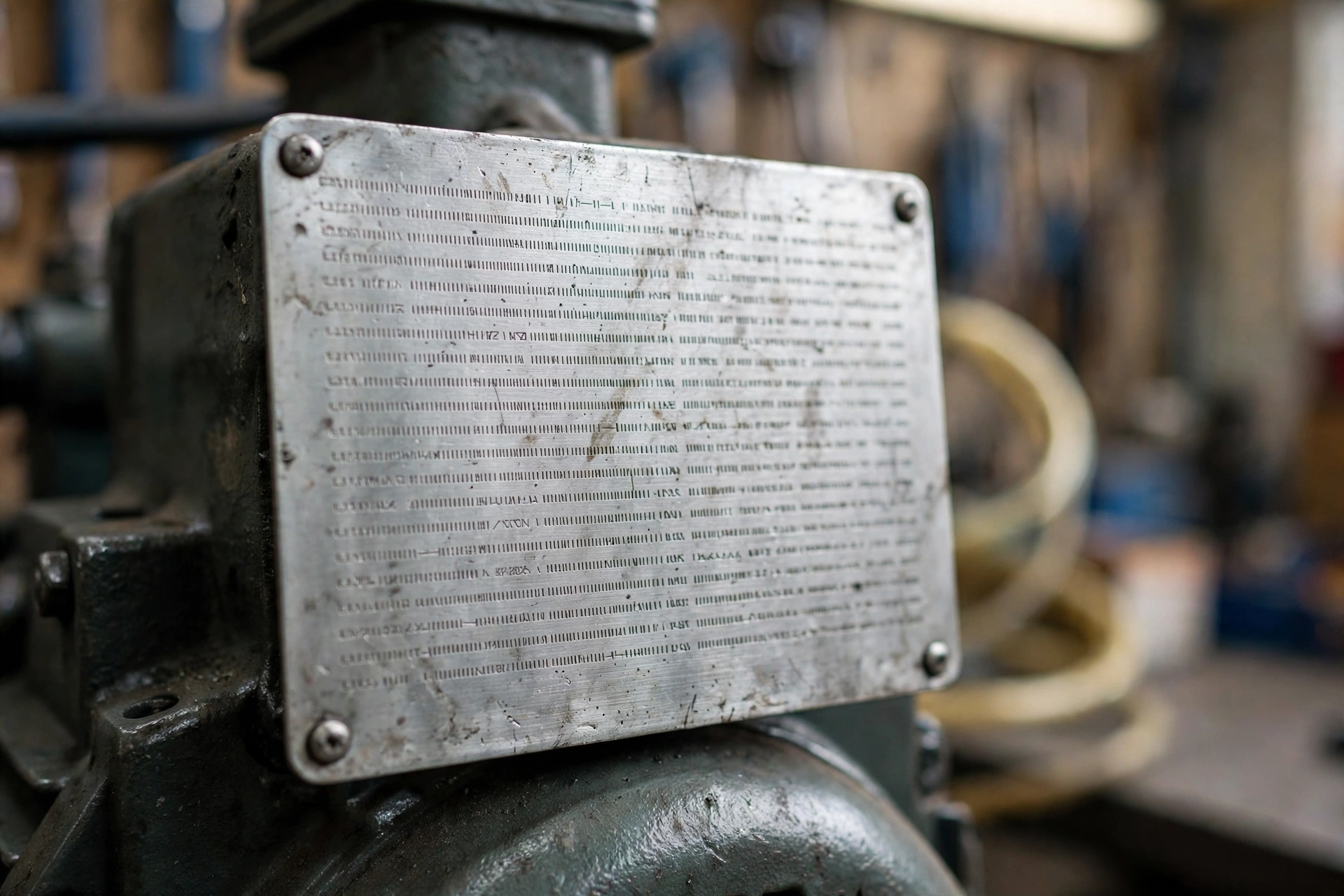
Take a typical 5 hp, 60-gallon (227-litre) single-stage compressor — the Ingersoll Rand SS5 pattern sold in thousands of workshops. Motor: 5 hp, 230 V, single-phase. Nameplate full-load amps: 23.5 A. NEC Table 430.248 lists 28 A for a 5 hp single-phase 230 V motor, so a nameplate in the low twenties already tells the buyer the motor is a genuine 5 hp unit, not a relabelled 3 hp.
Running input power is not 5 hp. Five horsepower is 3.73 kW of shaft output. At roughly 82% motor efficiency, electrical input is about 4.5 kW, or about 5.6 kVA at 0.8 power factor. That is the running load — the number the generator carries for hours.
Starting load is a different calculation. The motor’s locked-rotor code letter — Code H on this class of motor — means 6.3 to 7.1 kVA per horsepower at locked rotor under NEC Table 430.7(B). Five horsepower therefore demands 31.5 to 35.5 kVA at the instant of starting, or roughly 137 to 154 A at 230 V. That is six to seven times full-load current, for a fraction of a second, and it is the number the generator must survive.
A 10 kVA diesel set carries a short-term surge of about 1.5 times rating — roughly 15 kVA. That is less than half of what the motor asks for. A 15 kVA set surges to about 22 kVA and still falls short on paper, yet in practice it starts this compressor reliably, because the locked-rotor peak lasts milliseconds and the alternator’s subtransient reactance carries the brief spike. The honest answer for a true 5 hp single-phase compressor is therefore 10 to 15 kVA, with 15 kVA the safe choice where the compressor starts against pressure, and 10 kVA acceptable only where it starts unloaded.
Why an 8 kW generator stalls on it
An auto body shop in Nairobi learned this the expensive way. The shop bought a 5 hp, 60-gallon compressor and an 8 kW petrol generator — 8,000 W against a compressor that “only” draws 4,500 W running. On the first day, the compressor started, ran for three seconds, and the generator stalled. The breaker had not tripped. The engine had simply been dragged below its governing speed by a load it could not feed, and the voltage collapsed to the point where the motor could not develop starting torque.
The telling detail: with the drive belt removed, the same generator started the same motor without complaint. Unloaded, the motor’s starting current is a fraction of the loaded figure. Under load, against a tank at 120 psi, the motor needs its full locked-rotor current, and the 8 kW set cannot supply it. The shop’s fix was a 15 kVA diesel set, which starts the compressor at cut-in pressure without a flicker — and which also runs the shop’s lights and a 2 kW angle grinder at the same time, because the sizing was finally done on the surge.
Starting against pressure: the cut-in trap
A compressor does not always start from rest. It starts when tank pressure falls to the cut-in setting — typically 120 psi on a shop compressor, with cut-out at 150 to 175 psi. Starting against 120 psi of head pressure is a harder start than starting against an empty tank, and it is the start that matters, because it is the start that happens a dozen times a day.
This is the cut-in trap: a compressor that starts cleanly on an empty tank in the showroom fails on its third cycle in the workshop. The difference is the pressure the pump must push against from the first revolution. A working unloader valve — which vents the pump head to atmosphere while the motor spins up — removes most of that penalty, which is why a failed unloader valve is the first thing to check when a compressor that used to start on a generator suddenly will not. The valve costs a few dollars. The generator it saves costs thousands.
Duty Cycle: The Second Number Nobody Checks
Even a correctly sized generator can be beaten by a compressor that never stops. The second number on the specification sheet is duty cycle: the percentage of a ten-minute period the compressor is allowed to run.
Intermittent duty in a one-man workshop
Single-stage piston compressors are commonly rated at 50 to 75% duty cycle. A 50% duty-cycle pump runs five minutes in ten and rests five. In a one-man workshop — a spray gun here, a tyre inflator there, an impact wrench for a minute at a time — that is plenty, because the tank supplies air between cycles and the pump catches up during quiet spells.
Push past the rating and the failure is slow, not sudden. Pump temperature climbs, oil thins and carries over into the air line, moisture that should condense in the tank stays in the pump, and valve life shortens. The compressor still works. It just works for two years instead of ten. A workshop that runs a sandblaster or a die grinder continuously — tools that consume 15 to 25 CFM without pause — will drive a 50% duty-cycle piston compressor past its rating before lunch. That workshop needs a bigger pump, not a bigger generator, and the distinction matters: generator sizing solves the starting problem, duty cycle solves the running problem.
Continuous duty and rotary screw compressors
Rotary screw compressors are rated at 100% duty cycle. They run all day, every day, which is why they dominate workshops with continuous air demand. A 7.5 kW rotary screw delivers roughly 30 to 35 CFM at 7 bar, against about 18 CFM at 90 psi for a 5 hp single-stage piston unit — nearly double the air for half again the power.
A joinery workshop in Leeds illustrates the difference. The shop replaced a 5 hp piston compressor with a 7.5 kW rotary screw on a 20 kVA diesel set. The screw compressor’s variable-speed drive ramps the motor up over several seconds, so starting current stays near 1.5 times full-load amps and the generator never sees a surge. The set runs ten hours a day, five days a week, and the fuel bill is lower than the old arrangement — not because the screw compressor uses less power, but because it stops making air the moment demand stops, instead of running a piston pump against a full tank.
Will a Generator Damage My Air Compressor?
Yes — but only the wrong generator, and only in specific ways. A correctly sized generator is no more dangerous to a compressor than utility power. An undersized one damages the compressor slowly, and the damage looks like a compressor fault, not a generator fault.
Voltage dip and motor heating
The most common damage path is voltage dip at start-up. When the generator cannot supply locked-rotor current, terminal voltage falls — sometimes below 85% of nominal. Motor torque falls with the square of voltage, so at 85% voltage the motor develops only 72% of its starting torque. The motor turns slowly, draws locked-rotor current for seconds instead of milliseconds, and the windings heat. One failed start will not kill a motor. Fifty failed starts across a summer will cook the insulation, and the motor that “just wore out” actually died of chronic undervoltage.
The same dip affects everything else on the circuit. Lights dim, contactors chatter, and electronic controls reset. A voltage dip that lasts longer than about 1.5 seconds is the threshold where damage stops being theoretical: motor windings overheat, and electronic power supplies drop out.
Frequency sag and the governor
Under a sudden surge, the generator engine slows before the governor can add fuel. Frequency sags with engine speed — a 50 Hz set may dip to 47 or 48 Hz for a second. Motors tolerate brief frequency excursions, but a governor that hunts — overshooting, undershooting, overshooting again — introduces frequency instability that stresses both the compressor motor and any electronics on the same circuit. A diesel set with a properly sized engine and a responsive governor recovers in under a second. A petrol set running near its limit may hunt for several seconds, and every one of those seconds is time the compressor motor spends outside its design envelope.
VSD compressors and harmonics
Variable-speed-drive compressors solve the starting problem and create a different one. A VSD ramps the motor gently, so starting current is only about 1 to 1.5 times full-load amps. But the drive’s rectifier draws current in pulses, not a smooth sine wave, and the resulting harmonics and distortion heat the generator alternator. The rule of thumb from the harmonics literature is to oversize the alternator by 2.5 to 3 times the non-linear load — a rule that catches buyers who size a VSD compressor on its gentle starting current and forget the waveform it draws while running. A generator that starts a fixed-speed 5 hp compressor without trouble can still overheat its alternator on a VSD compressor of the same horsepower if the alternator is marginal.
Cutting the Surge: Soft Starters, VSDs and Unloader Valves
When the generator is already bought and the compressor will not start on it, three fixes exist, in order of cost.
Soft starters
A soft starter ramps the voltage to the motor over one to two seconds instead of applying full voltage instantly. Micro-Air’s EasyStart, the best-known unit for compressor duty, cuts starting current by up to 75%. A 5 hp compressor that demanded 35 kVA at locked rotor now asks for roughly 10 to 12 kVA, and a 10 kVA generator that stalled on it yesterday starts it today. Cost is typically $300 to $500, against $2,000 or more to step up a generator size. Two cautions: check with the compressor manufacturer that a soft starter does not affect the warranty, and remember that a soft starter does nothing for running load — if the running load alone exceeds the generator, no starter will help.
Variable-speed drive
A VSD goes further: it varies both voltage and frequency, ramping the motor from zero to full speed over several seconds, with starting current near running current. It also matches air output to demand, cutting energy use by 20 to 35% on variable-load workshops. The trade-off is the harmonics issue above, plus cost — a VSD for a 5 hp motor runs $800 to $1,500 — and sensitivity to the generator’s own voltage regulation. A VSD is the right answer for a workshop that runs its compressor all day. It is the wrong answer for a compressor that runs ten minutes a day.
Starting unloaded
The free fix is to start unloaded. Open the tank drain or the discharge valve, let the motor reach full speed with no load, then close the valve and let the pump build pressure. A working unloader valve does this automatically. Where the valve has failed, a manual start-unloaded routine costs nothing and often rescues a marginal generator-compressor pairing. It is not a substitute for correct sizing — the compressor still draws its full starting current at the next cut-in, when the valve is closed and the tank is at 120 psi — but it separates a starting problem from a running problem, and that diagnosis alone is worth the two minutes it takes.
Sizing the Whole Workshop, Not One Tool
A compressor rarely works alone. The workshop load list is where most sizing errors actually happen, because the buyer sizes the compressor correctly and then adds a welder, a dust extractor and a grinder as if they were light bulbs.
| Workshop load | Running | Starting surge |
|---|---|---|
| 5 hp air compressor | 4.5 kW | 32 kVA |
| Dust extractor, 2 hp | 1.5 kW | 4.5 kVA |
| Angle grinder | 2.0 kW | 4.0 kW |
| Work lights + chargers | 0.5 kW | 0.5 kW |
| Total running | 8.5 kW | — |
The sizing rule is the same as for a single load: total running watts, plus the single largest starting increment, plus 20 to 25% headroom. Total running is 8.5 kW, about 10.6 kVA. The compressor’s starting increment is its 32 kVA locked-rotor figure minus the 5.6 kVA already counted in the running total — about 26 kVA. Peak demand is therefore roughly 37 kVA, and the honest generator size for running all of this at once is a 40 kVA set.
That figure surprises buyers, and it should prompt the right question: does everything actually run at once? In most workshops, the answer is no. The compressor cycles; the grinder runs in bursts; the extractor runs with the saw. Staggering the starts — never starting the compressor and the extractor in the same second — and accepting that the compressor pauses while the welder runs can cut the requirement to a 20 to 25 kVA set. But that is a discipline, not a specification. If the workshop cannot guarantee the discipline, the 40 kVA figure stands. Sizing a generator for a welder follows the same logic, and a workshop that runs both should size for the larger of the two surges, not the sum — motors do not start at the same instant unless the operator makes them.
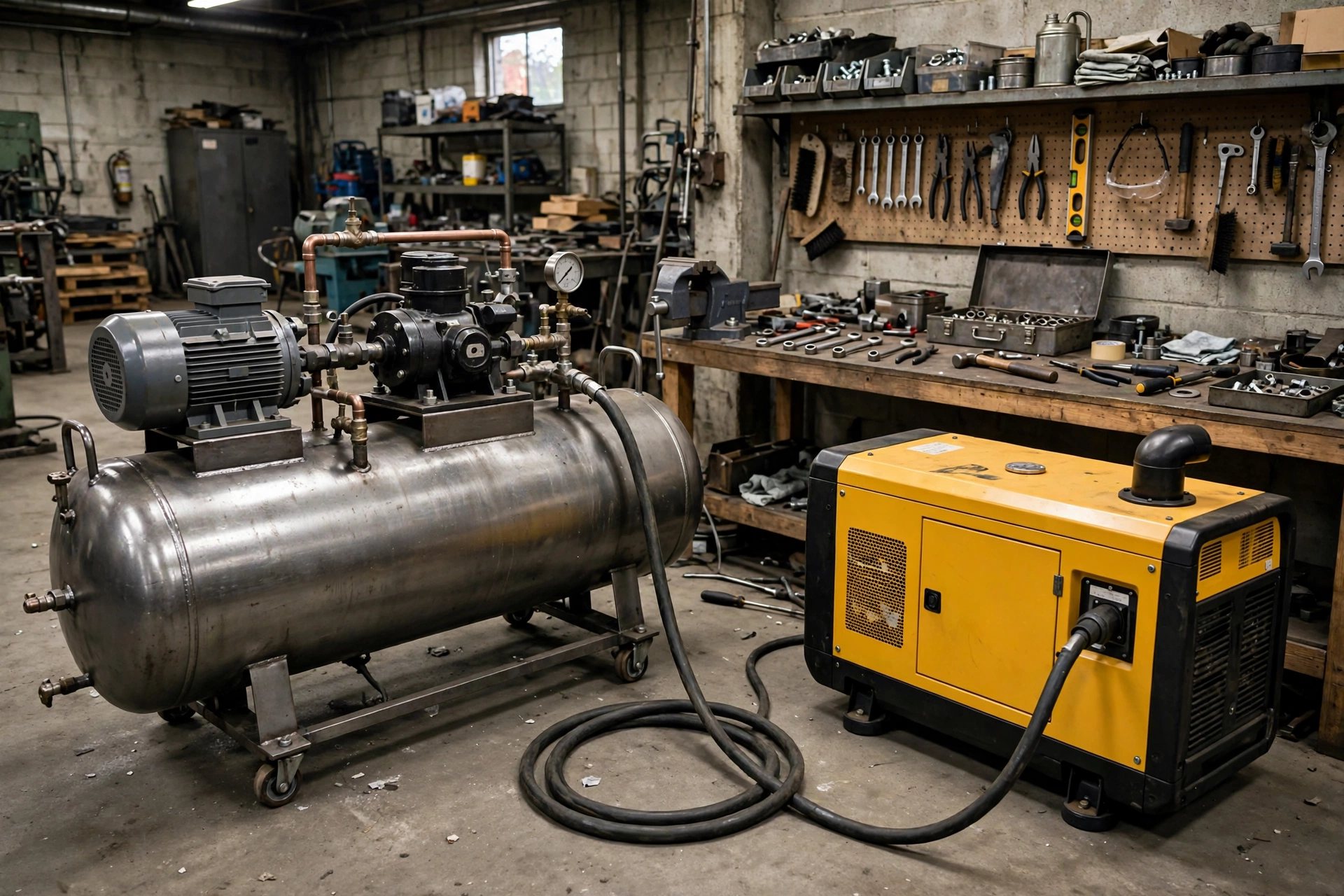
A mobile tyre service van shows the other end of the scale. The van carries a 3 hp compressor, a 12 V tyre changer and a work light, all on a 5.5 kVA diesel set. It works, year after year, because the compressor is the only motor, it starts unloaded, and the running load is under 3 kW. The set burns about 1.5 litres per hour at that load, so a 25-litre tank covers a full working day with margin. Fuel consumption at part load is the quiet cost of workshop power: a 15 kVA diesel set at 75% load burns roughly 3.2 litres per hour, or about 25 litres across an eight-hour day, and that figure belongs in the sizing decision alongside the kVA figure.
Frequently Asked Questions
What size generator do I need for an air compressor?
Size for starting watts, not running watts. A 1 hp compressor needs about a 4,000 W generator, a 2 hp about 6,500 W, a 3 hp about 8,000 W, and a true 5 hp single-phase compressor needs a 10–15 kVA diesel set. Always check the motor nameplate for full-load amps and the locked-rotor code letter, and add 20–25% headroom above the calculated peak.
Can a generator run an air compressor?
Yes, provided the generator is sized for the compressor’s starting surge rather than its running load. A generator that matches running watts alone will stall or trip the first time the compressor starts, especially against tank pressure at cut-in. Diesel sets suit workshop compressors best, because their alternators carry short-term surge better than small petrol sets of the same rating.
What size generator do I need for a 5 hp air compressor?
A true 5 hp single-phase compressor needs a 10–15 kVA generator. Running input is about 4.5 kW, but locked-rotor demand is 31.5–35.5 kVA for a Code H motor, so a 15 kVA set is the safe choice where the compressor starts against pressure. A 10 kVA set can work if the compressor starts unloaded or has a soft starter fitted.
How many watts does an air compressor use on startup?
Starting watts run three to four times running watts for most compressors. A 1 hp compressor draws about 1,500 W running and 4,500 W starting; a 2 hp about 2,800 W running and 7,700 W starting; a 5 hp about 4,500 W running and 12,000–15,000 W starting. The exact figure depends on the motor’s locked-rotor code letter and whether the compressor starts against tank pressure.
Will a generator damage my air compressor?
A correctly sized generator will not damage a compressor. An undersized generator can, because the voltage dip at start-up makes the motor draw locked-rotor current for seconds instead of milliseconds, overheating the windings over repeated starts. The damage is cumulative and looks like ordinary motor wear, which is why it is so often misdiagnosed as a compressor fault.
Specification Checklist: Seven Lines Before You Buy
1. Read the motor nameplate, not the box. Full-load amps, voltage, phase and the locked-rotor code letter are the only figures that matter. A compressor without a code letter has not been properly specified.
2. Calculate locked-rotor kVA. Multiply the code-letter kVA per horsepower by the motor horsepower. For a 5 hp Code H motor, that is 31.5 to 35.5 kVA — the number the generator must survive.
3. Check the cut-in pressure. A compressor that starts at 120 psi needs more generator than one that starts empty. Confirm the unloader valve works before blaming the generator.
4. Match duty cycle to the job. A 50% duty-cycle piston compressor suits intermittent workshop use. Continuous air demand — sandblasting, die grinding, spray lines — needs a 100% duty-cycle rotary screw.
5. Decide on a soft starter or VSD before buying the generator. Either device can cut the starting surge by 60 to 75% and drop the required generator by a full size class. Fitting one afterwards costs the same money and a second installation visit.
6. Size the alternator for the waveform, not just the watts. A VSD compressor draws harmonic current that heats an alternator. Where a VSD is fitted, oversize the alternator by 2.5 to 3 times the non-linear load.
7. Confirm the rating and the fuel. A workshop set runs hundreds of hours a year, which is prime duty, not standby — check the standby and prime ratings on the datasheet before paying. Then check the fuel: a 15 kVA set at 75% load burns about 3.2 litres per hour, so an eight-hour day needs roughly 25 litres on board.
A compressor is the hardest load in most workshops to start, and the easiest to size wrong, because the number that matters is invisible on the sales literature. Read the nameplate, calculate the locked-rotor figure, and size the generator for the first second of the start. Everything after that is the easy part. For a set sized to a real workshop load list — compressor, welder, extractor and lights together — contact PAVO with the nameplate figures and the duty cycle, and the quotation will carry the rating the job actually needs.