

What Size Generator Does a Desalination Plant Need? | PAVO
A desalination plant does not just lose power when the grid fails. It loses pressure — and pressure is the only thing standing between seawater and the membranes.
What size generator does a desalination plant need? A 10,000 m3/day seawater RO plant needs roughly a 1,600 kVA essential-board set, a 1,000 m3/day plant about 200 kVA, and a 100,000 m3/day plant several megawatts in parallel sets — because the high-pressure pumps alone take 70–80% of the plant’s power.
Contents:
- Why a Desalination Plant Is Not Just Another Big Load
- What the Generator Has to Power
- Sizing by Plant Capacity
- The High-Pressure Pump Problem
- What Happens in the First 60 Seconds
- Three Plants, Three Lessons
- Frequently Asked Questions
- Specification Checklist
Why a Desalination Plant Is Not Just Another Big Load
Desalination is no longer a niche technology for islands and oil platforms. The International Desalination Association puts global installed capacity at roughly 100 million m3/day, spread across some 16,000–20,000 plants in more than 150 countries. About 48% of that capacity sits in the Middle East and North Africa. Reverse osmosis now accounts for around 70% of installed capacity, and the plants keep getting bigger: Taweelah in Abu Dhabi produces 909,200 m3/day, Sorek 2 in Israel 670,000 m3/day, and Ras Al Khair in Saudi Arabia 1,036,000 m3/day as a hybrid thermal-plus-RO plant.
That scale changes what backup power means. A factory that loses power loses production. A desalination plant that loses power loses production, loses its water supply contract, and — if the shutdown is handled badly — loses its membranes. The product is drinking water for a city. In Taweelah’s case, the plant supplies a large share of Abu Dhabi’s municipal demand. In Sorek’s case, about 20% of Israel’s household water. There is no warehouse of finished stock to draw on while the plant is down. Storage tanks hold hours, not days.
The second difference is the physics of the process. A reverse osmosis plant works by pushing seawater through membranes at 55–80 bar — roughly 60 times atmospheric pressure. The high-pressure pumps that create that pressure consume about 80% of the plant’s total energy. When the power fails, the pressure collapses in seconds. What happens next inside the membrane vessels decides whether the plant restarts in an hour or spends weeks recovering.
The third difference is that most of the load cannot be backed up at all. A 624,000 m3/day plant at 3.0 kWh/m3 draws about 78 MW on average. No diesel installation backs up 78 MW. The generator’s job is narrower and more specific: keep the essential board alive — controls, instrumentation, flush pumps, intake protection and one or two RO trains — so the plant survives the outage instead of being damaged by it.
That distinction is the whole subject of this article. Sizing a generator for a desalination plant is not a matter of adding up the nameplate and buying the biggest set in the catalogue. It is a matter of deciding which loads must never stop, which loads can wait, and how long the membranes can be left without power before the damage becomes permanent.
What the Generator Has to Power
A seawater reverse osmosis plant has five load groups, and they do not matter equally in an outage. The generator sizing exercise starts by sorting them into three tiers: must never stop, must restart within minutes, and can wait until the grid returns.
Tier 1 — must never stop. Controls, instrumentation, the distributed control system, SCADA, chemical dosing control and emergency lighting. The load is small, typically 30–80 kW even on a large plant, but it is the load that decides whether the rest of the plant can be shut down safely. Lose the control system and the operators are blind during the event that matters most.
Tier 2 — must restart within minutes. Seawater intake pumps, pre-treatment, the high-pressure pumps of the RO trains selected for backup, energy recovery boosters, and post-treatment dosing. This is where the kVA lives. The high-pressure pump is the single largest motor in the plant, and on a mid-size plant it is a 400–800 kW machine.
Tier 3 — can wait. Product water distribution pumps, brine discharge pumps, workshops, HVAC in non-critical areas, and office loads. These are shed on transfer and restored when the grid returns. Putting them on the generator board is the most common sizing mistake in desalination backup design: it inflates the set by 30–40% and buys nothing.
The load split inside a modern SWRO plant looks like this:
| Load group | Share of plant electrical load | On the generator board? |
|---|---|---|
| High-pressure RO pumps | 70–80% | Selected trains only |
| Seawater intake pumps | 5–8% | Yes — reduced flow |
| Pre-treatment (filters, UF) | 3–5% | Yes |
| Energy recovery boosters | 3–5% | With the trains they serve |
| Post-treatment and dosing | 2–4% | Yes |
| Controls, SCADA, lighting | 1–3% | Yes — always |
| Product distribution pumps | 3–6% | No — shed on transfer |
| HVAC, workshops, offices | 2–4% | No — shed on transfer |
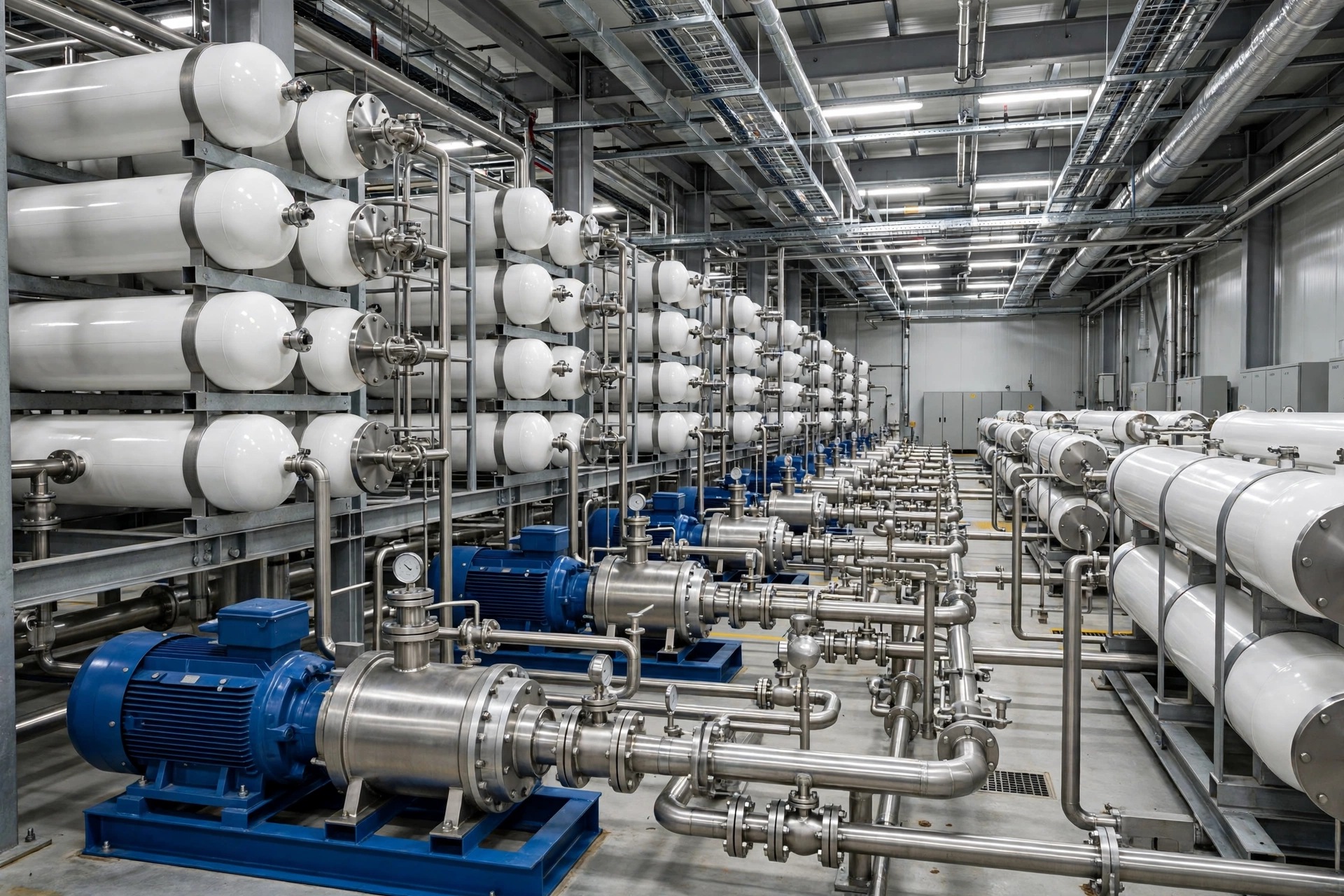
Two points in that table deserve attention. First, the high-pressure pump share is so large that the generator decision is really a decision about how many RO trains to keep running. Backing up one train out of six is a different purchase from backing up three. Second, intake matters more than its kW suggests. If the intake stops, the plant loses its cooling and flushing water as well as its feed. A plant that keeps its RO trains alive but lets its intake go dry has solved the wrong problem.
The water and wastewater pumping article covers pump sizing for municipal water and sewage stations in detail. A desalination plant shares the pumps but not the problem: the load that matters is the pressure, not the flow.
Sizing by Plant Capacity
Specific energy consumption is the number that turns plant capacity into generator size. A modern SWRO plant with pressure-exchanger energy recovery produces a cubic metre of water for about 3.0–3.5 kWh. Older plants without recovery run 6–8 kWh/m3. Thermal plants — multi-stage flash and multi-effect distillation — consume 10–15 kWh/m3, mostly as heat, which is why this article deals with RO plants: a diesel set can back up an RO plant’s essential board, but it cannot supply the steam a thermal plant needs.
At 3.5 kWh/m3, the arithmetic is straightforward. A 10,000 m3/day plant consumes 35,000 kWh/day, or about 1,460 kW on average. Design load runs 10–15% above average, so the plant’s total connected load is roughly 1,600 kW. The essential board — controls, intake at reduced flow, pre-treatment and one or two RO trains — is typically 75–85% of that, around 1,250 kW, or 1,560 kVA at 0.8 power factor.
The same calculation across the common plant sizes gives the following bands. These are essential-board figures, not total plant load, and they assume one or two RO trains kept in service with the rest shut down in an orderly sequence.
| Plant capacity | Average electrical load | Essential-board load | Generator size |
|---|---|---|---|
| 1,000 m3/day | ~145 kW | ~120 kW | 200 kVA |
| 5,000 m3/day | ~730 kW | ~600 kW | 800 kVA |
| 10,000 m3/day | ~1,460 kW | ~1,250 kW | 1,600 kVA |
| 50,000 m3/day | ~7,300 kW | ~6,000 kW | 7,500 kVA |
| 100,000 m3/day | ~14,600 kW | ~10,000 kW | 12,500 kVA |
Above about 50,000 m3/day, the generator is always a parallel set of machines, not a single unit. PAVO’s range tops out at 3,750 kVA per set, so a 100,000 m3/day essential board needs four sets in parallel with N+1 redundancy — five sets installed, four running. The paralleling decision should be made at the design stage, not after the first set is ordered: bus protection, load sharing and synchronising gear are cheaper when they are in the original scope. The generator sizing guide covers the step-by-step method for building a load list and applying diversity and starting allowances.
Fuel autonomy: 72 hours is the number
A desalination plant that runs out of fuel during an outage has the same problem as a plant with no generator at all, plus a set of membranes that were shut down in a hurry. Fuel autonomy should be sized for 72 hours at the expected load, not for the 8 hours that a fuel supplier promises on the phone.
Fuel consumption scales with load, and the reference point is the datasheet. A Cummins C500D5 — 500 kVA standby / 455 kVA prime — burns 93.2 L/h at full prime load. At the 70–75% load factor a desalination essential board typically runs at, consumption falls to roughly 70–75 L/h. The table below uses full-load figures, which is the conservative basis for tank sizing.
| Generator size (prime) | Full-load fuel use | Fuel for 72 hours |
|---|---|---|
| 200 kVA | ~41 L/h | ~3,000 L |
| 500 kVA | ~102 L/h | ~7,300 L |
| 1,000 kVA | ~205 L/h | ~14,800 L |
| 2,000 kVA | ~410 L/h | ~29,500 L |
A 1,600 kVA essential board at 72 hours needs roughly 24,000 litres of usable fuel — a bulk tank, not a sub-base tank, with a contracted delivery plan behind it. The quiet risk in that plan is diesel fuel ageing: a standby set’s bulk tank can sit for months between outages, and water, microbes and oxidation degrade the fuel while nobody is watching. Fuel polishing and regular testing belong in the maintenance schedule, not in the emergency response.
Salt air and where the set sits
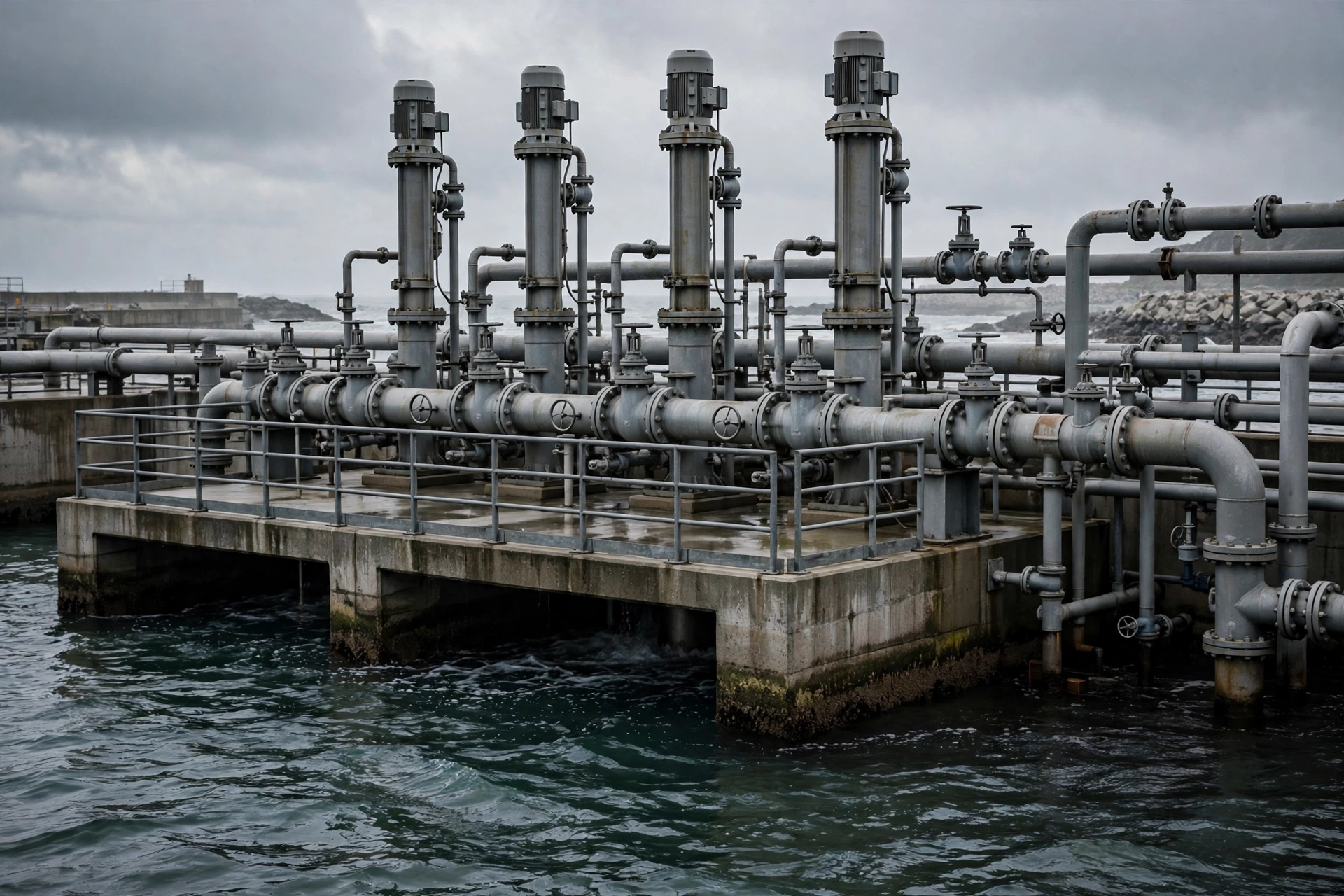
A desalination plant is, by definition, on the coast, and the generator lives in the same salt-laden air as the process. Salt air corrodes alternator windings, control cabinets and radiator cores faster than any inland site. Three provisions are worth specifying at order stage: a C5-M marine-grade coating on the canopy and base frame, anti-condensation heaters in the alternator and control panel, and a stainless or coated radiator rather than the standard unit.
Placement matters as much as coating. The set should sit above the storm-surge line and above the level of the intake pump deck, not in the lowest corner of the site where seawater goes first. The bunding rules for the fuel tank apply here with extra force: a spill at a desalination plant goes into the same sea the plant drinks from. Secondary containment of 110% of tank capacity is the minimum to specify.
The High-Pressure Pump Problem
The high-pressure pump is the load that breaks most generator sizing exercises. It is a large centrifugal pump — typically a 400–800 kW motor on a mid-size plant, 1,000 kW and above on a large one — and it has to raise seawater to 55–80 bar against the osmotic pressure of seawater at roughly 35,000 ppm total dissolved solids. Feed pressure rises with salinity, temperature and membrane age, so a pump sized for 60 bar on day one may be asked for 68 bar in year five.
Starting that motor is the problem. Direct-on-line starting draws 6–7 times running current for several seconds. A 630 kW high-pressure pump motor started direct-on-line demands a transient of roughly 4,000 kVA — more than the entire essential board of a 10,000 m3/day plant. No sane design does this. The standard answer is a variable-frequency drive, which ramps the motor from standstill to speed over 30–60 seconds and keeps starting current close to running current.
The VFD solves the starting problem and creates a different one. Drives draw non-linear current, and the generator’s alternator must be sized for the harmonic distortion they produce. The rule used across the industry is to oversize the alternator by 2.5–3 times the drive load, or to specify a drive with an active front end. Either way, the alternator decision belongs in the same conversation as the drive decision, not after it. The motor starting article covers the locked-rotor calculation and the voltage-dip limits in detail.
Energy recovery is the other half of the pump story. The brine leaving the membranes is still at almost full pressure — 55–75 bar — and it carries 55–60% of the feed flow with it. A pressure exchanger hands that energy straight back to the incoming feed stream at around 96% efficiency. That single device is the reason modern SWRO plants run at 3.0–3.5 kWh/m3 instead of the 6–8 kWh/m3 of the 1990s. It also means the high-pressure pump is smaller than the pressure suggests: the exchanger supplies most of the feed pressure, and the pump tops it up.
For the generator, the consequence is practical. The high-pressure pump motor is large, but it is a steady, predictable load once running, and it starts on a VFD ramp. The loads that actually trip generators on desalination sites are the ones nobody sized for: the intake pump that starts direct-on-line at the same moment as the VFD ramp, the air compressor that cycles on, the chemical dosing skid that nobody put on the load list. The load list must include every motor on the essential board with its starting method stated, or the first real outage will find the gaps.
What Happens in the First 60 Seconds
A grid failure at a desalination plant runs on a fixed clock, and the first minute decides the next week.
Seconds 0–10. The grid fails. The automatic transfer switch detects the loss, confirms it is not a transient dip, and signals the generator to start. NFPA 110 requires Level 1 emergency power within 10 seconds, and a well-maintained set reaches rated speed and voltage in 8–10 seconds. The ATS-gap article covers that transfer sequence in detail.
Seconds 10–30. The generator accepts load in steps. Controls and instrumentation first, then intake and pre-treatment, then the RO trains one at a time on their VFD ramps. A train that is ramped too fast will trip on overcurrent or on low suction pressure. The sequence is programmed into the plant control system, and it should be tested under load, not assumed.
Seconds 30–60. The membranes tell the story. When the high-pressure pump stops, pressure in the vessels decays. If the vessels were not flushed with permeate water, the feed side still holds seawater at 35,000 ppm, while the permeate side holds product water at a few hundred ppm. Natural osmosis then drives permeate backwards through the membrane — the permeate suck-back that DuPont’s FilmTec guidance warns about. The backflow itself can have a mild cleaning effect, but the membrane must never be exposed to a static permeate backpressure above 0.3 bar, and air must never be sucked into the elements. Check valves or atmospheric drain valves in the permeate line are the safeguard, and they must work during an unscheduled shutdown, not only during a planned one.
That is the 60-second story. The longer story is measured in hours, and it is governed by the shutdown rules that membrane manufacturers publish and too many plants ignore.
A membrane system is designed to run continuously. When it must stop, DuPont’s guidance is specific: flush the vessels with permeate water at about 3 bar until the concentrate conductivity matches the feedwater conductivity, stop chemical injection before flushing, and close the feed valves once the vessels are full of flushing water. The plant can then sit for 24 hours without preservation. Beyond 48 hours, the elements need a preservation solution — typically sodium bisulfite — and the vessels must never be allowed to dry out, because a dried element loses flux irreversibly.
In warm seawater, above 20°C, stagnant water in the vessels turns in about three days: bacteria multiply, biofilm forms, and the next start-up pushes a fouled membrane back into service. The rule is to flush every 24 hours while the plant is idle, or every day at water temperatures above 20°C. A generator that keeps the flush pumps and the control system alive is what makes that flushing possible. A plant with no backup power cannot flush at all, and its membranes sit in concentrated seawater while the outage runs its course.
The restart sequence is the mirror image. Flush first, repressurise gradually on the VFD ramp, bring permeate quality back inside specification before sending a litre to the product tank, and discard the first permeate — its salt passage is always high after a stop. A plant that restarts in a hurry sends off-spec water into the network and then spends a week explaining it.
Three Plants, Three Lessons
Case 1: Sydney — the tornado that took out a 250,000 m3/day plant
The Sydney Desalination Plant at Kurnell produces 250,000 m3/day — about 15% of Sydney’s drinking water — from a site built for A$1.803 billion and completed in 2010. On 16 December 2015, a tornado struck Kurnell with wind gusts of 213 km/h, the highest ever recorded in New South Wales. Large areas of the plant’s roof were blown off, the control room windows were blown out, and water and wind damage reached the control room itself.
The plant was in Water Security Mode — effectively standby — at the time, because dam levels were healthy. No water was lost to the network. But the reinstatement took nearly three years. About 34,000 operational assets were inspected, roughly 15% of them completely replaced, and repairs were not completed until October 2018. Even then, the operator’s own figures said the plant needed 3–4 months to produce its first water after switch-on, and 6–8 months to reach full capacity.
The lesson is not about wind loading. It is about the control room. The membranes survived. The pumps survived. The part of the plant that took the damage was the building that houses the controls — the same Tier 1 load the generator exists to protect. A backup power design that protects the process and leaves the control building exposed to the same storm has protected the wrong thing. Generators, control panels and switchgear at coastal plants need the same storm hardening as the process halls, and they need to sit above the surge line.
Case 2: Sorek — the scale that makes the essential board the whole answer
Sorek, on Israel’s Mediterranean coast, produces 624,000 m3/day and supplies about 20% of the country’s municipal water. It was the world’s largest SWRO plant when it opened in 2013, built for around $500 million, and it sells water to the national water authority for $0.58/m3. Its 16-inch membrane elements — twice the size of the largest used before — were an industry first.
At 3.0 kWh/m3, Sorek’s average electrical load is about 78 MW. That number is the point. No diesel installation backs up 78 MW, and no buyer should be sold one that claims to. The backup design for a plant of Sorek’s size is an essential board: controls, intake protection, flush pumps and a small number of RO trains, sized so the membranes survive the outage and the plant restarts in hours rather than weeks.
Sorek 2, commissioned in March 2025 at 670,000 m3/day, and Taweelah at 909,200 m3/day, follow the same logic at even larger scale. The generator question at that size is not “how big” but “which trains, and what happens to the rest”. The answer is written into the plant’s operating procedures before the generator is ordered, not after.
Case 3: Worked example — a 2,000 m3/day island plant
A resort island in the Indian Ocean runs a 2,000 m3/day SWRO plant as its only water source. Grid power is a single submarine cable, and it has failed twice in three years. The essential board is:
| Load | Running load |
|---|---|
| Seawater intake pump | 40 kW |
| Pre-treatment (media filters, UF) | 25 kW |
| High-pressure pump (VFD) | 230 kW |
| Energy recovery booster | 30 kW |
| Post-treatment and dosing | 20 kW |
| Controls, SCADA, lighting | 15 kW |
| Total | 360 kW |
At 0.8 power factor, 360 kW is 450 kVA. The correct set is a 500 kVA prime-rated machine, not a 500 kVA standby-rated one: the island’s outages run for days, and the standby rating’s 200-hour annual limit under ISO 8528-1 would be exhausted by the second outage of the year. The standby and prime power ratings article explains the distinction and why a standby set sold into prime duty fails early.
Fuel at 90% load on a 500 kVA prime set runs about 85 L/h. Seventy-two hours of autonomy needs 6,120 litres, so the island specifies a 7,000-litre bulk tank with a contracted delivery by barge. The set is containerised, coated to C5-M marine standard, and fitted with remote monitoring so the mainland operator sees fuel level, battery voltage and running hours without a site visit.
The plant’s total electrical load is about 480 kW; the generator covers the 360 kW essential board and sheds the rest. That is the design in one line: protect the water, protect the membranes, and let the rest wait.
Frequently Asked Questions
What size generator does a desalination plant need?
It depends on plant capacity and how many RO trains must keep running. A 1,000 m3/day plant needs about 200 kVA, a 10,000 m3/day plant about 1,600 kVA, and a 100,000 m3/day plant several megawatts in parallel sets. The essential board, not the total plant load, is the number to size from.
Do desalination plants need a backup generator?
Yes, and the reason is the membranes rather than the water. A plant can survive a few hours without producing water, but an unflushed shutdown leaves membranes sitting in concentrated seawater, and a restart without flushing pushes fouled membranes back into service. The generator keeps the flush pumps and controls alive so the shutdown is orderly.
How long can a desalination plant run on a generator?
As long as the fuel lasts and the rating allows. A prime-rated set has no annual hour limit under ISO 8528-1, so the practical limit is fuel logistics: 72 hours of autonomy is the standard to specify, with a contracted delivery plan behind it. A standby-rated set is limited to 200 hours a year and is the wrong choice for a plant that loses grid power regularly.
What happens to a desalination plant during a power outage?
Pressure in the membrane vessels collapses within seconds, and permeate can flow backwards through the membranes by natural osmosis. If the plant is not flushed with permeate water at about 3 bar, the membranes sit in concentrated seawater, biofilm grows within days in warm water, and the restart produces off-spec water until the membranes are cleaned or replaced.
Can a diesel generator power a desalination plant?
It can power the essential board of an RO plant — controls, intake, pre-treatment and selected RO trains — but it cannot power a whole large plant, and it cannot supply the steam a thermal MSF or MED plant needs. At 78 MW average load, a plant the size of Sorek is backed up train by train, not as a whole.
Specification Checklist
1. Which loads are on the essential board? Controls, intake, pre-treatment, selected RO trains and flush pumps. Product distribution, workshops and offices are shed. If the load list does not state the starting method of every motor, it is incomplete.
2. Which rating — ESP, PRP or COP? A desalination plant that loses grid power for days at a time needs prime power, not standby. The rating letters must appear on the datasheet and the contract.
3. How many RO trains stay in service? The answer decides the set size. One train out of six is a different purchase from three, and the decision belongs in the operating procedures, not in the generator quotation.
4. Is the high-pressure pump on a VFD? If it is started direct-on-line, the transient will be six to seven times running current. If it is on a VFD, the alternator must be sized for the drive’s harmonic distortion.
5. What is the 72-hour fuel plan? Tank capacity in litres, a contracted delivery route, and a fuel testing and polishing schedule. A bulk tank that has sat for a year holds degraded fuel.
6. Will the membranes survive the outage? Flush pumps on the generator board, permeate available for flushing, backpressure protection on the permeate line, and a written restart procedure that discards the first permeate. If the quotation does not mention flushing, the supplier has not designed for a desalination plant.
A desalination plant buys water security by the cubic metre, and the generator is the cheapest part of that security. The membrane replacement for a mid-size plant runs into six figures; a single 8-inch element costs roughly $500–$800, and a plant holds hundreds of them. The set that keeps the flush pumps running costs less than the membranes it protects. Before requesting a price, a buyer should provide four lines: plant capacity in m3/day, the number of RO trains and their high-pressure pump motor sizes, the essential-board load list with starting methods, and the site’s altitude, maximum temperature and distance from the sea. Any manufacturer that knows its business — PAVO included, with a range of 9 to 3,750 kVA in open, silent and containerised configurations, powered by Cummins, Weichai, Yuchai and Shanghai Diesel — will price the correct set from those four lines.
For a sizing review on a specific plant, contact PAVO with the capacity, the RO train count and the essential-board load list.