

What Size Generator Does a Biogas Plant Need? | PAVO
A biogas plant is the one power station that eats its own fuel supply when the grid fails. Stop the heat and the mixing, and the bacteria that make the gas go quiet — sometimes for days.
What size generator does a biogas plant need? A biogas plant needs a 100–1,000 kVA diesel generator, sized to its CHP class and feedstock throughput — roughly 150–250 kVA for a 250 kW farm plant and 500–750 kVA for a 1 MW food-waste plant. The set must carry digester heating, mixers and gas handling, not just the CHP auxiliaries.
Contents
- What a Biogas Plant Actually Needs When the Grid Fails
- How Big: Sizing a Biogas Plant Generator by Plant Size
- The Digester Window: Why Temperature Is the Real Deadline
- The CHP Problem: When the Plant’s Own Generator Goes Down With the Grid
- Three Biogas Plants, Three Outages
- Fuel, Gas Safety and Placement
- Frequently Asked Questions
- Specification Checklist: Nine Questions Before the Contract
What a Biogas Plant Actually Needs When the Grid Fails
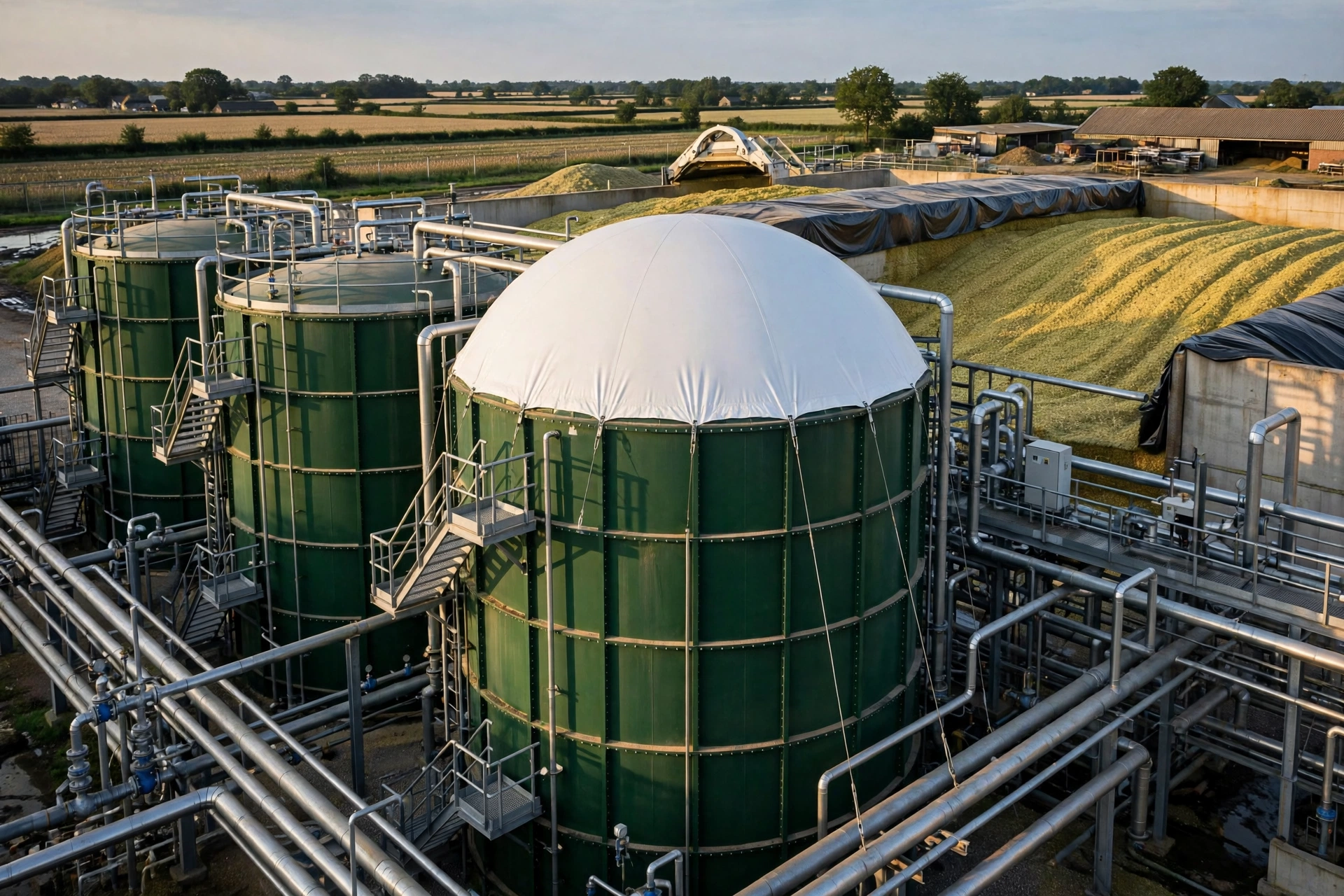
A biogas plant is not a building with a generator. It is a living process with a generator attached. Inside each digester, bacteria break down manure, food waste or crop silage in the absence of oxygen and release biogas — typically 50–70% methane and 30–40% carbon dioxide, with traces of hydrogen sulphide. That gas feeds a combined heat and power (CHP) engine, which turns it into electricity and heat. The heat goes back into the digesters to hold them at temperature. The electricity runs the plant and is exported to the grid.
Break any link in that loop and the whole plant degrades. The grid fails, the CHP engine stops, the heat stops, the digesters cool, the bacteria slow down, and gas production falls. A plant that loses power for an afternoon can lose gas production for a week. That is the difference between a biogas plant and a warehouse or a hotel. A warehouse loses a day of work. A biogas plant loses its biology.
Germany illustrates the scale. The Fachverband Biogas counted 9,315 biogas plants with on-site power generation in September 2025, plus 290 biomethane upgrading plants, producing around 87 TWh of biogas a year — more than any other country in the IEA Bioenergy Task 37 survey. China has more plants, over 100,000, mostly small. Most German farm plants run CHP engines in the 250–500 kW class. Every one of them has the same vulnerability: the plant makes its own power, but it cannot restart itself without grid power or a diesel set.
The load list for a biogas plant is therefore drawn up in tiers, and the tiers follow the process, not the building.
The first tier is the biology: digester heating circulation pumps, the mixers or agitators that keep the digestate moving, and the feed pumps that keep fresh substrate entering on schedule. A digester that stops mixing stratifies. Solids settle, a crust forms on top, and the bacteria in the lower layers starve while the gas bubbles stop finding their way out. Heating matters more than mixing in the first hours, and mixing matters more than heating over the first days. Both belong in tier one.
The second tier is gas handling: the gas booster or blower that moves biogas from the holder to the engine, the gas treatment skid that strips hydrogen sulphide and moisture, the flare igniter and its controls, and the gas holder level monitoring. Biogas keeps being produced for a while after the power fails, because the bacteria do not stop instantly. Gas keeps accumulating in the holder. If the holder fills and the flare cannot light, the pressure relief valves lift and raw biogas vents to atmosphere. A plant that loses its flare control during an outage has a gas problem on top of a power problem.
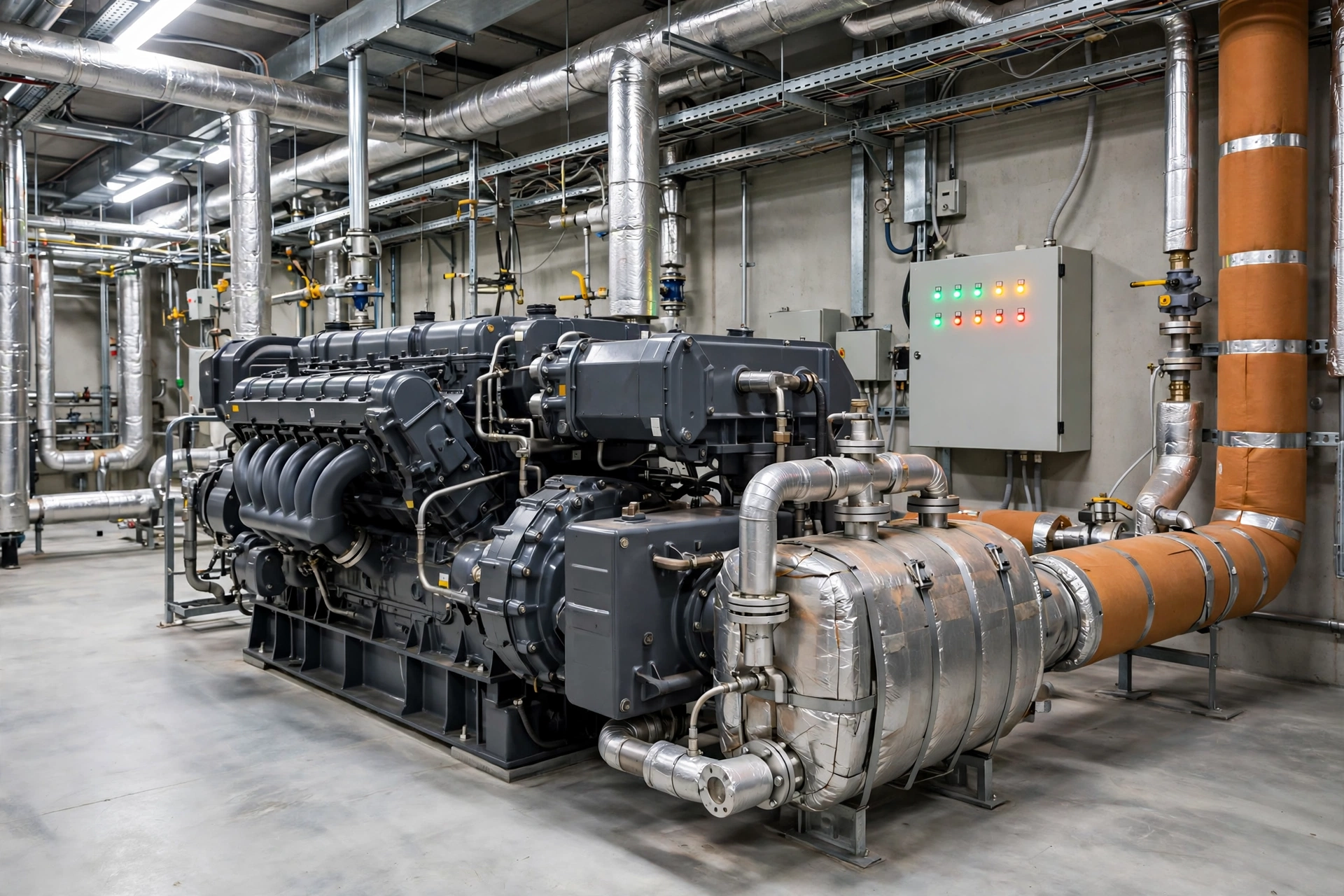
The third tier is the CHP engine itself: its starting system, jacket-water and lubrication pre-heating, cooling fans, ventilation and the control panel that manages synchronisation. A CHP engine is a gas engine, not a diesel engine. It cannot black-start the plant on its own in most installations, because its controls, gas train and auxiliaries need grid power or a separate source to come alive. That is the central irony of biogas backup power: the plant owns a generator, and still needs another generator.
The fourth tier is everything that keeps the site operating: feedstock reception and pre-treatment, pasteurisation where the regulations require it, digestate separation and pumping, the SCADA system and remote monitoring, lighting, and the office. Feedstock handling can wait a few hours. Pasteurisation cannot wait indefinitely, because animal by-product rules in the EU require Category 3 material to be held at 70°C for one hour, and a batch that cools halfway through the cycle has to be re-run or discarded.
The mistake most often made in biogas backup power is sizing the diesel set for the CHP auxiliaries alone. A 250 kW CHP engine needs perhaps 15–20 kW of auxiliaries. A set sized to that figure starts the engine, and then discovers that the digesters have been cooling for two hours, the mixers are stalled, the gas booster is off, and the flare is dark. The diesel set has to carry the process, not just the engine.
How Big: Sizing a Biogas Plant Generator by Plant Size
Sizing starts with the CHP class, because that is the figure every plant operator knows. A plant with a 250 kW CHP engine does not need a 250 kVA diesel set. It needs a set sized to the electrical load that keeps the process alive while the CHP is down — and that load is a fraction of the CHP rating, plus the starting surge of the largest motors.
The working rule is straightforward: add up the tier-one and tier-two loads at their running values, add the largest single motor starting surge, and add a 20–25% margin for load growth and voltage dip. The generator sizing guide gives the full method. The table below gives the result for the five plant sizes most commonly built.
| Plant type | CHP class | Feedstock | Diesel set | Running load on the set |
|---|---|---|---|---|
| Small farm | 75 kW | 15–20 t/day cattle slurry | 100–150 kVA | 60–90 kW |
| Medium farm | 250 kW | 50–70 t/day slurry + silage | 150–250 kVA | 90–150 kW |
| Large farm | 500 kW | 100–140 t/day mixed feedstock | 300–500 kVA | 180–300 kW |
| Food waste | 1 MW | 80–120 t/day food waste | 500–750 kVA | 300–450 kW |
| Industrial / wastewater | 2 MW | 200+ t/day or large sludge flow | 1,000–1,500 kVA | 600–900 kW |
Those running loads are smaller than the CHP rating because the CHP engine itself is not running on the diesel set. The diesel set powers the process around the engine: mixers, pumps, blowers, heating circulation, gas treatment and controls. A 500 kW farm plant typically draws 180–300 kW from its diesel set during an outage — roughly half the CHP rating. A 1 MW food-waste plant draws 300–450 kW, because food-waste plants run heavier pre-treatment: shredders, pulpers, pasteurisation and digestate separation.
The starting surge decides the frame, not the running load. Digester mixers are the worst offenders. A 15 kW submersible mixer on direct-on-line starting draws five to seven times its running current for a few seconds. Two mixers starting together, plus a 22 kW feed pump, can pull 150–200 kVA of starting demand from a set that only carries 90 kW of running load. That is why the table gives a range rather than a single figure, and why the upper end of the range applies when mixers start together. Stagger the starts — one mixer, wait ten seconds, the next — and the set can be a frame smaller. The motor starting guide covers the starting methods that make that possible: star-delta, soft starter and variable-speed drive, in that order of cost.
Feedstock sets the gas yield, and the gas yield sets how much the plant loses per hour of outage. Cattle slurry yields only 15–25 m³ of biogas per tonne. Maize silage yields 200–220 m³ per tonne. Food waste yields around 110 m³ per tonne. Each cubic metre of biogas produces about 2 kWh of electricity in a CHP engine running at 37–43.5% electrical efficiency. A 500 kW farm plant running on maize silage burns roughly 1,250 m³ of biogas an hour at full load. Every hour the CHP is down costs about 500 kWh of electricity — and, more importantly, the heat that would have kept the digesters at temperature.
That heat is the hidden load. A CHP engine running at 40% electrical efficiency and up to 90% total efficiency with heat recovery produces roughly as much usable heat as electricity. On a 500 kW plant that is about 500 kW of heat, and a large share of it goes straight back into the digesters. When the CHP stops, the diesel set has to replace the electrical part of that loop — the circulation pumps and the boiler or electric heaters that take over digester heating. A plant that heats its digesters with a biogas boiler has an easier outage than one that depends entirely on CHP jacket heat, because the boiler needs only a small electrical supply to keep burning stored gas. That single design choice can halve the diesel set size.
The standby and prime ratings decide which set to buy, not just how big. A biogas plant that loses grid power a few times a year needs a standby-rated set. A plant on a weak rural grid that loses power weekly, or a plant that runs its diesel set as part of a planned islanding test every month, needs a prime-rated set. The price difference is roughly 10–15% per kVA, and the wrong choice shows up as an early overhaul, exactly as it does on any other prime-duty site.
The Digester Window: Why Temperature Is the Real Deadline
Every other building on a backup-power list has a deadline measured in hours of comfort or tonnes of spoiled stock. A biogas plant has a deadline measured in degrees Celsius. The bacteria that make methane — methanogens — work inside a narrow temperature band, and they punish any drift outside it.
Most farm plants run mesophilic digesters at 37 ± 1°C, with a hydraulic retention time of 25–40 days. Thermophilic plants run at 55 ± 0.5°C with a retention time of 12–18 days. Thermophilic digestion produces gas faster and kills more pathogens, but it is far less forgiving: research shows that a change of just ±4°C in mesophilic conditions, and only ±1°C in thermophilic conditions, significantly reduces the rate of biogas production. The tighter the band, the faster the fall.
When the heat stops, the digester cools at a rate that depends on its size, insulation and the weather. Irish EPA licence guidance puts the figure at 0.5–10°C a day if feeding stops and the heat is off. A large, well-insulated concrete digester in summer loses less than a degree a day. A small steel tank in a January wind loses far more. Either way, the direction is the same, and the threshold is known: once the temperature has dropped to 28°C, gas production falls significantly. A mesophilic digester that starts at 37°C has nine degrees of margin. At one degree a day, that is nine days. At three degrees a day, it is three days. At five degrees a day in a cold snap, it is under two days — and the gas was already falling before the threshold was reached.
The recovery is slower than the fall. A laboratory study of thermophilic digestion of municipal organic waste simulated a heating failure by dropping the temperature from 55°C to 20°C and holding it there. Biogas production almost stopped, volatile fatty acids accumulated rapidly, and pH fell. When the temperature was restored, methane production resumed after 3 hours for a one-hour cold period, 11 hours for five hours cold, 56 hours for twelve hours cold, and 72 hours for a full day cold. A 24-hour outage cost three days of gas production — and that was in a two-litre laboratory digester with perfect mixing. A 600 m³ farm digester reheats far more slowly.
The mechanism is a downward spiral, and it has a name operators use with respect: a sour digester. Acid-forming bacteria keep working as the temperature falls, because they tolerate a wider range than the methanogens. Volatile fatty acids accumulate faster than the methanogens can consume them. The buffering capacity is used up, pH falls, and methane production declines further because the methanogens are now inhibited by the acid as well as the cold. The US EPA AgSTAR operator guidebook describes pH as a lagging indicator — by the time the pH meter shows the problem, the biology has been sliding for hours. The early warning is the gas meter: falling gas production and falling methane content, while the feed rate stays the same.
Restarting a cooled digester is not a matter of switching the heat back on. The Irish EPA guidance describes the procedure: mix continuously so no mat forms on the surface, warm the contents up slowly, and do not resume feeding at the normal rate until the temperature and the gas production have stabilised. A full start-up from cold takes one to three months to reach steady state. A plant that lets a digester go cold in January may not be back to full gas production until spring. The diesel set that prevents that is cheap by comparison.
| Digester state | Temperature | What happens | Recovery time |
|---|---|---|---|
| Normal mesophilic | 37 ± 1°C | Full gas production | — |
| Drift | 33–36°C | Gas rate falls, acids begin to accumulate | Hours once heat returns |
| Significant drop | Below 28°C | Gas production falls sharply | Days of reduced output |
| Cold shock | 20°C for 24 h | Gas almost stops, VFA accumulates, pH falls | 72 hours to resume methane (lab scale) |
| Full restart from cold | Ambient | Biology dormant, feeding must stop | 1–3 months to steady state |
The practical consequence is a simple rule for the generator specification: the diesel set must start fast enough and run long enough that the digester never drops more than 2–3°C. That means an automatic transfer switch with a 10-second start, not a manual changeover that waits for someone to drive to the site. It means fuel for at least 72 hours, because a grid outage that lasts a weekend is the one that kills a digester. And it means the heating circulation pumps are wired to the emergency board, not left on the normal board because “the CHP will handle the heat”. The CHP cannot handle the heat when the CHP is the thing that has stopped.
Thermophilic plants need a tighter rule still. Their ±1°C band means a heating failure shows up in the gas meter within hours, not days. A thermophilic plant on a weak grid should treat its diesel set as process equipment, not as a building service — tested monthly under load, fuelled for 72 hours, and sized for the heating load as well as the mixing load. The extra cost of a larger set is measured in hundreds of pounds a month. The cost of a sour digester is measured in weeks of lost gas.
The CHP Problem: When the Plant’s Own Generator Goes Down With the Grid
A biogas plant already owns a generator. It is called a CHP engine, it runs on the plant’s own gas, and it produces electricity and heat at the same time. The obvious question — why buy a diesel set when the plant already has one — has a short answer: the CHP engine cannot restart the plant by itself.
A CHP engine needs grid power, or a separate source, to come alive. Its control panel, its gas train, its starting system, its lubrication and jacket-water pre-heating, and its synchronisation equipment all draw power before the engine produces any. Most grid-connected CHP installations also have anti-islanding protection that disconnects the engine the moment the grid fails, and deliberately prevents it from reconnecting until the grid has been stable for several minutes. That protection exists for good reason: a generator feeding a dead grid endangers the linesmen repairing it. But it means the plant’s own engine goes dark at exactly the moment it is needed most.
The diesel set is therefore the bridge. It starts on the automatic transfer switch, takes up the tier-one and tier-two loads, restores heat and mixing, and holds the process steady while the operator decides what to do next. In some installations the diesel set also provides the reference voltage the CHP engine needs to synchronise and restart — a controlled islanding sequence, run by the plant controller, that brings the CHP back online on the plant’s own gas while the grid is still down. That sequence has to be designed in, tested, and written into the operating procedure. It does not happen by accident, and a CHP engine that is simply left in automatic mode will sit idle through the whole outage, waiting for a grid that is not coming back.
The numbers explain why the CHP engine is worth restarting rather than leaving off. A modern biogas CHP engine converts gas to electricity at 37–43.5% electrical efficiency, and with heat recovery the total efficiency reaches 90%. A 500 kW CHP engine produces roughly 500 kW of electricity and 500 kW of heat from about 1,250 m³ of biogas an hour. The diesel set that replaces it during an outage burns diesel at roughly 70 litres an hour for a 500 kVA frame at 75% load — about £100 an hour at current UK red diesel prices, before delivery. Running the plant on diesel for a weekend costs thousands. Running it on its own gas, once the CHP is back, costs the feedstock the plant was already buying. The diesel set earns its keep by keeping the biology alive for the hours until the CHP can take over again.
Gas quality decides whether the CHP engine survives the outage at all. Raw biogas carries hydrogen sulphide at typically 100–4,000 ppm. CHP engines work best with H₂S below 500 ppm, and the gas treatment skid — iron sponge, activated carbon or biological scrubbing — is what keeps it there. That skid needs power. If the treatment skid stops during an outage and the CHP restarts on untreated gas, the H₂S attacks the engine oil, the bearings and the exhaust system. The damage does not show up on the day. It shows up as a shortened oil life, then a bearing failure, months later. The diesel set must therefore power the gas treatment skid from the first second of the outage, not from the moment someone remembers it.
There is a second gas problem during an outage: too much gas, not too little. The bacteria keep producing gas for hours after the power fails, and the gas holder keeps filling. A typical farm plant has a double-membrane gas holder sized for a few hours of production — the AFBI Hillsborough research plant, for example, had a 200 m³ gas holder on a 600 m³ digester. When the holder reaches its limit and the CHP is not running to burn the gas, the flare has to light. The flare igniter and its flame monitoring need power, and they need it from the emergency board. A plant whose flare controls are on the normal board discovers during its first real outage that its only safe way to dispose of excess gas is a pressure relief valve venting raw biogas — roughly 60% methane — straight into the air. That is a safety failure and an environmental offence in the same moment.
The operating rule that follows is simple to state and easy to forget: during an outage, the diesel set runs the process, the flare disposes of the surplus, and the CHP restarts as soon as the controller allows it. The diesel set is not a substitute for the CHP engine. It is the thing that keeps the plant alive long enough for the CHP engine to come back. Where a plant upgrades its raw biogas to biomethane for grid injection, the upgrading skid — membranes, compressors and monitoring — draws a steady electrical load of its own, and the design questions overlap with those of gas processing plants.
Three Biogas Plants, Three Outages
Case 1: The Research Farm That Proved the Small Plant Works
The Agri-Food and Biosciences Institute research farm at Hillsborough, Northern Ireland, ran one of the best-documented small biogas plants in the literature. A 600 m³ continuously stirred digester ran at 37°C on cattle slurry from about 300 dairy cows, with a 200 m³ gas holder and a 23 kW Tedom CHP engine. Over 27 months on slurry alone, the CHP ran 26,283 engine hours and produced an average of 450 kWh of electricity and 873 kWh of heat a day, at 76% overall efficiency for biogas energy use. When the 23 kW unit was replaced, a 95 kW CHP took over the same digester.
The Hillsborough plant matters for backup power because of what it did during CHP downtime: it ran a biogas boiler. The boiler needed only a small electrical supply — circulation pumps and controls — to keep burning stored gas and keep the digester at temperature while the engine was serviced. That is the model for a small plant’s outage plan. The diesel set on a plant this size is a 100–150 kVA frame, and its job is almost entirely heat and mixing: keep the circulation pumps running, keep the agitator turning, keep the boiler lit. The plant’s own gas does the heating. The diesel does the moving.
The lesson scales up. Any plant with a gas boiler as well as a CHP engine has a cheaper outage than a plant that depends on CHP jacket heat alone. The boiler is the second heat source, and the diesel set only has to power its pumps. Specifying a boiler alongside the CHP adds cost at construction. It repays that cost the first time the CHP is down for a week and the digester stays at 37°C.
Case 2: The 500 kW Farm Plant and the January Weekend
A typical 500 kW farm plant in Lower Saxony runs two digesters of about 1,500 m³ each on a mix of cattle slurry and maize silage — roughly 120 tonnes of feedstock a day, producing about 1,250 m³ of biogas an hour at full load. The CHP engine is the plant’s income: electricity sold to the grid under the EEG tariff, heat used on the farm. The plant employs two people, and at weekends it runs unattended, watched by a remote monitoring system.
In January, a storm took down the grid connection on a Friday evening. The automatic transfer switch started the 400 kVA diesel set in under ten seconds. Mixers, heating circulation and the gas booster came back. The CHP engine stayed off — anti-islanding protection, correctly, kept it disconnected. The flare lit automatically and burned the surplus gas through the night.
By Saturday morning the digesters had lost less than a degree. The operator, alerted by the monitoring system, drove out, checked the gas holder level and the flare, and confirmed the digesters were holding at 36°C. The grid returned on Sunday afternoon, 40 hours after it failed. The diesel set had burned about 2,400 litres — 40 hours at roughly 60 litres an hour. The CHP restarted on its own gas, synchronised, and was back at full load within the hour. Gas production never dropped below 90% of normal.
The counterfactual is the same plant without the diesel set. The digesters would have lost 3–5°C a day in January. By Sunday the temperature would have been near 30°C, gas production would have fallen by half, and the volatile fatty acids would have been accumulating. Recovery would have taken a week of careful feeding at reduced load, and the lost electricity revenue alone would have exceeded the diesel bill several times over. The set cost the farm roughly £35,000 installed. One January weekend repaid a substantial part of it.
Case 3: The Food-Waste Plant and the Batch That Had to Be Re-Run
A 1 MW food-waste plant in the English Midlands processes about 100 tonnes of food waste a day — supermarket returns, catering waste and brewery residues — and pasteurises every batch at 70°C for one hour before it enters the digester, as the animal by-product rules require. The plant’s diesel set is a 750 kVA frame, sized for the pasteurisation load as well as the digesters.
During a summer outage the grid failed at 11 in the morning, halfway through a pasteurisation batch. The diesel set started, the mixers and heating came back, and the pasteuriser held its temperature — but only because the pasteurisation vessels were wired to the emergency board. A sister plant built two years earlier had left pasteurisation on the normal board, and its first outage cost it a full batch: 20 tonnes of food waste that had to be cooled, re-heated and re-run, at a cost of a day’s throughput and a day’s gate fees.
The food-waste plant’s outage lasted nine hours. Its diesel set burned about 550 litres. The plant lost no feedstock, no batch and no gas production. The case is a reminder that the load list has to follow the process, not the building: pasteurisation is not a building service, it is a process step, and process steps belong on the emergency board. The water and wastewater treatment sector learned the same lesson years ago — its plants put aeration blowers and sludge pumps on emergency power first, and offices last. A biogas plant should do the same, with digesters, mixers, gas handling and pasteurisation at the top of the list.
Fuel, Gas Safety and Placement
Fuel autonomy is the first number to settle, because it decides the tank. A biogas plant’s diesel set is not a standby set that runs for an hour a year. It is a process lifeline that may have to run for a weekend, and the fuel math is unforgiving.
The Cummins C500D5, a 500 kVA standby / 455 kVA prime frame often specified for mid-size plants, burns 93.2 litres an hour at full prime load, 69.9 litres an hour at 75%, 49.0 at 50% and 29.2 at 25%. A 500 kW farm plant running its set at 75% load through a 72-hour outage needs 69.9 × 72 = 5,033 litres — a 5,000-litre bulk tank, full, before the outage starts. A 1 MW food-waste plant on a 750 kVA frame at similar loading needs closer to 7,500 litres for the same 72 hours. Those figures assume the set carries the process load only. If the operator also powers the farmhouse, the workshop and the office from the same set, the fuel bill rises and the autonomy falls.
Fuel storage brings its own risk, and diesel fuel ageing matters more on a biogas plant than on most sites, because the set may sit for months between outages. Diesel in a bulk tank absorbs water, grows microbes and loses stability. A tank that is full of two-year-old fuel is not a 72-hour reserve. It is a filter-blocking, injector-fouling liability. The fuel should be tested annually, polished if the water content rises, and turned over by running the set under load every month — which is also the test that proves the set will start.
Gas safety decides where the set goes, and it is the part of the specification most often left to the installer. Biogas is typically 45–75% methane, and a 60% methane mixture has an explosive range of about 6–22% by volume in air. The inside of the gas system is normally too rich to burn. The danger is where gas can escape and mix with air: pressure relief devices, the membrane gas holder, condensate traps, gas blowers and the CHP engine room. German guidance in TRGS 529 and the DGUV example collection, and IEC 60079-10-1 elsewhere, require an explosion protection document that draws the hazardous zones around those release points. The diesel set, with its hot exhaust and its electrical equipment, must sit outside the zones — or be specified with the right equipment protection level for the zone it sits in.
Hydrogen sulphide is the second hazard, and the more insidious one. Raw biogas carries H₂S at typically 100–4,000 ppm, occasionally up to 2%. The smell of rotten eggs is obvious at low concentrations, but the sense of smell is deadened from about 100 ppm, and lethal concentrations are reported at around 300 ppm. H₂S is heavier than air, so it settles in valve pits, drainage sumps and low points around the plant. A diesel set installed in a pit or a low-lying enclosure near the digesters can sit in a gas that its operator cannot smell. Fixed gas detection — methane sensors high, H₂S sensors low — belongs in the generator enclosure as well as in the CHP room, and it belongs on the emergency power supply so it keeps working through the outage that creates the risk.
Placement has three more rules. First, the set needs the same ventilation and cooling consideration as any other installation, and a biogas plant site is often hot, dusty and humid — the digester hall throws off heat and moisture, and the feedstock reception area throws off dust. Second, the set must be reachable by a fuel tanker in all weather, because a 72-hour outage that outlasts the tank needs a delivery, and a tanker cannot reach a set parked behind a slurry lagoon in January mud. Third, the set must be far enough from the gas holder and the flare that a gas release does not reach it, and close enough to the digesters that the cable runs are short and the voltage drop is small. On most farm plants that means a concrete plinth on the clean side of the site, upwind of the digesters, with the fuel tank bunded and the exhaust pointing away from the gas holder.
The farm generator market has learned these lessons the hard way, and a biogas plant is, at its heart, a farm with a chemical process attached. The same rules apply: size for the process, fuel for 72 hours, test under load every month, and put the set where the gas cannot reach it and the tanker can.
Frequently Asked Questions
What size generator does a biogas plant need?
A biogas plant needs a 100–1,000 kVA diesel generator, sized to its CHP class and feedstock throughput. A 75 kW farm plant needs 100–150 kVA, a 250 kW plant needs 150–250 kVA, a 500 kW plant needs 300–500 kVA, and a 1 MW food-waste plant needs 500–750 kVA. The set must carry digester heating, mixers and gas handling, not just the CHP auxiliaries.
Do biogas plants need a backup generator?
Yes. A biogas plant needs a backup generator because its CHP engine cannot restart the plant on its own — anti-islanding protection disconnects it when the grid fails, and its controls need power to come alive. Without a diesel set, the digesters cool, gas production falls, and a 24-hour outage can cost three days of gas output or more.
How long can a biogas plant run on a generator?
A biogas plant can run on a diesel generator for as long as its fuel lasts — a 500 kVA set at 75% load burns about 70 litres an hour, so a 5,000-litre tank gives roughly 72 hours. The practical limit is the digester temperature, not the fuel: the set must start within seconds and keep the digesters within 2–3°C of their set point for the whole outage.
What happens to a biogas plant during a power outage?
During a power outage the CHP engine stops, digester heating and mixing stop, and the digesters begin to cool at 0.5–10°C a day. Gas keeps being produced for a while and fills the holder until the flare burns it or the relief valves lift. If the outage lasts long enough for the temperature to fall below 28°C, gas production drops sharply and the digester can turn sour, taking days or weeks to recover.
Can a diesel generator power a biogas plant?
Yes, a diesel generator can power a biogas plant, and it is the standard backup for the sector. The set powers digester heating circulation, mixers, feed pumps, the gas booster and treatment skid, flare controls and the CHP auxiliaries. It does not replace the CHP engine — it keeps the biology alive until the CHP can restart on the plant’s own gas.
Specification Checklist: Nine Questions Before the Contract
1. Which loads are on the emergency board? Digester heating circulation, mixers, feed pumps, gas booster, gas treatment, flare controls and pasteurisation. If any of those are on the normal board, the specification is wrong.
2. What is the CHP class, and what is the running load on the diesel set? A 500 kW CHP plant typically draws 180–300 kW from its diesel set. The set is sized to that load plus the largest motor starting surge, with a 20–25% margin.
3. Which rating — standby or prime? A plant on a reliable grid needs standby. A plant on a weak rural grid, or one that tests monthly under load, needs prime. The rating letters must appear on the datasheet and the contract.
4. How fast does it start? Ten seconds through an automatic transfer switch. A manual changeover that waits for someone to drive to the site is not backup power for a digester.
5. How much fuel, and how old is it? Seventy-two hours at the expected load — about 5,000 litres for a 500 kVA frame at 75%. The fuel must be tested annually and turned over by monthly loaded running.
6. Can the CHP restart from the diesel set? The islanding sequence must be designed in, tested and written into the operating procedure. A CHP engine left in automatic mode will sit idle through the whole outage.
7. Where are the hazardous zones? The explosion protection document must draw the zones around the gas holder, relief devices, blowers and CHP room, and the diesel set must sit outside them, with fixed gas detection in its enclosure.
8. What happens to the gas while the CHP is down? The flare must light automatically from the emergency supply, and the gas holder must have capacity for the hours until the CHP restarts. If the flare controls are on the normal board, fix that before the contract is signed.
9. Will the warranty stand at the stated duty? Ask in writing: “If this set runs at the stated duty, for the stated annual hours, at the stated site conditions, will the warranty remain valid?” A direct answer, with the rating letters attached, is worth more than a 5% discount. A vague answer is a warning.
A biogas plant is a living process, and its backup power has to be specified like one. The kVA figure matters, but the temperature band matters more: a set that starts in ten seconds, runs for 72 hours and keeps the digesters within two degrees of their set point is worth more than a larger set that starts late and runs dry. Before requesting a price, a buyer should provide five lines: CHP class and feedstock throughput, the tier-one and tier-two load list with the largest single motor and its starting method, the digester temperature band and retention time, the site’s hazardous zone drawing, and the honest annual outage hours including tests. Any manufacturer that knows its business — PAVO included, with a range of 9 to 3750 kVA in open, silent and containerised configurations, powered by Cummins, Weichai, Yuchai and Shanghai Diesel — will price the correct set from those five lines. A supplier that prices from kVA alone is not doing the buyer a favour.
For a specification matched to a real biogas plant — digester heating, mixer starting surge, CHP restart and 72-hour fuel autonomy included — contact PAVO with the CHP class, the feedstock and the digester temperatures, and the correct set will be priced from those numbers, not from a catalogue headline.