

Can a Diesel Generator Run at 110% Load? The Rule | PAVO
The 10% overload allowance is the most misread line on a generator datasheet. It is a one-hour emergency window, not a second rating.
Can a diesel generator run at 110% load? Yes, for one hour in every twelve, on a prime-rated set, and no more than about 25 hours a year in total. A standby-rated set has no overload allowance at all. Treat 110% as a usable rating and the engine, the alternator windings and the warranty all fail on the same schedule.
- What the 10% Rule Actually Says
- Why 110% Exists: Motor Starting, Not Extra Capacity
- What Overload Does Inside the Engine and Alternator
- Three Sites That Tested the Rule
- Standby Sets Have No Overload Allowance
- How to Tell You Are Overloaded
- Frequently Asked Questions
- Specification Checklist: Size for the Overload You Actually Have
What the 10% Rule Actually Says
ISO 8528-1 defines four generator ratings. Only one of them carries an overload allowance, and the allowance is narrowly defined.
| Rating | Code | Annual hours | Load | Overload allowance |
|---|---|---|---|---|
| Emergency standby power | ESP | Up to 200 hours | Variable, average 70% | None |
| Prime power | PRP | Unlimited | Variable, average 70% | 10% for 1 hour in 12, about 25 hours/year |
| Continuous operating power | COP | Unlimited | Constant, 100% load factor | None |
| Limited-time running power | LTP | Up to 500 hours | Constant, up to 100% | None |
The prime power (PRP) allowance reads: 10% overload for one hour in every twelve hours of operation. Chongqing Cummins states the same rule in its warranty power regulations, and adds the annual cap explicitly: total time at 10% overload must not exceed 25 hours per year. The alternator has its own, shorter allowance: most alternator designs tolerate 50% overload for 15 seconds, long enough to ride through a motor start, and no longer.
Three conditions attach to the rule, and all three are routinely ignored. First, the one hour in twelve is a recovery ratio, not a daily budget to be spent in one block. Second, the average load factor over 24 hours must stay at or below 70% of the prime rating — a set cannot spend eleven hours at 95% and one hour at 110% and call the day compliant. Third, the allowance applies to prime power only. A standby-rated set at 110% of its standby figure is not using a margin. It is outside its rating from the first minute.
The arithmetic is unforgiving at the boundary. A 500 kVA prime set may carry 550 kVA for one hour. A 500 kVA standby set may carry 500 kVA and nothing more. The same frame, the same engine, the same alternator — different numbers, because the rating describes the duty, not the hardware. The full comparison of the four ratings is set out in the article on standby vs prime power ratings.
Why 110% Exists: Motor Starting, Not Extra Capacity
The 10% allowance was written for transient events, not for load growth. Its original purpose is the few seconds after a large motor starts, when the generator must deliver a surge of current while the motor accelerates to speed.
A direct-on-line motor draws six to eight times its running current at standstill. A 90 kW conveyor motor is a 600 kVA problem for the first few seconds, not a 90 kW load. The voltage dips, the governor opens the fuel rack, exhaust temperature spikes, and the alternator windings carry a current far above their continuous rating. The 10% allowance, together with the alternator’s 15-second 50% capability, is the margin that lets the set absorb that transient without tripping or stalling. The sizing maths for that transient is covered in the guide to motor starting kVA.
What the allowance was never written for is a building that has grown past its generator. A hospital that adds a chiller, a factory that adds a second production line, a mine that adds a crusher — each of these pushes the steady load above the rating, and each of them is tempted to describe the excess as “only 8% over”. Eight percent over, sustained, is not an overload event. It is a new rating the manufacturer never issued.
The distinction matters because the damage mechanisms are different. A motor start lasts seconds; the windings heat, then cool. A sustained 8–10% overload lasts hours; the windings heat and stay hot, the engine runs at exhaust temperatures it was never validated for, and the cooling system operates at the edge of its capacity on a day when the ambient temperature is already 38°C. The set does not trip. That is the problem. It runs, quietly, at temperatures that shorten its life by years.
What Overload Does Inside the Engine and Alternator
Overload damage is thermal before it is mechanical. Every component in the set has a temperature limit, and overload pushes several of them at once.
The engine runs hotter than its cooling system was validated for
At 110% load, fuel delivery rises roughly 10% above the full-load figure. On a Cummins C500D5, prime full-load consumption is 93.2 L/h; at 110% it is close to 102 L/h. That extra fuel is not converted into useful power at the same efficiency. Exhaust gas temperature climbs, piston crown and exhaust valve temperatures climb with it, and the radiator — sized for the rated load at the rated ambient — has no spare capacity on a hot day. Oil temperature follows. Oil that runs 10–15°C hotter than design oxidises faster, thins sooner, and protects the bearings less. The first symptom is usually a slow rise in oil consumption, measured in litres per hundred hours, long before any alarm sounds.
The alternator windings cook from the inside
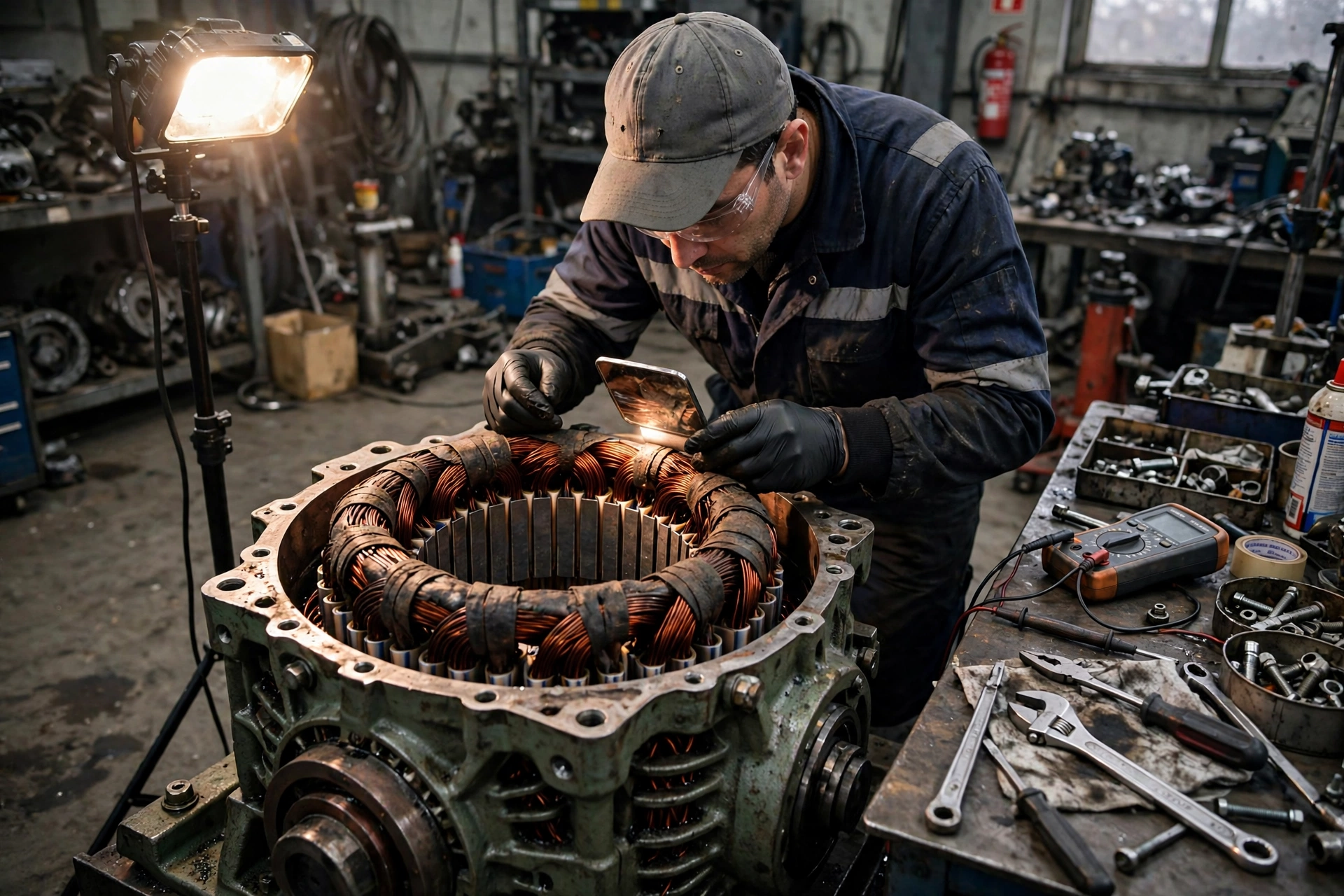
Alternator windings are insulated to a temperature class. Class H insulation is rated for 180°C at the hottest spot. At rated load, a well-designed alternator runs with margin. At 110% sustained, winding temperature rises roughly with the square of the current — a 10% current increase produces about a 21% increase in copper losses. The insulation does not fail at once. It ages. The rule of thumb in insulation engineering is that every 8–10°C above the rated temperature halves the insulation life. A set run at 110% for a few hundred hours a year can consume several thousand hours of winding life. The failure, when it comes, is a shorted turn or a ground fault, and the repair is a rewind or a replacement alternator — typically 30–40% of the cost of a new set.
The governor and the frequency give the game away
An overloaded engine cannot hold speed. The governor opens the fuel rack fully, and any further load increase pulls the frequency down. A set rated at 50 Hz that sags to 47–48 Hz under load is telling the operator, in the only language it has, that the load exceeds the engine’s capability. Sensitive loads notice first: UPS units refuse the generator supply and stay on battery, variable-frequency drives fault on undervoltage, and motors run hot at reduced speed. Frequency sag is the earliest reliable field indicator of overload, and it appears before the temperature alarms do.
Three Sites That Tested the Rule
Case 1: Cement plant — 130% for six weeks, one dead alternator
A cement plant in a remote district ran a 6.6 kV genset at 130% of rated power every day for several weeks to cover a temporary production spike. The set had no prime-rating headroom left; the operators had simply decided the overload was temporary and therefore safe. By the time the supplier was called, the stator windings had overheated far enough to cause partial insulation failure. The unit had to be replaced six months ahead of schedule. The production spike lasted six weeks. The replacement alternator, the crane hire, the transport and the lost production cost several times what a rental set would have cost for the same period. The warranty claim was refused: the controller’s event log recorded the overload hours precisely, and the rating did not permit them.
Case 2: Quarry — 108% every shift, bearings gone in 18 months
A quarry in West Africa ran a 500 kVA prime-rated set at an average of 540 kVA — 108% of prime — for ten hours a day, six days a week. The load was a crusher line that had grown by one conveyor since the set was specified. The operators knew the figure. They also knew the set had a “10% overload allowance”, and 108% is within 110%. The logic was wrong in the one way that matters: the allowance is one hour in twelve, not ten hours in ten. After eighteen months, main bearing temperatures had risen, oil consumption had reached one litre every five hours, and vibration analysis showed bearing wear far beyond the hours run. The engine needed a rebuild at roughly 9,000 hours — less than half its expected life. The rebuild cost more than the price difference between the 500 kVA set and the 630 kVA set that should have been ordered. The 10% allowance had been treated as a rating. It is not a rating. It is a clock.
Case 3: Hospital — 105% for one night, no damage, correct decision
A hospital outside Lagos lost grid power during a storm. Its 350 kVA standby set picked up the load, and a newly installed MRI chiller pushed the total to 368 kVA — 105% of the standby rating — for eleven hours. The facilities manager faced a choice: shed the chiller and lose imaging, or run 5% over. The set ran the night, held frequency, and the outage ended without incident. The correct follow-up was not to celebrate. It was to record the event, log the hours, and re-size the load list before the next outage — because a standby set has no overload allowance, and eleven hours at 105% is eleven hours outside the rating, even when nothing breaks. The hospital ordered a load-shedding controller and a larger set within the quarter. One night at 105% did not damage the machine. A year of nights at 105% would have.
Standby Sets Have No Overload Allowance
This is the point most often missed in procurement, and the most expensive to miss. Emergency standby power (ESP) carries no overload allowance. The standby figure is the ceiling, not a starting point with 10% on top.
The confusion has a simple origin. A 500 kVA standby set and a 455 kVA prime set are often the same machine. A buyer who reads the standby figure as the machine’s capability, then applies the 10% rule on top of it, arrives at 550 kVA — a figure the manufacturer never validated, never warranted, and never tested. The prime figure exists precisely because the same hardware, run without limit on hours, must be held back by about 10% to survive. Applying the prime allowance to the standby figure double-counts the margin.
The practical test is the datasheet. If the datasheet lists ESP 500 kVA and PRP 455 kVA, the 10% allowance applies to 455 kVA, giving 500 kVA for one hour in twelve. The standby figure is already the 110% number. A quotation that offers “500 kVA standby with 10% overload” is offering the prime allowance on the standby rating — a figure with no basis in the standard and no cover under warranty.
Warranty language follows the rating. Manufacturers write warranties around the rating category and the annual hours. A claim for an engine that failed after sustained operation above its rating is routinely refused on grounds of misapplication, and the controller’s logged hours are the evidence. Modern controllers record load, hours and alarms with timestamps. The log is not an opinion. It is the record the warranty assessor reads first.
How to Tell You Are Overloaded
Overload rarely announces itself with a shutdown. The protection that does exist — the generator breaker sizing and the controller’s overcurrent settings — is set to protect cables and to ride through motor starts, not to warn the operator that the set is running 8% over its rating for the third month. The signs are subtler, and they are all measurable.
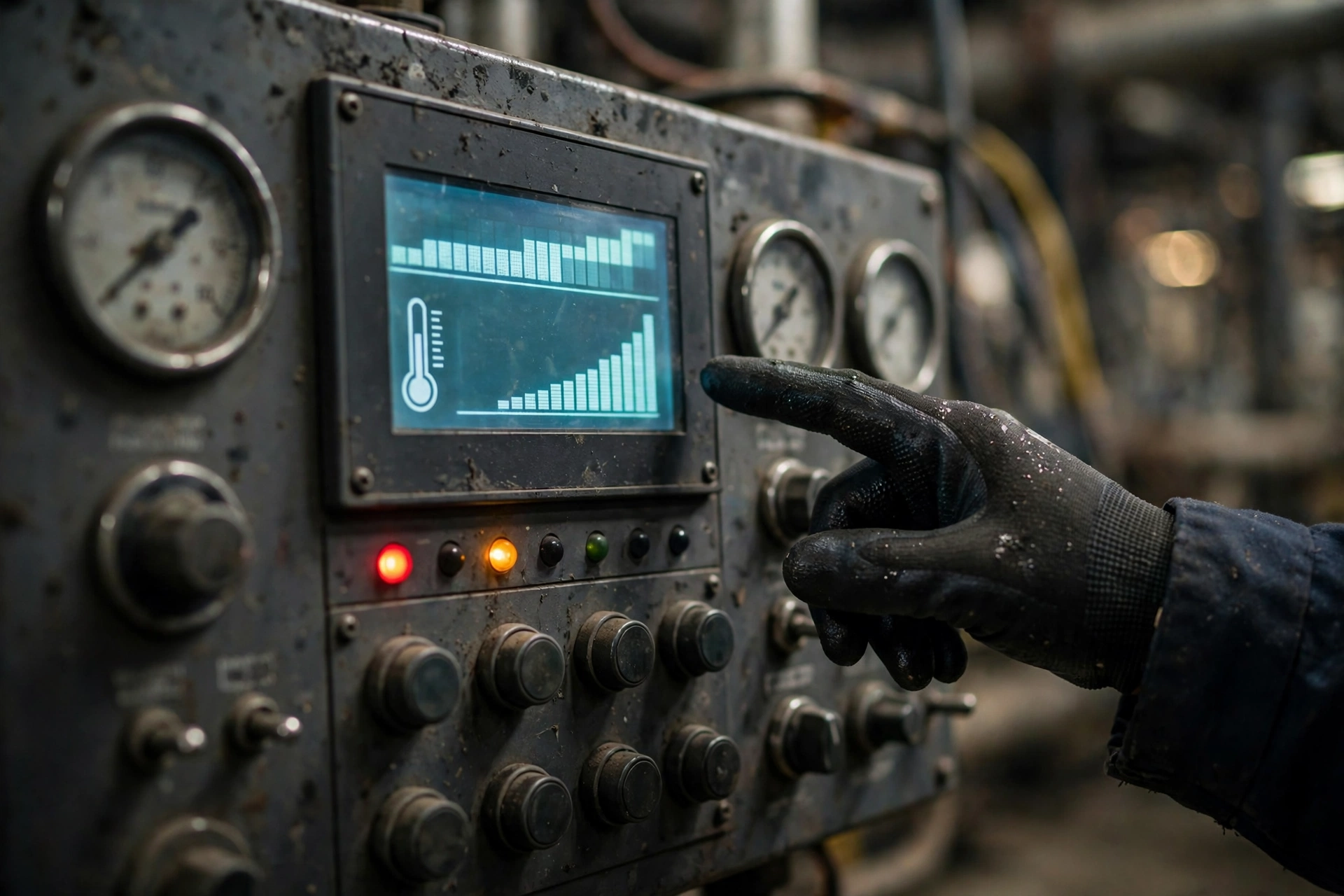
Frequency sag under load. A healthy set holds 50 Hz (or 60 Hz) within about 1% at steady load. A sustained dip to 48.5–49 Hz at steady load means the governor is at full rack and the engine has no reserve. Log frequency against load; the trend is more informative than any single reading.
Exhaust gas temperature. Most modern controllers display exhaust temperature or provide it over Modbus. A rise of 30–50°C above the full-load figure at the same ambient temperature indicates over-fuelling. Exhaust temperature is the fastest-responding overload indicator on the set, and it moves before coolant temperature does.
Fuel consumption above the datasheet figure. The C500D5 burns 93.2 L/h at prime full load. A set consistently burning 100–105 L/h at a load the operator believes is 90% is not at 90%. Fuel is the honest meter: it measures what the engine actually did, not what the load list said it would do. The maths for tank sizing and consumption is set out in the guide to diesel generator fuel consumption.
Oil consumption rising. A healthy engine consumes a fraction of a litre per hundred hours. A rise to one litre per 20–30 hours, without a visible leak, points to bore wear or glazing from sustained high-temperature operation. Oil consumption is a lagging indicator — by the time it moves, the damage is already under way — but it is the indicator that appears in the maintenance log, and it is the one a warranty assessor will ask about.
Breaker and controller event logs. The controller records overload alarms, high-temperature warnings and shutdown events with timestamps. Review the log monthly. A pattern of high-load warnings on the same shift, or a rising count of overload events, is the site telling the owner that the load has outgrown the set. The same log is the evidence that decides a warranty claim, for or against.
Frequently Asked Questions
Can a diesel generator run at 110% load?
Yes, for one hour in every twelve hours of operation, on a prime-rated set, and for no more than about 25 hours a year in total. The allowance exists for motor starting and transient peaks. A standby-rated set has no overload allowance, and a prime set run at 110% continuously is outside its rating.
What happens if you overload a diesel generator?
Short-term overload triggers the protection: the breaker trips or the controller shuts the set down to protect the windings. Sustained overload is worse, because the set keeps running. Exhaust temperature rises, oil thins and oxidises, winding insulation ages at roughly double the rate for every 8–10°C above its rated temperature, and bearing life falls sharply. The usual outcome is an early rebuild or a rewind, and a refused warranty claim.
How long can a diesel generator run at full load?
A prime-rated set can run at 100% of its prime rating indefinitely, provided the average load factor over 24 hours stays at or below 70%. A continuous-rated (COP) set can run at 100% constantly. A standby-rated set can run at 100% of its standby rating for up to 200 hours a year. Full load is not the problem; sustained load above the applicable rating is.
Does running a generator at full load damage it?
No — if full load means 100% of the correct rating for the duty. Prime and continuous ratings are designed for sustained full-load operation, and the 70–85% band is the optimum for fuel efficiency and engine life. Damage begins above the rating, or when a standby-rated set is run as though it were prime-rated. A set that spends its life at 100% of prime is working as designed; a set that spends its life at 105% of standby is not.
What is the 10% overload rule for diesel generators?
Under ISO 8528-1, a prime-rated (PRP) generator set may operate at 110% of its prime rating for one hour in every twelve hours, up to about 25 hours a year. The rule covers transient peaks such as motor starting. Standby (ESP) and continuous (COP) ratings allow no overload. The 10% allowance is a time-limited emergency window, not additional rated capacity.
Specification Checklist: Size for the Overload You Actually Have
1. Which rating is quoted — ESP, PRP, COP or LTP? The 10% allowance belongs to PRP only. If the quotation says standby, there is no overload allowance to use. The letters must appear on the datasheet and the contract.
2. What is the largest single step load, and how does it start? A direct-on-line motor needs its locked-rotor kVA covered by the set’s transient capability, not by the 10% allowance. Size the alternator for the dip, and the engine for the running load. The ISO 8528 performance classes set the voltage and frequency dip limits the load must tolerate.
3. What is the honest average load over 24 hours? The prime rating requires an average load factor at or below 70%. A site averaging 85% of prime has no margin left for a motor start, let alone an overload hour. If the average is above 70%, the next frame up is the correct answer.
4. What has been added since the set was specified? Load grows. A chiller, a conveyor, a second production line — each one moves the set closer to its rating. Re-audit the load list annually, and compare it with the controller’s logged average load, not with the original design sheet.
5. Is the overload budget being spent or saved? The prime allowance is about 25 hours a year. A site that has already used 20 hours by June has 5 left. Log overload hours the way fuel is logged: as a consumable with a finite annual budget. When the budget is gone, the answer to the next overload is load shedding, not another hour at 110%.
6. Will the warranty stand at the stated duty? Ask in writing: “If this set runs at the stated duty, for the stated annual hours, including the stated overload hours, will the warranty remain valid?” A direct answer, with the rating letters attached, is worth more than a 5% discount. A vague answer is a warning.
The 10% overload rule is useful headroom precisely because it is small, defined and time-limited. It absorbs the motor start, the transient peak, the one bad night. It was never intended to absorb a load list that has outgrown the generator. The set that runs at 110% every day does not fail because the rule is wrong. It fails because the rule was read as a rating, and a rating is a promise the manufacturer only makes once. Before the next order is placed, check the load list against the rating letters, and confirm the overload budget with a load bank testing run under controlled conditions. The cost of the next frame up is a fraction of the cost of a rewind, a rebuild and a refused claim.
For a quotation on the correct rating for the site’s actual load — including the derated figure at the site’s altitude and maximum temperature — contact PAVO. A set specified on the real load list, with the right rating letters and the right frame size, is the cheapest generator a site will ever own.