

What Size Trailer Do I Need for a Diesel Generator? | PAVO
A trailer genset is the only generator that has to pass a roadworthiness test as well as a load test. Buy the wrong trailer and the set never reaches the site legally.
What size trailer do I need for a diesel generator? The trailer must be rated for the set’s full travelling weight — generator, canopy, fuel, cables and tools — with at least 10% margin. A 100 kVA silent set weighs roughly 1,900–2,300 kg fuelled, so it needs a braked tandem-axle trailer rated at 2,500 kg.
Contents
- Mobile, Portable and Trailer-Mounted: Three Different Machines
- What Size Trailer Do I Need for a Diesel Generator?
- Road Rules: Licence, Brakes and Speed Limits
- The Tow Vehicle: Matching the Whole Combination
- What the Road Does to a Generator
- Three Jobs, Three Trailers
- Frequently Asked Questions
- Specification Checklist: Ten Lines Before You Buy a Trailer Genset
Mobile, Portable and Trailer-Mounted: Three Different Machines
The words mobile, portable and trailer-mounted are used as if they were synonyms. On a quotation they are not. Each describes a different machine, a different weight, a different legal position and a different job. Confusing them is the most common error in this part of the market, and it usually surfaces at the worst moment — at a weighbridge, at a site gate, or when a two-person crew discovers that the “portable” set they ordered weighs 1,700 kg.
What “mobile” means on a specification sheet
Mobile is the broadest term. It covers any generator designed to move between sites: a skid set lifted by crane, a containerised set on a flatbed, a vehicle-mounted set bolted into a truck body, and a trailer-mounted set with its own wheels. The common feature is that the set is built to travel. The differences sit in how it travels, and who is allowed to move it.
A vehicle-mounted set — a generator built into a truck or van body — travels under the vehicle’s own registration. The driver needs the licence for the truck, not a trailer entitlement. A containerised set travels on a flatbed under a crane and a low-loader permit. A trailer-mounted set travels on its own axle, behind a tow vehicle, under trailer rules. Three machines, three rulebooks, one word.
Buyers should treat “mobile” as a starting question, not an answer. The follow-up questions are: does it have its own wheels, does it need a crane, and what licence does the driver need to move it legally? A quotation that says only “mobile” has not answered any of them.
Portable sets: what they can and cannot do
Portable means a person, or two people, can carry it. In practice that limits portable diesel sets to roughly 2–10 kVA, 60–150 kg, with a small frame, a recoil or electric start, and a fuel tank of 10–25 litres. A 5 kVA portable set runs a site cabin, a few power tools, or a market stall. It does not run a tower crane, a concrete pump, or a 30 kVA site distribution board.
The confusion starts because some suppliers describe a 20 kVA set on a small single-axle trailer as “portable”. It is not. At 400–600 kg fuelled, no crew carries it, and it cannot be lifted into a van without a crane or a forklift. The correct term is trailer-mounted, and the difference matters the moment the set has to cross a public road: a portable set rides inside a vehicle, a trailer-mounted set is towed behind one, and the law treats those two situations differently.
Portable sets have their own limits that buyers underestimate. A 6 kVA portable diesel set burns roughly 1.5–2.0 litres per hour at 75% load, so a 15-litre tank gives 7–10 hours. Refuelling a hot set on a live site is a fire risk, and the small tank means somebody has to carry fuel cans every shift. Portable sets also run at higher noise levels for their size — typically 70–75 dB(A) at 7 metres — because the frame is too small for a proper acoustic canopy. For a weekend market stall that is acceptable. For a hospital car park at 2 a.m. it is not.
The trailer-mounted middle ground
A trailer-mounted genset is a full diesel generator — engine, alternator, canopy, fuel tank and control panel — permanently mounted on a road trailer with its own axle, brakes, lights and drawbar. Sizes run from about 20 kVA to about 500 kVA. The trailer is part of the product, not an accessory: the set is bolted to the trailer frame, the fuel tank is sized for the trailer’s payload, and the canopy is braced for road vibration.
The trailer-mounted format exists for one reason: the set has to work at a different place every week. Roadworks crews, events companies, film productions, emergency repair teams and agricultural contractors all move their power with the job. A fixed skid set would need a crane and a flatbed every time it moved. A trailer set needs a tow vehicle and ten minutes.
The format has a hard ceiling. Above roughly 500 kVA the weight — 6,000–8,000 kg fuelled — pushes the combination into heavy-goods territory, where a truck and a low-loader make more sense than a towbar. Below roughly 20 kVA, a portable set or a small skid set is usually cheaper and simpler. The trailer-mounted sweet spot is 20–200 kVA: the range where the set is too heavy to carry, too valuable to leave on site, and light enough to tow behind a pickup or a light truck. A trailer set that backs up a building rather than a site also needs a changeover device — an automatic transfer switch — so the set starts and takes load without an operator standing next to it.
That sweet spot is also where the mistakes concentrate. A 100 kVA trailer set looks towable behind a pickup, and it is — provided the pickup, the trailer, the licence and the load all agree. When one of the four does not, the result is a fine, an impounded trailer, or a set that arrives at the site with a cracked alternator foot and a fuel leak.
What Size Trailer Do I Need for a Diesel Generator?
Trailer sizing starts with a number most buyers get wrong: the weight of the set as it will actually travel. Not the dry weight on the datasheet. The travelling weight — generator, canopy, trailer, full fuel tank, cables, distribution board, tools and the spare wheel. The difference between the two figures is typically 15–25%, and it is the difference between a legal tow and an overloaded one.
The weight table: kVA to kilograms
The table below gives typical travelling weights for silent trailer-mounted sets in the PAVO range and comparable export builds. Figures are approximate — canopy thickness, fuel-tank size and trailer specification move them by 10–15% — but they are close enough to choose a trailer rating from.
| Set size | Typical dry weight (set only) | Fuel tank | Travelling weight (set + trailer + full fuel) | Minimum trailer rating |
|---|---|---|---|---|
| 20 kVA | 450–600 kg | 60 L | 800–1,000 kg | 1,300 kg braked |
| 40 kVA | 700–900 kg | 100 L | 1,100–1,400 kg | 1,500 kg braked |
| 62.5 kVA | 950–1,200 kg | 150 L | 1,500–1,800 kg | 2,000 kg braked |
| 100 kVA | 1,400–1,700 kg | 200 L | 1,900–2,300 kg | 2,500 kg braked |
| 131 kVA | 1,700–2,000 kg | 250 L | 2,300–2,700 kg | 3,000 kg braked |
| 200 kVA | 2,400–2,800 kg | 350 L | 3,100–3,600 kg | 3,500 kg braked |
| 300 kVA | 3,500–4,200 kg | 500 L | 4,500–5,500 kg | 5,500 kg braked, tandem axle |
| 500 kVA | 5,500–6,500 kg | 800 L | 7,000–8,500 kg | 8,500 kg braked, tandem axle, HGV tow |
Three reference points anchor the table. PAVO’s 62.5 kVA SDEC trailer set (PWSC-62GFT) sits in the 1,500–1,800 kg travelling band. The 100 kVA Volvo trailer set (PWV-100GFT), built on the Volvo TAD531GE/TAD551GE engine, sits in the 1,900–2,300 kg band. The 131 kVA Volvo trailer set (PWV-105GFS) on the TAD750GE sits in the 2,300–2,700 kg band. A 75 kVA Cummins silent set, a common export size, weighs 1,665 kg as a skid unit alone — 260 × 110 × 160 cm — before the trailer and fuel are added. Any buyer working from the skid weight alone will undersize the trailer by roughly 500 kg.
The pattern in the table is the point. A 100 kVA set does not fit on a 1,300 kg trailer. A 200 kVA set does not fit on a 2,500 kg trailer. The trailer rating is a maximum authorised mass, not a suggestion, and the set plus fuel plus trailer already consumes most of it before a single cable is loaded.
Gross trailer mass, payload and the fuel nobody counts
Three numbers appear on every trailer plate, and buyers mix them up. Maximum authorised mass (MAM), also called gross trailer mass or gross vehicle mass, is the most the trailer is allowed to weigh fully loaded. Tare weight is what the empty trailer weighs. Payload is the difference — what can be put on it.
A 3,500 kg MAM tandem-axle enclosed trailer typically has a tare weight of 900–1,100 kg, leaving a payload of 2,400–2,600 kg. A 100 kVA silent set at 1,600 kg dry plus 200 litres of fuel (170 kg) plus a distribution board and cables (80–120 kg) consumes 1,850–1,890 kg of that payload. That leaves roughly 500–700 kg of headroom. Acceptable, but not generous — and it vanishes if the buyer adds a second fuel drum, a spare wheel and a tool chest.
Fuel is the item most often forgotten. Diesel weighs 0.85 kg per litre. A 200-litre tank adds 170 kg. A 500-litre tank adds 425 kg. A 800-litre tank on a 500 kVA set adds 680 kg — more than the weight of a small portable generator. Buyers who size the trailer from the dry weight and then fill the tank have overloaded the trailer before leaving the yard.
The working rule is simple: size the trailer for the travelling weight, then add 10% margin. If the travelling weight is 2,200 kg, buy a 2,500 kg trailer, not a 2,200 kg one. The margin covers the fuel drum, the cable reel and the day the crew loads the set with the tank full instead of half full. A trailer run at 100% of its rating every week wears its brakes, bearings and tyres faster than one run at 90%. The margin is cheap. A roadside overload fine and a bearing failure on a motorway are not.
Road Rules: Licence, Brakes and Speed Limits
A trailer genset is a vehicle as well as a machine. The road rules that govern it are not generator rules — they are traffic law, and they vary by country. A set that is legal in one market can be illegal in the next, with the same trailer and the same tow vehicle. Three rules decide most cases: the driver’s licence, the trailer’s brakes, and the speed limit.
Licence categories: the 3,500 kg line
In Great Britain, the line that matters is 3,500 kg. A car licence with category BE allows a trailer of up to 3,500 kg maximum authorised mass. Drivers who passed their test before 1 January 1997 can usually drive a vehicle and trailer combination of up to 8,250 kg MAM. Drivers who passed after that date need BE on their licence for the heavier combinations, and the DVLA adds it at renewal.
The trap is that the limit applies to the plated mass, not the actual load. A trailer plated at 3,500 kg counts as a 3,500 kg trailer for licence purposes even if it is only loaded to 2,000 kg that day. A buyer who orders a 3,500 kg trailer “for the margin” has just changed the licence requirement for every driver who tows it. The same logic applies in Ireland, where a category B licence covers a combination up to 3,500 kg total, and a BE licence is needed to use the full 3,500 kg towing capacity of a large 4×4 such as a Land Rover Defender or Toyota Land Cruiser.
South Africa works differently again. Every trailer on a public road must be registered with NATIS, the National Traffic Information System, carry a valid roadworthy certificate, and comply with SABS/NRCS standards for braking, lighting and coupling. Trailers above 750 kg gross vehicle mass need independent registration and their own number plate. The tow vehicle’s rated towing capacity must equal or exceed the trailer’s GVM — a bakkie rated to tow 3,500 kg cannot legally pull a 4,000 kg GVM plant trailer, even if the actual payload is under the limit. Enforcement at weigh stations on the N1, N3 and N12 corridors has intensified in 2026.
The practical consequence for an export buyer is that the trailer specification is part of the purchase decision, not an afterthought. A rental fleet in Manchester, a contractor in Durban and an events company in Dublin all tow the same 100 kVA set, and all three need different paperwork. The manufacturer can supply the trailer, but the buyer must confirm the local licence, registration and inspection rules before the order ships. The Stage V emissions standard is the same kind of gate: a set that is legal in one market can be refused entry in another, and the time to discover that is before the container leaves Wuhu, not after it arrives. Frequency is another export detail that is fixed at the order stage — a set built for 50 Hz and 60 Hz markets differs in engine speed and alternator, and it cannot be changed in the yard.
Brakes and the 750 kg threshold
The second line that matters is 750 kg, and it appears in almost every jurisdiction. A trailer that weighs more than 750 kg when loaded must have its own working brake system. Below 750 kg, an unbraked trailer is permitted. Above it, brakes are mandatory — and for a trailer-mounted generator, that threshold is crossed by every set above roughly 20 kVA.
Braked trailers use one of two systems. An overrun brake, common on trailers up to 3,500 kg, applies the trailer brakes mechanically when the trailer pushes against the tow vehicle under braking. It is simple, needs no electrical connection to work, and is the standard fitment on most generator trailers. An electric or air brake system, used on heavier trailers, is controlled from the tow vehicle and gives better control, but needs a compatible tow vehicle and a controller.
Above 3,500 kg GVM, South African rules require a breakaway braking system in addition to the service brakes — a system that applies the trailer brakes automatically if the trailer detaches from the tow vehicle. The same requirement exists in the UK and Ireland for trailers above 750 kg: a breakaway cable that pulls the trailer brake on if the coupling fails. The cable is a small item, and it is the item most often found hanging loose, frayed or clipped to the wrong point during a roadside inspection. A breakaway cable that is not attached to the tow vehicle is not a breakaway cable. It is decoration.
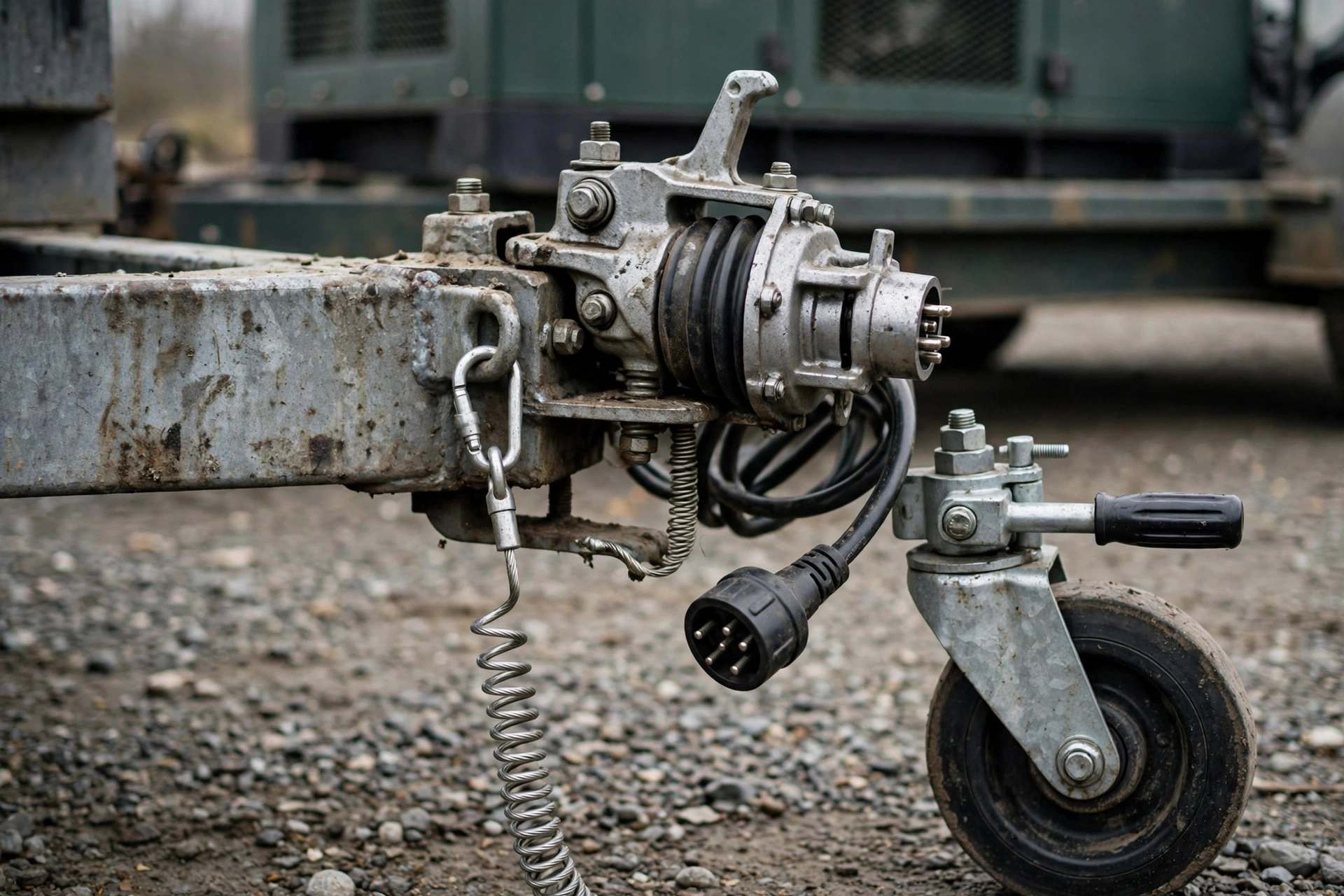
Brake maintenance is where trailer gensets quietly fail. A fixed generator’s brakes never exist. A trailer genset’s brakes sit unused for weeks, then work hard on a wet downhill. Overrun brake linkages seize, brake shoes glaze, and the handbrake cable stretches. A trailer that has stood in a yard for three months needs its brakes checked before it tows, not after the first downhill. Rental fleets that tow weekly know this. Buyers who tow twice a year usually learn it from a repair bill.
Speed limits and the sway problem
Towing a trailer changes the speed limit in most countries. In the UK, a car towing a trailer is limited to 50 mph on single carriageways and 60 mph on dual carriageways and motorways, unless signs say otherwise. In Ireland, vehicle-and-trailer combinations are limited to 80 km/h even on motorways. The limit is not advisory. It reflects the physics of a trailer: a towed load sways, and sway grows with speed.
Sway — the trailer oscillating from side to side behind the tow vehicle — is the most dangerous towing fault, and it is the one most often caused by loading rather than by speed. The main causes are too little nose weight, a load placed too far back, and a trailer whose axle sits too far forward. A generator is a dense, tall load. If it is mounted too far back on the trailer bed, the drawbar goes light, the trailer starts to hunt at 70–80 km/h, and the driver discovers the problem at the worst possible moment.
The countermeasures are mechanical and simple. Keep the nose weight in the 5–7% band (covered in the next section). Keep the heaviest part of the set — the engine and alternator — slightly forward of the axle. Keep tyre pressures at the plated figure, not the figure that feels right. And respect the speed limit: a trailer that is stable at 80 km/h can be uncontrollable at 110 km/h, and the difference between the two speeds is one overtaking manoeuvre on a motorway.
The Tow Vehicle: Matching the Whole Combination
The tow vehicle is the other half of the combination, and it is the half most often chosen by habit. A contractor tows with the pickup that is available, not the pickup that is rated. The result is a combination that the trailer can carry and the vehicle cannot — or, more often, a combination that the vehicle can pull on flat ground and cannot stop on a wet downhill.
Gross train weight decides, not the towbar sticker
Gross train weight — the maximum allowed weight of the towing vehicle plus the trailer plus everything in or on them — is the number that decides whether a combination is legal. It is not a suggestion. If the vehicle plate says 6,000 kg gross train weight and the loaded combination weighs 6,400 kg, the combination is over, even if the vehicle alone is under its gross weight and the trailer alone is under its MAM.
The towbar sticker is a different number and a common source of confusion. A towbar rated at 3,500 kg does not mean the vehicle can tow 3,500 kg. It means the towbar can. The vehicle’s own towing limit — in the handbook, or on the VIN plate — is the binding figure. A large SUV rated to tow 3,500 kg on a braked trailer can legally tow a 200 kVA trailer set. The same SUV’s smaller-engined sibling, rated at 1,800 kg, cannot, even with the same towbar fitted.
A worked example makes the point concrete. A pickup with a kerb weight of 2,200 kg, a gross vehicle weight of 3,200 kg and a gross train weight of 6,000 kg, towing a 100 kVA trailer set at 2,300 kg travelling weight, is legal with about 500 kg of margin for crew, fuel and tools in the pickup — provided the pickup itself is not overloaded. The same pickup towing a 200 kVA set at 3,500 kg travelling weight is at 5,700 kg before the crew and their tools are counted. One extra passenger and a full toolbox takes it over. The set did not get heavier. The margin disappeared.
The GOV.UK guidance adds a blunt rule that buyers should memorise: if the VIN plate does not list a train weight, the vehicle should not be used for towing. A vehicle without a plated train weight has no legal towing capacity, whatever the towbar salesman said.
Nose weight: the 5–7% rule
Nose weight is the downward load the trailer puts on the towball. Too little and the trailer sways. Too much and the rear axle is overloaded, the steering goes light, and the towbar and suspension take damage they were not designed for. The working band is 5–7% of the trailer’s loaded weight, within the tow vehicle’s own nose-weight limit — typically 75–150 kg for a pickup, 50–75 kg for a car.
For a 2,300 kg trailer set, 5–7% is 115–161 kg on the towball. That is a heavy load for a car towbar rated at 75 kg, and it is one reason trailer gensets above 100 kVA belong behind pickups and light trucks rather than cars. The nose weight is set by where the generator sits on the trailer bed, not by the driver. A set mounted with its centre of gravity ahead of the axle gives a positive nose weight. A set mounted behind the axle gives a negative one, and a trailer with a negative nose weight lifts the towball and steers itself.
Nose weight is checked with a gauge under the jockey wheel or a bathroom scale under the drawbar, and it should be checked every time the load changes — a full fuel tank moves the centre of gravity forward, a cable reel on the back of the trailer moves it back. Crews that check nose weight as part of the pre-tow routine almost never have a sway incident. Crews that never check it eventually do.
What the Road Does to a Generator
A fixed generator sits on a concrete plinth, level, dry and still. A trailer generator does 500 km on a rough road, then runs at full load the same day. The road is a test the set was not designed to take, and the damage it causes is rarely visible at handover. It shows up weeks later, as a fault that looks like a generator problem and is actually a transport problem.
Vibration: the damage you cannot see at handover
Road vibration is the main cause. A generator on a trailer experiences continuous low-frequency vibration, plus shock loads from potholes and speed bumps. The engine and alternator are mounted on anti-vibration mounts, but those mounts are designed for the engine’s own vibration at 1,500 rpm, not for road shock. The vulnerable points are the alternator feet, the control-panel wiring, the fuel-line connections and the canopy fixings.
The most common road-damage fault is a cracked alternator foot or a sheared mounting bolt. The set arrives, starts, takes load, and runs — with the alternator sitting slightly out of alignment. Over the next 200–300 hours, the misalignment wears the bearing, the bearing heats, and the alternator fails. The repair report says “bearing failure”. The cause was a pothole three months earlier.
Control-panel wiring is the second victim. A loom that is cable-tied tightly to a vibrating frame chafes through its insulation. The fault appears as an intermittent shutdown, a false alarm, or a controller that resets when the set is moved. The fix is a loom inspection after every long tow: check the ties, check the glands, and check that nothing has rubbed through. It takes fifteen minutes. A controller replacement takes a week and a spare part that may not be in the spare parts list the site keeps.
The countermeasure is built into the trailer, not added afterwards. A proper generator trailer has the set mounted on its own sub-frame with road-rated mounts, the canopy braced at four points, and the fuel tank baffled. Cheap trailers mount the set directly to the deck with rigid bolts and no baffles. They cost less, and they transmit every pothole straight into the alternator. The price difference between a good trailer and a cheap one is roughly $800–$1,500 on a 100 kVA outfit. One alternator bearing replacement costs more.
Fuel, coolant and the canopy on a rough road
Fuel slosh is the second road problem. A half-full 200-litre tank on a trailer is 85 kg of diesel moving from side to side. Without baffles, the slosh hammers the tank walls, stresses the seams, and aerates the fuel. Aerated fuel causes rough running and, on some engines, a low-fuel-pressure shutdown. The fix is a baffled tank — internal plates that break the fuel into compartments — and a rule that the tank is either full or nearly empty for transport, never half full. A full tank cannot slosh. A nearly empty tank has little to slosh.
Coolant is the quieter problem. A radiator cap that seals perfectly on a level plinth can weep on a trailer that is parked nose-down on a slope. A coolant hose that is tight when cold can work loose after a day of vibration and heat cycling. The result is a slow coolant loss that shows up as a high-temperature shutdown on the second day of a job, when the set is under load and nobody is watching the temperature gauge. The pre-start check — coolant level, hose clips, cap seal — takes two minutes and catches it.
The canopy takes the weather. A trailer set works outdoors in rain, dust and sun, and the canopy is its only protection. Door seals that have hardened in the sun let dust into the alternator windings. A canopy drain that is blocked with mud lets rainwater pool in the base frame, where it corrodes the fuel-tank straps. The maintenance routine for a trailer set therefore includes the canopy: seals, drains, door hinges and the condition of the sound-absorbing lining. A canopy that rattles is a canopy that is working loose. Fix it in the yard, not on the hard shoulder.
Three Jobs, Three Trailers
The rules above are general. The jobs below show how they apply in practice — three real shapes of work, three different trailer decisions, and three different ways of getting it wrong.
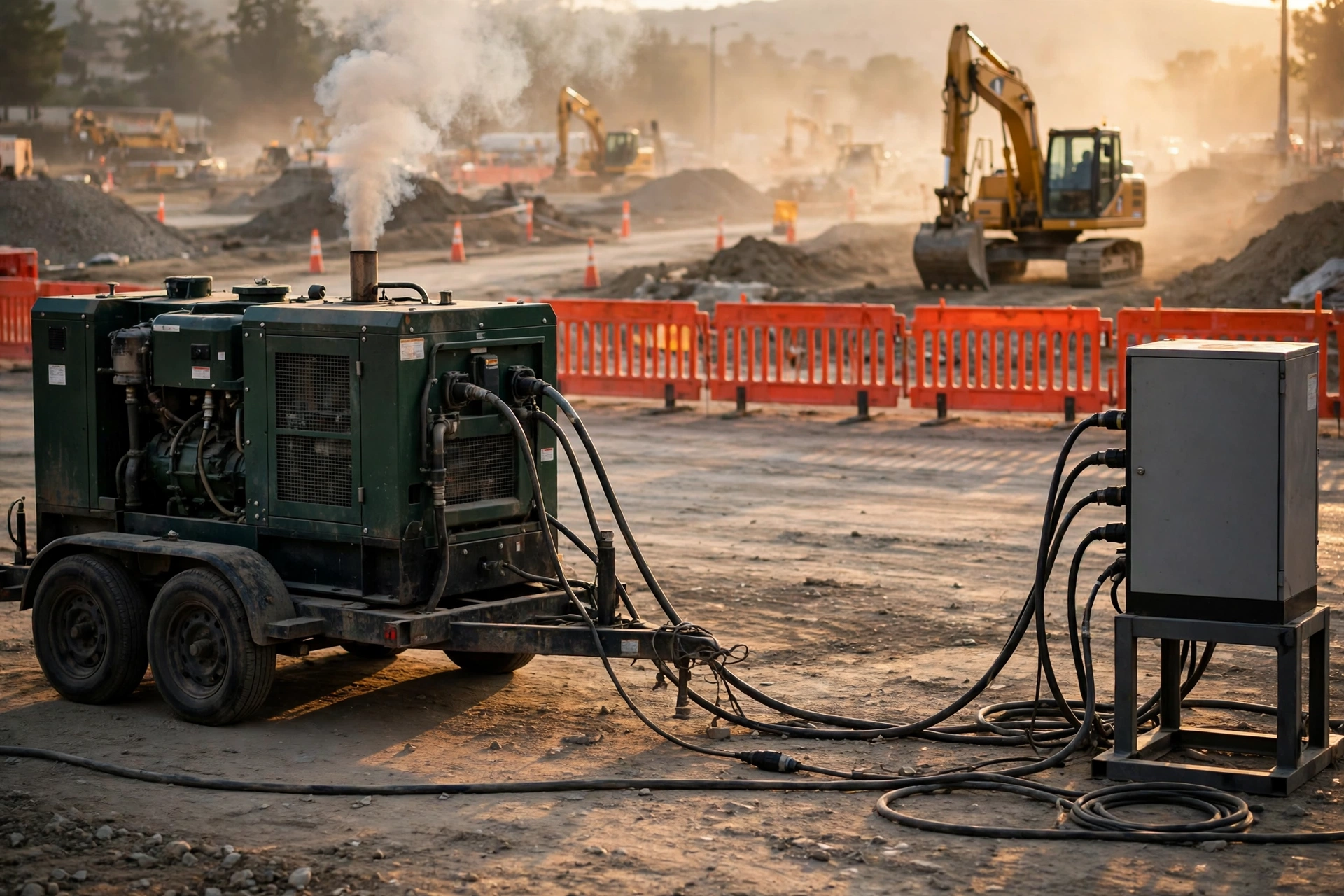
Case 1: A roadworks contractor in the UK — 100 kVA
A roadworks contractor in the Midlands runs a 100 kVA silent set on a tandem-axle trailer, moving between resurfacing jobs every one to two weeks. The set is a 100 kVA Volvo trailer set on the TAD531GE engine, travelling weight 2,200 kg on a 2,500 kg rated trailer. The tow vehicle is a pickup rated at 3,500 kg towing and 6,500 kg gross train weight. The driver holds a BE licence.
The combination is legal, and the contractor’s problem was not the law. It was the brakes. The set towed 40–60 km between jobs, stood for a week, then towed again. After eighteen months the overrun brake linkage had seized from disuse and road salt. The trailer passed its annual inspection — the brakes worked when the tester pulled the lever — but on a wet downhill on the M6 the trailer pushed the pickup, the combination jack-knifed at low speed, and the set finished the day on its side in a layby. Nobody was hurt. The repair bill was £4,800, and the set was off hire for three weeks.
The fix cost £180 a year: a brake service every six months, the linkage greased, the shoes checked, the breakaway cable replaced. The contractor now services the trailer brakes on the same schedule as the generator — every 250 hours or six months, whichever comes first. The generator and the trailer are one machine. Servicing one and ignoring the other is the error.
Case 2: An events company in South Africa — 62.5 kVA
An events company in Johannesburg runs a 62.5 kVA SDEC trailer set for outdoor concerts and film shoots, travelling weight about 1,700 kg on a 2,000 kg braked trailer. The tow vehicle is a bakkie rated to tow 3,000 kg. On paper the combination is legal. In practice the company was stopped at a weigh station on the N1 and fined, because the trailer was not registered with NATIS and had no roadworthy certificate.
The set had been bought as an export unit, shipped in a container, and put straight to work. Nobody had registered the trailer. The fine was R 2,500, but the real cost was the day: the trailer was impounded until the paperwork was produced, the event started two hours late, and the client deducted R 18,000 from the invoice. Registration and a roadworthy certificate would have cost about R 1,200 and a morning at the testing station.
The same company later learned the second South African rule the hard way. A second, larger set — a 131 kVA trailer outfit at 2,600 kg travelling weight — was towed behind the same bakkie. The bakkie’s towing limit was 3,000 kg, so the combination looked legal, but the trailer’s GVM was 3,500 kg. Under South African rules the tow vehicle’s rated capacity must equal or exceed the trailer’s GVM, not the actual load. The bakkie was 500 kg short on paper, and the combination was illegal even though it was never overloaded in practice. The company now runs the larger set behind a light truck.
Case 3: A farm and a mine in Kenya — 200 kVA and the flatbed decision
A contractor in Kenya needed 200 kVA of mobile power for a mine exploration camp, 300 km from Nairobi over mixed tarmac and murram roads. The first plan was a 200 kVA trailer set: travelling weight about 3,500 kg, tandem axle, braked, towed behind a 4×4 rated at 3,500 kg towing. The numbers worked on a spreadsheet. They did not work on the road.
The problem was the last 60 km: corrugated murram, dry-season dust, and gradients that a 3,500 kg trailer behind a loaded 4×4 could not climb without overheating the tow vehicle’s transmission. The first tow took eleven hours, the trailer lost a wheel bearing 40 km from camp, and the set arrived with a cracked canopy bracket and a fuel leak from a chafed line. The second tow was abandoned. The set now travels on a flatbed truck, and the trailer stays in Nairobi for tarmac jobs only.
The lesson is that a trailer rating is a road rating as well as a weight rating. A 3,500 kg trailer is legal on a motorway and a liability on a corrugated track. Above roughly 200 kVA, or wherever the road is unsealed, the flatbed is usually the better answer: the set rides on a truck built for the load, the driver holds the right licence, and the generator arrives in the condition it left in. The trailer format is at its best on sealed roads and short moves. It is not a substitute for a truck.
Frequently Asked Questions
What size trailer do I need for a diesel generator?
Size the trailer for the travelling weight — generator, canopy, trailer, full fuel tank, cables and tools — with at least 10% margin. A 100 kVA silent set weighs roughly 1,900–2,300 kg travelling, so it needs a braked tandem-axle trailer rated at 2,500 kg. Never size from the dry weight on the datasheet, which understates the travelling weight by 15–25%.
Can you tow a diesel generator on a trailer on the road?
Yes, provided the trailer is registered and roadworthy, the brakes work, the lights work, the driver holds the right licence category, and the tow vehicle’s gross train weight is not exceeded. Trailers over 750 kg must be braked in most jurisdictions, and a trailer plated at 3,500 kg counts as 3,500 kg for licence purposes even when lightly loaded.
What is the difference between a mobile and a portable generator?
A portable generator is carried by hand, typically 2–10 kVA and 60–150 kg. A mobile generator is any set built to move between sites, including skid, containerised, vehicle-mounted and trailer-mounted sets. A trailer-mounted generator is a full diesel set — 20–500 kVA — permanently mounted on its own road trailer with brakes, lights and a drawbar.
How much does a trailer mounted diesel generator weigh?
A 20 kVA trailer set weighs roughly 800–1,000 kg travelling. A 62.5 kVA set weighs about 1,500–1,800 kg. A 100 kVA set weighs about 1,900–2,300 kg. A 200 kVA set weighs about 3,100–3,600 kg. Fuel adds 0.85 kg per litre, so a 200-litre tank adds 170 kg to the travelling weight.
Do I need a licence to tow a generator trailer?
It depends on the country and the weights. In Great Britain, a category BE licence covers a trailer up to 3,500 kg MAM; drivers who passed before 1 January 1997 can drive combinations up to 8,250 kg. In Ireland, category B covers combinations up to 3,500 kg total. In South Africa, the trailer must be registered with NATIS and the tow vehicle’s rated capacity must meet or exceed the trailer’s GVM. Check the local rule before towing.
Specification Checklist: Ten Lines Before You Buy a Trailer Genset
1. What is the travelling weight? Generator, canopy, trailer, full fuel, cables and tools — not the dry weight. Demand the figure in writing.
2. What is the trailer rating, and what margin remains? The rating must exceed the travelling weight by at least 10%. A 2,200 kg outfit needs a 2,500 kg trailer.
3. Is the trailer braked, and what type? Overrun brakes up to 3,500 kg, electric or air brakes above it, and a breakaway system that is actually connected.
4. What licence does the driver need? Check the plated MAM against the local licence categories. A 3,500 kg plate changes the licence requirement even when the trailer is lightly loaded.
5. Can the tow vehicle legally pull it? Check gross train weight and the vehicle’s own towing limit, not the towbar sticker. If the VIN plate lists no train weight, do not tow with that vehicle.
6. What is the nose weight? Aim for 5–7% of the loaded trailer weight, within the tow vehicle’s limit. Check it with a gauge every time the load changes.
7. Is the fuel tank baffled? An unbaffled tank sloshes, aerates the fuel and stresses the seams. Transport with the tank full or nearly empty, never half full.
8. What are the standby and prime power ratings? A trailer set that works every day is a prime-duty machine, and the rating decides its service life. Check the rating letters on the datasheet before the price.
9. What is the emissions standard? A Stage V emissions standard set works anywhere in Europe. A lower-standard set is cheaper and its legal territory shrinks every year.
10. What does the fuel consumption look like at the real load? A 100 kVA set burns roughly 20 litres per hour at 75% load, so a 200-litre tank gives about ten hours. Size the tank — and the trailer — for the job, not the brochure.
Before ordering, a buyer should send the supplier four lines: the kVA and duty, the tow vehicle and its ratings, the countries where the set will be towed, and the worst road it will travel on. Any manufacturer that knows its business — PAVO included, with trailer-mounted sets from 20 kVA to 500 kVA in open, silent and containerised configurations, powered by Cummins, Weichai, Volvo, Yuchai and Shanghai Diesel — will size the trailer, the brakes and the tank from those four lines. A supplier that prices the generator and treats the trailer as an afterthought is selling half a machine. Sets shipped overseas travel in export packing built for the sea voyage, but the trailer still has to be road-legal at the destination — check that before the container is loaded, not after it is unloaded.
The generator makes the power. The trailer decides whether the power arrives. A buyer who checks the trailer plate, the tow vehicle’s train weight and the driver’s licence before paying the deposit will never watch a set sit in a layby, or in an impound yard, while the job waits for power that never arrives. To size a trailer genset for a specific job, road and tow vehicle, contact PAVO.