

How to Stop Diesel Fuel Theft at Telecom Towers | PAVO
At a remote tower site the fuel tank is the only asset that can be emptied without a tool, a key or a sound — and the only one whose loss shows up weeks later as a number nobody can explain.
How to stop diesel fuel theft at a telecom tower site? Combine three layers: barriers such as anti-siphon filler necks, locking caps and caged tanks; sensors that report fuel level remotely; and a fuel ledger that reconciles every litre delivered against generator running hours. No single measure works alone, and the ledger is what makes the other two pay.
Contents
- How Much Diesel Disappears — and What It Costs
- The Five Ways Fuel Leaves a Tower Site
- The Fuel Ledger: Reconciling Litres Against Running Hours
- Hardware That Stops the Casual Thief
- Sensors and Telemetry: Catching Theft the Night It Happens
- Three Sites That Stopped the Bleeding
- Frequently Asked Questions
- Specification Checklist: Ten Questions Before the Next Delivery
How Much Diesel Disappears — and What It Costs
A cell tower in a city with a reliable grid burns almost no diesel. A tower beyond the grid burns it every day. The GSMA’s Tower Power Africa report put the scale on the table more than a decade ago, and the numbers have only grown since: an off-grid tower site in Sub-Saharan Africa consumes nearly 13,000 litres of diesel a year, at an annual energy cost above US$21,000, while an unreliable-grid site consumes around 6,700 litres. Energy is up to 40% of network operating expenditure for a typical African tower. Then comes the line most operators read twice: on top of the diesel cost itself, there is an additional 10–15% cost due to diesel pilferage, described as very common practice in many countries across Africa.
That 10–15% is not a rounding error. At 13,000 litres a year and a delivered diesel price of US$0.65 per litre — a realistic figure for Nigeria after the 2023 fuel subsidy removal, when pump prices rose by as much as 200% within a year — a single off-grid site burns about US$8,450 of diesel a year. Pilferage at 12% adds just over US$1,000 a year to that one site, every year, for as long as nobody measures it. Multiply by a fleet and the arithmetic turns serious: Nigeria’s telecom industry consumes more than 40 million litres of diesel a month and spends over US$350 million a year on it, according to the Africa Finance Corporation’s State of Africa’s Infrastructure Report 2025. At the GSMA’s 10–15% pilferage rate, the stolen share of that spend is US$35–52 million a year in one country alone.
The theft is not only fuel. Ghana’s Chamber of Telecommunications reported 600 theft incidents at cell sites in a single half-year, with more than 150,000 litres of diesel and 240 batteries stolen, direct repair costs above GH¢30 million, and 18 million subscribers affected. Nigeria’s Communications Commission has recorded more than 50,000 cases of major destruction to telecom infrastructure in five years. Diesel theft sits inside a wider pattern of site crime — batteries, copper, rectifiers, solar panels — but diesel is the easiest target of all. It is liquid, it is fungible, it is worth money to anyone with a jerry can, and it leaves no empty shelf behind. A stolen battery is noticed the next morning. A hundred litres siphoned from a 500-litre tank is noticed at the end of the month, if it is noticed at all.
The cost is not only the litres. A site that runs dry goes dark, and a dark tower drops calls, mobile-money transactions and emergency communications for every village it serves. The generator itself is the second victim: a set that runs dry sucks air into the fuel system, loses prime, and may need a technician visit to re-prime and restart — a visit that costs more than the stolen fuel. A set that is repeatedly run low also runs its day tank dry, and the standby and prime power rating on the nameplate means nothing if the tank is empty. Fuel theft is an uptime problem wearing a cost problem’s clothes.
This is the part of telecom power that the general guides do not cover in depth. The companion article on this site, the diesel generator for telecom towers guide, covers sizing, battery backup, oversizing and hybrid solar, and gives theft two short paragraphs: a lockable canopy, a caged fuel filler, tamper alarms wired into remote monitoring. Those two paragraphs are correct. They are also the whole of what most buyers get told. This article is the rest of it: how the fuel actually leaves, how to measure the loss, what hardware stops it, what sensors prove it, and how the delivery chain — where the largest losses usually hide — gets brought under control.
The Five Ways Fuel Leaves a Tower Site
Fuel theft at a tower site is rarely one person with a hose in the middle of the night. It is five different mechanisms, each with its own signature, and a site that is protected against one is often wide open to another. The first step is to name them.
Siphoning through the filler neck
The oldest method and still the most common. A hose down the filler pipe, a siphon started by mouth or by a small hand pump, and 20 litres at a time into jerry cans. A standard filler neck on a generator sub-base tank is a straight, open pipe 50–60 mm across. Nothing in it resists a hose. A thief who knows the site’s visit pattern — and at a rural tower, everyone within walking distance knows it — can take 40 litres in ten minutes and be gone before the next scheduled visit, which may be two weeks away. The loss is invisible until the next dipstick reading, and by then the level has been topped up again and the evidence is gone.
Insider theft and short deliveries
The second mechanism is the one operators least like to discuss, because the thief is inside the chain. A fuel delivery driver bills 200 litres and delivers 160. A site technician drains 30 litres into his own vehicle during a routine visit. A security guard sells the site’s diesel to a neighbour at half price. The GSMA’s 10–15% figure is dominated by this kind of loss, not by strangers with hoses: the people who steal the most fuel are the people who already have the keys. Short delivery is particularly hard to catch without measurement, because the delivery docket says 200 litres, the tank level rises by roughly 200 litres — the driver’s gauge is read by eye on a dipstick in bad light — and the 40-litre gap hides inside the rounding.
Drain plugs and return-line taps
The third mechanism bypasses the filler entirely. Most generator fuel tanks have a drain plug at the lowest point for water and sediment. A thief who can reach it — and on an open-frame set in an unfenced compound, anyone can — opens it, fills a container, and closes it again. No alarm, no broken lock, no evidence. Return-line taps are subtler: a T-fitting spliced into the fuel return line between the engine and the tank, with a small valve and a length of hose hidden behind the canopy. The engine runs normally; a fraction of the returning fuel is diverted. The set’s own fuel consumption rises by 5–10%, which looks exactly like normal variation to anyone who is not reconciling litres against hours.
Sensor tampering and fake readings
The fourth mechanism attacks the measurement itself. A float-type fuel sensor can be held up with a wire or a magnet so that it reports a full tank while the level falls. A dipstick can be swapped for a shorter one. A controller’s fuel-level input can be bridged. Any site that relies on a single sensor reading, with no cross-check against running hours, is vulnerable to a thief who understands the sensor better than the operator does. This is why the detection section of this article insists on two independent measurements — level and hours — and why a sensor that never moves is more suspicious than one that moves too fast.
Whole-tank and equipment theft
The fifth mechanism is the bluntest: the tank itself, the generator, or the whole canopy disappears. At one site described in the companion telecom article, thieves took the entire control panel — bolts, wiring, everything — and left the engine sitting like a pulled tooth. Copper grounding bars are stripped for scrap. In the worst regions, an unguarded site loses the set itself to a truck and a cutting torch. This is no longer a fuel-theft problem; it is a site-security problem, and it is the reason the hardware section of this article starts with the compound and the canopy, not with the filler cap. A silent canopy with a steel shell and concealed hinges is part of the fuel-theft answer, not only a noise answer.
The Fuel Ledger: Reconciling Litres Against Running Hours
Every anti-theft measure in this article is either a lock or a measurement. The locks are cheap and obvious. The measurement is the one that pays, because it is the only thing that tells an operator whether the locks are working. A fuel ledger is a simple document: for each site, each month, four numbers — litres delivered, litres in the tank at the start, litres in the tank at the end, and generator running hours. From those four numbers, everything else follows.
The expected burn is the product of running hours and the set’s fuel consumption at its actual load. A typical macro tower pulls 3–8 kW of DC load, and a 20 kVA diesel set burns roughly 4–6 litres an hour at that kind of load. The companion telecom article uses those figures, and they are the right starting point — but they are not the figure to reconcile against. The figure to reconcile against comes from the set’s own datasheet at its real load factor, and it should be measured once, on site, with a dipstick and a stopwatch, during commissioning. A 20 kVA set at 25% load burns about 4.5 L/h; the same set at 50% load burns about 7 L/h. Reconciling against the wrong load factor manufactures phantom theft or hides real theft with equal ease.
The ledger arithmetic is straightforward. Opening stock plus deliveries minus closing stock equals litres consumed. Litres consumed divided by running hours equals litres per hour. Litres per hour compared with the expected rate gives the variance. A variance above 5% is a flag; above 10% is an investigation. The table below works a three-month example for one off-grid site with a 20 kVA set, a 500-litre tank and an expected burn of 4.5 L/h.
| Month | Hours run | Expected burn (L) | Delivered (L) | Stock change (L) | Actual burn (L) | Variance |
|---|---|---|---|---|---|---|
| January | 310 | 1,395 | 1,500 | +55 | 1,445 | +3.6% |
| February | 296 | 1,332 | 1,500 | +28 | 1,472 | +10.5% |
| March | 305 | 1,373 | 1,400 | −62 | 1,462 | +6.5% |
January is normal noise: dipstick error, temperature expansion, a slightly different load. February is the flag: 10.5% above expected, 140 litres unaccounted for, worth about US$91 at US$0.65 a litre. March confirms the pattern is not a one-off. A site showing two consecutive months above 5% gets a visit, a sensor check and a delivery audit — not a shrug. Across a fleet, the same table ranks sites: the worst 10% of sites usually account for more than half of the total loss, and they are the sites where the hardware and the sensors go first.
Two details make the ledger work. First, the tank must be dipped the same way every time — same dipstick, same point, same person if possible — because a 500-litre rectangular tank loses about 1.5 litres per millimetre of level, and a careless reading is worth 30 litres of phantom variance. Second, the delivery must be measured independently of the delivery docket. The docket is a claim, not a measurement. The dipstick before and after delivery is the measurement, and the difference between the two is the only number that enters the ledger. Operators who adopt RFID-tagged, geo-fenced delivery — the Indus Towers Fuel@Doorstep model described later in this article — get this measurement automatically, with the nozzle and the tank talking to each other before a single litre flows.
The ledger also answers the question of how long a set will run, which is the question every tower buyer asks first. How long a diesel generator runs on a full tank depends on load and tank size, not on the nameplate: a 500-litre tank at 4.5 L/h is about 111 hours, or four and a half days, and a site that loses 12% of its fuel to theft loses half a day of autonomy with it. Theft is not only a cost line. It is a hole in the autonomy calculation, and it is the hole that shows up during the longest outage of the year.
Hardware That Stops the Casual Thief
Hardware does not stop a determined, organised thief. It stops the casual one, the opportunist and the insider who needs the theft to be quick and deniable. That is most of the theft at most sites, and hardware is cheap relative to the fuel it protects. Three layers, in order of cost.
Anti-siphon filler devices
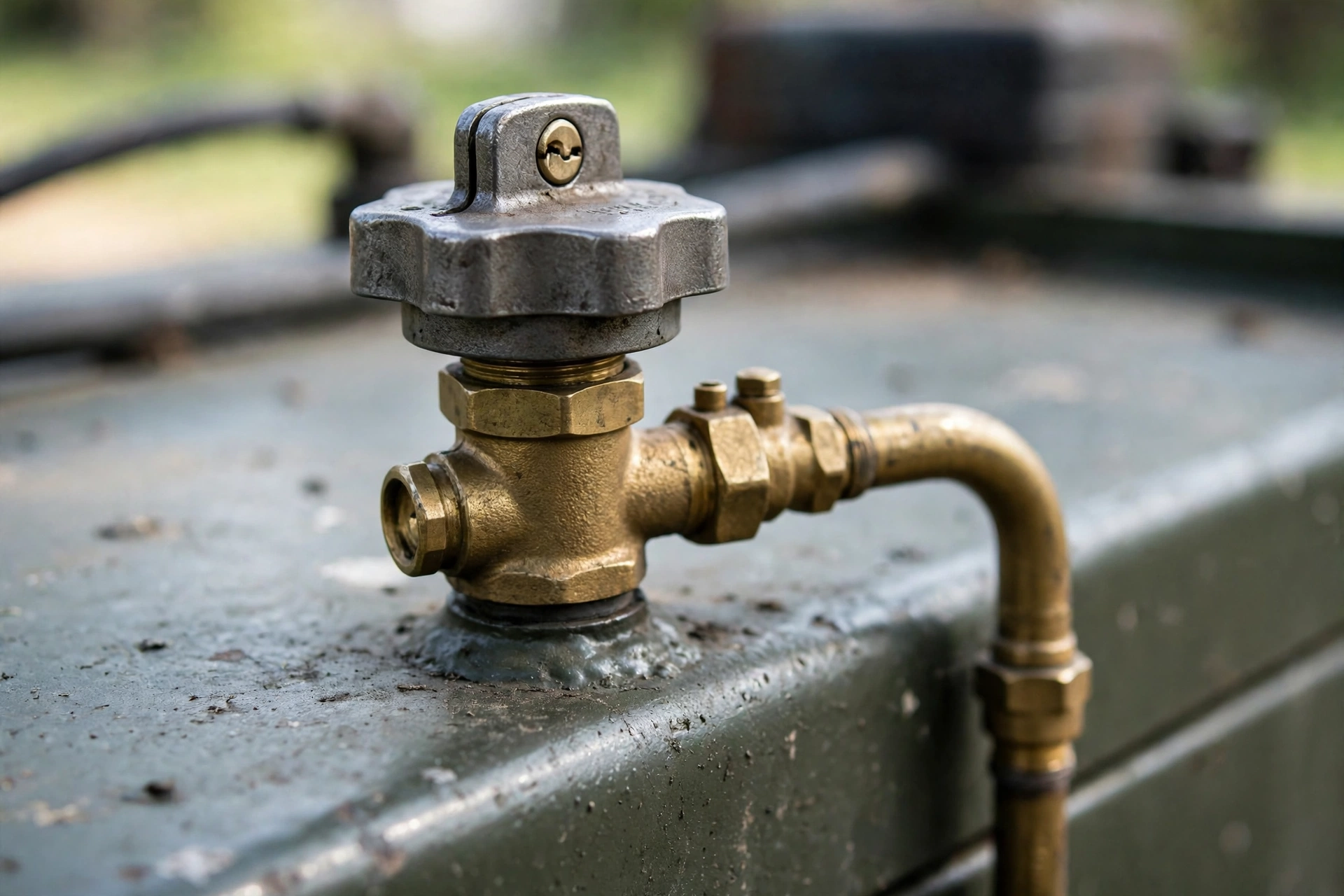
An anti-siphon device is a one-way mechanism fitted inside the filler neck. The common types use a spring-loaded ball bearing or a flapper gate: the fuel nozzle pushes the valve open during filling, and once the nozzle is removed, gravity or spring tension snaps it shut. A hose pushed down the neck meets a closed valve a few centimetres in. The better designs add a short chamber that limits access to only the top few centimetres of fuel, so even a thin tube slipped past the valve can only skim a small volume.
The numbers matter when specifying one. A device must handle the site’s peak fill rate — typically 60–100 litres per minute from a delivery pump — with a pressure drop below 0.1 bar, or the delivery crew will remove it on the first visit and never put it back. Service life for a ball-bearing type is 5 years or more in clean diesel. Cost is typically US$30–80 per unit, which is less than the value of the fuel it protects in a single month at a pilferage-prone site. The honest limit: an anti-siphon device does not stop theft through the drain plug, through a cut tank, or through micro-tubing thin enough to pass the valve. It stops the hose, which is the most common method, and it forces every other method to be slower, noisier and more visible. Pair it with a locking cap and the filler is closed twice.
Locking caps, caged fillers and tank shields
A locking cap is the cheapest measure on a tower site and the most often skipped. The cap should be a proper keyed or combination lock, not a padlock through a hasp that can be cut with bolt cutters in ten seconds. The keys should be held by the operator, not left on a hook in the site cabin, and the number of keys in circulation should be counted — every uncounted key is a future theft.
The filler cage is the next step: a steel mesh or plate enclosure around the filler neck and the tank’s vulnerable fittings, locked with a high-security padlock. On high-risk sites the whole tank goes inside a cage, or the tank is buried, or the set is specified with an integral sub-base tank that sits under the engine and cannot be reached without lifting the canopy. The HuaQuan rollout in Italy, described in the cases section below, used 3 mm steel enclosures with concealed hinges, IK10 impact rating and Abloy CLIQ electronic padlocks — locks that log every opening by user and time, so a key used at 2 a.m. is a fact, not a suspicion.
Tank shields — steel plates welded or bolted over the drain plug and the fuel lines — close the third theft method. A drain plug that needs a spanner and a shield removal is a different proposition from a drain plug that needs only a hand. The shield costs little at manufacture and almost nothing to specify on a new order; retrofitting it on a site visit costs an hour of a technician’s time.
The compound, the canopy and the light
The outermost hardware layer is the site itself. A fence that can be walked through is decoration. A compound with a locked gate, a canopy bolted to a concrete plinth, and a light that comes on when someone approaches changes the economics of a night visit: the thief needs more time, more tools and more nerve. Solar-powered motion lights cost little and work at sites with no grid. A door-open alarm on the canopy, wired into the site’s remote monitoring, turns a physical intrusion into a message on someone’s phone within seconds. The alarm does not need to summon the police — at a rural site there may be no police to summon — but it creates a timestamp, and a timestamp is what turns a suspicion into a case.
None of this hardware is exotic. The total cost for a typical tower site — anti-siphon device, locking cap, filler cage, drain-plug shield, door alarm — is roughly US$400–900 in materials, plus a day of labour. Against a pilferage loss of US$1,000 a year per site, the payback is under a year at a bad site and the hardware lasts five years or more. A spare anti-siphon device, a spare locking cap and a spare fuel sensor should travel in the site’s spare parts kit, so that a damaged lock or a failed sensor is replaced on the next visit instead of leaving the tank open for a month. The reason sites go without it is rarely the money. It is that nobody owns the decision: the generator supplier ships a standard tank, the tower company assumes the supplier thought about theft, and the theft continues in the gap between the two assumptions. The specification checklist at the end of this article exists to close that gap in writing, before the order is placed.
Sensors and Telemetry: Catching Theft the Night It Happens
Hardware slows theft down. Sensors prove it happened, and prove it fast enough to act. A fuel-level sensor that reports to the network operations centre turns a monthly ledger variance into a same-night alert, and the difference between those two is the difference between losing 40 litres and losing 400.
Capacitive fuel-level sensors
The sensor that works at a tower site is a capacitive probe: two concentric metal tubes lowered into the tank, whose electrical capacitance changes in proportion to the fuel level between them. Unlike a float arm, it has no moving parts to jam, no magnet to hold up with a wire, and it reports continuously — millimetre precision, not the coarse 5% steps of a factory dashboard float. During installation the tank is calibrated with a 10-point to 20-point stepped table of litres against sensor output, so the sensor reads litres, not just level, even in an irregularly shaped tank.
The sensor reads every 10 seconds and the telemetry unit transmits the level, the generator’s running state and the GPS position to a cloud platform. The platform applies a moving-average filter to smooth out fuel slosh — a real effect on a site where the tank sits on a vibrating set — and then watches for one specific pattern: a sudden drop in level while the generator is off and the site is stationary. That pattern is siphoning, and the better platforms raise a high-priority alert with the exact timestamp, the location and the litres lost. A drop of 20 litres or more while the set is off is a standard alert threshold; a drop while the set is running is compared against the expected burn rate instead.
Cost is modest: a capacitive sensor with a telemetry unit is typically US$250–500 per site installed, and a monthly data subscription of a few dollars. The sensor also pays for itself in a second way: it replaces the dipstick visit. A site that is visited only to check the fuel level can be visited half as often, and every visit not made is a visit that cannot be used to steal fuel.
Runtime reconciliation and the alarm that gets read
A sensor without a reconciliation rule is a louder version of the same problem. The rule is the same as the ledger’s, automated: expected burn equals running hours multiplied by the set’s measured consumption at its real load, and any gap above 5–10% raises a flag. Hybrid-power guidance for telecom sites uses the same threshold — telemetry that detects 5–10% abnormal fuel loss before it becomes chronic theft — and the better operators run the reconciliation daily, not monthly, so a bad week is caught in seven days instead of thirty.
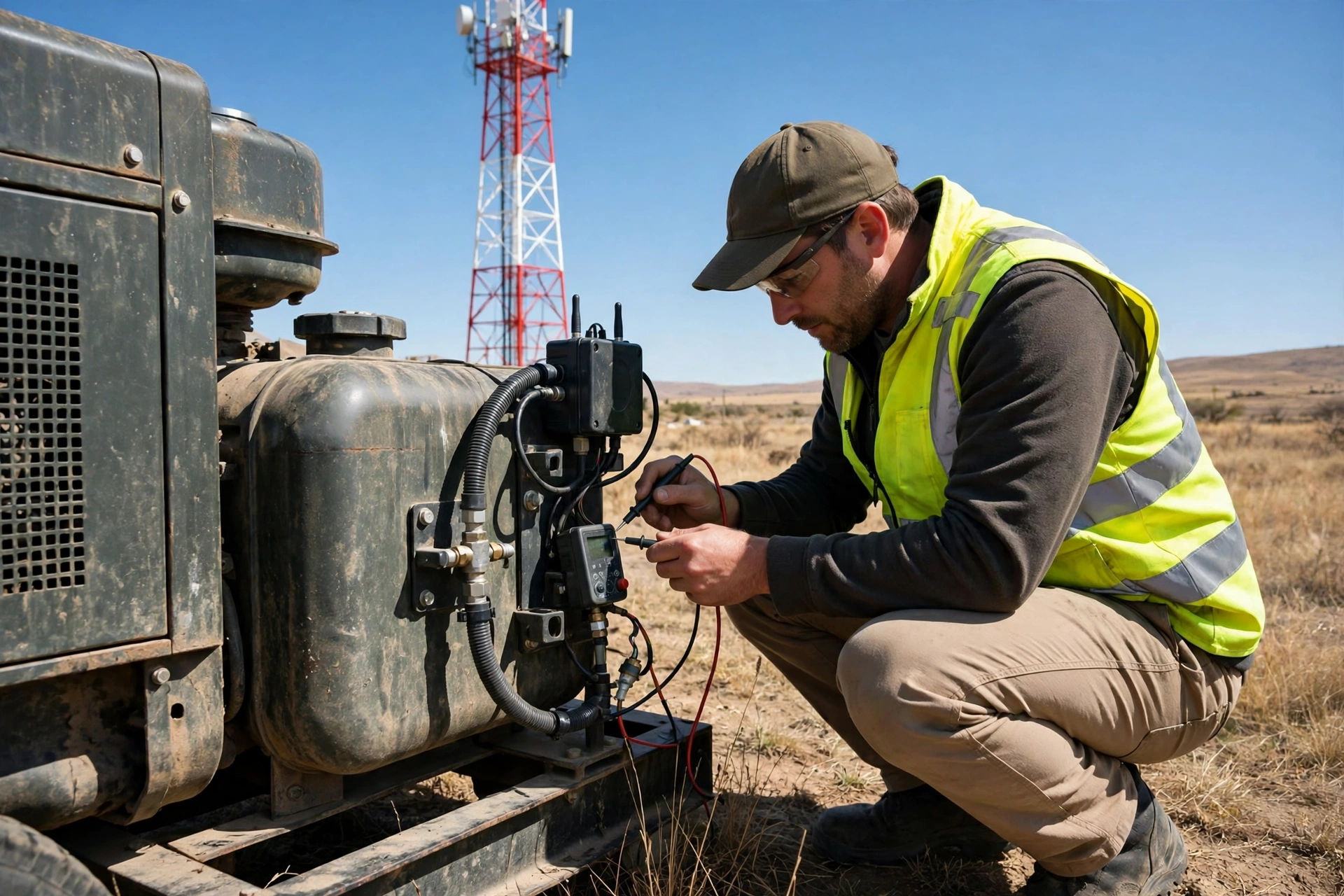
The weak point is not the sensor. It is the inbox. The companion telecom article tells the story of a site that ran dry with a perfectly working fuel-level sensor, because the low-fuel warning sat unread for six days in a network operations centre inbox with four thousand other alarms. A theft alert that nobody reads is a sensor that does not exist. The fix is procedural, not technical: fuel alerts go to a named person, not a shared inbox; a drop-while-off alert gets a phone call, not an email; and the alarm is tested monthly, the same way the automatic transfer switch is tested, so that the first time it fires is not the first time anyone has seen it fire. The remote monitoring article on this site covers the controller and Modbus side of this in detail; the point here is the human chain, which is where most monitoring fails.
Tying the sensor into the controller
On a new installation, the fuel sensor should be wired into the generator’s own controller — a Deep Sea DSE7320 or equivalent — so that fuel level, running hours, battery voltage and alarms travel over the same link, whether that is Modbus, 4G or an SNMP trap to the operator’s network management system. A sensor on its own telemetry unit works, but a sensor integrated with the controller gives one event log, one clock and one source of truth, and it makes the reconciliation trivial: the controller already knows the hours, so the platform only has to divide litres by hours and compare. When ordering a set for a tower site, the fuel sensor, the controller input and the telemetry SIM should be on the same purchase order as the generator, not added as an afterthought by a different contractor six months later. Diesel fuel lasts in a generator tank for six to twelve months under good conditions, but a tank that is being stolen from does not last long enough for ageing to matter — the sensor is the priority, and the fuel-polishing schedule can wait its turn.
Three Sites That Stopped the Bleeding
The measures above are not theory. They are in service, on real tower fleets, with published numbers. Three cases, three different scales, one pattern: measurement first, hardware second, and the delivery chain last.
Case 1: A northern Nigeria tower cluster — the ledger found the thief
An operator running a cluster of 85 off-grid tower sites in northern Nigeria was reconciling fuel by delivery dockets alone — the docket said how much had been delivered, and nobody measured what was in the tank. When the operator introduced a monthly ledger — dipstick before and after every delivery, running hours from the controller, expected burn from each set’s datasheet — the picture changed in a month. The fleet average variance was 12%, and the worst ten sites were running at 18–22%. The loss across the cluster was about US$7,200 a month, roughly US$86,000 a year, at a delivered diesel price near US$0.65 a litre.
The response was layered. Anti-siphon devices and locking caps went on every tank. Capacitive fuel sensors with 4G telemetry went on the worst twenty sites first. Delivery was changed to a metered bowser with a flow meter that the site technician reads and photographs, so the docket and the meter have to agree. Six months later the fleet variance was under 3%, and the saving was about US$5,800 a month — near US$70,000 a year. The sensors cost about US$400 a site installed; the twenty worst sites paid for their sensors in under two months. The lesson the operator took from it was not about hardware. It was that the theft had been running for years, and the only reason it stopped was that somebody finally divided litres by hours and wrote the answer down.
Case 2: A Ghana operator — cages, dipsticks and a monthly ranking
Ghana’s industry-wide numbers are the backdrop: 150,000 litres of diesel stolen in six months, 600 theft incidents at cell sites, and direct repair costs above GH¢30 million. One operator’s response was deliberately low-tech. Every site got a filler cage and a locking cap. Every site got a dipstick protocol: the visiting technician dips the tank on arrival and on departure, photographs the dipstick against a marked scale, and sends the photograph to a supervisor. Every month, the regional manager receives a one-page ranking of sites by variance, and the worst three sites get a visit from the manager personally.
The photograph is the key detail. A dipstick reading written in a notebook can be invented; a photograph of a wet dipstick against a scale cannot be invented as easily, and the technician knows it. Within a year the operator’s worst sites had moved from double-digit variance to the low single digits, and the monthly ranking had become a competition the site teams took seriously. The total spend was under US$300 a site — cage, cap, dipstick and a laminated scale. No sensors, no telemetry, no software. The case matters because it proves the ledger works without electronics, and because it shows where the money goes when the budget is small: the filler, the dipstick and the manager’s attention, in that order.
Case 3: Twenty Italian mountain sites — the full package, zero thefts
The third case is a manufacturer-published rollout, and it is the most complete version of the package. Twenty 100 kVA DC diesel generator sets were installed at telecom tower sites across Italy, many of them remote mountain sites, with anti-theft specified from the start rather than added later. Each enclosure was fabricated from 3 mm steel plate with concealed hinges, rated IK10 for impact resistance, fitted with Abloy CLIQ electronic padlocks that log every opening, and a door-open alarm that triggers an immediate SNMP trap to the operator’s Nokia network operations centre. GPS tracking used a Teltonika FMB920 unit with an internal backup battery, reporting position every 15 minutes and immediately on any vibration or movement. Fuel level, runtime hours and maintenance alarms were integrated with the operator’s NOC via SNMPv3 traps and a REST API. Each set carried a 500-litre integral tank giving 7 days of fuel autonomy.
The result, measured over twelve months: theft incidents fell from a fleet average of 3 per year to zero. Not reduced — zero. The same rollout also moved service intervals to 500 hours using synthetic 5W-40 oil, high-capacity sumps and dual-stage fuel filtration, cutting annual service visits from eight to two per continuously operating site. The anti-theft package is the expensive end of the spectrum, and a 20-site rollout in Italy is not a 2,000-site fleet in West Africa — but the case proves the ceiling. When the enclosure, the lock, the sensor and the NOC are specified together, from the factory, theft stops being a cost of doing business and becomes a solved problem. The gap between the Ghana case and the Italy case is money and scale, not principle. Both start with the same decision: the fuel will be measured, and the measurement will be read.
Frequently Asked Questions
How to stop diesel fuel theft at a telecom tower site?
Combine three layers: physical barriers such as anti-siphon filler necks, locking caps and caged tanks; electronic proof such as capacitive fuel-level sensors with remote alerts; and a monthly fuel ledger that reconciles litres delivered against generator running hours. Start with the ledger — it costs nothing and tells you which sites need the hardware first.
How much diesel fuel is stolen from cell towers?
The GSMA estimates diesel pilferage adds 10–15% to the cost of diesel power at African tower sites. Nigeria’s telecom industry spends over US$350 million a year on diesel, which puts the stolen share at roughly US$35–52 million a year in that country alone. In Ghana, more than 150,000 litres of diesel were stolen from cell sites in a single six-month period.
How to detect fuel theft in a diesel generator tank?
Reconcile two independent measurements: tank level and generator running hours. Divide litres consumed by hours run and compare the result with the set’s expected fuel consumption at its real load — a variance above 5% is a flag and above 10% is an investigation. A capacitive fuel-level sensor with remote telemetry automates the same check and raises an alert the night a sudden drop occurs while the generator is off.
What is an anti-siphon device for a diesel fuel tank?
It is a one-way valve fitted inside the filler neck — usually a spring-loaded ball bearing or flapper gate — that opens when the fuel nozzle pushes in during filling and snaps shut when the nozzle is removed, so a siphon hose cannot reach the fuel. It must handle peak fill rates of 60–100 litres per minute with less than 0.1 bar pressure drop, and it costs roughly US$30–80. It stops siphoning through the filler, but not theft through the drain plug or a cut tank, so it should be paired with a locking cap and a drain-plug shield.
How to secure a diesel generator fuel tank from theft?
Work in layers, from the outside in: a locked compound and a canopy bolted to a plinth; a filler cage and locking cap; an anti-siphon device in the filler neck; a shield over the drain plug and fuel lines; a capacitive fuel-level sensor with remote alerts; and a delivery procedure that measures fuel with a dipstick or a metered bowser instead of trusting the delivery docket. Order the package with the generator, and write it into the specification before the deposit is paid.
Specification Checklist: Ten Questions Before the Next Delivery
- Is the tank dipped before and after every delivery, and does the ledger reconcile litres against running hours monthly?
- Is the expected fuel consumption taken from the set’s datasheet at its real load — not from a rule of thumb?
- Is an anti-siphon device fitted in the filler neck, rated for the site’s peak fill rate?
- Is the filler cap a keyed or combination lock, with the number of keys in circulation counted?
- Is the filler caged, and is the drain plug shielded?
- Is a capacitive fuel-level sensor fitted, calibrated to the tank, and reporting to a named person?
- Does a sudden level drop while the generator is off raise an alert that is answered by phone, not email?
- Is the delivery measured independently — dipstick, metered bowser or RFID geo-fenced dispensing — rather than taken from the docket?
- Is the canopy lockable, bolted down, and fitted with a door-open alarm?
- Are the worst sites by variance ranked monthly, and does the worst site get a visit from a manager?
A tower site’s diesel is worth stealing precisely because it is valuable, portable and hard to trace — which is also why it is worth protecting properly. The fuel ledger costs nothing, the hardware pays for itself in months, and the sensor turns a monthly surprise into a same-night alert. Order the protection with the generator, measure every litre, and read the alerts. The sites that do that stop losing fuel. The sites that do not keep paying for it, one unmeasured delivery at a time.
For a tower-site generator specified with anti-theft hardware, fuel-level telemetry and a factory load-test report, contact PAVO — the engineering team will size the set, the tank and the protection package for the site’s real load, its worst outage on record, and the risk level of the region it sits in.