

What Size Generator Does a Distillery Need? | PAVO
A distillery does not stop when the power fails. It starts losing the batch that is already in the still — one wash, one column and one warehouse at a time.
What size generator does a distillery need? A craft pot-still distillery usually needs 60–150 kVA, a mid-size malt distillery 250–600 kVA, and a large grain distillery 1,000–2,500 kVA for its critical loads — because the stills, mash tun and cooling are the load, and the boiler is usually steam, not electric.
Contents
- What a Distillery Actually Draws: The Load in Numbers
- What Size Generator Does a Distillery Need?
- What Happens in the First Minutes of an Outage
- The Stillhouse Is a Hazardous Area
- What the Generator Must Carry — and What It Must Not
- How Long Can a Distillery Run on a Generator?
- Frequently Asked Questions
- Specification Checklist: Before You Order the Set
What a Distillery Actually Draws: The Load in Numbers
A distillery is a thermal plant that happens to use electricity. That single fact decides the generator size, and most buyers get it wrong in the same direction: they add up the steam load and the electrical load together and specify a set two or three times larger than the site needs. Distillation is the most energy-hungry step in spirit production. A review of nine operational distilleries published in the Journal of Chemical Technology & Biotechnology puts distillation and purification at roughly 70% of thermal energy use, and distillation alone at 50–85% of total plant energy — about 5.6 MJ per litre out of a total of 11.1–12.5 MJ per litre of alcohol. Total specific energy across those nine plants ran 1.73–4.05 kWh per litre of alcohol. A University of Strathclyde survey of Scotch whisky distilleries found an average total energy demand of 8.83 kWh per litre of whisky produced, including heat.
None of that heat is the generator’s problem. In almost every distillery above craft scale, the stills are heated by steam from a boiler burning gas, oil or biomass. A modern multi-effect distillation train uses 3.0–4.2 kg of steam per litre of 96% ethanol. The boiler keeps making steam while the grid is down, provided its own fans, pumps and controls have power. The US EPA’s ENERGY STAR guide for distilleries splits the load the same way: 70–75 kBtu of thermal energy and 0.7–1.0 kWh of electricity per US gallon at 200 proof. The thermal number is ten times the electrical number, and the generator only carries the electrical one.
The electrical slice of a thermal process
The electrical load is smaller, but it is spread across the whole site and it is not steady. A mid-size malt distillery running at about 1 million litres of pure alcohol a year draws roughly 150–300 kW of electrical load while distilling, with peaks when the mash tun agitator, the condenser cooling pumps and the bottling line run together. The table below gives typical electrical loads for the equipment a generator must actually carry. These are running loads; starting surge is a separate problem, covered in the sizing section.
| Equipment | Typical running load | Notes |
|---|---|---|
| Mash tun agitator and rakes | 11–22 kW | Intermittent, 8-hour mash cycle |
| Washback cooling and transfer pumps | 15–30 kW | Continuous during fermentation |
| Still condenser cooling-water pumps | 30–55 kW | Largest single continuous load |
| Spirit receiver and transfer pumps | 5–11 kW | Intermittent |
| Compressed air (bottling, controls) | 15–30 kW | Cyclic, high starting current |
| Bottling and labelling line | 30–75 kW | Only when the line runs |
| Lighting, controls, IT and security | 10–20 kW | Continuous, small but always on |
| Water treatment and effluent plant | 15–30 kW | Continuous, often forgotten |
| Typical mid-size malt distillery total | 150–300 kW | Before starting surge |
Pot stills and column stills use that electricity very differently. A pot still is a batch machine: the wash still is charged, heated, run for several hours, drained and recharged. Its electrical demand is mostly the condenser cooling pump and the spirit-safe instrumentation, and it rises and falls with the run. A column still runs continuously for days or weeks, and its electrical load is steadier — reboiler condensate pumps, reflux pumps, cooling water and instrumentation — but it never goes away while the column is up to temperature. The EPA figures show the same split: an efficient column still uses about 10 kBtu per 80-proof gallon, the US industry average runs 28–30 kBtu, and a pot still runs 34.4 kBtu. The pot still burns more energy per litre of spirit, but the column still is the one that punishes a power cut hardest, because a column that loses its utilities does not simply pause. It loses its internal equilibrium.
Water, cooling and the condenser
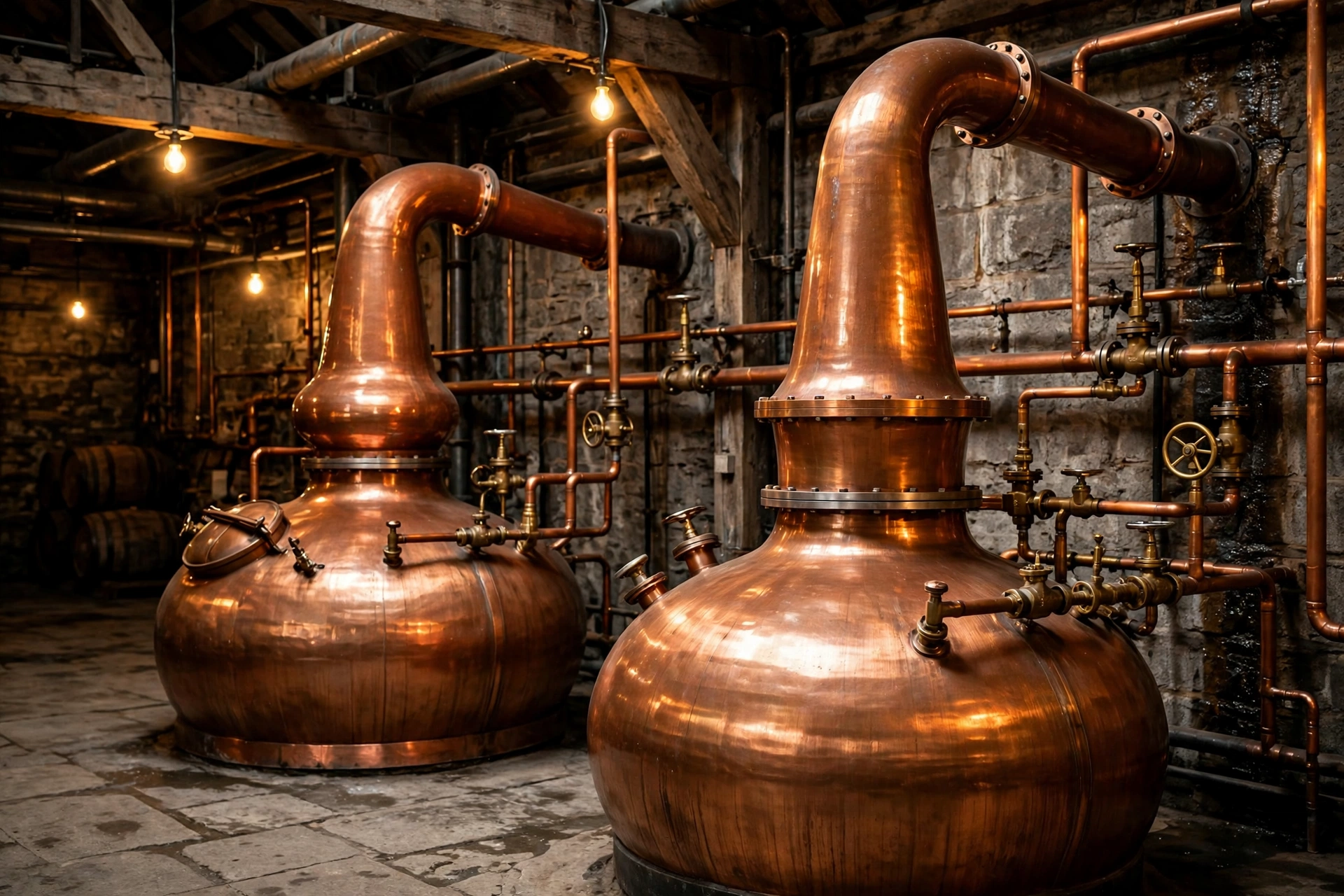
Water is the distillery’s second-biggest operating number after energy, and most of it is cooling water. The Strathclyde survey found 296 litres of cooling water and 17 litres of process water per litre of whisky produced. That cooling water is moved by electric pumps, and the condenser is the one piece of equipment that cannot be allowed to stop while a still is hot. A wash still charged with 13,000 litres of wash at 78 °C holds enough heat to keep producing vapour for a long time after the power fails. If the condenser cooling pump stops, that vapour has nowhere to go except out of the condenser vent, the spirit safe and every pressure-relief point in the stillhouse. The vapour is ethanol. It is flammable at room temperature. That is why the condenser cooling pump sits at the top of the critical load list, above the mash tun and above the bottling line.
The scale of the industry puts these numbers in context. Scotland has 151–154 operating whisky distilleries, with a total malt capacity of 403 million litres of pure alcohol a year; in 2024 the industry produced 307 million litres at 77% capacity. The two largest grain distilleries, Cameronbridge and Girvan, are each rated at 110 million litres a year. About 22 million casks are maturing in Scotland, and Scotch exports were worth £5.36 billion in 2025. In Kentucky, 16.1 million bourbon barrels are ageing in warehouses. Every one of those sites has a generator question, and the answer is never the same number twice, because the load that matters is the electrical slice, not the thermal one.
What Size Generator Does a Distillery Need?
The sizing rule for a distillery is the same as for any industrial site: size from the critical load, add the starting surge of the largest motors, then add a margin for growth. The worked method is in the generator sizing guide, and the numbers below apply that method to five distillery sizes. The kVA figures are for the critical board — the loads that must not stop — not for the whole site. A distillery that tries to back up everything, including electric still heating and comfort cooling, will specify a set two or three times larger than it needs and pay for it in fuel, maintenance and capital for twenty years.
| Distillery type | Annual output | Critical load | Generator size |
|---|---|---|---|
| Craft pot still | Up to 50,000 LPA | 45–110 kW | 60–150 kVA |
| Small malt | 50,000–500,000 LPA | 110–260 kW | 150–350 kVA |
| Mid-size malt | 500,000–5,000,000 LPA | 200–450 kW | 250–600 kVA |
| Large malt | 5,000,000–20,000,000 LPA | 450–1,100 kW | 600–1,500 kVA |
| Grain / neutral spirit | 20,000,000 LPA and above | 750–1,900 kW | 1,000–2,500 kVA |
LPA means litres of pure alcohol. The bands overlap because two distilleries of the same output can have very different critical loads: one runs electric still heating and a full bottling line, the other runs steam stills and bottles off-site. The survey behind the table is the site’s own load list, not a catalogue figure.
A craft pot-still distillery
A craft distillery is the simplest sizing case, and the one most often done wrong. The site typically has a 200–2,000-litre wash still, a spirit still of similar size, a small mash tun, two or three washbacks and a bottling bench. The electrical load is 45–110 kW: condenser cooling pump, mash tun agitator, transfer pumps, lighting and controls. A 60–150 kVA set covers it, and the set is usually a silent-canopy machine on a concrete plinth outside the stillhouse — the featured image shows exactly that arrangement at a stone-built Scottish distillery.
The trap at craft scale is electric still heating. A 200-litre still running on a 5.5 kW immersion heater is common in small distilleries, and a 1,000-litre still can carry 18–36 kW of heating elements. That heat load is resistive, so it adds directly to the generator load with no starting surge — but it adds all of it, all the time the still is running. A craft distillery that backs up its electric still heating needs a set one size larger than the table suggests, and it needs to ask whether the money is better spent on a gas-fired still or a steam jacket. Most craft distilleries that outgrow their first set do so because of heating elements, not because of production growth.
A mid-size malt distillery
Bruichladdich on Islay is a useful reference for this band, because its process numbers are published in unusual detail. One mash uses 6.5 tonnes of grain milled and mixed with 33,000 litres of water at 65 °C; the mash takes 8 hours and the site averages two mashes a day. The wort ferments in one of six washbacks for about two days at 22 °C to about 7% ABV. The wash is pumped to a 30,000-litre charging tank, then charged in roughly 13,000-litre batches into one of two 17,245-litre wash stills, which produce low wines at about 22% ABV. Those feed two 12,742-litre spirit stills, which produce spirit at an average of 68% ABV: foreshots run for 40 minutes, the middle cut runs for 2.5–3 hours, and the spirit is filled to cask at 68.5%.
A distillery of that shape draws 200–450 kW on its critical board and needs a 250–600 kVA set. The largest single starting load is usually the condenser cooling-water pump, followed by the mash tun agitator and the compressed-air compressor. The question of motor starting decides the set size more often than the running load does: a 55 kW pump motor started direct-on-line draws five to seven times its running current for a few seconds, and a generator that is sized only for running load will dip in voltage, trip the automatic transfer switch on undervoltage, or stall the stillhouse ventilation fans at the moment they are needed most. The sizing guide’s step-load method — largest motor first, then the rest in sequence — is the way to avoid that.
A large grain and neutral-spirit plant
A grain distillery is a different machine. It runs continuously, it distils to 96% alcohol in a column train, and its total electrical load can exceed 10 MW. No diesel generator backs up a load like that, and no honest specification pretends otherwise. The generator covers the critical slice: column cooling and reflux pumps, boiler controls and fans, gas detection, fire systems, emergency lighting, effluent treatment and the control room. That slice runs 750–1,900 kW, which is a 1,000–2,500 kVA set, usually two or three sets in parallel with an N+1 arrangement so that one set can be serviced while the plant is running.
The honest limit matters here. A buyer who asks a supplier for a generator to “run the distillery” without defining which loads is asking for a quotation that cannot be answered. The specification must list the loads, in tiers, with running and starting currents. The tiers are in the section below. A grain plant that writes that list properly usually finds that its critical slice is 10–20% of its total electrical load, and that a 1,500 kVA set does the job that a 10,000 kVA fantasy could not.
What Happens in the First Minutes of an Outage
A distillery outage has a shape that is different from a factory outage, because the product is a liquid in a hot vessel and the vapour is flammable. The first ten seconds are the same as anywhere: the lights go out, the automatic transfer switch senses the loss, the generator cranks and takes the load. The next ten minutes are where distilleries lose money. The stills are still hot. The wash in the washbacks is still fermenting. The column, if there is one, is still full of liquid and vapour at operating temperature. None of that stops because the power stopped. What stops is the equipment that controls it: the condenser cooling pumps, the reflux pumps, the ventilation fans, the agitators and the instrumentation.
Heaven Hill Bernheim, Louisville
The Bernheim distillery in Louisville, Kentucky, lost power at 9:45 a.m. on a Monday morning. The outage tripped the fire alarms, and the Louisville fire department attended the site. A few hundred gallons of whiskey spilled during the outage. The fire department gave the all-clear at 11 a.m., about 75 minutes later, and the spill was monitored by the Louisville Metropolitan Sewer District. The distillery’s director of Kentucky distillation said there was no cause for concern to surrounding neighbours — which is the right answer for a few hundred gallons. It is also a reminder that a power cut in a distillery is not only a production problem. It is a spill problem, a fire-alarm problem and a neighbourhood problem, and the generator that restores power in ten seconds does not undo the 75 minutes in between.
The Bernheim case is small in volume and large in lesson. A few hundred gallons of whiskey is a rounding error in a distillery that fills thousands of barrels a day. But the spill happened because a transfer or a drain lost its pump, its valve or its level control at the moment the power failed. The generator’s job is not only to keep the stills running. It is to keep the pumps, the valves and the level controls running so that the liquid stays where it belongs.
Buffalo Trace, Frankfort
Buffalo Trace in Frankfort, Kentucky, is the oldest continuously operating distillery in the United States, and in April 2025 it closed after the Kentucky River flooded the site. The river crested at 48.2 feet, the second-highest level in Frankfort’s history, and the distillery’s own statement called the damage “substantial”. The site had a flood plan and activated it before the surge arrived, which limited the damage. It still closed, and the reopening date moved more than once.
Floods are not power cuts, but the Buffalo Trace case belongs in this section because it shows the second half of the outage problem: the restart. A distillery that has been under water, or without power for days, does not restart by switching the generator on. Every vessel must be inspected, every pump primed, every control loop checked, and the first distillation run after the restart is a test run, not a production run. A generator that can carry the site for a week is worth more than a generator that can carry it for a day, because the outage that matters is rarely the one-hour outage. It is the three-day outage, and the three days after it.
A planned week without the grid
The cleanest generator case in the distilling industry is a planned outage, not an emergency. A bourbon distillery in Kentucky faced a one-week shutdown while its utility provider upgraded the local substation. With no power for the whole week, production would have stopped completely. The distillery brought in a temporary power contractor, which installed two 1 MW diesel generators with transformers and distribution equipment — 2 MW in total — and kept the site running at full capacity for the week. The contractor’s load analysis cut the rental down from the larger fleet the distillery had first asked for, and the saving against that first plan was about $100,000 in rental, freight, labour and fuel.
That case is the template for the sizing argument in this article. The distillery did not rent 2 MW because it needed 2 MW of running load. It rented 2 MW because the load analysis said the critical board, the starting surge and the margin added up to that figure — and because the alternative, a week of lost production, cost far more than the rental. The same arithmetic applies to a permanent set: the cost of the generator is measured against the cost of the outage, not against the cost of the next-cheapest generator.
The Stillhouse Is a Hazardous Area
A distillery is one of the few industrial sites where the product itself is the explosion hazard. Ethanol has a flash point of about 12 °C, which means that spirit at every strength a distillery normally handles — from low wines to bottling strength — gives off flammable vapour at or near room temperature. The lower explosion limit is 3.1% by volume in air, the upper limit 27.7%, and the ignition temperature is 400 °C, which puts ethanol in temperature class T2. Its gas group is IIB when dry and IIA when the air contains at least 4% water vapour. A generator is an ignition source: it has a hot exhaust, a sparking alternator brush assembly and a fuel system of its own. Putting one next to a stillhouse without a hazardous-area assessment is the kind of mistake that is only made once.
Where the zones sit
Zones are expected around the stills, the spirit receivers and their vents, the spirit safe, the tank farm, cask filling, tanker loading and high-strength bottling. The stillhouse itself is the obvious zone, but the bonded warehouse needs its own assessment, and it often concludes differently: a warehouse full of sealed casks at ambient temperature is a lower release risk than a stillhouse full of open vessels and hot spirit. Malt or grain milling adds a dust hazard on top of the vapour hazard, because grain dust is explosive in its own right. The employer decides and records the classification — the DSEAR assessment in Great Britain, the explosion protection document elsewhere in Europe, the fire code and the National Electrical Code in the United States.
The practical consequence for the generator is distance and direction. The set sits outside the classified zones, upwind of the stillhouse vents, with its exhaust pointed away from the building and its fuel tank separated from the spirit store. The cable run from the generator to the stillhouse switchboard crosses the zone boundary, so the glands, the containment and the earthing are specified for the zone they pass through, not for the room they start in. A generator supplier who has never worked in a distillery will quote a standard canopy set and a standard cable run. A supplier who has will ask for the DSEAR assessment before quoting.
Ventilation does the work
Ventilation is the control that makes the zone classification workable, and a worked example shows why. A 200-litre still running on a 5.5 kW heater, with its safety valve as the release source, produces a vapour release that — in a room with only natural ventilation — drives the background concentration to about 9% ABV, far above the safe limit of 0.775% ABV, which is 25% of the lower flammability limit. After the release stops, the room takes about 5 hours to fall back to a safe level, and the zone classification around the valve is revised to Zone 1, which requires explosion-proof equipment throughout.
The same still, the same release, with a fan moving 1,500 m³/h — eight air changes an hour in that room — holds the background concentration at 0.68% ABV, just below the safe limit, and the zone around the valve stays at Zone 2 with a radius of about 2 metres. Ventilation is not a comfort item in a distillery. It is the difference between Zone 1 and Zone 2, between explosion-proof equipment everywhere and explosion-proof equipment in a two-metre radius, and between a generator that can sit 10 metres from the stillhouse and one that must sit 30 metres away. That is why the stillhouse ventilation fans are on the critical board, and why they are the first load the generator picks up after the condenser pumps.
Where the generator can and cannot sit
The generator itself must not become the ignition source. The set goes on a plinth outside the classified area, with its own bunded fuel tank, its exhaust stack clear of the stillhouse roof vents, and its air intake upwind of any vapour source. The fuel tank needs the same secondary containment as any diesel installation, and the fill point must be outside the zone. The automatic transfer switch and the main switchboard are the other half of the placement problem: they contain arcing contacts, and they belong outside the zone or in an enclosure rated for it.
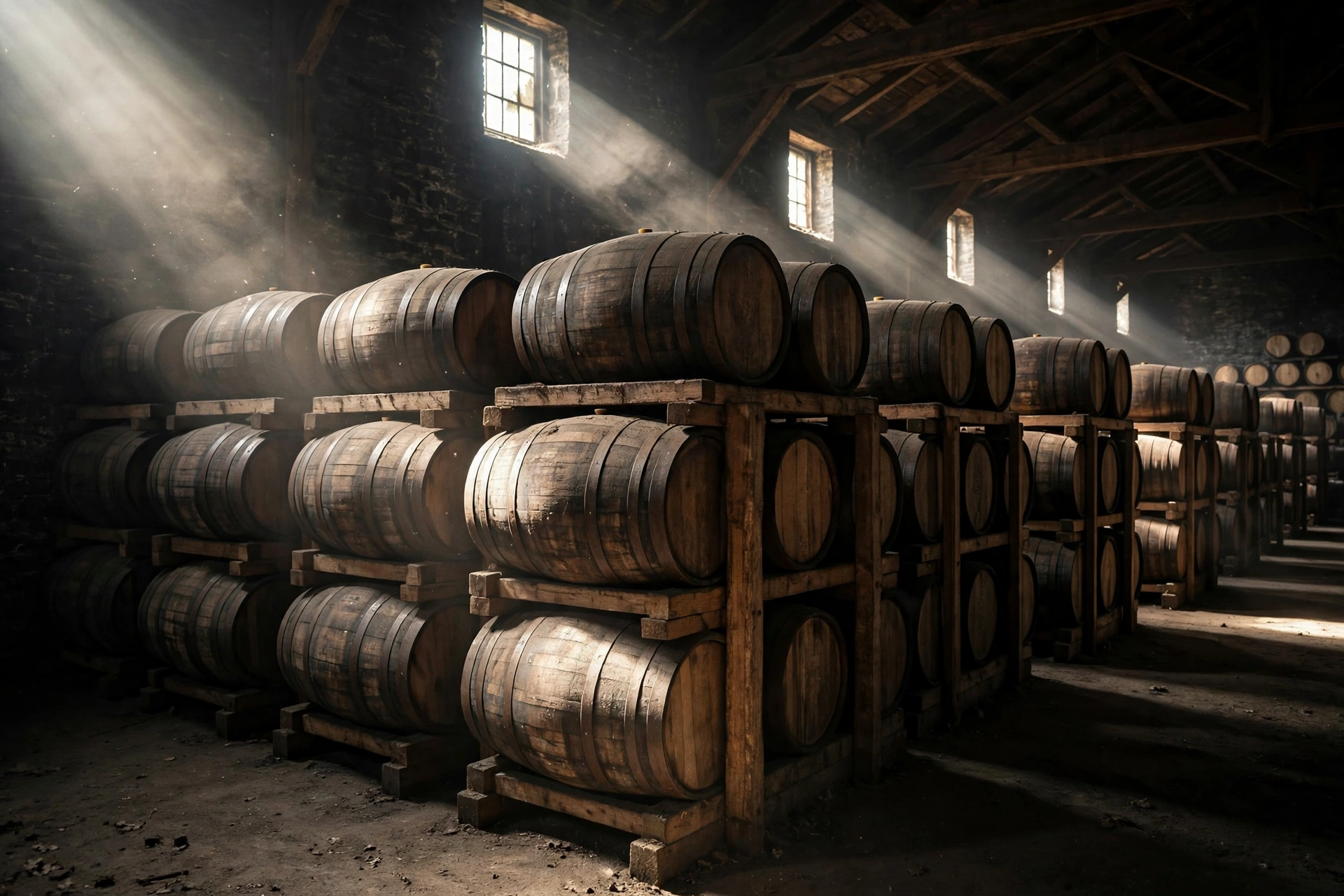
The bonded warehouse deserves a separate note. A warehouse holding thousands of casks is a fuel load of a different kind: each cask holds up to 200 litres of spirit at 63–70% ABV, and a fire in a warehouse does not behave like a fire in a factory. The generator does not protect the warehouse from fire. It protects the warehouse’s fire detection, its alarm system and its emergency lighting, and it keeps the pumps that supply the fire water running if the mains supply is electric. That is a small load and a large responsibility, and it belongs on the critical board even though the warehouse itself draws almost no power in normal operation.
What the Generator Must Carry — and What It Must Not
The load list is the specification. A distillery that writes it properly ends up with three tiers, and the tiers are decided by what happens if the load stops, not by how large the load is. Tier 1 is the load that must not stop for even a minute. Tier 2 is the load that must restart within the hour. Tier 3 is the load that can wait until the grid returns. The generator is sized for Tier 1 plus Tier 2, with Tier 3 shed on transfer.
Tier 1 — life safety and process protection
Tier 1 is the smallest tier and the most important. It holds the fire detection and alarm system, the emergency lighting, the stillhouse ventilation fans, the condenser cooling-water pumps, the gas detection system and the control system that watches the stills. It also holds the effluent treatment plant’s aerators and pumps, because a distillery that stops treating its effluent while it is still producing wash is breaking the law within hours, not days. The total for a mid-size malt distillery is usually 60–120 kW — a fraction of the site’s total load, and the fraction that decides whether the outage is an inconvenience or a disaster.
The condenser cooling pump deserves emphasis because it is the load that buyers most often leave off the critical board. A still that is hot and has no cooling is a still that is venting ethanol vapour into a room full of hot surfaces. The pump is not large — 30–55 kW in a mid-size plant — but it is the first load the generator must pick up, and it must be picked up in sequence, not in parallel with the rest of the board, so that its starting current does not dip the voltage below the level the ventilation fans need.
Tier 2 — restart and recovery
Tier 2 holds the loads that get the distillery back to production: the mash tun agitator, the washback cooling, the transfer pumps, the compressed air system and the bottling line at reduced speed. Distilleries share their fermentation problem with breweries, where the same washback cooling and temperature control decide whether a batch survives an outage. A washback that loses its cooling for an hour does not lose its wash — fermentation is a slow process, and the wash temperature rises by a degree or two an hour, not by ten — but a washback that loses its cooling for a day does. Yeast activity falls off sharply above 35–40 °C, and a wash that has been allowed to overheat will not finish fermenting. The mash tun is similar: a mash left unstirred for an hour is a mash that needs to be reworked, not a mash that is ruined. Tier 2 is the tier that turns a one-hour outage into a one-hour delay instead of a one-day loss.
The bottling line is the Tier 2 load that causes the most argument. It is large — 30–75 kW — and it is not part of the distillation process. But a distillery that has filled 10,000 bottles and cannot label and pack them is a distillery with a warehouse full of unfinished stock, and a bottling line that stops mid-run leaves open bottles on the conveyor. Most distilleries put the bottling line on Tier 2 at reduced speed, with the labeller and the capper on the critical board and the case packer shed. That is a commercial decision, not an engineering one, and it belongs in the load list as a commercial decision.
Tier 3 — shed on transfer
Tier 3 is everything else: electric still heating where it exists, comfort cooling and heating, the visitor centre, the offices, the warehouse lighting beyond emergency levels and the electric vehicle chargers. Shedding Tier 3 is not a sacrifice. It is the reason the generator can be a 250 kVA set instead of a 1,000 kVA set. A distillery that refuses to shed anything is a distillery that pays for a generator four times larger than it needs, and then pays again in fuel and maintenance for twenty years.
The most common Tier 3 mistake is the electric still. A craft distillery with a 1,000-litre electrically heated still can carry 18–36 kW of heating elements, and the temptation is to put them on the critical board so that the run continues through the outage. That is almost always the wrong call. A still run that is interrupted can be restarted; a still run that is kept going on a generator that is too small will trip the generator and take the condenser pumps and the ventilation fans with it. The still heating is shed, the run is restarted when the grid returns, and the generator keeps the loads that actually protect the site.
How Long Can a Distillery Run on a Generator?
The answer depends on the set size, the load and the tank — three numbers that multiply together. The fuel figures below use the Cummins C500D5 as the reference machine, because its datasheet is public and its consumption is typical for the class: 500 kVA standby / 455 kVA prime, burning 93.2 L/h at full prime load, 69.9 L/h at 75% and 49.0 L/h at 50%. The smaller sets in the table scale from the same specific consumption, roughly 0.20–0.22 litres per kWh at 75% load.
The fuel maths
A 250 kVA set carrying a mid-size malt distillery’s critical board at 75% load — about 150 kW — burns roughly 32 litres an hour. A 150 kVA craft set at the same load factor burns about 19 litres an hour. A 500 kVA set burns 70 litres an hour, and a 1,000 kVA set about 140 litres an hour. Those numbers are the reason the tank is sized in days, not hours: a 250 kVA set running for three days burns about 2,300 litres, and a 1,000 kVA set running for a week burns about 23,500 litres. The fuel bill for a week-long outage at a large distillery is not a rounding error. It is a line in the outage budget, and it is the line that decides whether the distillery runs on the generator for a week or shuts down on day three and waits for the grid.
| Generator size | Load at 75% | Fuel use | 24 hours | 72 hours | 168 hours |
|---|---|---|---|---|---|
| 150 kVA | 90 kW | ~19 L/h | 456 L | 1,368 L | 3,192 L |
| 250 kVA | 150 kW | ~32 L/h | 768 L | 2,304 L | 5,376 L |
| 500 kVA | 300 kW | ~70 L/h | 1,680 L | 5,040 L | 11,760 L |
| 1,000 kVA | 600 kW | ~140 L/h | 3,360 L | 10,080 L | 23,520 L |
The figures are at 75% load. A set running at 50% load burns about 30% less per hour, and a set running at full load burns about 30% more. The table is a planning tool, not a fuel order: the actual consumption comes from the set’s own datasheet at the load the site will actually carry.
Tank sizing for 24, 72 and 168 hours
The tank decision is a risk decision, and the distilling industry has a useful reference point: the Aggreko bourbon case ran for one week on temporary generators, and the distillery’s own fuel logistics — road tankers, a bunded bulk tank and a day tank with a transfer pump — were part of the plan from the start. A distillery that sizes its tank for 24 hours is betting that no outage lasts longer than a day. That bet loses regularly in rural Scotland, in Kentucky storm season and in any country where the grid is repaired by a crew that has to drive to the site.
The practical rule is 72 hours in the bulk tank plus a day tank that holds 8–12 hours, with a transfer pump and a low-level alarm that is wired to the remote monitoring system so that someone off-site knows the tank is falling. Seventy-two hours covers the storm, the substation failure and the flood. A week of fuel needs a bulk tank of 5,000–25,000 litres depending on the set size, and at that volume the tank itself becomes a project: bunding, planning permission, fire separation and a delivery route that a road tanker can use in the same weather that caused the outage. The tank is not an accessory. It is half the backup power system.
Keeping the fuel usable
A distillery generator is a standby set, and a standby set’s fuel sits in the tank for months between runs. Diesel ages, water condenses in the tank, and microbes grow at the fuel-water interface. The fuel in a distillery’s bulk tank is no different from the fuel in any other standby set, and the failure mode is the same: the set starts, runs for twenty minutes, and then the filters block and the engine stops. The rules for diesel fuel ageing are covered in depth in the companion article, and they are short: test the fuel twice a year, polish it when the water content rises, keep the tank full so that condensation has nowhere to form, and treat the fuel with a biocide if the site is warm and humid. A distillery in a tropical climate — a rum distillery in the Caribbean, a sugar-cane distillery in Brazil — needs to treat fuel ageing as a monthly task, not an annual one.
The other fuel risk is the one that the distillery industry knows better than most: theft. A bulk tank holding 10,000 litres of diesel on a rural site is a target, and the fuel-theft article covers the hardware — anti-siphon fillers, level telemetry, locked caps — that keeps it in the tank. A distillery that loses its fuel to theft loses its backup power on the same night it loses its fuel, and the outage that follows is the one the generator was bought to survive.
Frequently Asked Questions
What size generator does a distillery need?
A craft pot-still distillery needs 60–150 kVA, a mid-size malt distillery 250–600 kVA, and a large grain distillery 1,000–2,500 kVA for its critical loads. Size from the critical board — condenser pumps, ventilation, controls and effluent treatment — not from the site’s total electrical load, and add the starting surge of the largest motor before choosing the set.
Do distilleries need a backup generator?
Yes, if the distillery cannot afford to lose a batch in the still, a wash in the washbacks or a day of effluent compliance. A power cut does not stop a hot still from producing vapour, and it does not stop a fermenting wash from warming. The generator keeps the condenser pumps, the ventilation fans and the controls running, which is what keeps the stillhouse safe and the batch recoverable.
How long can a distillery run on a generator?
As long as the fuel lasts. A 250 kVA set at 75% load burns about 32 litres an hour, so a 2,300-litre tank gives about 72 hours. A 1,000 kVA set at the same load factor burns about 140 litres an hour and needs about 10,000 litres for three days. The practical limit is the bulk tank and the fuel delivery route, not the generator.
What happens to a distillery during a power outage?
The stills stay hot, the wash keeps fermenting and the column keeps its inventory of liquid and vapour, but the pumps, fans and controls that manage them stop. Condenser cooling is the first loss and the most dangerous, because ethanol vapour then has nowhere to go except out of the vents. Spills, fire alarms and lost batches follow — as the Heaven Hill Bernheim outage showed, when a few hundred gallons of whiskey spilled in 75 minutes.
Can a diesel generator power a distillery?
Yes, for its critical loads. A diesel set cannot carry a grain distillery’s full 10 MW electrical load, and it is not asked to. It carries the critical slice — cooling, ventilation, controls, effluent treatment and the loads needed to restart — which is typically 10–20% of the total. The stills themselves are steam-heated, so the generator never has to carry the thermal load that dominates the distillery’s energy bill.
Specification Checklist: Before You Order the Set
- List the loads in three tiers — life safety and process protection, restart and recovery, shed on transfer — with running and starting currents for each motor.
- Confirm the stills are steam-heated. If any still is electrically heated, decide explicitly whether its elements are on the critical board or shed on transfer.
- Get the DSEAR or explosion-protection assessment before the generator is sited, and place the set outside the classified zones, upwind of the stillhouse vents.
- Put the condenser cooling pumps and the stillhouse ventilation fans first in the start sequence, so their starting current does not dip the voltage for the rest of the board.
- Size the set from the critical board plus the largest motor’s starting surge, using the step-load method in the generator sizing guide — not from the site’s total connected load.
- Check the standby and prime ratings of the set against the duty it will actually see: a set that runs for a week on prime rating is a different machine from one that runs for an hour on standby rating.
- Specify the bulk tank for 72 hours at 75% load as a minimum, with a day tank, a transfer pump and a low-level alarm wired to remote monitoring.
- Write the fuel-testing schedule into the generator maintenance schedule: test twice a year, polish when the water content rises, and keep the tank full between runs.
- Test the whole system on load every month, including the automatic transfer switch, and record the run hours, the fuel used and the voltage dip on the largest motor start.
- Get the quotation in writing with the set, the switchgear, the tank, the bunding, the cable run and the commissioning test itemised — and confirm the warranty start date before the deposit is paid.
For a set sized to your stillhouse, your still capacity and your fuel autonomy target, contact PAVO with the load list and the DSEAR assessment, and the quotation will come back against the loads that must not stop — not against a catalogue rating.