

What Size Generator Does a Coffee Roasting Plant Need | PAVO
A coffee roasting plant does not sell heat. It sells a batch that was dropped at exactly the right second — and a power cut that stops the drum mid-roast turns that batch into charcoal, the next four hours into a restart, and the week’s orders into apologies.
What size generator does a coffee roasting plant need? A micro-roastery running one 25 kg roaster needs 25–50 kVA, a 120 kg plant needs 150–250 kVA, and a 1,500 kg/h line needs 300–500 kVA. The roaster itself draws little power; the afterburner, cooling tray, grinders and packaging set the size.
This article works through the load list of a real coffee roasting plant, the sizing bands by roaster capacity, the starting surge of drums, fans and grinders, the minutes-long window in which a stopped roast becomes a lost batch, and the afterburner, chaff and placement rules that decide where the set may stand. It covers micro-roasteries, mid-size commercial plants and large industrial lines, with the fuel, placement and specification numbers a buyer needs before paying a deposit.
Contents
- The Roaster’s Clock: Minutes That Decide a Batch
- What a Coffee Roasting Plant Actually Runs: The Load List
- Sizing by Plant Capacity: From a 12 kg Sample Roaster to a 1,500 kg/h Line
- Starting Surge: Roaster Drums, Fans and the Restart Sequence
- Three Outages That Show What a Roastery Loses
- Afterburners, Chaff and the Fire Risk Nobody Sizes For
- Frequently Asked Questions
- Specification Checklist: Ten Lines Before the Deposit
The Roaster’s Clock: Minutes That Decide a Batch
A coffee roasting plant runs on a clock measured in minutes, not hours, and the clock starts the moment green beans hit a hot drum. A typical commercial drum roast runs 8–15 minutes from charge to drop. Green beans enter at about 10–12% moisture and a charge temperature near 195 °C. The first four to six minutes are drying, with bean temperature climbing through 150–170 °C. Then comes the Maillard phase, 170–200 °C, where sugars and amino acids build the flavour compounds. First crack arrives at 196–205 °C, usually seven to nine minutes in. Development runs another 90 seconds to four minutes, and the batch drops at 196–205 °C for a light roast, 210–220 °C for medium, 225–235 °C for dark. Cooling must pull the beans below 50 °C within two to four minutes, or the roast keeps cooking in the tray. The beans lose 15–20% of their weight in the process.
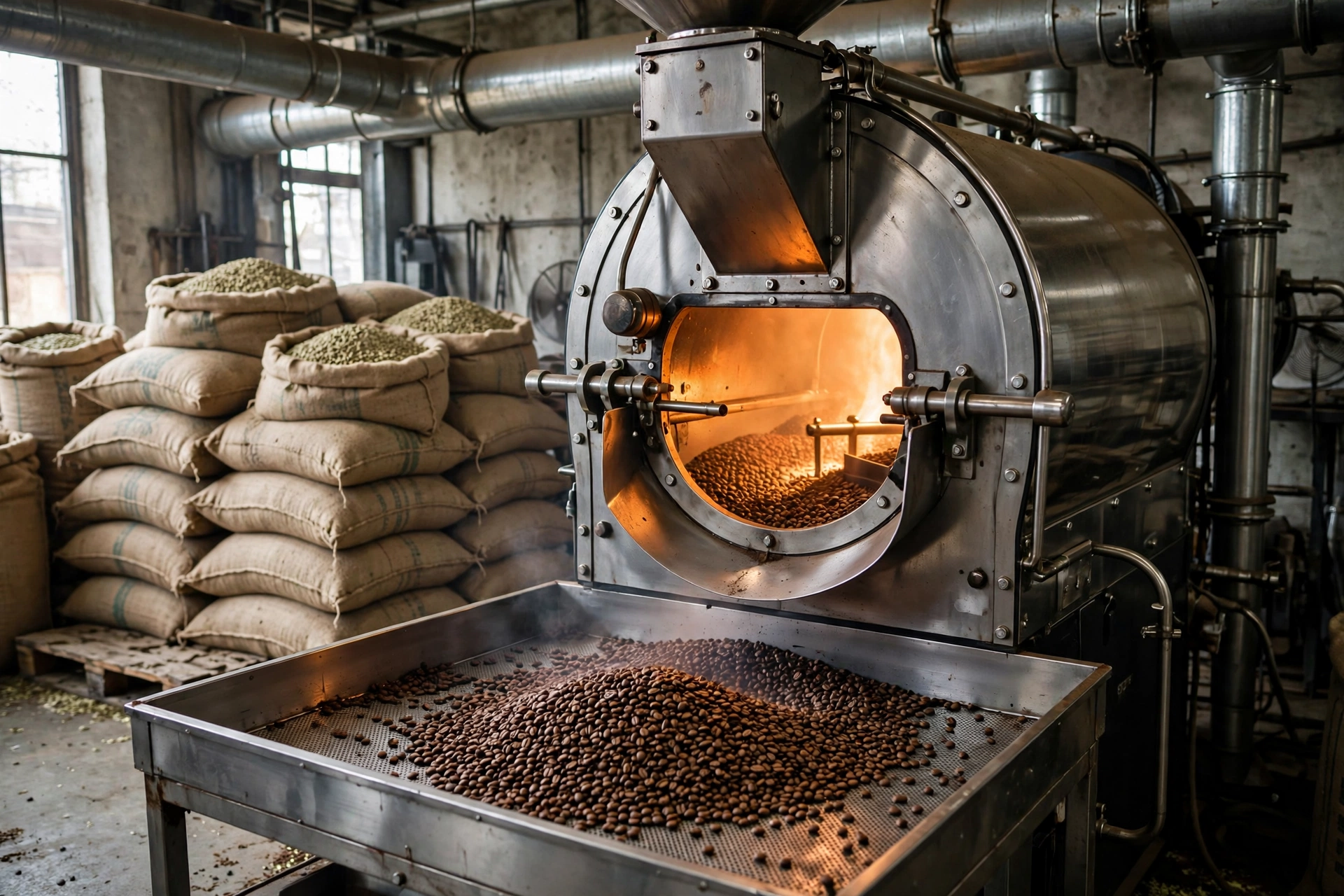
That curve is the reason a power cut in a roasting plant is different from a power cut in a warehouse. The product is being cooked, in real time, at 200 °C and above. Stop the drum, stop the airflow and stop the cooling fan at the same time, and the batch in the drum does not wait. Beans sitting against a hot drum wall with no air moving scorch in minutes. A batch at first crack is lost the moment the drum stops turning — the roast cannot be resumed, because the temperature profile that defines the flavour is broken and cannot be rebuilt. The roaster operator has one decision to make, and it is not whether to save the batch. It is whether to get the beans out of the drum before they catch fire.
The second clock is the warm-up. A drum roaster does not restart cold. The Probat P25, a standard 25 kg batch roaster, needs 25–40 minutes of warm-up before the first charge, and a large industrial drum needs longer. That warm-up is not wasted time: the drum, the burner and the exhaust system must reach a stable temperature before a single bean goes in, or the first three batches of the day will roast unevenly and be sold at a discount or thrown away. A one-hour outage therefore costs a roastery not one hour of production, but one hour plus the warm-up plus the batches that were in the drum, the cooling tray and the grinder when the power failed. A plant that roasts four batches an hour on a 35 kg roaster loses 140 kg of roasted coffee per hour of outage, before the restart is counted — and at wholesale prices of $12–18 per kilogram, that is $1,700–2,500 of product per hour, plus the green coffee that went into the lost batches.
The third clock belongs to the afterburner. Roasting produces smoke, chaff and volatile organic compounds, and in most jurisdictions a commercial roaster may not vent them raw. The exhaust passes through a thermal oxidiser or catalytic afterburner that holds 650–800 °C — the Loring S35 lists a continuous stack temperature of 788 °C — and destroys the smoke and odour before it reaches the stack. That unit is gas-fired on most drum roasters, but its fans, controls and safety interlocks are electric. Lose power and the afterburner trips. Relighting it is not a switch flick: the unit must purge, prove flame and climb back to operating temperature, and while it is down the roaster cannot run, because running a roaster without its emission control is a permit violation in California, the EU and most Australian states. The generator that keeps a roasting plant running must therefore keep the afterburner running too, and the afterburner fan is often the largest single motor on the exhaust side.
The fourth clock is the green coffee itself. Green beans are stored in 60 kg jute bags or one-tonne bulk bags, and they are stable — but only while the warehouse stays dry and ventilated. A roasting plant in Ho Chi Minh City or Medellín runs dehumidifiers and warehouse fans around the clock in the wet season, because green coffee at 10–12% moisture absorbs humidity fast and moulds faster. A day without dehumidification in a tropical warehouse does not ruin a tonne of beans at once, but it starts the clock on a claim the buyer will discover three weeks later, when the roast tastes flat and the moisture meter reads 13.5%. The generator that protects the plant protects the warehouse too, and the dehumidifier load belongs on the essential board.
What a Coffee Roasting Plant Actually Runs: The Load List
The surprise in a coffee roasting plant is how little power the roaster itself draws, and how much power everything around it draws. A gas-fired drum roaster is a gas machine with an electric control system. The drum motor, the burner fan, the exhaust fan and the controls are the whole electrical load, and the numbers are small. The Loring S35 Kestrel, a 35 kg automated roaster, draws 3.8 kW nominal and 7.2 kW peak. The Loring S70 Peregrine, at 70 kg a batch, draws 8.6 kW nominal and 17.5 kW peak. The Probat G120, a 60–120 kg drum roaster, needs 15 kW of three-phase power for its motors and controls, while its burner delivers 280 kW of heat from gas. Even the Probat R1500, a 250 kg batch machine producing 1,500 kg/h, lists a connected electrical load of only 36 kVA. The roaster is not the load. The plant is.
The afterburner is the first load most buyers forget. A thermal oxidiser for a 120 kg roaster draws 15–30 kW for its combustion-air fan, exhaust fan and controls, and it must run whenever the roaster runs. A catalytic oxidiser draws less — the Loring design builds the oxidiser into the recirculating system and cuts VOCs by 92.4% — but the exhaust fan that pulls air through it still draws 5–10 kW, and it starts against a cold duct. The afterburner is also a load that cannot be shed. Shed it and the roaster must stop, because the plant’s air permit depends on it.
The cooling tray is the second load. A 35 kg batch drops onto a cooling tray with a high-speed fan and paddle stirrers, and the tray must pull the beans from 220 °C to below 50 °C in under four minutes. The cooling fan on a mid-size plant draws 5–11 kW, and it runs at full speed for every batch, several times an hour. A plant that roasts 12 batches a day runs that fan for two hours of every shift, and a plant that loses cooling mid-batch loses the batch, because beans left hot in the tray keep roasting and go dark.
The grinders are the third load, and they are the one that trips generators. A commercial roller grinder for a roasting plant draws 7.5–22 kW depending on throughput, and it starts under load — beans are already in the grinding chamber when the motor starts. A 15 kW grinder motor on direct-on-line start draws five to seven times its running current for a few seconds, and a plant that starts a grinder at the same moment the roaster’s exhaust fan restarts will see a voltage dip that trips the roaster’s controls. Grinders also run in bursts, not continuously, which makes them easy to underestimate on a load list and easy to trip on in practice.
Packaging, conveying and compressed air make up the fourth group. A vertical form-fill-seal machine draws 3–8 kW, a valve applicator and nitrogen-flush unit another 2–5 kW, and the pneumatic conveying that moves beans from the roaster to the grinder to the packing line runs on a 7.5–15 kW compressor. The compressor cycles, so its average draw is low, but its starting surge is the largest single transient in the plant after the grinders. Add destoners, colour sorters, blending silos with their own motors, and the pallet wrapper at 3–5 kW, and the packaging hall draws 30–60 kW in a mid-size plant — more than the roaster.
The fifth group is the building itself: warehouse dehumidifiers at 3–10 kW each, HVAC for the roasting hall at 10–25 kW, lighting at 5–15 kW, and the quality-control laboratory with its sample roasters, moisture analysers and cupping equipment at 3–8 kW. None of these is large on its own. Together they are a third of the plant’s load, and they are the loads that run all day, every day, whether the roaster is turning or not.
| Load group | Typical running load | Starting behaviour | Can it be shed? |
|---|---|---|---|
| Drum roaster (25–120 kg) | 4–15 kW | Drum motor soft start, low surge | No — it is the business |
| Afterburner / oxidiser | 5–30 kW | Fan start, 4–6x surge | No — permit depends on it |
| Cooling tray fan | 5–11 kW | High-speed fan, 4–5x surge | No — batch is lost without it |
| Grinders | 7.5–22 kW | Starts under load, 5–7x surge | Briefly — but it blocks packing |
| Packaging line | 10–25 kW | Motors and heaters, moderate surge | Briefly — orders wait |
| Compressor (pneumatic conveying) | 7.5–15 kW | Largest transient after grinders | No — beans stop moving |
| HVAC, dehumidifiers, lighting | 20–50 kW | Compressors cycle, moderate surge | Partly — warehouse first |
| QC lab and offices | 3–8 kW | Small, steady | Yes — last priority |
A load list built this way gives a 25 kg micro-roastery a running load of 20–35 kW, a 120 kg mid-size plant 80–140 kW, and a 1,500 kg/h industrial line 200–350 kW. The roaster is the smallest line on the list. The plant around it is the generator.
Sizing by Plant Capacity: From a 12 kg Sample Roaster to a 1,500 kg/h Line
Sizing a generator for a roasting plant starts with the roaster, but it ends with the afterburner and the grinders. The table below gives the bands that hold in practice, for plants that roast eight hours a day, five to six days a week. The figures assume the afterburner, cooling tray, one grinder, packaging and the warehouse dehumidifiers all run, and that the largest motor starts while the rest of the plant is at full load.
| Plant size | Roaster | Running load | Generator size | Fuel at 75% load |
|---|---|---|---|---|
| Micro-roastery | 12–25 kg batch, 1 roaster | 20–35 kW | 25–50 kVA | 5–9 L/h |
| Small commercial | 35–70 kg, 1–2 roasters | 45–80 kW | 75–125 kVA | 12–20 L/h |
| Mid-size plant | 60–120 kg, 1 roaster + afterburner | 80–140 kW | 150–250 kVA | 22–38 L/h |
| Large plant | 250–330 kg, 1,000–2,000 kg/h | 200–350 kW | 300–500 kVA | 45–75 L/h |
A micro-roastery is the most common buyer, and the easiest to get wrong. A single 25 kg Probat P25 draws about 12 kW of electrical power at peak, and a buyer who sizes from the roaster alone will order a 20 kVA set and wonder why it trips. The afterburner fan adds 7–15 kW, the cooling tray 5 kW, a small grinder 7.5 kW on start, the compressor 5.5 kW, and the shop’s lights, HVAC and dehumidifier another 8–12 kW. The real running load is 35–45 kW, and the set that carries it with a margin for the grinder’s starting surge is 50 kVA — a 40 kW prime set, not a 20 kVA one. The difference in price is about $2,000–3,000. The difference in outcome is a plant that roasts through an outage and one that does not.
A small commercial roastery running a 35 kg Loring S35 and a 15 kg Loring S15 side by side is a different shape. The two roasters together draw under 12 kW nominal, but the plant around them — afterburner, two cooling trays, a 15 kW grinder, packaging, compressor, HVAC and warehouse — draws 60–80 kW. The set for that plant is 100–125 kVA, and it should be specified prime-rated if the plant roasts more than 200 hours a year on generator power, which a plant in a grid-unstable region easily does. Standby and prime ratings are not interchangeable here: a standby-rated set that runs 1,500 hours a year as the plant’s second power source will follow the same early-wear pattern as any standby set run beyond its rating.
A mid-size plant built around a 120 kg Probat G120 is where the afterburner becomes the sizing driver. The roaster draws 15 kW electrical and burns 15 m³/h of gas while roasting. The thermal oxidiser that cleans its exhaust draws 15–30 kW for its fans, and it starts against a cold duct at four to six times running current. The cooling tray, grinder, packaging line and compressor add another 50–70 kW. The running load lands at 100–140 kW, and the generator that carries it with a starting margin is 200–250 kVA. At 75% load a set in that range burns 30–38 litres an hour, so a 1,000-litre day tank gives 26–33 hours of autonomy — enough for a two-day outage with a fuel delivery on the second morning.
A large plant running a 250 kg Probat R1500 at 1,500 kg/h is an industrial load, not a roastery load. The roaster’s connected load is only 36 kVA, but the plant around it — afterburner, multiple cooling trays, 22 kW grinders, high-speed packaging lines, a 15 kW compressor, silo conveying, HVAC and a warehouse the size of a football field — draws 250–350 kW. The generator for that plant is 400–500 kVA, and it is almost always specified as a containerised set with a 2,000-litre bulk tank, because a set that size burns 60–75 litres an hour at full load and a day tank would need refilling twice a shift. The Cummins C500D5, rated 500 kVA standby / 455 kVA prime, burns 93.2 L/h at full prime load — a useful reference point for the top of this band.
The sizing rule that holds across all four bands is simple, and it is the same rule the generator sizing guide sets out: size the generator for the plant, not the roaster. Add the afterburner first, the cooling tray second, the grinder third, and the packaging and building loads last. Then add 20–25% for the largest motor’s starting surge. A buyer who sizes from the roaster’s nameplate alone will buy a set that is too small by a factor of two, and will discover it on the first outage, when the grinder starts and the roaster’s controls drop out.
Starting Surge: Roaster Drums, Fans and the Restart Sequence
Motor starting is where roasting plants lose generators, because the plant’s loads start in bursts and the bursts overlap. The motor starting load is what decides the generator’s size here, not the running load. A drum roaster’s drum motor is small and usually soft-started, so it is not the problem. The problem is everything that starts at the same time as the drum: the exhaust fan, the cooling-tray fan, the grinder and the compressor. Each of those draws four to seven times its running current for a few seconds, and the voltage dip they cause together is what trips a roaster’s burner controls and its PLC.
The worst overlap in a roasting plant is the restart after an outage. The automatic transfer switch closes, the generator is already at speed, and every motor in the plant tries to start at once — the roaster’s exhaust fan, the afterburner’s combustion fan, the cooling-tray fan, the compressor and the HVAC. A plant with 80 kW of running load can present 250–300 kVA of starting demand in the first three seconds. A generator sized for the running load alone will dip below 70% voltage, the contactors will chatter, the roaster’s flame safeguard will lock out, and the plant will be dark again with the generator running. The fix is a staged restart, and it belongs in the plant’s control system, not in the operator’s memory.
A staged restart works in four steps. First, the generator takes the building loads — lighting, dehumidifiers and the control panels — and nothing else. A remote monitoring controller on the set — Deep Sea or Smartgen — logs each transfer and start, so the plant manager sees the outage and the restart sequence from a phone instead of discovering it in the logbook the next morning. Second, after ten seconds, the afterburner’s fans start and the oxidiser begins its purge and light-off sequence, because the roaster cannot run without it. Third, the roaster’s drum and exhaust fan start, and the drum begins its warm-up. Fourth, and only after the roaster is at temperature, the grinder, packaging line and compressor are released one at a time, with a five-second gap between each. The whole sequence takes two to three minutes, and it is the difference between a plant that restarts cleanly and a plant that trips its own generator.
The second surge to plan for is the grinder. A 15 kW grinder motor on direct-on-line start draws 75–105 kW of apparent power for the first second, and it starts under load because beans are already in the chamber. The standard fix is a soft starter or a variable-frequency drive, which cuts the starting current to two to three times running current and removes the dip almost entirely. A soft starter on a 15 kW grinder costs $400–800. A generator upsized by 50 kVA to absorb the same surge costs $3,000–5,000. The soft starter is the cheaper answer, and it also extends the grinder motor’s life.
The third surge is the compressor. A 15 kW screw compressor starts unloaded, so its surge is smaller than the grinder’s, but it cycles — it starts and stops ten or twenty times a shift as air demand rises and falls. Each start is a small dip, and the dips add up in the roaster’s control voltage. The fix is a receiver tank large enough that the compressor starts no more than four times an hour, and a pressure switch set so the compressor does not start at the same moment as the grinder. Two timers and a larger receiver cost less than $500. A generator that trips once a week costs far more.
The restart sequence also has a rule for the afterburner that no buyer should ignore: the oxidiser must be at operating temperature before the roaster charges its first batch. A thermal oxidiser that is still climbing through 400 °C when the roaster starts will pass smoke and odour straight to the stack, and in a plant with neighbours — which is most roasting plants — that is a complaint, a fine, or a permit review. The generator’s load step should therefore hold the roaster’s burner off until the afterburner’s temperature interlock clears, which takes 15–25 minutes from a cold start. That delay is not lost time. It is the warm-up the drum needs anyway.
Three Outages That Show What a Roastery Loses
Case 1: A 25 kg Specialty Roastery in Melbourne — One Batch, One Morning
A specialty roastery in Melbourne’s inner north runs a single 25 kg Probat P25, roasting 180 kg a day across eight batches for a dozen cafés. The plant’s running load is 32 kW: roaster 12 kW, afterburner fan 7 kW, cooling tray 5 kW, a 5.5 kW grinder, compressor 3 kW. The generator is a 50 kVA silent set with a 200-litre tank, installed after a storm outage in 2024 cost the roastery a full day’s orders.
On a Tuesday morning at 9:40, the grid dropped during the fourth batch of the day. The beans were at 198 °C, just past first crack, with three minutes of development remaining. The automatic transfer switch closed in eight seconds, the generator took the load, and the drum kept turning. The batch finished, dropped at 214 °C, cooled in the tray, and went into the grinder on schedule. The roastery lost nothing — not the batch, not the morning, not the café orders. The outage lasted 47 minutes. The generator burned 6 litres of diesel.
The same outage without the generator would have cost the roastery the batch in the drum (25 kg of green coffee, $250 at wholesale), the batch in the cooling tray (25 kg, another $250), the warm-up time to restart (30 minutes), and the three batches that would have been roasted in the hour after the outage (75 kg, $1,350 of roasted coffee at wholesale). The total, $1,850 of product and a morning of café deliveries missed, is more than the generator’s annual service cost. The set paid for its fuel in the first outage.
Case 2: A 120 kg Plant in Buôn Ma Thuột, Vietnam — The Afterburner Trips First
A mid-size roasting plant outside Buôn Ma Thuột, in Vietnam’s Central Highlands, runs a 120 kg Probat G120 for export contracts, roasting 2,400 kg a day across two shifts. The plant’s running load is 115 kW. The generator is a 200 kVA set, installed in 2023, and the plant’s grid supply fails three to four times a month in the wet season.
The failure that taught the plant its lesson was not a grid outage. It was the afterburner. The thermal oxidiser’s combustion-air fan is a 22 kW motor on direct-on-line start, and it starts at the same moment as the roaster’s exhaust fan after every transfer. On a wet-season afternoon the grid dropped, the transfer closed, both fans started together, and the voltage dipped to 68%. The oxidiser’s flame safeguard locked out. The roaster’s burner, interlocked to the oxidiser, shut down. The drum kept turning on the generator, but with no heat and no exhaust, the 110 kg batch inside went from 205 °C to a stalled, scorched mess in six minutes. The batch was lost, the oxidiser needed a manual reset and a 20-minute purge and relight, and the plant lost 90 minutes of production — 300 kg of roasted coffee, $4,800 at export prices.
The fix cost $620: a soft starter on the oxidiser fan and a five-second start delay in the transfer panel, so the oxidiser starts before the roaster’s exhaust fan. The plant has had eleven grid failures since, and none has cost a batch. The lesson is not that the generator was too small. The 200 kVA set was correctly sized for the running load. The lesson is that a roasting plant’s starting sequence is a design problem, not a size problem, and the cheapest fix is usually a timer, not a larger engine.
Case 3: A 1,500 kg/h Line in Hamburg — The Night the Warehouse Went Dark
A large roasting plant in Hamburg runs a 250 kg Probat R1500 line at 1,500 kg/h, supplying supermarket private-label coffee across northern Germany. The plant’s running load is 290 kW, carried by a 400 kVA containerised set with a 2,000-litre bulk tank. The generator was specified for the roasting line, the packaging hall and the warehouse — and the warehouse is where the story turns.
On a January night the grid failed at 2:10 a.m., during the plant’s night shift. The transfer closed, the generator took the line, and roasting continued. What nobody had put on the essential board was the warehouse dehumidification. The plant stores 400 tonnes of green coffee in a warehouse that holds 18 °C and 55% relative humidity around the clock, and the dehumidifiers draw 24 kW across four units. The transfer panel’s load shed had cut them, on the reasoning that warehouse air was not production. By 6:00 a.m. the warehouse had risen to 24 °C and 78% relative humidity. The coffee was not ruined — green coffee tolerates a bad night — but the moisture content of the top layer of bags rose from 11.2% to 12.8%, and the plant’s quality team quarantined 18 tonnes for re-drying and re-testing. The re-drying cost €3,400, the re-testing €1,100, and the batch scheduling that week was rebuilt around the quarantine.
The plant’s response was to move the dehumidifiers onto the essential board and to add a 60 kVA margin to the next generator specification — the set was already running at 72% load, and the dehumidifiers pushed it to 78%, still within prime rating. The lesson is the same one every food plant learns: the loads that protect the product are as essential as the loads that make it, and a food processing plant that sizes its generator for the line alone will find the loss in the warehouse, the cold store or the laboratory. The generator protects the whole plant, or it protects only the part that was measured.
Afterburners, Chaff and the Fire Risk Nobody Sizes For
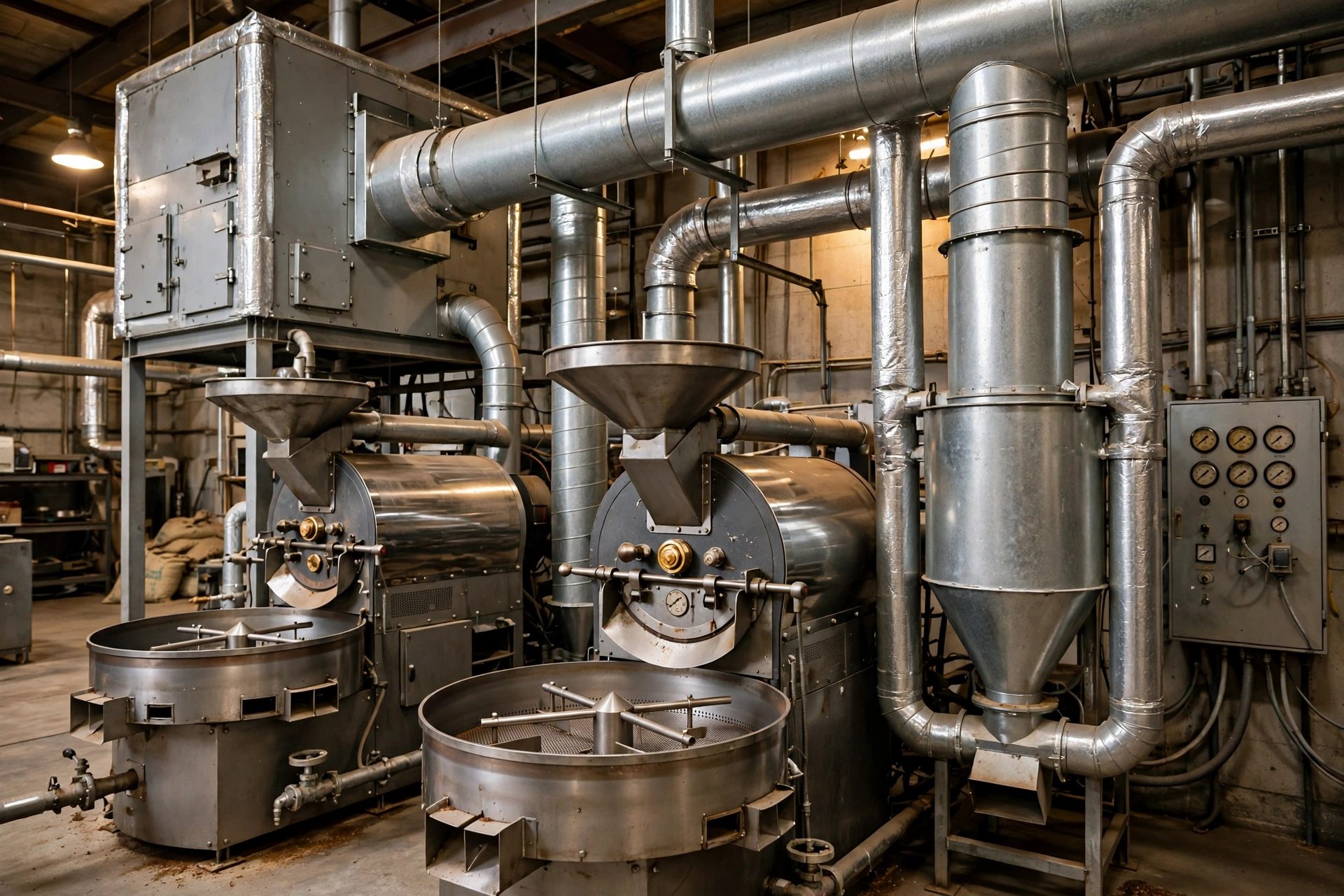
Coffee roasting has a fire risk that most generator buyers never hear about, and it lives in the exhaust duct. Every batch of coffee sheds chaff — the thin papery skin of the bean — and a 120 kg roaster produces 1–2 kg of chaff per batch. The chaff is carried out of the drum by the exhaust air, separated in a cyclone, and collected in a bin. It is light, dry and almost pure fuel, and it accumulates in the ductwork wherever the airflow slows: at bends, at the cyclone inlet, at the afterburner face. A chaff fire in a duct starts silently, burns at 600–800 °C, and is fed by the same airflow that carries it. It is the most common fire in a roasting plant, and it is the reason the exhaust system has its own rules.
The first rule is that the exhaust fan must keep running after the roaster stops. A roaster that loses power with a full duct of hot chaff and no airflow is a duct full of fuel at ignition temperature with no way to clear it. The generator must therefore keep the exhaust fan running for at least ten minutes after the last batch drops, and the plant’s control system must enforce that run-on even if the operator hits the emergency stop. A fan that stops with the roaster is a fire waiting for a spark.
The second rule is the afterburner’s temperature. A thermal oxidiser holds 650–800 °C to destroy VOCs, and its refractory lining stores that heat for an hour after the burner shuts down. If the generator stops and the oxidiser’s fans stop with it, the lining keeps radiating heat into a duct that has no airflow, and the chaff in the duct ignites. The oxidiser’s fans must therefore be on the generator’s essential board, with the same ten-minute run-on as the exhaust fan, and the plant’s fire procedure must include a duct inspection after any outage, not just after a fire alarm.
The third rule is placement. A roasting plant is a hot, dusty building. The roasting hall runs at 30–40 °C in summer, the air carries chaff dust and coffee oil vapour, and the generator room or pad must be separated from both. A silent canopy set installed against the roasting hall wall will draw chaff into its radiator and air filter, and a chaff-clogged radiator is a set that derates by 10–15% on the hottest day of the year, exactly when the plant needs it most. The set should stand at least 5 metres from the roasting hall’s exhaust outlet, with its air intake on the clean side, and its radiator and air filter inspected monthly — not at the annual service, but monthly, because chaff builds up in weeks, not years. Diesel fuel ageing is a slower risk in the same building: a roasting plant’s day tank sits in a warm room, and warm fuel grows microbes faster than cold fuel, so the plant’s fuel store needs a diesel fuel ageing test every six months — water, microbes and filter condition — because fuel that has gone bad in the tank will not start the set on the day it is needed.
The fourth rule is the gas supply. Most commercial roasters are gas-fired, and the gas supply is the one utility the generator cannot replace. A plant that loses grid power keeps its gas, and the roaster keeps burning gas while the generator supplies the motors and controls. But a plant that loses gas pressure — a street works outage, a regulator failure — loses the roaster even with the generator running. The plant’s specification should therefore include a gas-pressure interlock that shuts the roaster’s burner down cleanly and a written procedure for the operator, because a roaster that loses gas mid-batch with the drum still turning is a batch that stalls at 190 °C and a drum that needs a full clean before the next charge. The generator protects the electric side. The gas side needs its own plan.
Frequently Asked Questions
What size generator does a coffee roasting plant need?
A micro-roastery with one 25 kg roaster needs 25–50 kVA, a mid-size plant with a 120 kg roaster needs 150–250 kVA, and a large line running 1,500 kg/h needs 300–500 kVA. The roaster itself draws only 4–15 kW; size from the afterburner, cooling tray, grinders, packaging and building loads, then add 20–25% for starting surge.
Do coffee roasting plants need a backup generator?
Yes, wherever the grid is unreliable or the plant roasts under contract. A roast is a 8–15 minute process at 200 °C and above, and a power cut mid-roast loses the batch in the drum, the batch in the cooling tray and the 25–40 minute warm-up to restart. A plant that roasts 180 kg a day loses about $1,850 of product from a single one-hour outage, before missed deliveries are counted.
How long can a coffee roasting plant run on a generator?
As long as the fuel lasts. A 200 kVA set at 75% load burns 30–38 litres an hour, so a 1,000-litre day tank gives 26–33 hours and a 2,000-litre bulk tank gives 50–65 hours. The limit is fuel logistics, not the generator: arrange a fuel delivery contract before the outage, and test the fuel for water and microbes every six months.
What happens to a coffee roaster during a power outage?
The drum stops, the exhaust fan stops and the cooling tray stops, all at once. A batch at first crack is lost within minutes, because beans sitting against a hot drum with no airflow scorch and cannot be resumed. The afterburner trips, the oxidiser needs a purge and relight, and the roaster needs a 25–40 minute warm-up before the next batch. Chaff left in a hot duct with no airflow is a fire risk until the fans run again.
Can a diesel generator power a coffee roasting plant?
Yes. A roasting plant is a straightforward industrial load: three-phase motors, fans, grinders and packaging machinery, with no sensitive electronics beyond the roaster’s PLC and the afterburner’s flame safeguard. A generator sized for the plant’s running load plus 20–25% starting margin, with a staged restart sequence and a soft starter on the grinder and afterburner fan, carries a roasting plant through an outage without a lost batch.
Specification Checklist: Ten Lines Before the Deposit
- What is the plant’s running load, not the roaster’s? List the afterburner, cooling tray, grinders, packaging, compressor, HVAC, dehumidifiers and lighting separately. The roaster is the smallest line. A quotation that sizes from the roaster’s nameplate alone is wrong by a factor of two.
- Which rating — ESP, PRP or COP — and for how many hours a year? A plant that runs on generator power 1,500 hours a year needs a prime-rated set. The standby and prime ratings on the datasheet are the authority, not the headline kVA figure. A standby-rated set at that duty will wear early and the warranty claim will fail. The rating letters must appear on the datasheet and the contract.
- Is the afterburner on the essential board? The oxidiser’s fans, controls and safety interlocks must transfer with the roaster, not after it. If the afterburner is shed, the roaster must stop, and the plant loses the batch anyway.
- Is there a staged restart sequence? The transfer panel must start the building loads, then the afterburner, then the roaster, then the grinder, packaging and compressor one at a time. A plant that starts everything at once will trip its own generator.
- Are the grinder and afterburner fan on soft starters? A 15 kW grinder on direct-on-line start draws five to seven times running current. A soft starter costs $400–800 and removes the dip that trips the roaster’s controls.
- What is the fuel autonomy, in hours, at 75% load? A 1,000-litre tank on a 200 kVA set gives 26–33 hours. Ask for the figure in hours, not litres, and ask for the fuel delivery contract that covers the second day.
- Where does the set stand relative to the exhaust? At least 5 metres from the roasting hall’s exhaust outlet, intake on the clean side, radiator and air filter inspected monthly for chaff. A chaff-clogged radiator derates the set by 10–15% on the hottest day of the year.
- Is the exhaust fan on a ten-minute run-on? After the last batch drops, the exhaust fan and the oxidiser fans must keep running for ten minutes to clear chaff from the duct. The run-on must be enforced by the control system, not left to the operator.
- Are the warehouse dehumidifiers on the essential board? Green coffee at 10–12% moisture absorbs humidity fast. A night without dehumidification in a tropical warehouse starts a mould and moisture claim that surfaces weeks later. Protect the warehouse, not just the line.
- What is the maintenance schedule, in hours and in calendar months? Oil and filters every 250 hours or six months, coolant and belts annually, load-bank test annually, fuel test every six months. A maintenance schedule agreed in writing before the deposit is worth more than a discount after it.
A coffee roasting plant buys a generator for the same reason it buys a roaster: to protect a process that cannot be paused. The roast curve does not wait, the batch in the drum does not wait, and the afterburner does not wait. Size the set for the plant, stage the restart, keep the exhaust fans running, and put the dehumidifiers on the essential board. The generator that does those four things will carry a roasting plant through an outage without a lost batch — and the one that does not will cost more in a single afternoon than the set itself.
For a quotation sized to the plant — roaster capacity, afterburner type, grinder and packaging loads, site altitude and maximum temperature — contact PAVO. PAVO builds diesel generator sets from 9 to 3750 kVA in open, silent and containerised configurations, powered by Cummins, Weichai, Yuchai and Shanghai Diesel, and prices the correct rating from the plant’s real load list.