

What Size Generator Does a Fish Farm Really Need? | PAVO
A fish farm is the only kind of factory where the product dies if the power stops for a few hours. The generator is not there to keep the lights on. It is there to keep the water breathable.
What size generator does a fish farm need? A 10-acre catfish pond needs 20–30 kVA of standby backup for its aerators, a 10-hectare shrimp farm needs 250–300 kVA of prime-rated power, and a salmon recirculating system needs 300 kVA to 2 MW. Size depends on species, stocking density and system.
This article works through the load list of a real fish farm, the oxygen clock that sets the deadline, the sizing table by farm type, the aerator starting surge that trips undersized sets, and three outages that show what a short gap costs when the product is alive. It covers catfish ponds, shrimp ponds, tilapia, salmon recirculating systems and hatcheries, with the fuel, placement and specification numbers a buyer needs before paying a deposit.
Contents
- The Oxygen Clock: Why a Fish Farm Fails in Hours, Not Days
- What a Fish Farm Actually Runs: The Load List
- Sizing by Farm Type: From a 5-Acre Catfish Pond to a Salmon RAS
- Aerator Starting Surge: The Motor Problem Nobody Budgets For
- Three Outages That Show What the Clock Costs
- Fuel, Placement and Protection: Running the Set Where the Fish Are
- Frequently Asked Questions
- Specification Checklist: Ten Lines Before the Deposit
The Oxygen Clock: Why a Fish Farm Fails in Hours, Not Days
Every other industry in this series buys time with a generator. A hotel buys comfort, a warehouse buys fulfilment, a cement plant buys a kiln that must not freeze. A fish farm buys oxygen, and the price of being late is measured in dead stock, not delayed output. Dissolved oxygen in a stocked pond falls the moment aeration stops, and it falls fastest exactly when the farm is most valuable — at night, in warm water, with fish at market size.
The US Department of Agriculture’s warmwater aquaculture researchers put it bluntly: power failure in a heavily stocked and fed pond-based system can result in massive fish losses within minutes. That is not a figure of speech. In a split-pond system, where the fish are concentrated into 20% of the pond area, the fish-to-water ratio is so high that a tractor-powered emergency aerator cannot be deployed fast enough by hand. The researchers’ conclusion is equally blunt: sufficiently sized and dependable emergency electric power is essential for intensive pond-based aquaculture, and a farm that gambles on having no standby power should expect, sooner or later, to be hit with catastrophic fish losses.
The clock is not the same for every species, but it is short for all of them. Warm water holds less oxygen than cold water, and warm-water fish consume more of it. A pond at 30°C holds about 7.5 mg/L of oxygen at saturation, against about 10 mg/L at 15°C, while the fish, the bacteria breaking down feed waste and the algae all draw on the same shrinking reserve. When the sun goes down, the algae stop producing oxygen and start consuming it. That is why most fish kills happen between midnight and dawn, and why a grid failure at 2 a.m. is a different event from the same failure at 2 p.m.
Dissolved oxygen: the number that decides everything
Dissolved oxygen, measured in milligrams per litre (mg/L, the same as parts per million), is the single water-quality number that decides whether fish eat, grow or die. The working limits differ by species, and a generator specification that ignores them is guessing.
| Species / system | Healthy level | Stress begins | Mortality risk |
|---|---|---|---|
| Atlantic salmon (RAS / tanks) | Above 7 mg/L | Below 6 mg/L | Below 5 mg/L for hours |
| Tilapia (ponds / tanks) | Above 5 mg/L | Below 4 mg/L | Below 3 mg/L within 6–12 hours |
| Shrimp (ponds) | Above 5 mg/L | Below 4 mg/L | Below 3 mg/L within hours |
| Channel catfish (ponds) | Above 3 mg/L morning minimum | Below 2.5 mg/L | Below 1.5 mg/L, feeding collapses |
The catfish figures come from two years of pond trials at the Thad Cochran National Warmwater Aquaculture Center in Stoneville, Mississippi. When the morning dissolved oxygen was allowed to fall to 1.5 mg/L, feed consumption fell 45%, average fish weight fell 31% and net production fell 54% compared with ponds held above 5 mg/L. At 2.5 mg/L the losses were smaller but still measurable. The practical optimum the researchers settled on was a morning minimum of 1.5 to 2.5 mg/L — not because fish thrive at those levels, but because holding oxygen higher than 3 mg/L all night costs more in electricity than it returns in growth. Catfish are unusually tolerant. Tilapia are less so: below 4 mg/L they stop feeding and their immune response weakens, and below 3 mg/L mortality can begin within 6 to 12 hours. Shrimp sit in the same range, and salmon, the cold-water species, need the most oxygen of all — a salmon tank held below 6 mg/L is already in trouble.
Two points follow for generator sizing. First, the set does not need to restore full aeration to save the crop; it needs to hold dissolved oxygen above the stress threshold until the grid returns or the fuel runs out. That is why running half the aerators on generator power is a legitimate emergency strategy, and why the USDA researchers note it cuts the generator cost by about 50%. Second, the set must start fast. A 10-second transfer delay is a rounding error for a hotel. For a heavily stocked pond at 2 a.m., ten seconds of no aeration is nothing — but ten minutes of a farm manager driving to the site, finding the tractor, hitching the emergency paddlewheel and getting it into the water is the difference between a scare and a kill. An automatic transfer switch that starts the set and takes the load without a human in the loop is not a convenience on a fish farm. It is the whole point.
Night is when the clock runs fastest
A pond’s oxygen budget flips at sunset. During the day, algae photosynthesise and add oxygen. At night, the same algae respire and consume it, along with the fish and the bacteria decomposing uneaten feed and waste. Dissolved oxygen in a stocked pond typically falls to its lowest point between 4 a.m. and 6 a.m. — the “dawn minimum”. A power cut at 10 p.m. therefore gives the farm perhaps four to six hours before oxygen reaches the stress threshold. A power cut at 4 a.m. can give it less than one.
This is also why aeration is a night load. US catfish farmers run their 10-hp paddlewheels hardest overnight, switching the first aerator on when dissolved oxygen falls to 4 or 5 mg/L, then adding more as it falls further. The industry average is close to 2 hp of aeration per acre, with intensive farms running up to 6 hp per acre. In Thailand, shrimp ponds run 24 to 36 hp per hectare — 18 to 27 kW per hectare — for about 20 hours a day over a 60- to 100-day crop. Aeration is 80 to 90% of a shrimp farm’s total energy use. Any generator that cannot carry the night aeration load is not a backup system. It is a decoration.
The practical consequence is a sizing rule that surprises first-time buyers: the generator for a fish farm is sized on the night load, not the day load, and the night load is the aeration load at full stocking density, at the end of the crop, when the biomass is greatest. A set sized on the average load of a half-grown crop will be undersized on the night the fish are worth the most.
What a Fish Farm Actually Runs: The Load List
A fish farm’s electrical load looks simple on a single-line diagram and behaves badly in practice. Almost everything on the list is a motor, almost every motor starts with a surge, and almost every load is essential at the same time — at night, when oxygen is falling. The load list below is the basis for every sizing number in this article.
Pond aeration: the biggest load on most farms
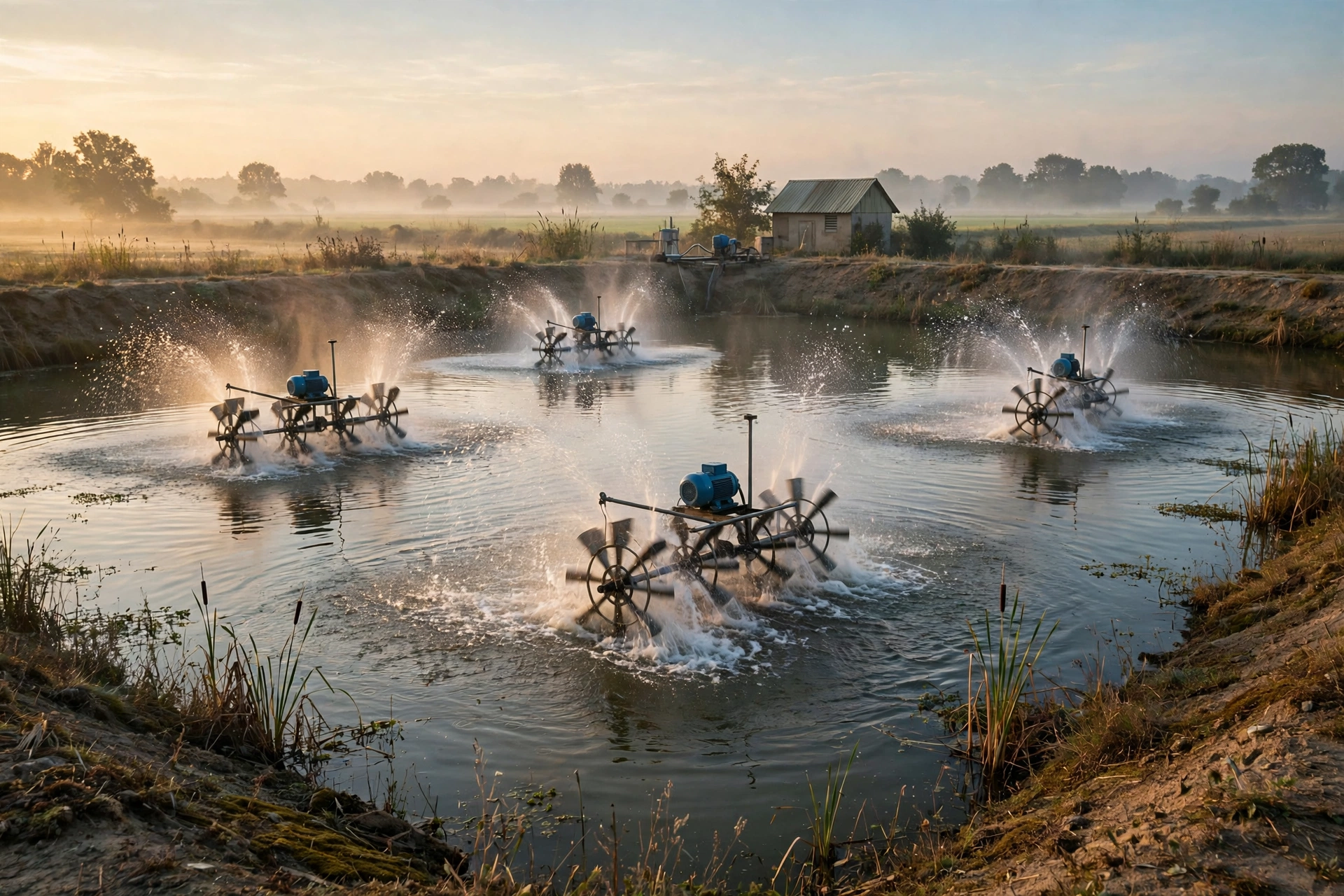
Paddlewheel aerators are the workhorses of pond aquaculture, and they dominate the load. The US catfish industry has standardised on the 10-hp electric paddlewheel for routine aeration, with tractor-powered paddlewheels and “sidewinders” kept for emergency use. A 10-acre pond at the industry average of 2 hp per acre carries 20 hp of aeration — about 15 kW of motor load, running most of the night. An intensive 10-acre pond at 6 hp per acre carries 60 hp, about 45 kW. A split-pond concentrates the same fish into a 2-acre basin, so the aeration is concentrated too, and the generator must be sized for the basin, not the pond.
Shrimp ponds are heavier still. The rule of thumb used across Asia is 1 hp of aeration for every 300 to 500 kg of shrimp production, or 2.0 to 3.33 hp per tonne. At a production target of 8,000 kg per hectare — a good crop in Thailand — that is 16 to 27 hp per hectare, and the aerators run about 20 hours a day. A 10-hectare shrimp farm therefore carries 160 to 270 hp of aeration, roughly 120 to 200 kW, and it carries it for 60 to 100 days without a break. That is prime duty, not standby duty, and the standby and prime ratings on the datasheet decide whether the set survives the season.
The aerator itself is not the whole load. Ponds also run water-exchange pumps, feed blowers and automatic feeders, pond-side lighting for night feeding and security, and dissolved-oxygen monitoring systems that must stay alive through the outage — a DO monitor that goes dark at 2 a.m. leaves the farm blind at the worst moment. None of these is large on its own. Together they add 10 to 20% to the aeration load, and they all start at the same moment the transfer switch closes.
Recirculating systems: pumps and oxygen that never stop
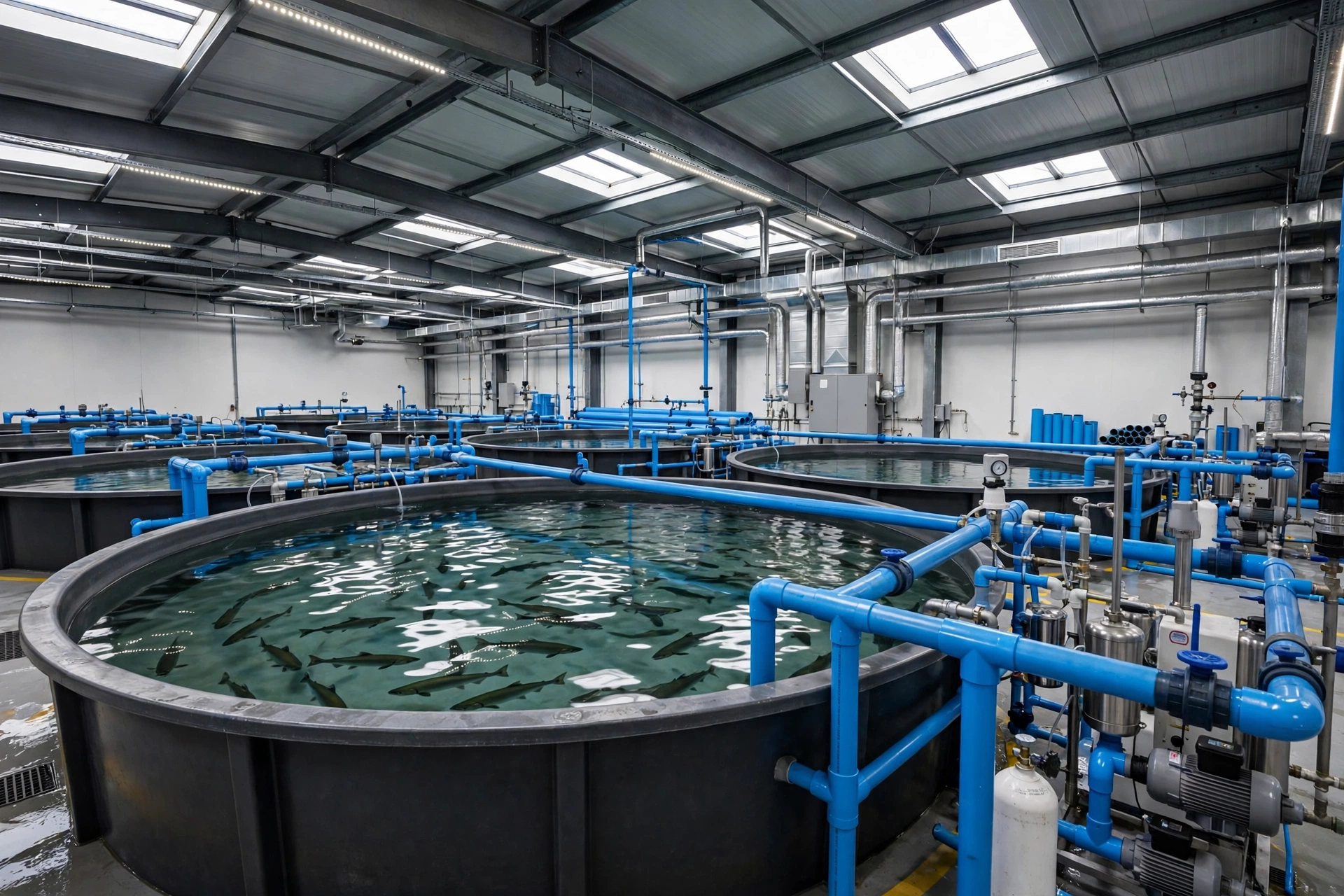
A recirculating aquaculture system (RAS) is a different animal from a pond. The fish live in tanks, the water is pumped through mechanical filters, biofilters, UV disinfection and oxygen cones, and the whole loop runs 24 hours a day. There is no night-time lull and no natural oxygen to fall back on. If the pumps stop, the biofilter — the living colony of bacteria that converts toxic ammonia into nitrate — begins to die within hours, and the oxygen cones stop dissolving oxygen into the water. A RAS without power is a tank of fish in still water. The clock is measured in tens of minutes, not hours.
The energy numbers are correspondingly large. A model of a post-smolt Atlantic salmon RAS built by researchers at the Western Norway University of Applied Sciences, validated against a real facility, used 663.8 MWh over a 15-week growth phase — 4.933 MWh per day at the start, rising to 6.955 MWh per day as the fish grew — or 9.586 kWh per kilogram of fish produced. Pumps accounted for 45.48% of the total energy demand once the oxygen-cone pump was included. A life-cycle comparison in the same field put open-flow systems at 2.55 kWh per kilogram and RAS at 19.6 kWh per kilogram. Commercial salmon RAS facilities report around 7.5 kWh per kilogram, and a Polish salmonid RAS producing 500 to 600 tonnes a year runs on 180 kW of connected load, or 2.6 to 3.1 kWh per kilogram. Freshwater RAS averages about 7.5 kWh per kilogram; saltwater RAS, which must heat or cool seawater and run heavier treatment, averages about 14.5 kWh per kilogram.
For generator sizing, the RAS figure that matters is the continuous kilowatt demand, not the kilowatt-hours per kilogram. A 180 kW RAS needs a 250 to 300 kVA set just to hold the loop alive, and it needs that set to start in seconds and run at a steady 70 to 80% load for as long as the outage lasts. That is prime or continuous duty, and it is the reason the largest land-based salmon projects in Norway buy megawatt-scale emergency power rather than a single standby set.
Hatcheries: small loads, zero tolerance
A hatchery is the smallest load on this list and the least forgiving. Incubation trays, larval tanks, broodstock holding, water heating and UV sterilisation add up to 20 to 50 kW for a commercial hatchery — a 30 to 75 kVA set covers most of them. But the stock is eggs and larvae, which have no tolerance for oxygen dips or temperature swings at all. A two-hour outage that a grow-out pond survives with stressed fish can wipe out a hatchery’s entire season of eggs. Hatcheries also run on tight temperature bands: tropical species held at 28°C lose viability fast if the water cools, and cold-water species held at 12°C suffer if it warms.
The hatchery specification therefore inverts the usual priorities. Size is easy. Speed and reliability are everything. The transfer switch must be fast, the set must be tested under real load every month — not the 15-minute no-load exercise that passes on paper and fails at 3 a.m. — and the fuel tank must cover the longest outage the site has ever seen, plus a margin. A hatchery that shares a generator with a grow-out pond must have its loads on a priority circuit, so the pond aerators cannot starve the incubation room of power during a transfer.
Sizing by Farm Type: From a 5-Acre Catfish Pond to a Salmon RAS
The table below gives the working range a buyer should start from. Every figure is a starting point for a load list, not a substitute for one — the generator sizing guide explains how to build the list, add the starting surge and apply the site derating. The ranges assume the set carries the full night aeration or pumping load; running half the aerators in an emergency roughly halves the set size, at the cost of a thinner oxygen margin.
| Farm type | Typical load | Generator size | Duty |
|---|---|---|---|
| 5-acre catfish pond, 2 hp/acre | 10 hp aeration, ~8 kW | 15–20 kVA | Standby |
| 10-acre catfish pond, 2 hp/acre | 20 hp aeration, ~15 kW | 20–30 kVA | Standby |
| 10-acre split-pond, intensive | 40–60 hp on the basin, ~30–45 kW | 50–75 kVA | Standby |
| 5-ha tilapia pond farm | 40–60 kW aeration + pumps | 75–100 kVA | Standby |
| 10-ha shrimp farm, 24 hp/ha | 240 hp aeration, ~180 kW | 250–300 kVA | Prime |
| Salmon RAS, 500–600 t/year | 180 kW continuous | 250–300 kVA | Prime |
| Salmon RAS, large land-based | 1,000–2,000 kW continuous | 1,250–2,500 kVA | Prime |
| Commercial hatchery | 20–50 kW | 30–75 kVA | Standby |
Pond farms: size by aeration horsepower
Pond sizing starts with the aeration horsepower per acre or per hectare, multiplied by the stocked area, then converted to kilowatts at roughly 0.75 kW per hp, with 10 to 20% added for pumps, feeders, lighting and monitoring. The trap is the growth curve. A pond stocked with fingerlings in March needs a fraction of the aeration it needs in September, when the same fish are at market weight and the water is warmest. Size for September, not March. The USDA researchers make the same point about split-ponds: the generator for a 10-acre split-pond costs $21,000 to $37,000 installed, or $2,100 to $3,700 per acre, and that figure buys a set sized for the basin at full biomass. A buyer who sizes for the average month saves a few thousand dollars on the set and risks the entire crop in the last month of the season.
The second pond trap is the assumption that aeration is the only load. A farm with 20 paddlewheels spread across 10 acres needs cabling, distribution boards and motor starters that can survive a wet, corrosive environment, and every one of those motors draws its starting surge at the same instant the transfer switch closes. That surge is the subject of the next section, and it is the most common reason a correctly sized pond generator still trips on transfer.
RAS: size by continuous kilowatts
RAS sizing starts with the continuous kilowatt demand of the loop — pumps, blowers, oxygen generation, UV, heating or cooling, and controls — and adds the largest single motor’s starting surge. The Polish salmonid RAS cited above runs 180 kW for 500 to 600 tonnes a year; a 1,000-tonne facility on the same design basis needs roughly 300 kW, and the set to carry it is 375 to 400 kVA prime-rated. The Norwegian projects show the top end of the scale. At Salmon Evolution’s land-based salmon facility at Indre Haroy, HIMOINSA supplied three HGY-2350 D5 PRP sets, from 1,250 to 2,000 kW each, giving nearly 2 MW of emergency power, with engine start in under 8 seconds and ISO 8528-5 class G3 performance — the tightest frequency and voltage regulation class, specified because the load is pumps and oxygenation that cannot tolerate a sag. One set is dedicated to the fjord water pumping system; the other two cover the tank system, buildings and critical systems. At Laksefjord in Finnmark, in the far north of Norway, the same supplier installed 2 x 2,000 kVA for a smoltification facility, with a hot-air recirculation system to hold the generator room at temperature through Arctic winters from October to May. At Steinkjer, Genesal Energy supplied 2,600 kVA in four 650 kVA sets running in parallel, because a power cut of just a few minutes, in the supplier’s words, can lead to large economic losses for the business.
The RAS lesson is that the set is part of the life-support system, not an accessory to it. It should be specified, tested and maintained with the same rigour as the biofilter and the oxygen supply, and it should be redundant where the stock value justifies it. A single set is a single point of failure for a tank of fish that cannot survive without it.
Hatcheries: size by the smallest critical load
Hatchery sizing is the simplest arithmetic in this article and the easiest to get wrong by overthinking it. List the incubation, larval, broodstock, heating and UV loads, add 25% for starting surge, and buy the next frame up. A 30 kVA set covers most small hatcheries; a 75 kVA set covers a large one. The money is better spent on the transfer switch, the fuel autonomy and the testing regime than on extra kilovolt-amperes the hatchery will never use. What a hatchery cannot afford is a set that starts slowly, a fuel tank that covers 8 hours when the longest local outage is 24, or a maintenance schedule that exists on paper and nowhere else.
Aerator Starting Surge: The Motor Problem Nobody Budgets For
Every paddlewheel aerator, pump and blower on a fish farm is an induction motor, and every induction motor draws five to seven times its running current for the first few seconds after it starts. A 10-hp paddlewheel that runs on 7.5 kW draws roughly 45 kW of apparent power while it spins up. Ten of them starting together draw 450 kVA of surge against a running load of 75 kW. A generator sized on the running load alone will see its voltage collapse, its frequency dip, and its protection trip — and the farm will be back in the dark with the oxygen still falling.
Why ten 10-hp paddlewheels do not start like one 100-hp motor
The arithmetic is the same as for any motor load, but fish farms make it worse in three ways. First, the motors are numerous and distributed: a 10-hectare shrimp farm may have 40 or more paddlewheels, each on its own starter, all fed from the same distribution board. Second, they are all commanded to start at once, because the transfer switch energises the whole board in a single step. Third, the load is wet and mechanical: a paddlewheel that has been standing in a pond all day starts against the drag of water and weed on the paddles, so the starting current lasts longer than it does for a fan in a clean room. The motor starting guide covers the locked-rotor kVA maths in full; the fish-farm version is that the surge is the sizing load, and the running load is the fuel load.
The practical fix is sequencing. A controller that starts the aerators in groups of three or four, with a few seconds between groups, cuts the peak surge to a third of the simultaneous figure and lets a sensibly sized set carry the farm. Deep Sea and Smartgen controllers both support staged load acceptance, and a farm that buys a set without asking for it is buying a problem. Sequencing also protects the fish: aerators that start in waves disturb the pond less than forty paddlewheels hammering into life at once.
Soft starters, VFDs and sequencing
Three tools manage the surge, and they are not interchangeable. A soft starter ramps the voltage to one motor and cuts its starting current to roughly two to three times running current; it is cheap, robust and the right choice for a paddlewheel that runs at a fixed speed all night. A variable-frequency drive (VFD) does the same and adds speed control, which lets a farm run aerators slower on cool nights and faster on hot ones — but a VFD is a non-linear load that injects harmonics into the generator output, and it needs an alternator with enough subtransient reactance margin to stay stable. On a small set, a VFD can cause more trouble than it solves. Sequencing, the third tool, costs nothing but controller programming, and it is the one every fish farm should have regardless of the other two.
The specification to write into the order is simple: the set must accept the full farm load in no more than three steps, with no more than a 10% voltage dip and a 5% frequency dip at any step, and the supplier must demonstrate it on a load bank before the set ships. A factory acceptance test that only runs the set at a steady load proves nothing about the night the transfer switch closes on forty paddlewheels.
Three Outages That Show What the Clock Costs
Case 1: Kauai, Hawaii — 120,000 lb of shrimp and 48 hours
In October 2026, Hurricane Lowell struck Kauai and knocked out power to roughly 80% of the island. Aloun Farms, a shrimp farm leasing about 2,500 acres on the island, was left racing to save roughly 120,000 lb of shrimp. Without power, the farm’s aeration systems stopped, and the shrimp had about 48 hours before they began dying, according to the farm’s managing director. The farm scrambled to keep about 20 of its 40 shrimp ponds operating while crews worked to bring in generators — half the ponds, because that was all the emergency power available, and the rest were left to the oxygen clock.
The numbers are the lesson. Forty ponds, 120,000 lb of shrimp, 48 hours, and a farm that had to choose which half of its crop to save. The generators that arrived were not sized for the farm; they were whatever could be hired and delivered while the roads were blocked and the power lines were down. A farm that owns its backup power chooses in advance. A farm that hires it in a hurricane chooses from what is left.
Case 2: Andhra Pradesh — 11,483 acres without power
In the same month, Cyclone Arnab struck the coast of Andhra Pradesh in India, one of the world’s largest shrimp-farming regions. Continuous rain, flooding and prolonged power disruption hit aquaculture across 11,483 acres in the coastal districts of West Godavari and Konaseema. With electricity supply interrupted, oxygen levels in fish and shrimp ponds became the main concern, and farmers who had invested lakhs of rupees in pond preparation, feed and cultivation faced losing their entire investment. Sixty-one fish tanks were reported damaged, and the state government was still assessing the full fisheries damage when the first reports were filed.
Andhra Pradesh is instructive because it is not a remote island. It is a dense, commercial aquaculture region with grid power, roads and suppliers — and a cyclone still took the power out for long enough that oxygen, not flooding, became the threat farmers named first. The farms that survived best were the ones with a set on site, a full tank and a transfer switch that worked without a phone call. The farms that waited for the grid to come back waited with the oxygen falling.
Case 3: Mississippi — the split-pond arithmetic
The third case is not a disaster. It is a costing exercise from the USDA’s warmwater aquaculture researchers, and it is the most useful of the three because it gives the buyer a number to work with. A 10-acre split-pond — the intensive system in which fish are held in a small basin and the rest of the pond treats the water — needs a generator costing $21,000 to $37,000 installed, or $2,100 to $3,700 per acre. Running only half the aerators on generator power cuts that cost by about 50%.
Set that against the stock value. A 10-acre split-pond producing 15,000 to 20,000 lb of catfish per acre holds 150,000 to 200,000 lb of fish. At a farm-gate price of roughly $1.20 to $1.50 per lb, the crop in the water is worth $180,000 to $300,000. The generator costs a tenth of one crop. The researchers’ point is that the gamble is not close: a farm that runs intensive ponds without standby power will, sooner or later, lose a crop worth ten times the set. The question is not whether the generator pays for itself. It is whether the farm can afford the year it does not have one.
Fuel, Placement and Protection: Running the Set Where the Fish Are
A fish farm generator lives in a hard place: outdoors, near water, in salt air on coastal sites, with fuel deliveries that may not arrive during the same storm that caused the outage. The set must be specified for the site, not the catalogue.
How long the tank has to last
Fuel autonomy is the second clock, after oxygen. The set keeps the fish alive only as long as the tank lasts, and the tank must cover the longest outage the site has credibly faced, plus a margin for a fuel delivery that arrives late. Forty-eight hours is the minimum a commercial farm should plan for; 72 hours is the right target where the farm is remote, the roads flood, or the fuel supplier is a day away. The table below uses the Cummins C500D5 datasheet figures — 93.2 litres per hour at full prime load — and typical consumption for smaller frames.
| Generator size | Fuel use at ~75% load | 24 hours | 48 hours | 72 hours |
|---|---|---|---|---|
| 30 kVA | ~6 L/h | 145 L | 290 L | 435 L |
| 100 kVA | ~20 L/h | 480 L | 960 L | 1,440 L |
| 250 kVA | ~50 L/h | 1,200 L | 2,400 L | 3,600 L |
| 500 kVA (C500D5) | ~70 L/h | 1,680 L | 3,360 L | 5,040 L |
Two cautions apply. First, diesel fuel ageing matters more on a fish farm than on most sites, because the set may sit for months between outages in warm, humid air. Fuel grows water and microbes in a standby tank, and a set that starts on contaminated fuel will stop again within the hour. Test the fuel, polish it, and keep the tank full — a full tank condenses less water than a half-empty one. Second, the fuel store itself needs a bund. A 5,000-litre bulk tank beside a pond is a spill into the farm’s own water if it leaks, and a diesel spill in a fish pond is a total loss of the stock it was bought to protect. Secondary containment is not an environmental nicety on a fish farm. It is stock insurance.
Salt air, flooding and the bund
Coastal fish farms are among the most corrosive sites a generator will ever work on. Salt-laden air attacks the alternator windings, the control panel, the radiator and every unprotected steel surface. A set specified for an inland warehouse will not last five years on a shrimp farm in Vietnam or a salmon site in Norway without a marine-grade canopy, a tropicalised alternator winding and a control panel rated against salt mist. The enclosure should be specified as a silent canopy with a salt-resistant coating, and the set should be inspected for corrosion at every service — not discovered at the annual visit.
Flooding is the second site risk, and the Kauai and Andhra Pradesh cases show why it cannot be an afterthought. A generator installed at pond level will be under water in the same storm that takes the grid out. The set should sit on a raised plinth above the highest recorded flood level on the site, with the fuel tank bunded and the cabling run overhead or in sealed ducting. The transfer switch and distribution board should be at the same level. A set that survives the storm but cannot be reached because the access road is flooded is no better than a set that is under water.
Noise deserves a line of its own. Fish are sensitive to vibration transmitted through water and structures, and a generator bolted to a pond bank or a tank hall wall will transmit both. A silent canopy and proper anti-vibration mounts are worth specifying, and the set should be sited away from hatchery and broodstock tanks where the stock is most sensitive. The farm’s neighbours matter too: a coastal farm that runs a set all night during a storm will hear from them, and a canopy that holds the set to 65 dB(A) at 7 metres is cheaper than a complaint.
Frequently Asked Questions
What size generator does a fish farm need?
A 10-acre catfish pond needs 20–30 kVA of standby backup for its aerators, a 10-hectare shrimp farm needs 250–300 kVA of prime-rated power, and a salmon recirculating system needs 250 kVA for a 500-tonne facility up to 2 MW for a large land-based plant. Size from the night aeration or pumping load at full stocking density, then add the starting surge of the largest motor group.
Do fish farms need a backup generator?
Yes, if the farm is intensive enough that the stock cannot survive a power cut. In heavily stocked ponds, dissolved oxygen falls fast enough to cause massive losses within minutes of a power failure, and in a recirculating system the fish have no natural oxygen to fall back on at all. A farm with a generator chooses which loads to protect; a farm without one leaves the decision to the grid.
How long can a fish farm run on a generator?
As long as the fuel lasts. A 100 kVA set at 75% load burns about 20 litres per hour, so a 1,000-litre tank gives about 48 hours; a 500 kVA set burns about 70 litres per hour and needs about 3,400 litres for the same period. Plan for 48 hours as a minimum and 72 hours where the site is remote or the roads flood.
What happens to fish during a power outage?
Aeration, pumping and oxygenation stop, and dissolved oxygen falls. Tilapia begin to stress below 4 mg/L and can die below 3 mg/L within 6 to 12 hours; catfish stop feeding as oxygen falls toward 2.5 mg/L and production collapses at 1.5 mg/L; shrimp stop feeding below 4 mg/L; salmon in tanks are at risk below 6 mg/L. In a heavily stocked pond, losses can begin within minutes, and stressed fish that survive often develop disease weeks later.
Can a diesel generator power a fish farm?
Yes. Diesel sets from 15 kVA to 2,500 kVA cover every farm type in this article, from a 5-acre catfish pond to a land-based salmon RAS. Pond farms usually need standby-rated sets sized on aeration horsepower, while shrimp farms and RAS facilities need prime-rated sets because aeration and pumping run 16 to 20 hours a day for months at a time.
Specification Checklist: Ten Lines Before the Deposit
- Which loads, at what hours? List every aerator, pump, blower, feeder and monitor with its running kilowatts and its starting surge. Size on the night load at full stocking density, not the average load of a half-grown crop.
- Which rating — ESP, PRP or COP? Pond farms with a few hundred hours a year can use standby (ESP). Shrimp farms and RAS facilities running 16 to 20 hours a day need prime (PRP). The letters must be on the datasheet.
- How does it start? The set must start and accept load in under 10 seconds through an automatic transfer switch, with staged load acceptance in no more than three steps and no more than a 10% voltage dip at any step.
- Can it start the aerators? Ask the supplier to demonstrate the full farm load on a load bank before the set ships, with the aerators sequenced as they will be on site. A steady-load test proves nothing about transfer.
- How long will the fuel last? Size the tank for 48 hours at the real load as a minimum, 72 hours for remote or flood-prone sites, and confirm a fuel delivery contract in writing before the outage, not during it.
- Is the fuel clean? Test the stored fuel, polish it if it has water or microbes, and keep the tank full. A set that starts on contaminated fuel stops again within the hour.
- Is the site protected? The set sits on a raised plinth above the highest recorded flood level, in a salt-resistant canopy on coastal sites, with a bunded fuel tank and remote monitoring so the farm knows the set has started without driving to the site.
- What is the maintenance schedule? Follow the generator maintenance schedule for oil, filters, coolant and batteries, and test the set under real farm load every month. A 15-minute no-load exercise is not a test.
- What does the warranty cover at this duty? Ask in writing whether the warranty stands at the stated duty, hours and site conditions. A supplier that will not answer in writing has answered.
- What happens to the cold chain? If the farm also stores or processes its catch, the generator must cover the refrigeration as well — cold storage backup power is a separate load with its own starting surge, and it should be on the same load list.
Before requesting a price, a buyer should provide four lines: the farm type and species, the stocked area or tank volume and the biomass at harvest, the aeration or pumping load with the largest single motor and its starting method, and the site conditions — altitude, maximum temperature, salt exposure and flood level. Any manufacturer that knows its business — PAVO included, with a range of 9 to 3750 kVA in open, silent and containerised configurations, powered by Cummins, Weichai, Yuchai and Shanghai Diesel — will price the correct set from those four lines. A supplier that prices from kVA alone is not doing the buyer a favour.
The price on a quotation states what a generator costs today. The oxygen clock states how long the farm has when the power fails. Of the two figures, the clock decides whether the buyer still owns a crop in the morning. Read the oxygen number before the price line.
To size a generator for a fish farm or aquaculture site, with the aeration load, the starting surge and the fuel autonomy worked out for the species and the system, contact PAVO — the team will price the correct rating from the farm’s load list and site conditions.